Evaluating the Effectiveness of Functional Family Therapy within
- Slides: 24
Evaluating the Effectiveness of Functional Family Therapy within Local Authority Social Work Services, (Glasgow and Renfrewshire, Scotland) Using the Strengths and Difficulties Questionnaire Added Value Score (Journal) Child and Adolescent Mental Health, 2016
Authors Ø Dr John J Marshall, Clinical Forensic Psychologist and Clinical Lead for Evidence Based Programme Development and Implementation, Greater Glasgow and Clyde NHS and Glasgow Council Social Work Services Ø Russell Hamilton, Programme Manager FFT, Renfrewshire Council and Action for Children Ø Nicole Cairns, Research Assistant, Greater Glasgow and Clyde NHS
Acknowledgements FFT Teams in Glasgow and Renfrewshire Susanne Miller, Chief Officer, Social Work Services Glasgow Stephen Mc. Leod, Head of Children’s Specialist (Mental Health) Services, NHS Greater Glasgow and Clyde Steve Collins’ Former Operation Manager, Evidence Based Programmes and FFT Glasgow Jessica Killilea, Research Assistant, Greater Glasgow and Clyde NHS Peter Macleod, Director of Children’s Services, Renfrewshire Council John Trainer, Acting Head of Early Years and Inclusion, Renfrewshire Council Jim Cantley, Operational Director – Children’s Services, Action for Children Michael S. Robbins Ph. D, Clinical Research Director, FFT. Senior Scientist Oregon Research Institute Joanna Pearce, Consultant Systemic Psychotherapist Family First Team Manager Brighton & Hove YOS. FFT National Consultant
What is FFT? Functional Family Therapy (FFT) is an evidence based ‘Blueprints’ programme Short term, Family focussed, Prevention intervention with high-risk young people aged between 11 and 18 and their families Seeks to address problematic family relationships and resultant behaviours with a strengths based relational approach
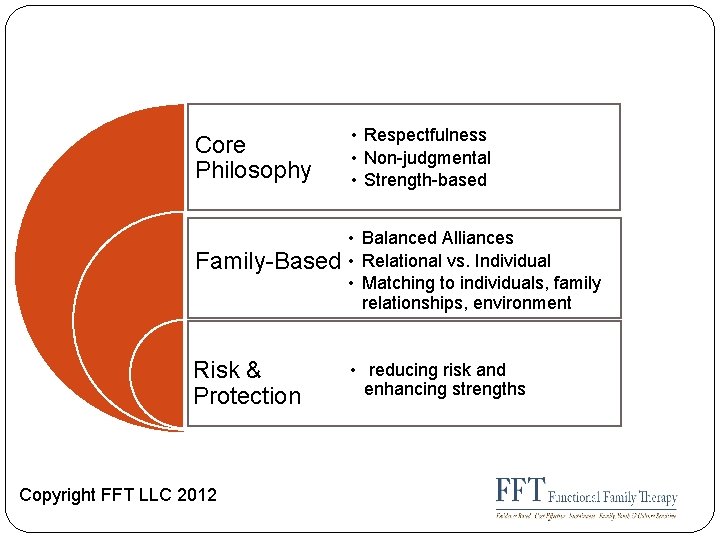
Core Philosophy Family-Based Risk & Protection Copyright FFT LLC 2012 • Respectfulness • Non-judgmental • Strength-based • Balanced Alliances • Relational vs. Individual • Matching to individuals, family relationships, environment • reducing risk and enhancing strengths
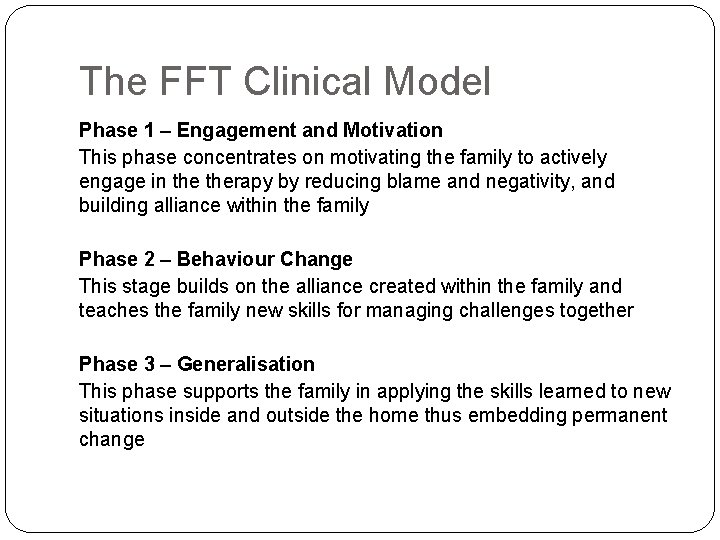
The FFT Clinical Model Phase 1 – Engagement and Motivation This phase concentrates on motivating the family to actively engage in therapy by reducing blame and negativity, and building alliance within the family Phase 2 – Behaviour Change This stage builds on the alliance created within the family and teaches the family new skills for managing challenges together Phase 3 – Generalisation This phase supports the family in applying the skills learned to new situations inside and outside the home thus embedding permanent change
• Therapists are involved with families for between 3 -5 months. Sessions are typically delivered at home but can be delivered in school or other community settings where there is a good reason to do so. • Positive outcomes in terms of: • Improved family relations • Improved communication skills • Improved adolescent behaviour • Improved parenting skills for handling subsequent problems • Improved parent supervision • Decreased family conflict
Why FFT? The need for Social Work to demonstrate proof of concept for evidence based intervention Children with complex needs (conduct disorder/ODD) not often receiving intensive treatment from mental health services despite poor life outcomes FFT has a strong evidence base internationally however there is very little evaluation of its efficacy in a Scottish context. The goal of the current study was to assess whether FFT was having a positive impact on families within the Local Authorities delivering it. Family Based Therapy are recommended by NICE for CD along with systematic reviews of evidence
Participants 2 Local Authorities took part: Renfrewshire Council with Action for Children and Glasgow City Council Social Work Services. Data was collected from 164 families with young people ranging in age from 11 to 16 years old. These young people had a range of externalising and internalising behavioural issues and were at risk of becoming looked after or accommodated by the local authority.
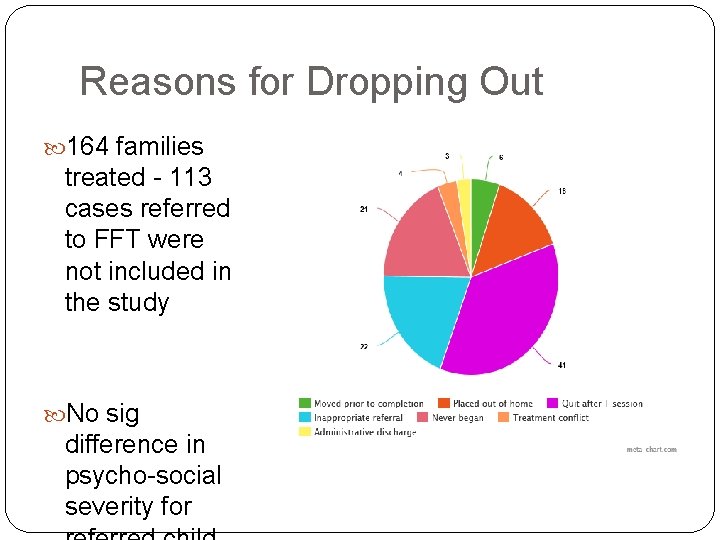
Reasons for Dropping Out 164 families treated - 113 cases referred to FFT were not included in the study No sig difference in psycho-social severity for
Measures Outcome Questionnaire: Measures any improvement made in adults receiving psychosocial intervention. Client Outcome Measure (COM-A and COM-P): Specific to FFT - focuses on family-reported changes following treatment. Completed by both the parent and the young person
Measures Strengths and Difficulties Questionnaire: Measures different psychological attributes in young people. 5 different subscales - emotional distress, behavioural difficulties, hyperactivity/ inattention difficulties, peer relationship problems, and prosocial behaviour. Items on all scales, except the prosocial behaviour scale, can be combined to create the total difficulties score.
SDQ Added Value Score A proxy control group was created from a sample of high-risk adolescents who participated in the British Child and Adolescent Mental Health Survey in 2004 (Ford et al. , 2009) to use in this study (609 children with similar problems). Ford et al. (2009) developed the Added Value Score by using an algorithm to compare the follow-up outcome scores obtained from a sample that has received an intervention with the predicted outcome scores from the sample of high-risk adolescents that have not received any intervention.
Results Parent-rated SDQ scores for emotional distress, hyperactivity/attention difficulties and prosocial behaviour were found to be within the range of the community population after FFT. Adolescent self-reported SDQ total difficulty scores were significantly lower and scores for prosocial behaviour significantly increased following FFT.
Results Ø For adolescent self-reported SDQ scores, all subscales were reduced post-intervention. The only one that was not statistically significant was peer problems. Ø However mean scores in all areas on the main scale were below the clinical cut-off points postintervention. Ø Parents also reported significant improvements in all areas of the SDQ as well as in all areas of their own psychosocial wellbeing on the OQ following FFT.
Results The COM-P shows that the majority of parents rated family change (93. 1%), communication skills (93. 1%), adolescent problem behaviour (88. 2%), parenting skills (94. 4%), parent supervision (91. 4%) and family conflict (92. 6%) as ‘some better’ or higher, with most scores falling within the rating of ‘a lot better’.
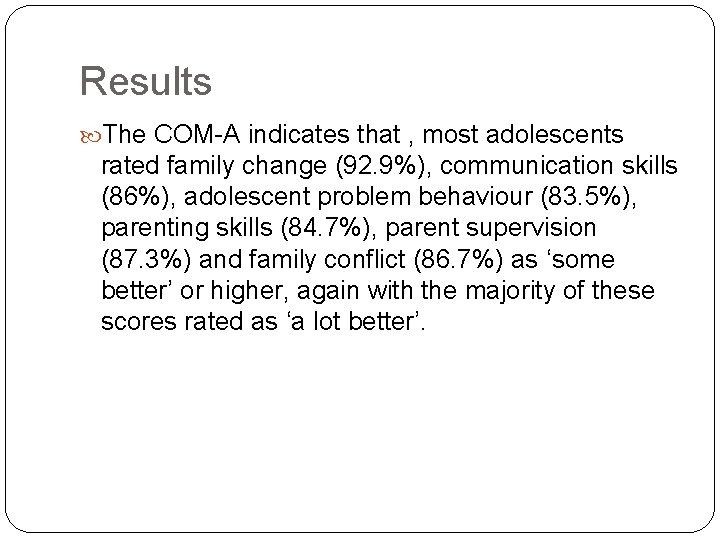
Results The COM-A indicates that , most adolescents rated family change (92. 9%), communication skills (86%), adolescent problem behaviour (83. 5%), parenting skills (84. 7%), parent supervision (87. 3%) and family conflict (86. 7%) as ‘some better’ or higher, again with the majority of these scores rated as ‘a lot better’.
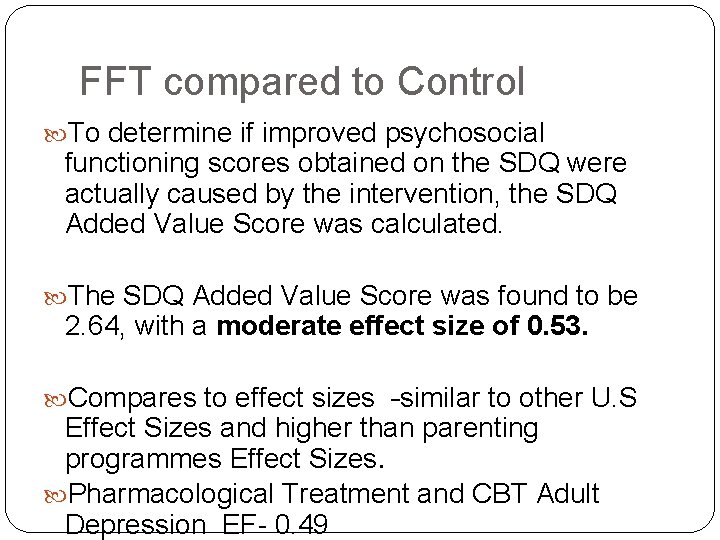
FFT compared to Control To determine if improved psychosocial functioning scores obtained on the SDQ were actually caused by the intervention, the SDQ Added Value Score was calculated. The SDQ Added Value Score was found to be 2. 64, with a moderate effect size of 0. 53. Compares to effect sizes –similar to other U. S Effect Sizes and higher than parenting programmes Effect Sizes. Pharmacological Treatment and CBT Adult Depression EF- 0. 49
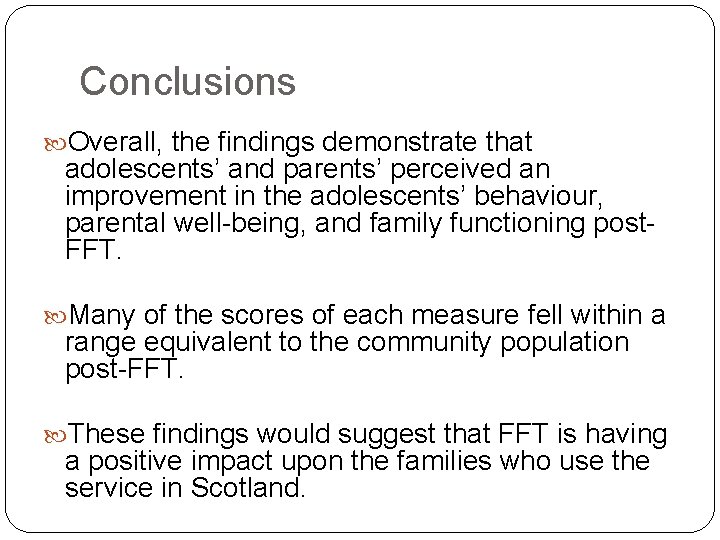
Conclusions Overall, the findings demonstrate that adolescents’ and parents’ perceived an improvement in the adolescents’ behaviour, parental well-being, and family functioning post. FFT. Many of the scores of each measure fell within a range equivalent to the community population post-FFT. These findings would suggest that FFT is having a positive impact upon the families who use the service in Scotland.
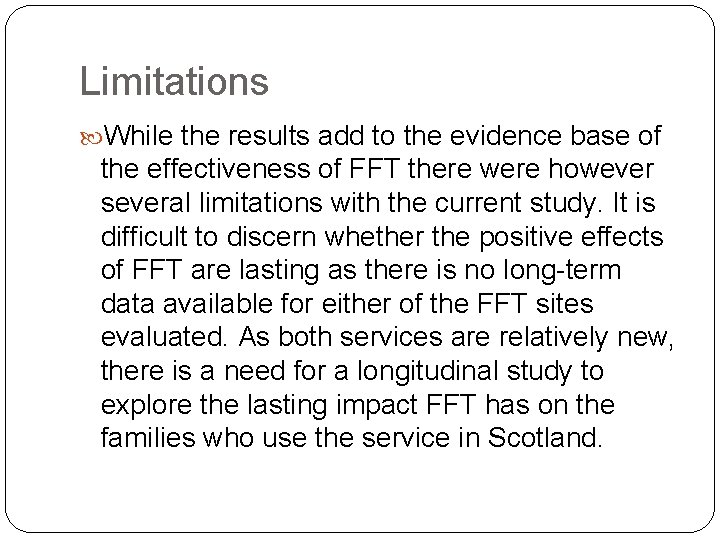
Limitations While the results add to the evidence base of the effectiveness of FFT there were however several limitations with the current study. It is difficult to discern whether the positive effects of FFT are lasting as there is no long-term data available for either of the FFT sites evaluated. As both services are relatively new, there is a need for a longitudinal study to explore the lasting impact FFT has on the families who use the service in Scotland.
Limitations The results of this study only include families who finished the intervention with completed pre- and postoutcome measures. Therefore families who dropped out are not included, meaning that the resultant sample is not entirely representative of all those who were initially referred to the service. An attempt was made to counter this by comparing all available SDQ and OQ baseline scores of families who completed and dropped out of the intervention. No significant difference was found indicating that the results are likely representative of all those referred. However it is not possible to draw a firm conclusion regarding this.
Limitations • While the SDQ Added Value Score has many advantages, using it does disadvantage the current study compared to an RCT. • As study was not an RCT the possibility of the effect found being caused by confounding factors cannot be ruled out.
Future Research Future research should investigate why families drop-out and aim to consider how FFT can be delivered to minimise dropout rates. The rationale behind families refusing to participate in FFT despite meeting the referral criteria should also be considered, with a view to making the intervention more accessible and increasing the participation rate.
Implications The role of evidence base programmes for Social Work Services serving socially excluded families The role of Clinical Support to Social Work in implementing and evaluating programmes. Non diagnostic/formulation/ non clinical service with clinical gains. Importance of model adherence and supervision/coaching around proven models delivered fully Thinking relationally about problems An Evidence Based Programme promotes attachments Further large scale outcome trials required Important for Policy makers focusing on scale for population impacts