Forame ovale pervio e ictus criptogenetico indicazioni alla

- Slides: 28
Forame ovale pervio e ictus criptogenetico: indicazioni alla chiusura Dott. Giovanni Benedetti FTGM-Ospedale del Cuore, Massa Scuola Superiore Sant’Anna, Pisa
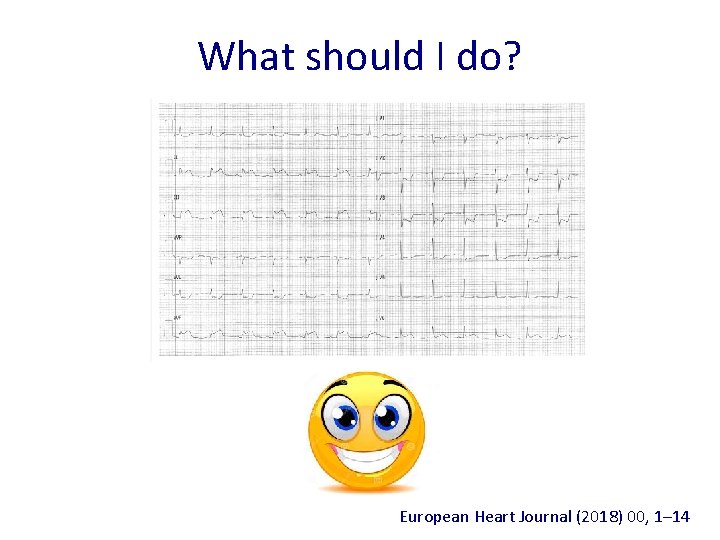
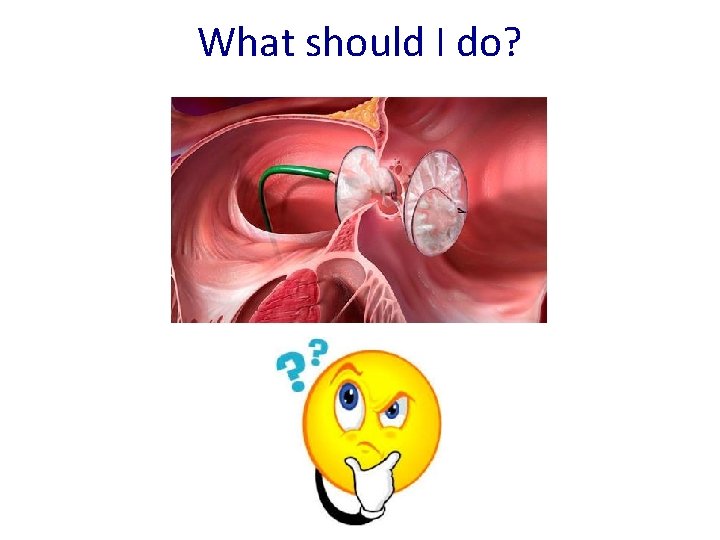
What should I do? European Heart Journal (2018) 00, 1– 14
What should I do?
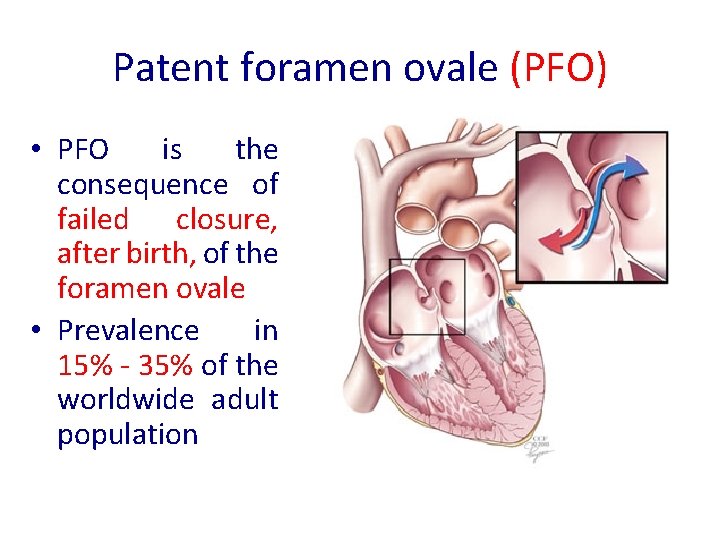
Patent foramen ovale (PFO) • PFO is the consequence of failed closure, after birth, of the foramen ovale • Prevalence in 15% - 35% of the worldwide adult population
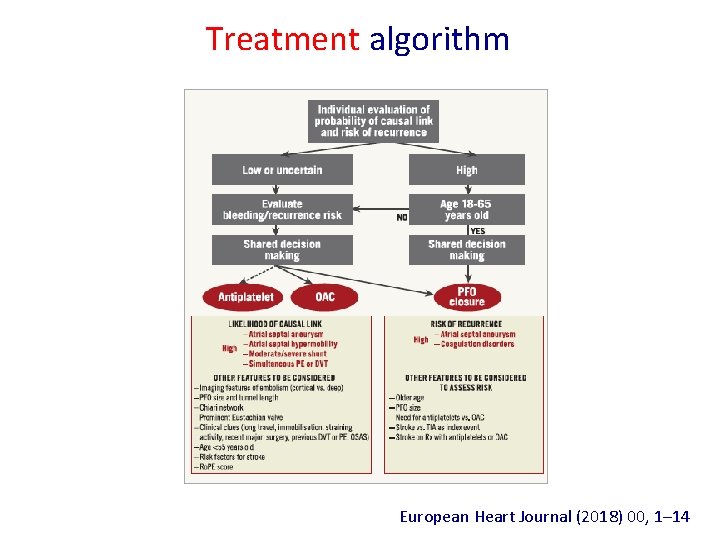
PFO management: teamwork and systematic evaluation The decision making should be done taking into account an estimation of the individual: 1. Probability of a causal role of the PFO in the clinical picture 2. Risk of recurrence
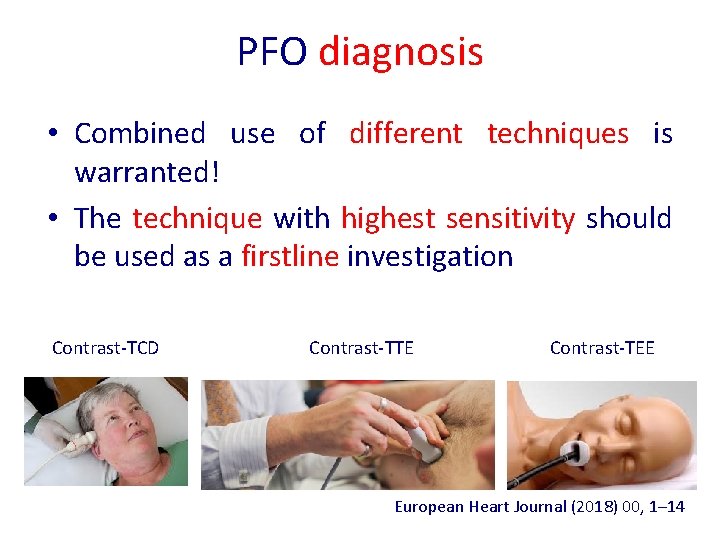
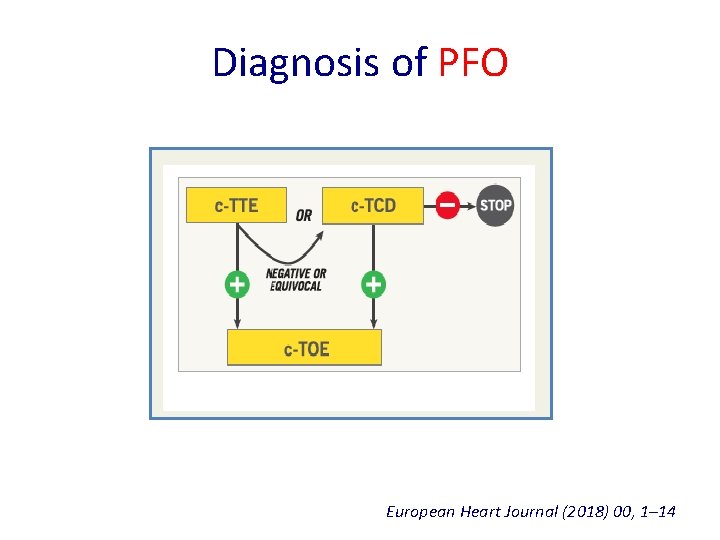
PFO diagnosis • Combined use of different techniques is warranted! • The technique with highest sensitivity should be used as a firstline investigation Contrast-TCD Contrast-TTE Contrast-TEE European Heart Journal (2018) 00, 1– 14
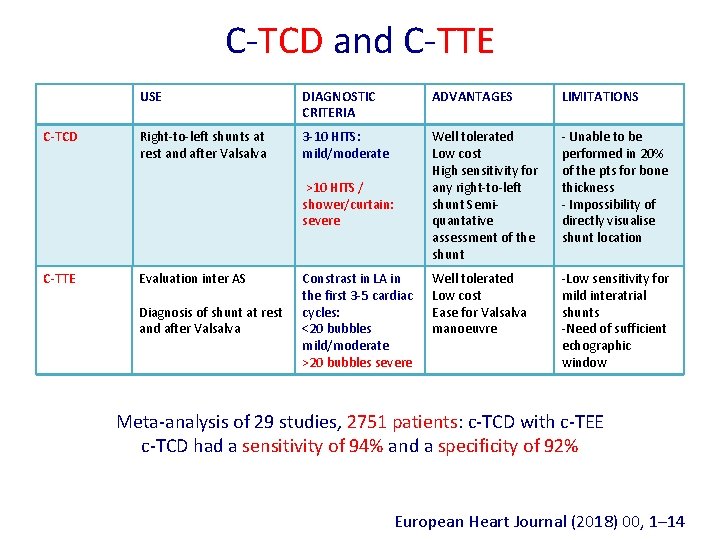
C-TCD and C-TTE C-TCD USE DIAGNOSTIC CRITERIA ADVANTAGES LIMITATIONS Right-to-left shunts at rest and after Valsalva 3 -10 HITS: mild/moderate Well tolerated Low cost High sensitivity for any right-to-left shunt Semiquantative assessment of the shunt - Unable to be performed in 20% of the pts for bone thickness - Impossibility of directly visualise shunt location Well tolerated Low cost Ease for Valsalva manoeuvre -Low sensitivity for mild interatrial shunts -Need of sufficient echographic window >10 HITS / shower/curtain: severe C-TTE Evaluation inter AS Diagnosis of shunt at rest and after Valsalva Constrast in LA in the first 3 -5 cardiac cycles: <20 bubbles mild/moderate >20 bubbles severe Meta-analysis of 29 studies, 2751 patients: c-TCD with c-TEE c-TCD had a sensitivity of 94% and a specificity of 92% European Heart Journal (2018) 00, 1– 14
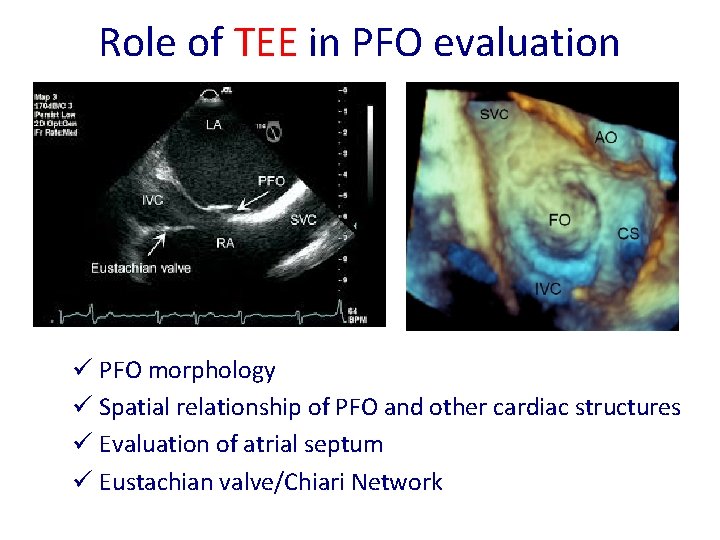
Role of TEE in PFO evaluation ü PFO morphology ü Spatial relationship of PFO and other cardiac structures ü Evaluation of atrial septum ü Eustachian valve/Chiari Network
Diagnosis of PFO European Heart Journal (2018) 00, 1– 14
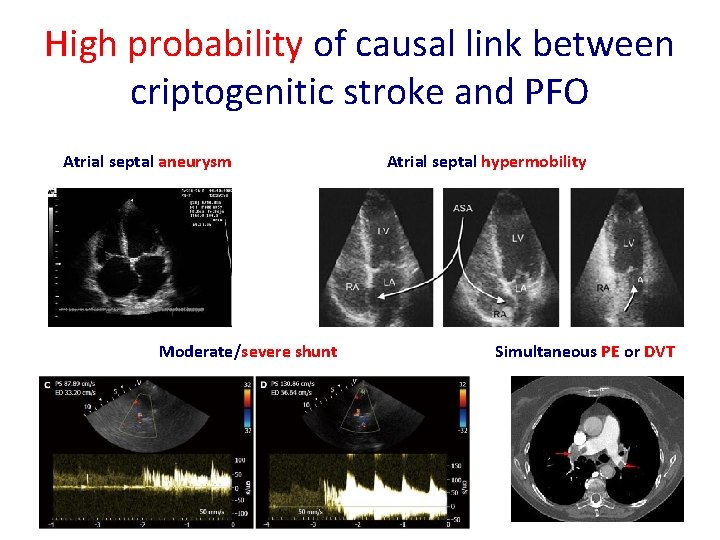
High probability of causal link between criptogenitic stroke and PFO Atrial septal aneurysm Moderate/severe shunt Atrial septal hypermobility Simultaneous PE or DVT
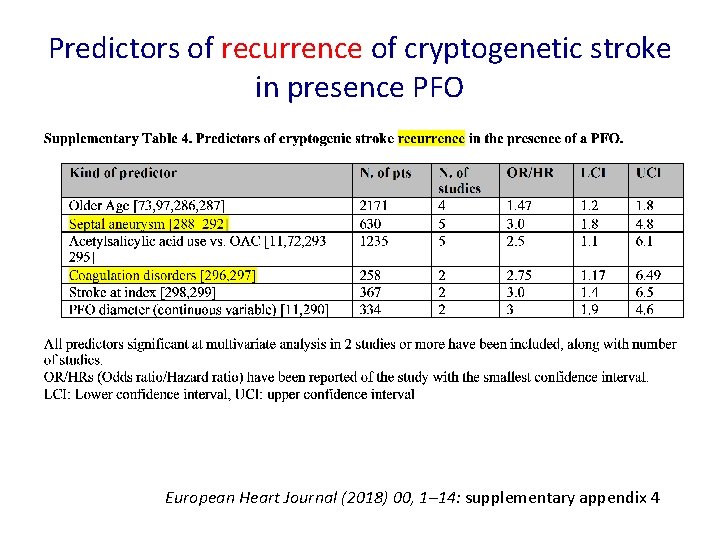
Predictors of recurrence of cryptogenetic stroke in presence PFO European Heart Journal (2018) 00, 1– 14: supplementary appendix 4
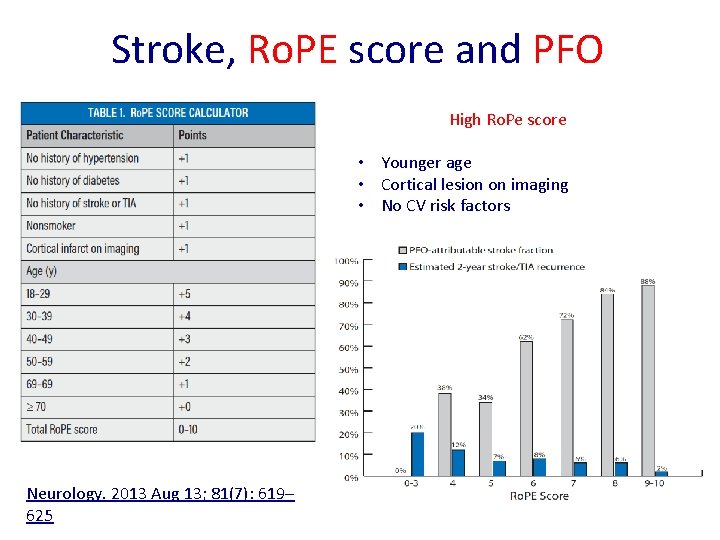
Stroke, Ro. PE score and PFO High Ro. Pe score • Younger age • Cortical lesion on imaging • No CV risk factors Neurology. 2013 Aug 13; 81(7): 619– 625
Treatment algorithm European Heart Journal (2018) 00, 1– 14
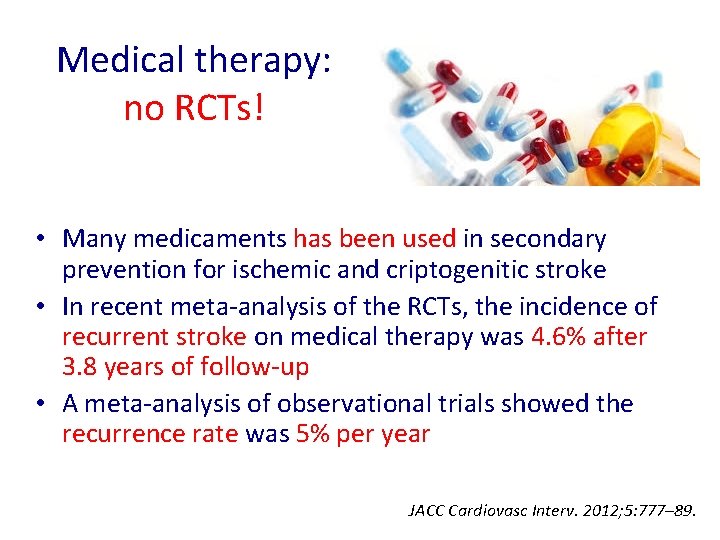
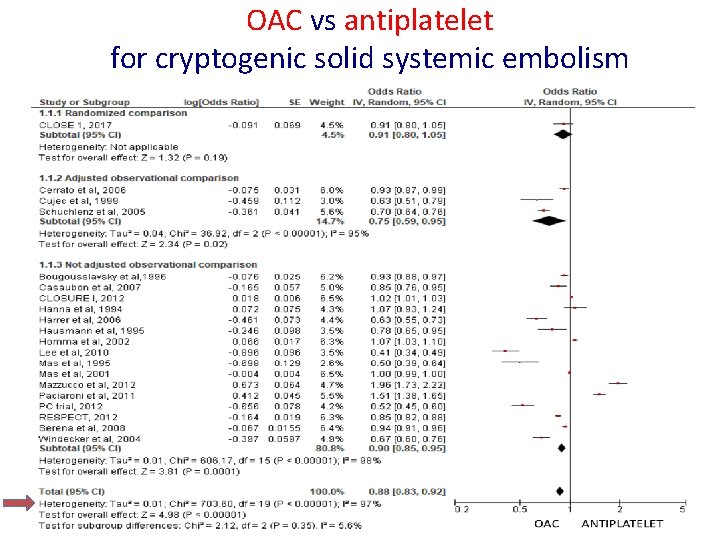
Medical therapy: no RCTs! • Many medicaments has been used in secondary prevention for ischemic and criptogenitic stroke • In recent meta-analysis of the RCTs, the incidence of recurrent stroke on medical therapy was 4. 6% after 3. 8 years of follow-up • A meta-analysis of observational trials showed the recurrence rate was 5% per year JACC Cardiovasc Interv. 2012; 5: 777– 89.
OAC vs antiplatelet for cryptogenic solid systemic embolism
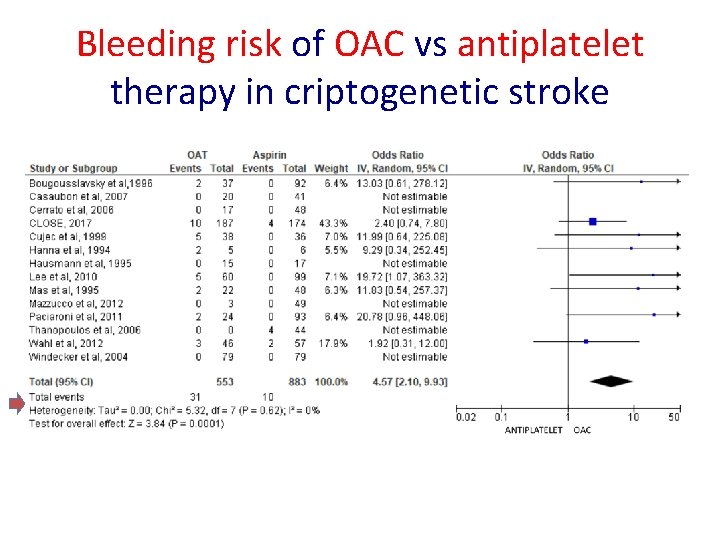
Bleeding risk of OAC vs antiplatelet therapy in criptogenetic stroke
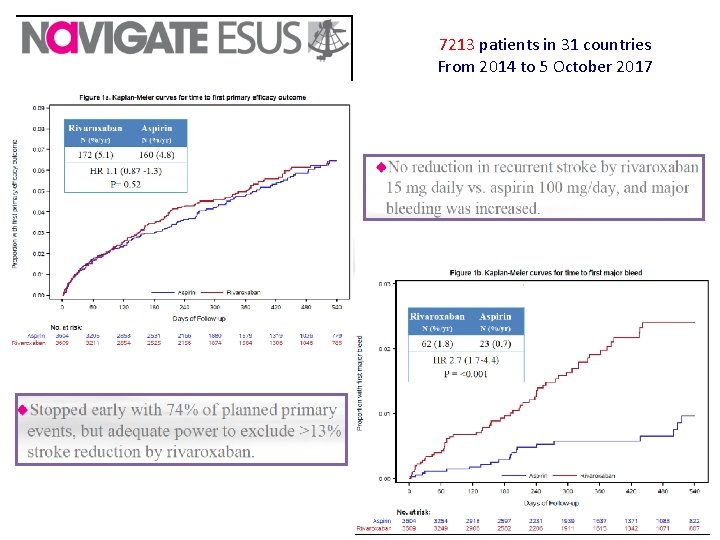
7213 patients in 31 countries From 2014 to 5 October 2017
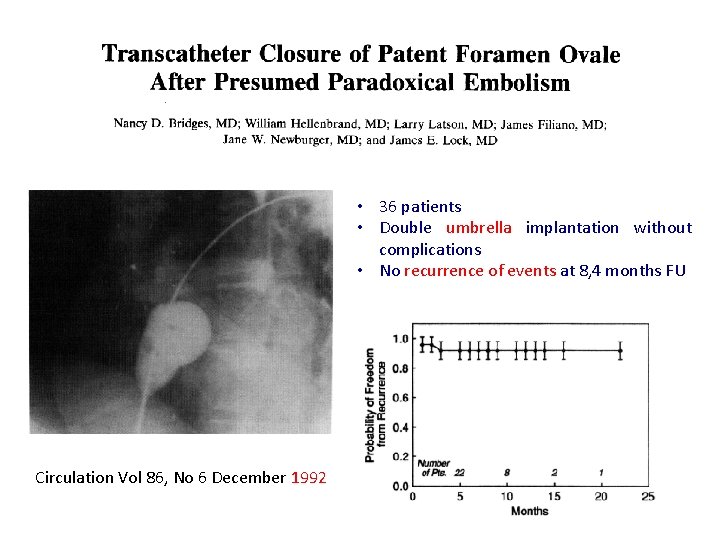
• 36 patients • Double umbrella implantation without complications • No recurrence of events at 8, 4 months FU Circulation Vol 86, No 6 December 1992
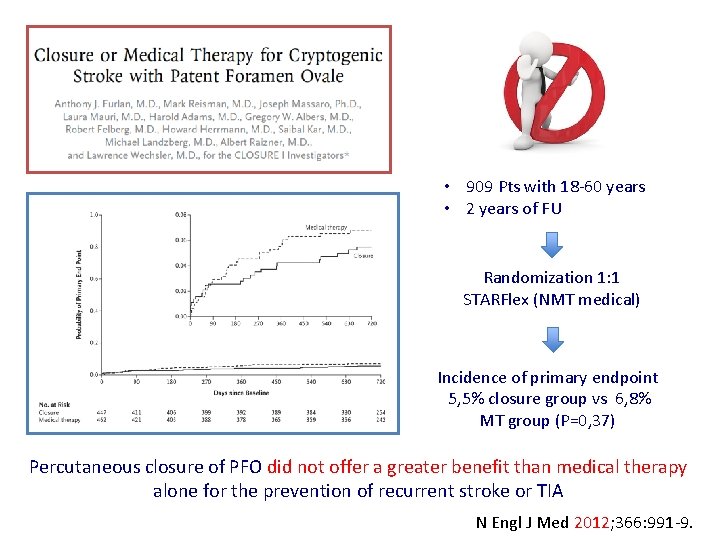
• 909 Pts with 18 -60 years • 2 years of FU Randomization 1: 1 STARFlex (NMT medical) Incidence of primary endpoint 5, 5% closure group vs 6, 8% MT group (P=0, 37) Percutaneous closure of PFO did not offer a greater benefit than medical therapy alone for the prevention of recurrent stroke or TIA N Engl J Med 2012; 366: 991 -9.
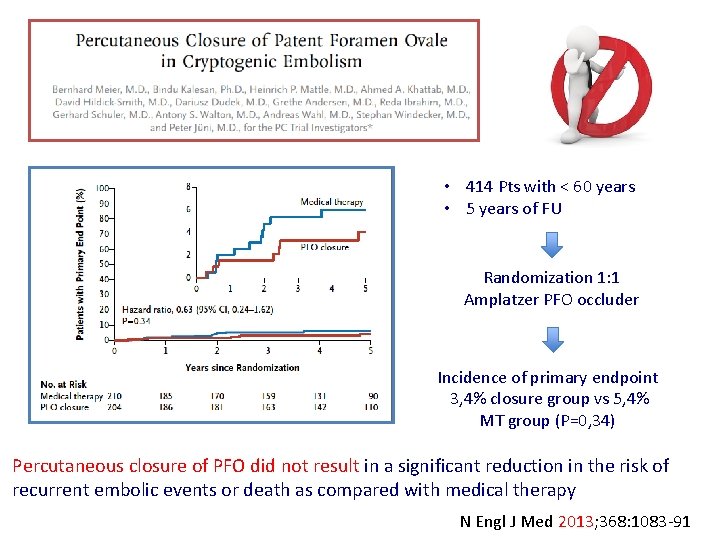
• 414 Pts with < 60 years • 5 years of FU Randomization 1: 1 Amplatzer PFO occluder Incidence of primary endpoint 3, 4% closure group vs 5, 4% MT group (P=0, 34) Percutaneous closure of PFO did not result in a significant reduction in the risk of recurrent embolic events or death as compared with medical therapy N Engl J Med 2013; 368: 1083 -91
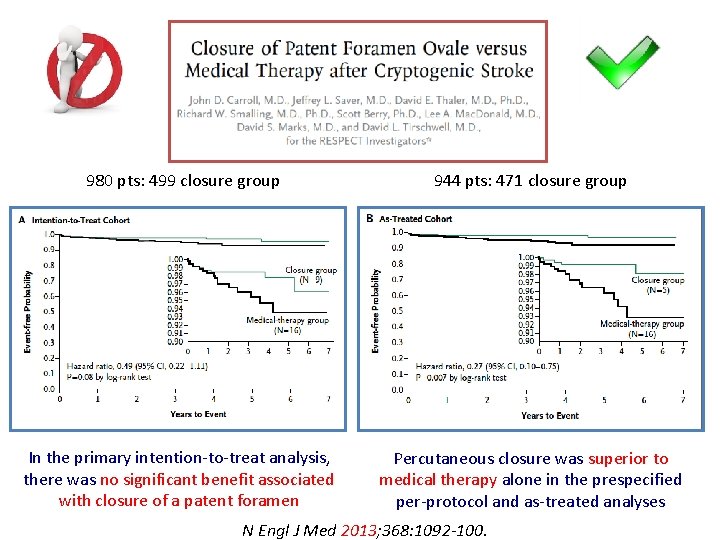
980 pts: 499 closure group 944 pts: 471 closure group In the primary intention-to-treat analysis, there was no significant benefit associated with closure of a patent foramen Percutaneous closure was superior to medical therapy alone in the prespecified per-protocol and as-treated analyses N Engl J Med 2013; 368: 1092 -100.
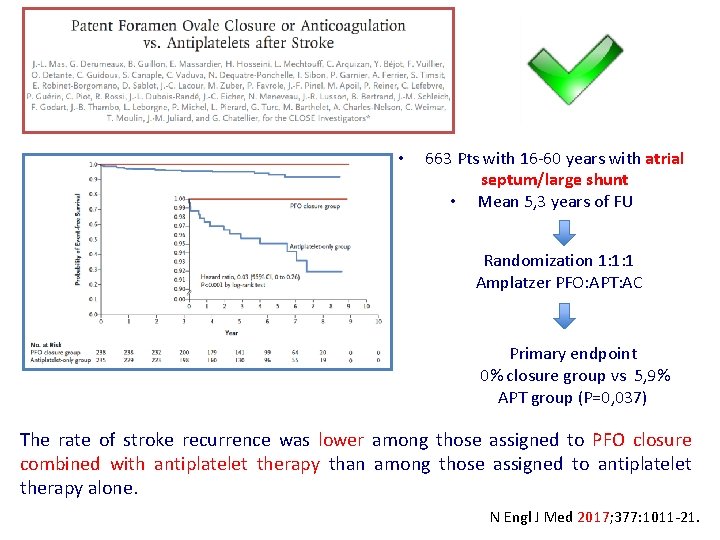
• 663 Pts with 16 -60 years with atrial septum/large shunt • Mean 5, 3 years of FU Randomization 1: 1: 1 Amplatzer PFO: APT: AC Primary endpoint 0% closure group vs 5, 9% APT group (P=0, 037) The rate of stroke recurrence was lower among those assigned to PFO closure combined with antiplatelet therapy than among those assigned to antiplatelet therapy alone. N Engl J Med 2017; 377: 1011 -21.
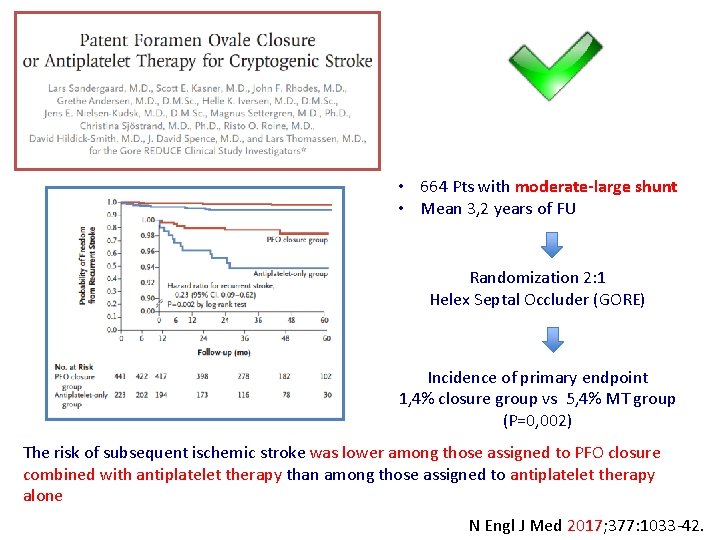
• 664 Pts with moderate-large shunt • Mean 3, 2 years of FU Randomization 2: 1 Helex Septal Occluder (GORE) Incidence of primary endpoint 1, 4% closure group vs 5, 4% MT group (P=0, 002) The risk of subsequent ischemic stroke was lower among those assigned to PFO closure combined with antiplatelet therapy than among those assigned to antiplatelet therapy alone N Engl J Med 2017; 377: 1033 -42.
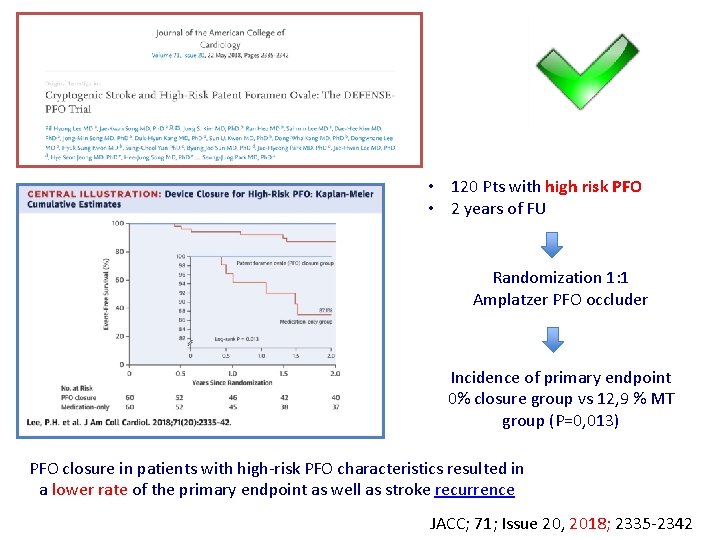
• 120 Pts with high risk PFO • 2 years of FU Randomization 1: 1 Amplatzer PFO occluder Incidence of primary endpoint 0% closure group vs 12, 9 % MT group (P=0, 013) PFO closure in patients with high-risk PFO characteristics resulted in a lower rate of the primary endpoint as well as stroke recurrence JACC; 71; Issue 20, 2018; 2335 -2342
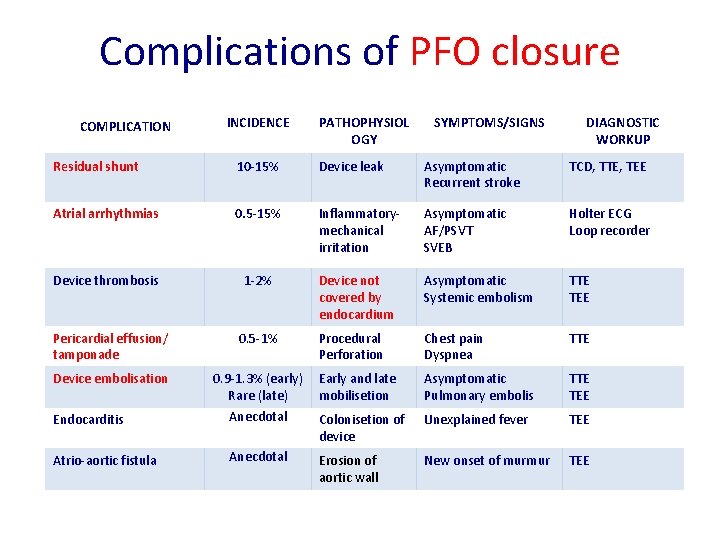
Complications of PFO closure COMPLICATION INCIDENCE PATHOPHYSIOL OGY SYMPTOMS/SIGNS DIAGNOSTIC WORKUP Residual shunt 10 -15% Device leak Asymptomatic Recurrent stroke TCD, TTE, TEE Atrial arrhythmias 0. 5 -15% Inflammatorymechanical irritation Asymptomatic AF/PSVT SVEB Holter ECG Loop recorder Device thrombosis 1 -2% Device not covered by endocardium Asymptomatic Systemic embolism TTE TEE Procedural Perforation Chest pain Dyspnea TTE Early and late mobilisetion Asymptomatic Pulmonary embolis TTE TEE Colonisetion of device Unexplained fever TEE Erosion of aortic wall New onset of murmur TEE Pericardial effusion/ tamponade 0. 5 -1% Device embolisation 0. 9 -1. 3% (early) Rare (late) Anecdotal Endocarditis Atrio-aortic fistula Anecdotal
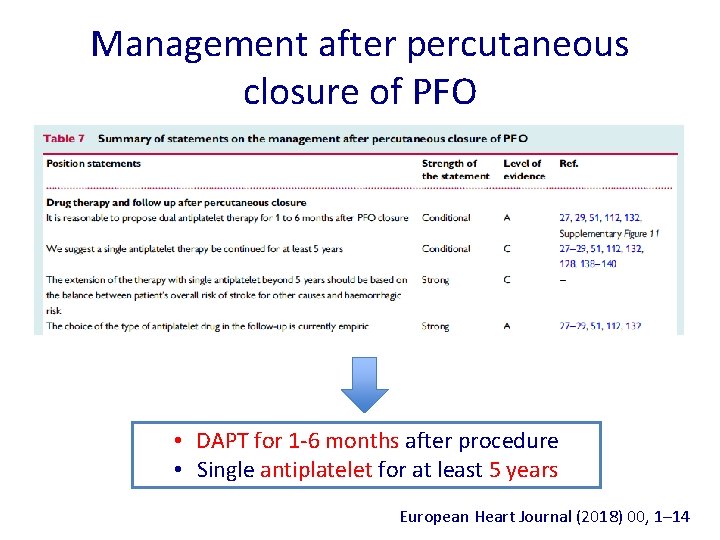
Management after percutaneous closure of PFO • DAPT for 1 -6 months after procedure • Single antiplatelet for at least 5 years European Heart Journal (2018) 00, 1– 14
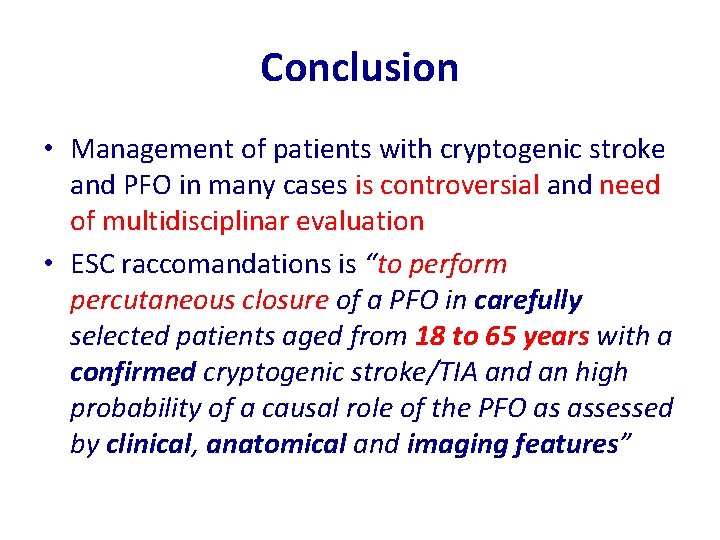
Conclusion • Management of patients with cryptogenic stroke and PFO in many cases is controversial and need of multidisciplinar evaluation • ESC raccomandations is “to perform percutaneous closure of a PFO in carefully selected patients aged from 18 to 65 years with a confirmed cryptogenic stroke/TIA and an high probability of a causal role of the PFO as assessed by clinical, anatomical and imaging features”
Giovanni Benedetti, M. D giovannibenedetti@me. com