FireEMS Safety Stand Down Mayday Self Rescue and
- Slides: 50
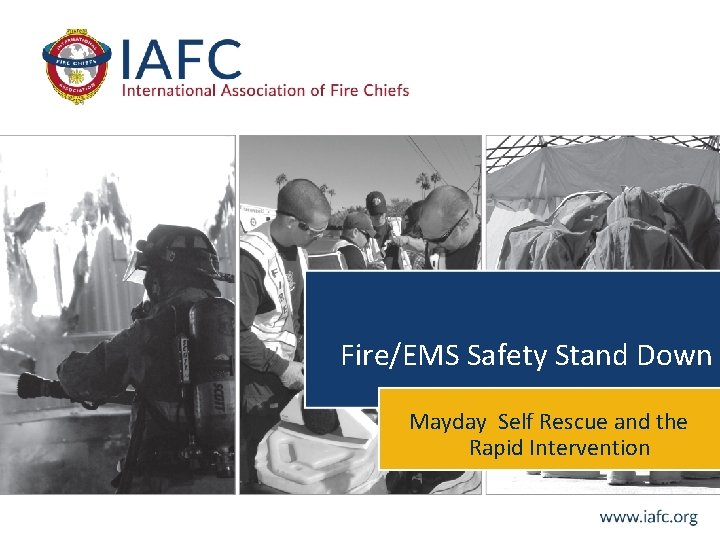
Fire/EMS Safety Stand Down Mayday Self Rescue and the Rapid Intervention
1. Unearthing the FACTS about Maydays through Research 2. Mayday Self Rescue keeps them coming back 3. When You Absolutely, Positively Had To Call Mayday, What if RIT was too late?
Partners
Mayday and the RIT • Acknowledgements: – Chief Don Abbott (Retired) – Secret List – NVFC – NFPA – IAFF – FSRI – Dr. Burton A. Clark EFO • Acknowledgements: – – – – SHS IAFC ISFSI First Arriving IFSTA Florida Firefighters OSHA USFA
Mayday and the RIT • Objectives: – The Member will understand when firefighters call Mayday and will know tactical options – The Company Officer will understand when firefighters call Mayday and know response options – The Command Officer will understand when firefighters call Mayday and know strategic options
Mayday and the RIT Introduction: • Training for a First Alarm Event • Does Your department have established common terminology? • Response plans • Do you know the statistics? – Did you know 67% of Maydays occur when command is mobile?
Mayday and the RIT • Objective: – The Member will understand when firefighters call Mayday and will know tactical options
Mayday and the RIT • Firefighter ages: – 50% are between ages 32 -40 • Experience: – 6 -15 years
Mayday and the RIT • Emotional event: – A lot of yelling
Mayday and the RIT • Time of Day • Shift
Mayday and the RIT • Understanding the situation is key “We should have a recording of a good and bad on scene report here. ” https: //www. youtube. com/watch? v=Q 3 FSs. OSw 1 t. Y https: //www. youtube. com/watch? v=X 1 D 1 s. DZOAg. Q
Mayday and the RIT Terminology • RIC: Rapid Intervention Crew • RIT: Rapid Intervention Team • FAST: Firefighter Assistance and Search Team
Mayday and the RIT Terminology • LUNAR: Location – Unit – Name – Assignment – Resources • NUCAN: Name – Unit (Assignment/Location) – Conditions – Actions – Needs • UCAN: Unit – Conditions – Actions – Needs
Mayday and the RIT • For local add on • Review your on scene policy here
Mayday and the RIT • Which unit is most often involved in a Mayday? – 1 st Unit On Scene 52% https: //www. youtube. com/watch? v=68 j. Ad. LJ 8 Sm 4 – 2 nd Unit On Scene 23% – 3 rd Unit On Scene 17% – 4 th Unit On Scene 5%
Mayday and the RIT We suggest a video be inserted here relevant for your locality.
Mayday and the RIT • Crew size when Mayday is called – 2 Person 21% – 3 Person 37% – 4 Person 42%
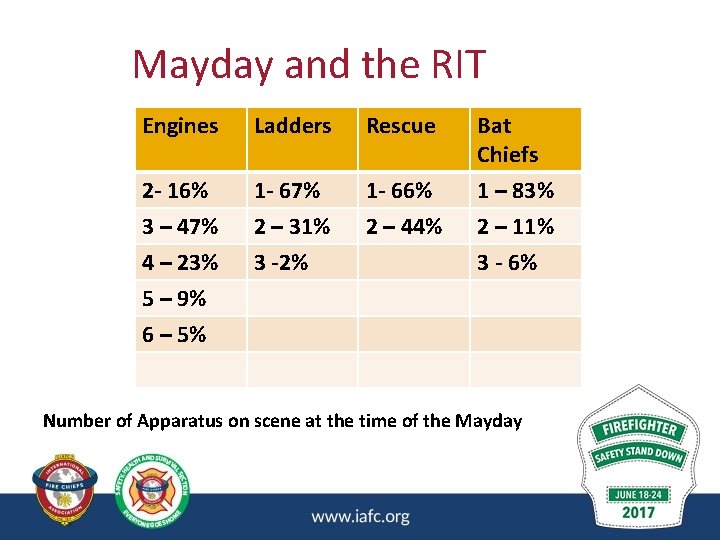
Mayday and the RIT Engines Ladders Rescue 2 - 16% 3 – 47% 1 - 67% 2 – 31% 1 - 66% 2 – 44% 4 – 23% 5 – 9% 6 – 5% 3 -2% Bat Chiefs 1 – 83% 2 – 11% 3 - 6% Number of Apparatus on scene at the time of the Mayday
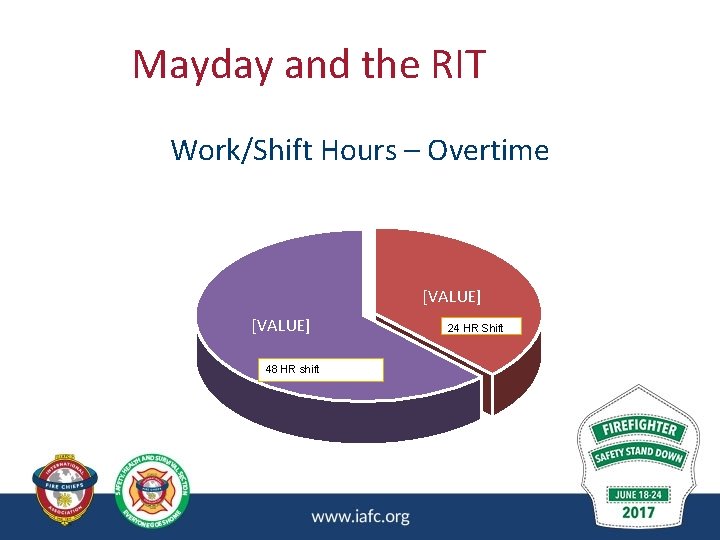
Mayday and the RIT Work/Shift Hours – Overtime [VALUE] 48 HR shift 24 HR Shift
Mayday and the RIT Sleep deprivation videos https: //www. youtube. com/watch? v=yr. MH-MXjqvc https: //www. youtube. com/watch? v=pb. Jx. LITdt_E
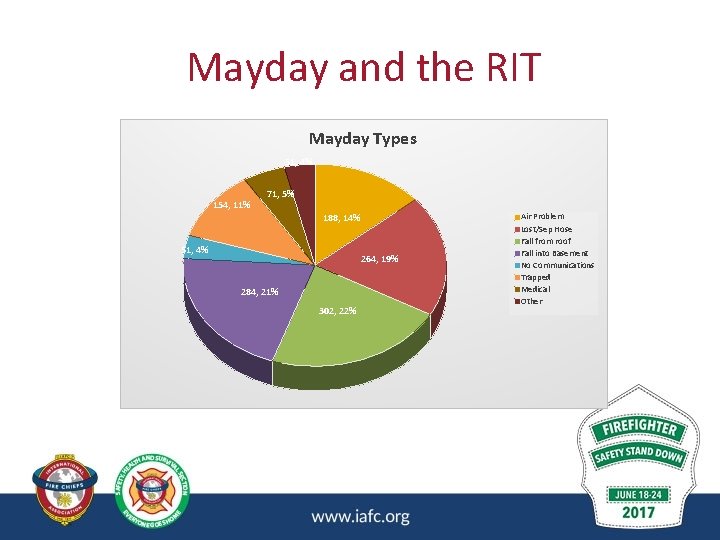
Mayday and the RIT Mayday Types 51, 4% 154, 11% 71, 5% 188, 14% 51, 4% 264, 19% 284, 21% 302, 22% Air Problem Lost/Sep Hose Fall from roof Fall into Basement No Communications Trapped Medical Other
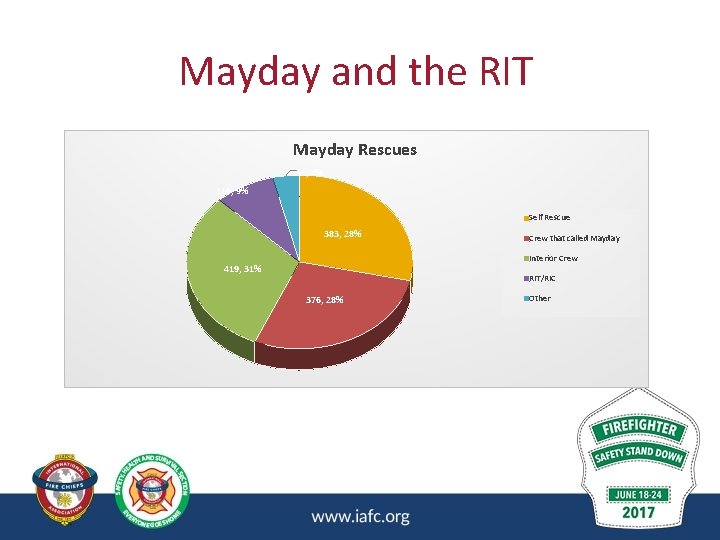
Mayday and the RIT Mayday Rescues 51, 4% 116, 9% Self Rescue 383, 28% Crew that called Mayday Interior Crew 419, 31% RIT/RIC 376, 28% Other
Mayday and the RIT • Call the Mayday when: – Falls – Collapse – Alarms – Caught – entangled – Lost – disoriented – Trapped
Mayday and the RIT • Other factors: – ZVC (Zero Visibility Conditions) - 36% of the time – PZVC (Prolonged Zero Visibility Conditions) – 23% of the time
Mayday and the RIT • “The capability of our protective gear can now consistently out perform the natural limits of our anatomy and physiology…just because you can go someplace on the fire ground doesn’t mean you should go there … simply our modern turnouts can live a lot longer than our old fashioned bodies. ” Chief Alan Brunacini
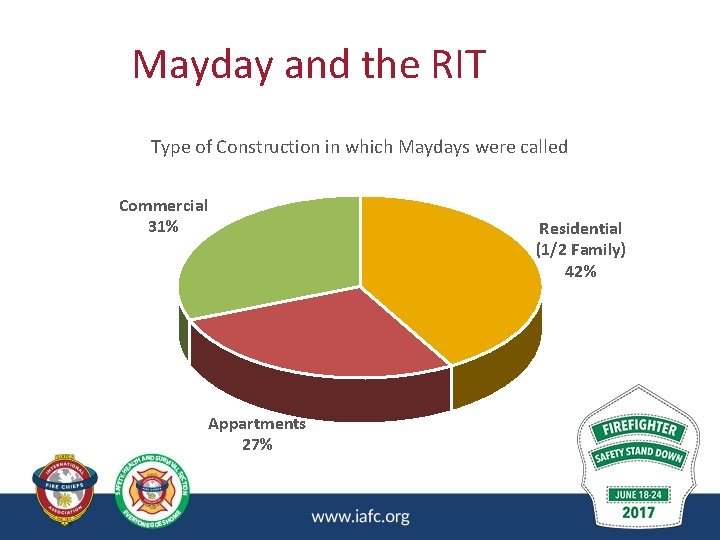
Mayday and the RIT Type of Construction in which Maydays were called Commercial 31% Residential (1/2 Family) 42% Appartments 27%
Mayday and the RIT “The only way to guarantee a successful outcome of a “Mayday” is to prevent it!” (From Project Mayday) “ You will not rise and stay to an occasion, but will sink to the level of your training. ” Josh Medcalf
Mayday and the RIT • Objective: – The Company Officer will understand when firefighters call Mayday and know response options
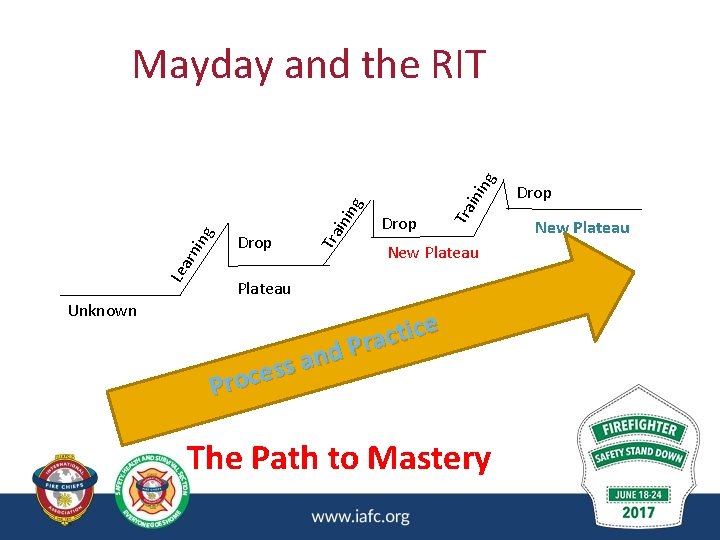
Le Unknown ini ng Drop Tra arn ing Mayday and the RIT New Plateau e c i t c ra P d n a s s e c o r P The Path to Mastery Drop New Plateau
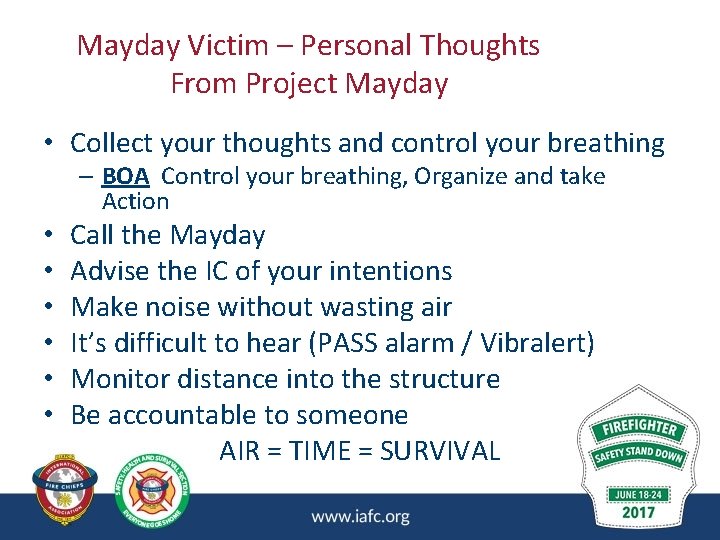
Mayday Victim – Personal Thoughts From Project Mayday • Collect your thoughts and control your breathing – BOA Control your breathing, Organize and take Action • • • Call the Mayday Advise the IC of your intentions Make noise without wasting air It’s difficult to hear (PASS alarm / Vibralert) Monitor distance into the structure Be accountable to someone AIR = TIME = SURVIVAL
Mayday and the RIT On the following slides are a sampling the results of individual personal survey questions asked of Mayday victims during Component 2 of Project Mayday. Would your members’ percentage of yes answers be higher?
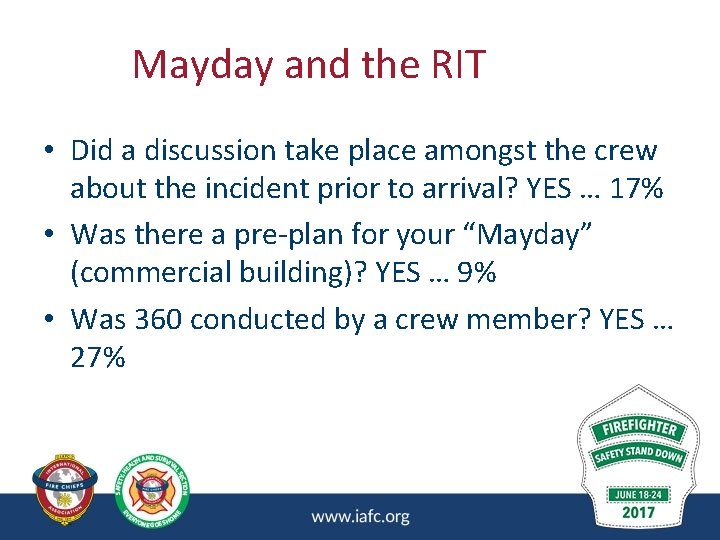
Mayday and the RIT • Did a discussion take place amongst the crew about the incident prior to arrival? YES … 17% • Was there a pre-plan for your “Mayday” (commercial building)? YES … 9% • Was 360 conducted by a crew member? YES … 27%
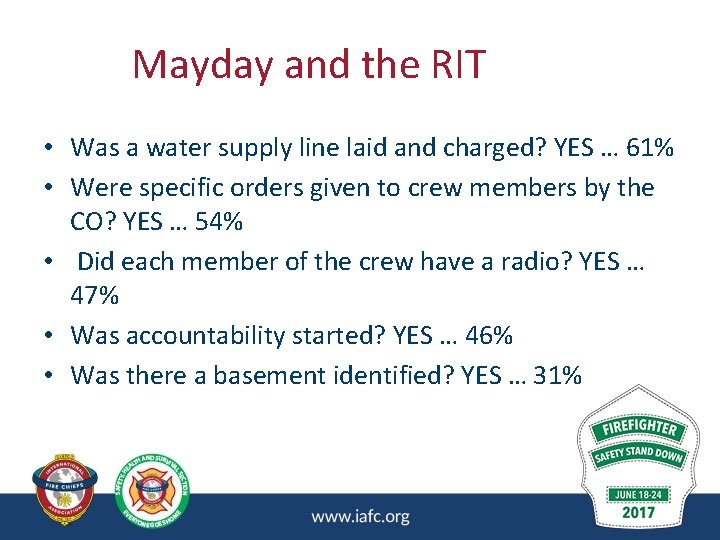
Mayday and the RIT • Was a water supply line laid and charged? YES … 61% • Were specific orders given to crew members by the CO? YES … 54% • Did each member of the crew have a radio? YES … 47% • Was accountability started? YES … 46% • Was there a basement identified? YES … 31%
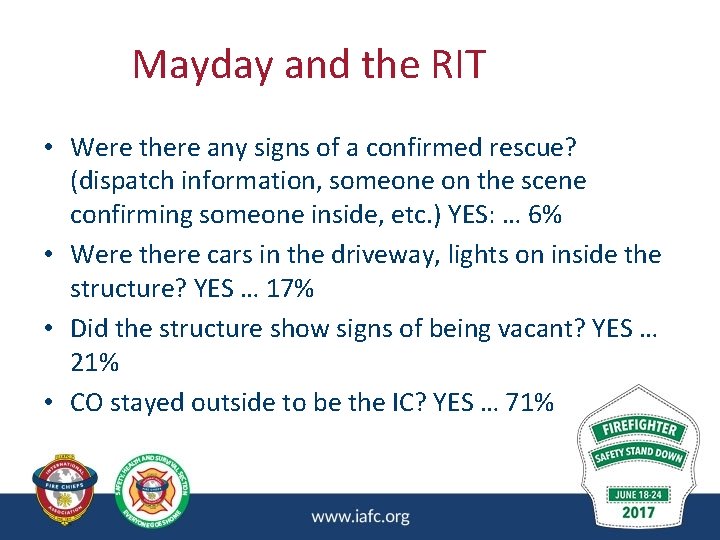
Mayday and the RIT • Were there any signs of a confirmed rescue? (dispatch information, someone on the scene confirming someone inside, etc. ) YES: … 6% • Were there cars in the driveway, lights on inside the structure? YES … 17% • Did the structure show signs of being vacant? YES … 21% • CO stayed outside to be the IC? YES … 71%
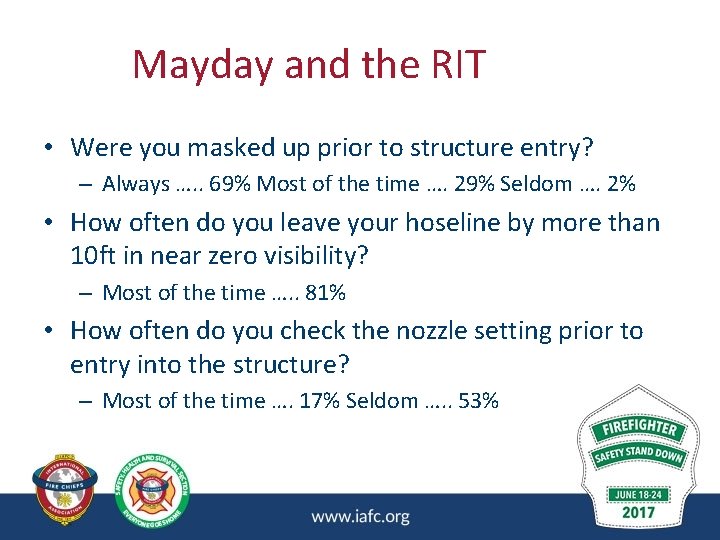
Mayday and the RIT • Were you masked up prior to structure entry? – Always …. . 69% Most of the time …. 29% Seldom …. 2% • How often do you leave your hoseline by more than 10 ft in near zero visibility? – Most of the time …. . 81% • How often do you check the nozzle setting prior to entry into the structure? – Most of the time …. 17% Seldom …. . 53%
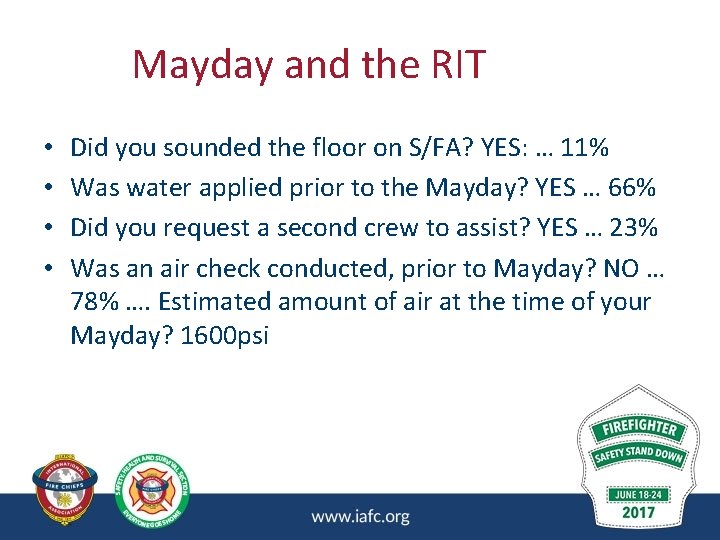
Mayday and the RIT • • Did you sounded the floor on S/FA? YES: … 11% Was water applied prior to the Mayday? YES … 66% Did you request a second crew to assist? YES … 23% Was an air check conducted, prior to Mayday? NO … 78% …. Estimated amount of air at the time of your Mayday? 1600 psi
Mayday and the RIT Do You Know The Way Out?
Mayday and the RIT • Objectives: – The Command Officer shall understand when firefighters call Mayday and know strategic options
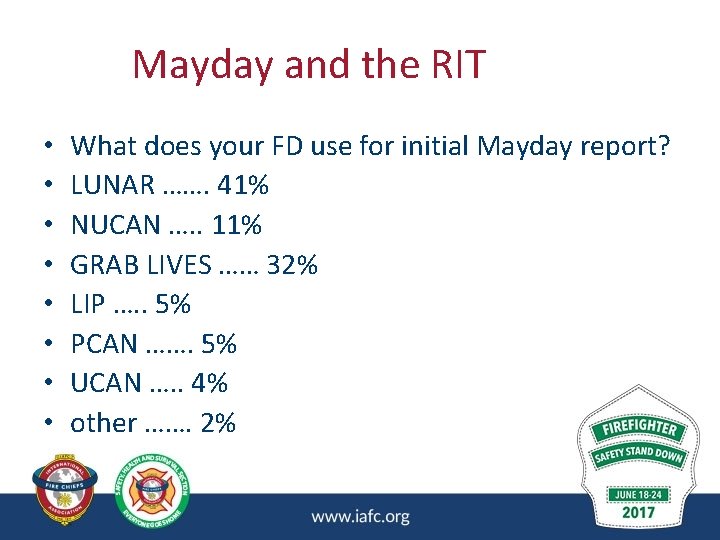
Mayday and the RIT • • What does your FD use for initial Mayday report? LUNAR ……. 41% NUCAN …. . 11% GRAB LIVES …… 32% LIP …. . 5% PCAN ……. 5% UCAN …. . 4% other ……. 2%
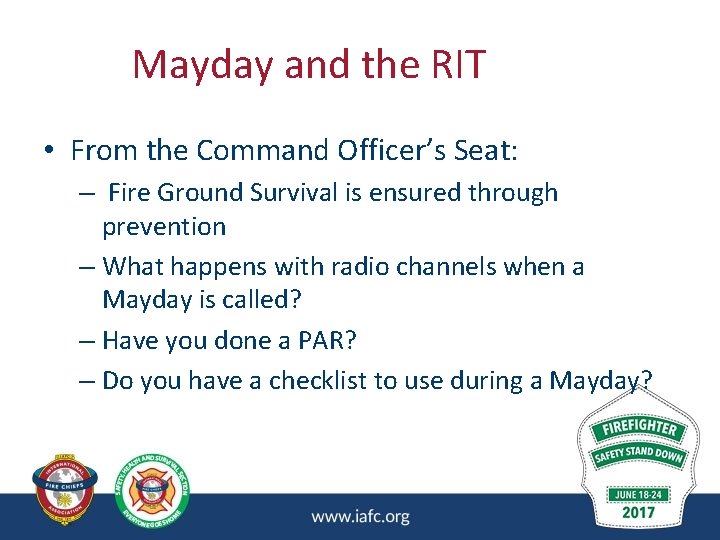
Mayday and the RIT • From the Command Officer’s Seat: – Fire Ground Survival is ensured through prevention – What happens with radio channels when a Mayday is called? – Have you done a PAR? – Do you have a checklist to use during a Mayday?
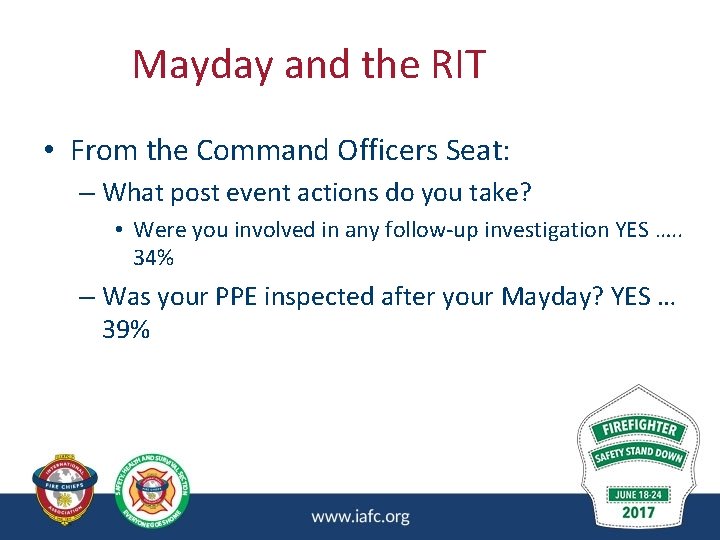
Mayday and the RIT • From the Command Officers Seat: – What post event actions do you take? • Were you involved in any follow-up investigation YES …. . 34% – Was your PPE inspected after your Mayday? YES … 39%
Mayday and the RIT • From Project Mayday, the following are comments victims of the reported Maydays made. • Why did you agree to do this survey? – I needed to share my story. – I wanted people to learn from my mistakes. – Did I do what others have done?
Mayday and the RIT On deteriorating conditions: • Came faster than expected • Couldn’t react fast enough • Crew passing on situation awareness was slow or never came to all crew members • Moved faster than we should have • Got off hose line farther than I should have
Mayday and the RIT On deteriorating conditions: • Spacing off the hose line was to far • When we fell into the basement, someone should have passed us a line • TIC didn’t work as expected on the first floor with fire in the basement • There should have been ladders at a third floor window for escape, instead of jumping
Considerations / Recommendations From Project Mayday • The three most common reasons firefighters need to be rescued: – inadequate fire experience – Inadequate fire training – poor leadership at the company level • Lack of situational awareness
Considerations / Recommendations From Project Mayday • Restful Sleep vs Stressful Sleep • Declaring a Mayday without a radio: – assume position that offers the most safety – activate the PASS – tap on hard objects, pipes, wall, etc. – shine flashlight at the ceiling – draw attention to your location
Considerations / Recommendations From Project Mayday • Complete size-up, conduct a 360 • Smoke and fire reports/information need to be consistent and accurate • At a certain point a person must accept they need help and must know and follow the procedures to do so
Considerations / Recommendations From Project Mayday • WHY DO WE WAIT SO LONG? - Tunnel vision, become to focused on the wrong things - Underestimate existing conditions and NOT forecasting what they could become • YOU CALLED A Mayday … Now What? - Collect your thoughts, control your breathing - What are you intentions? - Can you do those things ask by the IC? - Keep mask on - Have a plan when you start to run low on air! - Exercise your Mayday call (LUNAR, GRAB LIVES) - Don’t give up
Considerations / Recommendations From Project Mayday • Be realistic with your training needs, what is your weakest area, then work hard with your training. • Become the rescuer that you want to be … that would rescue yourself. • When working with a new officer or crew, under- stand their expectations. • As a officer have fire ground rules that your crew must follow.
Mayday and the RIT • Chief Abbott recommends that we continue to train on our May. Day procedures. • What program for continuing training do you have for your Fire Department? ? • The IAFC , the SHS section , NVFC and other supporters thank you for taking your time to focus on safety.