Fellowship Research Goals Cari Mc Carty Ph D
- Slides: 30
Fellowship Research Goals Cari Mc. Carty, Ph. D. November 2, 2012 Divisions of General Pediatrics and Adolescent Medicine, University of Washington Center for Child Health Behavior and Development Seattle Children’s Hospital
Outline l l l Goals of fellowship Task management Selecting a research project Identifying and working with mentors Research resources at Children’s and the UW
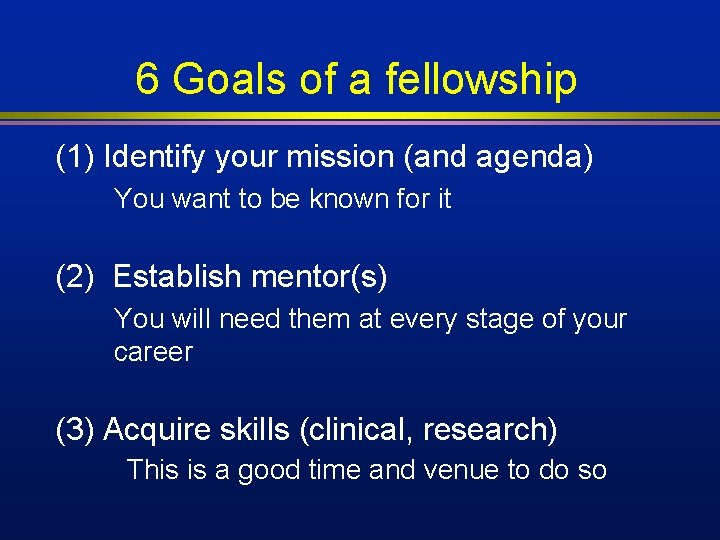
6 Goals of a fellowship (1) Identify your mission (and agenda) You want to be known for it (2) Establish mentor(s) You will need them at every stage of your career (3) Acquire skills (clinical, research) This is a good time and venue to do so
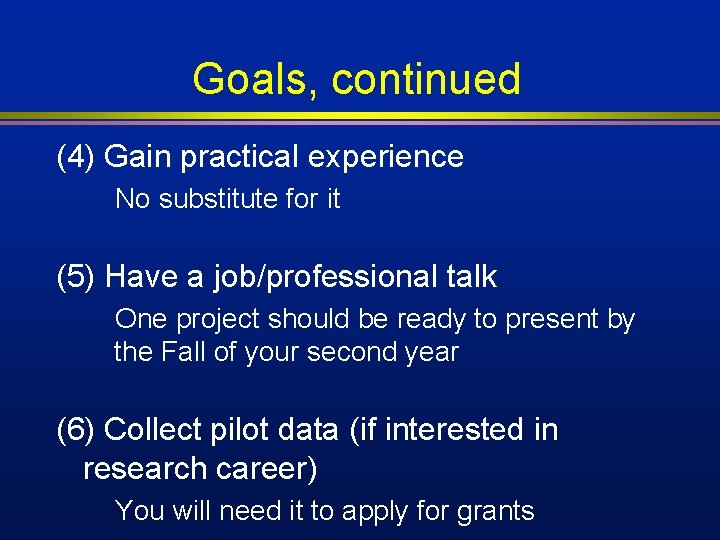
Goals, continued (4) Gain practical experience No substitute for it (5) Have a job/professional talk One project should be ready to present by the Fall of your second year (6) Collect pilot data (if interested in research career) You will need it to apply for grants
Caveats l l Have passion for what you work on Don’t be afraid to take some chances (say “yes” often) Don’t spread yourself too thin (don’t be afraid to say “no”) Don’t take an “elective” approach to your fellowship
What is your time situation? l l l Length of fellowship How much time and interest in research? When is your dedicated research time? Are you planning on course work? Where are you headed?
How will you divide your time? l l l Research Patient care Seminars and conferences Administration/Leadership Course work Teaching
Task Management Strategy: Mission Statement l l Concise statement of what you intend to contribute Provides you with » Identity » Guiding framework for planning » Rationale for saying YES or NO » Focus. . .
Mission Statement l To improve the emotional and behavioral health of children and adolescents through enhanced scientific understanding, promoting socialemotional competencies, and disseminating high-quality treatments
Task Management Strategy: Objectives at 3 Time Points l ~ 6 years: Big goal » Test an intervention to improve adherence to asthma guidelines l ~ 3 years: Worthy in & of itself » Identify reasons for guideline non-adherence l Immediate Steps » Learn methods (epidemiology, biostatistics) and content areas (chronic illness care, health systems, provider behavior)
Time Sinks l l l Waiting for data (be realistic) Dead end projects Excessive course work (? advanced degree) Job search Moonlighting
Selecting Projects: Goals l l Acquire skills in research design, methods Develop your agenda Work with particular people Have a product available for job talk
Selecting Projects: Criteria l “FINER” criteria Useful for Evaluating Fellowship Projects From: Hulley and Cummings, Designing Clinical Research.
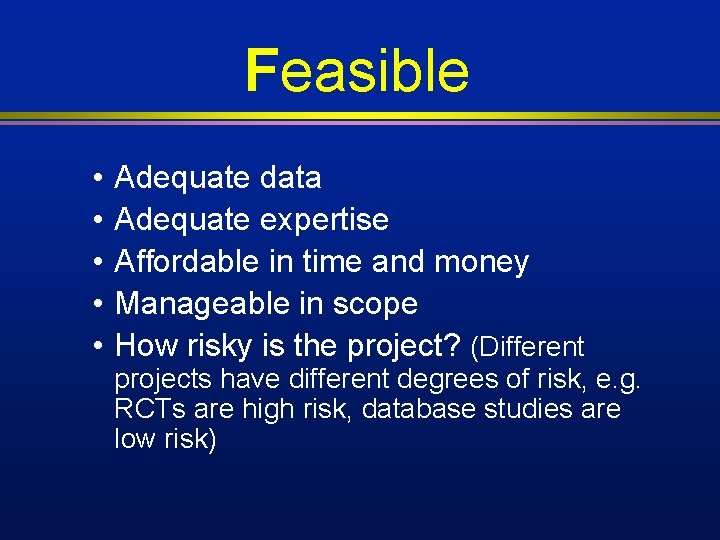
Feasible • • • Adequate data Adequate expertise Affordable in time and money Manageable in scope How risky is the project? (Different projects have different degrees of risk, e. g. RCTs are high risk, database studies are low risk)
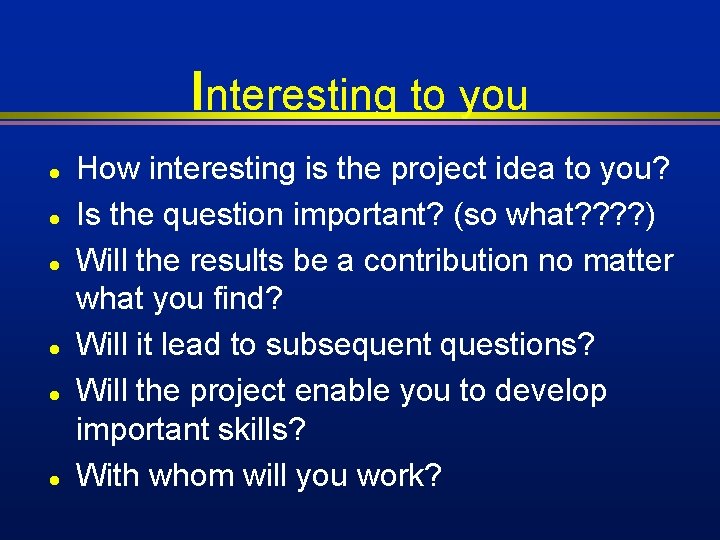
Interesting to you l l l How interesting is the project idea to you? Is the question important? (so what? ? ) Will the results be a contribution no matter what you find? Will it lead to subsequent questions? Will the project enable you to develop important skills? With whom will you work?
Novel • Confirms or refutes previous findings • Extends previous findings • Provides new findings
Ethical • IRB • NIH Inclusion Policy • Cultural competence
Relevant • To scientific knowledge • To clinical and health policy • To future research
Choosing a research project l l Draw your inspiration from your observations Do something important: frequency, severity, something you can impact, new information Do something that is feasible given time and resources It should lead to subsequent studies
Selecting a project, cont’d l l l Strike a balance between independence and apprenticeship: make sure you have something that is your own If feasible, pursue more than one at a time (smoothes down times, decreases risk) Develop a diverse portfolio
Cultural Competence in Research l l Collect and examine data by subgroup, when possible Develop and validate linguistic and culturally appropriate measures Disseminate best research practices as they pertain to racial/ethnic minority health Striving for cultural competence is a process, not a finite action
Identifying Mentors l l l A mentor is a close, trusted, and experienced counselor or guide. Mentors provide methodologic expertise, guidance, moral support, connections. They are critical to success in academia They must be invested in your career You can (and should) have more than one
Working with a Mentor l l The success of the relationship depends on you There are 5 keys to a good relationship
Be Proactive l l l Do not wait for mentors to contact you Meet with them regularly (how frequently depends on the project) Schedule the next meeting at the end of the prior one
Be Respectful l l Mentors are typically very busy Ask when it will be convenient to meet Be punctual (even if they are not) Give them adequate time to review materials (1 -2 weeks for a grant or manuscript)
Be Organized l l Prepare a list of points to cover at your meeting Have some provisional ideas about what you want to do
Be Responsive l l l Take their advice & comments seriously Even if you disagree with them, others are likely to raise similar concerns Give them feedback on how you responded to their advice
Be Appreciative l l Acknowledge their time & efforts Keep them abreast of your progress Let them know helpful they have been Let their boss know, too
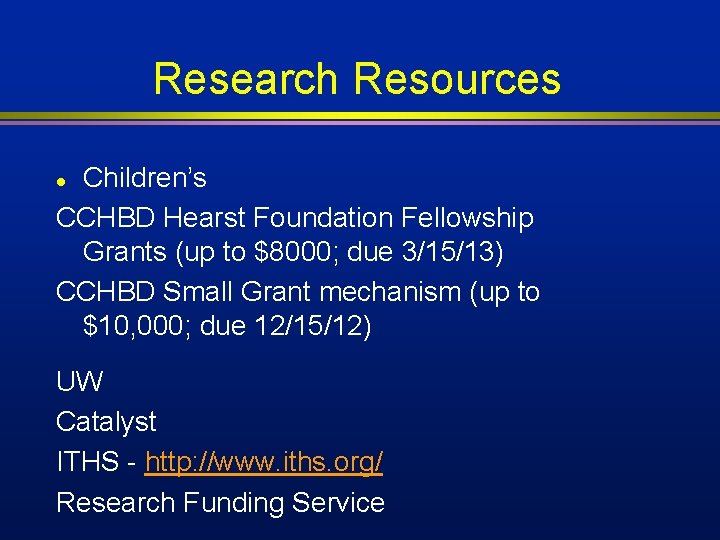
Research Resources Children’s CCHBD Hearst Foundation Fellowship Grants (up to $8000; due 3/15/13) CCHBD Small Grant mechanism (up to $10, 000; due 12/15/12) l UW Catalyst ITHS - http: //www. iths. org/ Research Funding Service
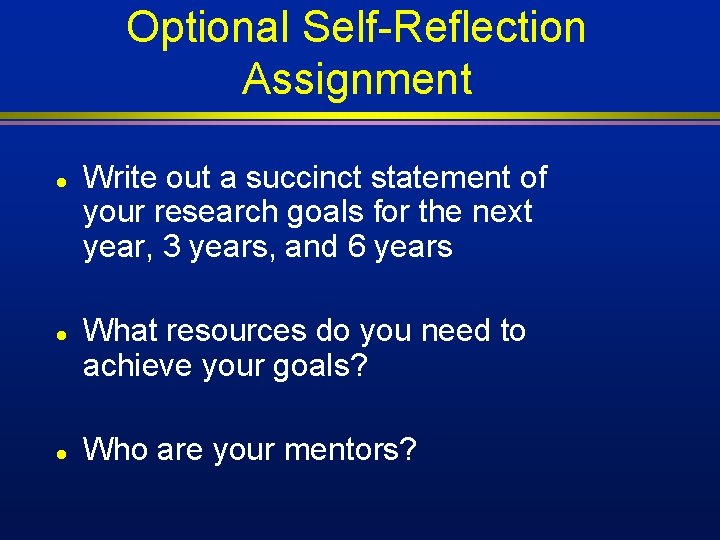
Optional Self-Reflection Assignment l l l Write out a succinct statement of your research goals for the next year, 3 years, and 6 years What resources do you need to achieve your goals? Who are your mentors?