
Poultry breeds Body Parts Desi Fowl 1 2

Poultry breeds
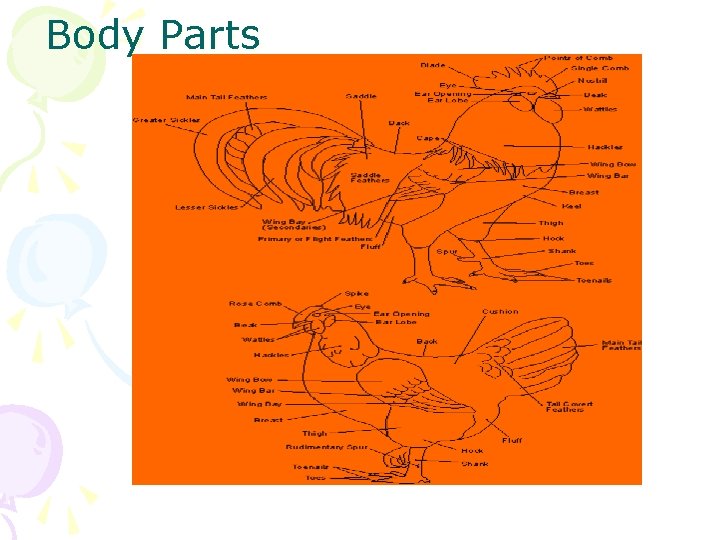
Body Parts
Desi Fowl 1. 2. 3. 4. 5. 6. 7. 8. 9. Faverolla Punjab brown Brown desi Ankaleshwar Bursa Frizzle fowl Naked nake Kadaknath Aseel 9. Kalasthi 10. Ghagus 11. Tellichery 12. Haringhata black 13. Daothigir 14. Miri 15. Chittong or malay 16. Nikobari 17. Teni 18. Titri
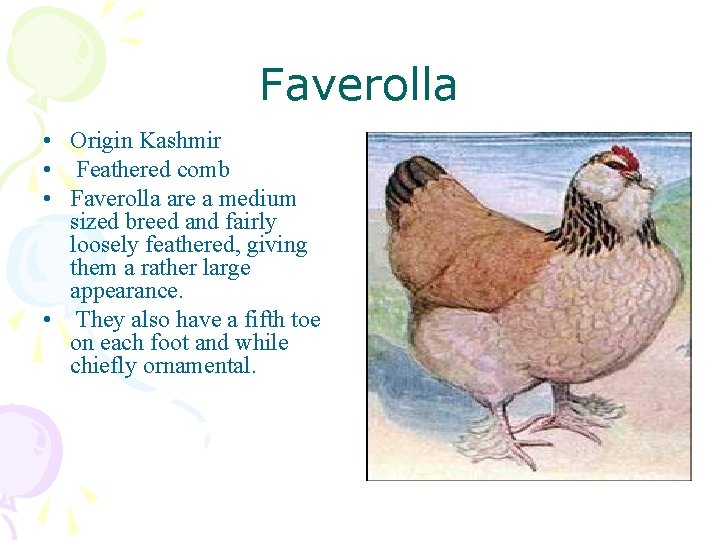
Faverolla • Origin Kashmir • Feathered comb • Faverolla are a medium sized breed and fairly loosely feathered, giving them a rather large appearance. • They also have a fifth toe on each foot and while chiefly ornamental.
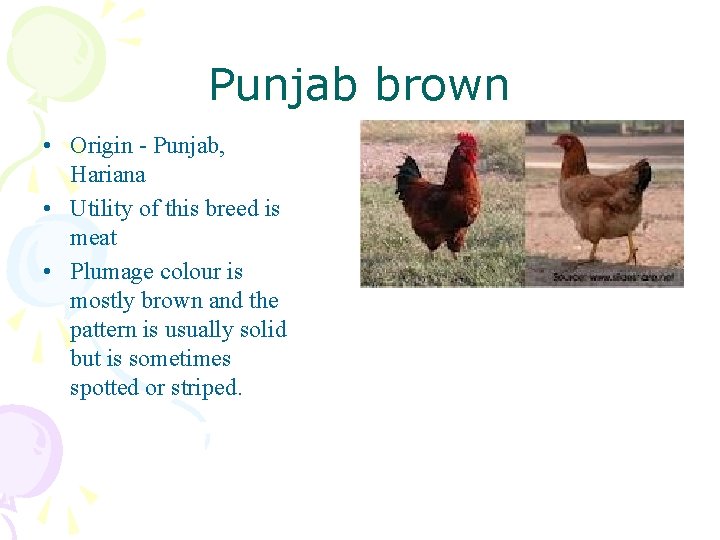
Punjab brown • Origin - Punjab, Hariana • Utility of this breed is meat • Plumage colour is mostly brown and the pattern is usually solid but is sometimes spotted or striped.
Conti……. . • Males in particular have black spots/stripes on their neck, wings and tail. • The comb is red, of single type and erect in position. • Average Weight: Cock: 2. 15 kg Hen: 1. 57 kg.
Conti. . ……. . • Average at first laying cycle: 5 – 6 months. • Annual egg production : 60 - 80. • Average egg weight: 46. 0 gms. • Egg shell colour is mostly light brown.

Brown Desi • Origin of this breed is UP • Layer type • Single comb
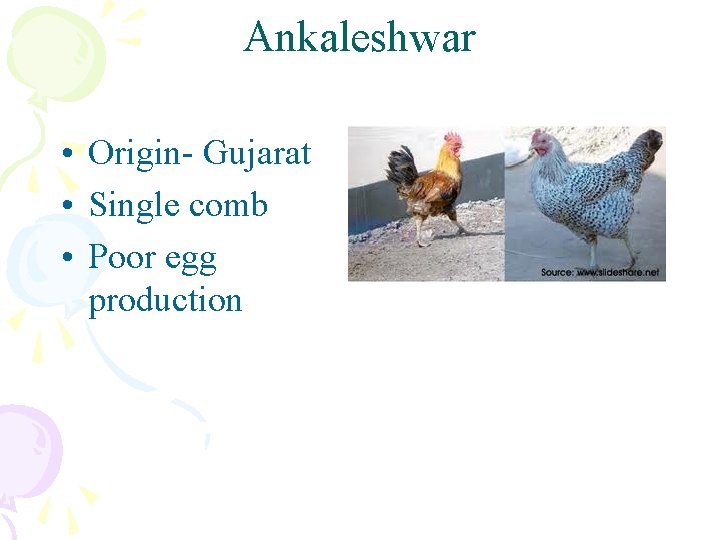
Ankaleshwar • Origin- Gujarat • Single comb • Poor egg production
Conti. • • Average Flock Size: 5 – 10 birds. Comb shape is single, rose-coloured. Annual egg production : 81 Average at first laying cycle: 181 days. Average egg weight: 34. 3 gms. Fertility: 91. 3%. Hatchability of Fertile Eggs: 92. 4%.
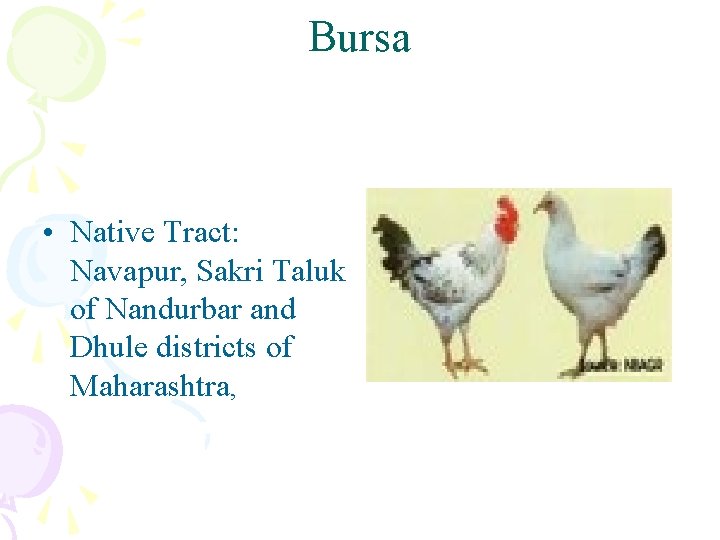
Bursa • Native Tract: Navapur, Sakri Taluk of Nandurbar and Dhule districts of Maharashtra,
Conti……… • Average Flock Size: 9 birds. • Plumage is mostly white mixed with black feathers on the neck, back, tail, and reddish brown feathers on shoulders and wings.
Conti……. • Comb is red, single, small to medium in size, stands erect. • Beak is yellow and wattles are red, with a yellow shank. • Standard Weight: Cocks: 0. 85 to 1. 25 kgs Hens: 0. 8 to 1. 2 kgs. • Average at first laying cycle: 5 -7 months. • Annual egg production: 40 -55. • Hatchability of eggs: 60 -85%. • Eggs are small weighing about 28 – 38 gms. • The shell colour is primarily light brown.
Frizzle fowl • Origin - hot humid costal region and north east region • Curved feather • Better heat dissipation and adaptability in arid region
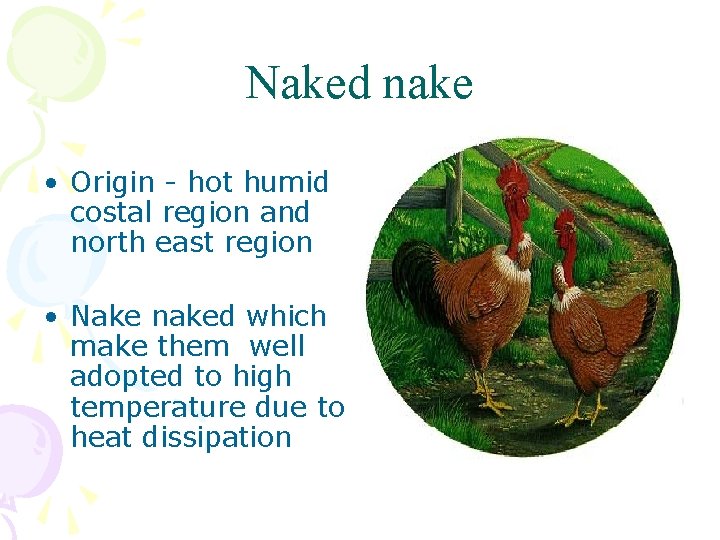
Naked nake • Origin - hot humid costal region and north east region • Nake naked which make them well adopted to high temperature due to heat dissipation
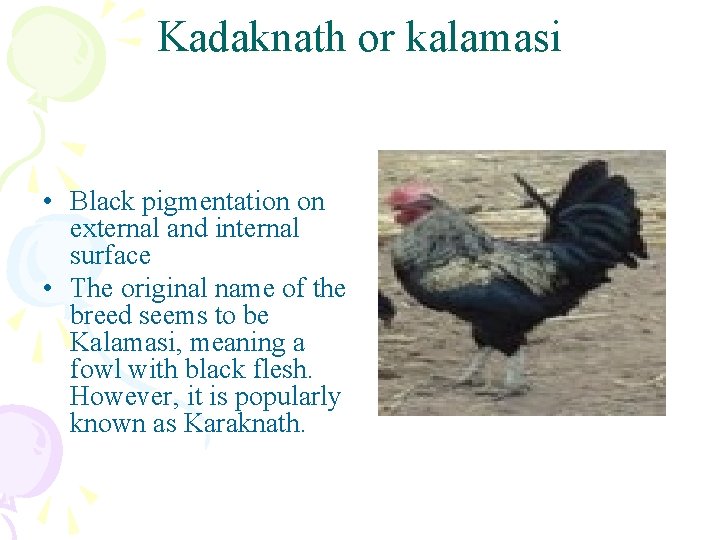
Kadaknath or kalamasi • Black pigmentation on external and internal surface • The original name of the breed seems to be Kalamasi, meaning a fowl with black flesh. However, it is popularly known as Karaknath.
Conti……. . • The eggs are light brown. The day-old chicks are bluish to black with irregular dark stripes over the back. • The adult plumage varies from silver and gold-spangled to bluish-black without any spangling. • The skin, beak, shanks, toes and soles of feet are slate like in colour.
Conti……… • The black pigment has been due to deposition of melanin, The flesh although repulsive to look at, is delicious. • A medium layer, lays about 80 eggs per year. • The bird is resistant to diseases in its natural habitat in free • The comb, wattles and tongue are purple.
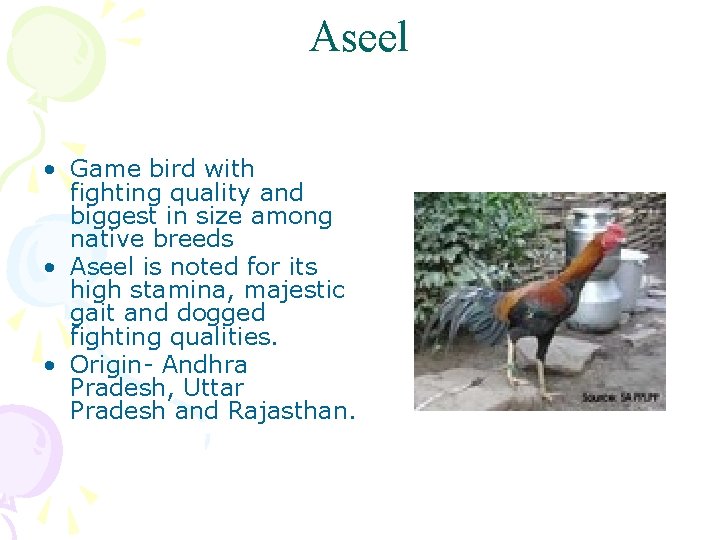
Aseel • Game bird with fighting quality and biggest in size among native breeds • Aseel is noted for its high stamina, majestic gait and dogged fighting qualities. • Origin- Andhra Pradesh, Uttar Pradesh and Rajasthan.
Conti……… • The most popular varieties are Peela (golden red), yarkin (black and red), Nurie 89(white), kagar (black), chitta (black and white silver), Teekar (brown) and Reza (light red). • Although poor in productivity, the birds of this breed are well-known for their meat qualities. • Broodiness in most common and the hen is a good sitter and efficient mother. • They possess pea combs which are small but firmly set on head.
Conti……. • Wattles and ear lobes are bright red, and the beak is hart. • The face is long and slender, and not covered with feather. The eyes are compact, well set and present bold looks. • The neck is long, uniformly thick but no fleshy. • Standard weight (kg): Cocks 4 to 5; hen 3 to 4; cockerels 3. 5 to 4. 5; pullets 2. 5 to 3. 5.
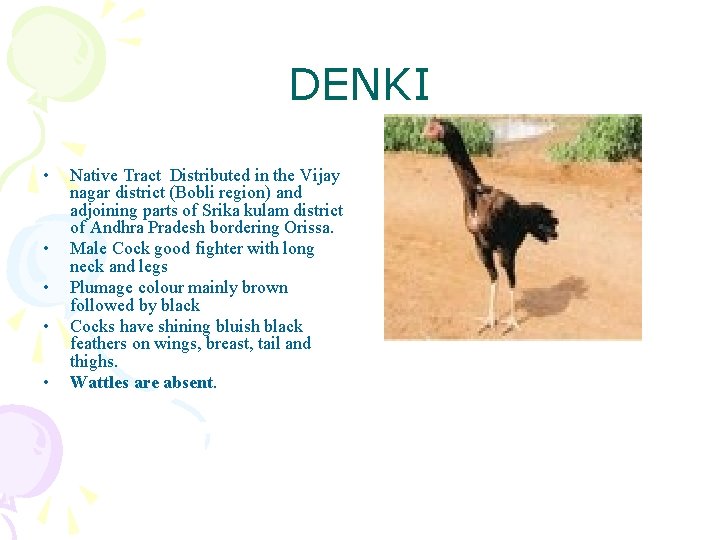
DENKI • • • Native Tract Distributed in the Vijay nagar district (Bobli region) and adjoining parts of Srika kulam district of Andhra Pradesh bordering Orissa. Male Cock good fighter with long neck and legs Plumage colour mainly brown followed by black Cocks have shining bluish black feathers on wings, breast, tail and thighs. Wattles are absent.
Conti…… • Comb is red, pea type and compressed. • Spur is long and sharp in cocks and small in hens. • Average Weight: Cocks: 3. 12 kg Hens: 2. 22 kg. • Average at first laying cycle: 6 -8 months. • Number of eggs laid in one egg laying cycle of 1520 days: 8 - 12. • Annual egg production: 25 - 35. • Average egg weight: 46. 16 gms.
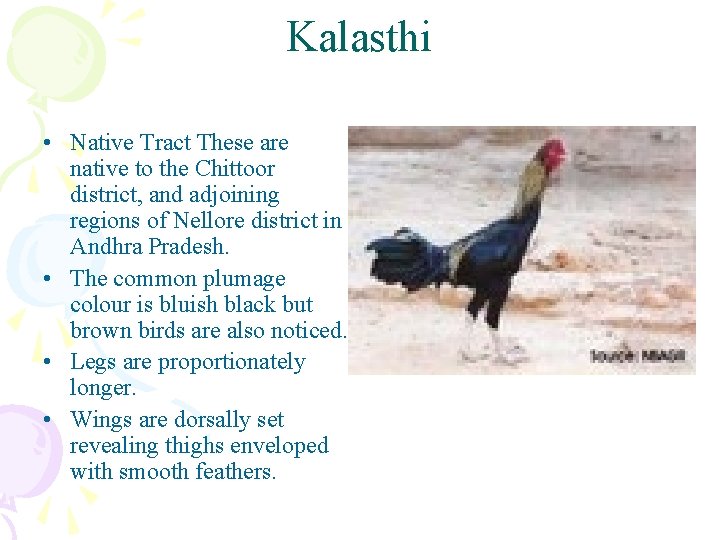
Kalasthi • Native Tract These are native to the Chittoor district, and adjoining regions of Nellore district in Andhra Pradesh. • The common plumage colour is bluish black but brown birds are also noticed. • Legs are proportionately longer. • Wings are dorsally set revealing thighs enveloped with smooth feathers.
Conti… • • Wattles are absent. Comb is red, pea type and compressed. Spur is small in size. Average adult weight: Cock is 2. 48 Hen is 1. 85 Average at first laying cycle: 6 -8 months. Number of eggs laid in one egg laying cycle of 15 -25 days: 9 -14. Annual egg production: 30 -40. Average egg weight: 42. 91 gms.
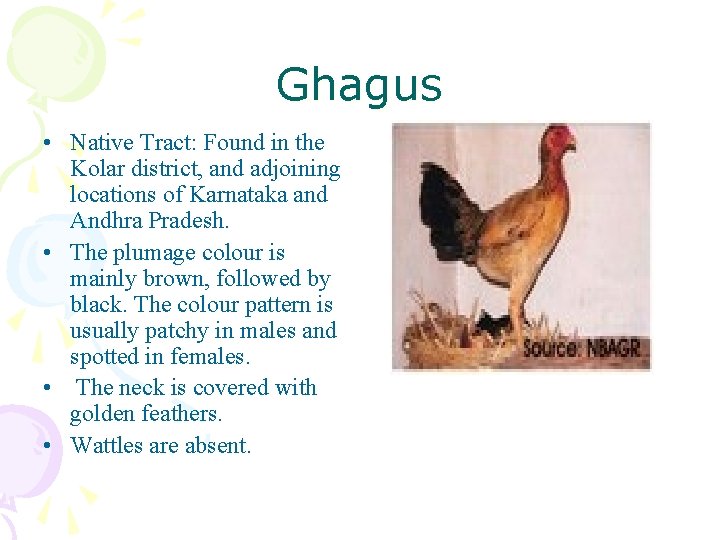
Ghagus • Native Tract: Found in the Kolar district, and adjoining locations of Karnataka and Andhra Pradesh. • The plumage colour is mainly brown, followed by black. The colour pattern is usually patchy in males and spotted in females. • The neck is covered with golden feathers. • Wattles are absent.
Conti…. . • Comb is red and pea or single type. • Spur is short in cocks. • Average adult body weight Cock: 2. 16 kg, Hens: 1. 43 kg. • Average at first laying cycle: 5– 7 months. • Annual egg production: 45– 60. • Average egg weight: 40. 25 ± 2. 39 gms.
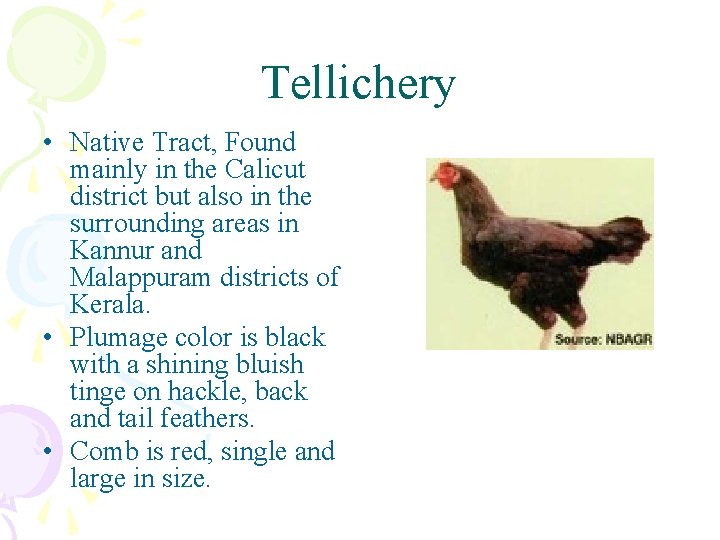
Tellichery • Native Tract, Found mainly in the Calicut district but also in the surrounding areas in Kannur and Malappuram districts of Kerala. • Plumage color is black with a shining bluish tinge on hackle, back and tail feathers. • Comb is red, single and large in size.
Conti……… • Average weight: Cock: 1. 62 ± 0. 16 kg Hen: 1. 24± 0. 10 kg. • Eggs are tinted. • Annual egg production: 60 – 80. • Average egg weight: 40. 02 gms.
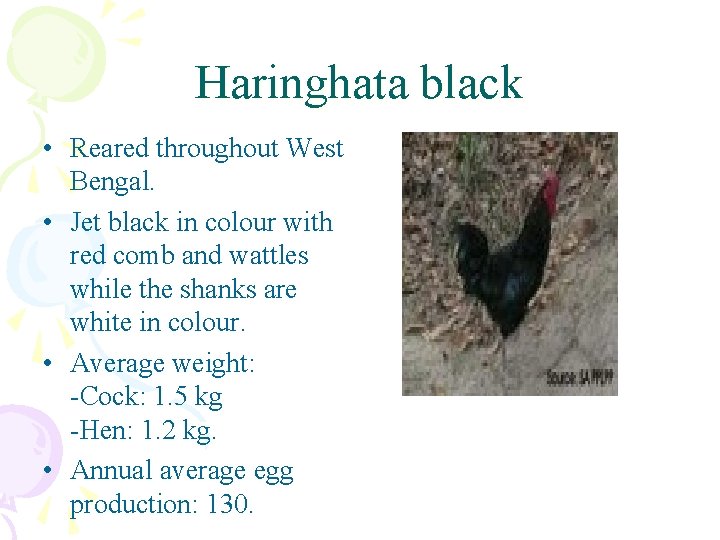
Haringhata black • Reared throughout West Bengal. • Jet black in colour with red comb and wattles while the shanks are white in colour. • Average weight: -Cock: 1. 5 kg -Hen: 1. 2 kg. • Annual average egg production: 130.
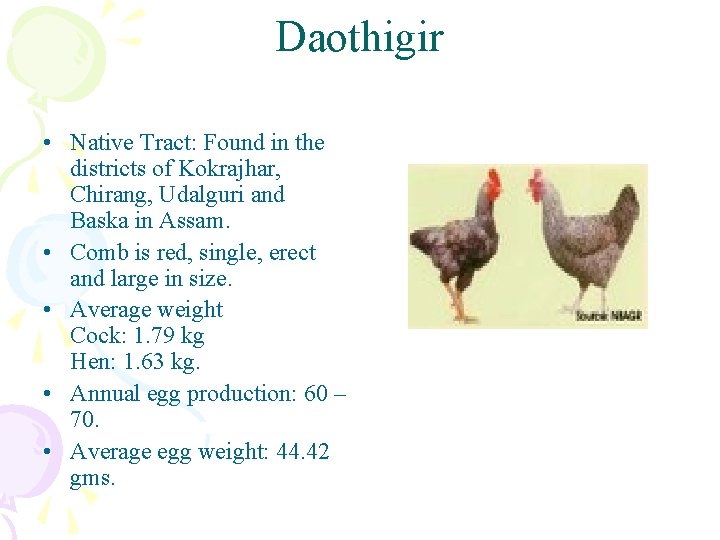
Daothigir • Native Tract: Found in the districts of Kokrajhar, Chirang, Udalguri and Baska in Assam. • Comb is red, single, erect and large in size. • Average weight Cock: 1. 79 kg Hen: 1. 63 kg. • Annual egg production: 60 – 70. • Average egg weight: 44. 42 gms.
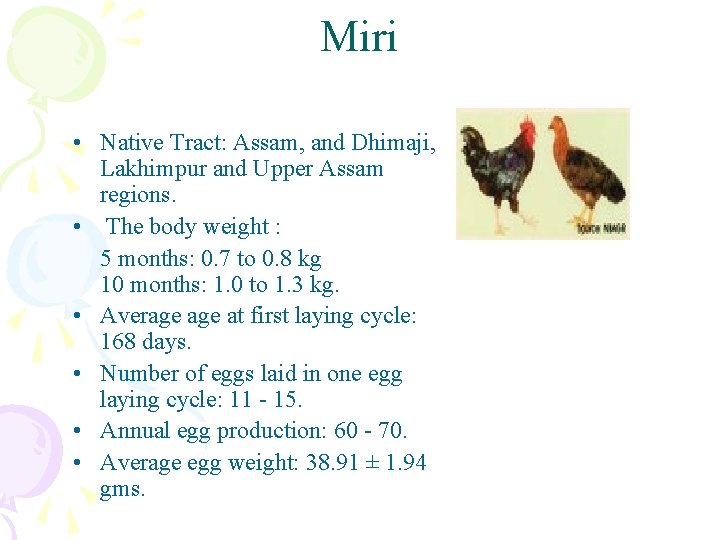
Miri • Native Tract: Assam, and Dhimaji, Lakhimpur and Upper Assam regions. • The body weight : 5 months: 0. 7 to 0. 8 kg 10 months: 1. 0 to 1. 3 kg. • Average at first laying cycle: 168 days. • Number of eggs laid in one egg laying cycle: 11 - 15. • Annual egg production: 60 - 70. • Average egg weight: 38. 91 ± 1. 94 gms.
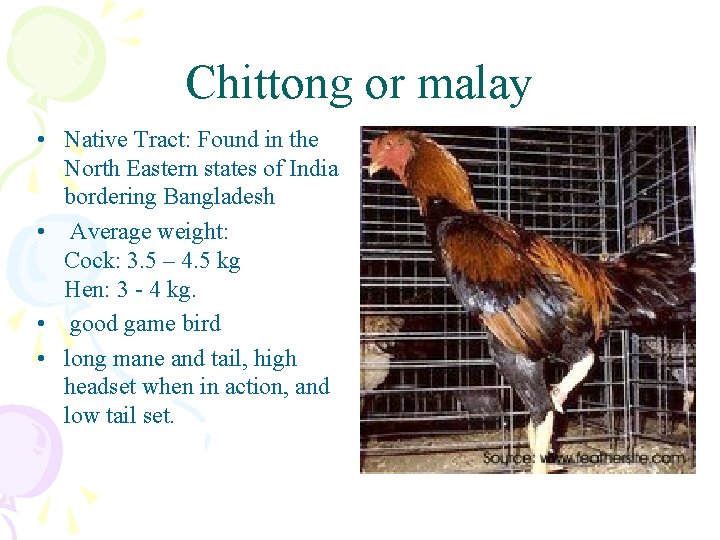
Chittong or malay • Native Tract: Found in the North Eastern states of India bordering Bangladesh • Average weight: Cock: 3. 5 – 4. 5 kg Hen: 3 - 4 kg. • good game bird • long mane and tail, high headset when in action, and low tail set.
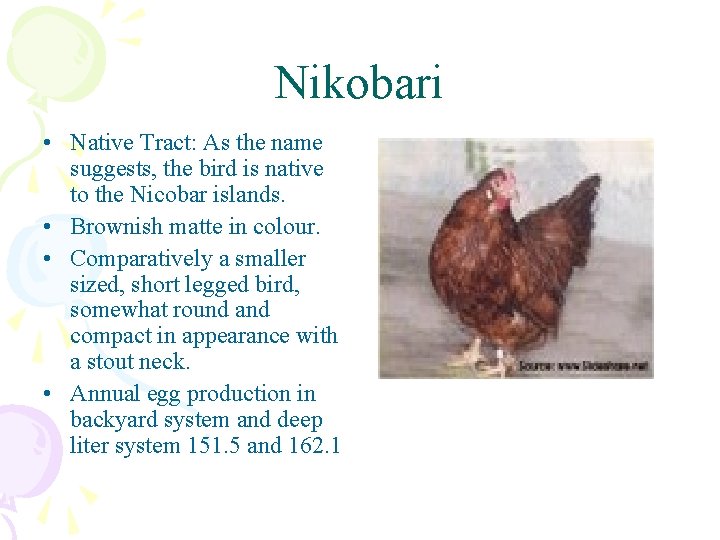
Nikobari • Native Tract: As the name suggests, the bird is native to the Nicobar islands. • Brownish matte in colour. • Comparatively a smaller sized, short legged bird, somewhat round and compact in appearance with a stout neck. • Annual egg production in backyard system and deep liter system 151. 5 and 162. 1
Crossbreed Poultry Evolved from ICAR Ø Vanraja Ø Gram. Priya Ø Cari. Gold Ø Giriraj Ø Krishna- J Ø Yamuna Ø Kalinga Brown Ø Gram Lakshmi Ø Nandanam Ø Cari – Nirbhik Ø Cari- Shyam Ø Upcari Ø Hitcari
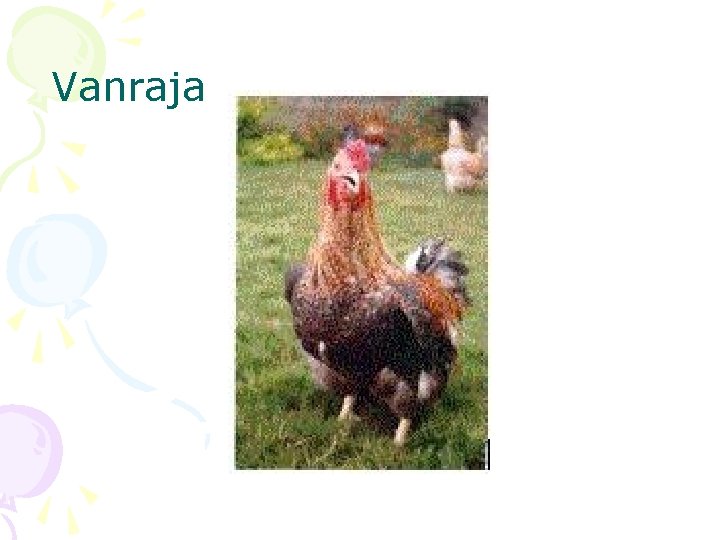
Vanraja
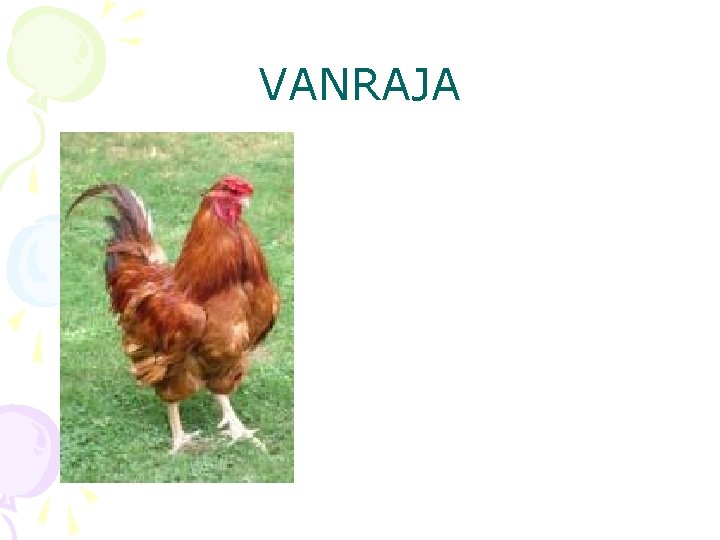
VANRAJA

Gram Priya
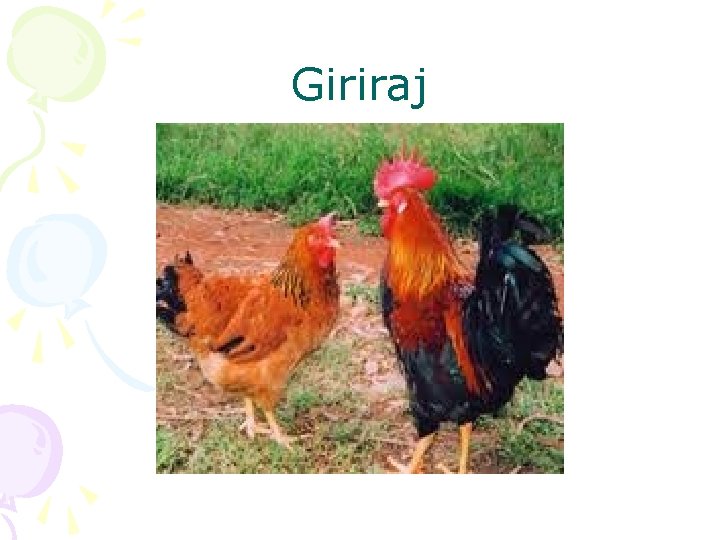
Giriraj
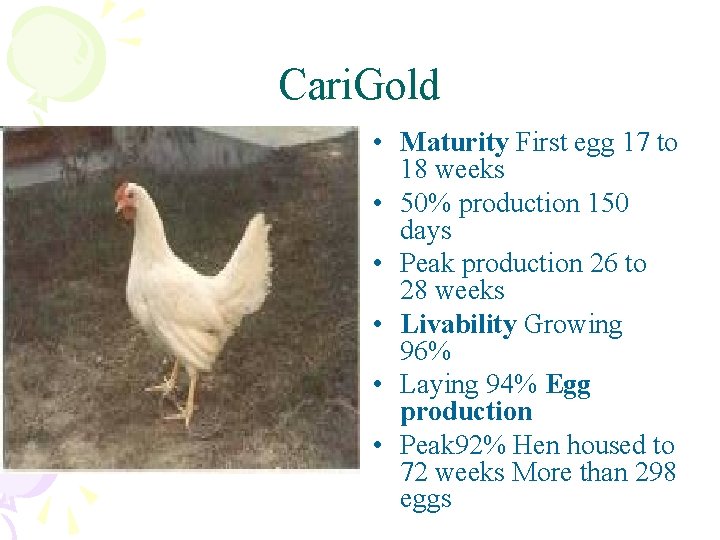
Cari. Gold • Maturity First egg 17 to 18 weeks • 50% production 150 days • Peak production 26 to 28 weeks • Livability Growing 96% • Laying 94% Egg production • Peak 92% Hen housed to 72 weeks More than 298 eggs
CONTI…… • Hen day to 72 weeks More than 301 eggs • Feed consumption Per dozen eggs 1. 77 kg. Per kg • egg mass 2. 57 kg • Egg size Average egg weight 57 g • Egg quality Internal Excellent internal quality
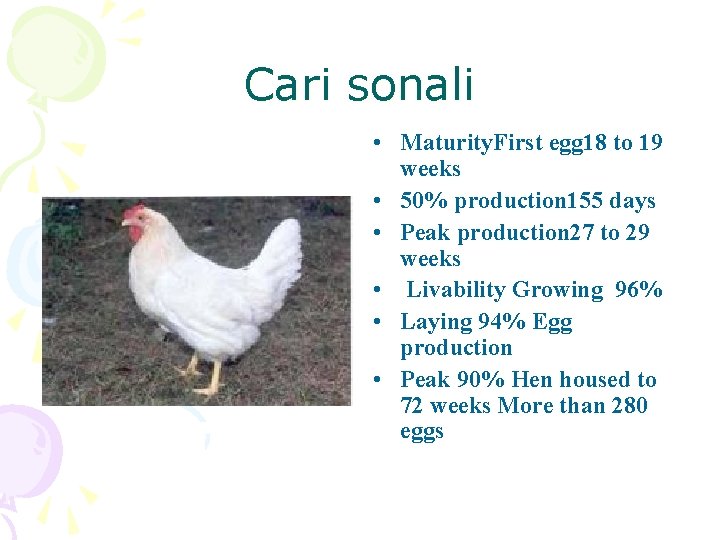
Cari sonali • Maturity. First egg 18 to 19 weeks • 50% production 155 days • Peak production 27 to 29 weeks • Livability Growing 96% • Laying 94% Egg production • Peak 90% Hen housed to 72 weeks More than 280 eggs
Conti……. • Hen day to 72 weeks More than 283 eggs • Feed consumption Per dozen of eggs 2. 3 kg Per kg of egg mass 3. 8 kg • Egg size. Average egg weight 54 g • Egg quality. Internal. Excellent internal quality. Temperament Easy to handle, • Lays brown eggs • Efficient feed conversion • High egg production
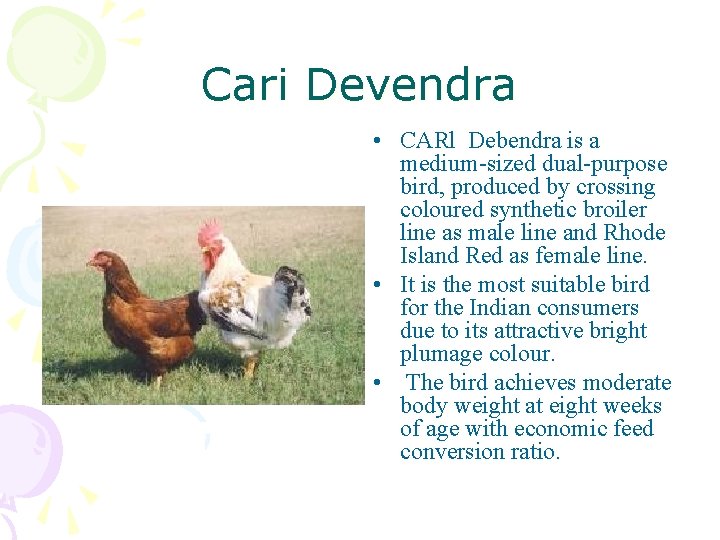
Cari Devendra • CARl Debendra is a medium-sized dual-purpose bird, produced by crossing coloured synthetic broiler line as male line and Rhode Island Red as female line. • It is the most suitable bird for the Indian consumers due to its attractive bright plumage colour. • The bird achieves moderate body weight at eight weeks of age with economic feed conversion ratio.
Conti…… • The meat has lower carcass and abdominal fat than broiler meat, which makes it a consumer's delight. • CARl Debendra is also a suitable bird for rural poultry because of its better survivability and moderate egg production ability.
Conti………. • • • Body weight at 8 weeks 1100 -1200 g Body weight at 10 weeks 1400 to 1500 g Body weight at 12 weeks 1700 to 1800 g Feed conversion ratio (0 -8 week) 2. 5 -2. 6 Age at sexual maturity 155 - 160 days Egg production 190 -200 Annual egg production 97%Livability (Growing)94%Special Features Efficient feed conversion High positive return over feed cost Superiority over other stocks Low laying house mortality
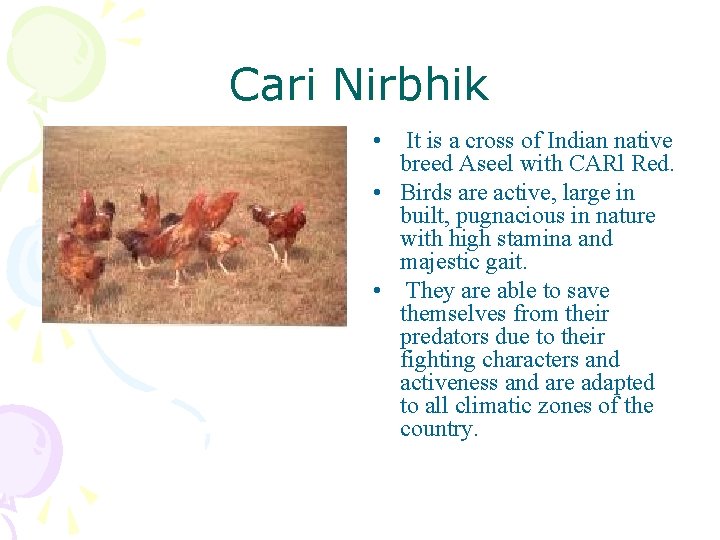
Cari Nirbhik • It is a cross of Indian native breed Aseel with CARl Red. • Birds are active, large in built, pugnacious in nature with high stamina and majestic gait. • They are able to save themselves from their predators due to their fighting characters and activeness and are adapted to all climatic zones of the country.
CONTI……. • Production Characteristics Body weight at 20 weeks (Males)1847 g. Body weight at 20 weeks (Females)1350 g. Age at sexual maturity days 176 Annual egg production 198 Egg weight at 40 weeks Fertility 54 g 88%Hatchability (FES)81%
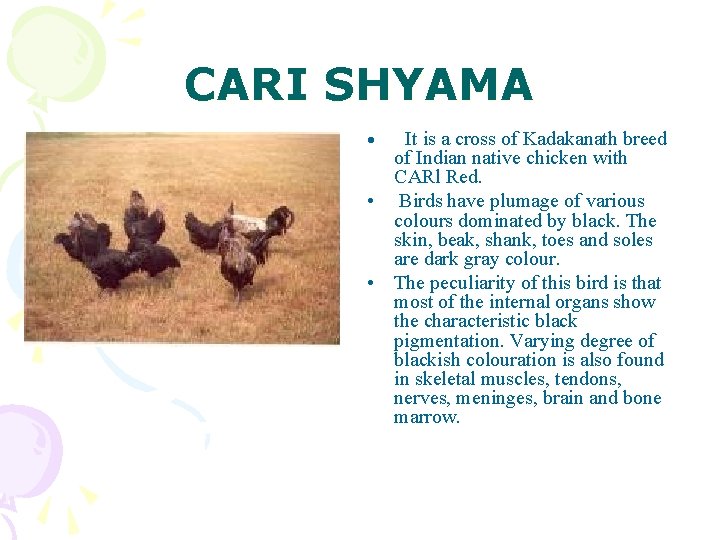
CARI SHYAMA • It is a cross of Kadakanath breed of Indian native chicken with CARl Red. • Birds have plumage of various colours dominated by black. The skin, beak, shank, toes and soles are dark gray colour. • The peculiarity of this bird is that most of the internal organs show the characteristic black pigmentation. Varying degree of blackish colouration is also found in skeletal muscles, tendons, nerves, meninges, brain and bone marrow.
Conti…. . • The black colour of muscles and tissues is due to deposition of melanin pigment which causes increase in protein and decrease of fat and muscle fiber length. • This variety is ideally suited for rearing in tribal areas due to preference for dark meat by the tribal population.

CONTI…… • Production Characteristics. Body weight at 20 weeks (Males) 1460 g Body weight at 20 weeks (Females)1120 g. Age at sexual maturity 170 days Annual egg production 210 Egg weight at 40 weeks 53 g Fertility 85%Hatchability (FES)82%U
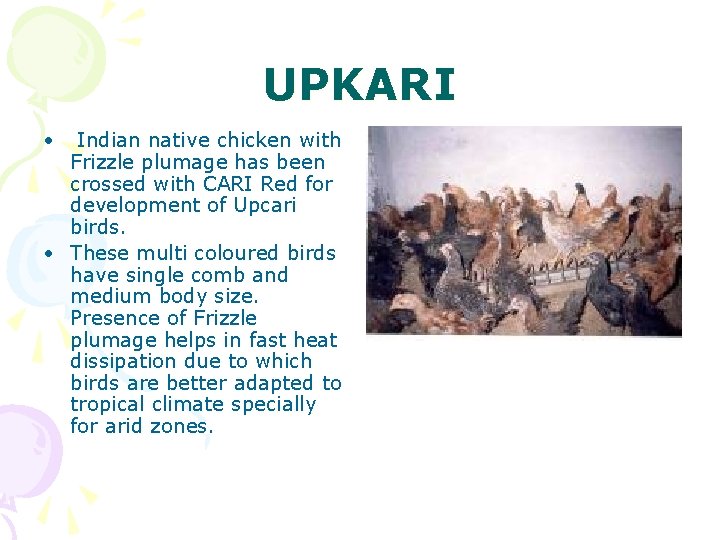
UPKARI • Indian native chicken with Frizzle plumage has been crossed with CARI Red for development of Upcari birds. • These multi coloured birds have single comb and medium body size. Presence of Frizzle plumage helps in fast heat dissipation due to which birds are better adapted to tropical climate specially for arid zones.
HITCARI • Hitcari birds have been developed by crossing the Indian native Naked neck with exotic breed CARI Red. • The neck region is devoid of feathers and there is reduction of 30 to 40% feathers on the body. • The reduction in feathers help in internal heat dissipation which increases the tropical adaptability due to which there is no reduction in egg production and egg shell thickness during extreme summer. • There is a decrease in heat stress mortality, increase in fertility and hatchability during summer and protein requirement for juvenile growth is reduced. • These birds are very suitable for rearing in the hot humid coastal region.
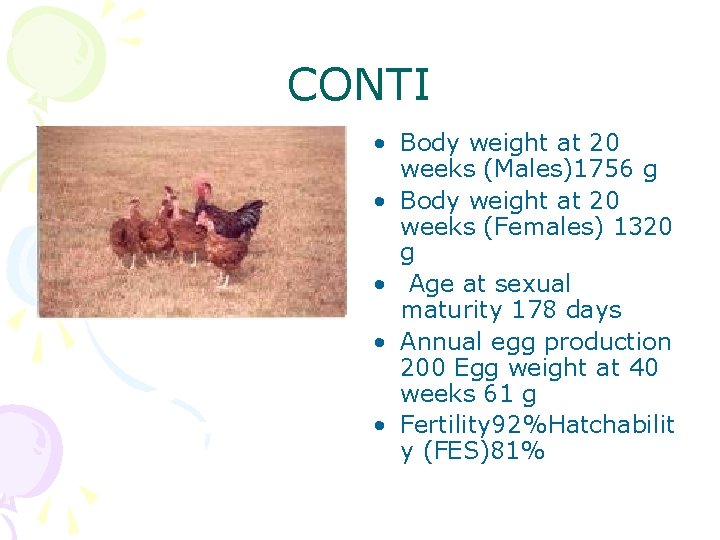
CONTI • Body weight at 20 weeks (Males)1756 g • Body weight at 20 weeks (Females) 1320 g • Age at sexual maturity 178 days • Annual egg production 200 Egg weight at 40 weeks 61 g • Fertility 92%Hatchabilit y (FES)81%
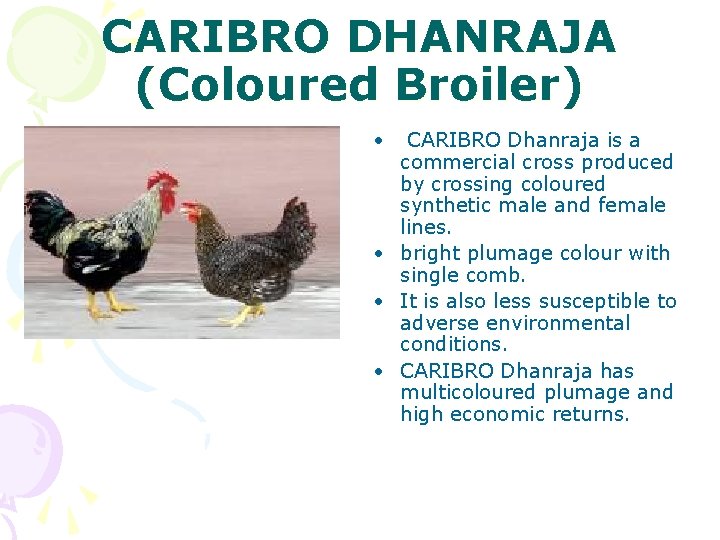
CARIBRO DHANRAJA (Coloured Broiler) • CARIBRO Dhanraja is a commercial cross produced by crossing coloured synthetic male and female lines. • bright plumage colour with single comb. • It is also less susceptible to adverse environmental conditions. • CARIBRO Dhanraja has multicoloured plumage and high economic returns.
CONTI…… • Production Characteristics. Body weight at day old 46 g. Body weight at 6 weeks 1500 to 1700 g. Body weight at 7 weeks 2000 to 2125 g. Dressing percentage at 6 weeks 73 -75 Livability percentage at 6 weeks 9698 Feed conversion ratio at 7 weeks 1. 92
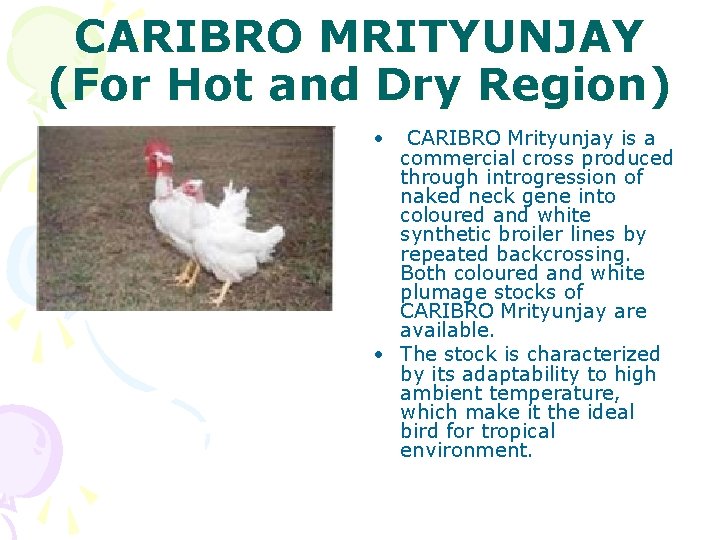
CARIBRO MRITYUNJAY (For Hot and Dry Region) • CARIBRO Mrityunjay is a commercial cross produced through introgression of naked neck gene into coloured and white synthetic broiler lines by repeated backcrossing. Both coloured and white plumage stocks of CARIBRO Mrityunjay are available. • The stock is characterized by its adaptability to high ambient temperature, which make it the ideal bird for tropical environment.
Conti……. • • • Body weight at day old 38 -42 g Body weight at 6 weeks 1400 to 1500 g Body weight at 7 weeks 1800 to 2000 g Dressing percentage at 6 weeks 75 -77 Livability percentage at 6 weeks 97 -98 Feed conversion ratio at 6 weeks 1. 95 Special Features • Both coloured as well as white • Adaptable to high ambient temperatur • Efficient feed conversion
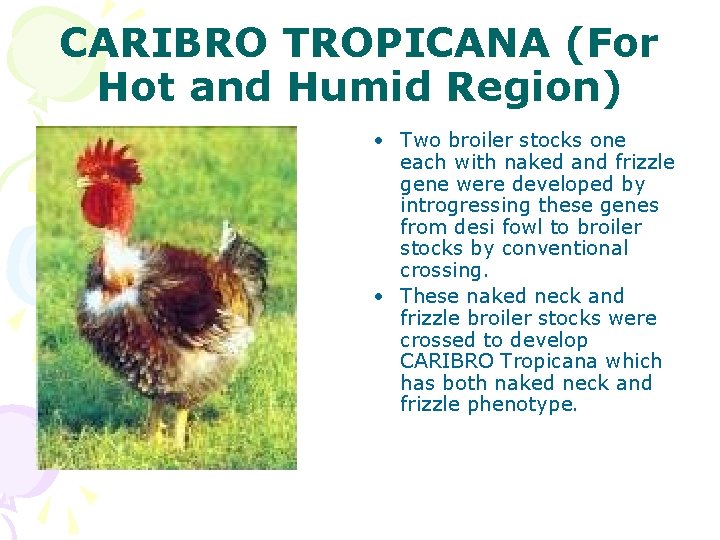
CARIBRO TROPICANA (For Hot and Humid Region) • Two broiler stocks one each with naked and frizzle gene were developed by introgressing these genes from desi fowl to broiler stocks by conventional crossing. • These naked neck and frizzle broiler stocks were crossed to develop CARIBRO Tropicana which has both naked neck and frizzle phenotype.
Conti…. . ……. • • • Body weight at 6 weeks 1300 g Body weight at 7 weeks 1800 g Feed conversion ratio at 6 weeks 1. 90 Feed conversion ratio at 7 weeks 2. 11 Dressing percentage at 7 weeks 74 Livability percentage at 7 weeks 97 Special Features Better heat tolerant Better dressing percentage Perform better with low inputs under hot and humid conditions Better option for tropical poultry production
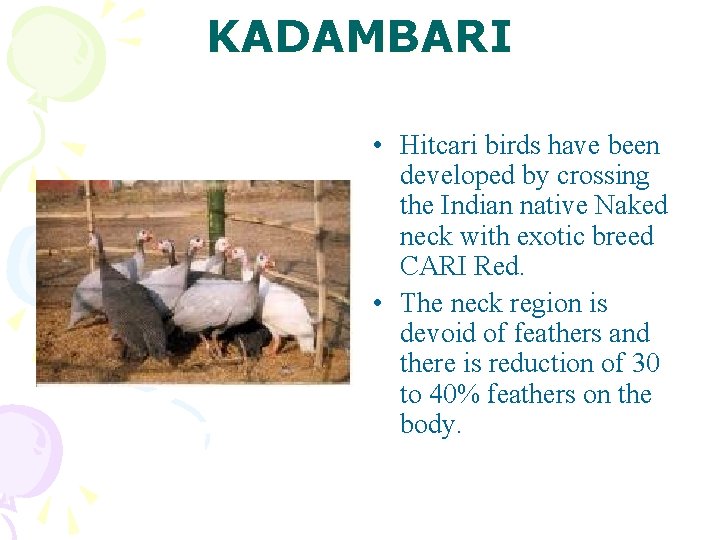
KADAMBARI • Hitcari birds have been developed by crossing the Indian native Naked neck with exotic breed CARI Red. • The neck region is devoid of feathers and there is reduction of 30 to 40% feathers on the body.

Conti. . • There is a decrease in heat stress mortality, increase in fertility and hatchability during summer and protein requirement for juvenile growth is reduced. • These birds are very suitable for rearing in the hot humid coastal region.
Cont……. . • Body weight at 8 weeks 500 -550 g • Body weight at 12 weeks 950 - 1000 g • Age at first egg 230 -250 Day. Egg weight 3840 g • Egg production 100 -120 eggs(March to September) • Fertility 70 -73 %Hatchability on fertile eggs set 70 -78 % • Livability. Excellent. Special Features • Kadambari has black plumage with white and uniformly distributed spot. • Chitambari
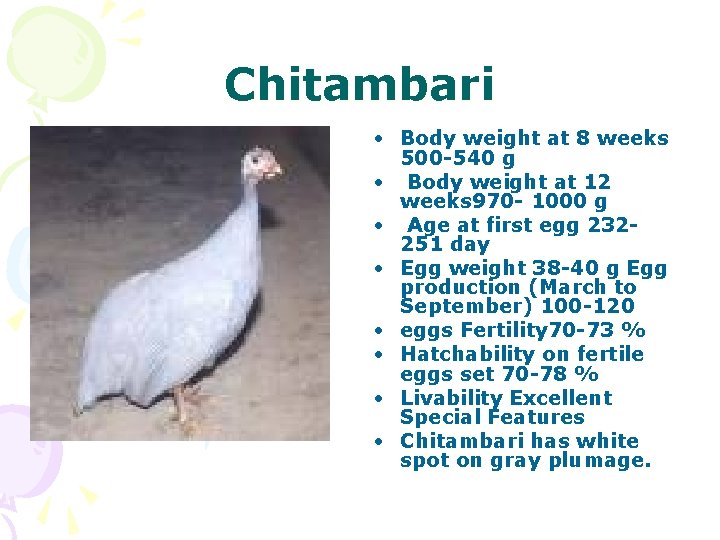
Chitambari • Body weight at 8 weeks 500 -540 g • Body weight at 12 weeks 970 - 1000 g • Age at first egg 232251 day • Egg weight 38 -40 g Egg production (March to September) 100 -120 • eggs Fertility 70 -73 % • Hatchability on fertile eggs set 70 -78 % • Livability Excellent Special Features • Chitambari has white spot on gray plumage.
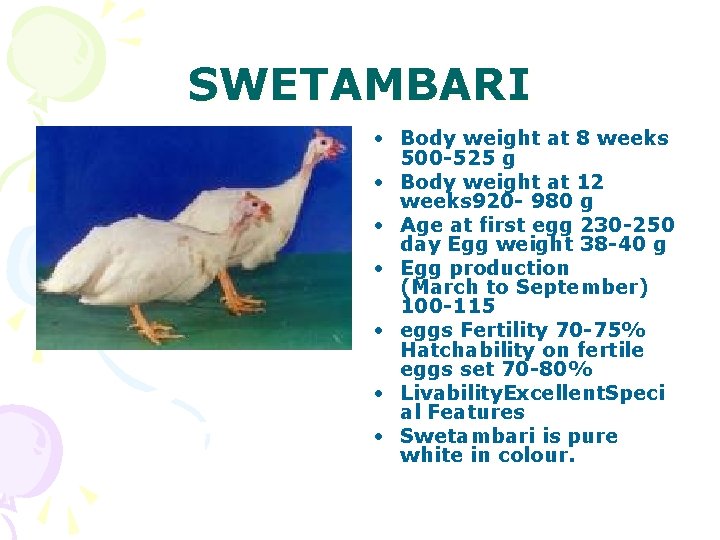
SWETAMBARI • Body weight at 8 weeks 500 -525 g • Body weight at 12 weeks 920 - 980 g • Age at first egg 230 -250 day Egg weight 38 -40 g • Egg production (March to September) 100 -115 • eggs Fertility 70 -75% Hatchability on fertile eggs set 70 -80% • Livability. Excellent. Speci al Features • Swetambari is pure white in colour.
Exotic Poultry Breed Exotics Poultry breeds are classified in to following groups • American : New Hampshire, white Plymouth Rock, Rhode Island Red, Wyandote II. • English : Australorp, Cornish, Sussex, Orphington • Mediterranean : Leghorn, Minorca, Ancona • Asiatic : Brahaman, cochin , langshan

New Hamphsire • • Skin Color - Yellow Egg Color - Brown Origin - Massachusetts Characteristics 1. Rapid growth 2. Early maturing 3. Fast Feathering
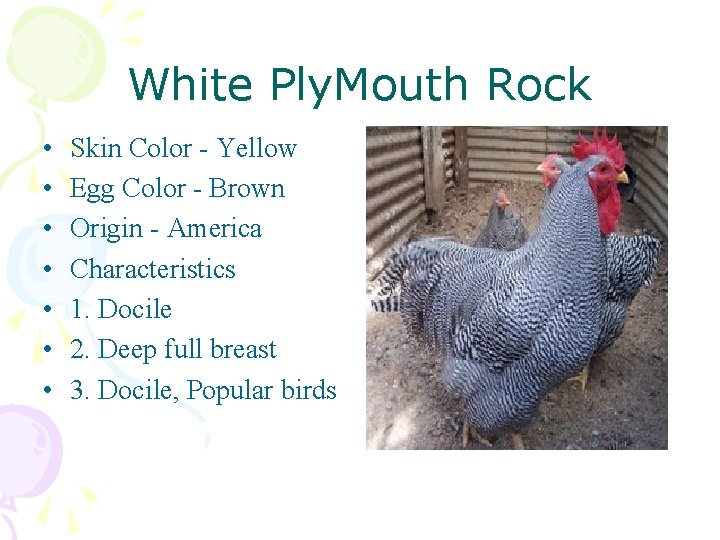
White Ply. Mouth Rock • • Skin Color - Yellow Egg Color - Brown Origin - America Characteristics 1. Docile 2. Deep full breast 3. Docile, Popular birds

Rhode Island Reds • • Skin Color - Yellow Egg Color - Brown Origin - New England Characteristics - 1. Dual Purpose 2. Egg Production 3. Meat Production
Conti……. Standard Weight in kg : § Cock - 3. 8 § Hen - 3. 0 § Cockerel - 3. 4 § Pullet - 2. 5
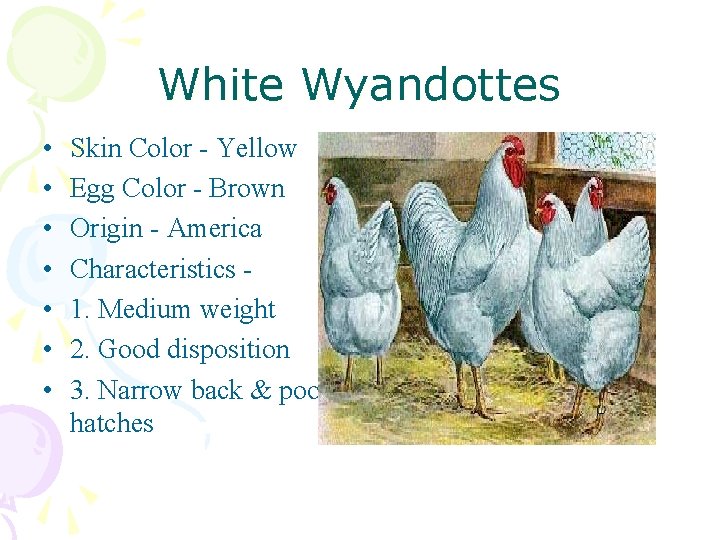
White Wyandottes • • Skin Color - Yellow Egg Color - Brown Origin - America Characteristics - 1. Medium weight 2. Good disposition 3. Narrow back & poor hatches
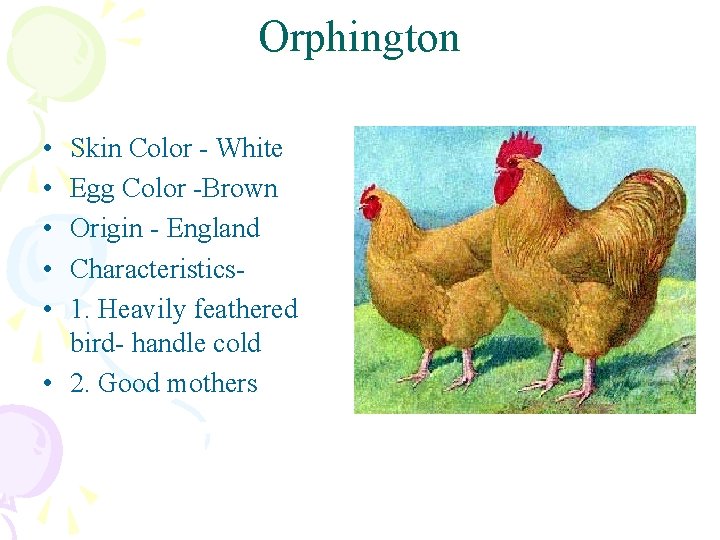
Orphington • • • Skin Color - White Egg Color -Brown Origin - England Characteristics 1. Heavily feathered bird- handle cold • 2. Good mothers
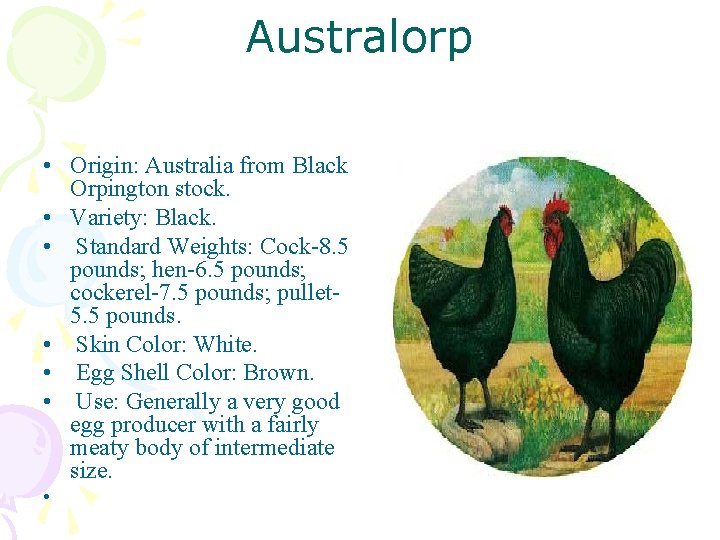
Australorp • Origin: Australia from Black Orpington stock. • Variety: Black. • Standard Weights: Cock-8. 5 pounds; hen-6. 5 pounds; cockerel-7. 5 pounds; pullet 5. 5 pounds. • Skin Color: White. • Egg Shell Color: Brown. • Use: Generally a very good egg producer with a fairly meaty body of intermediate size. •
Conti……. • Australorps have intense beetle-green sheen on the black birds, dark eyes, deep bodies and are very active. • They are one of the best dual-purpose fowls. • This cross of Australorp x White Leghorn became the successor to purebred breeds on many Midwestern farms. Broodiness was a problem with the cross and some markets discounted the tinted eggs they laid. Therefore, it soon fell victim to the inbred hybrid crosses of "Hyline" and "De. Kalb. " • Australorps are good egg producers and hold the world's record for egg production with one hen having laid 364 eggs in 365 days under official Australian trapnest testing
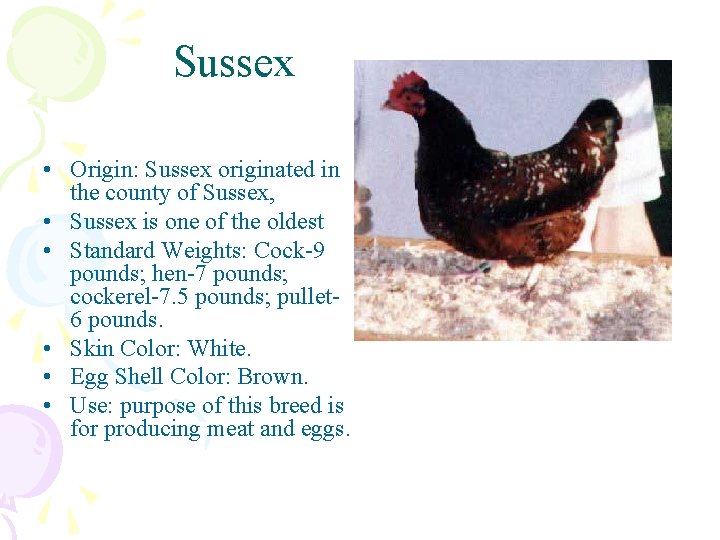
Sussex • Origin: Sussex originated in the county of Sussex, • Sussex is one of the oldest • Standard Weights: Cock-9 pounds; hen-7 pounds; cockerel-7. 5 pounds; pullet 6 pounds. • Skin Color: White. • Egg Shell Color: Brown. • Use: purpose of this breed is for producing meat and eggs.

Conti……… • Breeds that is still with us today in fair numbers. • Characteristics: Sussex are alert, attractive and good foragers. They have rectangular bodies; • Sussex go broody and make good mothers.
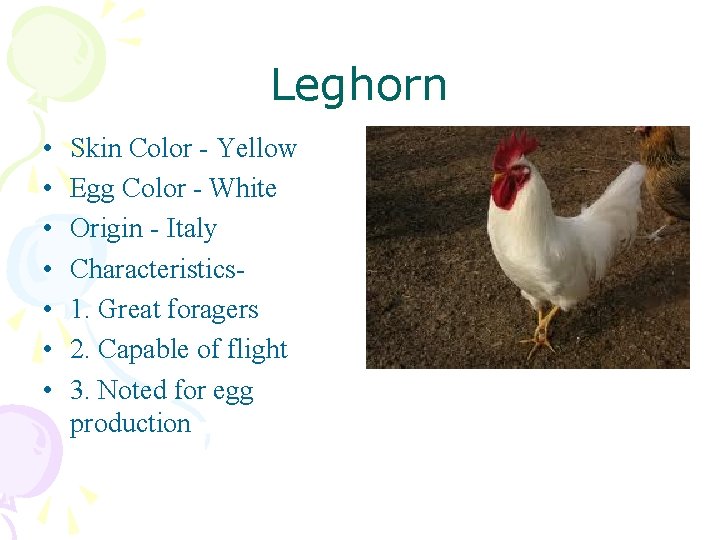
Leghorn • • Skin Color - Yellow Egg Color - White Origin - Italy Characteristics 1. Great foragers 2. Capable of flight 3. Noted for egg production
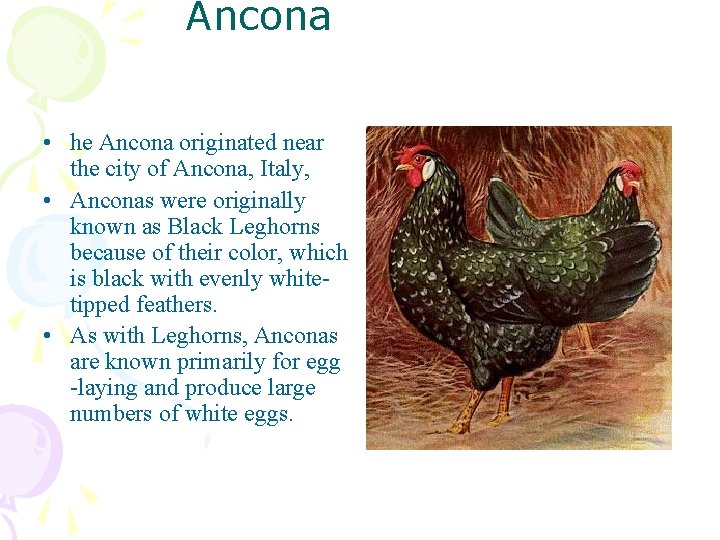
Ancona • he Ancona originated near the city of Ancona, Italy, • Anconas were originally known as Black Leghorns because of their color, which is black with evenly whitetipped feathers. • As with Leghorns, Anconas are known primarily for egg -laying and produce large numbers of white eggs.
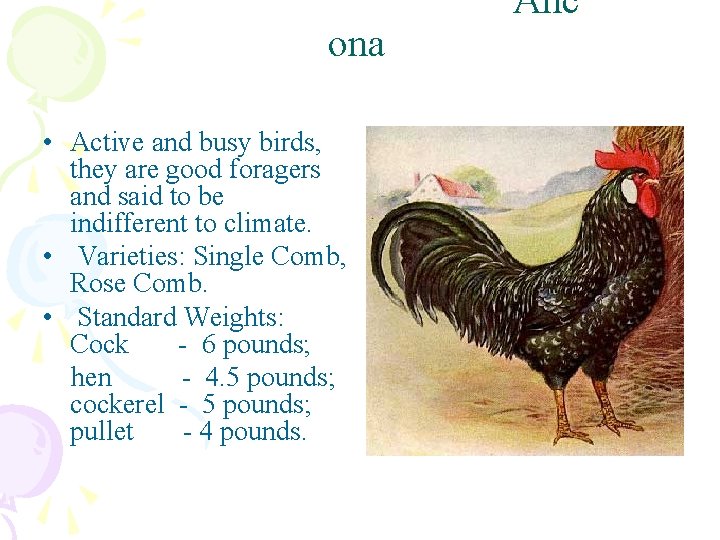
Anc ona • Active and busy birds, they are good foragers and said to be indifferent to climate. • Varieties: Single Comb, Rose Comb. • Standard Weights: Cock - 6 pounds; hen - 4. 5 pounds; cockerel - 5 pounds; pullet - 4 pounds.
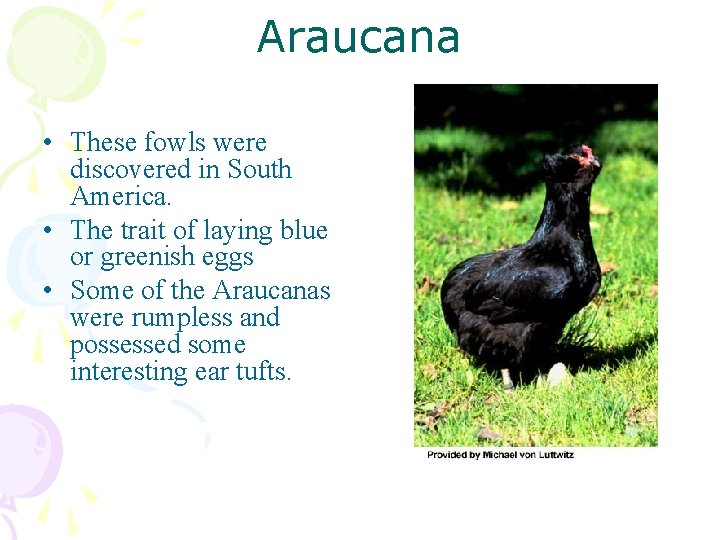
Araucana • These fowls were discovered in South America. • The trait of laying blue or greenish eggs • Some of the Araucanas were rumpless and possessed some interesting ear tufts.
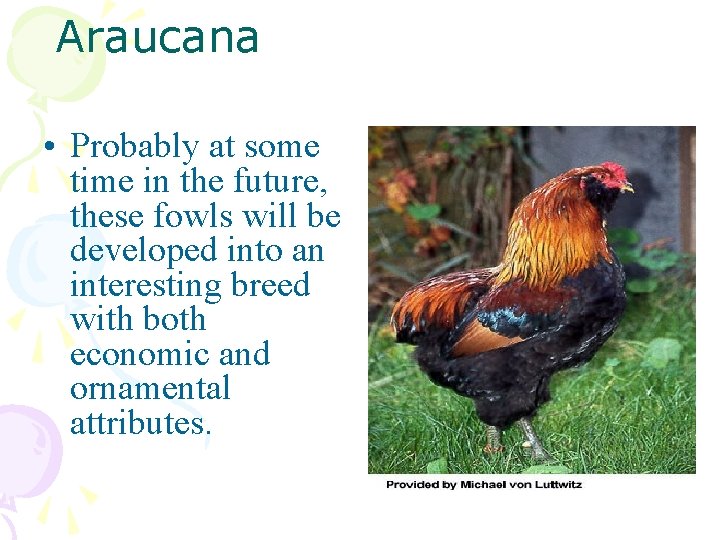
Araucana • Probably at some time in the future, these fowls will be developed into an interesting breed with both economic and ornamental attributes.
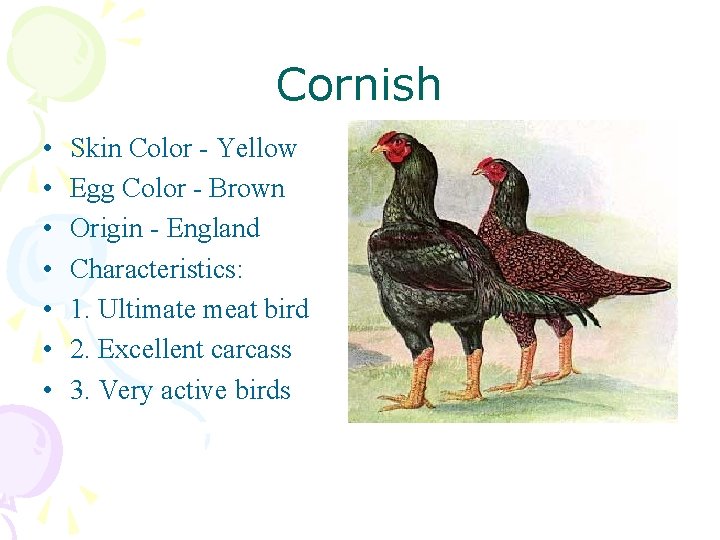
Cornish • • Skin Color - Yellow Egg Color - Brown Origin - England Characteristics: 1. Ultimate meat bird 2. Excellent carcass 3. Very active birds
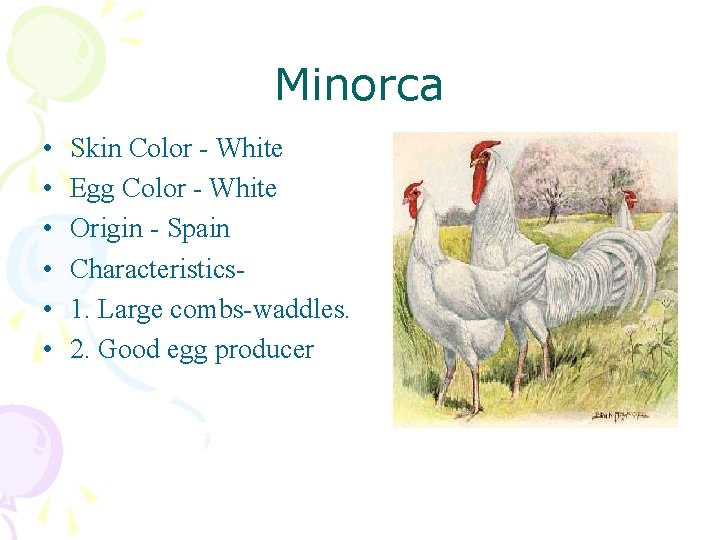
Minorca • • • Skin Color - White Egg Color - White Origin - Spain Characteristics 1. Large combs-waddles. 2. Good egg producer
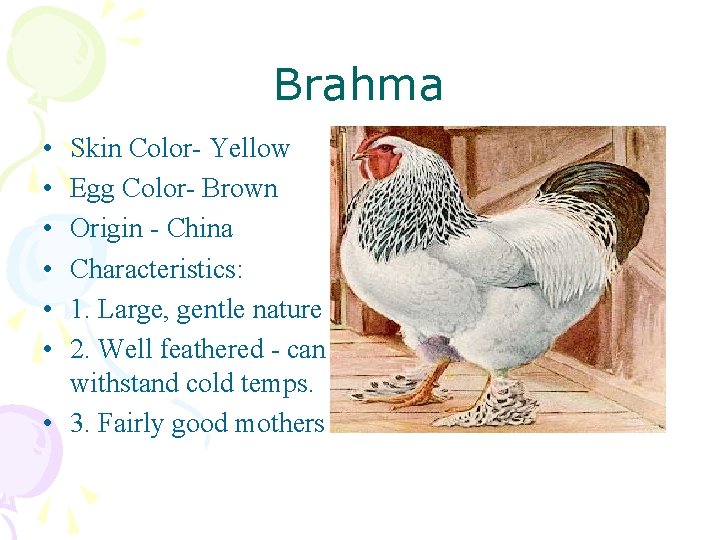
Brahma • • • Skin Color- Yellow Egg Color- Brown Origin - China Characteristics: 1. Large, gentle nature 2. Well feathered - can withstand cold temps. • 3. Fairly good mothers
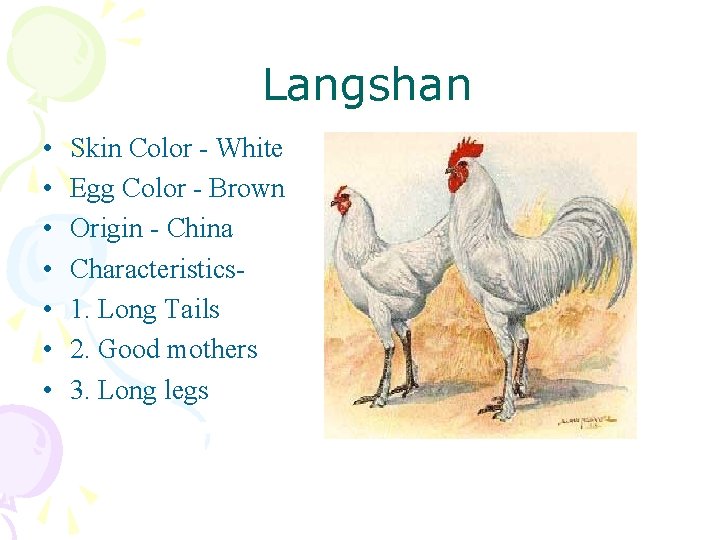
Langshan • • Skin Color - White Egg Color - Brown Origin - China Characteristics 1. Long Tails 2. Good mothers 3. Long legs
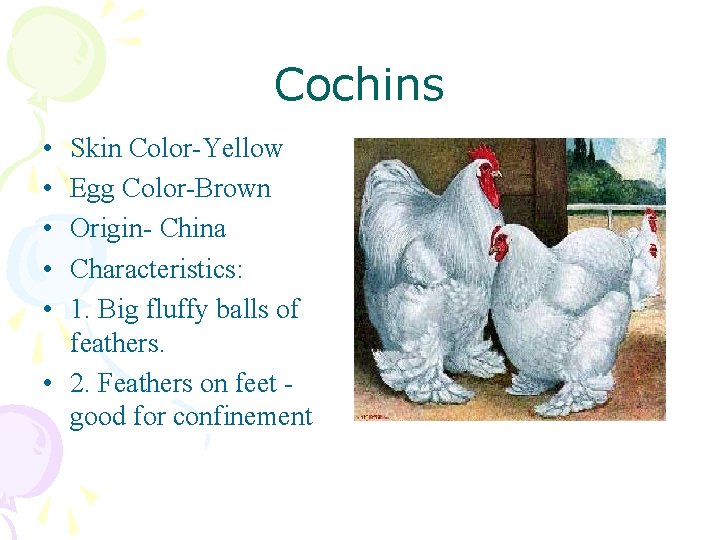
Cochins • • • Skin Color-Yellow Egg Color-Brown Origin- China Characteristics: 1. Big fluffy balls of feathers. • 2. Feathers on feet - good for confinement
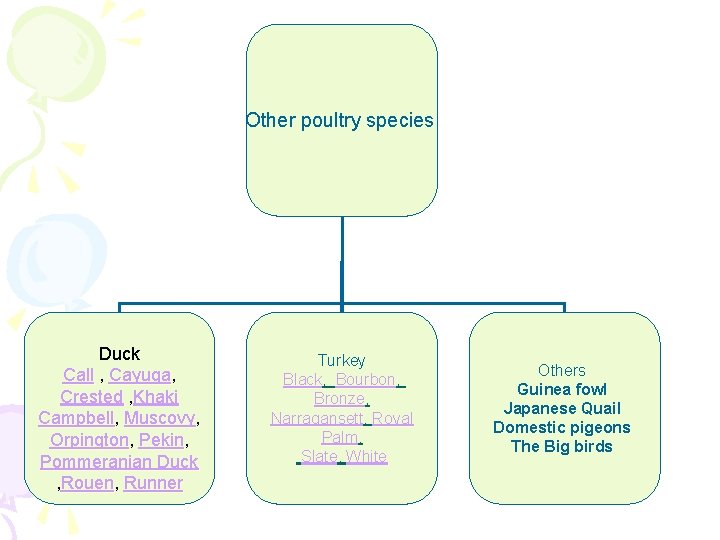
Other poultry species Duck Call , Cayuga, Crested , Khaki Campbell, Muscovy, Orpington, Pekin, Pommeranian Duck , Rouen, Runner Turkey Black, Bourbon, Bronze, Narragansett, Royal Palm, Slate, White Others Guinea fowl Japanese Quail Domestic pigeons The Big birds
Ducks • The age at first egg is about 150 days • Indian breed Nageswari, Synthetemete and Indian runner and • others are as follows
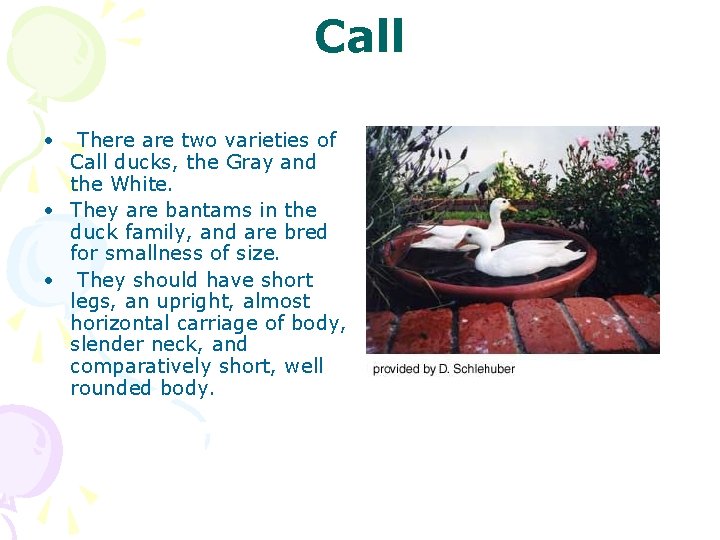
Call • There are two varieties of Call ducks, the Gray and the White. • They are bantams in the duck family, and are bred for smallness of size. • They should have short legs, an upright, almost horizontal carriage of body, slender neck, and comparatively short, well rounded body.
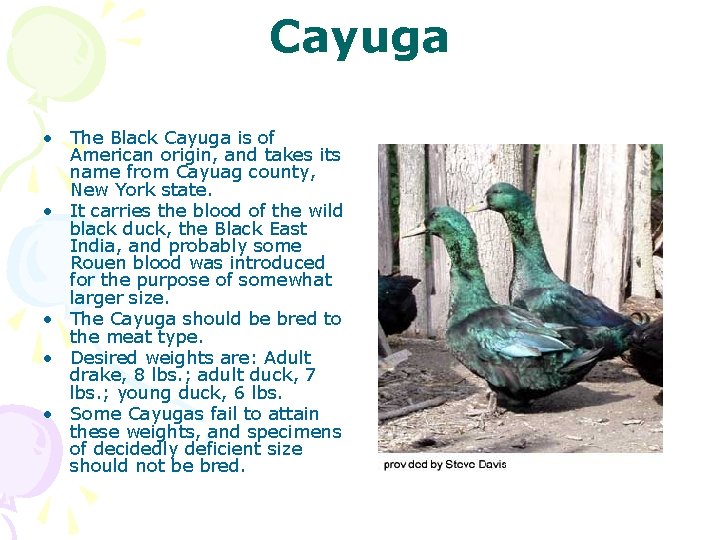
Cayuga • The Black Cayuga is of American origin, and takes its name from Cayuag county, New York state. • It carries the blood of the wild black duck, the Black East India, and probably some Rouen blood was introduced for the purpose of somewhat larger size. • The Cayuga should be bred to the meat type. • Desired weights are: Adult drake, 8 lbs. ; adult duck, 7 lbs. ; young duck, 6 lbs. • Some Cayugas fail to attain these weights, and specimens of decidedly deficient size should not be bred.
Crested • The Crested White ducks are probably of Pekin and Aylesbury breeding, the tuft of feathers on the head. • which occasionally appears, having been recognized as a point of attraction, selected and bred for. • The breed has not been extensively bred. The best specimens usually run about 1 lb lighter in weight than the best Pekin. • In type they follow the Pekin.
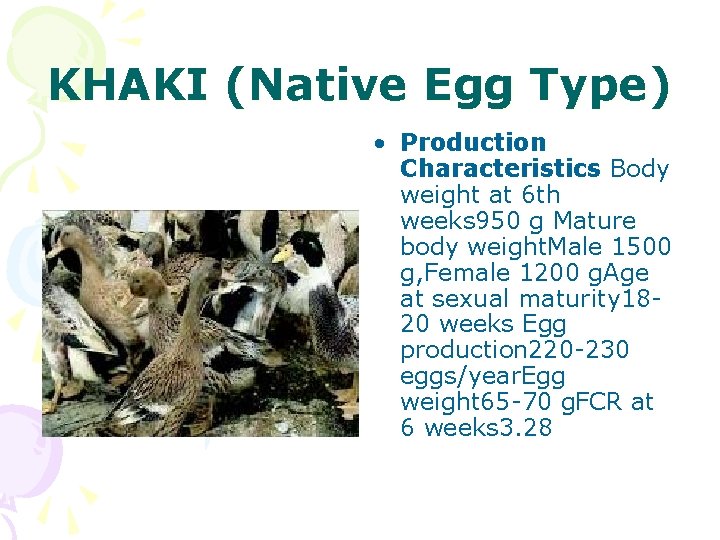
KHAKI (Native Egg Type) • Production Characteristics Body weight at 6 th weeks 950 g Mature body weight. Male 1500 g, Female 1200 g. Age at sexual maturity 1820 weeks Egg production 220 -230 eggs/year. Egg weight 65 -70 g. FCR at 6 weeks 3. 28
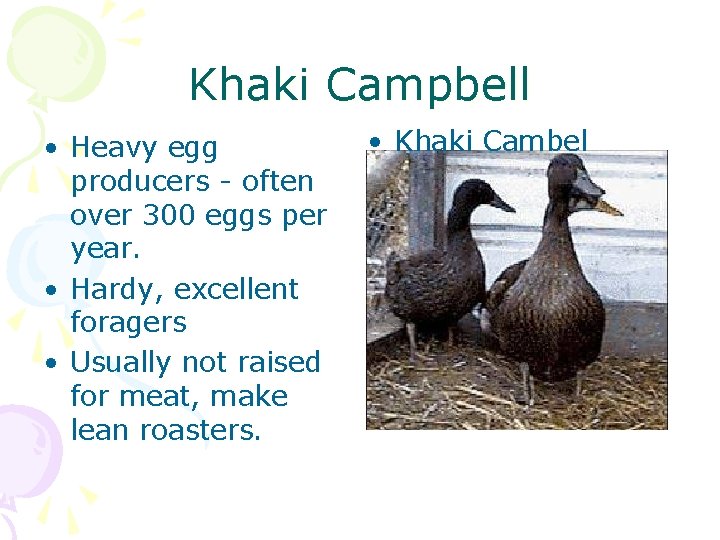
Khaki Campbell • Heavy egg producers - often over 300 eggs per year. • Hardy, excellent foragers • Usually not raised for meat, make lean roasters. • Khaki Cambel
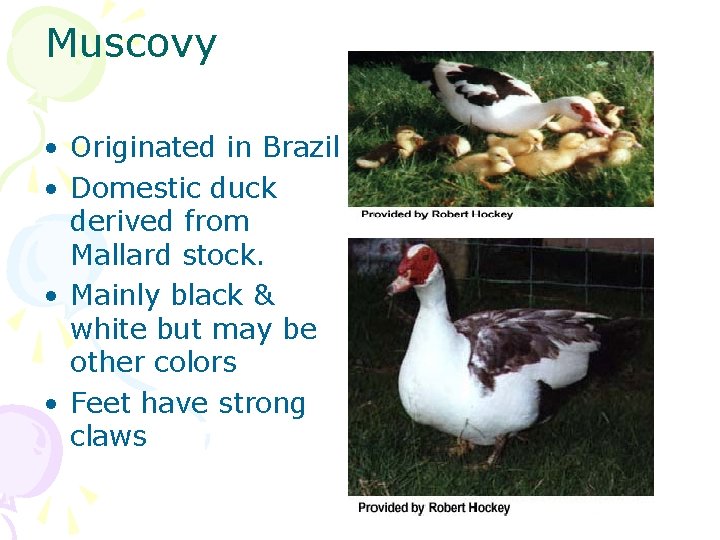
Muscovy • Originated in Brazil • Domestic duck derived from Mallard stock. • Mainly black & white but may be other colors • Feet have strong claws
Orpington • The Buff Orpington duck, sometimes called the Buff duck, is of English origin. • The color should be buff or it is sometimes described as seal brown or rich fawn. • These ducks should follow the Pekin in size and shape.
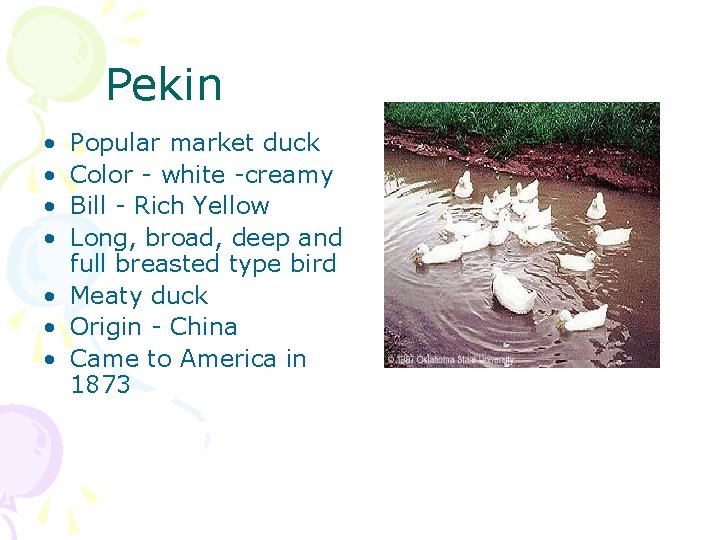
Pekin • • Popular market duck Color - white -creamy Bill - Rich Yellow Long, broad, deep and full breasted type bird • Meaty duck • Origin - China • Came to America in 1873
Pommeranian Duck • Origin: From various European countries. • They were named after the main breeding area, Pommerania, and have been bred since 1920 in Switzerland. • The Pommeranian Duck has a weight of approx. 2. 3 to 2. 7 kg; The drakes reach on average 3 kg. • They are tireless snail hunters and despite their size not plump. Besides a good laying ability, approx. • 150 eggs (70 g) per year, the young ducks are very secure in all weather and at eight to ten weeks ready for butchering. • Even perennial ducks perform well and often reliably raise a brood before the beginning of moulting in summer.
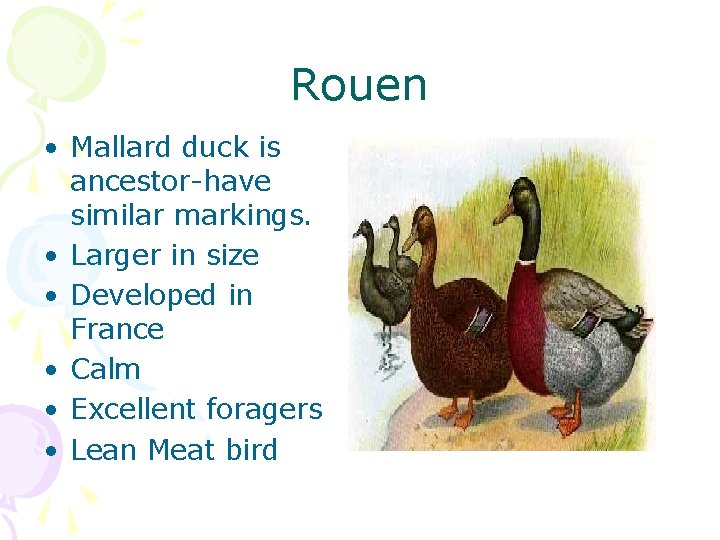
Rouen • Mallard duck is ancestor-have similar markings. • Larger in size • Developed in France • Calm • Excellent foragers • Lean Meat bird
Runner • This breed originated in India, was introduces into England as early perhaps as 1830, but was little known in the United States prior to 1900. • The Indian Runner produces a small to medium size carcass, but one of good quality. The ducks are practically non-sitters and are popular because of their prolific egg production which rivals the 200 egg stains of chickens. • The Runner ducks are the Leghorns of the duck family. • They are prolific layers. • Three hundred egg Indian Runner ducks were described and illustrated in the poultry press of 1912 to 14, and preceded the future for 300 egg hens which came later. • In England, duck egg laying contests are carried on.
Runner • There are three varieties of Indian Runners, the Fawn and White, the White, and the Penciled. • The breed has a distinctive type, the long, flat, straight head and long, slender neck forming, in shape, and umbrella handle and stem; the back should be long, straight and carried upright, and with the body should take on almost horizontal bearing. The type should be clean cut, there being little indication of a keel. The entire bearing should be upright and racey. • The desired weights are: Adult drake, 4 1/2 lbs. ; adult duck, 4 lbs. ; young drake, 4 lbs. ; young duck, 3 1/2 lbs.
Turkeys • Black • Bourbon • Bronze • Narragansett • Royal Palm • Slate • White
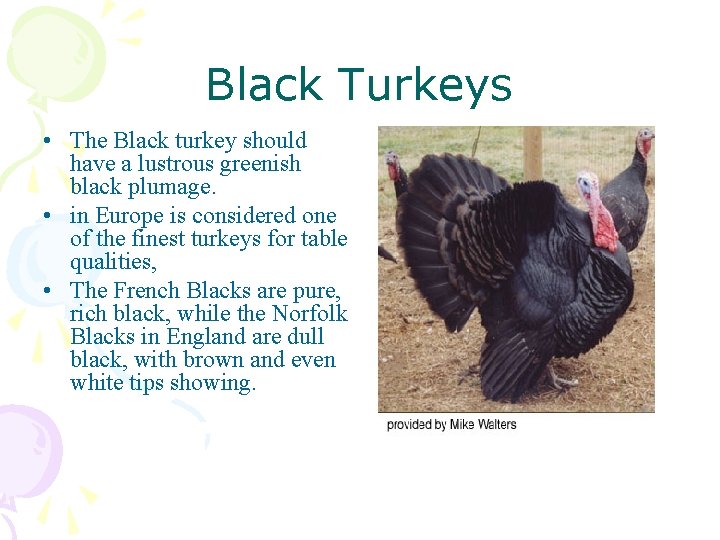
Black Turkeys • The Black turkey should have a lustrous greenish black plumage. • in Europe is considered one of the finest turkeys for table qualities, • The French Blacks are pure, rich black, while the Norfolk Blacks in England are dull black, with brown and even white tips showing.
Black Turkeys • The French blacks are the hardiest. In middle Europe the Black turkeys are smaller in size. • The desired weights for the variety in America are: Adult cock, 27 lbs. ; yearling cock, 22 lbs. ; cockerel, 18 lbs. ; hen, 18 lbs. ; pullet, 12 lbs.
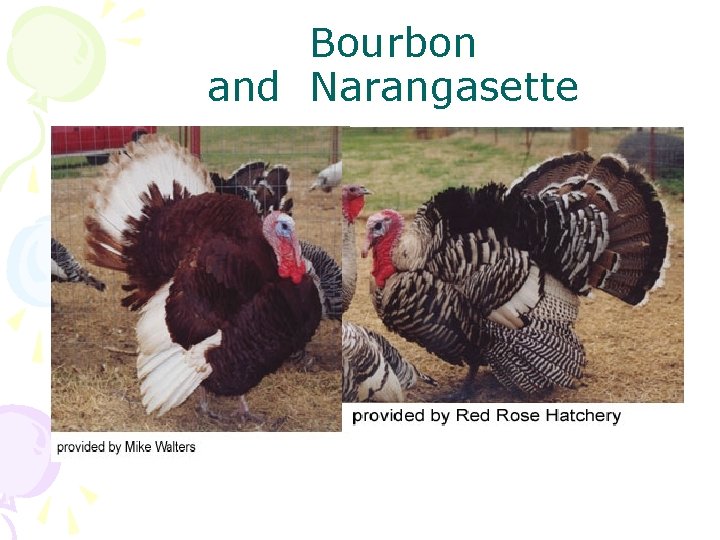
Bourbon and Narangasette
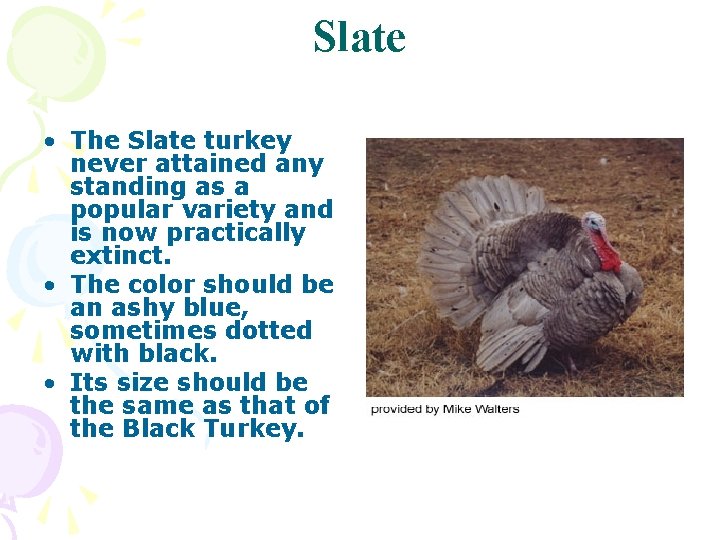
Slate • The Slate turkey never attained any standing as a popular variety and is now practically extinct. • The color should be an ashy blue, sometimes dotted with black. • Its size should be the same as that of the Black Turkey.
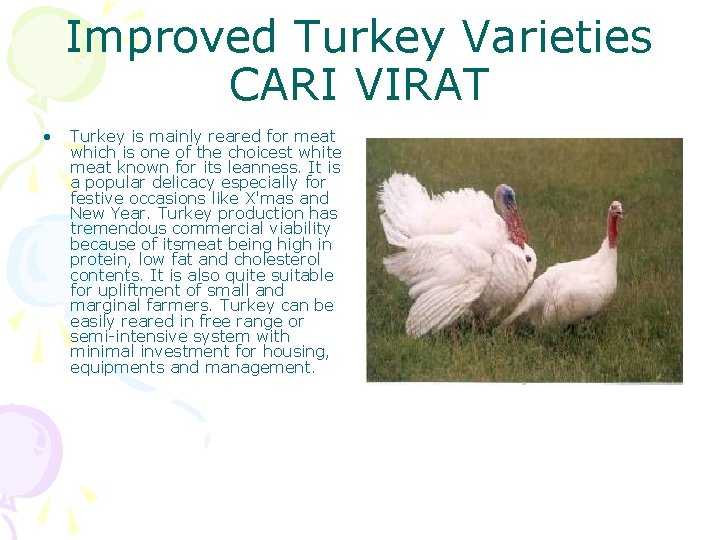
Improved Turkey Varieties CARI VIRAT • Turkey is mainly reared for meat which is one of the choicest white meat known for its leanness. It is a popular delicacy especially for festive occasions like X'mas and New Year. Turkey production has tremendous commercial viability because of itsmeat being high in protein, low fat and cholesterol contents. It is also quite suitable for upliftment of small and marginal farmers. Turkey can be easily reared in free range or semi-intensive system with minimal investment for housing, equipments and management.

CARI VIRAT • Special Features • Low fat • Low cholesterol • Choicest white meat • Suitable for backyard rearin
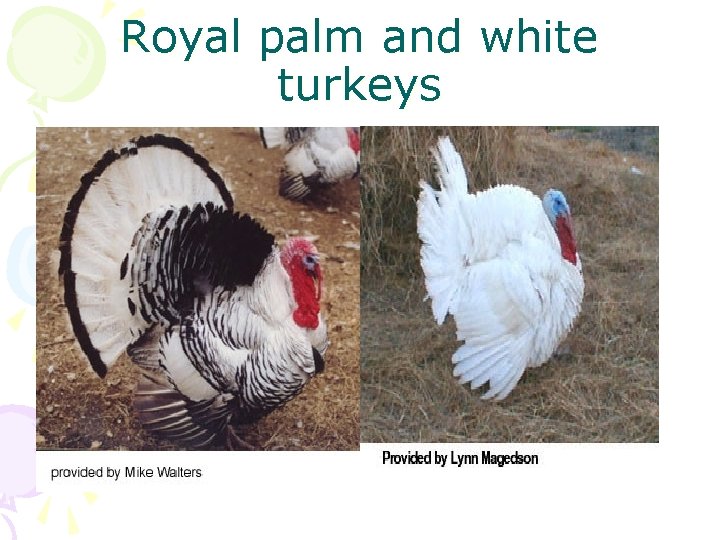
Royal palm and white turkeys

OTHERS
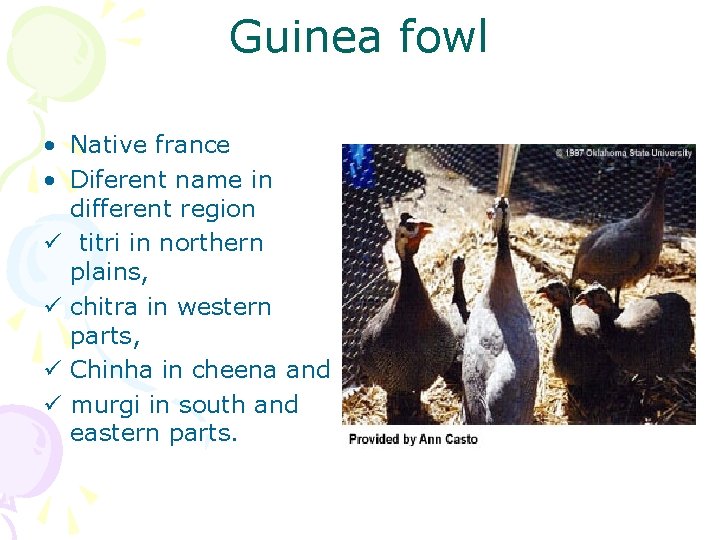
Guinea fowl • Native france • Diferent name in different region ü titri in northern plains, ü chitra in western parts, ü Chinha in cheena and ü murgi in south and eastern parts.
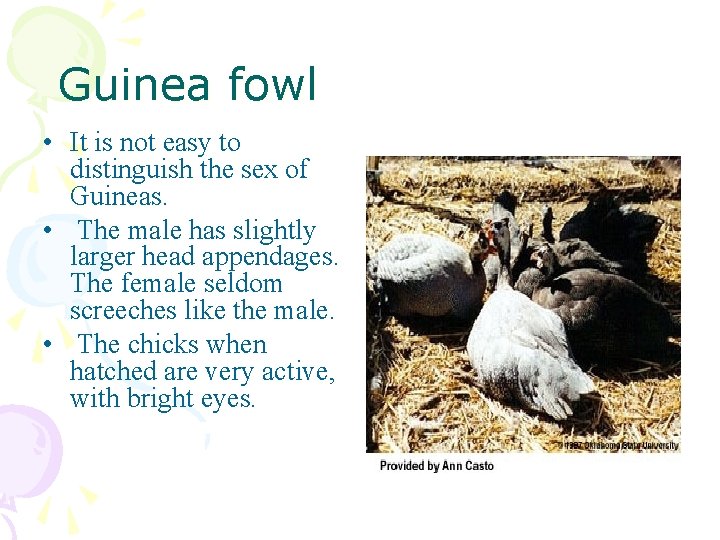
Guinea fowl • It is not easy to distinguish the sex of Guineas. • The male has slightly larger head appendages. The female seldom screeches like the male. • The chicks when hatched are very active, with bright eyes.
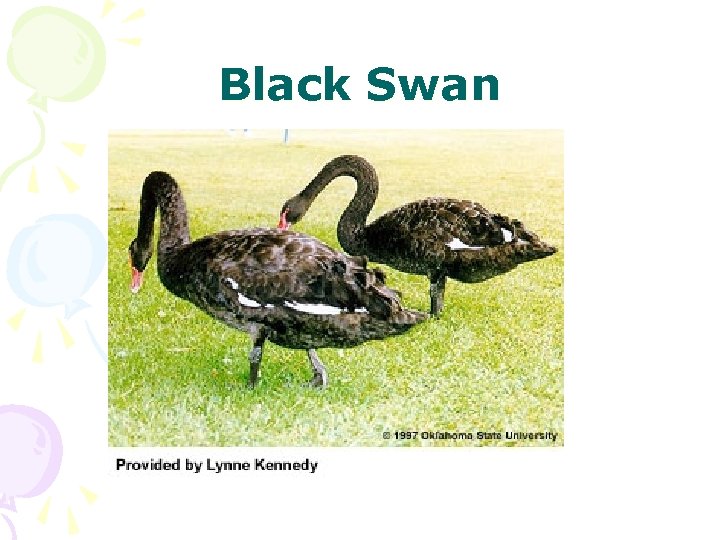
Black Swan
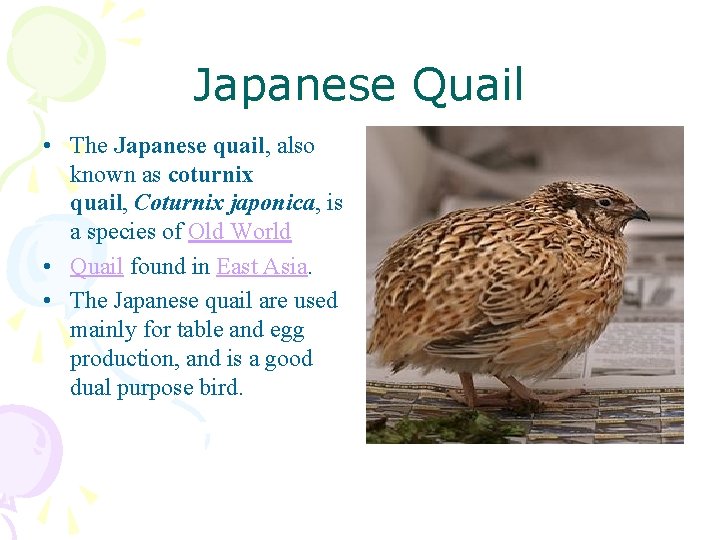
Japanese Quail • The Japanese quail, also known as coturnix quail, Coturnix japonica, is a species of Old World • Quail found in East Asia. • The Japanese quail are used mainly for table and egg production, and is a good dual purpose bird.
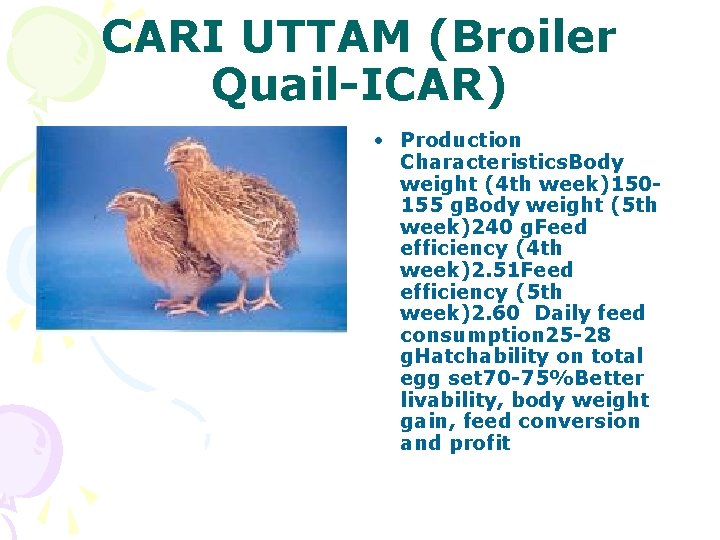
CARI UTTAM (Broiler Quail-ICAR) • Production Characteristics. Body weight (4 th week)150155 g. Body weight (5 th week)240 g. Feed efficiency (4 th week)2. 51 Feed efficiency (5 th week)2. 60 Daily feed consumption 25 -28 g. Hatchability on total egg set 70 -75%Better livability, body weight gain, feed conversion and profit
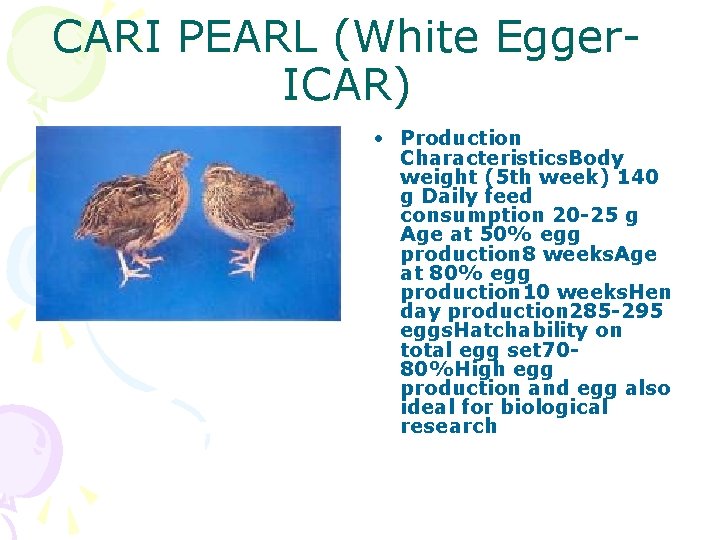
CARI PEARL (White Egger. ICAR) • Production Characteristics. Body weight (5 th week) 140 g Daily feed consumption 20 -25 g Age at 50% egg production 8 weeks. Age at 80% egg production 10 weeks. Hen day production 285 -295 eggs. Hatchability on total egg set 7080%High egg production and egg also ideal for biological research
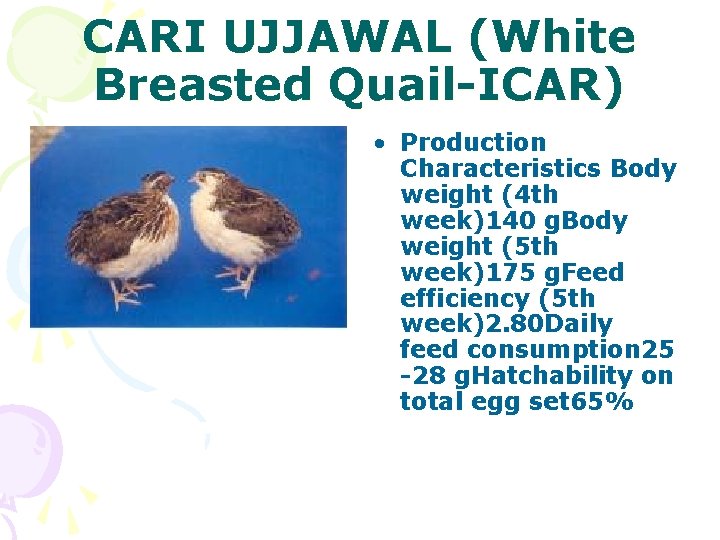
CARI UJJAWAL (White Breasted Quail-ICAR) • Production Characteristics Body weight (4 th week)140 g. Body weight (5 th week)175 g. Feed efficiency (5 th week)2. 80 Daily feed consumption 25 -28 g. Hatchability on total egg set 65%
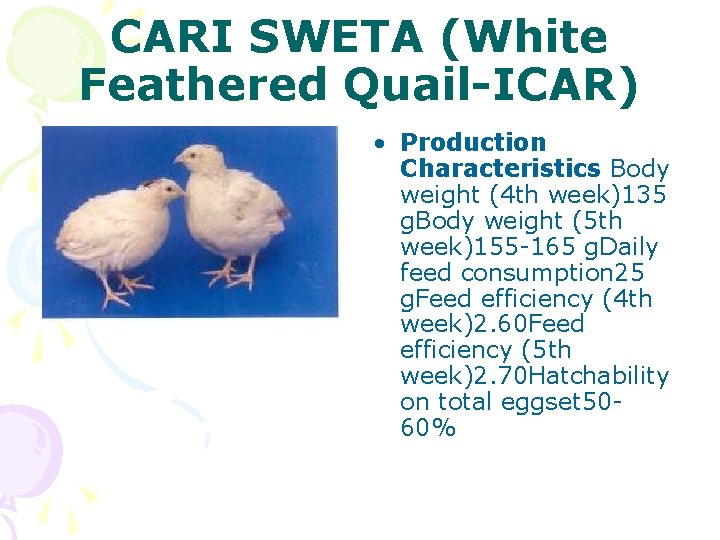
CARI SWETA (White Feathered Quail-ICAR) • Production Characteristics Body weight (4 th week)135 g. Body weight (5 th week)155 -165 g. Daily feed consumption 25 g. Feed efficiency (4 th week)2. 60 Feed efficiency (5 th week)2. 70 Hatchability on total eggset 5060%
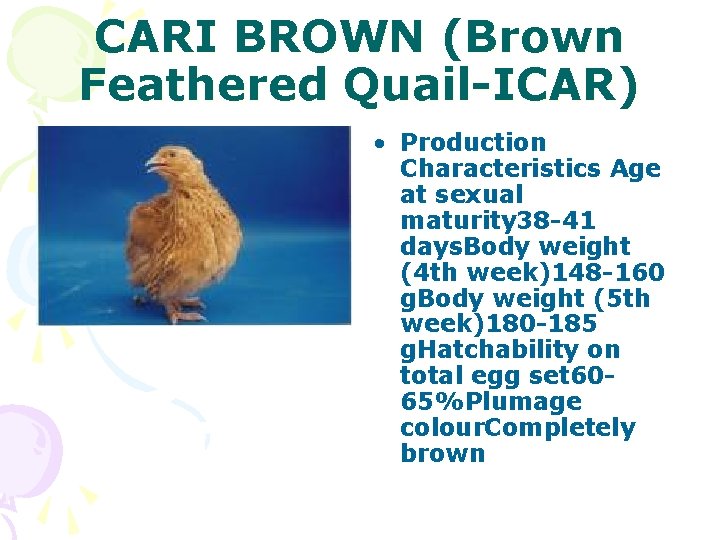
CARI BROWN (Brown Feathered Quail-ICAR) • Production Characteristics Age at sexual maturity 38 -41 days. Body weight (4 th week)148 -160 g. Body weight (5 th week)180 -185 g. Hatchability on total egg set 6065%Plumage colour. Completely brown
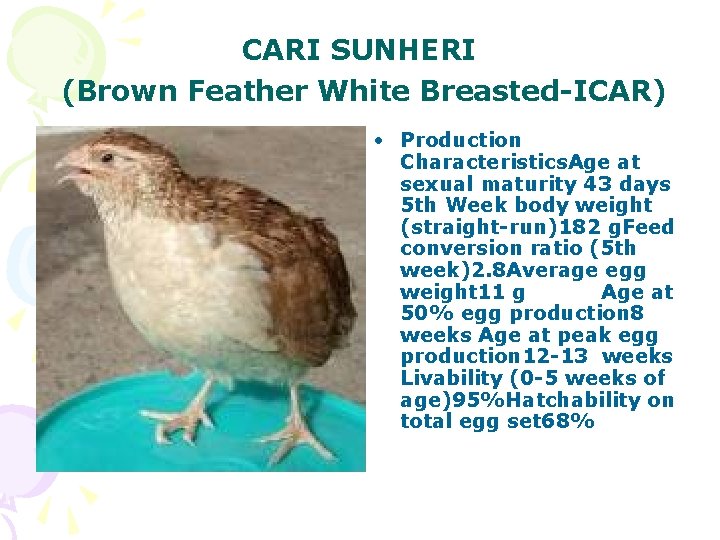
CARI SUNHERI (Brown Feather White Breasted-ICAR) • Production Characteristics. Age at sexual maturity 43 days 5 th Week body weight (straight-run)182 g. Feed conversion ratio (5 th week)2. 8 Average egg weight 11 g Age at 50% egg production 8 weeks Age at peak egg production 12 -13 weeks Livability (0 -5 weeks of age)95%Hatchability on total egg set 68%
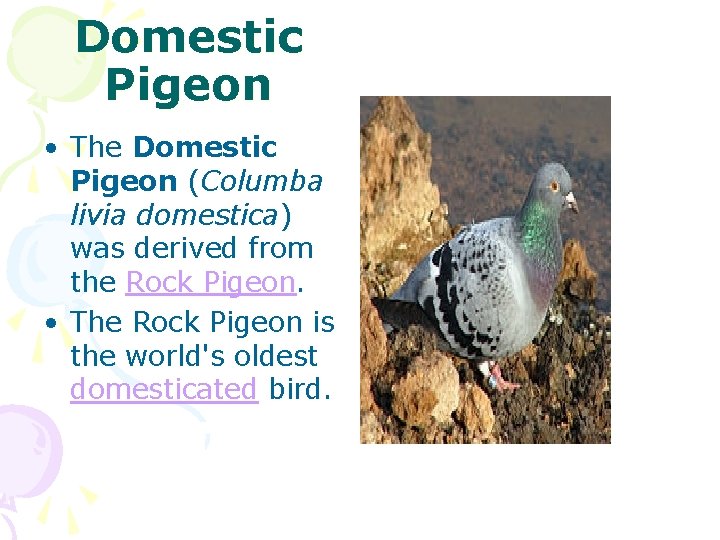
Domestic Pigeon • The Domestic Pigeon (Columba livia domestica) was derived from the Rock Pigeon. • The Rock Pigeon is the world's oldest domesticated bird.
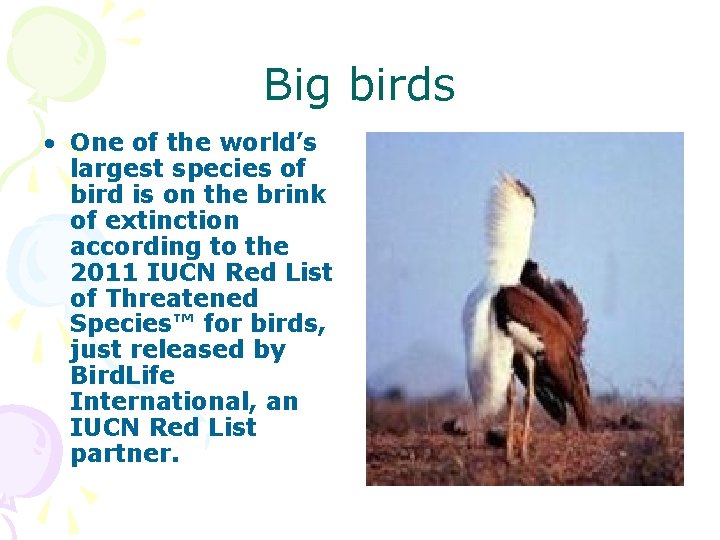
Big birds • One of the world’s largest species of bird is on the brink of extinction according to the 2011 IUCN Red List of Threatened Species™ for birds, just released by Bird. Life International, an IUCN Red List partner.
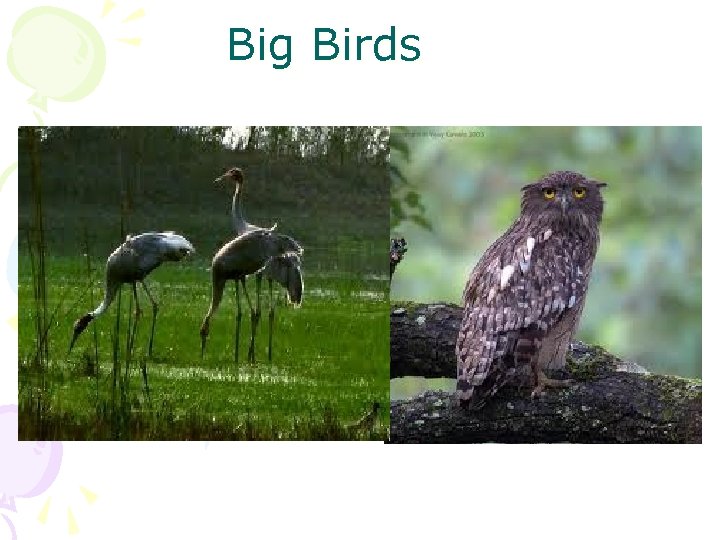
Big Birds
- Slides: 122