Eye Care Update Part I Ron Melton OD



- Slides: 41
Eye Care Update – Part I Ron Melton, OD, FAAO Randall Thomas, OD, MPH, FAAO www. eyeupdate. com
Financial Disclosure Drs Ron Melton and Randall Thomas are consultants to, on the speakers bureau of, on the advisory committee of, or involved in research for the following companies: ICARE and Valeant.
Refractionist or Doctor § A new world of vision testing and eye wear sales is dawning now that refractions and prescription fulfillment are being offered online. § These developments may not be a negative for ophthalmology practices and patients. § Websites: Ø Ø Ø Opternative Eye. Netra My. Vision. Pod Ø Ø Ø Smart Vision Labs Vmax Vision Warby. Parker § Optometrists: Expand your scope of patient care services to protect your future! § The AOA is aggressively fighting for optometry: Join the AOA!! Eyenet , Aug 2017.
Eye Glasses From 3 -D Printing Technology n n The (unintended) assault on traditional optometric practice continues 3 -D printing technology can make a lightweight (7 grams), customized pair of eye glasses in 14 hours at a cost of about $160. 00 We believe that a variety of technologies will steadily replace the need for traditional optometric care. Embrace medical eye care, or you might devolve into a dinosaur! Clin Exp Optom, May, 2018
What Makes a Happy Patient “Time spent with the physician and ease of scheduling an appointment are the 2 most important factors in determining whether or not a patient will recommend a particular practice to others. Even practices that provide the highest-quality care will not be successful if patients have trouble making appointments and do not get what is perceived to be adequate time with the practitioner” Long C, et al. Ophthalmology 2016; 123: 242 -7
Eye Drops for Presbyopia n EVO 6 (Novartis) – new agent designed to restore crystalline lens flexibility n Prodrug with lipoic acid choline ester 1. 5% - converts to dihydolipoic acid – breaks down disulphide bonds in lens – improved flexibility n Goal is to maintain reverse lens hardering and allow lens to maintain or regain accommodation Review of Optometry, June 15, 2017 n Liquid Vision drops – temporary presbyopia-correcting therapy lasting five hours or longer n In Phase Iia trials – combines aceclidine (miotic) with tropicamide (cycloplegic) to create super pinhole effect and moderate accommodation n Developed by Presbyopia Therapies Review of Optometry, June 15, 2017
Solar and Laser Retinopathy n n Similar pathophysiology: DDx- good Hx Central scotoma with mild to moderate reduction in BVA Small, focal yellowish macular lesion OCT: Compromise to RPE and outer layers n n Inner layer involvement in severe damage Light energy is absorbed by RPE resulting in heat damage to the tissue Some recovery of vision may occur over several months
Hand-Held Laser Retinal Injury n n n Delay in diagnosis is a common feature. Average of exposure 9 -16 years, mostly males. 50% admit to laser exposure. Vision decrease highly variable; modest recovery over time. Symptoms: Central scotoma, variable blurrred vision. OCT is critical to the diagnosis; Focal RPE and outer retinal tissues are preferentially damaged. “The lack of awareness of such injuries among ophthalmologists is likely to contribute toward a delay in making the diagnosis, as evidenced by the fact that almost a third of children in this study were referred as retinal dystrophies. ” This is likely true for most eye doctors. Raoof N, et al. Am J Ophthalmol. 2016; 171: 88 -94
Antibacterial Medications n n n Sulfa Preparations Erythromycin Bacitracin / Polymyxin B / Neomycin Chloramphenicol Gentamicin Tobramycin Trimethoprim / Polymyxin B Fluoroquinolones Azithromycin Oral antibiotics
Are Generics OK? “The more recent (since 1992) ophthalmic generics are approved according to strict criteria for sameness and are expected to behave in the same manner as the innovator. ” Reference: Ophthalmology, June 2012. Editorial by W. Chambers, MD of the FDA
Off label n “An estimated 50 percent of medications used routinely in ophthalmic practice are used offlabel. ” n “Clinical practice should be guided by the best interest of the patient. ” n “In many instances, off-label treatments may be the best , or the only, available treatment, and withholding treatment would be unethical. ” Reference: Eye. Net. April 2011
Compounding of Rx Glaucoma Meds n “Our compounded drugs are not FDA-approved as a whole, but each ingredient we use is FDAapproved. Since we are a compounding pharmacy, that is FDA-registered and inspected, we are able to compound these FDA-approved ingredients. Let me know if I need to explain a little clearer. If you have any other questions, please let me know. Thank you!” Imprimis Pharmaceuticals
FDA Pregnancy Categories A- Controlled studies show no risk B- No evidence of risk in humans w Either animal studies show risk, human studies do not; or if no human studies, animal studies negative C- Risk cannot be ruled out. w Human studies lacking, and animal studies positive for fetal risk or lacking. Potential benefits may justify potential risks D- Positive evidence of risk post-marketing data show risk to fetus. If needed in life-threatening w Investigational or situation or serious disease, drug may be acceptable if safer drugs cannot be used X- Contraindicated in pregnancy w Fetal risk clearly outweighs any benefit to patient
Treating During Pregnancy n n n 6. 3 million pregnancies reported in US each year Pregnancy creates a natural reduction in IOP (19. 6% reduction is normal; 24. 4% decrease in OH) Past FDA Pregnancy Categories no longer apply for drugs approved after June 30, 2015; Doctor must now read the package inserts and analyze the safety data to make an informed decision. Until new drugs are approved, use the more familiar pregnancy category labeling In glaucoma, brimonidine only category B (avoid during lactation- linked to CNS dedression) Consult patient’s OB/GYN or PCP prior to treatment
Herpes Gladiatorum n n n n Occurs most commonly among young wrestlers, or in other sports where there is very close skin contact. First described in the 1960’s – NEJM It is an expression of HSV-I Lymph nodes (preauricular and/or submandibular) are commonly present on one or both sides Treated with oral antiviral for a week Like all HSV infections, can become recurrent in nature. Temporary isolation from sports while being treated is key to breaking cycle of perpetuation
Eczema Herpeticum n n Opportunistic non-unilateral expression usually of the face and neck These patients have atopy, of which eczema is the typical association - - get a good history Seen mostly in people in their teens and 20’s Primary expression of HSV n n Globe is rarely involved Because of potential for a more virulent expression, use Zoster dosage of 800 mg of ACV 5 XD, or 1, 000 mg of VCV TID X 7 -10 days Usually seen primarily by dermatology, but if periocular involvement, eye doctor consultation is common practice. www. healthguideinfo. com/skin-allergies/p 63286
Primary HSV Infection n Vesicular eruptions on the eyelid skin and/or eyelid margin n Can be limited to the skin or can also result in follicular conjunctivitis and/or corneal epithelial disease n Treatment: PO ACV 400 mg 5 x D x 1 W PO Valtrex 500 mg tid x 1 W n Vesicles resolve without scarring
Non-ophthalmic steroid: ointment/cream/lotion n Triamcinolone - moderate potency steroid n Available in cream, ointment and lotion (0. 5%, 0. 1%, 0. 025%) n Our favorite: the 0. 1% cream Reference: Drug Facts and Comparisons
Anti-inflammatory Effects of 0. 1% Tacrolimus § The topical calcineurin inhibitor, tacrolimus, has good antiinflammatory properties. § 0. 1% tacrolimus eye drops can be highly effective in treating severe allergic conjunctival diseases. § Tacrolimus eye drops often cause a stinging sensation or conjunctival redness, especially in the beginning of treatment of severely inflamed eyes. This can be avoided by topical steroid pretreatment. § Tacrolimus eye drops did not have an immediate effect and required 1 -2 weeks to be effective. § In contrast, topical steroids are fast acting and can immediately relieve allergic symptoms. Although treatments eventually can be conducted without topical steroids, prompt relief of symptoms merits topical steroids. Ophthalmology, March 2017
Systemic Prednisone n Most common Rx’d systemic corticosteroid n Common initial dosage 40 -60 mg n Available generically in both tablets and Dose. Paks (5 or 10 mg at 6 or 12 day course) n Questions to ask before prescribing? Diabetic? Peptic Ulcer Disease? Tuberculosis? Pregnant?
Perspective on Oral Prednisolone n n n Using oral prednisolone at 1, 250 mg/day is equivalent to 1, 000 mg of I. V. methylprednisolone sodium succinate (Solu. Medrol®) for 3 days in treating acute optic neuritis. “There was no significant difference in adverse events between the groups. ” And, … we are concerned about using 40 – 60 mg/day!? ! JAMA Neurology, June, 2018
Bilateral Periorbital Impetigo - Dermatitis n n n Impetigo is a Staph aureus infection, often seen in patients with eczema Usually seen in children and young adults Can cause a secondary inflammatory dermatitis Can create cicatricial ectropion Tx with oral antibiotic and topical antibiotic/steroid or steroid ointment Ophthalmology, June, 2018
Perspective on Posterior Vitreous Detachment n Occurs mostly between ages 50 and 70 (peak incidence 62) n No association with refractive error, except patients with -3. 00 D or more go to P. V. D. 5 -10 years earlier n 80 -90% of breaks associated with P. V. D. are in the superior quadrants n Within 2 years, 10% of patients will develop a P. V. D. in the fellow eye
Acute PVD and Retinal Tears § The rate of an acute retinal tear associated with an acute symptomatic PVD is about 8% at the initial visit, and 1. 5% of eyes without a tear on the initial visit are found to have a tear on follow-up examination. Ophthalmology, January 2018
Treatment of Vitreous Floaters n Treatment options: Live with them Vitrectomy Vitreolysis n n n YAG laser – angle of focus can be changed to reach floaters; special vitreous lenses allow the laser beam to focus on floater Advantages: simple, noninvasive, no pain or discomfort Disadvantages: healthy eyes getting elective surgery, risk of retinal detachment, possibly worsening of symptoms Clear visualization of floaters key to successful treatment Treatment may require more than one laser session; symptomatic vitreous opacifications (SVO); only SVO’s > 4 mm from retina treated Patient decision on benefits vs risks CRST, May 2016 (Stonecipher)
Timing and RD Repair: Is there a hurry? n Preoperative VA is the strongest predictor of postoperative VA n When control vision is affected, about 30% of patients ultimately achieve 20/40 or better n “There is no difference in VA outcomes among patients who underwent within the first week of onset. ” n VA can improve for months to years after surgical repair n There was no association between duration of macular detachment and postoperative VA n “Clinical evidence suggests that the duration of macular detachment has a minor, if any, effect on visual outcome when repair is performed within about one week. Similarly, many fovea-sparing RD’s can likely be deferred for a short period without affecting visual outcomes. ” JAMA Oph. November 2013
Visual Recovery After Retinal Detachment with Macula-Off After 10 days, no rush for up to 30 days n Enhanced result if surgery is done witin the first 3 days n BJO, 2016; 100 (11)
Risk of Progression in Macula-On Retinal Detachment n A “bullous configuration” of a macula-on rhegmatogenous RD portends a higher risk of macular detachment. This study suggests “prompt surgery in patients diagnosed with bullous macula-on rhegmatogenous RD. ” Clinical and Experimental ophthalmology, August, 2017
Acute and Chronic Conjunctivitis Due to Over-the-Counter Ophthalmic Decongestants “Conclusion: Nonprescription decongestant eyedrops can produce acute and chronic forms of conjunctivitis by pharmacological, toxic, and allergic mechanisms. Once recognized, conjunctival inflammation often takes several weeks to resolve. ” Reference: C Soparkar et al. Arch of Ophthalmol. January 1997
Brimonidine Dermatologic Gel n n n Used to address the erythema and flushing commonly expressed in facial and eyelid rosacea Causes microvascular vasoconstriction Comes in a 30 gram tube – applied once daily Provides a “somewhat effective” clinical response Available as a. 33% gel by Gladerma Reference: The Medical Letter, October 2013
Lumify (brimonidine 0. 025%) Ophthalmic Solution n n n FDA approved in December 2017 – OTC product Major upgrade to help the chronic red eye Superior to early generation vasoconstrictors No rebound hyperemia Used once or twice a day PRN Marketed as Lumify OTC by Bausch & Lomb
Perspective on Central Corneal Thickness (CCT) n n n CCT has become “standard-of-care” in the POAG (or suspect) work-up Thinner corneas are a strong risk factor for POAG because true IOP is actually higher than the measured IOP. Some patients with measured ocular hypertension may simply have a thicker CCT, thus reducing POAG risk because the true IOP is actually less than the measured IOP “CCT is the most heritable aspect of ocular structure (more than refraction, axial length, or optic disc size), suggesting that it is under exquisite genetic control. ” (Ophthalmology, Nov. 2007) “Stop adjusting IOP measurements” JAMA, May 2017
Role of Self-IOP Measurements in Glaucoma Management n n Home tonometry – logical step in understanding and management of glaucoma Recent FDA approvals of devices Triggerfish (Sensimed) – contact lens ICARE Home (ICARE USA) – rebound tonometry requiring no anesthetic n Home tonometry helpful in better understanding the IOP changes and to support future glaucoma management
News on “HOME” Tonometry n n n “Up to 75% of individuals have peak IOP outside of office hours. ” “Most patients (73%) were able to accurately measure their own IOP after a short training session. Self-tonometry was deemed comfortable and relatively easy to perform and has the potential to improve patient engagement in their own care. ” “Patients with glaucoma may not only find selfmonitoring of IOP acceptable, but also soon demand it. ” JAMA Ophthalmol, October, 2017
Prostaglandin Receptor Agonists Latanoprost (Xalatan and generic) 0. 005% n Travoprost (Travatan Z) 0. 004% n Bimatoprost (Lumigan) 0. 01% n Tafluprost (Zioptan) 0. 0015% n
Latanoprostene Bunod 0. 024% n n n FDA approved in November 2017 First nitric oxide – donating prostaglandin One molecule – two mechanisms of action Enhances uveoscleral outflow Enhances trabecular meshwork outflow n n n Reduces IOP by 7. 5 – 9. 1 mm Hg Perserved with 0. 2% BAK Used once daily in the evening (6% red eyes) Comes in a 2. 5 and 5 ml opaque bottle Refrigerate until opened Marketed as Vyzulta by Bausch & Lomb
Each Millimeter of IOP Reduction Matters n “Our current understanding of the relationship between IOP lowering and glaucoma onset or progression translates to the effect of each mm Hg IOP reduction on the development of progression of visual field loss. ” de Moraes CG, et al. Survey Ophthalmol 2016; 61(5): 597 -615
“Glaucoma Treatment: by the Highest Level of Evidence” n n The risk reduction could be about 19% per mm Hg, confirming results from the Early Manifest Glaucoma Trial and Canadian Glaucoma Study, and showing that IOP reduction is highly effective, and that every mm of pressure counts. These results should serve as a stimulus to the pharmaceutical industry to continue development of new and even more potent drugs. Heijl, A. The Lancet , April 5, 2015
Perspective on IOP and Progression on Glaucomatous Optic Neuropathy n “Progression was closely linked to the magnitude of the initial IOP reduction with treatment. The initial change in IOP (from baseline to the initial follow-up visit) was strongly associated with progression, with about a 10% lowering of the risk with each mm Hg of IOP reduction. ” Leske M, et al. Arch Ophthalmol, Jan 2003 n “Elevated IOP is a strong risk factor for glaucoma progression, with hazard ratio increasing by 11% for every 1 mm Hg of higher IOP” Bengtsson B, et al. Ophthalmology, Feb 2007
Rhopressa (netarsudil 0. 02%) n n n n FDA approved in December 2017 First rhokinase inhibitor MOA purported to be enhancement of conventional trabecular outflow Use once daily in the evening Reduces IOP about 4 -5 mm Hg Perserved with 0. 015% BAK Comes in a 2. 5 ml bottle Potential Side Effects: In phase III, 53% experienced red eyes; Can cause subconjunctival hemorrhages Can cause an amiodarone-like vortex keratopathy n Marketed by Aerie Pharmaceuticals
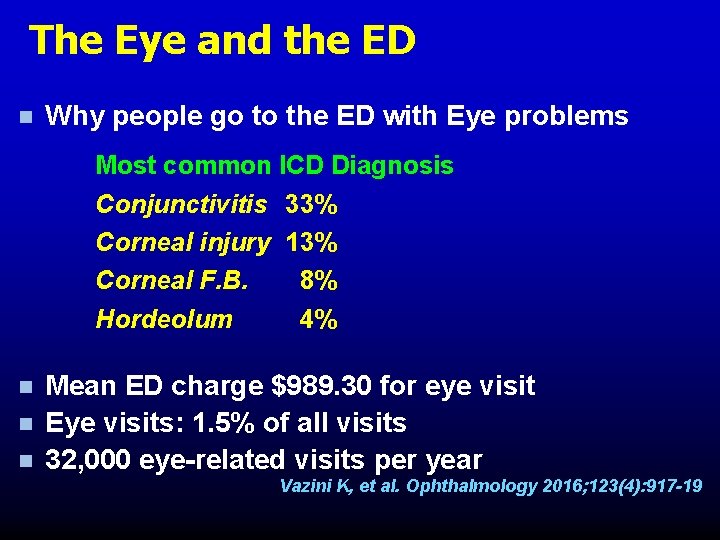
The Eye and the ED n Why people go to the ED with Eye problems Most common ICD Diagnosis Conjunctivitis 33% Corneal injury 13% Corneal F. B. 8% Hordeolum 4% n n n Mean ED charge $989. 30 for eye visit Eye visits: 1. 5% of all visits 32, 000 eye-related visits per year Vazini K, et al. Ophthalmology 2016; 123(4): 917 -19