
CONTEMPORARY GLAUCOMA CARE Ron Melton OD FAAO Randall

- Slides: 51
CONTEMPORARY GLAUCOMA CARE Ron Melton, OD, FAAO Randall Thomas, OD, MPH, FAAO WWW. EYEUPDATE. COM PENNSYLVANIA OPTOMETRIC ASSOCIATION SPRING CONFERENCE MAY 18, 2019 KALAHARI RESORT MOUNT POCONO, PENNSYLVAINA
Financial Disclosure Dr. Ron Melton and Dr. Randall Thomas are consultants to, on the speakers bureau of, on the advisory committee of, or involved in research for the following companies: ICARE, Valeant.
The Strength of Optometric Glaucoma Care • “Although highly desirable, physician-patient communication is an often overlooked but essential element in engaging patients in their own care. ” • “When physicians communicate well, adherence rates are 19% higher than for patients whose physicians communicate less effectively. ” • Who can spend more time with their patients, those seeing 20 -some patients daily or those seeing 40 -some patients daily? It’s simple arithmetic! Ophthalmology. July 2015.
Systemic Medicines and Their Associations with Advanced Glaucoma • SSRI’s (selective serotonin reuptake inhibitors) and » Prozac®, Zoloft®, Paxil® and Lexapro® SNRI’s (serotonin-norepinephrine reuptake inhibitors) » Effexor®, Cymbalta® showed a 30% protective effect • Beta-blockers (mainly metoprolol); 20% protection • CCB (calcium channel blockers) (mainly amlodipine) (Norvasc®) have a strong harmful association with glaucoma. • Eye physicians need to be aware of these positive and negative influences on their patients with advancing, and advanced glaucoma. Ophthalmology, July, 2018
Sleeping Relationship on IOP • IOP is highest while we sleep • In Supine posture there is a hydrostatic increase in the pressure of the episcleral and orbital veins. • “The reason that nocturnal IOP elevation is so important is because: the increase is greater for glaucoma patients and the increase coincides with the time when our systemic blood pressure is the lowest. If IOP increases and BP decreases, the ocular perfusion pressure will decrease, leaving it at greater risk for glaucomatous damage. ” Doug Rett, OD, FAAO. Primary Care Optometry News. March 28, 2018.
Glaucoma: Nocturnal Dip in Blood Pressure • Role of BP in glaucoma pathogenesis is critical • Extreme dipper (~20% of people) portend higher risk for glaucoma, esp. in normotensive patients • Antihypertensive meds need morning administration! • Relationship between IOP and POAG is weak with lower levels of IOP Ophthalmology, June, 2018
Head position effect on IOP • IOP is higher in recumbent than sitting posture • In the lateral decubitus position (laying on one’s side), the dependent (more downward) eye will have a relatively increased IOP. • “The IOP rise of the dependent eye in the lateral decubitus posture occurs despite IOP-lowering medical treatment. ” • The difference between the two eyes is however small • For patients with more advanced glaucomatous optic neuropathy, counseling about sleeping posture could be important! Am J Ophthalmol, Nov, 2015
Role of Cataract Extraction on IOP • “The role of cataract extraction in the alogorithm of glaucoma treatment is undeniable. ” • “The latest studies to include washout in the context of MIGS show surprisingly large effects of phacoemulsification alone and relatively small incremental benefit of MIGS. ” • (M+T: Don’t be “oversold” on hyped MIGS!) • Results of cataract extraction » For angle closure, reduction averaged 6. 4 mm Hg » For open angle glaucoma, about 2. 7 mm Hg reduction Survey Ophthalmol. September - October, 2018
Perspective on Ocular Hypertension Treatment Study • About 5% of Americans over age 40 have OHT • Screening tests are RNFL assessment and VF testing • “Median time to develop POAG was 6. 0 years in the observation group and 8. 7 years in the medication group. ” • “There is little absolute benefit of early treatment in low-risk OHT patients. Most OHT patients fall into this group and probably can be followed less frequently without treatment. ” • 5 Key Factors: Age, IOP, CCT, C/D ratio, and VF’s Am J Ophthalmol, May, 2018
Regarding Treating Patients with OHT • “One approach would be to treat every individual with elevated IOP. However, the potential benefit of treatment would have to outweigh the low conversion rate to POAG, as well as the cost, inconvenience, and potential adverse effects of treatment. ” • “Starting medical treatment after the development of early signs of POAG has only a modest impact on the rate of VF loss over the subsequent 5 -year F/U. Some clinicians may choose not to treat any OHT patients until early glaucomatous damage is confirmed. However, this approach requires patients to return for F/U visits and appropriate diagnostic tests in a timely fashion. ” Am J Ophthalmol, May, 2018
β-Blockers Are Helpful In Patients with COPD! • “Conclusion: Treatment with β-blockers may reduce the risk of exacerbations and improve survival in patients with COPD, possibly as a result of dual cardiopulmonary protective properties. ” 1 • “Patients with COPD often do not receive β-blockers because of concerns that they might exacerbate respiratory symptoms. ” • “Beta-blocker users who subsequently received diagnosis of COPD didn’t have worse outcomes; indeed, outcomes were better in the beta-blocker cohort. ” 2 References: 1. Rutten F, et al. Arch Int Med. 2010; 170(10) 2. E-Clin Med, January, 2019 (as reported in Journal Watch , April 1, 2019.
New SITA-FASTER • Judging “rate of progression” is a critical step in managing glaucoma • New proposal protocol: » 3 fields per year for the first 2 years » Then revert to annual testing • Known for over 2 decades: Overall SITA-Fast is just as good as SITA-Standard • SITA-Faster shaves about 2 minutes per eye off testing time, making more frequent testing more practical. Am J Ophthalmol. February 2019
The Optometric Perspective on Hysteresis • “Although research has a long way to go in better understanding CH’s role in glaucoma, clinicians may one day measure CH as part of routine glaucoma care and follow-up. ” Review of Optometry, June 15, 2018
Underdiagnosis of POAG • Population studies suggest over half of all glaucoma patients have not been diagnosed • From the Baltimore Eye Study: One-half of all people who were found to have glaucoma had seen an eye doctorwithin the past year and were unaware they had glaucoma! • “Despite all the progress being made in the field, it is sobering that ophthalmologists fail to diagnose more than 50% of cases of glaucoma. ” (Quigley, Ophthalmology Times)
Role of Self-IOP Measurements in Glaucoma Management • Home tonometry – logical step in understanding and management of glaucoma • Recent FDA approvals of devices » Triggerfish (Sensimed) – contact lens » ICARE Home (ICARE USA) – rebound tonometry requiring no anesthetic • Home tonometry helpful in better understanding the IOP changes and to support future glaucoma management
Literature on “HOME” Tonometry • “Up to 75% of individuals have peak IOP outside of office hours. ” • “Most patients (73%) were able to accurately measure their own IOP after a short training session. Self-tonometry was deemed comfortable and relatively easy to perform and has the potential to improve patient engagement in their own care. ” • “Patients with glaucoma may not only find selfmonitoring of IOP acceptable, but also soon demand it. ” JAMA Ophthalmol, October, 2017
Glaucoma Treatment Options • Prostaglandin Analogs • Pilocarpine derivatives • Beta-Adrenergic Blockers • Epinephrine derivatives • Prostaglandin / Beta-Blocker combinations • Laser Trabeculoplasty • Adrenergic Agonists • Adrenergic Agonist / Beta. Blocker combination • Carbonic Anhydrase Inhibitors (CAI’s) • CAI/Beta-Blocker combination • MIGS • Surgical Trabeculectomy • Nitric Oxide donating PGA • Rho-kinase Inhibitor
Compounding of Rx Glaucoma Meds “Our compounded drugs are not FDA-approved as a whole, but each ingredient we use is FDAapproved. Since we are a compounding pharmacy, that is FDA-registered and inspected, we are able to compound these FDA-approved ingredients. Let me know if I need to explain a little clearer. If you have any other questions, please let me know. Thank you!” Imprimis Pharmaceuticals
FDA Pregnancy Categories • A- Controlled studies show no risk • B- No evidence of risk in humans » Either animal studies show risk, human studies do not; or if no human studies, animal studies negative • C- Risk cannot be ruled out. » Human studies lacking, and animal studies positive for fetal risk or lacking. Potential benefits may justify potential risks • D- Positive evidence of risk post-marketing data show risk to fetus. If needed in life-threatening » Investigational or situation or serious disease, drug may be acceptable if safer drugs cannot be used • X- Contraindicated in pregnancy » Fetal risk clearly outweighs any benefit to patient
Treating During Pregnancy • 6. 3 million pregnancies reported in US each year • Pregnancy creates a natural reduction in IOP (19. 6% reduction is normal; 24. 4% decrease in OH) • Past FDA Pregnancy Categories no longer apply for drugs approved after June 30, 2015; Doctor must now read the package inserts and analyze the safety data to make an informed decision. • Until new drugs are approved, use the more familiar pregnancy category labeling • In glaucoma, brimonidine only category B (avoid during lactation- linked to CNS dedression) • Consult patient’s OB/GYN or PCP prior to treatment
Prostaglandin Receptor Agonists • • Latanoprost (Xalatan and generic) 0. 005% Travoprost (Travatan Z and generic) 0. 004% Bimatoprost (Lumigan) 0. 01%, and generic 0. 03% Tafluprost (Zioptan) 0. 0015%
Prostaglandins • • • Pharmacology: prostaglandin analog Mechanism: enhances uveoscleral outflow Dosage: once daily, usually in the evening Effectiveness: 30% reduction in IOP Potential side effects: Iris darkening, hypertrichosis, CME, iritis, HSK activation, migraine headache, inflammatory bowel disease (IBS) • Xalatan 0. 005% by Pfizer (and generic), Travatan (Z) 0. 004% by Alcon, Lumigan 0. 01% by Allergan, and Zioptan 0. 0015% by Akorn
Prostaglandin-Associated Periorbitopathy • A more newly recognized side effect of prostaglandin therapy • Periorbital fat atrophy gives rise to marked deepening of the superior lid sulcus, which can result in ptosis and enophthalmos • Beyond the obvious cosmetic concerns, such altered lid/orbital anatomy can make applanation tonometry quite challenging • Probably expressed more in middle-aged patients than in older patients • Tends to be at least partially reversible over a few months. Advanced Ocular Care, July-August 2011
Latanoprostene Bunod 0. 024% • FDA approved in November 2017 • First nitric oxide – donating prostaglandin • One molecule – two mechanisms of action » Enhances uveoscleral outflow » Enhances trabecular meshwork outflow • • • Reduces IOP by 7. 5 – 9. 1 mm Hg Perserved with 0. 2% BAK Used once daily in the evening (6% red eyes) Comes in a 2. 5 and 5 ml opaque bottle Refrigerate until opened Marketed as Vyzulta by Bausch & Lomb
Each Millimeter of IOP Reduction Matters • “Our current understanding of the relationship between IOP lowering and glaucoma onset or progression translates to the effect of each mm Hg IOP reduction on the development of progression of visual field loss. ” de Moraes CG, et al. Survey Ophthalmol 2016; 61(5): 597 -615
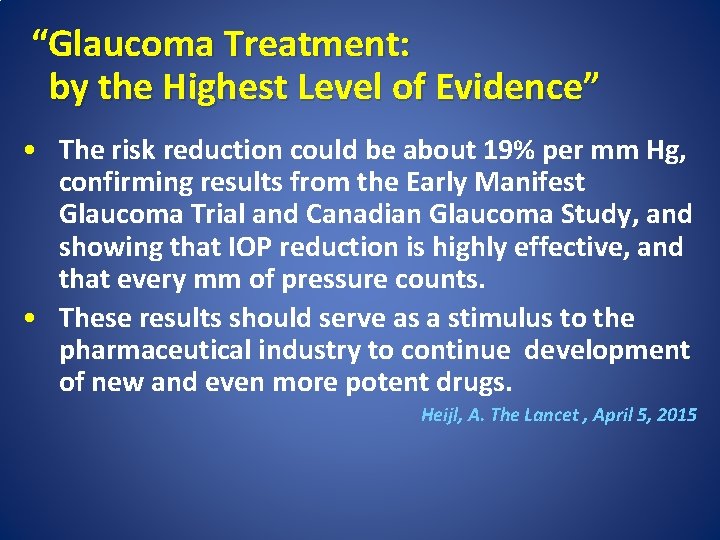
“Glaucoma Treatment: by the Highest Level of Evidence” • The risk reduction could be about 19% per mm Hg, confirming results from the Early Manifest Glaucoma Trial and Canadian Glaucoma Study, and showing that IOP reduction is highly effective, and that every mm of pressure counts. • These results should serve as a stimulus to the pharmaceutical industry to continue development of new and even more potent drugs. Heijl, A. The Lancet , April 5, 2015
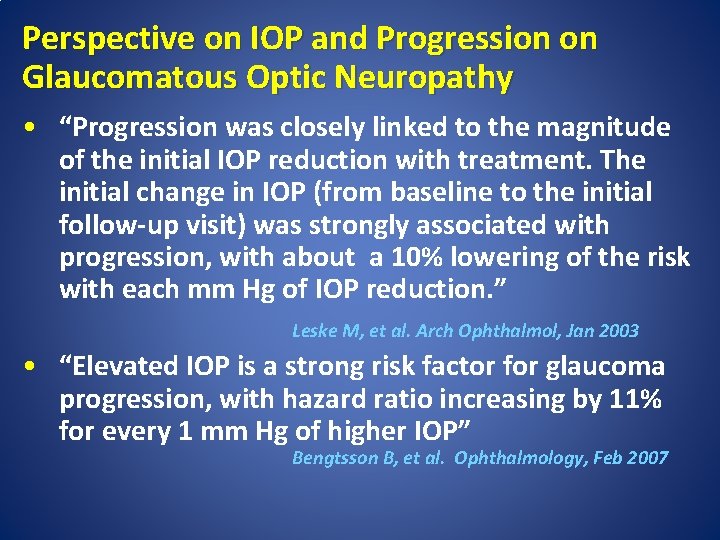
Perspective on IOP and Progression on Glaucomatous Optic Neuropathy • “Progression was closely linked to the magnitude of the initial IOP reduction with treatment. The initial change in IOP (from baseline to the initial follow-up visit) was strongly associated with progression, with about a 10% lowering of the risk with each mm Hg of IOP reduction. ” Leske M, et al. Arch Ophthalmol, Jan 2003 • “Elevated IOP is a strong risk factor for glaucoma progression, with hazard ratio increasing by 11% for every 1 mm Hg of higher IOP” Bengtsson B, et al. Ophthalmology, Feb 2007
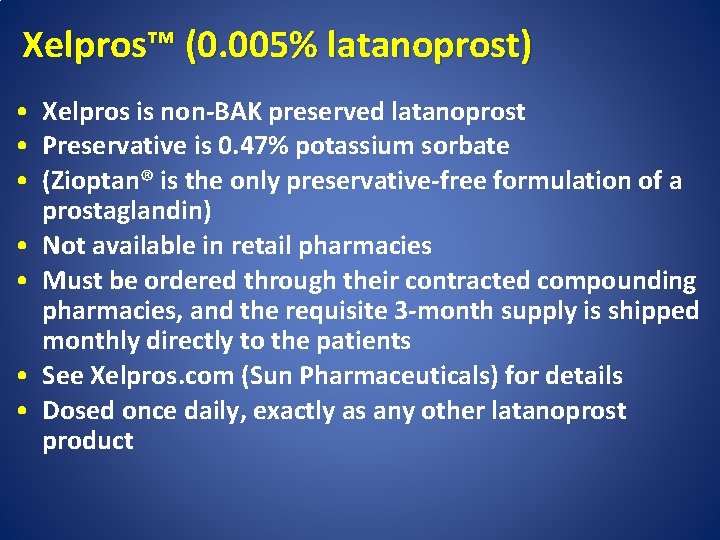
Xelpros™ (0. 005% latanoprost) • Xelpros is non-BAK preserved latanoprost • Preservative is 0. 47% potassium sorbate • (Zioptan® is the only preservative-free formulation of a prostaglandin) • Not available in retail pharmacies • Must be ordered through their contracted compounding pharmacies, and the requisite 3 -month supply is shipped monthly directly to the patients • See Xelpros. com (Sun Pharmaceuticals) for details • Dosed once daily, exactly as any other latanoprost product
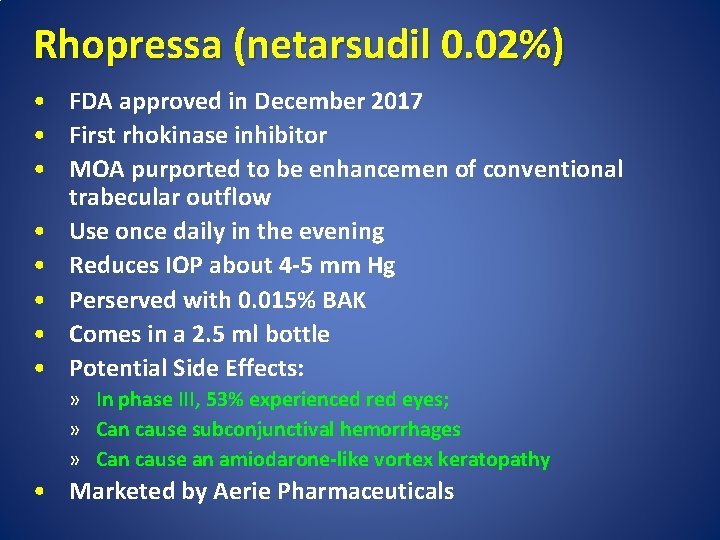
Rhopressa (netarsudil 0. 02%) • FDA approved in December 2017 • First rhokinase inhibitor • MOA purported to be enhancemen of conventional trabecular outflow • Use once daily in the evening • Reduces IOP about 4 -5 mm Hg • Perserved with 0. 015% BAK • Comes in a 2. 5 ml bottle • Potential Side Effects: » In phase III, 53% experienced red eyes; » Can cause subconjunctival hemorrhages » Can cause an amiodarone-like vortex keratopathy • Marketed by Aerie Pharmaceuticals
Rocklatan™ Ophthalmic Solution • A combination of netarsudil 0. 02% (Rhopressa) and latanoprost 0. 005% • First combination drug of a prostaglandin and a rho-kinase inhibitor • Both ingredient drugs are “once daily” administration • As with new drugs, coupons may be essential to achieve cost-effectiveness • Conjunctival hyperemia (59%) may be a limiting factor • Marketed by Aerie Pharmaceuticals
Topical Beta-Andrenergic Receptor-Blocking Drugs • * Timolol (Timoptic and Timoptic XE / Betimol) 0. 25% and 0. 5%; (Istalol) 0. 5% • *Levobunolol (Betagan) 0. 25% and 0. 5% • Metipranolol (Optipranolol) 0. 3% • Carteolol (Ocupress) 1. 0% • Betaxolol (Betoptic-S 0. 25%) * Have longer half-lives than other beta-blockers
Topical Beta-Blockers • • Decrease aqueous production Reduces IOP. 25%; no response 15% R/O asthma Recommend monocular trial with lowest concentration once daily • Possible diminished effect if used with systemic betablockers • No advantage to gel-forming solution
Timoptic in Ocu. Dose • Only preservative-free glaucoma medicine • Niche product: indicated when ocular preservatives, particularly benzalkonium chloride (BAK), impair surface tissues of the eye • Available as. 25% and. 5% in. 2 m. L individual units of solution from Valeant
Systemic Adverse Effects of Beta-adrenergic Blockers: An Evidence-based Assessment “Ophthalmic beta-adrenergic blockers are effective in lowering IOP and have a long history of success and tolerability, despite the known contraindications. However, many of these beta-adrenergic blocker contraindications have been either disproven or there is no definite evidence to prove a casual link. . Wide acceptance of such traditionally purported side effects has been largely due to propagation of isolated case reports and short series as well as personal communication felt to reflect expert opinion. Based on published evidence many more patients are eligible for ophthalmic -adrenergic blockers than previously presumed. However, it remains incumbent on the clinician to elicit the appropriate history, check the pulse for bradycardia or arrhythmia, and refer for medical evaluation when appropriate before initiating ophthalmic adrenergic blockers. ” Reference: Paul Lama, MD. AJO. November 2002
Beta Blockers and Chronic Heart failure • “Unless there is a specific contraindication, all patients with stable heart failure with reduced ejection fraction should receive a beta blocker in addition to an ACE inhibitor” • “A recent observational cohort study in patients with heart failure with preserved ejection fraction found that use of a beta blocker was associated with a decreased rate of allcause mortality. ” Reference: The Medical Letter, Vol. 57 (1460). January 19, 2015
β-Blockers May Reduce Mortality and Risk of Exacerbations in Patients with Chronic Obstructive Pulmonary Disease Conclusion: Treatment with β-blockers may reduce the risk of exacerbations and improve survival in patients with COPD, possibly as a result of dual cardiopulmonary protective properties. Reference: F Rutten et al. Archives of Internal Medicine. 2010; 170(10)
Adrenergic-Receptor Agonists • • Brimonidine Apraclonidine Dipivefrin Epinephrine
Brimonidine Tartrate • Alpha-2 adrenergic agonist; tid FDA approval • Acts by reducing aqueous production with some enhancement of uveoscleral outflow • Reduces IOP similar to timolol 0. 5% bid • Side effects: fatigue and dry mouth most common side effects; uveitis reported; may reduce systolic BP 10 mm. Hg • Less tachyphylaxis or allergy development than the other alpha-2 agonists • Neuro-protective potential unknown • Alphagan (0. 2%) by Allergan, and generic Alphagan P (0. 15%) by Allergan and generic, and Alphagan P (0. 1%) by Allergan
How important is “Preservative Free”? • “Published studies have not demonstrated any clear benefits of the BAK-Free formulations. ” • “There is a lack of evidence of clinically significant harm from a small number of BAK preserved drops in patients without OSD. This means that generally more expensive PF glaucoma medications should only be recommended for those on poly pharmacy or those with OSD but are not necessarily required for all patients. ” Br J Ophthalmol, July, 2018
Lumify (brimonidine 0. 025%) Ophthalmic Solution • • • FDA approved in December 2017 – OTC product Major upgrade to help the chronic red eye Superior to early generation vasoconstrictors No rebound hyperemia Used once or twice a day PRN Marketed as Lumify OTC by Bausch & Lomb
Neuroprotection “Despite the long list of neuroprotective candidates, clinicians lack a proven neuroprotective agent with which to manage glaucoma. ” Glaucoma Today. November/December 2014.
Combigan Ophthalmic Solution • Combination of 0. 2% brimonidine and 0. 5% timolol • With ANY combination drug, always try one of the component drugs as monotherapy, and only use the combination product if or when the monotherapy drug comes close, but does not achieve target IOP • Remember, most all drugs have a non-response rate of about 10%, so there is a 20% chance that one of the components of any combination drug is not performing • Marketed as Combigan by Allergan in 5, 10, and 15 ml opaque white bottles, preserved with BAK. 005%
Topical CAI’s • • • Dorzolamide 2% sol. and Brinzolamide 1% susp. Mechanism: decreases aqueous humor secretion Reduces IOP approximately 15% FDA dosage: tid, practical dosage bid Contraindications: Allergy to sulfa and/or history of blood dyscrasias • Side effects: minimal; some burning, bitter taste, rare allergic reaction • Most all patients controlled with oral acetazolamide were successfully controlled with a topical CAI • Azopt 1% susp-Alcon; Trusopt 2% sol-Merck
Dorzolamide Hydrochloride 2% –Timolol Maleate. 5% (Cosopt) • Both components decrease IOP by reducing aqueous humor secretion • Because of the CAI, must be used bid, which results in excessive beta-blocker therapy • Contraindications: patients with asthma, heart disease, or allergy to sulfa drugs • Ocular side effects: burning/stinging and perversion in taste • Marketed as Cosopt by Merck bottle, PF and generic
Simbrinza • Combination drug without a beta blocker where both ingredient drugs are dosed the same (b. i. d. ) • Combines 1% brinzolamide (Azopt ophthalmic suspension) with 0. 2% brimonidine • Offers a wide range of treatment possibilities due to its strong efficacy and ability to decrease elevated IOP by 21 - 35% • Marketed by Alcon under the brand name Simbrinza
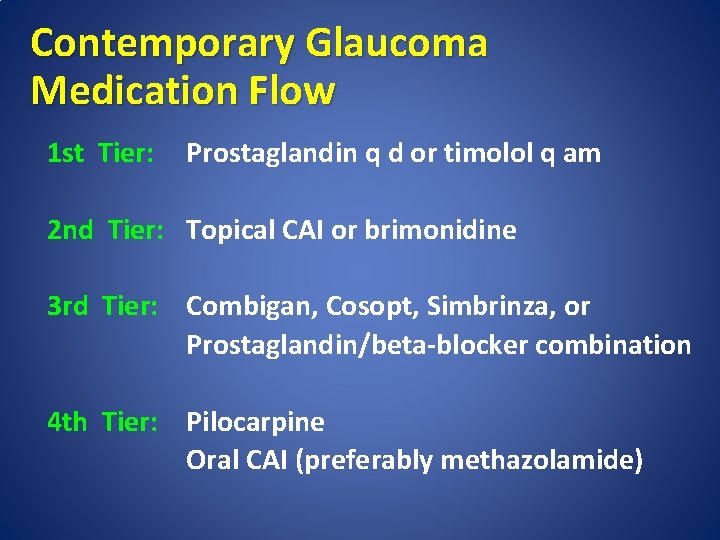
Contemporary Glaucoma Medication Flow 1 st Tier: Prostaglandin q d or timolol q am 2 nd Tier: Topical CAI or brimonidine 3 rd Tier: Combigan, Cosopt, Simbrinza, or Prostaglandin/beta-blocker combination 4 th Tier: Pilocarpine Oral CAI (preferably methazolamide)
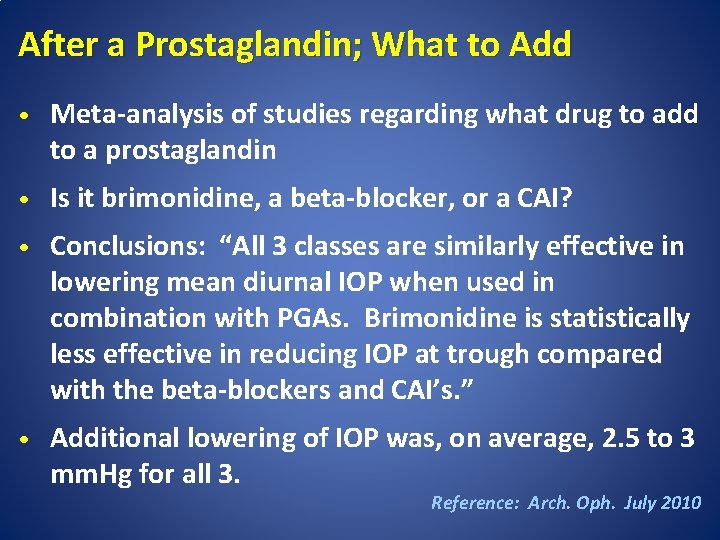
After a Prostaglandin; What to Add • Meta-analysis of studies regarding what drug to add to a prostaglandin • Is it brimonidine, a beta-blocker, or a CAI? • Conclusions: “All 3 classes are similarly effective in lowering mean diurnal IOP when used in combination with PGAs. Brimonidine is statistically less effective in reducing IOP at trough compared with the beta-blockers and CAI’s. ” • Additional lowering of IOP was, on average, 2. 5 to 3 mm. Hg for all 3. Reference: Arch. Oph. July 2010
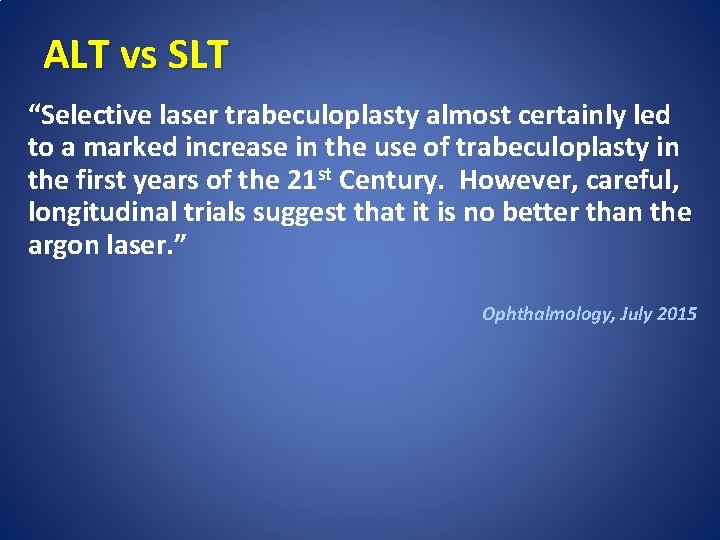
ALT vs SLT “Selective laser trabeculoplasty almost certainly led to a marked increase in the use of trabeculoplasty in the first years of the 21 st Century. However, careful, longitudinal trials suggest that it is no better than the argon laser. ” Ophthalmology, July 2015
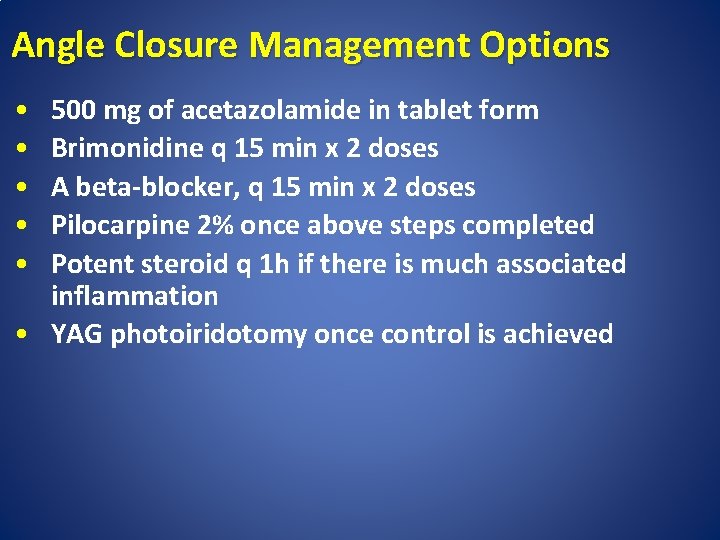
Angle Closure Management Options • • • 500 mg of acetazolamide in tablet form Brimonidine q 15 min x 2 doses A beta-blocker, q 15 min x 2 doses Pilocarpine 2% once above steps completed Potent steroid q 1 h if there is much associated inflammation • YAG photoiridotomy once control is achieved
Alert on Topiramate (Topamax) • • • Approved 12 -96 for seizure disorders Unapproved: Migraine HA, weight loss, depression, bipolar disorder Mechanism of action is unknown Because of a topiramate-associated risk for oral clefts, the FDA has now designated topiramate as a pregnancy category D drug. Numerous reported cases of acute, bilateral, simultaneous angleclosure glaucoma Onset usually within first 2 weeks of therapy Most common presenting symptom: blurred vision Exact mechanism of increased IOP is unknown Tx: Stat consult with prescribing physician to begin to reduce topiramate dosage; then aqueous suppressants, oral CAI, cycloplegia (retracts ciliary body) - no miotics IOP normalizes in 1 -4 days, no laser treatment indicated
Topiramate (Topamax) and Vision • Uses: anticonvulsant, migraine prevention, bipolar disorder, obesity, OCD, IIH, neuropathic pain, essential tremor, post-herpetic neuralgia, and other esoteric uses. • Topiramate is a sulfa derivative (like CAI’s) • Idiosyncratic ciliochoroidal effusion is the most common ocular side effect, and most always results in a myopic shift with or without increased IOP • This rare event usually occurs within 2 weeks of initiation (or doubling) of dosing • First described in 2001 – 70% are female • Tx: D/C the medicine; use (PRN) beta-blocker, brimonidine, or in refractory case, oral prednisone or IV methylprednisolone. Also, instill cycloplegic agent, and do not use pilocarpine. Reference: Clinical Ophthalmology. January 2012