External Sorting Chapter 13 1 Why Sort A
- Slides: 29
External Sorting Chapter 13 1
Why Sort? A classic problem in computer science! v Data requested in sorted order v § e. g. , find students in increasing gpa order Sorting is first step in bulk loading B+ tree index. v Sorting useful for eliminating duplicate copies in a collection of records (Why? ) v Sort-merge join algorithm involves sorting. v v Problem: sort 1 Gb of data with 1 Mb of RAM. § why not virtual memory? 2
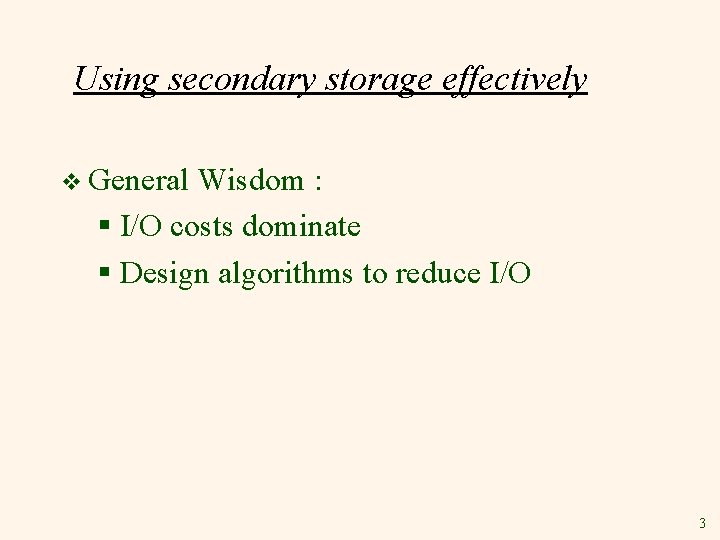
Using secondary storage effectively v General Wisdom : § I/O costs dominate § Design algorithms to reduce I/O 3
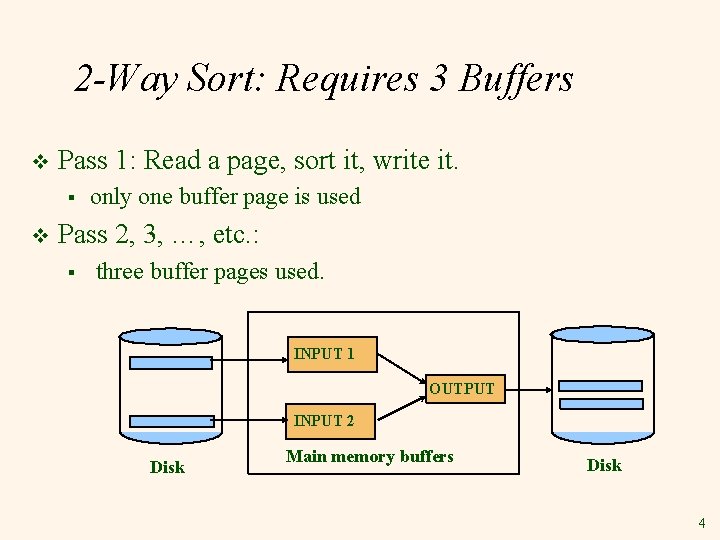
2 -Way Sort: Requires 3 Buffers v Pass 1: Read a page, sort it, write it. § v only one buffer page is used Pass 2, 3, …, etc. : § three buffer pages used. INPUT 1 OUTPUT INPUT 2 Disk Main memory buffers Disk 4
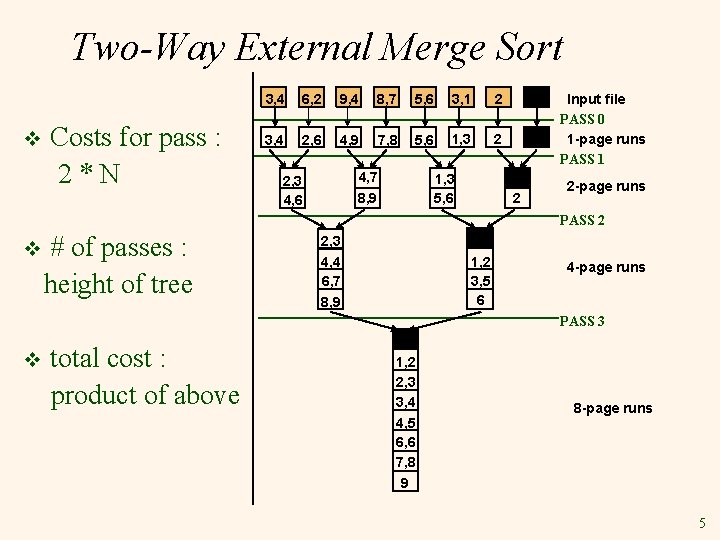
Two-Way External Merge Sort v Costs for pass : 2*N 3, 4 6, 2 9, 4 8, 7 5, 6 3, 1 2 3, 4 2, 6 4, 9 7, 8 5, 6 1, 3 2 4, 7 8, 9 2, 3 4, 6 1, 3 5, 6 Input file PASS 0 1 -page runs PASS 1 2 2 -page runs PASS 2 v # of passes : height of tree 2, 3 4, 4 6, 7 8, 9 1, 2 3, 5 6 4 -page runs PASS 3 v total cost : product of above 1, 2 2, 3 3, 4 4, 5 6, 6 7, 8 9 8 -page runs 5
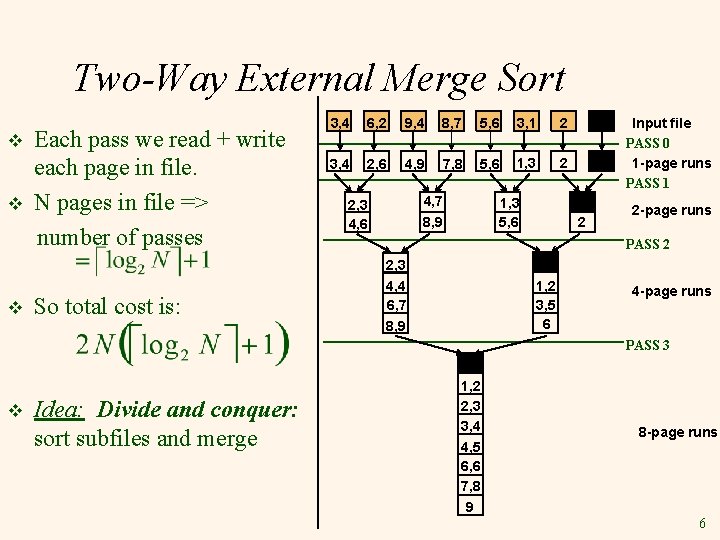
Two-Way External Merge Sort v v Each pass we read + write each page in file. N pages in file => number of passes 3, 4 6, 2 9, 4 8, 7 5, 6 3, 1 2 3, 4 2, 6 4, 9 7, 8 5, 6 1, 3 2 4, 7 8, 9 2, 3 4, 6 1, 3 5, 6 Input file PASS 0 1 -page runs PASS 1 2 2 -page runs PASS 2 2, 3 v So total cost is: 4, 4 6, 7 8, 9 1, 2 3, 5 6 4 -page runs PASS 3 v Idea: Divide and conquer: sort subfiles and merge 1, 2 2, 3 3, 4 4, 5 6, 6 7, 8 9 8 -page runs 6
External Merge Sort What if we had more buffer pages? v How do we utilize them wisely ? v - Two main ideas ! 7
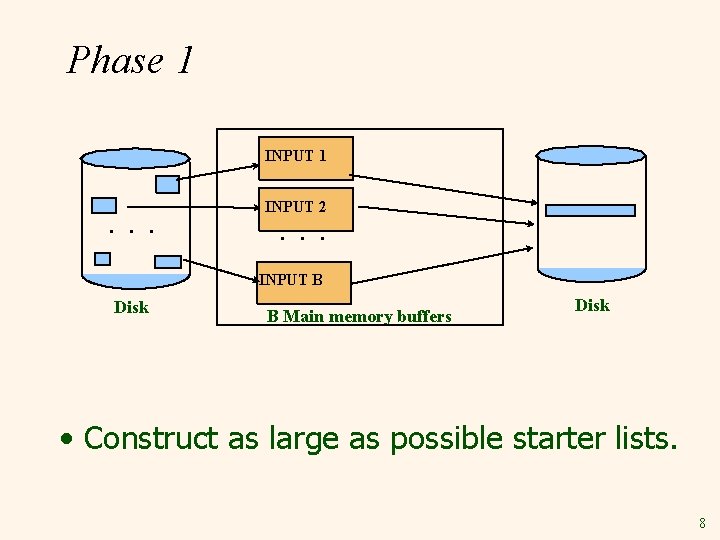
Phase 1 INPUT 1 . . . INPUT 2 . . . INPUT B Disk B Main memory buffers Disk • Construct as large as possible starter lists. 8
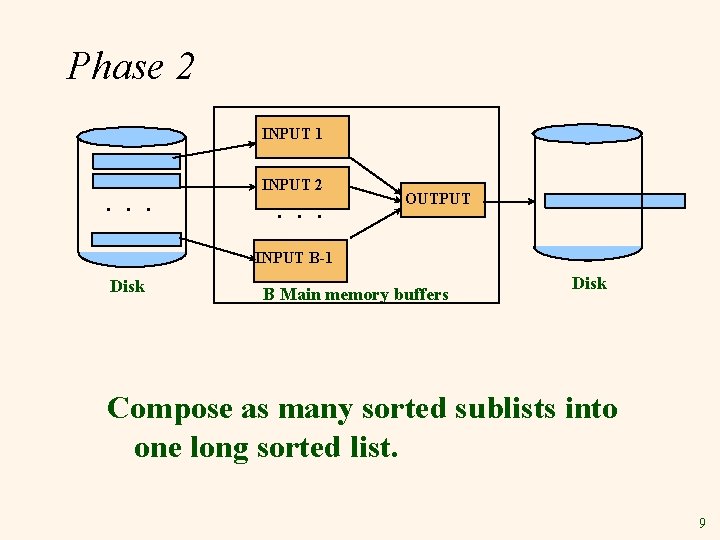
Phase 2 INPUT 1 . . . INPUT 2 . . . OUTPUT INPUT B-1 Disk B Main memory buffers Disk Compose as many sorted sublists into one long sorted list. 9
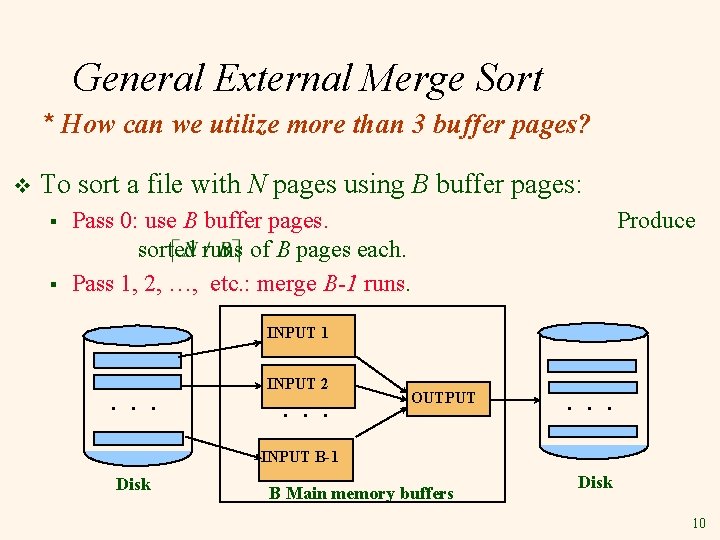
General External Merge Sort * How can we utilize more than 3 buffer pages? v To sort a file with N pages using B buffer pages: § § Pass 0: use B buffer pages. sorted runs of B pages each. Pass 1, 2, …, etc. : merge B-1 runs. Produce INPUT 1 . . . INPUT 2 . . . OUTPUT . . . INPUT B-1 Disk B Main memory buffers Disk 10
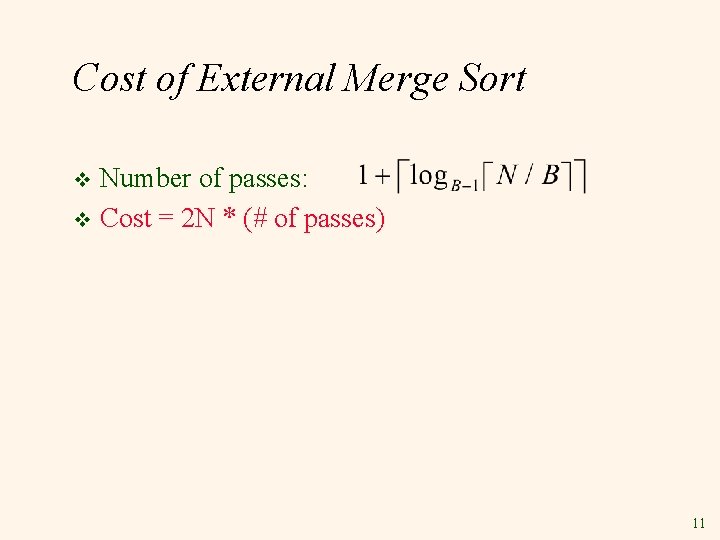
Cost of External Merge Sort Number of passes: v Cost = 2 N * (# of passes) v 11
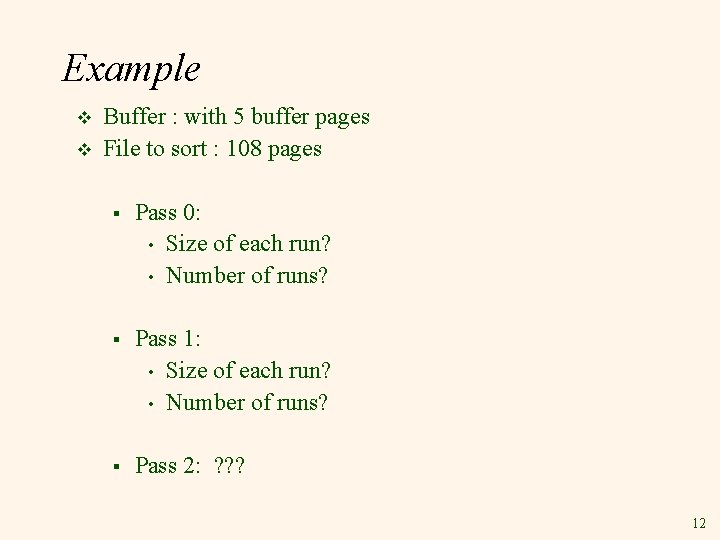
Example v v Buffer : with 5 buffer pages File to sort : 108 pages § Pass 0: • Size of each run? • Number of runs? § Pass 1: • Size of each run? • Number of runs? § Pass 2: ? ? ? 12
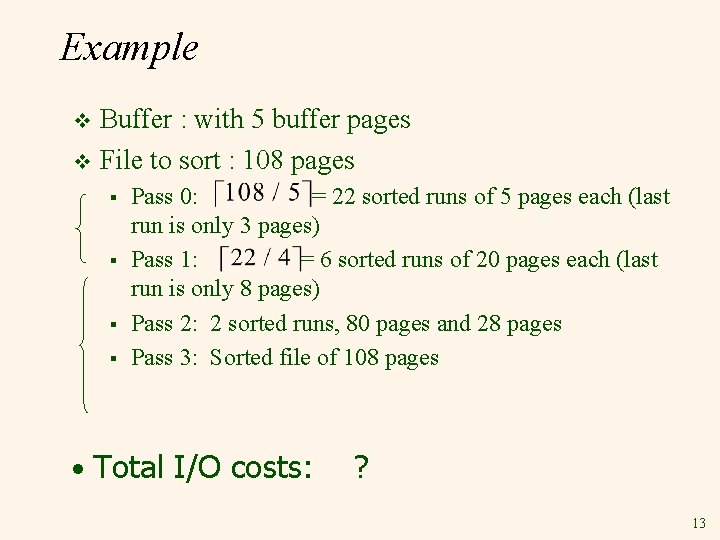
Example Buffer : with 5 buffer pages v File to sort : 108 pages v § § Pass 0: = 22 sorted runs of 5 pages each (last run is only 3 pages) Pass 1: = 6 sorted runs of 20 pages each (last run is only 8 pages) Pass 2: 2 sorted runs, 80 pages and 28 pages Pass 3: Sorted file of 108 pages • Total I/O costs: ? 13
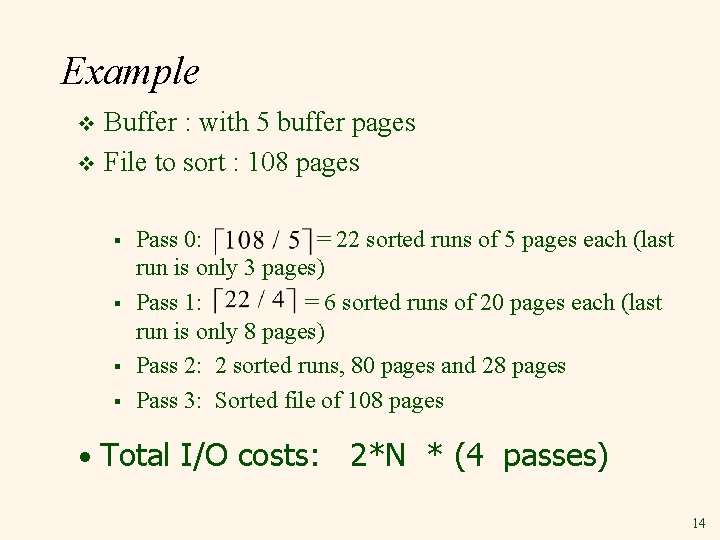
Example Buffer : with 5 buffer pages v File to sort : 108 pages v § § Pass 0: = 22 sorted runs of 5 pages each (last run is only 3 pages) Pass 1: = 6 sorted runs of 20 pages each (last run is only 8 pages) Pass 2: 2 sorted runs, 80 pages and 28 pages Pass 3: Sorted file of 108 pages • Total I/O costs: 2*N * (4 passes) 14
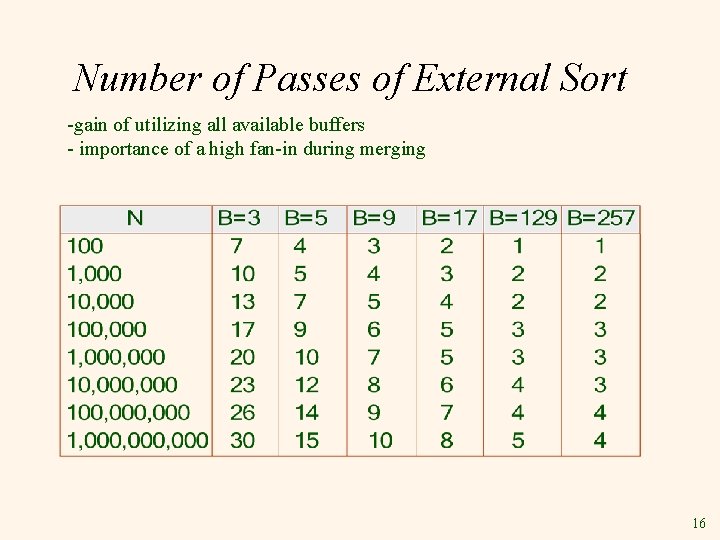
Number of Passes of External Sort -gain of utilizing all available buffers - importance of a high fan-in during merging 16
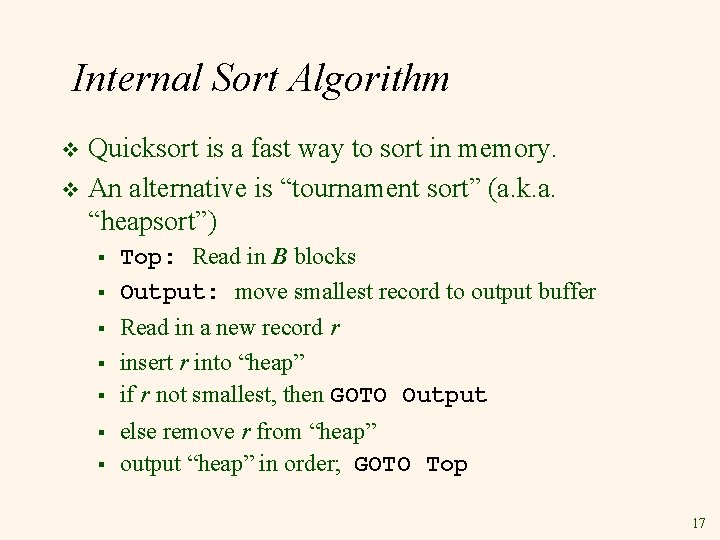
Internal Sort Algorithm Quicksort is a fast way to sort in memory. v An alternative is “tournament sort” (a. k. a. “heapsort”) v § § § § Top: Read in B blocks Output: move smallest record to output buffer Read in a new record r insert r into “heap” if r not smallest, then GOTO Output else remove r from “heap” output “heap” in order; GOTO Top 17
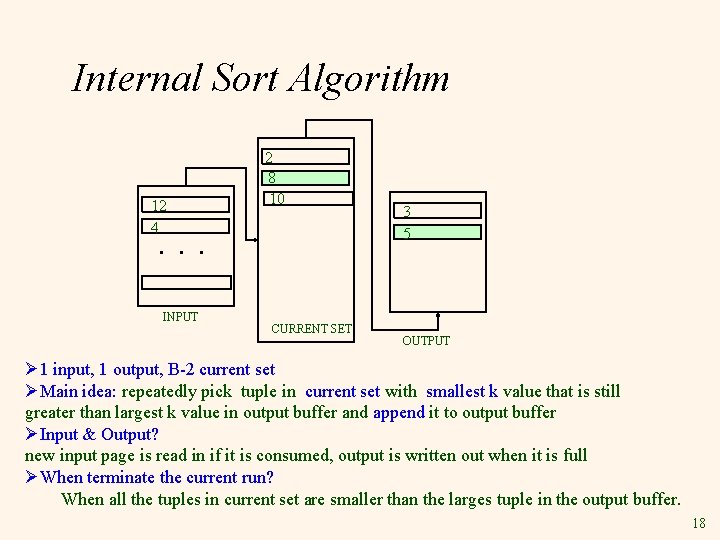
Internal Sort Algorithm 12 4 2 8 10 . . . INPUT CURRENT SET 3 5 OUTPUT Ø 1 input, 1 output, B-2 current set ØMain idea: repeatedly pick tuple in current set with smallest k value that is still greater than largest k value in output buffer and append it to output buffer ØInput & Output? new input page is read in if it is consumed, output is written out when it is full ØWhen terminate the current run? When all the tuples in current set are smaller than the larges tuple in the output buffer. 18
Optimizing External sorting v Cost metric § I/O Only (till now) § CPU is nontrivial, worth reducing v Further optimization for external sorting. § Blocked I/O § Double buffering 19
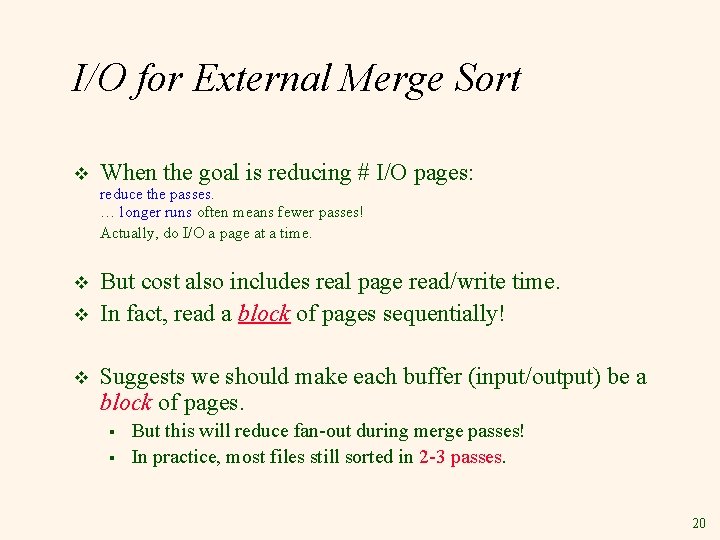
I/O for External Merge Sort v When the goal is reducing # I/O pages: reduce the passes. … longer runs often means fewer passes! Actually, do I/O a page at a time. v v v But cost also includes real page read/write time. In fact, read a block of pages sequentially! Suggests we should make each buffer (input/output) be a block of pages. § § But this will reduce fan-out during merge passes! In practice, most files still sorted in 2 -3 passes. 20
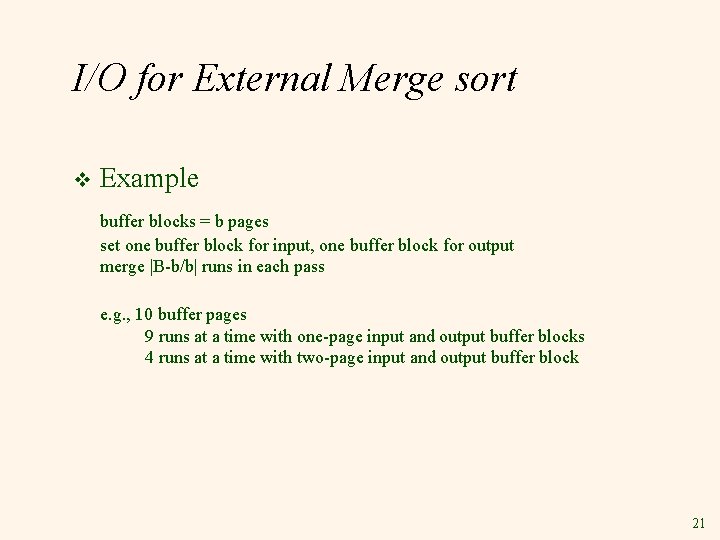
I/O for External Merge sort v Example buffer blocks = b pages set one buffer block for input, one buffer block for output merge |B-b/b| runs in each pass e. g. , 10 buffer pages 9 runs at a time with one-page input and output buffer blocks 4 runs at a time with two-page input and output buffer block 21
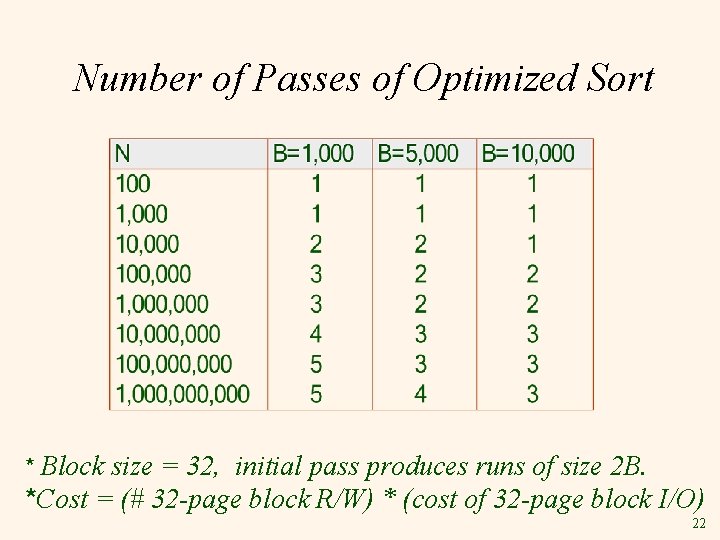
Number of Passes of Optimized Sort * Block size = 32, initial pass produces runs of size 2 B. *Cost = (# 32 -page block R/W) * (cost of 32 -page block I/O) 22
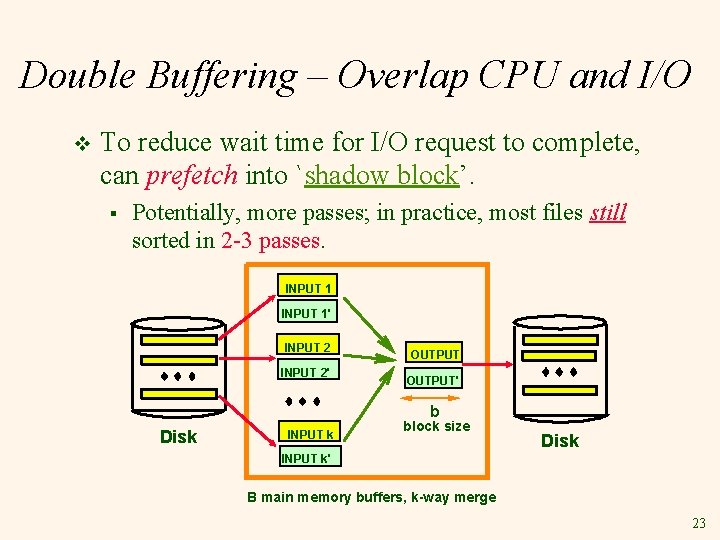
Double Buffering – Overlap CPU and I/O v To reduce wait time for I/O request to complete, can prefetch into `shadow block’. § Potentially, more passes; in practice, most files still sorted in 2 -3 passes. INPUT 1' INPUT 2' OUTPUT' b Disk INPUT k block size Disk INPUT k' B main memory buffers, k-way merge 23
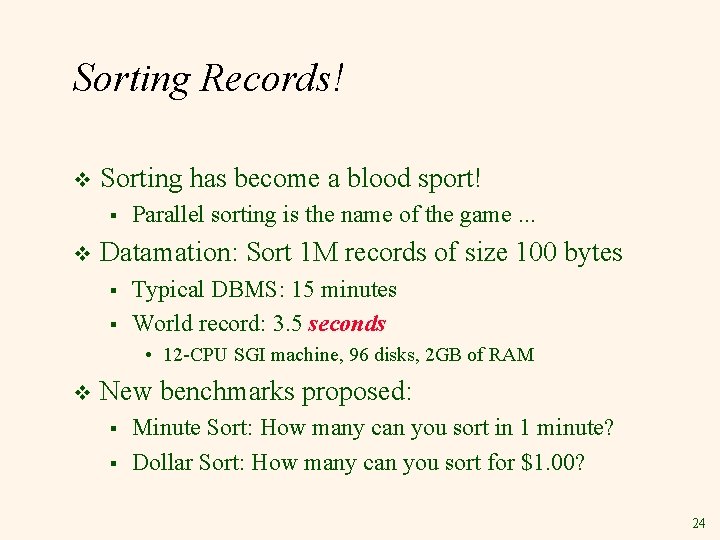
Sorting Records! v Sorting has become a blood sport! § v Parallel sorting is the name of the game. . . Datamation: Sort 1 M records of size 100 bytes § § Typical DBMS: 15 minutes World record: 3. 5 seconds • 12 -CPU SGI machine, 96 disks, 2 GB of RAM v New benchmarks proposed: § § Minute Sort: How many can you sort in 1 minute? Dollar Sort: How many can you sort for $1. 00? 24
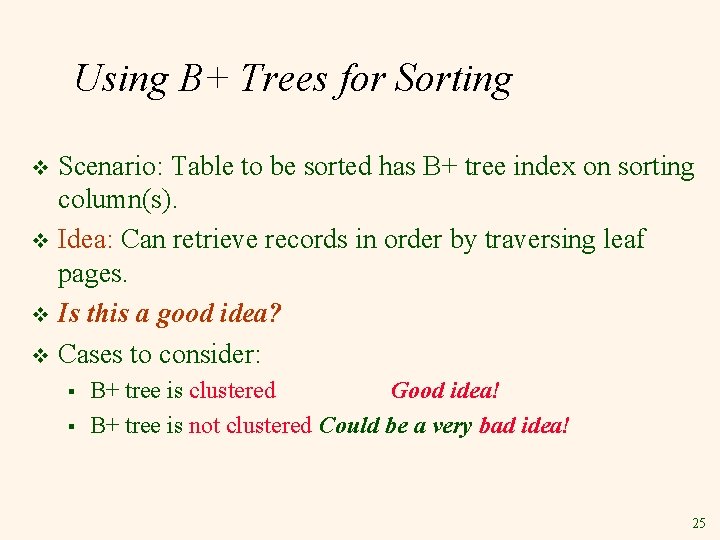
Using B+ Trees for Sorting Scenario: Table to be sorted has B+ tree index on sorting column(s). v Idea: Can retrieve records in order by traversing leaf pages. v Is this a good idea? v Cases to consider: v § § B+ tree is clustered Good idea! B+ tree is not clustered Could be a very bad idea! 25
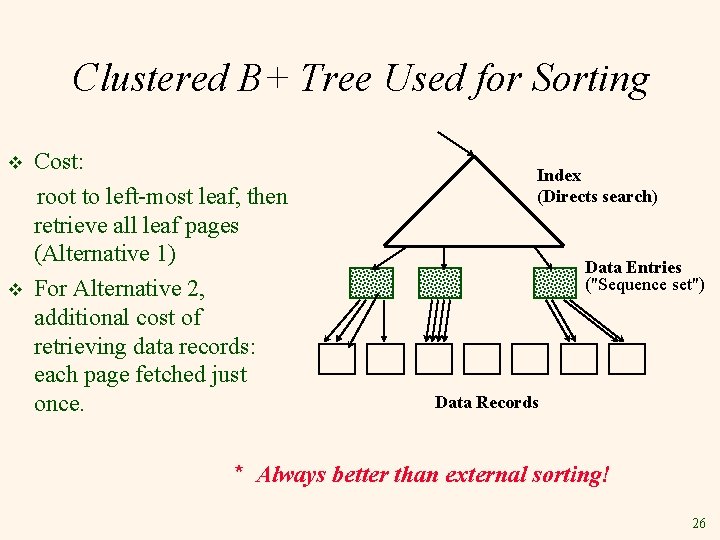
Clustered B+ Tree Used for Sorting v v Cost: root to left-most leaf, then retrieve all leaf pages (Alternative 1) For Alternative 2, additional cost of retrieving data records: each page fetched just once. Index (Directs search) Data Entries ("Sequence set") Data Records * Always better than external sorting! 26
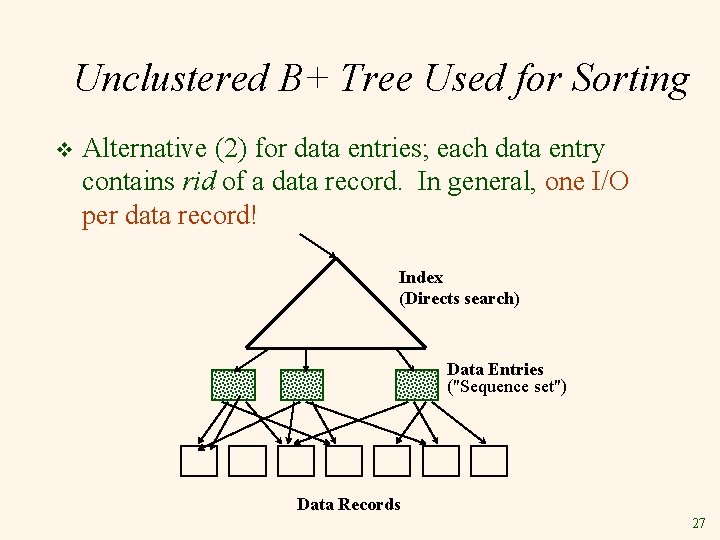
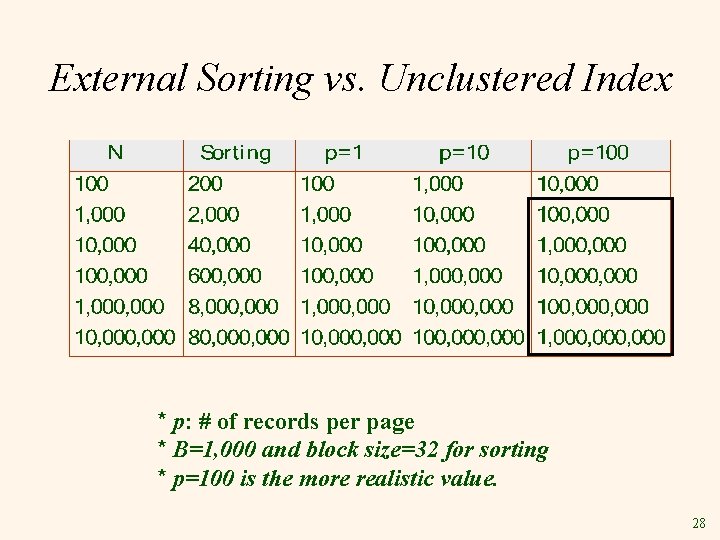
Unclustered B+ Tree Used for Sorting v Alternative (2) for data entries; each data entry contains rid of a data record. In general, one I/O per data record! Index (Directs search) Data Entries ("Sequence set") Data Records 27
External Sorting vs. Unclustered Index * p: # of records per page * B=1, 000 and block size=32 for sorting * p=100 is the more realistic value. 28
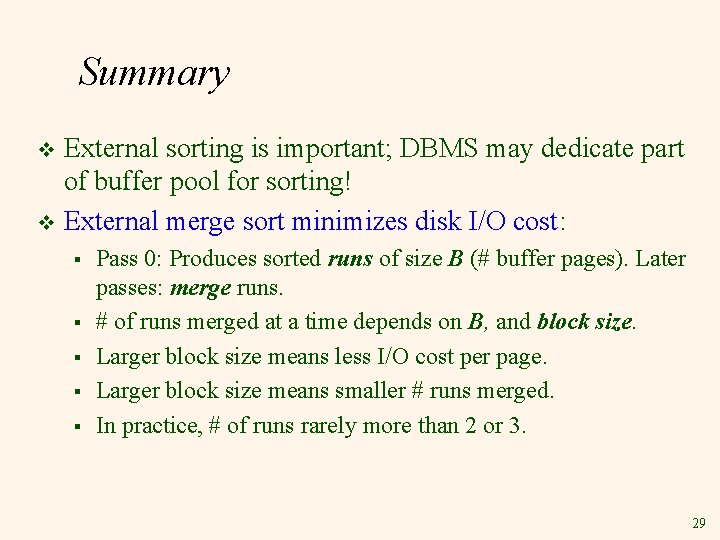
Summary External sorting is important; DBMS may dedicate part of buffer pool for sorting! v External merge sort minimizes disk I/O cost: v § § § Pass 0: Produces sorted runs of size B (# buffer pages). Later passes: merge runs. # of runs merged at a time depends on B, and block size. Larger block size means less I/O cost per page. Larger block size means smaller # runs merged. In practice, # of runs rarely more than 2 or 3. 29
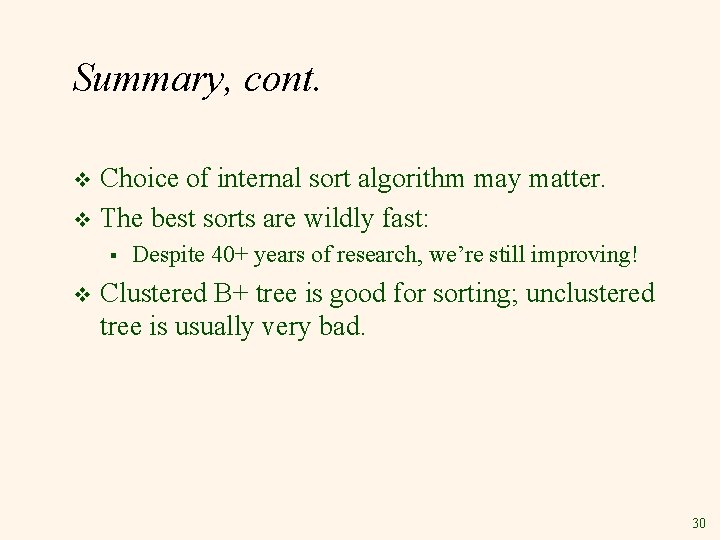
Summary, cont. Choice of internal sort algorithm may matter. v The best sorts are wildly fast: v § v Despite 40+ years of research, we’re still improving! Clustered B+ tree is good for sorting; unclustered tree is usually very bad. 30