Experiences with nonO 157 STEC and implications on

- Slides: 34
Experiences with non-O 157 STEC and implications on Public Health Programs FLEMMING SCHEUTZ STATENS SERUM INSTITUT The International Escherichia and Klebsiella Centre (WHO) Copenhagen
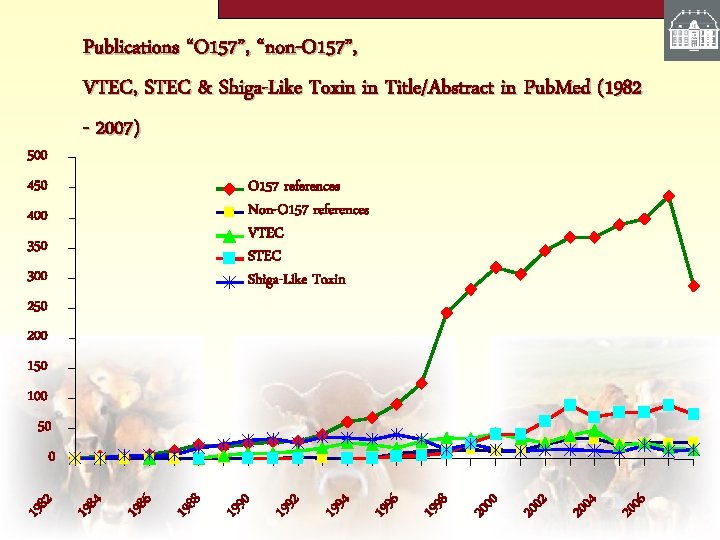
Publications “O 157”, “non-O 157”, VTEC, STEC & Shiga-Like Toxin in Title/Abstract in Pub. Med (1982 - 2007) 500 450 O 157 references Non-O 157 references VTEC Shiga-Like Toxin 400 350 300 250 200 150 100 50 6 200 4 200 0 200 2 8 199 200 6 2 199 0 199 4 8 199 6 4 198 2 198 0
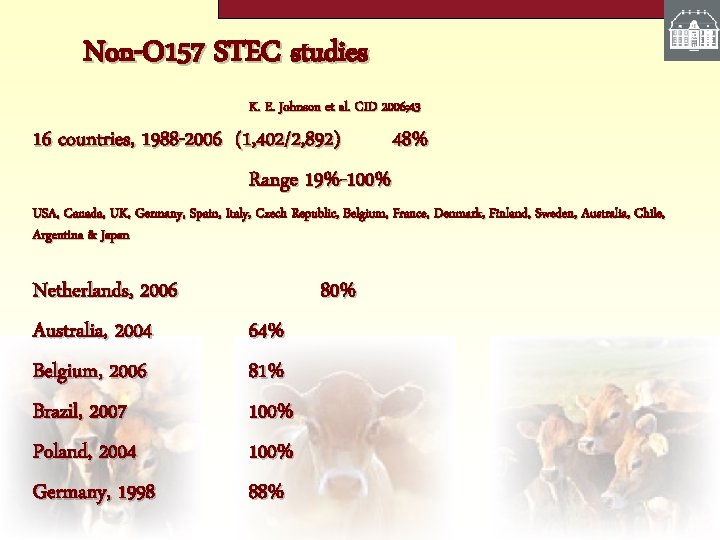
Non-O 157 STEC studies K. E. Johnson et al. CID 2006; 43 16 countries, 1988 -2006 (1, 402/2, 892) 48% Range 19%-100% USA, Canada, UK, Germany, Spain, Italy, Czech Republic, Belgium, France, Denmark, Finland, Sweden, Australia, Chile, Argentina & Japan Netherlands, 2006 Australia, 2004 Belgium, 2006 Brazil, 2007 Poland, 2004 Germany, 1998 80% 64% 81% 100% 88%
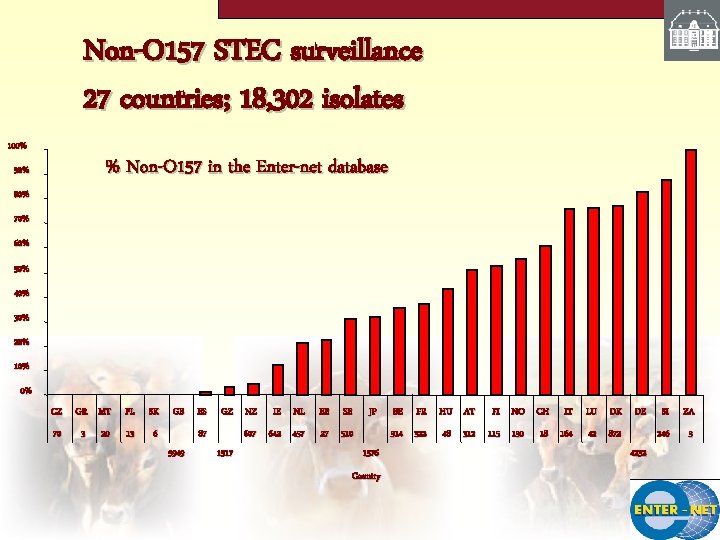
Non-O 157 STEC surveillance 27 countries; 18, 302 isolates 100% % Non-O 157 in the Enter-net database 90% 80% 70% 60% 50% 40% 30% 20% 10% 0% CZ 70 GR MT 3 20 PL SK 13 6 GB 5949 ES GZ NZ 87 607 1517 IE NL 642 457 EE SE JP 27 510 1576 Country BE FR HU AT 314 322 48 312 FI NO CH 115 130 IT 18 164 LU DK DE 42 872 4232 SI ZA 246 3
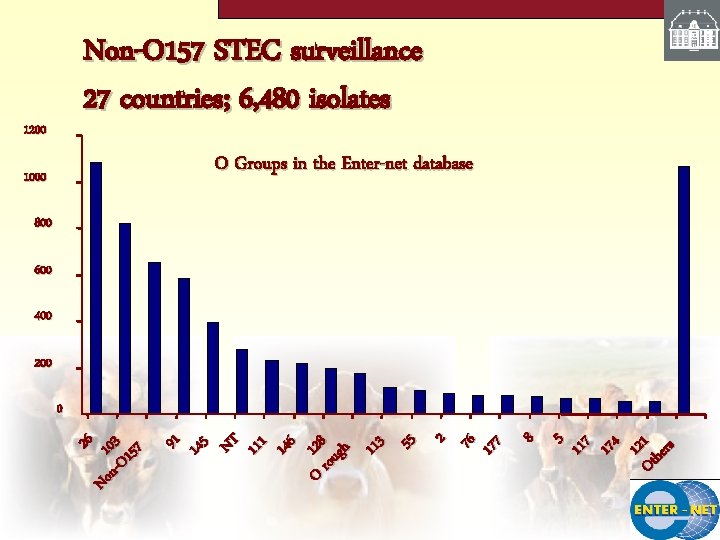
Non-O 157 STEC surveillance 27 countries; 6, 480 isolates 1200 O Groups in the Enter-net database 1000 800 600 400 200 8 5 117 174 1 Ot 21 her s 91 145 NT 111 146 O 128 rou gh 113 55 2 76 177 26 No 1 n-O 03 157 0
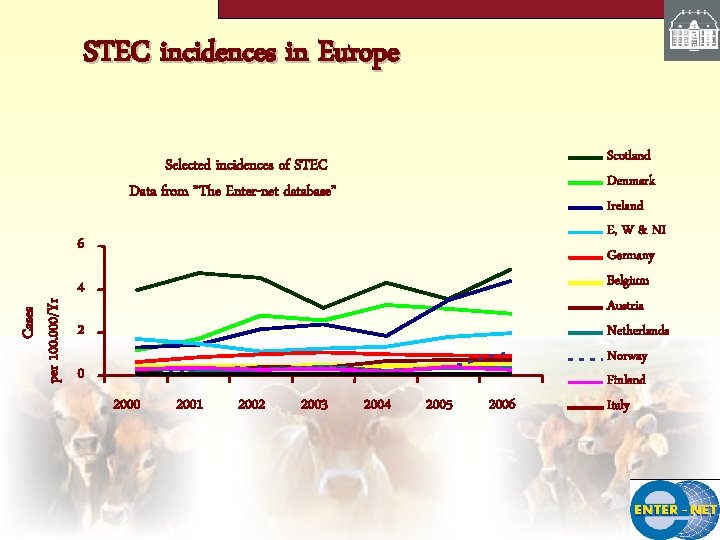
STEC incidences in Europe Selected incidences of STEC Data from ”The Enter-net database” Cases per 100. 000/Yr 6 4 2 0 2001 2002 2003 2004 2005 2006 Scotland Denmark Ireland E, W & NI Germany Belgium Austria Netherlands Norway Finland Italy
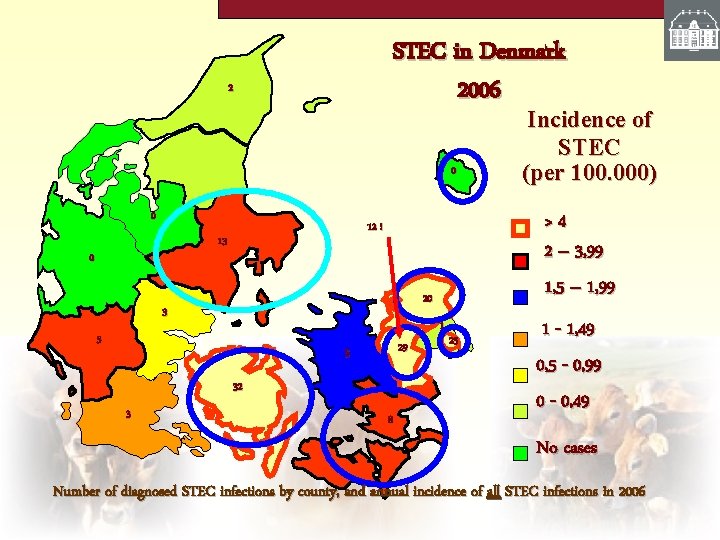
STEC in Denmark 2006 2 0 0 0 20 3 1 5 29 12 5 32 3 >4 2 – 3, 99 1, 5 – 1, 99 12 ! 13 8 Incidence of STEC (per 100. 000) 25 1 - 1, 49 0, 5 - 0, 99 0 - 0, 49 No cases Number of diagnosed STEC infections by county, and annual incidence of all STEC infections in 2006
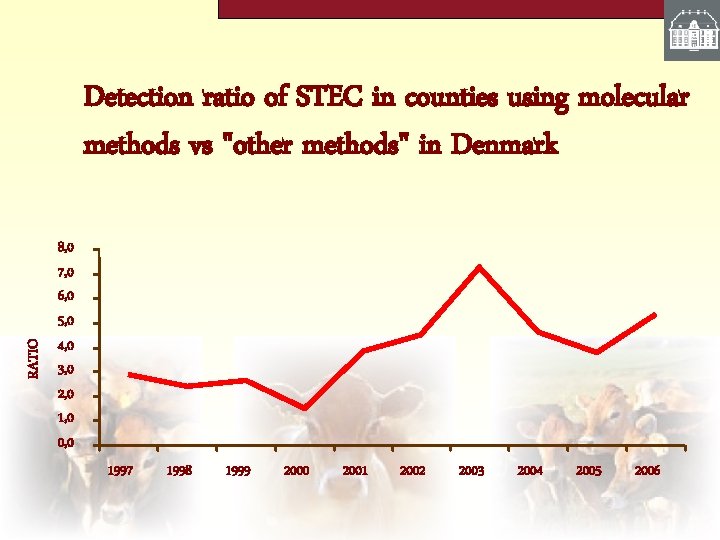
RATIO Detection ratio of STEC in counties using molecular methods vs "other methods" in Denmark 8, 0 7, 0 6, 0 5, 0 4, 0 3, 0 2, 0 1, 0 0, 0 1997 1998 1999 2000 2001 2002 2003 2004 2005 2006
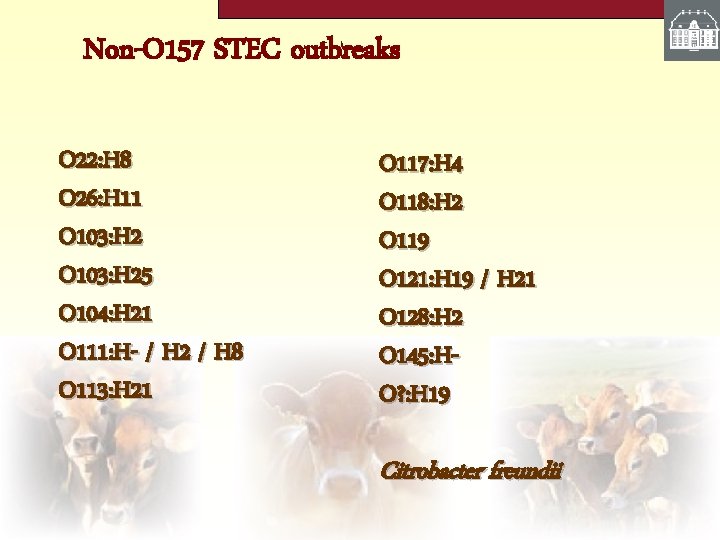
Non-O 157 STEC outbreaks O 22: H 8 O 26: H 11 O 103: H 25 O 104: H 21 O 111: H- / H 2 / H 8 O 113: H 21 O 117: H 4 O 118: H 2 O 119 O 121: H 19 / H 21 O 128: H 2 O 145: HO? : H 19 Citrobacter freundii
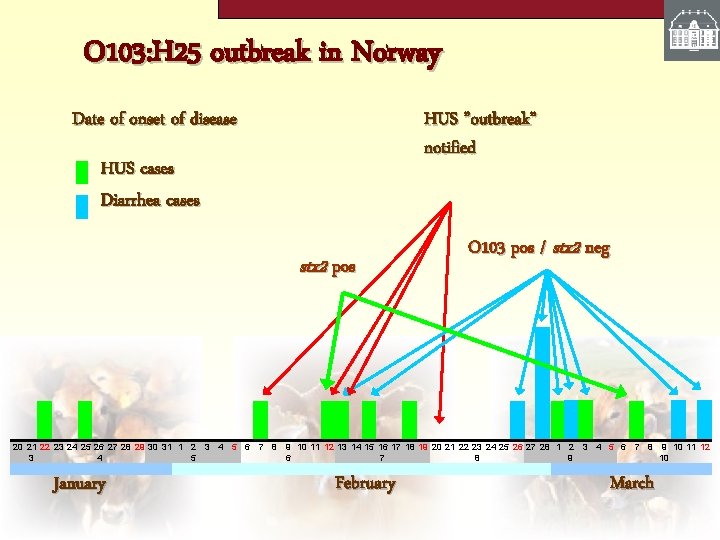
O 103: H 25 outbreak in Norway Date of onset of disease HUS ”outbreak” notified HUS cases Diarrhea cases stx 2 pos O 103 pos / stx 2 neg 20 21 22 23 24 25 26 27 28 29 30 31 1 2 3 4 5 6 7 8 9 10 11 12 13 14 15 16 17 18 19 20 21 22 23 24 25 26 27 28 1 2 3 4 5 6 7 8 9 10 11 12 3 4 5 6 7 8 9 10 January February March
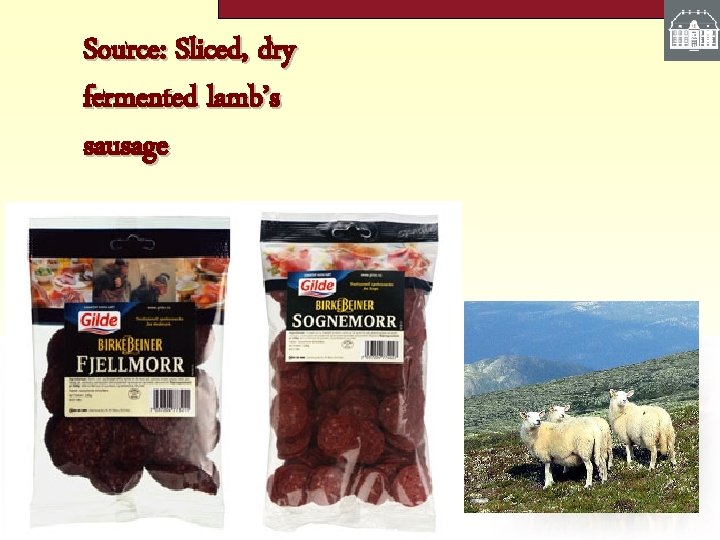
Source: Sliced, dry fermented lamb’s sausage
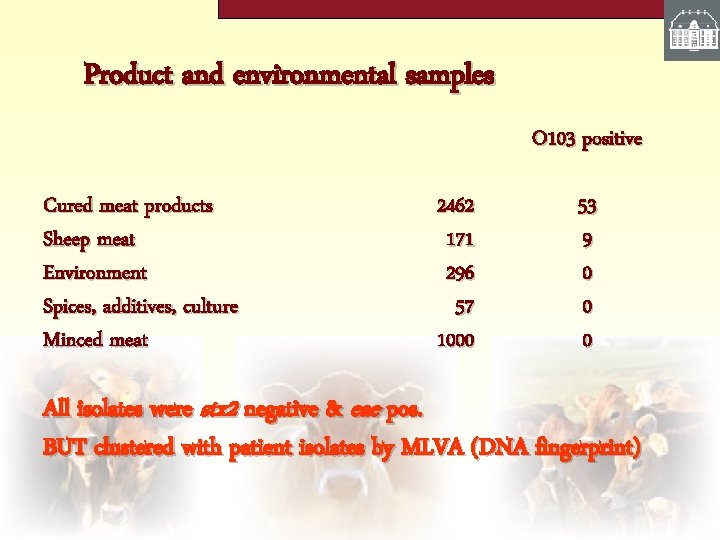
Product and environmental samples O 103 positive Cured meat products Sheep meat Environment Spices, additives, culture Minced meat 2462 171 296 57 1000 53 9 0 0 0 All isolates were stx 2 negative & eae pos. BUT clustered with patient isolates by MLVA (DNA fingerprint)
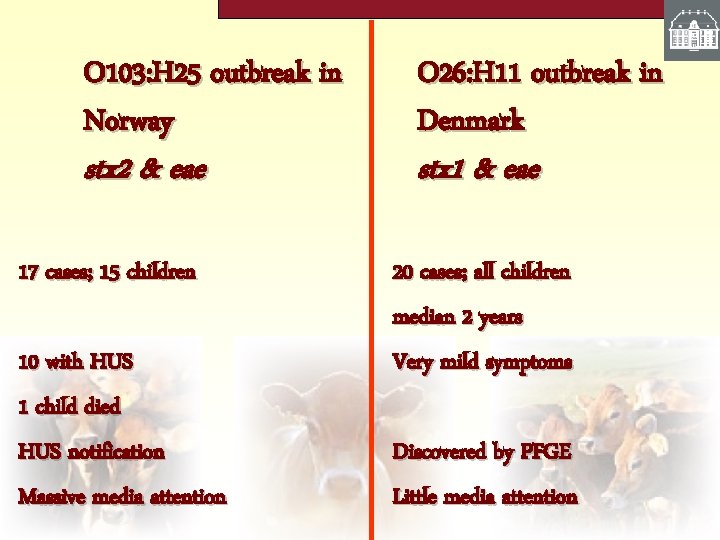
O 103: H 25 outbreak in Norway stx 2 & eae 17 cases; 15 children 10 with HUS 1 child died HUS notification Massive media attention O 26: H 11 outbreak in Denmark stx 1 & eae 20 cases; all children median 2 years Very mild symptoms Discovered by PFGE Little media attention
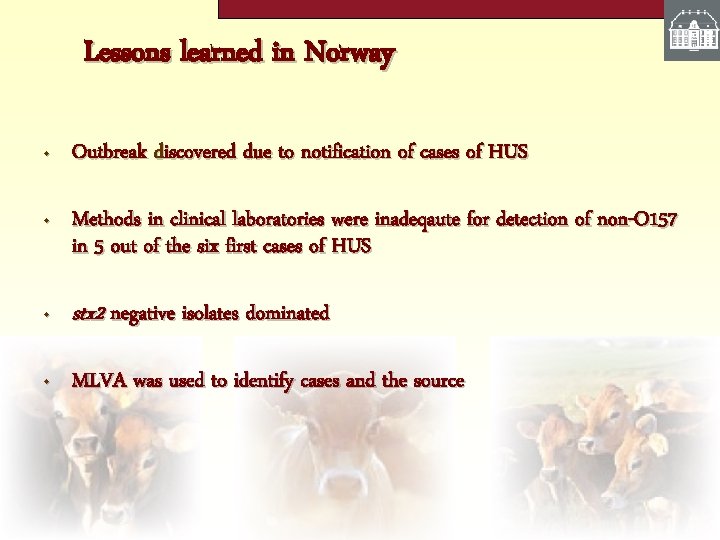
Lessons learned in Norway • Outbreak discovered due to notification of cases of HUS • Methods in clinical laboratories were inadeqaute for detection of non-O 157 in 5 out of the six first cases of HUS • stx 2 negative isolates dominated • MLVA was used to identify cases and the source
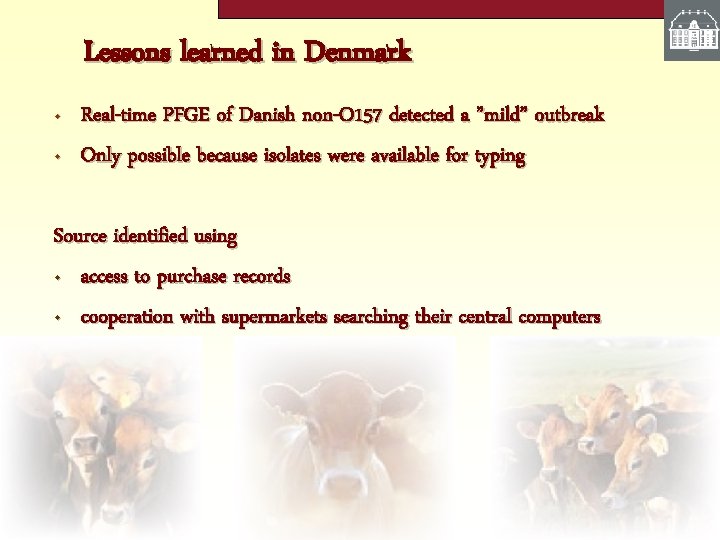
Lessons learned in Denmark • • Real-time PFGE of Danish non-O 157 detected a ”mild” outbreak Only possible because isolates were available for typing Source identified using • access to purchase records • cooperation with supermarkets searching their central computers
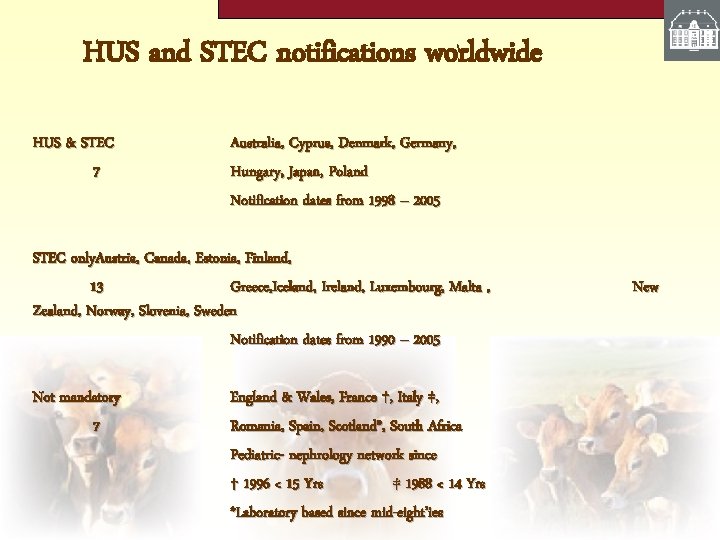
HUS and STEC notifications worldwide HUS & STEC 7 Australia, Cyprus, Denmark, Germany, Hungary, Japan, Poland Notification dates from 1998 – 2005 STEC only. Austria, Canada, Estonia, Finland, 13 Greece, Iceland, Ireland, Luxembourg, Malta , Zealand, Norway, Slovenia, Sweden Notification dates from 1990 – 2005 Not mandatory 7 England & Wales, France †, Italy ‡, Romania, Spain, Scotland*, South Africa Pediatric- nephrology network since † 1996 < 15 Yrs ‡ 1988 < 14 Yrs *Laboratory based since mid-eight’ies New
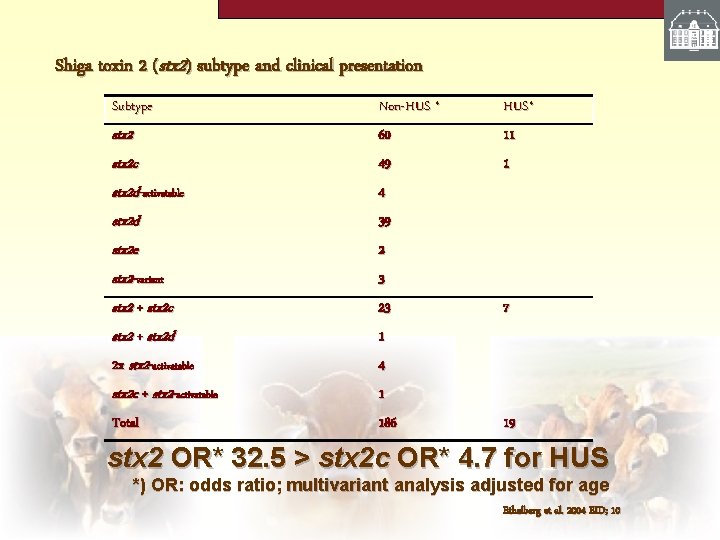
Shiga toxin 2 (stx 2) subtype and clinical presentation Subtype Non-HUS * HUS* stx 2 c 60 11 49 1 stx 2 d-activatable stx 2 d 4 stx 2 e stx 2 -variant 2 stx 2 + stx 2 c stx 2 + stx 2 d 23 2 x stx 2 -activatable 4 stx 2 c + stx 2 -activatable 1 Total 186 39 3 7 1 19 stx 2 OR* 32. 5 > stx 2 c OR* 4. 7 for HUS *) OR: odds ratio; multivariant analysis adjusted for age Ethelberg et al. 2004 EID; 10
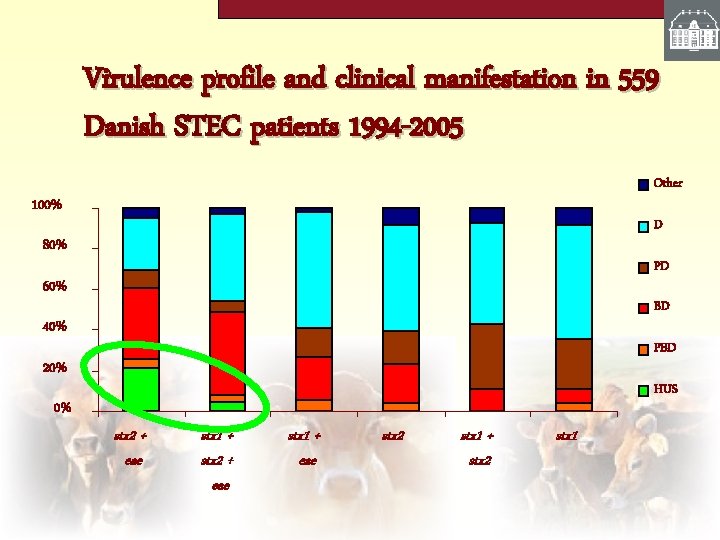
Virulence profile and clinical manifestation in 559 Danish STEC patients 1994 -2005 Other 100% D 80% PD 60% BD 40% PBD 20% HUS 0% stx 2 + eae stx 1 + eae stx 2 stx 1 + stx 2 stx 1
Stx 1 : 4 subtypes a - d 7 -8 variants Stx 1 a-S. _dysenteriae-3818 T Stx 1 a-S. _sonnei-CB 7888 a Stx 1 b-O 111 -CB 168 Stx 1 b-O 157 -EDL 933 Stx 1 b-O 48 -94 C Stx 1 b-O 111 -PH Stx 1 c-O 174 -DG 131 -3 Stx 1 d-ONT-MHI 813 SP A 1 A 2 SP B b c d
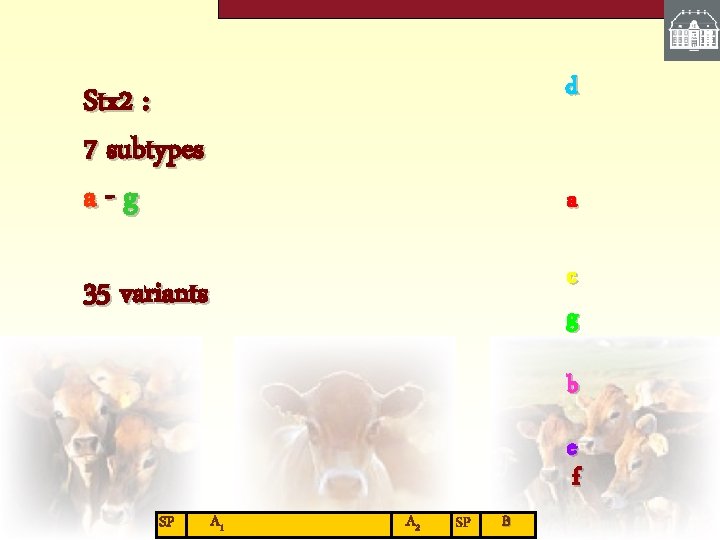
Stx 2 : 7 subtypes a-g d 35 variants c g a b e f SP A 1 A 2 SP B
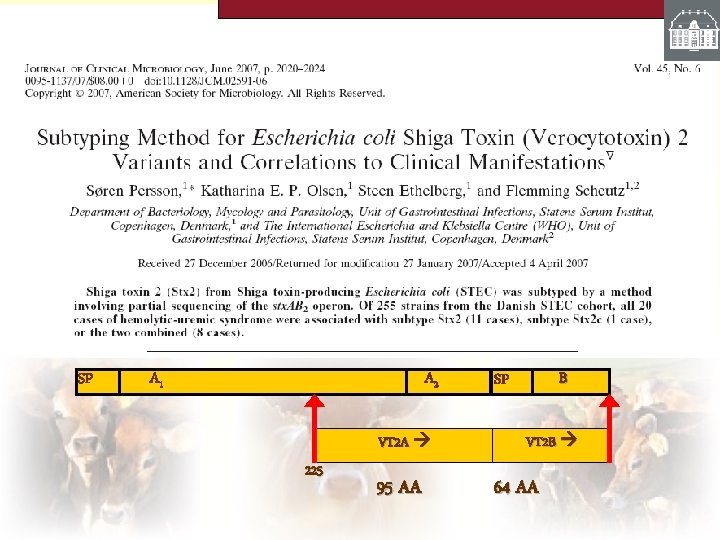
SP A 1 A 2 VT 2 A 225 95 AA B SP VT 2 B 64 AA
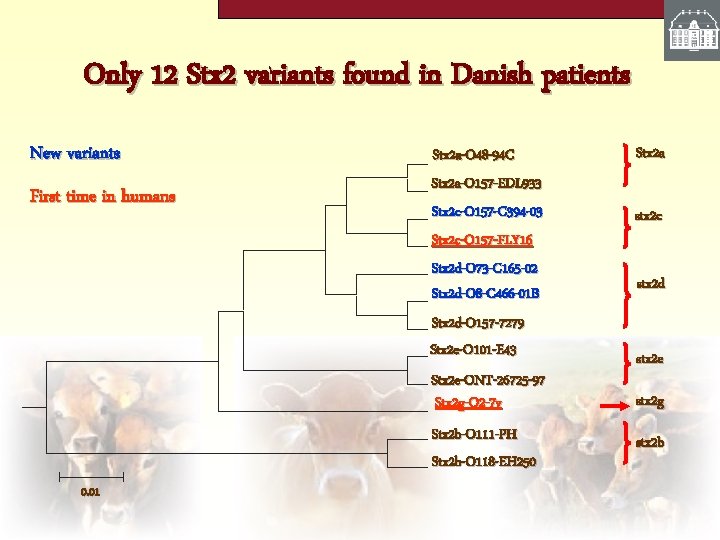
Only 12 Stx 2 variants found in Danish patients New variants First time in humans Stx 2 a-O 48 -94 C Stx 2 a-O 157 -EDL 933 Stx 2 c-O 157 -C 394 -03 Stx 2 c-O 157 -FLY 16 Stx 2 d-O 73 -C 165 -02 Stx 2 d-O 8 -C 466 -01 B Stx 2 d-O 157 -7279 Stx 2 e-O 101 -E 43 0. 01 Stx 2 a stx 2 c stx 2 d stx 2 e Stx 2 e-ONT-26725 -97 Stx 2 g-O 2 -7 v stx 2 g Stx 2 b-O 111 -PH Stx 2 b-O 118 -EH 250 stx 2 b
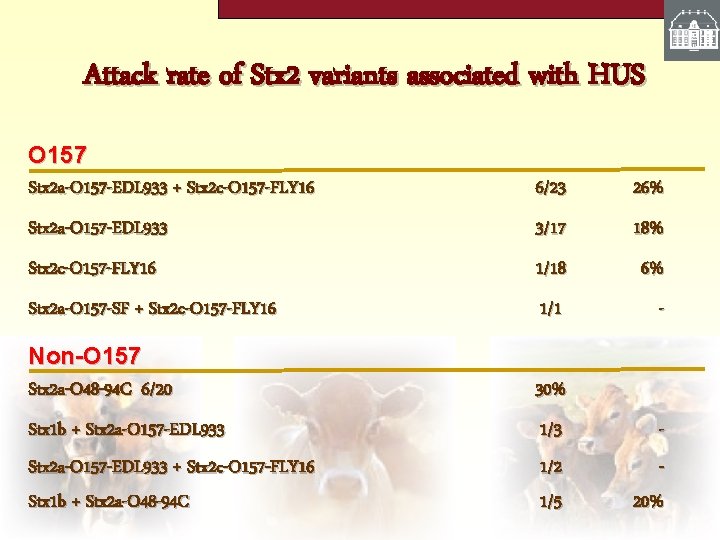
Attack rate of Stx 2 variants associated with HUS O 157 Stx 2 a-O 157 -EDL 933 + Stx 2 c-O 157 -FLY 16 6/23 26% Stx 2 a-O 157 -EDL 933 3/17 18% Stx 2 c-O 157 -FLY 16 1/18 6% Stx 2 a-O 157 -SF + Stx 2 c-O 157 -FLY 16 1/1 - Non-O 157 Stx 2 a-O 48 -94 C 6/20 30% Stx 1 b + Stx 2 a-O 157 -EDL 933 1/3 - Stx 2 a-O 157 -EDL 933 + Stx 2 c-O 157 -FLY 16 Stx 1 b + Stx 2 a-O 48 -94 C 1/2 1/5 20%
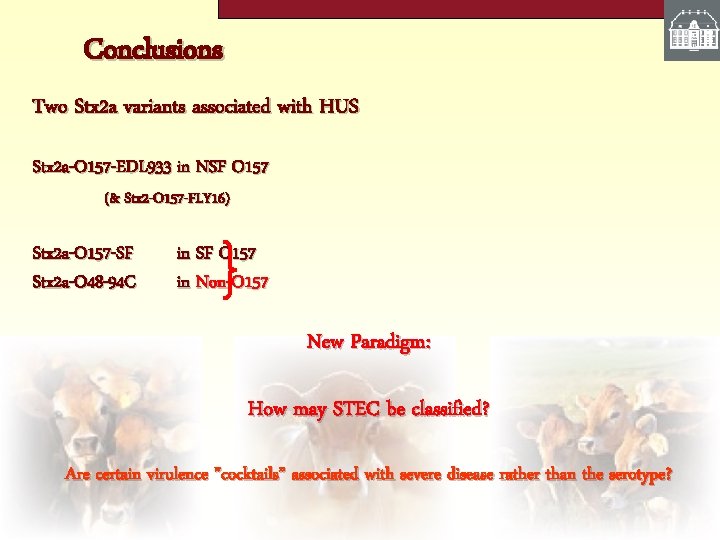
Conclusions Two Stx 2 a variants associated with HUS Stx 2 a-O 157 -EDL 933 in NSF O 157 (& Stx 2 -O 157 -FLY 16) Stx 2 a-O 157 -SF Stx 2 a-O 48 -94 C in SF O 157 in Non-O 157 New Paradigm: How may STEC be classified? Are certain virulence ”cocktails” associated with severe disease rather than the serotype?
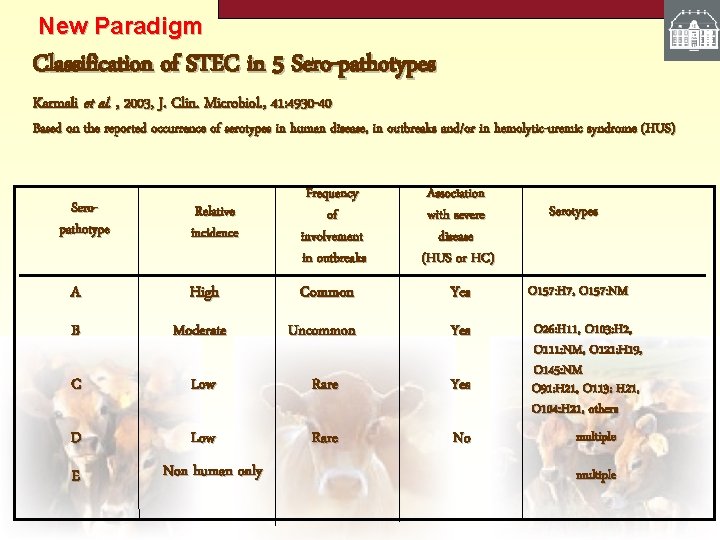
New Paradigm Classification of STEC in 5 Sero-pathotypes Karmali et al. , 2003, J. Clin. Microbiol. , 41: 4930 -40 Based on the reported occurrence of serotypes in human disease, in outbreaks and/or in hemolytic-uremic syndrome (HUS) Relative incidence Frequency of involvement in outbreaks A High Common Yes O 157: H 7, O 157: NM B Moderate Uncommon Yes C Low Rare Yes O 26: H 11, O 103: H 2, O 111: NM, O 121: H 19, O 145: NM O 91: H 21, O 113: H 21, O 104: H 21, others D Low Rare No Seropathotype E Non human only Association with severe disease (HUS or HC) Serotypes multiple
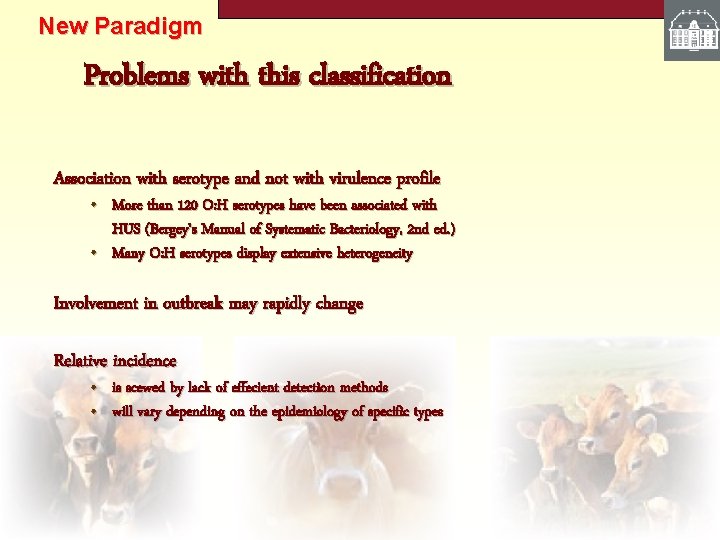
New Paradigm Problems with this classification Association with serotype and not with virulence profile • More than 120 O: H serotypes have been associated with HUS (Bergey’s Manual of Systematic Bacteriology, 2 nd ed. ) • Many O: H serotypes display extensive heterogeneity Involvement in outbreak may rapidly change Relative incidence • • is scewed by lack of effecient detection methods will vary depending on the epidemiology of specific types
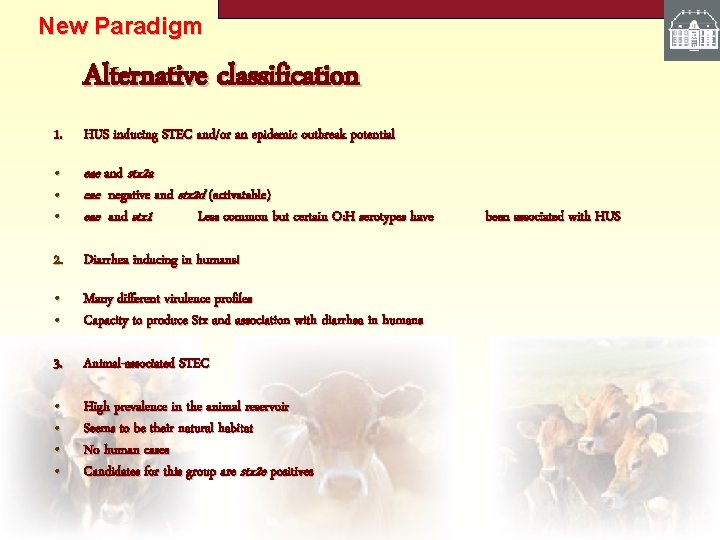
New Paradigm Alternative classification 1. HUS inducing STEC and/or an epidemic outbreak potential • • • eae and stx 2 a eae negative and stx 2 d (activatable) eae and stx 1 Less common but certain O: H serotypes have 2. Diarrhea inducing in humans! • • Many different virulence profiles Capacity to produce Stx and association with diarrhea in humans 3. Animal-associated STEC • • High prevalence in the animal reservoir Seems to be their natural habitat No human cases Candidates for this group are stx 2 e positives been associated with HUS
New Paradigm Questions Should management and treatment of patients be adjusted according to virulence cocktail?
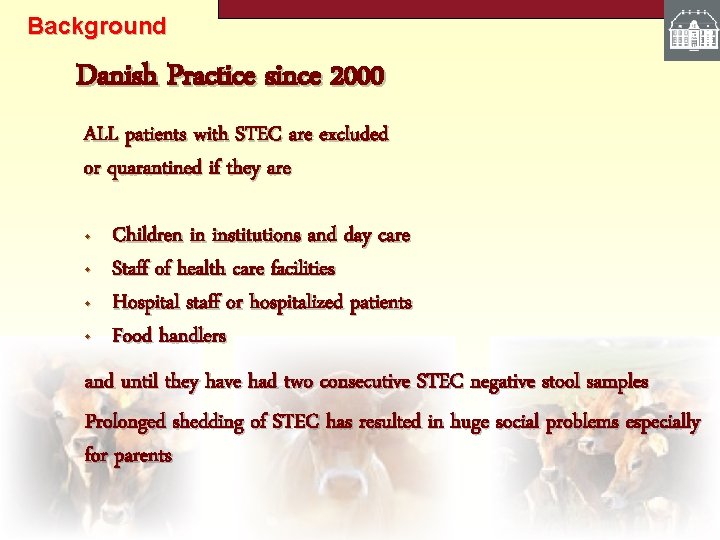
Background Danish Practice since 2000 ALL patients with STEC are excluded or quarantined if they are • • Children in institutions and day care Staff of health care facilities Hospital staff or hospitalized patients Food handlers and until they have had two consecutive STEC negative stool samples Prolonged shedding of STEC has resulted in huge social problems especially for parents
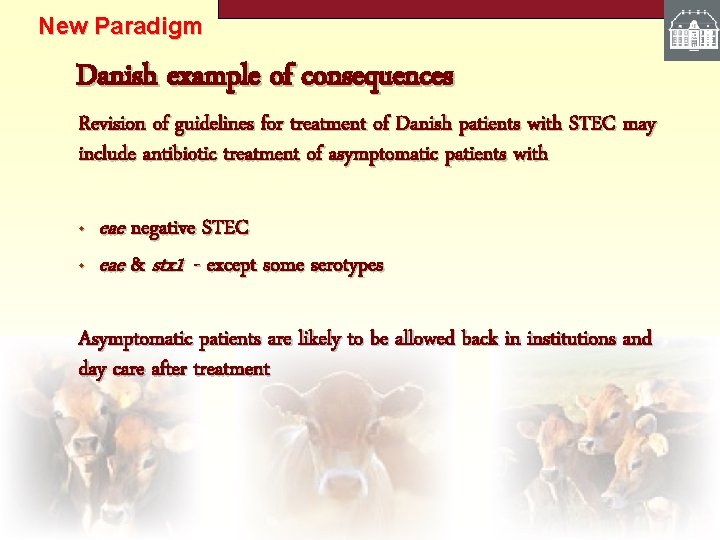
New Paradigm Danish example of consequences Revision of guidelines for treatment of Danish patients with STEC may include antibiotic treatment of asymptomatic patients with • • eae negative STEC eae & stx 1 - except some serotypes Asymptomatic patients are likely to be allowed back in institutions and day care after treatment
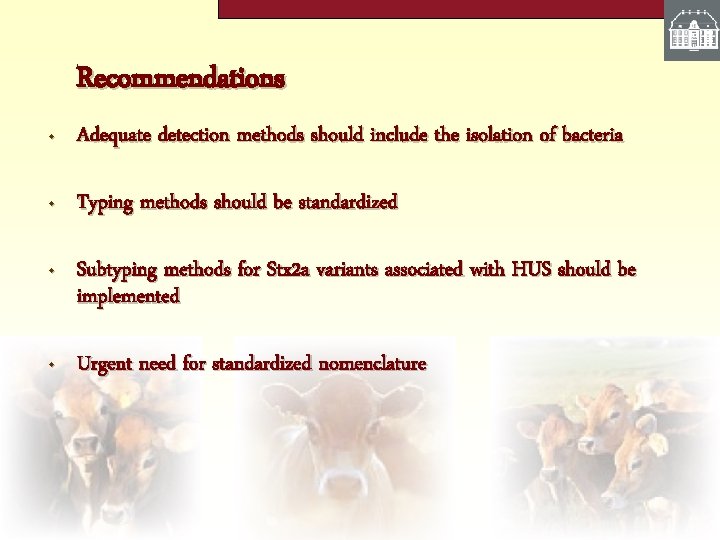
Recommendations • Adequate detection methods should include the isolation of bacteria • Typing methods should be standardized • Subtyping methods for Stx 2 a variants associated with HUS should be implemented • Urgent need for standardized nomenclature
Questions 1. 2. 3. • • • How much is detection and surveillance scewed? Can case definitions for HUS to be notified within the Public Health system be established? Will management and treatment of STEC patients depend on a case-to-case based assessment? an outbreak-to-outbreak approach? local epidemiology?
Question Should non-O 157: H 7 STECs be considered to be adulterants as E. coli O 157: H 7? YES - some
Acknowledgements Statens Serum Institut, Copenhagen Joan Neverman Jensen Søren Persson Katharina E. P. Olsen Co-authors on nomenclature Lothar Beutin, Federal Institute for Risk Assessment, Berlin Denis Piérard, Academisch Ziekenhuis Vrije Universiteit, Brussels Nancy A. Strockbine, National Center for Zoonotic, Vector-borne and Enteric Diseases (CDC), Atlanta