NonO 157 Shiga toxinproducing Escherichia coli Isolation and



- Slides: 31
Non-O 157 Shiga toxin-producing Escherichia coli: Isolation and detection challenges Cheryl Bopp, M. S. , Chief, Epidemic Investigations Laboratory Unit, Enteric Diseases Laboratory Branch NCZVED-CDC
Outline Nomenclature (STEC, EHEC, VTEC) and abbreviations Isolation and detection challenges – Diagnostic methodology – Detection of outbreaks – Guidelines for laboratories and physicians Summary
Nomenclature Verocytotoxin-producing E. coli (VTEC) – Konawalchuck, et al, 1977 Enterohemorrhagic E. coli (EHEC) Shiga toxin-producing E. coli (STEC) – O’Brien, et al, 1983 Shiga toxin-producing E. coli (STEC) nomenclature used in this presentation
Abbreviations O 157 STEC – Shiga toxin-producing E. coli O 157: H 7 Non-O 157 STEC – All other serotypes of Shiga toxin-producing E. coli (more than 100) Stx – Shiga toxin Stx-EIA – Shiga toxin immunoassay (test which detects the presence of Shiga toxin) – not all are enzyme immunoassays
Diagnostic methodology challenges
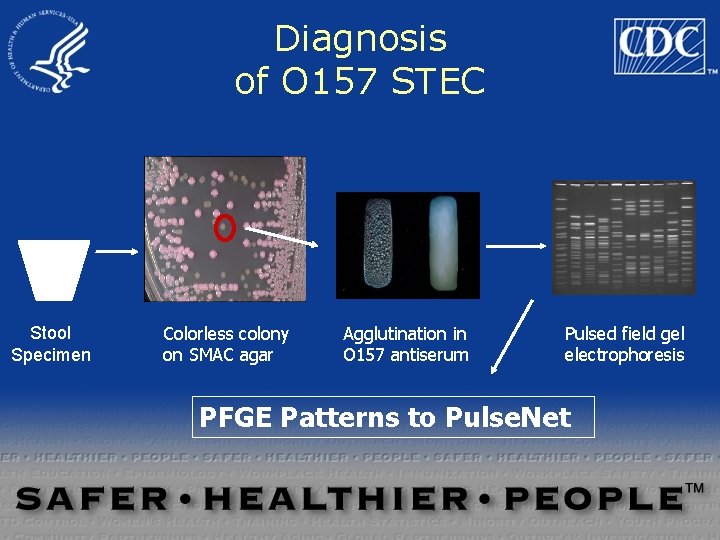
Diagnosis of O 157 STEC Stool Specimen Colorless colony on SMAC agar Agglutination in O 157 antiserum Pulsed field gel electrophoresis PFGE Patterns to Pulse. Net
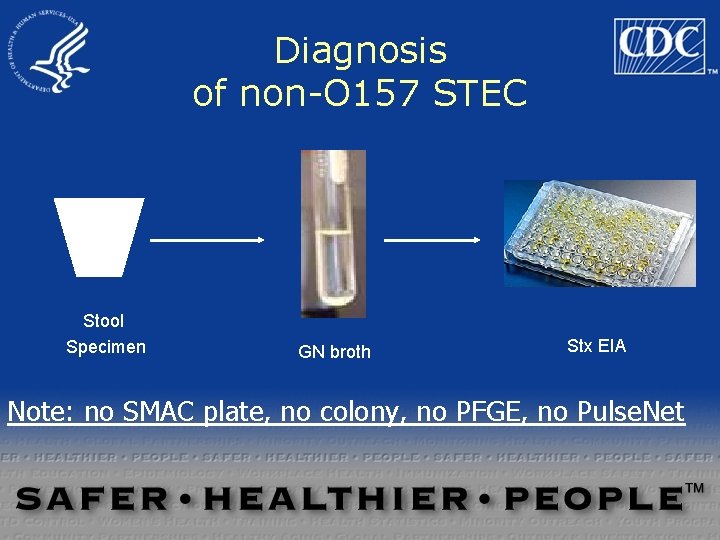
Diagnosis of non-O 157 STEC Stool Specimen GN broth Stx EIA Note: no SMAC plate, no colony, no PFGE, no Pulse. Net
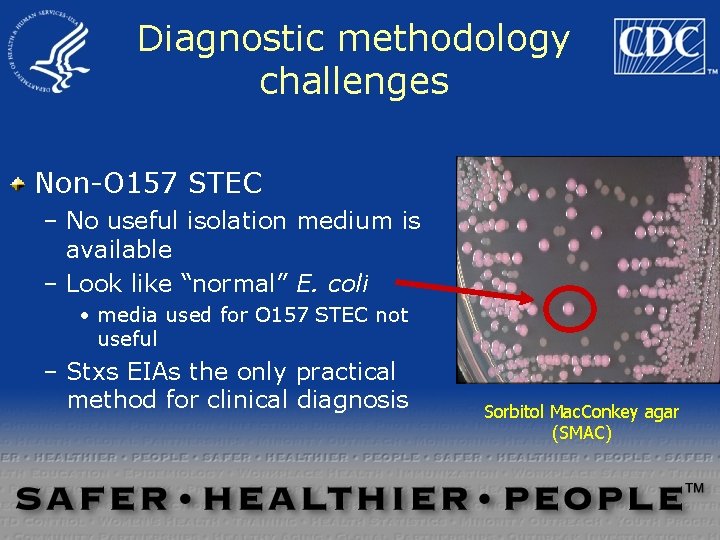
Diagnostic methodology challenges Non-O 157 STEC – No useful isolation medium is available – Look like “normal” E. coli • media used for O 157 STEC not useful – Stxs EIAs the only practical method for clinical diagnosis Sorbitol Mac. Conkey agar (SMAC)
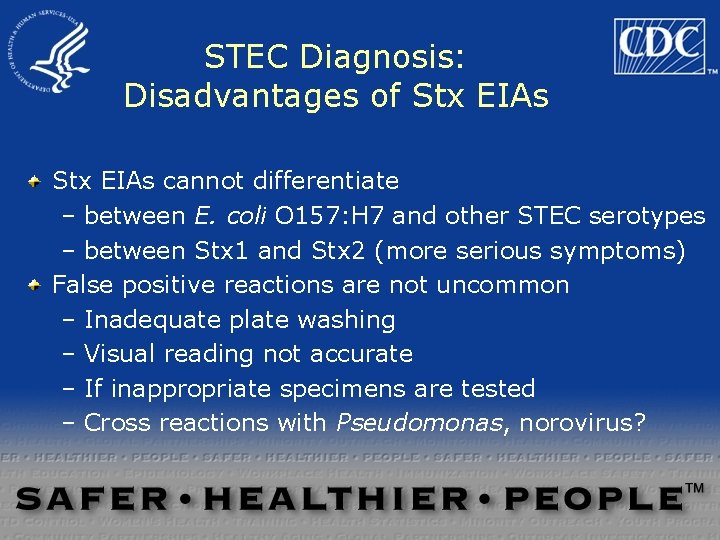
STEC Diagnosis: Disadvantages of Stx EIAs cannot differentiate – between E. coli O 157: H 7 and other STEC serotypes – between Stx 1 and Stx 2 (more serious symptoms) False positive reactions are not uncommon – Inadequate plate washing – Visual reading not accurate – If inappropriate specimens are tested – Cross reactions with Pseudomonas, norovirus?
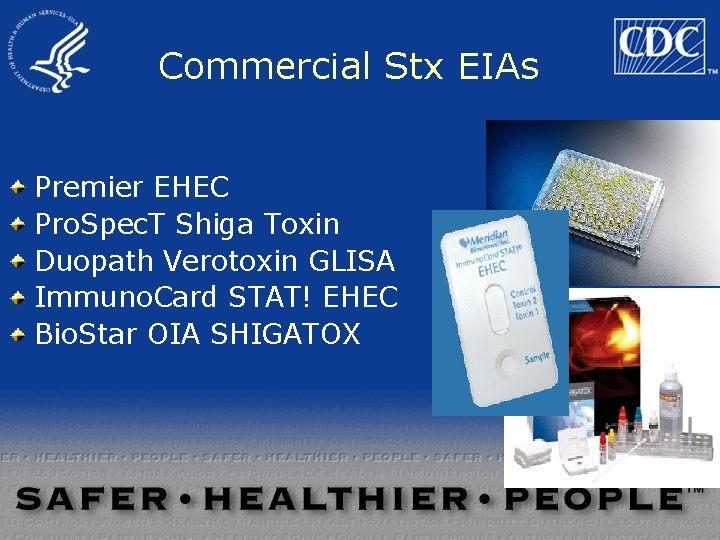
Commercial Stx EIAs Premier EHEC Pro. Spec. T Shiga Toxin Duopath Verotoxin GLISA Immuno. Card STAT! EHEC Bio. Star OIA SHIGATOX
1, 945 Non-O 157 STEC Serotyped by CDC, 1983 -2005 510 K-approval of commercial Stx EIA CDC, unpublished data
Challenges for outbreak detection (how do you isolate non-O 157 STEC? )
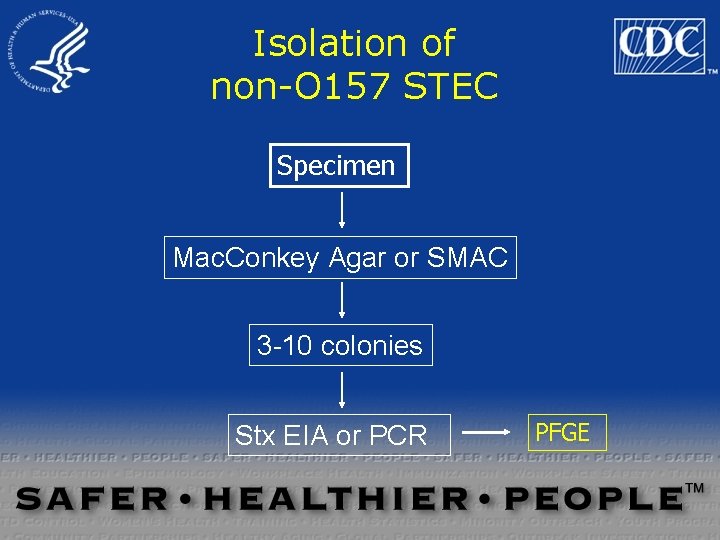
Isolation of non-O 157 STEC Specimen Mac. Conkey Agar or SMAC 3 -10 colonies Stx EIA or PCR PFGE
Challenges for outbreak detection Most clinical laboratories don’t attempt to isolate non-O 157 STEC – Clinical labs send Shiga toxin positive broths to public health laboratories Public health laboratories – Most isolate non-O 157 STEC from broths sent by clinical labs
Problems for Public Health Labs Testing broths for non-O 157 STEC is expensive – Multiple isolates must be tested by EIA or PCR – Laboratory personnel and reagents are expensive Public health labs have other priorities – Influenza – HIV and STDs – Tuberculosis – Bioterrorism
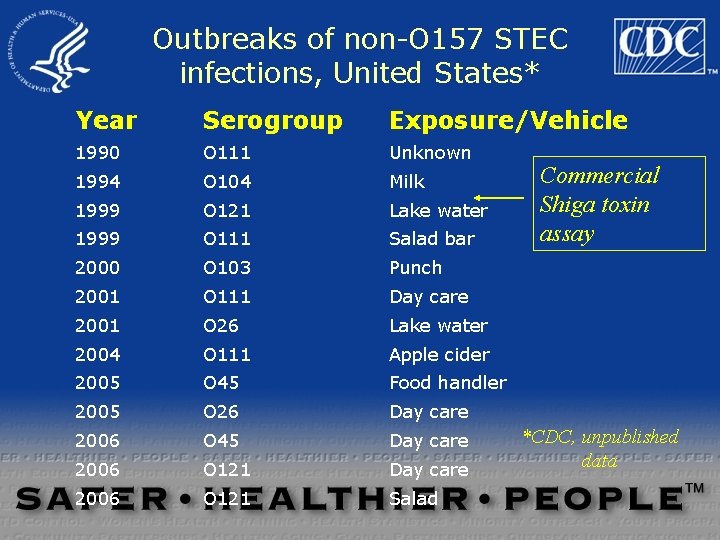
Outbreaks of non-O 157 STEC infections, United States* Year Serogroup Exposure/Vehicle 1990 O 111 Unknown 1994 O 104 Milk 1999 O 121 Lake water 1999 O 111 Salad bar 2000 O 103 Punch 2001 O 111 Day care 2001 O 26 Lake water 2004 O 111 Apple cider 2005 O 45 Food handler 2005 O 26 Day care 2006 O 45 Day care 2006 O 121 Salad Commercial Shiga toxin assay *CDC, unpublished data
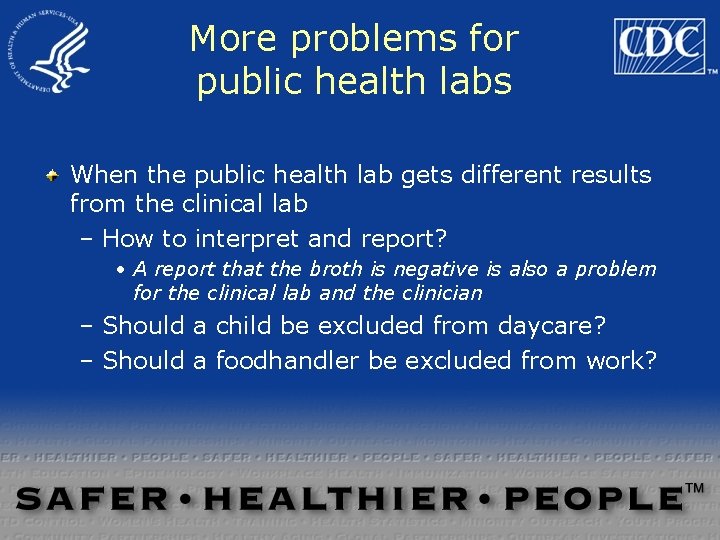
More problems for public health labs When the public health lab gets different results from the clinical lab – How to interpret and report? • A report that the broth is negative is also a problem for the clinical lab and the clinician – Should a child be excluded from daycare? – Should a foodhandler be excluded from work?
A critical need: guidelines for laboratories and physicians
Guidelines for laboratories and physicians Guidelines needed for diagnosis and detection of non O 157 STEC – Physicians – Clinical diagnostic laboratories – Public health laboratories
Physicians need to know Must act quickly - only 3 to 4 days to prevent HUS Order appropriate diagnostic test and understand its utility and limitations
Clinical labs need to know Clinical laboratories need specific guidelines for diagnostic testing – What specimens to test – What test methods to use – How to interpret and report results to physicians – E. coli O 157: H 7 isolates and Shiga toxin-positive broths should be sent to a public health laboratory
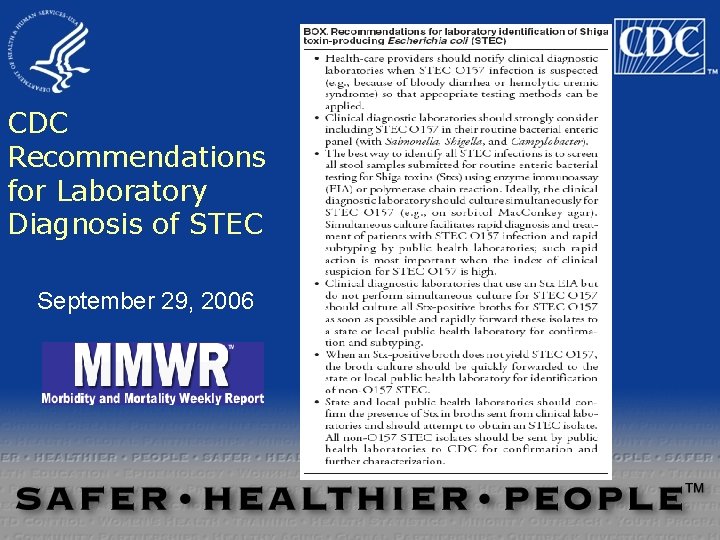
CDC Recommendations for Laboratory Diagnosis of STEC September 29, 2006
What else do clinical labs need to know? SMAC is not enough (only detects O 157: H 7) Commercial assays can produce false positives and false negatives Importance of promptly communicating positive results to the physician Participate in proficiency testing program (API, CAP) How can the laboratory be reimbursed for testing for non-O 157 STEC?
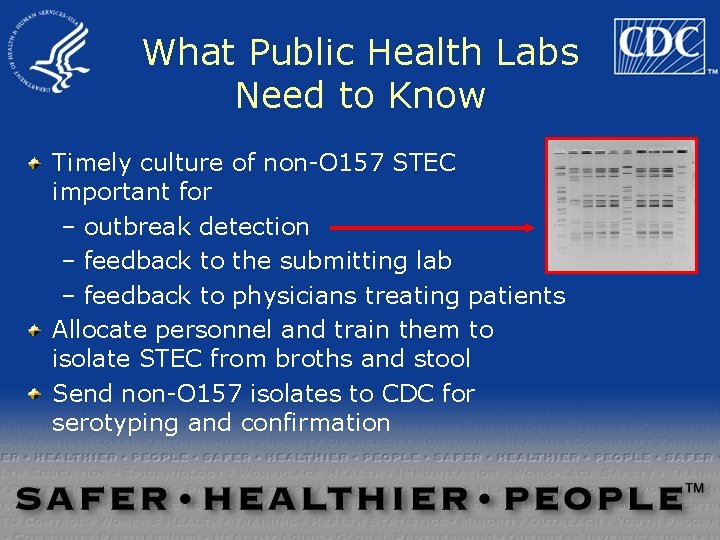
What Public Health Labs Need to Know Timely culture of non-O 157 STEC important for – outbreak detection – feedback to the submitting lab – feedback to physicians treating patients Allocate personnel and train them to isolate STEC from broths and stool Send non-O 157 isolates to CDC for serotyping and confirmation
What else do public health labs need to know? Large diagnostic labs are confused and frustrated about what type of Stx-positive specimens to public health labs – Broth? – Fecal specimen? – Isolate? Public health labs have different specimen submission rules
Guidelines for STEC specimen submission need to be developed Develop consensus guidelines for submission of broths and specimens for STEC testing – The Association for Public Health Laboratories (APHL) – Public health labs – Clinical diagnostic labs
Guidelines for STEC Diagnosis CDC Goals Develop consensus guidelines for isolation and identification of STEC with partners – APHL, ASM, Public Health Labs, Clinical Labs, Clinicians Develop interpretation guidelines for Stx EIA results
Summary
Summary The challenges are daunting – No selective medium for non-O 157 STEC – Lack of personnel and resources – Lack of clear guidelines for testing, interpretation of results, and reporting – Need for training of laboratory personnel – Need for standard state submission laws accessible to clinical lab personnel – Need to educate physicians about test availability, utility, and limitations – Etc.
Summary But there is remarkable cooperation among -commercial diagnostic laboratories -public health laboratories -APHL -clinicians -CDC to address these challenges!
Thank you for your attention The findings and conclusions in this presentation are those of the author and do not necessarily represent the views of the Centers for Disease Control and Prevention