Emergency Oxygen Professor Thida Win 10032015 SCN Emergency
- Slides: 30
Emergency Oxygen Professor Thida Win 10/03/2015 SCN Emergency Oxygen Event
Why Important • Oxygen is the main ‘‘fuel’’ of the cells and it is essential for humans to maintain a safe level of oxygen in the bloodstream • Oxygen is the most commonly use drug in emergency situation • 34% of emergency ambulance patients receive oxygen 1 • ~14% of UK hospital patients were on oxygen during BTS audits • Approx 2 -4 million people per year in UK 10/38/2015 SCN emergency Oxygen Event
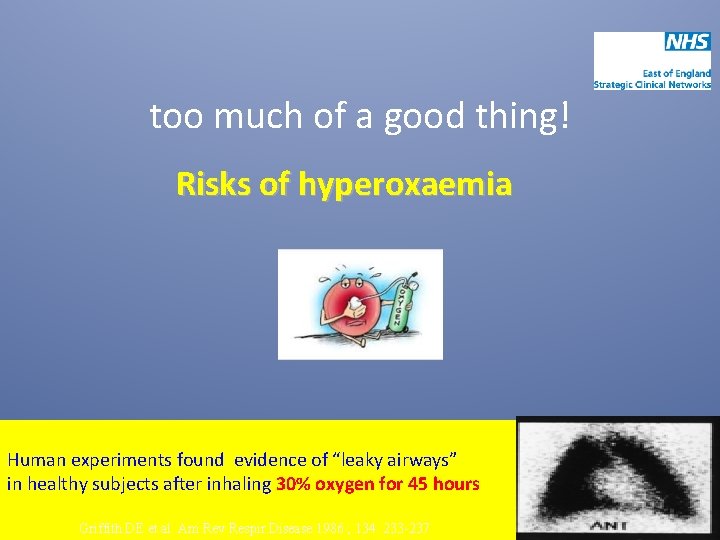
too much of a good thing! Risks of hyperoxaemia Human experiments found evidence of “leaky airways” in healthy subjects after inhaling 30% oxygen for 45 hours 10/38/2015 SCN emergency Oxygen Event Griffith DE et al Am Rev Respir Disease 1986 ; 134: 233 -237
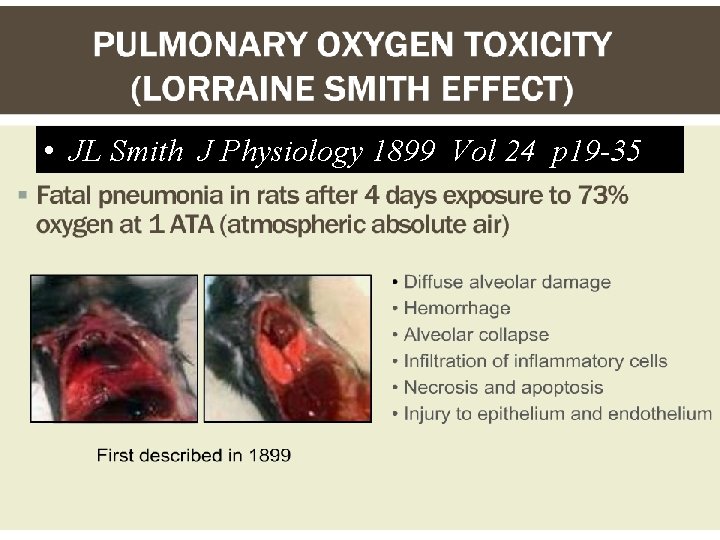
• JL Smith J Physiology 1899 Vol 24 p 19 -35 10/38/2015 SCN emergency Oxygen Event
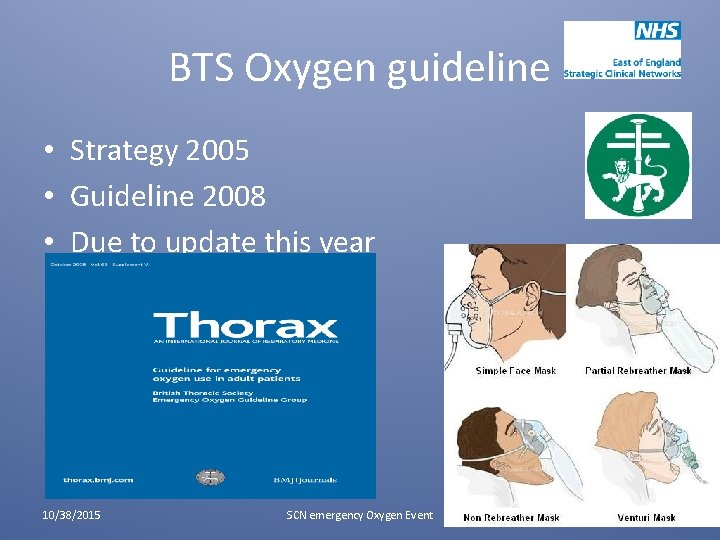
BTS Oxygen guideline • Strategy 2005 • Guideline 2008 • Due to update this year 10/38/2015 SCN emergency Oxygen Event
BTS Emergency Oxygen Audits Audit 1 July-Sept 2008 Before Guideline launch in October 2008 Audit 2 November 2009 Audit 3 Oct-November 2010 Audit 4 Aug-November 2011 Audit 5 Aug-November 2012 • Oxygen champions conducted audits • Methodology- BTS online Audit tool 10/38/2015 SCN emergency Oxygen Event
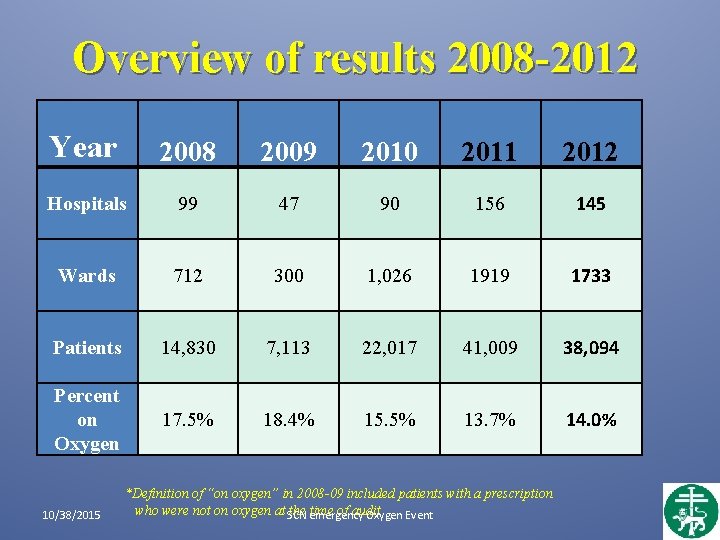
Overview of results 2008 -2012 Year 2008 2009 2010 2011 2012 Hospitals 99 47 90 156 145 Wards 712 300 1, 026 1919 1733 Patients 14, 830 17. 5% 7, 113 22, 017 41, 009 38, 094 18. 4% 15. 5% 13. 7% 14. 0% Percent on Oxygen 10/38/2015 *Definition of “on oxygen” in 2008 -09 included patients with a prescription who were not on oxygen at SCN the emergency time of audit Oxygen Event
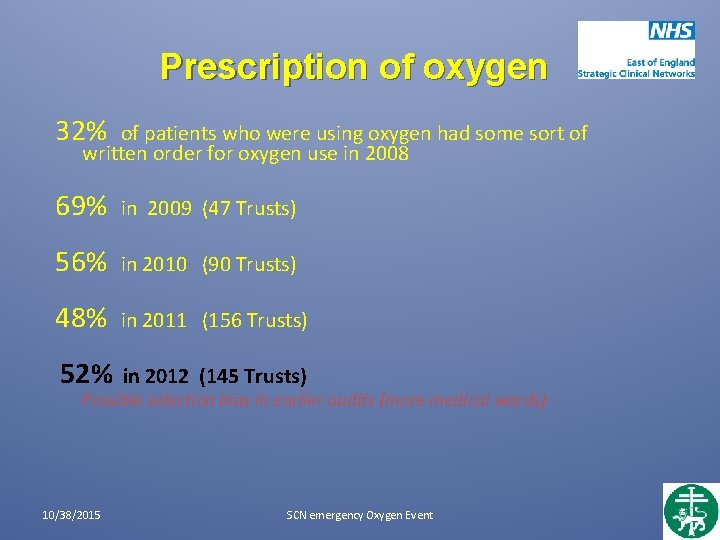
Prescription of oxygen 32% of patients who were using oxygen had some sort of written order for oxygen use in 2008 69% in 2009 (47 Trusts) 56% in 2010 (90 Trusts) 48% in 2011 (156 Trusts) 52% in 2012 (145 Trusts) Possible selection bias in earlier audits (more medical wards) 10/38/2015 SCN emergency Oxygen Event
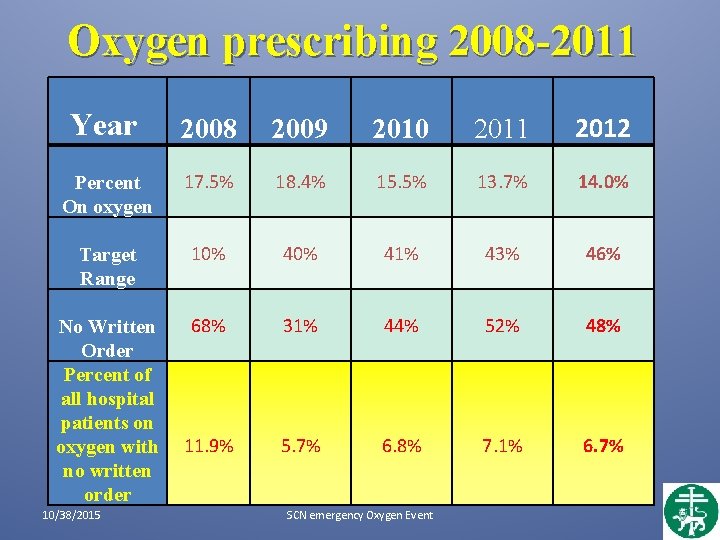
Oxygen prescribing 2008 -2011 Year 2008 2009 2010 2011 2012 Percent On oxygen 17. 5% 18. 4% 15. 5% 13. 7% 14. 0% Target Range 10% 41% 43% 46% 31% 44% 52% 48% 5. 7% 6. 8% 7. 1% 6. 7% 68% No Written Order Percent of all hospital patients on oxygen with 11. 9% no written order 10/38/2015 SCN emergency Oxygen Event
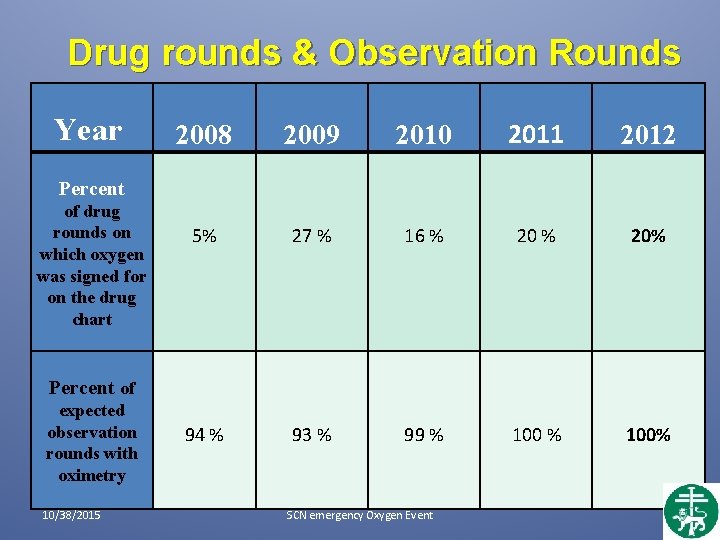
Drug rounds & Observation Rounds Year 2008 2009 2010 2011 2012 5% 27 % 16 % 20% 94 % 93 % 99 % 100% Percent of drug rounds on which oxygen was signed for on the drug chart Percent of expected observation rounds with oximetry 10/38/2015 SCN emergency Oxygen Event
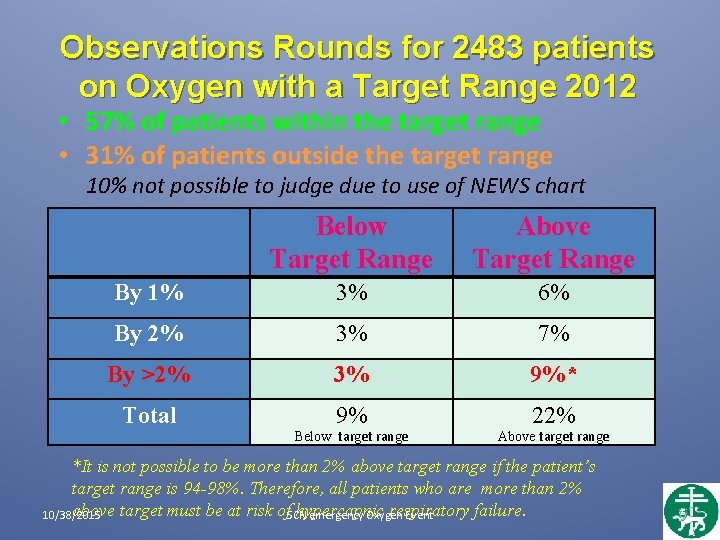
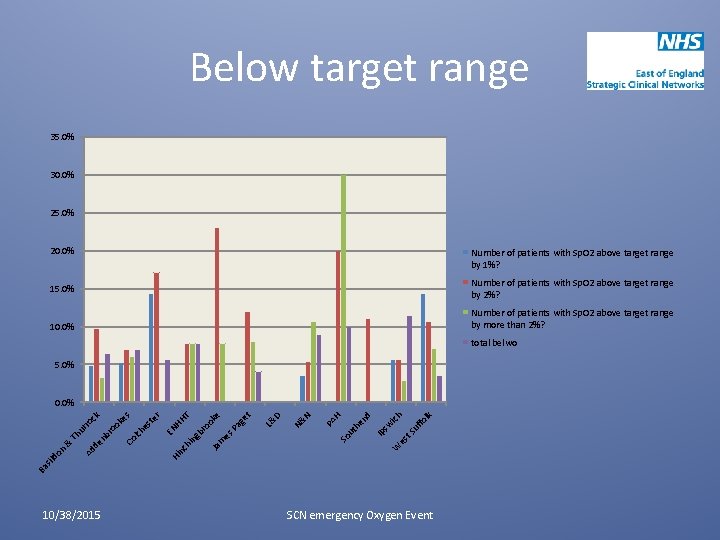
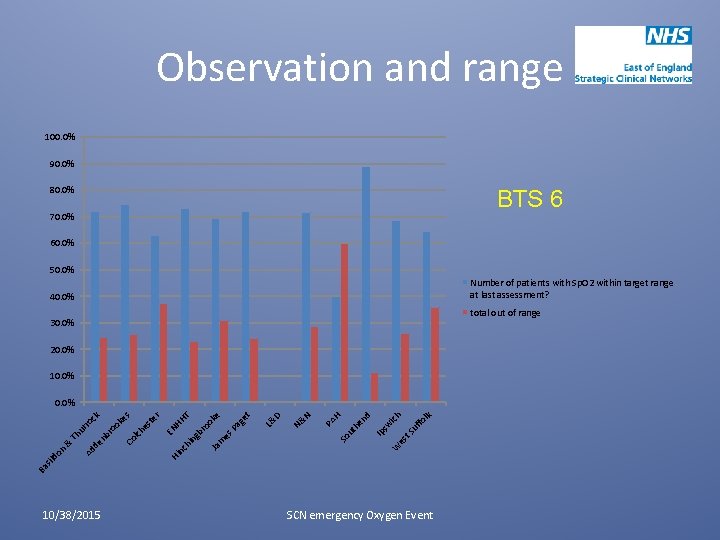
Observations Rounds for 2483 patients on Oxygen with a Target Range 2012 • 57% of patients within the target range • 31% of patients outside the target range 10% not possible to judge due to use of NEWS chart Below Target Range Above Target Range By 1% 3% 6% By 2% 3% 7% By >2% 3% 9%* Total 9% 22% Below target range Above target range *It is not possible to be more than 2% above target range if the patient’s target range is 94 -98%. Therefore, all patients who are more than 2% above target must be at risk of. SCN hypercapnic respiratory failure. 10/38/2015 emergency Oxygen Event
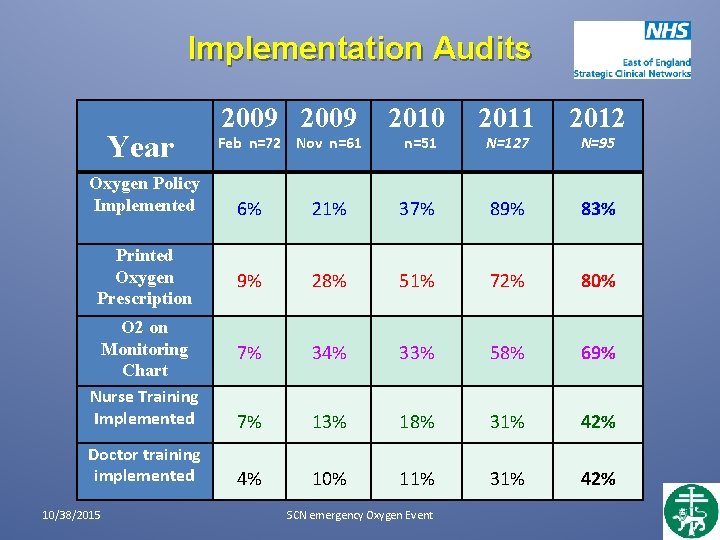
Implementation Audits Year Oxygen Policy Implemented Printed Oxygen Prescription O 2 on Monitoring Chart Nurse Training Implemented Doctor training implemented 10/38/2015 2009 2010 2011 2012 Feb n=72 Nov n=61 n=51 N=127 N=95 6% 21% 37% 89% 83% 9% 28% 51% 72% 80% 7% 34% 33% 58% 69% 7% 13% 18% 31% 42% 4% 10% 11% 31% 42% SCN emergency Oxygen Event
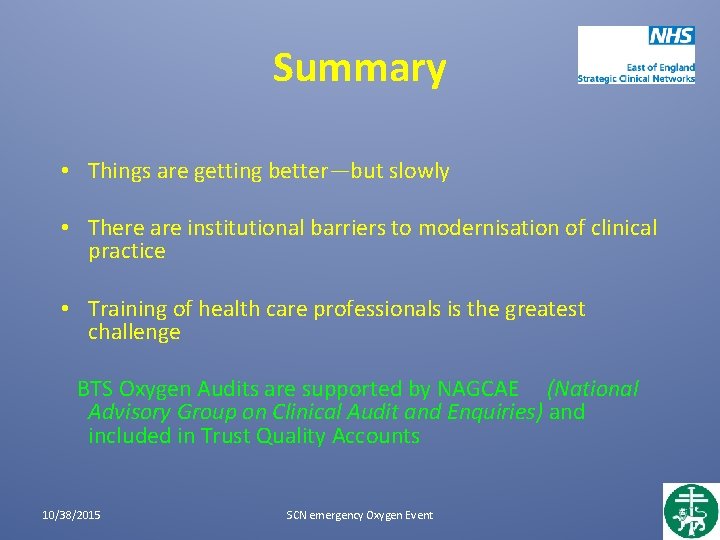
Summary • Things are getting better—but slowly • There are institutional barriers to modernisation of clinical practice • Training of health care professionals is the greatest challenge BTS Oxygen Audits are supported by NAGCAE (National Advisory Group on Clinical Audit and Enquiries) and included in Trust Quality Accounts 10/38/2015 SCN emergency Oxygen Event
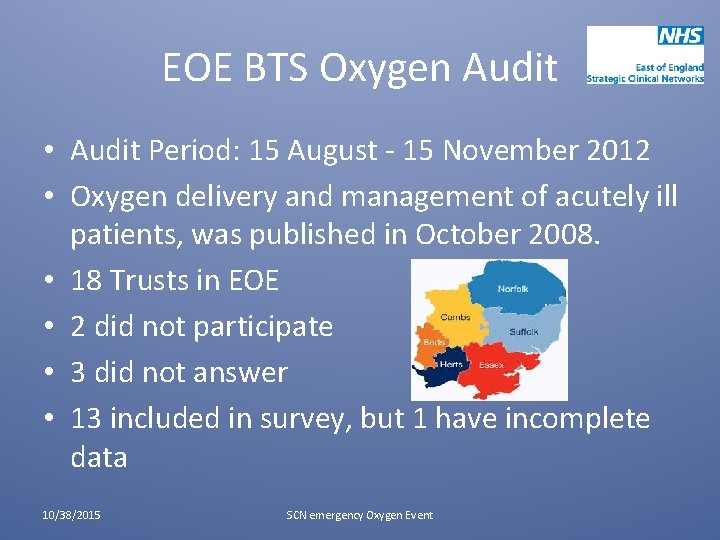
EOE BTS Oxygen Audit • Audit Period: 15 August - 15 November 2012 • Oxygen delivery and management of acutely ill patients, was published in October 2008. • 18 Trusts in EOE • 2 did not participate • 3 did not answer • 13 included in survey, but 1 have incomplete data 10/38/2015 SCN emergency Oxygen Event
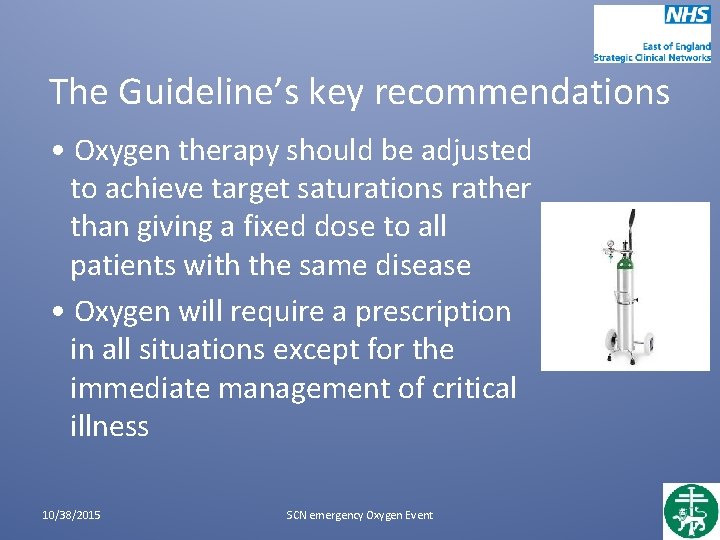
The Guideline’s key recommendations • Oxygen therapy should be adjusted to achieve target saturations rather than giving a fixed dose to all patients with the same disease • Oxygen will require a prescription in all situations except for the immediate management of critical illness 10/38/2015 SCN emergency Oxygen Event
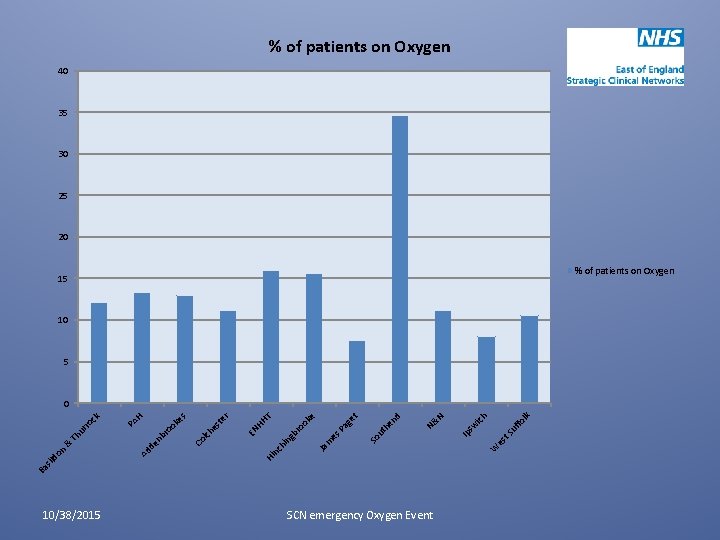
10/38/2015 SCN emergency Oxygen Event lk uf fo t. S es W ich sw Ip N N& nd he t ke ge Pa ut So es m Ja oo br ng r EN HH T te es lch es ok ro nb H PA ck rro Th u Co nc hi Hi & de Ad n do sil Ba % of patients on Oxygen 40 35 30 25 20 15 % of patients on Oxygen 10 5 0
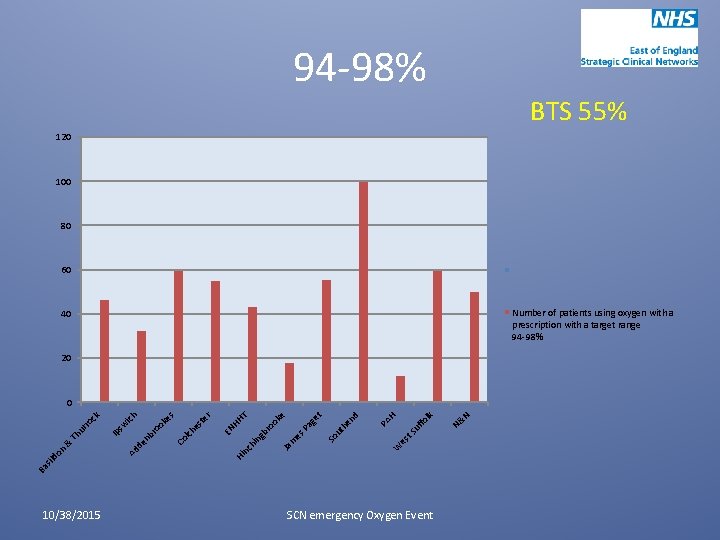
94 -98% BTS 55% 120 100 80 60 Number of patients using oxygen with a prescription with a target range 94 -98% 40 20 10/38/2015 uf fo t. S es W SCN emergency Oxygen Event N N& lk H PA nd he ut Pa es m Ja So ge t ke oo br nc hi ng EN HH T Hi r te es lch ro nb de Co ok es ich sw Ad Ip Ba sil do n & Th u rro ck 0
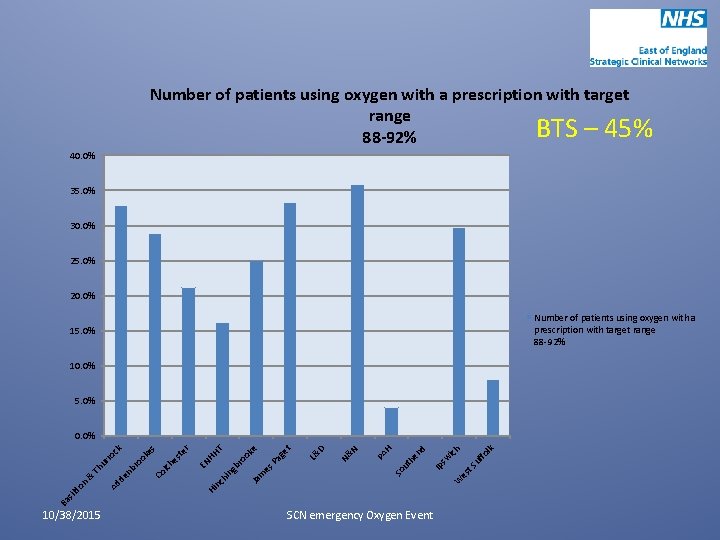
Number of patients using oxygen with a prescription with target range BTS – 45% 88 -92% 40. 0% 35. 0% 30. 0% 25. 0% 20. 0% Number of patients using oxygen with a prescription with target range 88 -92% 15. 0% 10. 0% 5. 0% 10/38/2015 lk t. S es W SCN emergency Oxygen Event uf fo ich sw Ip So ut he nd H PA D N N& Pa es m L& ge t ke oo Ja br nc hi ng EN HH T Hi r te es lch Co ok ro nb de Ad Ba sil do n & Th u rro ck es 0. 0%
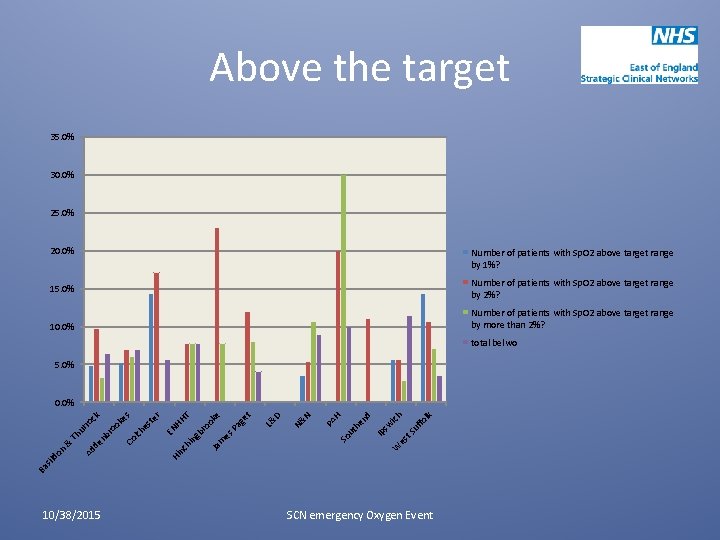
Above the target 35. 0% 30. 0% 25. 0% 20. 0% Number of patients with Sp. O 2 above target range by 1%? Number of patients with Sp. O 2 above target range by 2%? 15. 0% Number of patients with Sp. O 2 above target range by more than 2%? 10. 0% total belwo 5. 0% lk W es t. S uf fo ich sw Ip he nd H ut PA N t D L& N& So m es Pa ge ke oo br ng nc hi Hi Ja r EN HH T te es lch ok Co ro nb de Ad Ba sil do n & Th u rro ck es 0. 0% 10/38/2015 SCN emergency Oxygen Event
Below target range 35. 0% 30. 0% 25. 0% 20. 0% Number of patients with Sp. O 2 above target range by 1%? Number of patients with Sp. O 2 above target range by 2%? 15. 0% Number of patients with Sp. O 2 above target range by more than 2%? 10. 0% total belwo 5. 0% lk W es t. S uf fo ich sw Ip he nd H ut PA N t D L& N& So m es Pa ge ke oo br ng nc hi Hi Ja r EN HH T te es lch ok Co ro nb de Ad Ba sil do n & Th u rro ck es 0. 0% 10/38/2015 SCN emergency Oxygen Event
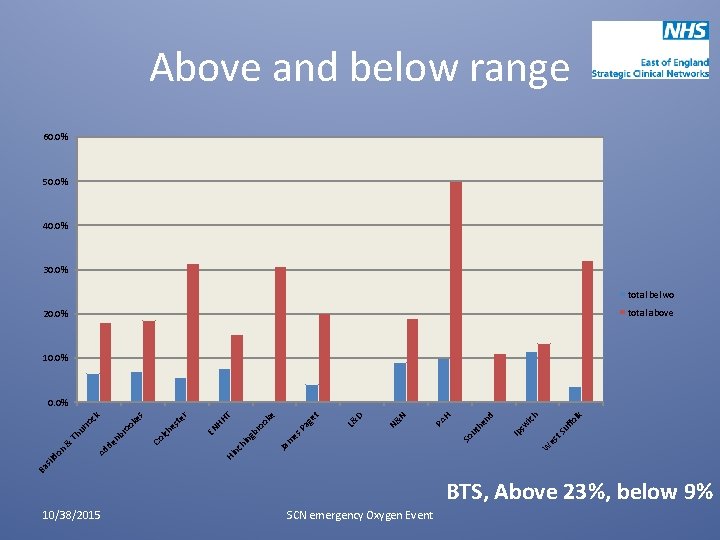
Above and below range 60. 0% 50. 0% 40. 0% 30. 0% total belwo total above 20. 0% 10. 0% lk uf fo ich sw W es t. S Ip So ut he nd H PA D N N& Pa Ja m es L& ge t ke oo br Hi nc hi ng EN HH T r te es lch Co nb de Ad Ba sil do n & Th u ro ok rro ck es 0. 0% BTS, Above 23%, below 9% 10/38/2015 SCN emergency Oxygen Event
Observation and range 100. 0% 90. 0% 80. 0% BTS 64% in range 70. 0% 60. 0% 50. 0% Number of patients with Sp. O 2 within target range at last assessment? 40. 0% total out of range 30. 0% 20. 0% 10. 0% lk W es t. S uf fo ich sw Ip he nd H ut PA N t D L& N& So m es Pa ge ke oo br ng nc hi Hi Ja r EN HH T te es lch ok Co ro nb de Ad Ba sil do n & Th u rro ck es 0. 0% 10/38/2015 SCN emergency Oxygen Event
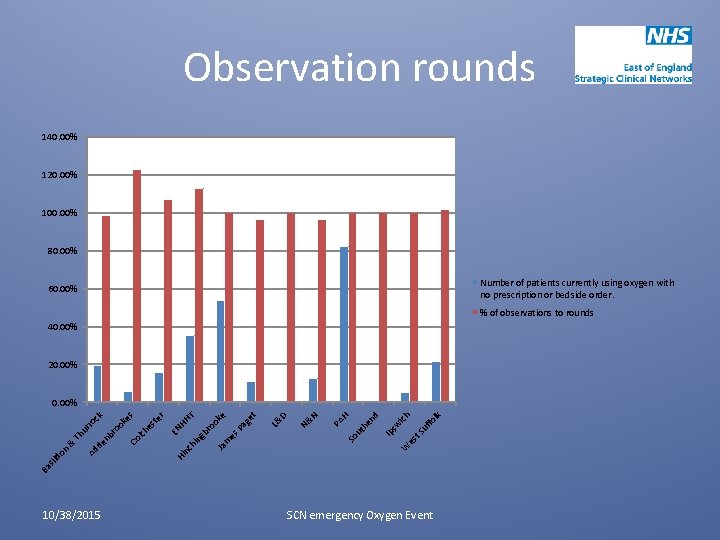
Observation rounds 140. 00% 120. 00% 100. 00% 80. 00% Number of patients currently using oxygen with no prescription or bedside order. 60. 00% % of observations to rounds 40. 00% 20. 00% lk W es t. S uf fo ich sw Ip he nd H ut PA N t D L& N& So m es Pa ge ke oo br ng nc hi Hi Ja r EN HH T te es lch ok Co ro nb de Ad Ba sil do n & Th u rro ck es 0. 00% 10/38/2015 SCN emergency Oxygen Event
Summary • 7 -34% of patients were on Oxygen • Majority with higher target range, however, surprisingly big number with lower target range (except southend) • Significant number without prescription • Significant number without signature • More Above the range than below 10/38/2015 SCN emergency Oxygen Event
Limitations. . • • No data for education No data for Observation Chart No data for organisational factor No data on Ambulance No data on harm Data Long time ago- a lot moved on Cross section data of given time 10/38/2015 SCN emergency Oxygen Event
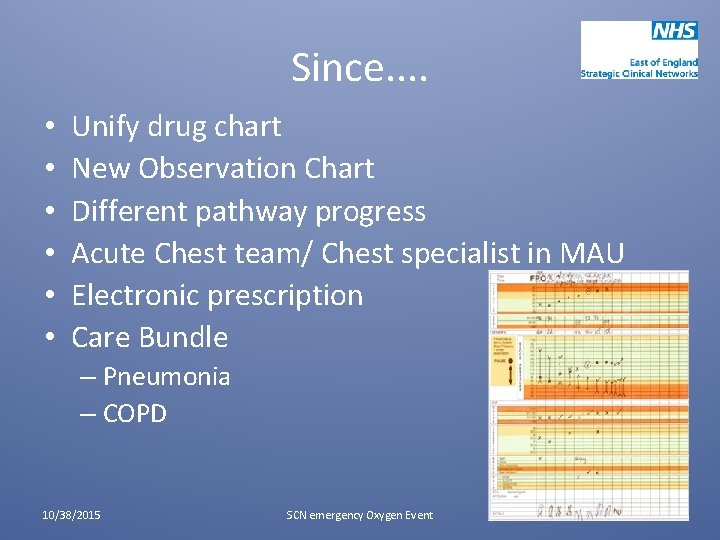
Since. . • • • Unify drug chart New Observation Chart Different pathway progress Acute Chest team/ Chest specialist in MAU Electronic prescription Care Bundle – Pneumonia – COPD 10/38/2015 SCN emergency Oxygen Event
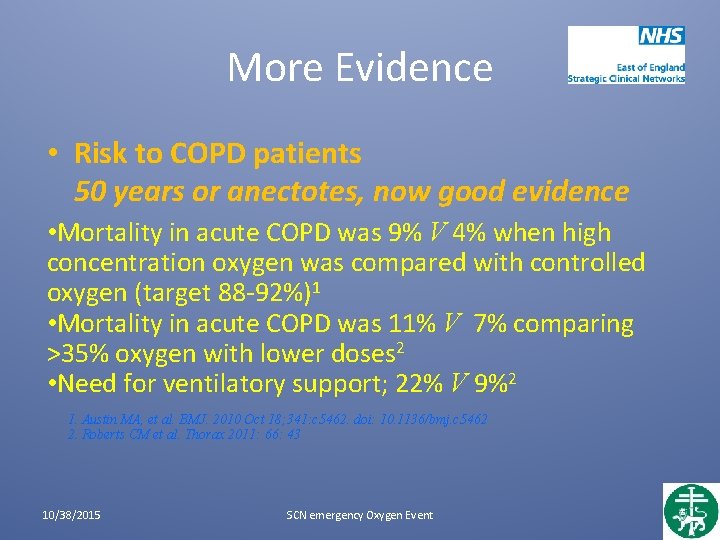
More Evidence • Risk to COPD patients 50 years or anectotes, now good evidence • Mortality in acute COPD was 9% V 4% when high concentration oxygen was compared with controlled oxygen (target 88 -92%)1 • Mortality in acute COPD was 11% V 7% comparing >35% oxygen with lower doses 2 • Need for ventilatory support; 22% V 9%2 1. Austin MA, et al. BMJ. 2010 Oct 18; 341: c 5462. doi: 10. 1136/bmj. c 5462 2. Roberts CM et al. Thorax 2011: 66: 43 10/38/2015 SCN emergency Oxygen Event
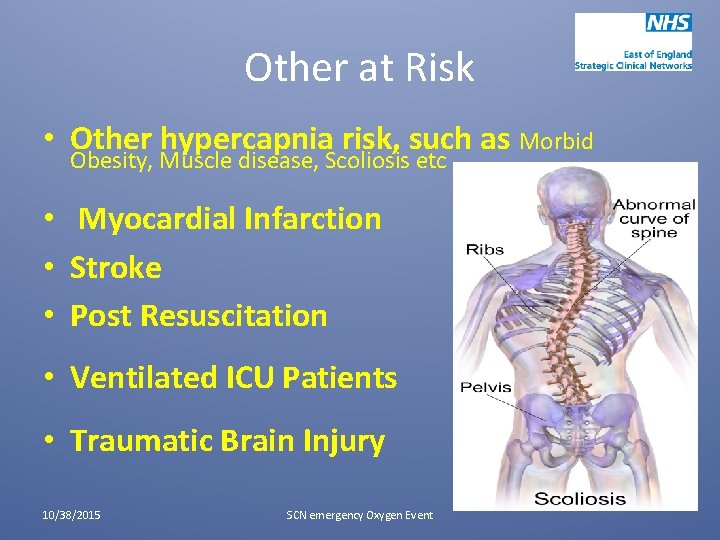
Other at Risk • Other hypercapnia risk, such as Morbid Obesity, Muscle disease, Scoliosis etc • Myocardial Infarction • Stroke • Post Resuscitation • Ventilated ICU Patients • Traumatic Brain Injury 10/38/2015 SCN emergency Oxygen Event
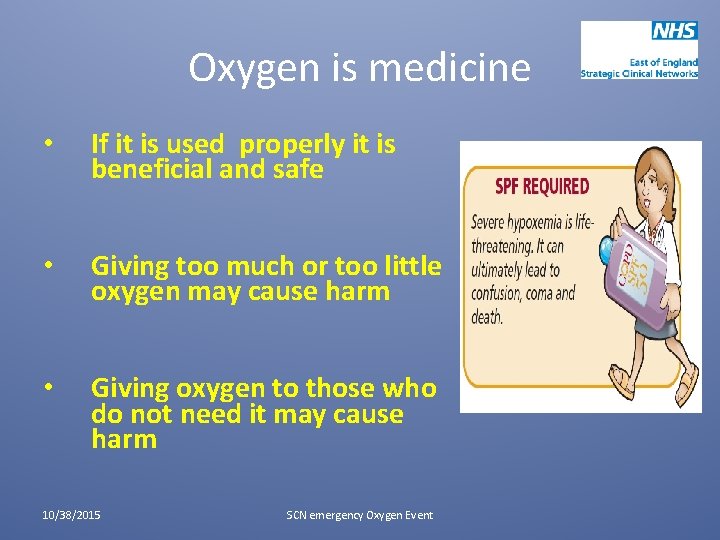
Oxygen is medicine • If it is used properly it is beneficial and safe • Giving too much or too little oxygen may cause harm • Giving oxygen to those who do not need it may cause harm 10/38/2015 SCN emergency Oxygen Event
AIMS of today. . . • • Re enthuse oxygen Champions Re publish what’s out there Re member oxygen guideline Re mind oxygen Audit Re emphasize importance of education Re organise oxygen group Re energise all enthusiastic colleagues 10/38/2015 SCN emergency Oxygen Event