
Aim I can describe the properties of oxygen
Aim • I can describe the properties of oxygen gas. • I can explain how oxygen was discovered. Success Criteria • • • • Statement 1 Lorem ipsum dolor amet, consectetur I can describe the scientists whosit discovered oxygen. adipiscing elit. Statement 2 I can explain how the discovery of oxygen changed scientific ideas. • Sub statement • I can conduct an experiment to demonstrate oxygen’s properties.
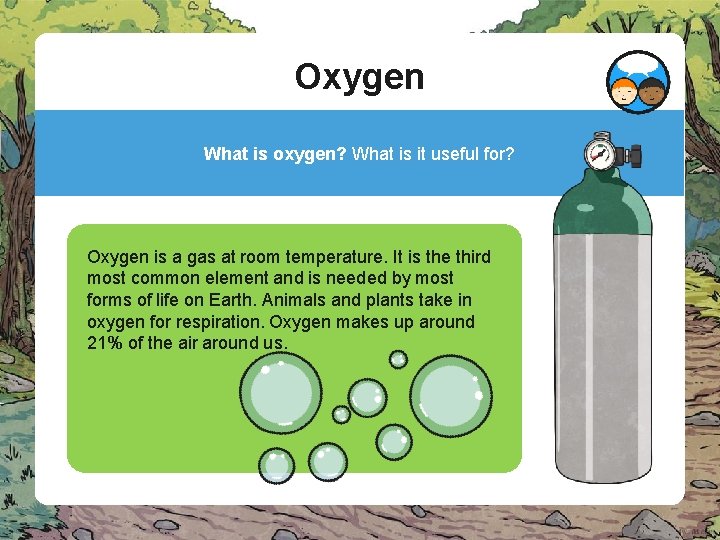
Oxygen What is oxygen? What is it useful for? Oxygen is a gas at room temperature. It is the third most common element and is needed by most forms of life on Earth. Animals and plants take in oxygen for respiration. Oxygen makes up around 21% of the air around us.

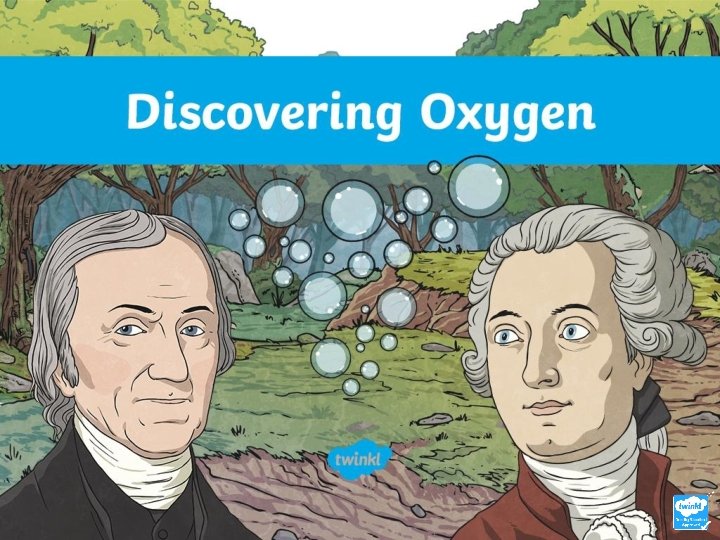
Who Discovered Oxygen? Two scientists were mainly responsible for the discovery of oxygen: Antoine Lavoisier and Joseph Priestley. Antoine Lavoisier 1743 -1794 Antoine Lavoisier was born into a wealthy French family. His father was a lawyer and Lavoisier inherited a large fortune at the age of five when his mother died. He was very interested in science at school and although he received a law degree, he never became a lawyer. Instead, he worked in various government jobs and was elected to the Royal Academy of Science in 1764. In 1775, he set up a laboratory in Paris where he could conduct experiments. It was in this lab that Lavoisier made many of his important discoveries to do with chemistry.
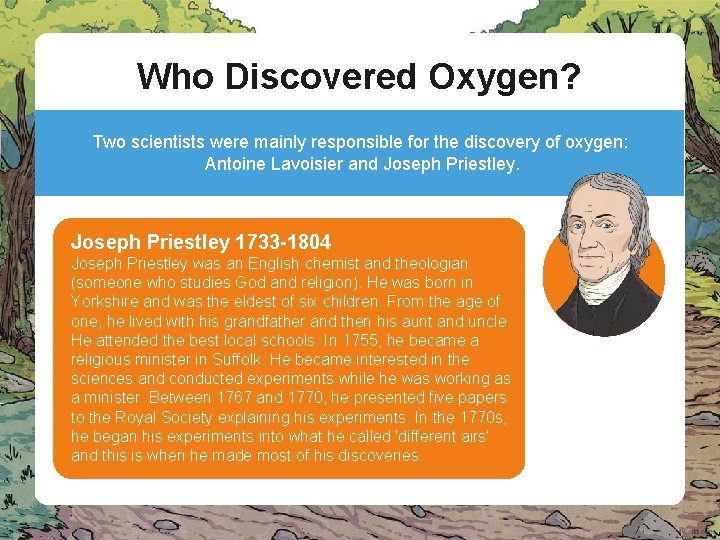
Who Discovered Oxygen? Two scientists were mainly responsible for the discovery of oxygen: Antoine Lavoisier and Joseph Priestley 1733 -1804 Joseph Priestley was an English chemist and theologian (someone who studies God and religion). He was born in Yorkshire and was the eldest of six children. From the age of one, he lived with his grandfather and then his aunt and uncle. He attended the best local schools. In 1755, he became a religious minister in Suffolk. He became interested in the sciences and conducted experiments while he was working as a minister. Between 1767 and 1770, he presented five papers to the Royal Society explaining his experiments. In the 1770 s, he began his experiments into what he called 'different airs' and this is when he made most of his discoveries.

Phlogiston Theory In the 1700 s, scientists believed in a theory called the 'phlogiston theory'. They thought that flammable objects contained a substance called phlogiston that caused the objects to burn. The theory also stated that when objects burned, the phlogiston inside them left the object, so the object should become lighter. However, experiments showed that actually, some objects gain mass when they burn, becoming slightly heavier. Phlogiston theory could not explain this. It was not until Antoine Lavoisier's work that the problems of phlogiston theory were solved.
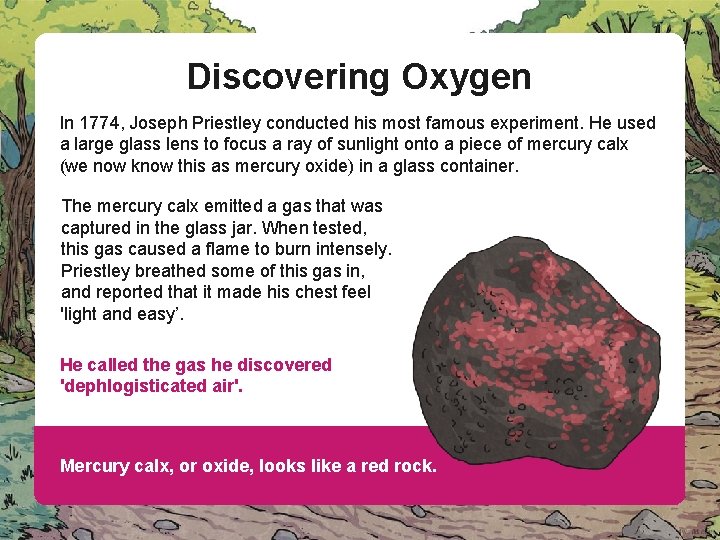
Discovering Oxygen In 1774, Joseph Priestley conducted his most famous experiment. He used a large glass lens to focus a ray of sunlight onto a piece of mercury calx (we now know this as mercury oxide) in a glass container. The mercury calx emitted a gas that was captured in the glass jar. When tested, this gas caused a flame to burn intensely. Priestley breathed some of this gas in, and reported that it made his chest feel 'light and easy’. He called the gas he discovered 'dephlogisticated air'. Mercury calx, or oxide, looks like a red rock.
Discovering Oxygen Priestley met Lavoisier on a trip to France. He told Lavoisier about his experiments and the gas he had discovered. Lavoisier used this information as the basis for his own experiments and ideas. His work would finally disprove the phlogiston theory. He found that when objects burn, they do not lose phlogiston, they actually combine with the gas that Priestley had discovered. Lavoisier realised that phlogiston simply did not exist! He called the gas oxygen. Priestley's and Lavoisier's work changed scientific ideas forever.
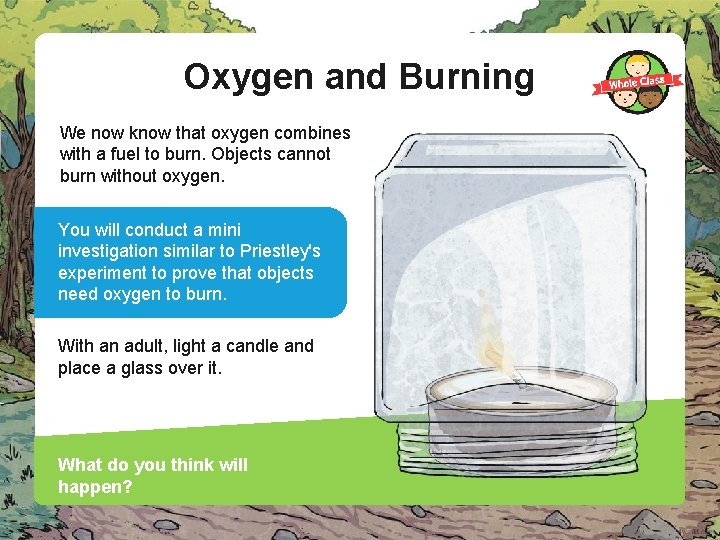
Oxygen and Burning We now know that oxygen combines with a fuel to burn. Objects cannot burn without oxygen. You will conduct a mini investigation similar to Priestley's experiment to prove that objects need oxygen to burn. With an adult, light a candle and place a glass over it. What do you think will happen?
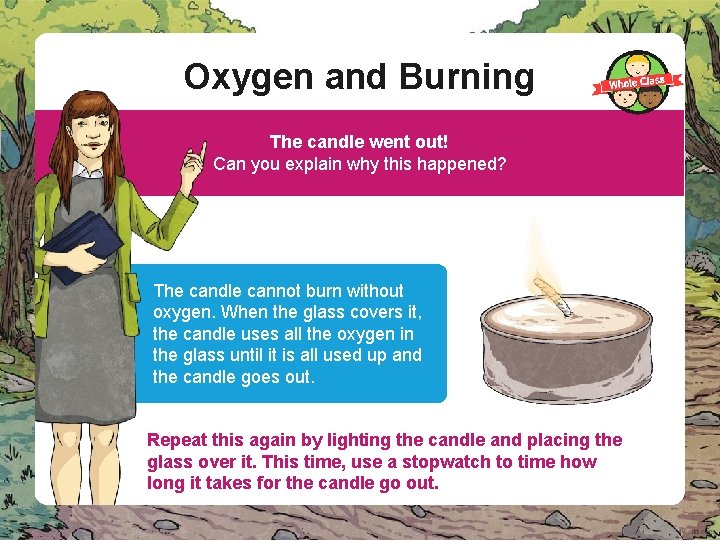
Oxygen and Burning The candle went out! Can you explain why this happened? The candle cannot burn without oxygen. When the glass covers it, the candle uses all the oxygen in the glass until it is all used up and the candle goes out. Repeat this again by lighting the candle and placing the glass over it. This time, use a stopwatch to time how long it takes for the candle go out.
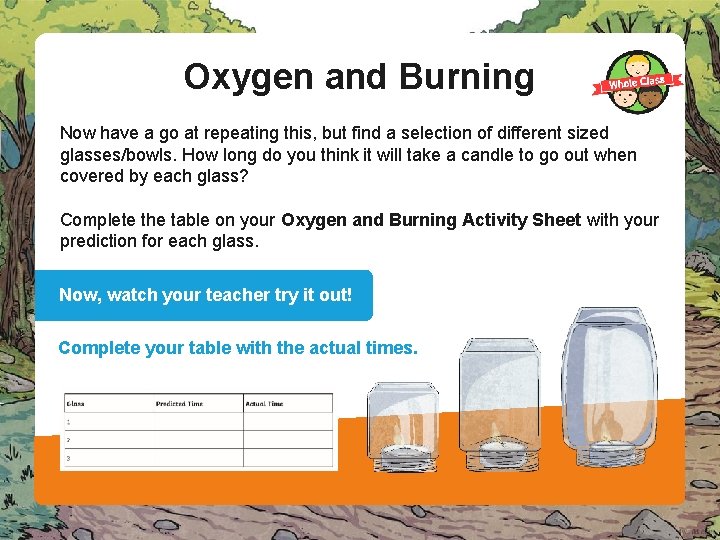
Oxygen and Burning Now have a go at repeating this, but find a selection of different sized glasses/bowls. How long do you think it will take a candle to go out when covered by each glass? Complete the table on your Oxygen and Burning Activity Sheet with your prediction for each glass. Now, watch your teacher try it out! Complete your table with the actual times.
Oxygen and Burning Did you discover that the smallest glass or jar made the candle go out more quickly and that the largest glass or jar made the candle go out slowest? Explain why you think this happened on your Activity Sheet.
- Slides: 12