
Elements of ART Principals Of Design Styles and



- Slides: 51
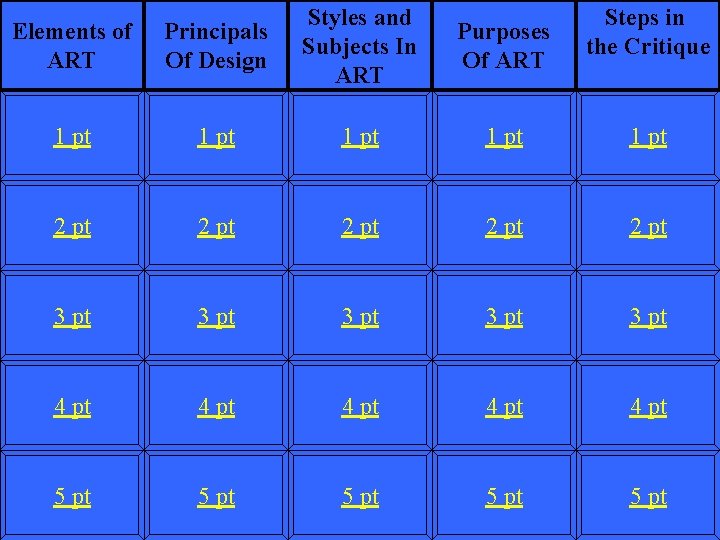
Elements of ART Principals Of Design Styles and Subjects In ART Purposes Of ART Steps in the Critique 1 pt 1 pt 2 pt 2 pt 3 pt 3 pt 4 pt 4 pt 5 pt 5 pt
2 -D, can be organic or geometric.
What is shape?
Red, yellow, and orange.
What are warm colors?
How something feels.
What is texture?
This element of art can make a flat surface look 3 -D.
What is Form?
Red, light red, and dark red are examples of this element of art.
What is value?
The feeling of harmony between all parts of work of art. Creates a sense of completeness.
What is unity?
Use of several elements of design to hold the viewers attention.
What is variety?
The repeating of an object or symbol all over the work of art.
What is a pattern?
A type of balance in which both sides are the same.
What is symmetrical balance?
This is done by putting something in the middle, making it big, and making it brighter colors than other things.
What is emphasis?
This type of artwork looks like a person.
What is a portrait?
The subject of this artwork is land.
What is a landscape?
This style does not represent anything real.
What is non-objective?
This style of art represents something real but is not as the eye sees it.
What is abstract?
The subject of this artwork is things that do not move.
What is still life?
The purpose of a Native American totem pole is to tell a story.
What is narrative art?
The purpose of an African basket can be to carry goods.
What is functional art?
Native American art can show feelings or emotions.
What is expressive art?
This type of art is used to convince the viewer of something.
What is persuasive?
This type of art is used in religious or cultural ceremonies.
What is ceremonial?
The number of elements you need to describe.
What are seven?
The number of principles of design that need to be discussed.
What is at least three?
The number of reasons you must give for your opinion of the artwork.
What is three?
This is the third step of the critique.
What is the artist’s meaning or how it made you feel?
This is the last step in the critique.
What is judgment or evaluation ?