EECS 105 Fall 2003 Lecture 8 Capacitors and
- Slides: 24
EECS 105 Fall 2003, Lecture 8: Capacitors and PN Junctions Prof. Niknejad Department of EECS University of California, Berkeley
EECS 105 Fall 2003, Lecture 8 Prof. A. Niknejad Lecture Outline l l Department of EECS Review of Electrostatics IC MIM Capacitors Non-Linear Capacitors PN Junctions Thermal Equilibrium University of California, Berkeley
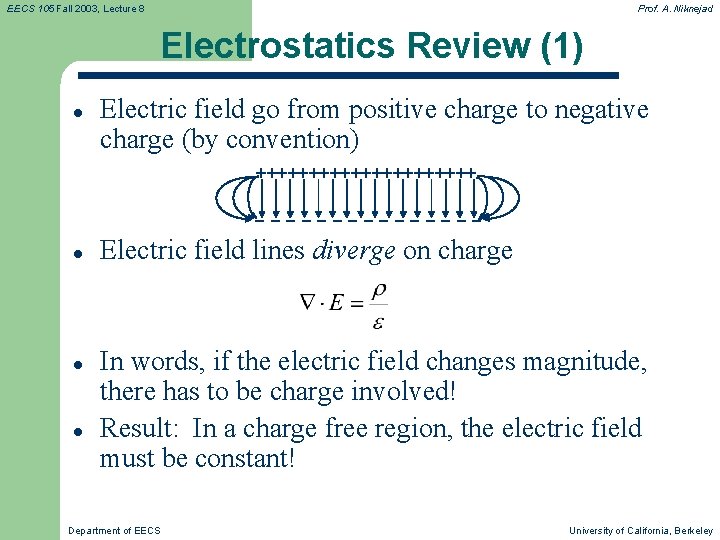
EECS 105 Fall 2003, Lecture 8 Prof. A. Niknejad Electrostatics Review (1) l Electric field go from positive charge to negative charge (by convention) +++++++++++ −−−−−−−− l l l Electric field lines diverge on charge In words, if the electric field changes magnitude, there has to be charge involved! Result: In a charge free region, the electric field must be constant! Department of EECS University of California, Berkeley
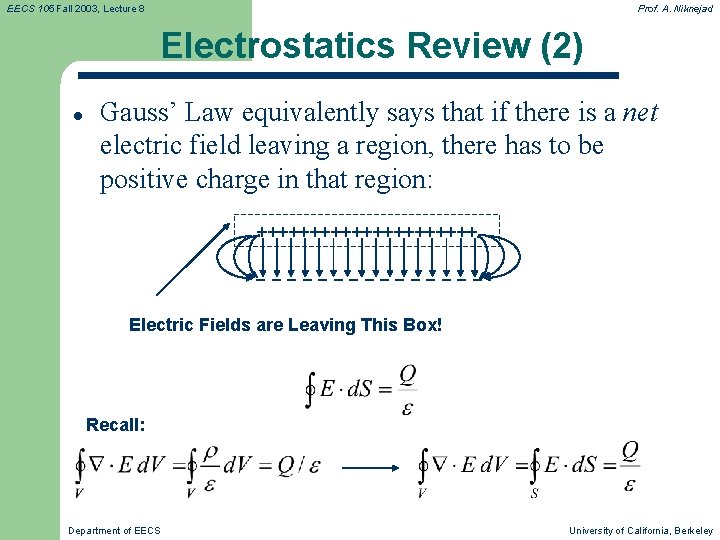
EECS 105 Fall 2003, Lecture 8 Prof. A. Niknejad Electrostatics Review (2) l Gauss’ Law equivalently says that if there is a net electric field leaving a region, there has to be positive charge in that region: +++++++++++ −−−−−−−− Electric Fields are Leaving This Box! Recall: Department of EECS University of California, Berkeley
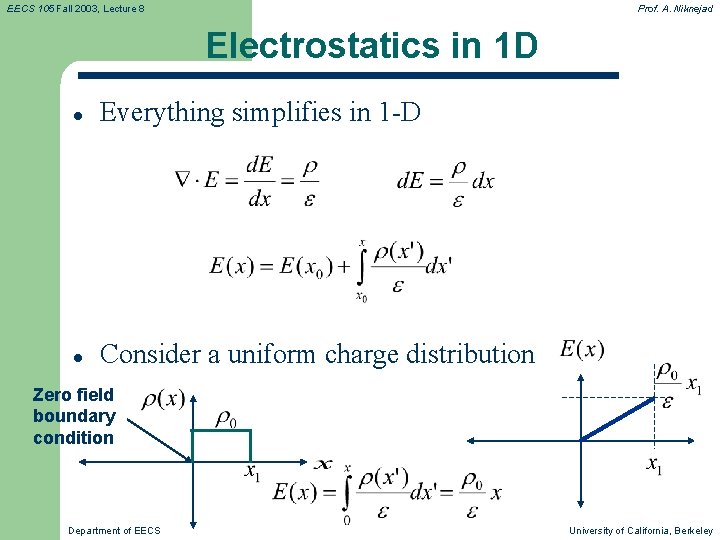
EECS 105 Fall 2003, Lecture 8 Prof. A. Niknejad Electrostatics in 1 D l Everything simplifies in 1 -D l Consider a uniform charge distribution Zero field boundary condition Department of EECS University of California, Berkeley
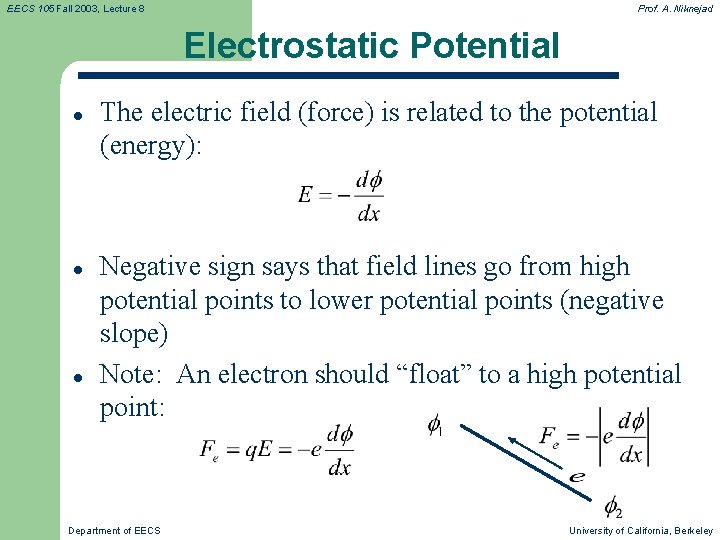
EECS 105 Fall 2003, Lecture 8 Prof. A. Niknejad Electrostatic Potential l The electric field (force) is related to the potential (energy): Negative sign says that field lines go from high potential points to lower potential points (negative slope) Note: An electron should “float” to a high potential point: Department of EECS University of California, Berkeley
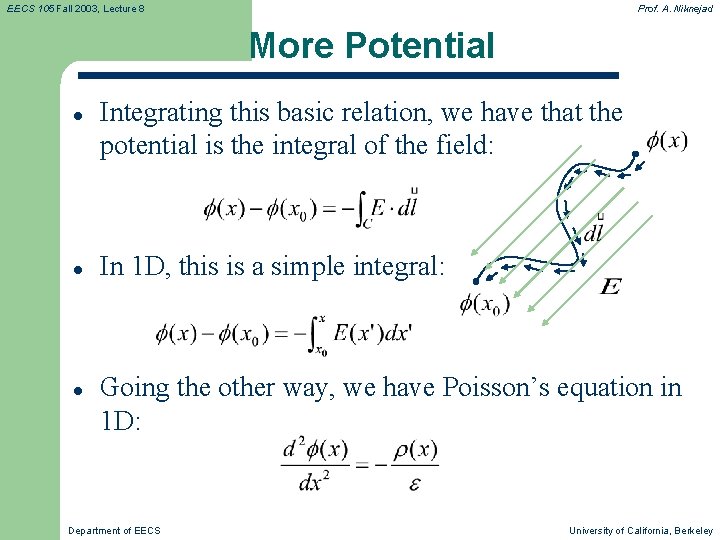
EECS 105 Fall 2003, Lecture 8 Prof. A. Niknejad More Potential l Integrating this basic relation, we have that the potential is the integral of the field: In 1 D, this is a simple integral: Going the other way, we have Poisson’s equation in 1 D: Department of EECS University of California, Berkeley
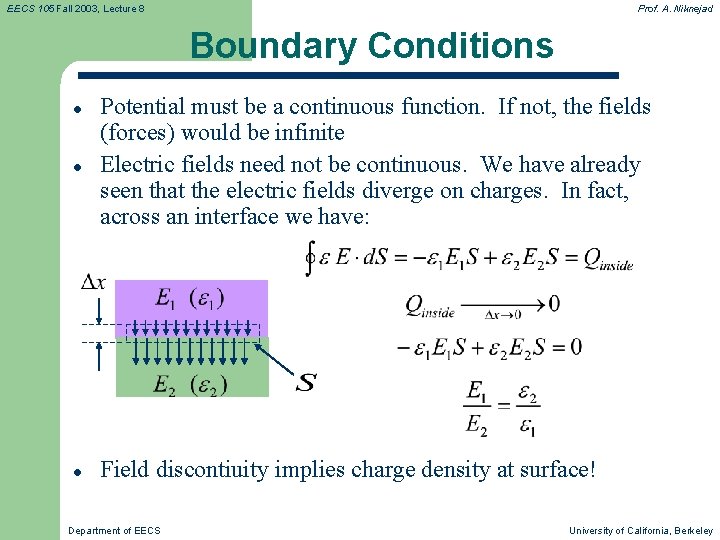
EECS 105 Fall 2003, Lecture 8 Prof. A. Niknejad Boundary Conditions l l l Potential must be a continuous function. If not, the fields (forces) would be infinite Electric fields need not be continuous. We have already seen that the electric fields diverge on charges. In fact, across an interface we have: Field discontiuity implies charge density at surface! Department of EECS University of California, Berkeley
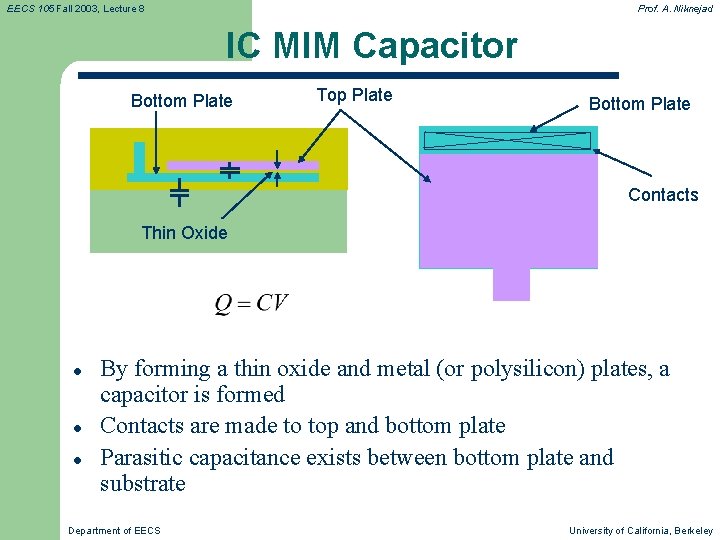
EECS 105 Fall 2003, Lecture 8 Prof. A. Niknejad IC MIM Capacitor Bottom Plate Top Plate Bottom Plate Contacts Thin Oxide l l l By forming a thin oxide and metal (or polysilicon) plates, a capacitor is formed Contacts are made to top and bottom plate Parasitic capacitance exists between bottom plate and substrate Department of EECS University of California, Berkeley
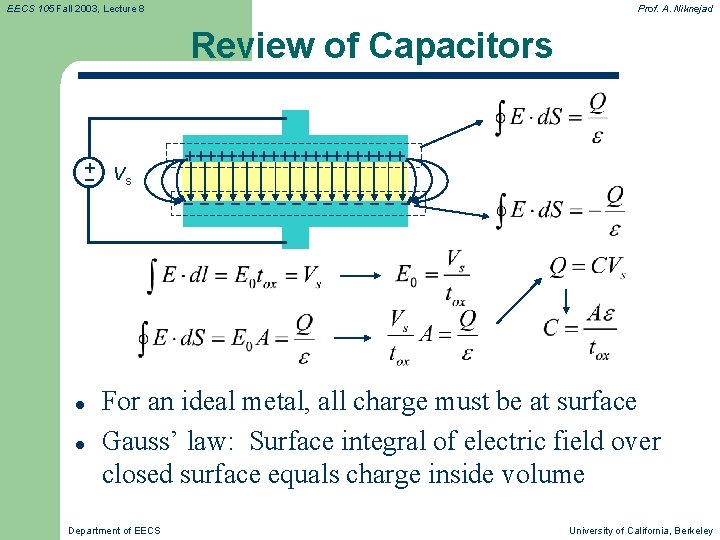
EECS 105 Fall 2003, Lecture 8 Prof. A. Niknejad Review of Capacitors + − Vs +++++++++++ −−−−−−−− l l For an ideal metal, all charge must be at surface Gauss’ law: Surface integral of electric field over closed surface equals charge inside volume Department of EECS University of California, Berkeley
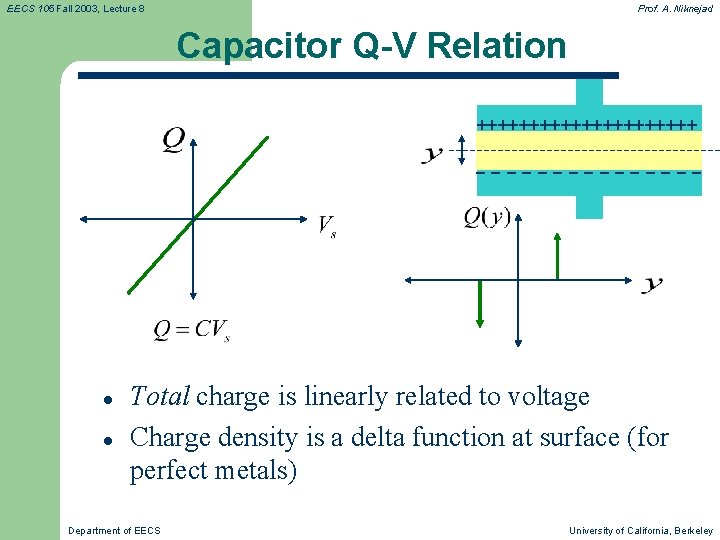
EECS 105 Fall 2003, Lecture 8 Prof. A. Niknejad Capacitor Q-V Relation +++++++++++ −−−−−−−− l l Total charge is linearly related to voltage Charge density is a delta function at surface (for perfect metals) Department of EECS University of California, Berkeley
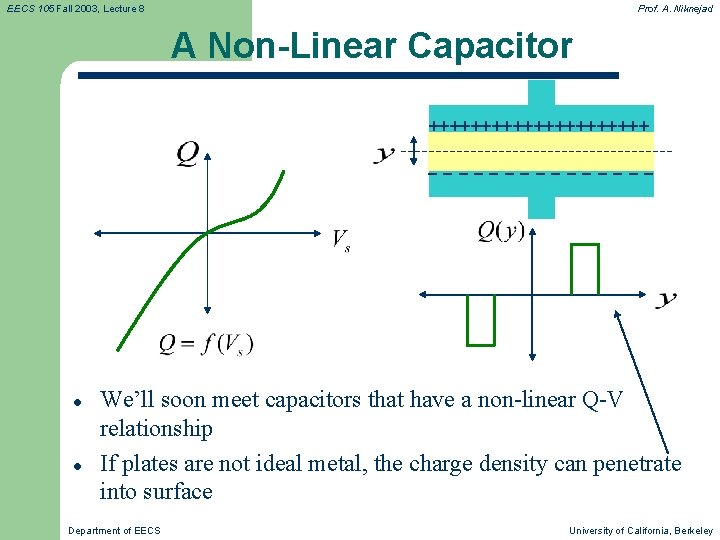
EECS 105 Fall 2003, Lecture 8 Prof. A. Niknejad A Non-Linear Capacitor +++++++++++ −−−−−−−− l l We’ll soon meet capacitors that have a non-linear Q-V relationship If plates are not ideal metal, the charge density can penetrate into surface Department of EECS University of California, Berkeley
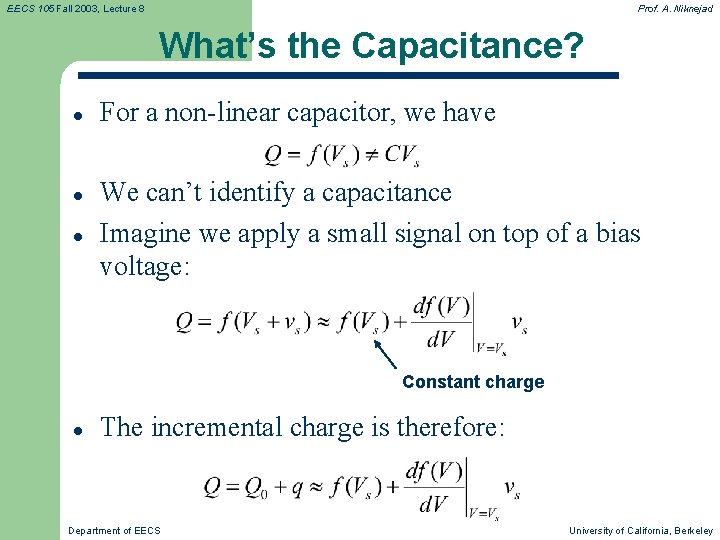
EECS 105 Fall 2003, Lecture 8 Prof. A. Niknejad What’s the Capacitance? l l l For a non-linear capacitor, we have We can’t identify a capacitance Imagine we apply a small signal on top of a bias voltage: Constant charge l The incremental charge is therefore: Department of EECS University of California, Berkeley
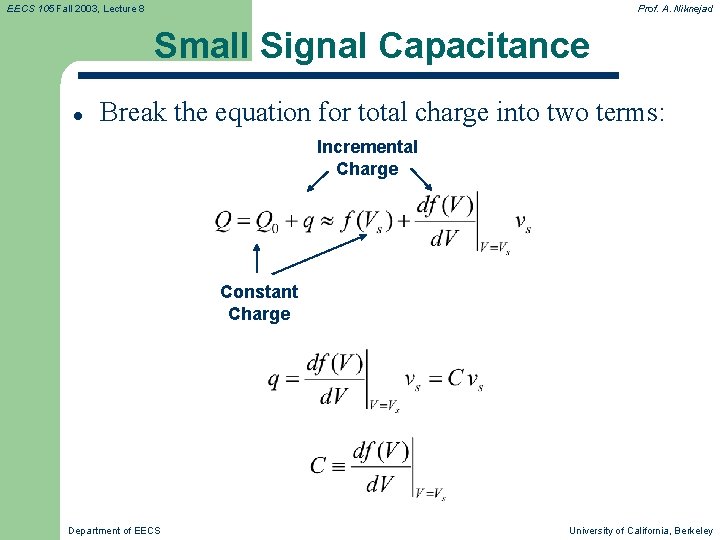
EECS 105 Fall 2003, Lecture 8 Prof. A. Niknejad Small Signal Capacitance l Break the equation for total charge into two terms: Incremental Charge Constant Charge Department of EECS University of California, Berkeley
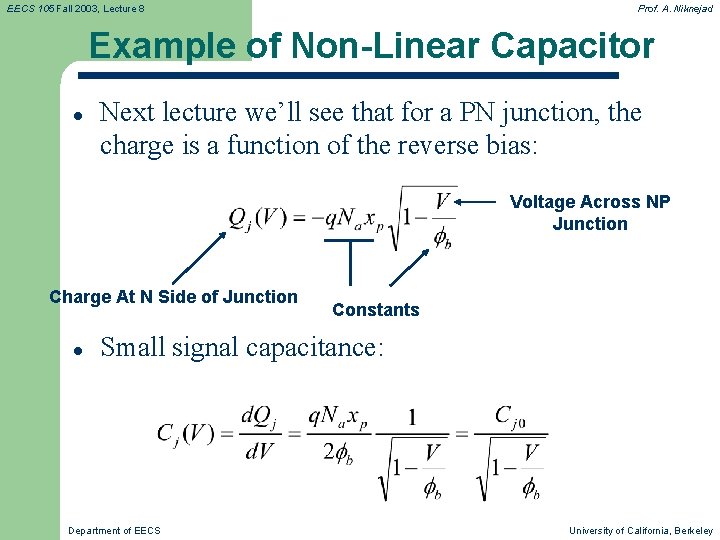
EECS 105 Fall 2003, Lecture 8 Prof. A. Niknejad Example of Non-Linear Capacitor l Next lecture we’ll see that for a PN junction, the charge is a function of the reverse bias: Voltage Across NP Junction Charge At N Side of Junction l Constants Small signal capacitance: Department of EECS University of California, Berkeley
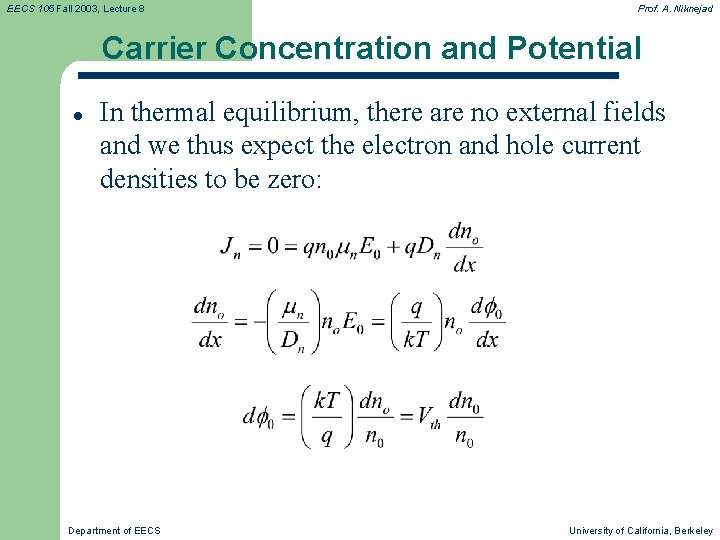
EECS 105 Fall 2003, Lecture 8 Prof. A. Niknejad Carrier Concentration and Potential l In thermal equilibrium, there are no external fields and we thus expect the electron and hole current densities to be zero: Department of EECS University of California, Berkeley
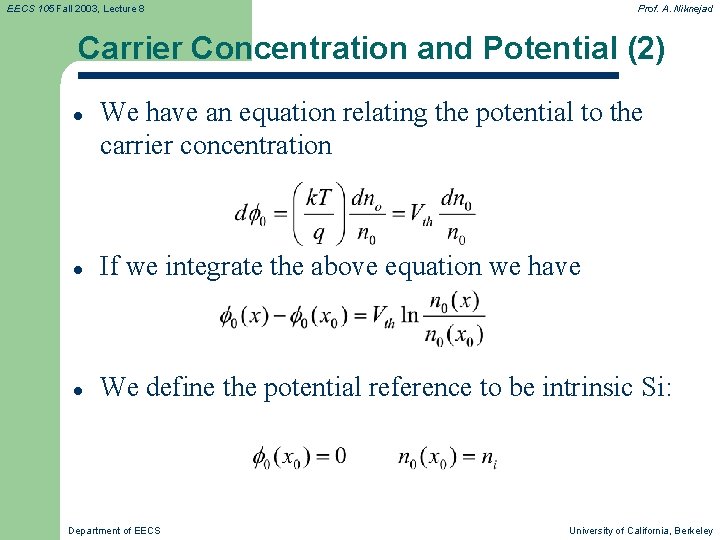
EECS 105 Fall 2003, Lecture 8 Prof. A. Niknejad Carrier Concentration and Potential (2) l We have an equation relating the potential to the carrier concentration l If we integrate the above equation we have l We define the potential reference to be intrinsic Si: Department of EECS University of California, Berkeley
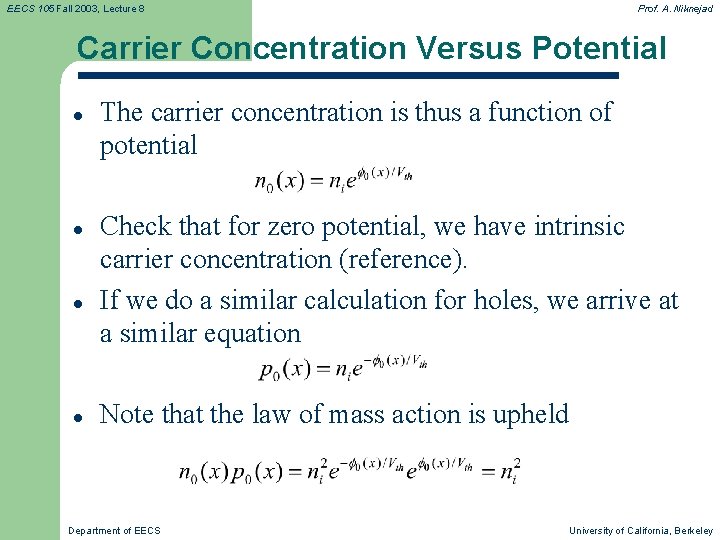
EECS 105 Fall 2003, Lecture 8 Prof. A. Niknejad Carrier Concentration Versus Potential l l The carrier concentration is thus a function of potential Check that for zero potential, we have intrinsic carrier concentration (reference). If we do a similar calculation for holes, we arrive at a similar equation Note that the law of mass action is upheld Department of EECS University of California, Berkeley
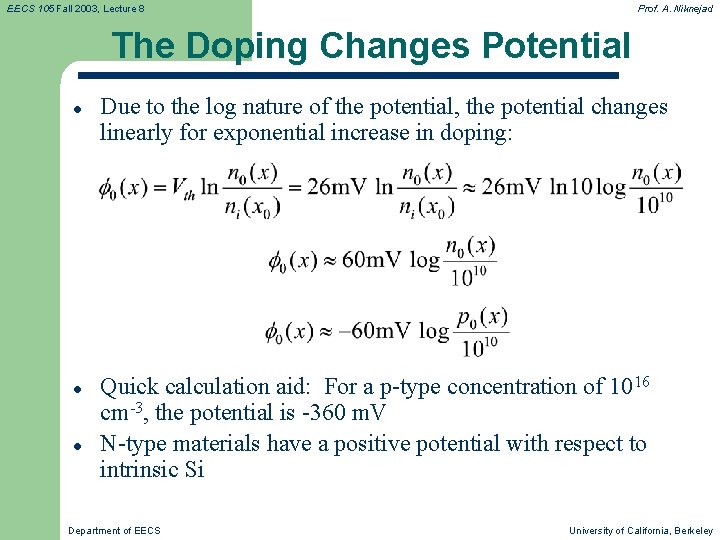
EECS 105 Fall 2003, Lecture 8 Prof. A. Niknejad The Doping Changes Potential l Due to the log nature of the potential, the potential changes linearly for exponential increase in doping: Quick calculation aid: For a p-type concentration of 1016 cm-3, the potential is -360 m. V N-type materials have a positive potential with respect to intrinsic Si Department of EECS University of California, Berkeley
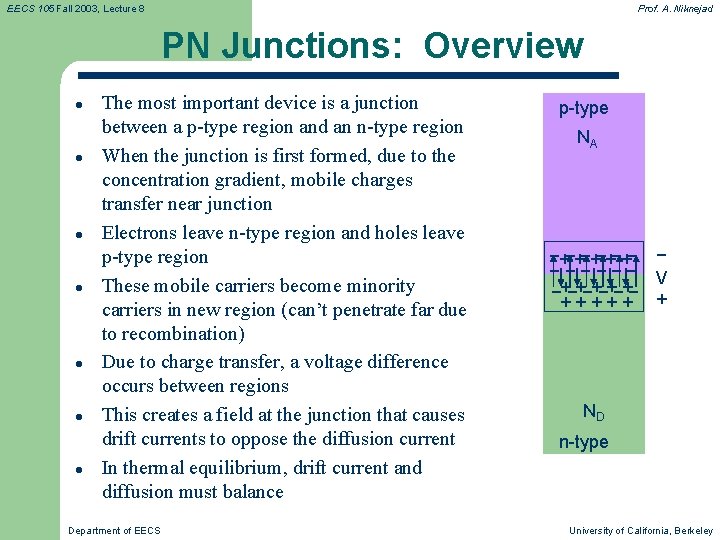
EECS 105 Fall 2003, Lecture 8 Prof. A. Niknejad PN Junctions: Overview l l l l The most important device is a junction between a p-type region and an n-type region When the junction is first formed, due to the concentration gradient, mobile charges transfer near junction Electrons leave n-type region and holes leave p-type region These mobile carriers become minority carriers in new region (can’t penetrate far due to recombination) Due to charge transfer, a voltage difference occurs between regions This creates a field at the junction that causes drift currents to oppose the diffusion current In thermal equilibrium, drift current and diffusion must balance Department of EECS p-type NA −+−+−+− − −−−−−− V +−+− −+ − +++++ + ND n-type University of California, Berkeley
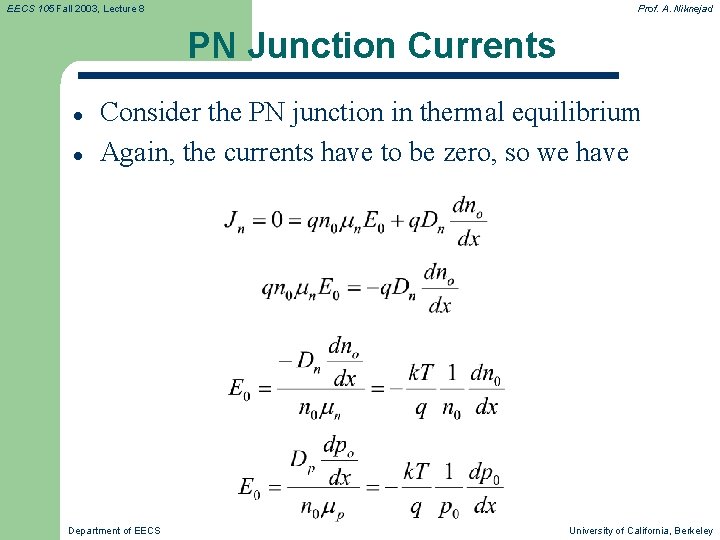
EECS 105 Fall 2003, Lecture 8 Prof. A. Niknejad PN Junction Currents l l Consider the PN junction in thermal equilibrium Again, the currents have to be zero, so we have Department of EECS University of California, Berkeley
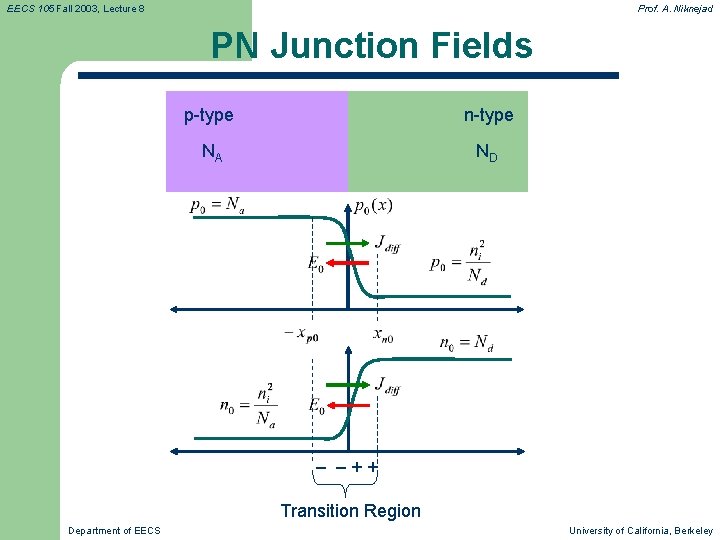
EECS 105 Fall 2003, Lecture 8 Prof. A. Niknejad PN Junction Fields p-type n-type NA ND – –++ Transition Region Department of EECS University of California, Berkeley
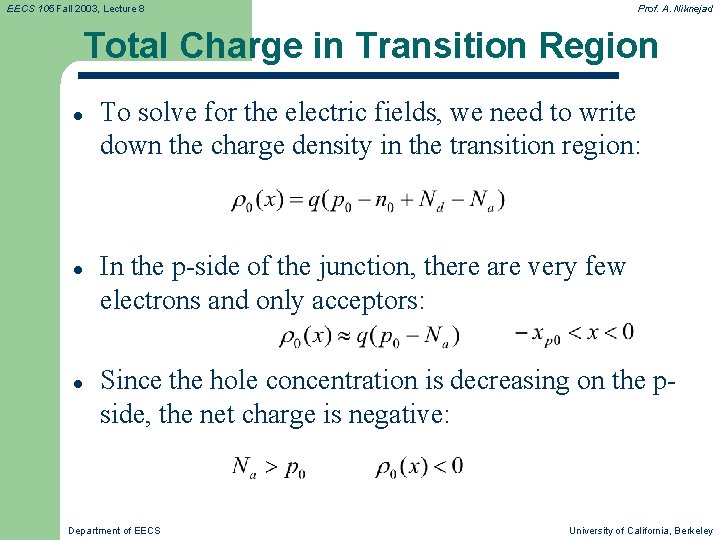
EECS 105 Fall 2003, Lecture 8 Prof. A. Niknejad Total Charge in Transition Region l l l To solve for the electric fields, we need to write down the charge density in the transition region: In the p-side of the junction, there are very few electrons and only acceptors: Since the hole concentration is decreasing on the pside, the net charge is negative: Department of EECS University of California, Berkeley
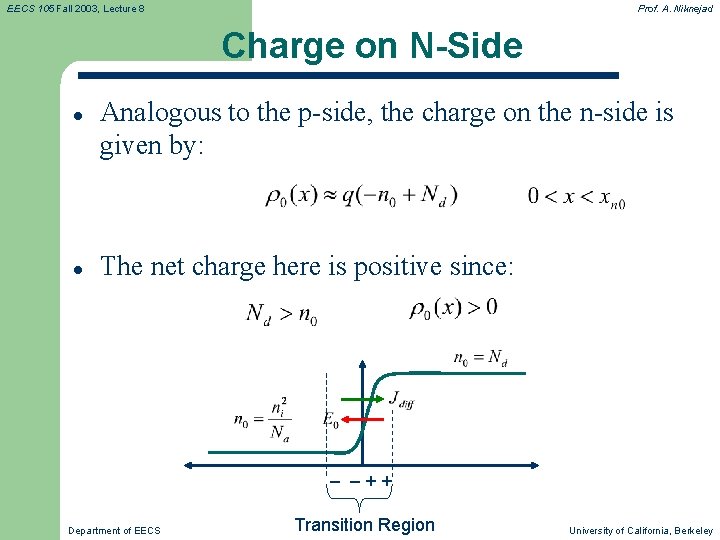
EECS 105 Fall 2003, Lecture 8 Prof. A. Niknejad Charge on N-Side l l Analogous to the p-side, the charge on the n-side is given by: The net charge here is positive since: – –++ Department of EECS Transition Region University of California, Berkeley