DSP 1 1150 homing pigeon 1790 semaphore 19



- Slides: 40
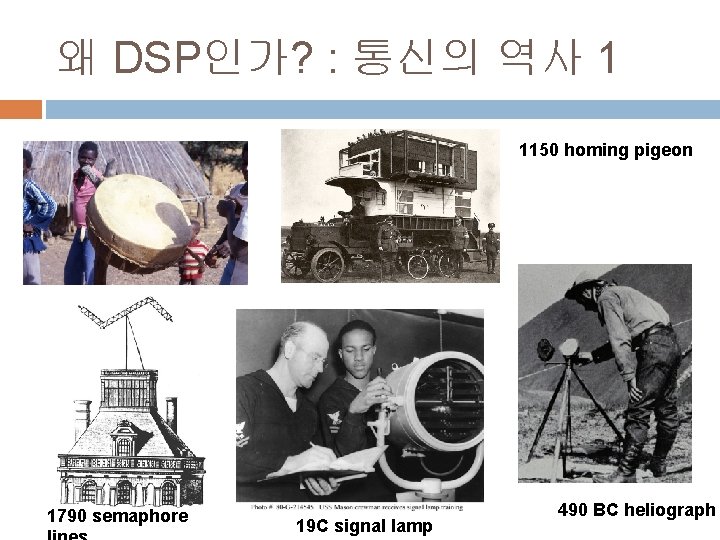
왜 DSP인가? : 통신의 역사 1 1150 homing pigeon 1790 semaphore 19 C signal lamp 490 BC heliograph
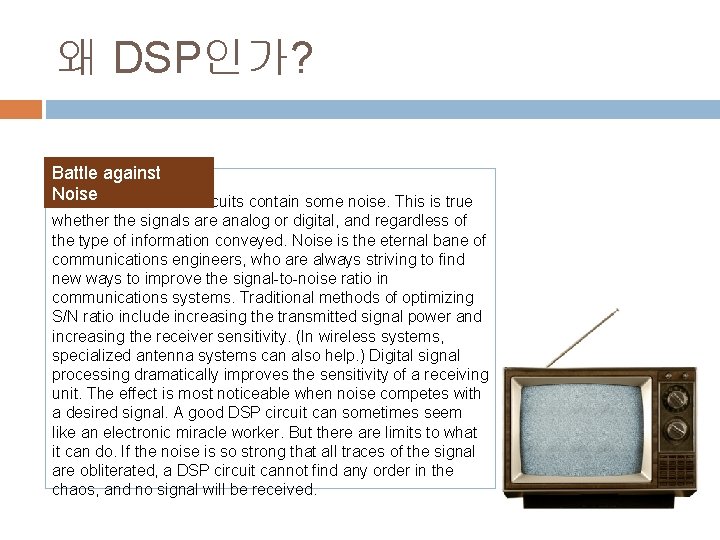
왜 DSP인가? Battle against Noise All communications circuits contain some noise. This is true whether the signals are analog or digital, and regardless of the type of information conveyed. Noise is the eternal bane of communications engineers, who are always striving to find new ways to improve the signal-to-noise ratio in communications systems. Traditional methods of optimizing S/N ratio include increasing the transmitted signal power and increasing the receiver sensitivity. (In wireless systems, specialized antenna systems can also help. ) Digital signal processing dramatically improves the sensitivity of a receiving unit. The effect is most noticeable when noise competes with a desired signal. A good DSP circuit can sometimes seem like an electronic miracle worker. But there are limits to what it can do. If the noise is so strong that all traces of the signal are obliterated, a DSP circuit cannot find any order in the chaos, and no signal will be received.
Contents DSP definition and application Frequency and sinusoids Discrete time signals Basic DSP operations Discrete time systems DSP system
Digital Signal DSP 정의 및 응 용 What is Signal? Any physical quantities that varies with time, space or any other independent variable Carriers of information Classification of signals Scalar vs. vector Continuous-time vs. discrete-time Continuous-valued vs. discrete-valued Deterministic vs. random Digital Signal=discrete-time+discrete-valued
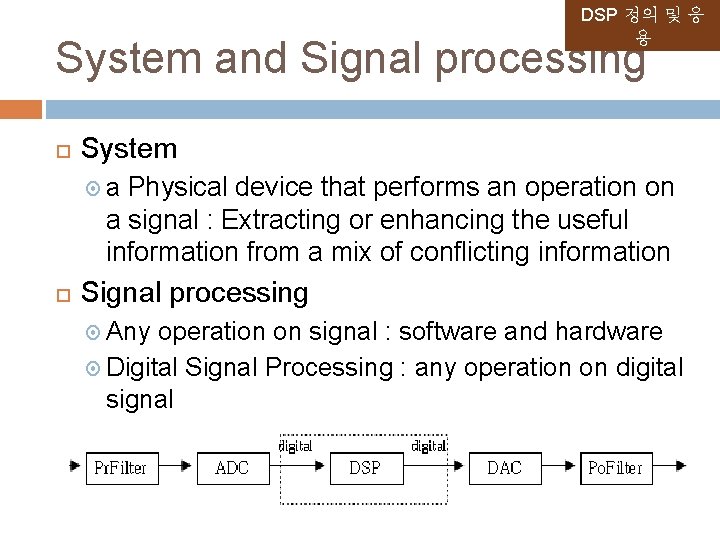
DSP 정의 및 응 용 System and Signal processing System Physical device that performs an operation on a signal : Extracting or enhancing the useful information from a mix of conflicting information a Signal processing Any operation on signal : software and hardware Digital Signal Processing : any operation on digital signal
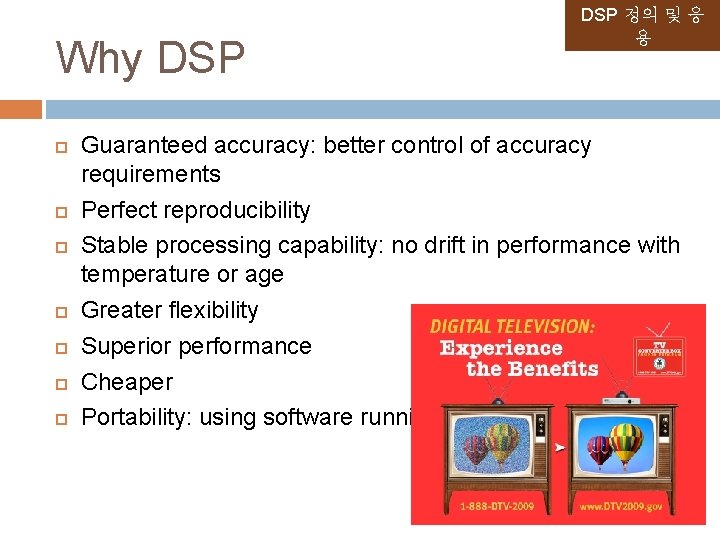
Why DSP 정의 및 응 용 Guaranteed accuracy: better control of accuracy requirements Perfect reproducibility Stable processing capability: no drift in performance with temperature or age Greater flexibility Superior performance Cheaper Portability: using software running
Disadvantage of DSP 정의 및 응 용 Speed Bandwidths in the 100 MHz range is still processed only by analogue device Design time Quantization error Finite wordlength effect
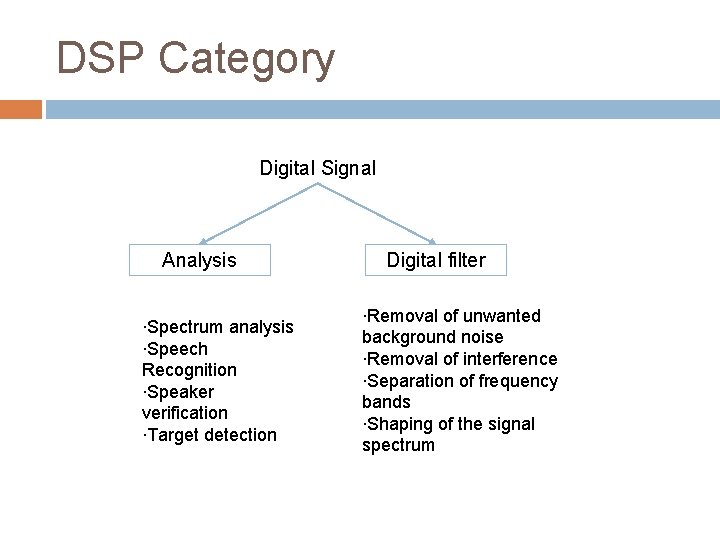
DSP Category Digital Signal Analysis ∙Spectrum analysis ∙Speech Recognition ∙Speaker verification ∙Target detection Digital filter ∙Removal of unwanted background noise ∙Removal of interference ∙Separation of frequency bands ∙Shaping of the signal spectrum
Application DSP 정의 및 응 용 Image processing: pattern recognition, robotic vision, image enhancement, facsimile, satellite weather map, animation Instrumentation/control: spectrum analysis, position and rate control, noise reduction, data compression Speech/Audio: speech recognition, speech synthesis, digital audio, equalization Military: secure communication, radar & sonar processing, missile guidance Telecommunications: echo cancellation, adaptive equalization, codec, spread spectrum, video conference, data communication Biomedical : patient monitoring, scanners, EEG brain mapers, ECG analysis, X-ray storage/enhancement Etc
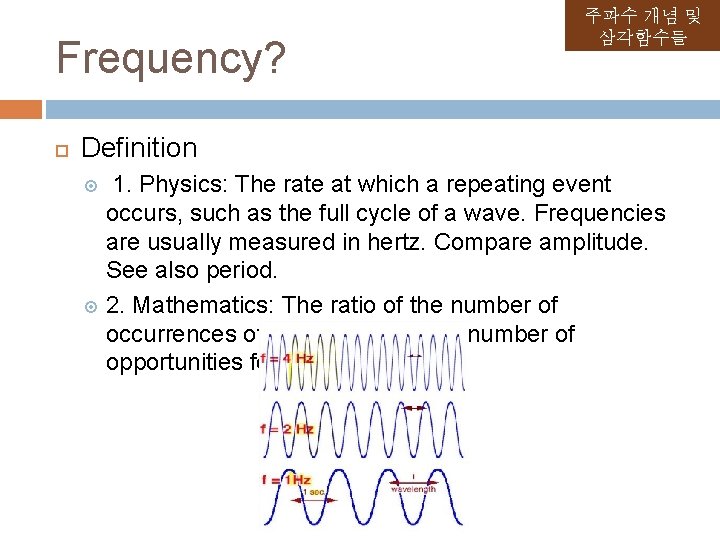
Frequency? 주파수 개념 및 삼각함수들 Definition 1. Physics: The rate at which a repeating event occurs, such as the full cycle of a wave. Frequencies are usually measured in hertz. Compare amplitude. See also period. 2. Mathematics: The ratio of the number of occurrences of some event to the number of opportunities for its occurrence.
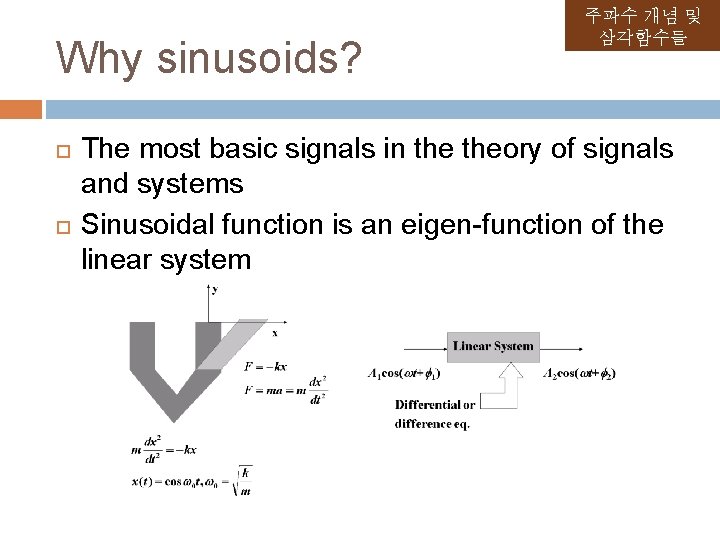
Why sinusoids? 주파수 개념 및 삼각함수들 The most basic signals in theory of signals and systems Sinusoidal function is an eigen-function of the linear system
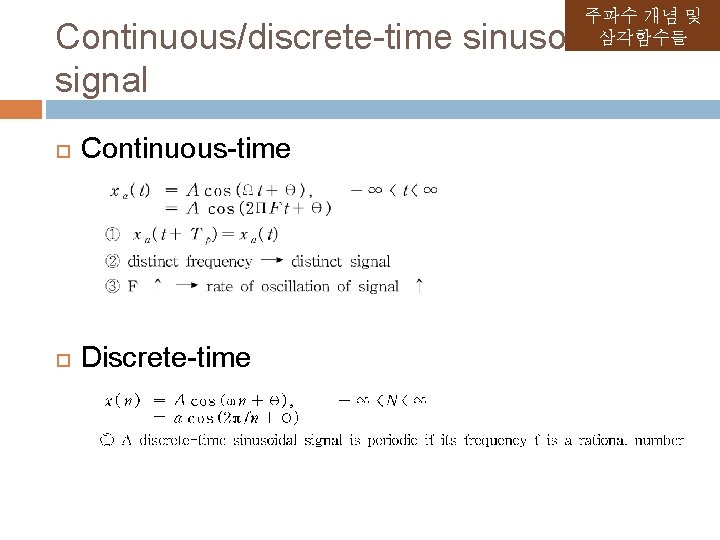
주파수 개념 및 삼각함수들 Continuous/discrete-time sinusoidal signal Continuous-time Discrete-time
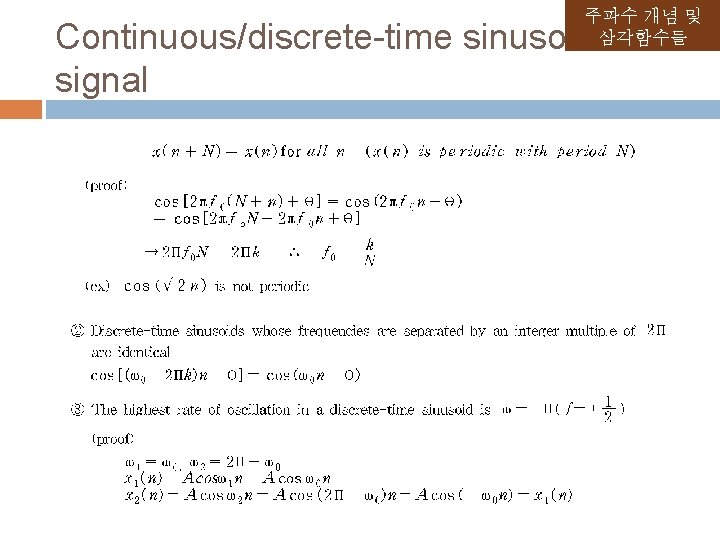
주파수 개념 및 삼각함수들 Continuous/discrete-time sinusoidal signal
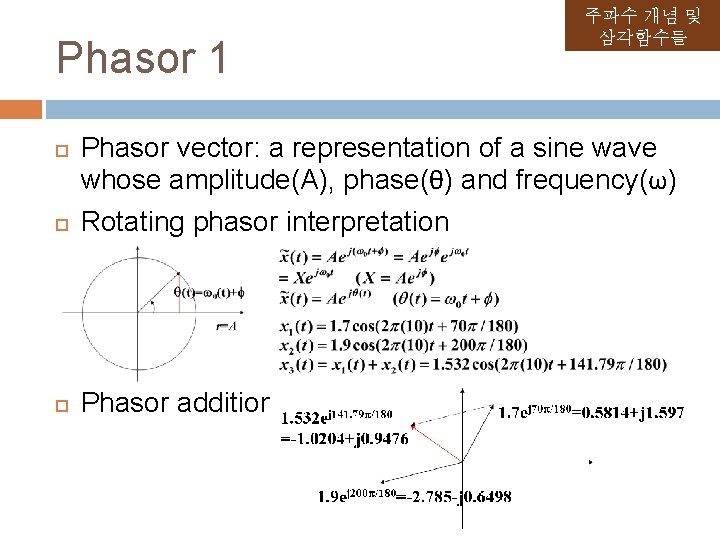
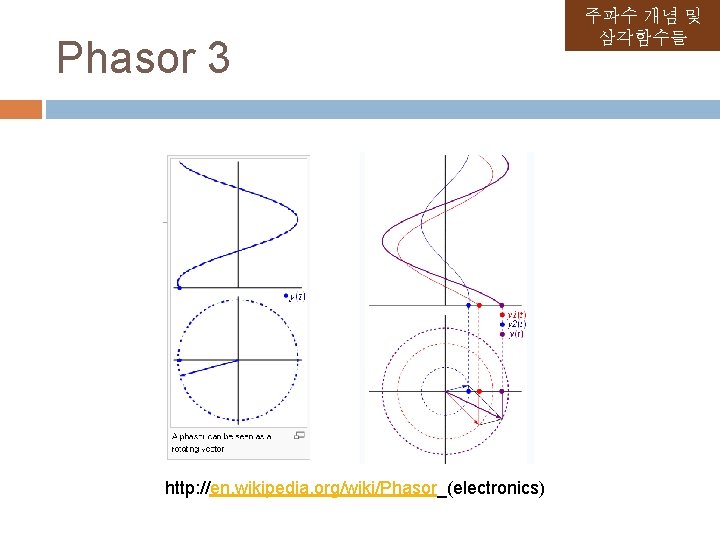
Phasor 1 주파수 개념 및 삼각함수들 Phasor vector: a representation of a sine wave whose amplitude(A), phase(θ) and frequency(ω) Rotating phasor interpretation Phasor addition
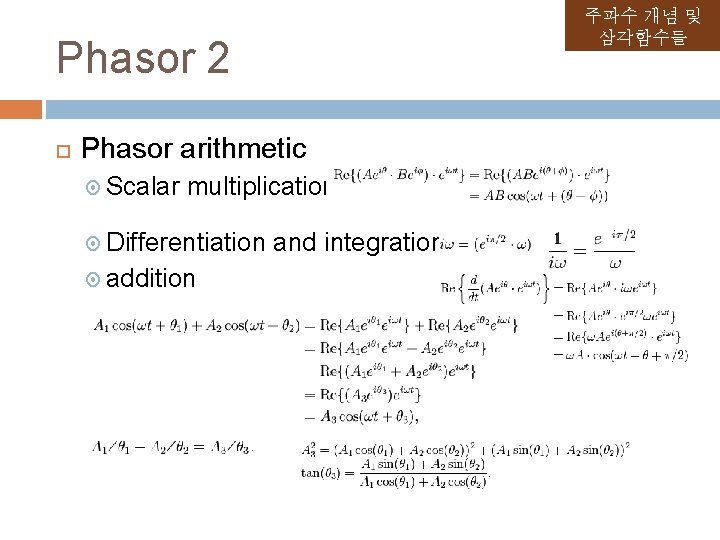
주파수 개념 및 삼각함수들 Phasor 2 Phasor arithmetic Scalar multiplication Differentiation addition and integration
Phasor 3 http: //en. wikipedia. org/wiki/Phasor_(electronics) 주파수 개념 및 삼각함수들
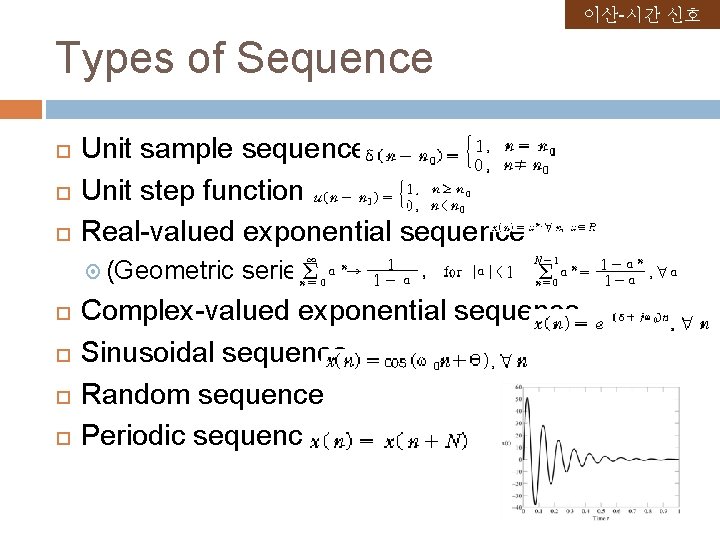
이산-시간 신호 Types of Sequence Unit sample sequence Unit step function Real-valued exponential sequence (Geometric series) Complex-valued exponential sequence Sinusoidal sequence Random sequence Periodic sequence
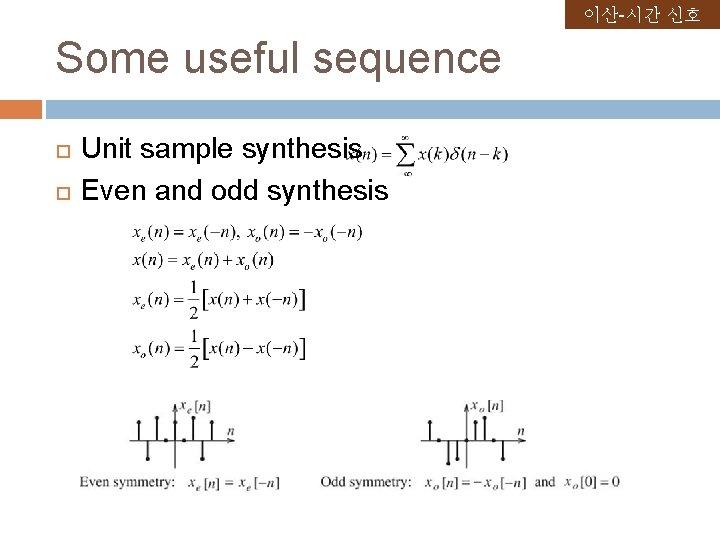
이산-시간 신호 Some useful sequence Unit sample synthesis Even and odd synthesis
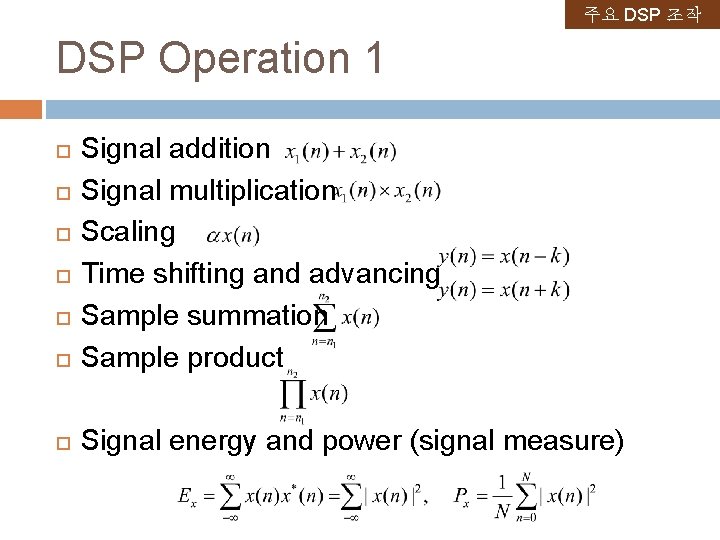
주요 DSP 조작 DSP Operation 1 Signal addition Signal multiplication Scaling Time shifting and advancing Sample summation Sample product Signal energy and power (signal measure)
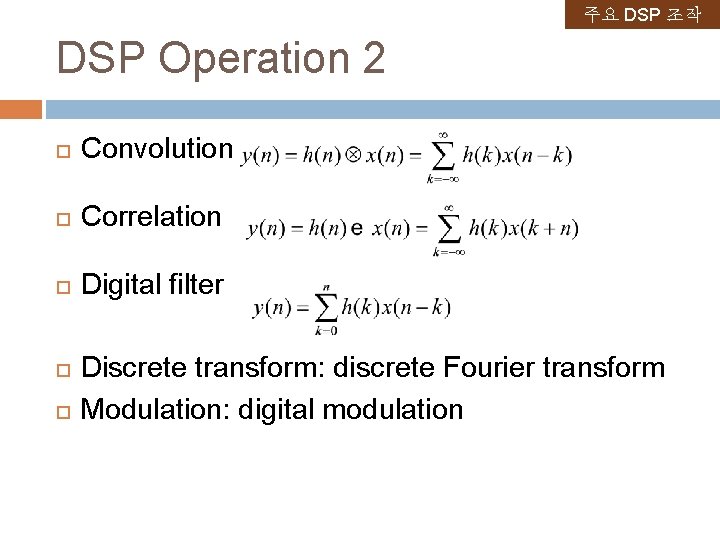
주요 DSP 조작 DSP Operation 2 Convolution Correlation Digital filter Discrete transform: discrete Fourier transform Modulation: digital modulation
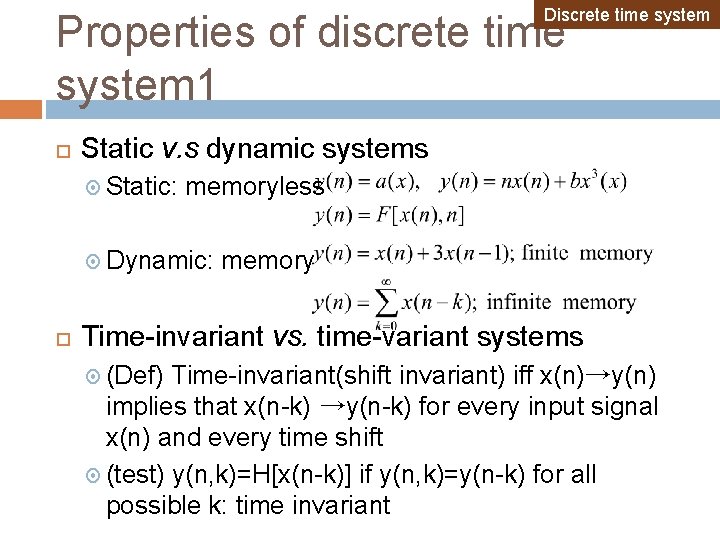
Discrete time system Properties of discrete time system 1 Static v. s dynamic systems Static: memoryless Dynamic: memory Time-invariant vs. time-variant systems (Def) Time-invariant(shift invariant) iff x(n)→y(n) implies that x(n-k) →y(n-k) for every input signal x(n) and every time shift (test) y(n, k)=H[x(n-k)] if y(n, k)=y(n-k) for all possible k: time invariant
Discrete time system Properties of discrete time system 2 (Ex) time-multiplier Linear vs. nonlinear systems (Def) A system H is linear iff H[a 1 x 1 (n)+a 2 x 2 (n)]=a 1 H[x 1 (n)]+a 2 H[x 2 (n)]
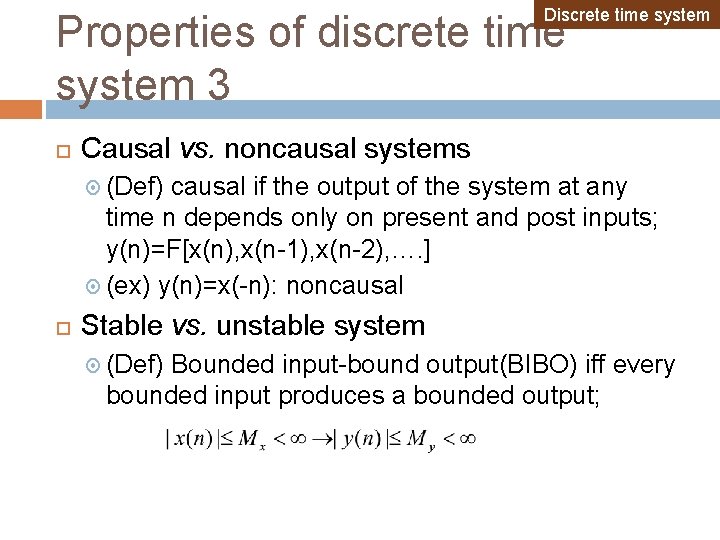
Discrete time system Properties of discrete time system 3 Causal vs. noncausal systems (Def) causal if the output of the system at any time n depends only on present and post inputs; y(n)=F[x(n), x(n-1), x(n-2), …. ] (ex) y(n)=x(-n): noncausal Stable vs. unstable system (Def) Bounded input-bound output(BIBO) iff every bounded input produces a bounded output;
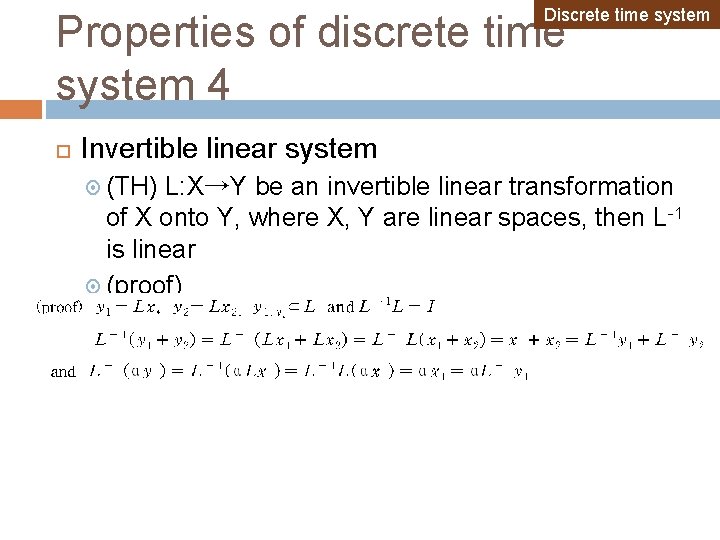
Discrete time system Properties of discrete time system 4 Invertible linear system (TH) L: X→Y be an invertible linear transformation of X onto Y, where X, Y are linear spaces, then L-1 is linear (proof)
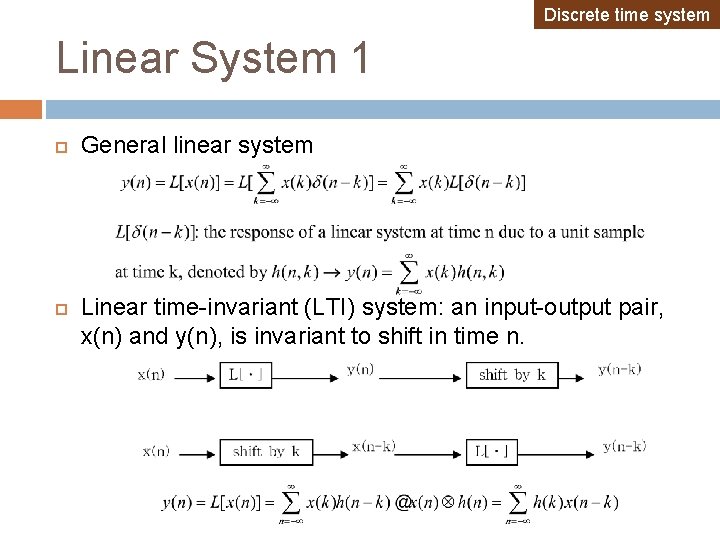
Discrete time system Linear System 1 General linear system Linear time-invariant (LTI) system: an input-output pair, x(n) and y(n), is invariant to shift in time n.
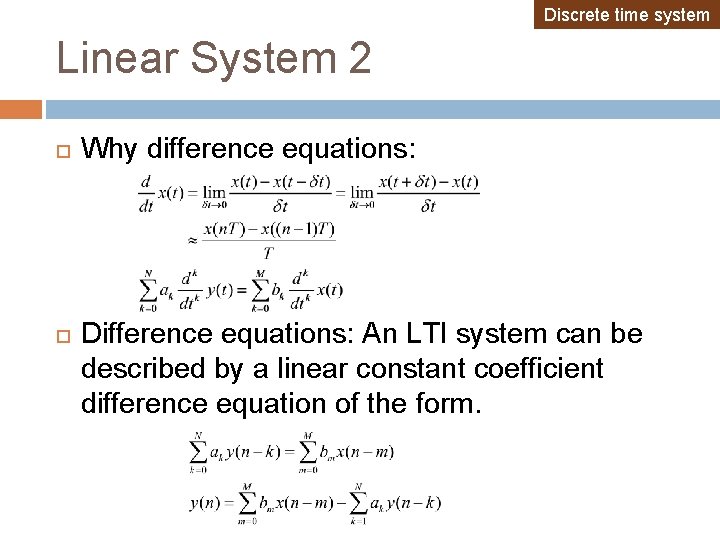
Discrete time system Linear System 2 Why difference equations: Difference equations: An LTI system can be described by a linear constant coefficient difference equation of the form.
Digital signal processing system Block diagram of DSP system A/D conversion DSP DA conversion Block diagram of a simplified, generalized real-time digital signal processing system
Digital signal processing system Analog-to-digital conversion process 1 A/D process The (band limited) signal is first sampled in time (t=n. T, x(n. T)→x(n)) The amplitude of each signal sample is quantized into one of 2 B levels The discrete amplitude levels are represented or encoded into distinct binary words each of length B bits
Sampling 1 Digital signal processing system Sampling theorem: If the highest frequency contained in an analog signal xa(t) is Fmax=B and the signal is sampled at a rate Fs≥ 2 fmax=2 B, then xa(t) can be exactly recovered from its sample values using the interpolation function g(t)=(sin 2πBT)/(2πBT). Thus xa(t) may be expressed as where xa(n/Fs)=xa(n. T)=x(n) are the samples of xahttp: //en. wikipedia. org/wiki/File: Sinc_function_(normalized). s (t). vg
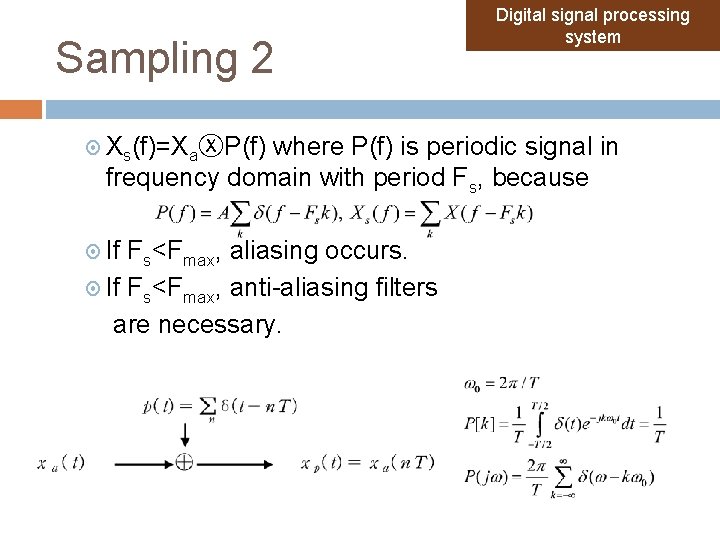
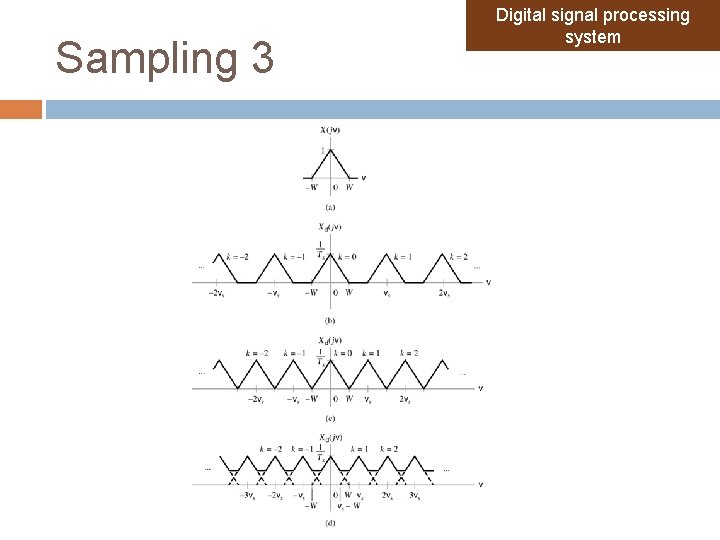
Sampling 2 Xs(f)=XaⓧP(f) Digital signal processing system where P(f) is periodic signal in frequency domain with period Fs, because If Fs<Fmax, aliasing occurs. If Fs<Fmax, anti-aliasing filters are necessary.
Sampling 3 Digital signal processing system
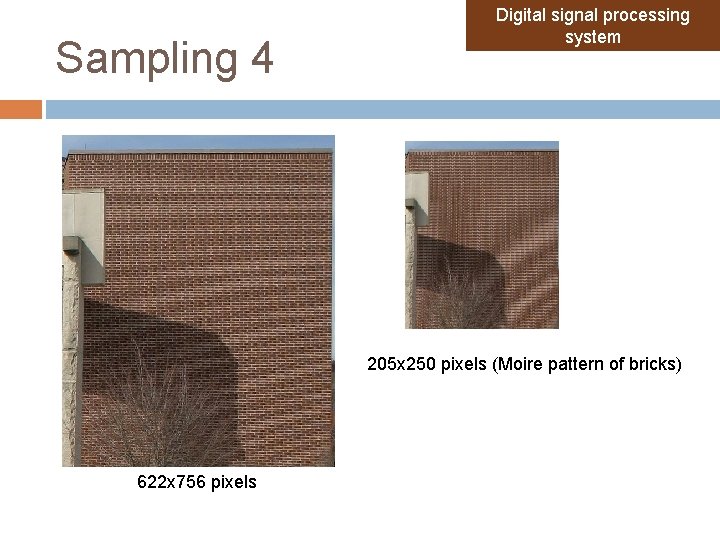
Sampling 4 Digital signal processing system 205 x 250 pixels (Moire pattern of bricks) 622 x 756 pixels
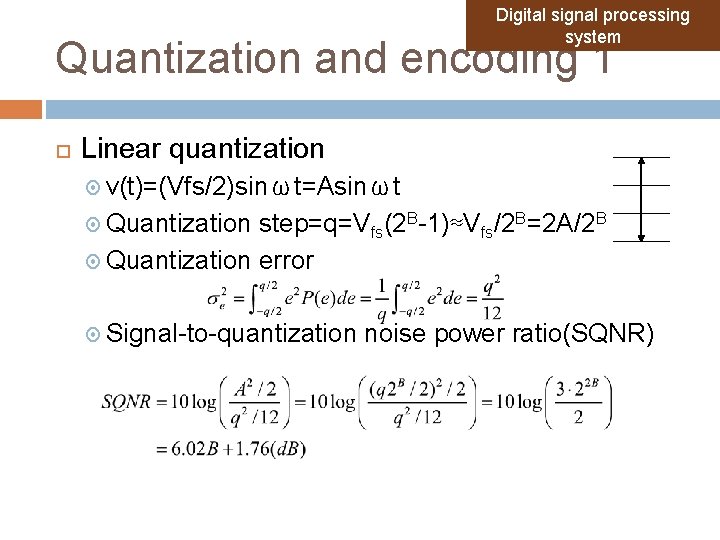
Digital signal processing system Quantization and encoding 1 Linear quantization v(t)=(Vfs/2)sinωt=Asinωt Quantization step=q=Vfs(2 B-1)≈Vfs/2 B=2 A/2 B Quantization error Signal-to-quantization noise power ratio(SQNR)
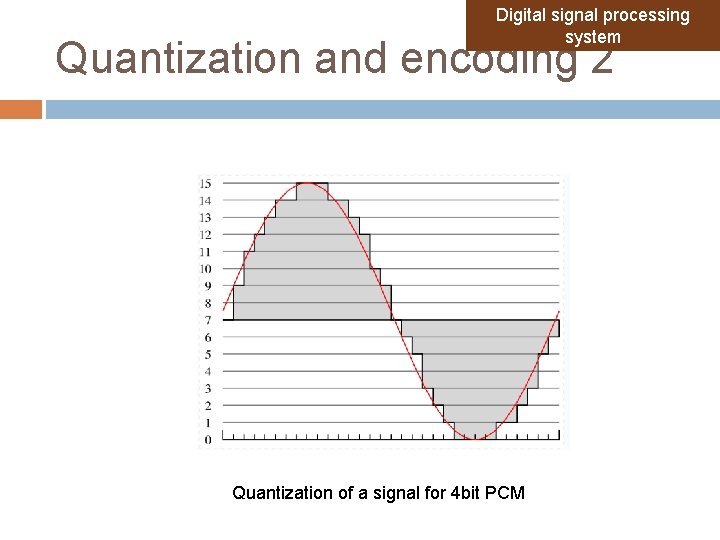
Digital signal processing system Quantization and encoding 2 Quantization of a signal for 4 bit PCM
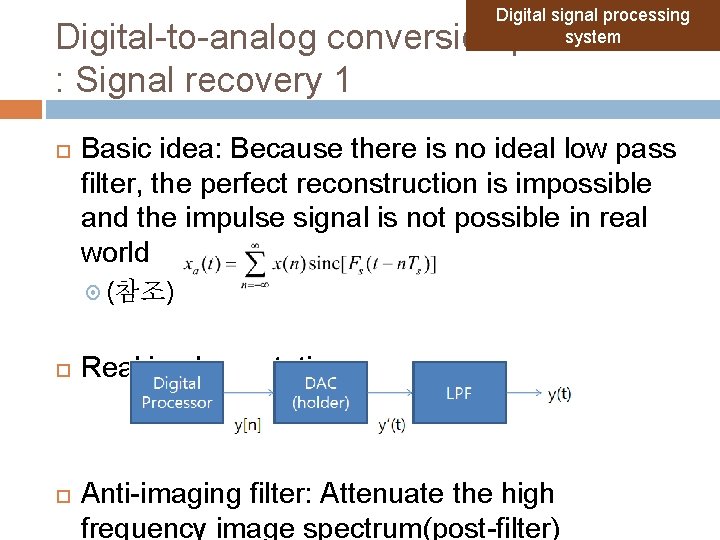
Digital signal processing system Digital-to-analog conversion process : Signal recovery 1 Basic idea: Because there is no ideal low pass filter, the perfect reconstruction is impossible and the impulse signal is not possible in real world (참조) Real implementation Anti-imaging filter: Attenuate the high frequency image spectrum(post-filter)
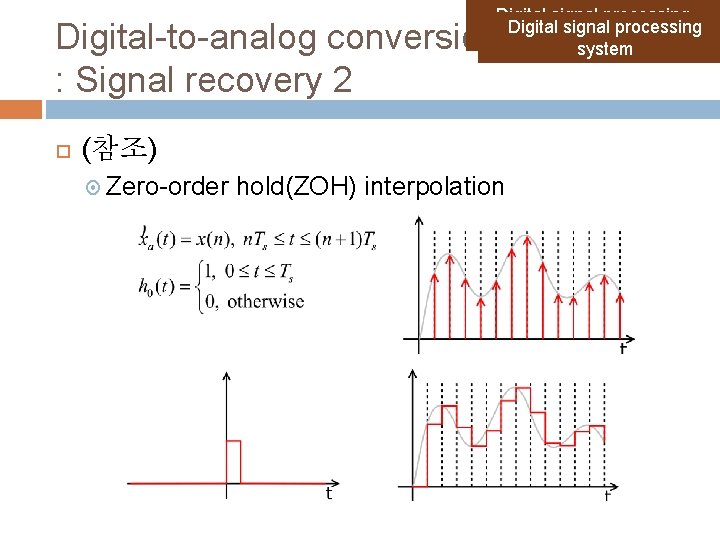
Digital signal processing system Digital-to-analog conversion process : Signal recovery 2 (참조) Zero-order hold(ZOH) interpolation
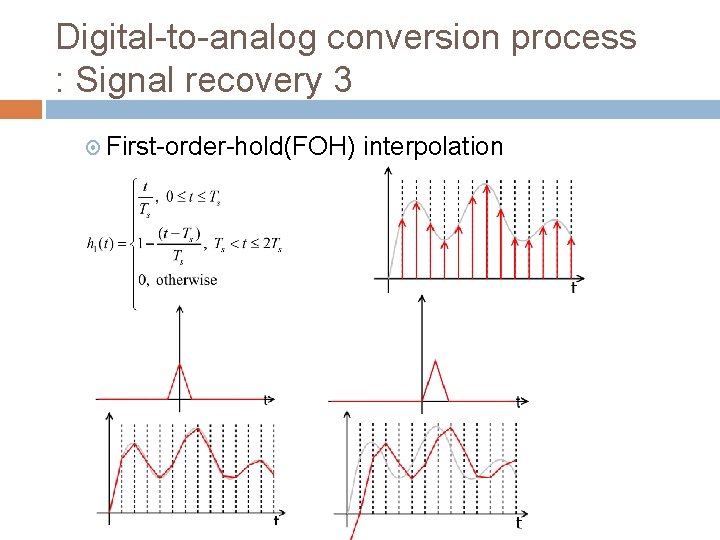
Digital-to-analog conversion process : Signal recovery 3 First-order-hold(FOH) interpolation