Determination of Forward and Futures Prices Chapter 5
- Slides: 39
Determination of Forward and Futures Prices Chapter 5 Fundamentals of Futures and Options Markets, 5 th Edition, Copyright © John C. Hull 2004 5. 1
Introduction: Chapter 5 l In this chapter, we will study how forward prices and future prices are related to the spot prices of the underlying asset. l l Forward prices & spot prices Futures prices & spot prices for contracts on l l l Stock indices Foreign exchange Commodities Fundamentals of Futures and Options Markets, 5 th Edition, Copyright © John C. Hull 2004 5. 2
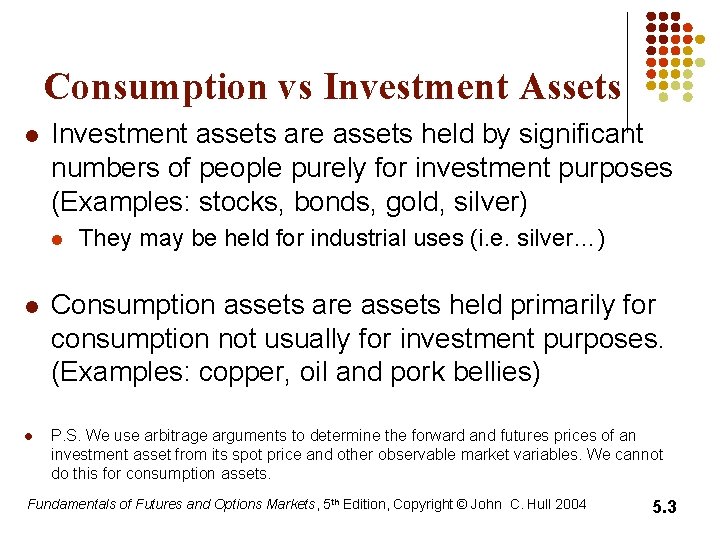
Consumption vs Investment Assets l Investment assets are assets held by significant numbers of people purely for investment purposes (Examples: stocks, bonds, gold, silver) l l l They may be held for industrial uses (i. e. silver…) Consumption assets are assets held primarily for consumption not usually for investment purposes. (Examples: copper, oil and pork bellies) P. S. We use arbitrage arguments to determine the forward and futures prices of an investment asset from its spot price and other observable market variables. We cannot do this for consumption assets. Fundamentals of Futures and Options Markets, 5 th Edition, Copyright © John C. Hull 2004 5. 3
Short Selling (Shorting) l Short selling involves selling securities you do not own. l Your broker borrows the securities from another client and sells them in the market in the usual way. (possible for some, not all, investment assets. ) Fundamentals of Futures and Options Markets, 5 th Edition, Copyright © John C. Hull 2004 5. 4
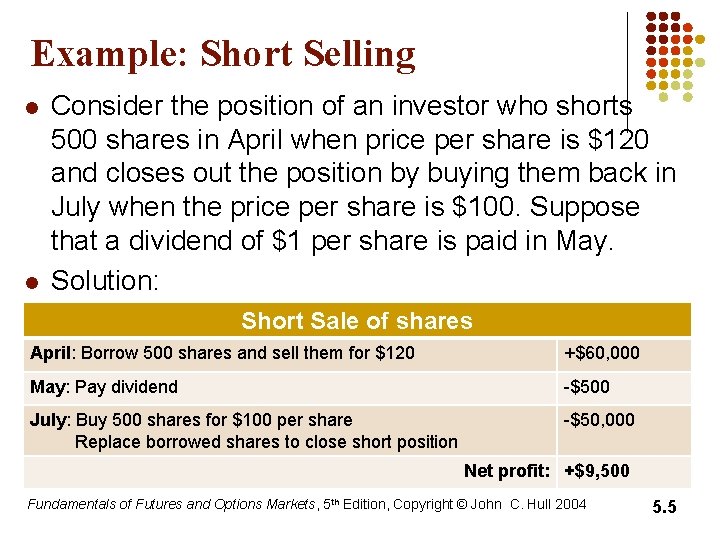
Example: Short Selling l l Consider the position of an investor who shorts 500 shares in April when price per share is $120 and closes out the position by buying them back in July when the price per share is $100. Suppose that a dividend of $1 per share is paid in May. Solution: Short Sale of shares April: Borrow 500 shares and sell them for $120 +$60, 000 May: Pay dividend -$500 July: Buy 500 shares for $100 per share Replace borrowed shares to close short position -$50, 000 Net profit: +$9, 500 Fundamentals of Futures and Options Markets, 5 th Edition, Copyright © John C. Hull 2004 5. 5
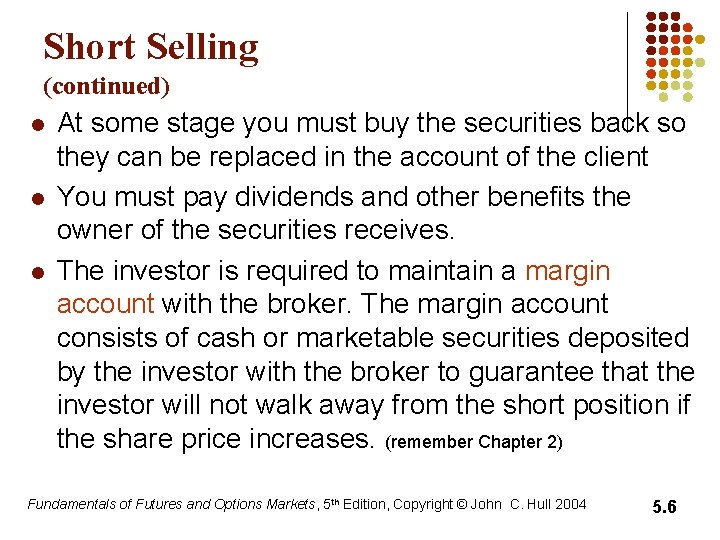
Short Selling (continued) l l l At some stage you must buy the securities back so they can be replaced in the account of the client You must pay dividends and other benefits the owner of the securities receives. The investor is required to maintain a margin account with the broker. The margin account consists of cash or marketable securities deposited by the investor with the broker to guarantee that the investor will not walk away from the short position if the share price increases. (remember Chapter 2) Fundamentals of Futures and Options Markets, 5 th Edition, Copyright © John C. Hull 2004 5. 6
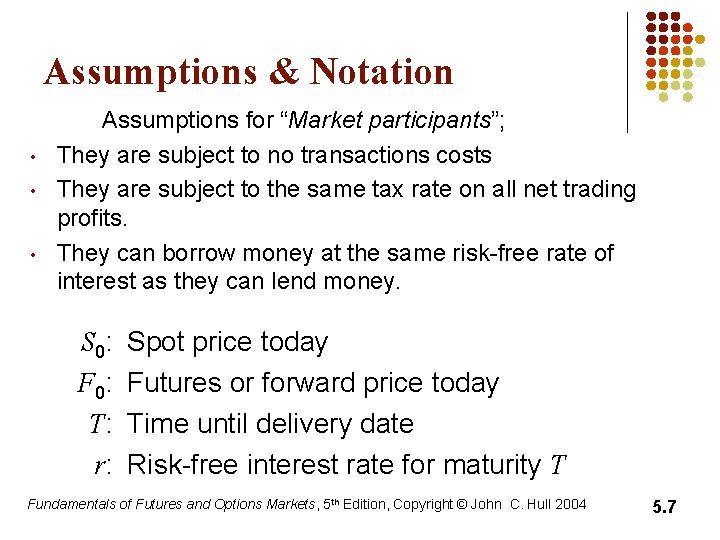
Assumptions & Notation • • • Assumptions for “Market participants”; They are subject to no transactions costs They are subject to the same tax rate on all net trading profits. They can borrow money at the same risk-free rate of interest as they can lend money. S 0: F 0: T: r: Spot price today Futures or forward price today Time until delivery date Risk-free interest rate for maturity T Fundamentals of Futures and Options Markets, 5 th Edition, Copyright © John C. Hull 2004 5. 7
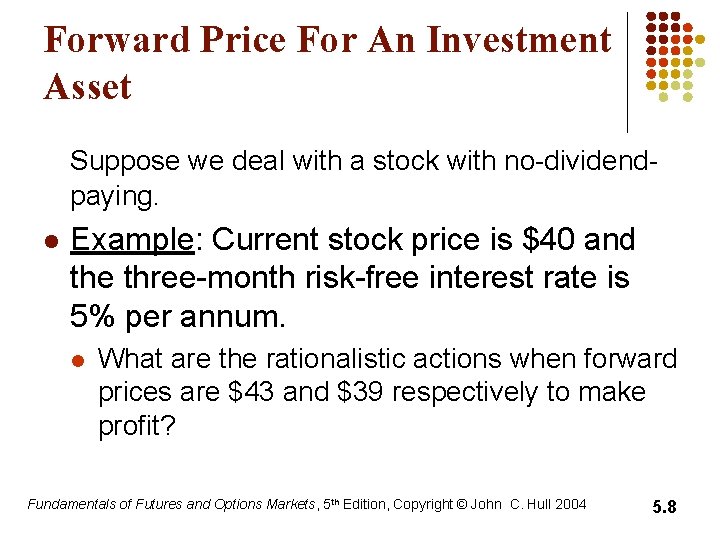
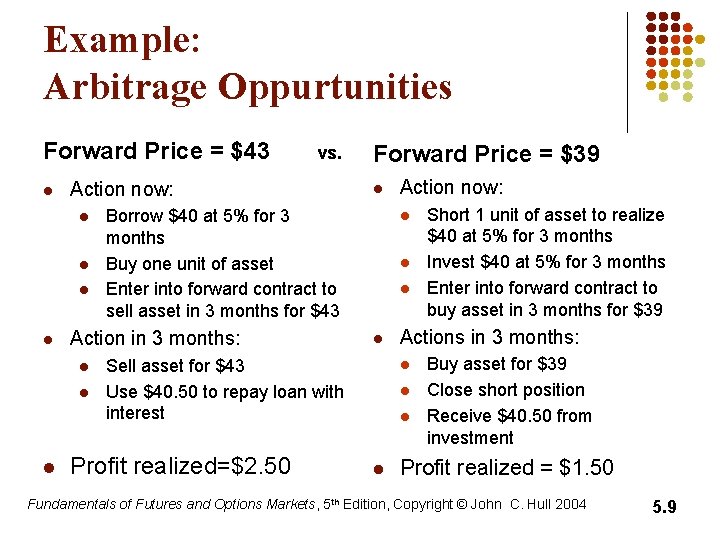
Forward Price For An Investment Asset Suppose we deal with a stock with no-dividendpaying. l Example: Current stock price is $40 and the three-month risk-free interest rate is 5% per annum. l What are the rationalistic actions when forward prices are $43 and $39 respectively to make profit? Fundamentals of Futures and Options Markets, 5 th Edition, Copyright © John C. Hull 2004 5. 8
Example: Arbitrage Oppurtunities Forward Price = $43 l Action now: l l l Forward Price = $39 l Borrow $40 at 5% for 3 months Buy one unit of asset Enter into forward contract to sell asset in 3 months for $43 Action in 3 months: l l vs. l l Sell asset for $43 Use $40. 50 to repay loan with interest Profit realized=$2. 50 Action now: Actions in 3 months: l l Short 1 unit of asset to realize $40 at 5% for 3 months Invest $40 at 5% for 3 months Enter into forward contract to buy asset in 3 months for $39 Buy asset for $39 Close short position Receive $40. 50 from investment Profit realized = $1. 50 Fundamentals of Futures and Options Markets, 5 th Edition, Copyright © John C. Hull 2004 5. 9
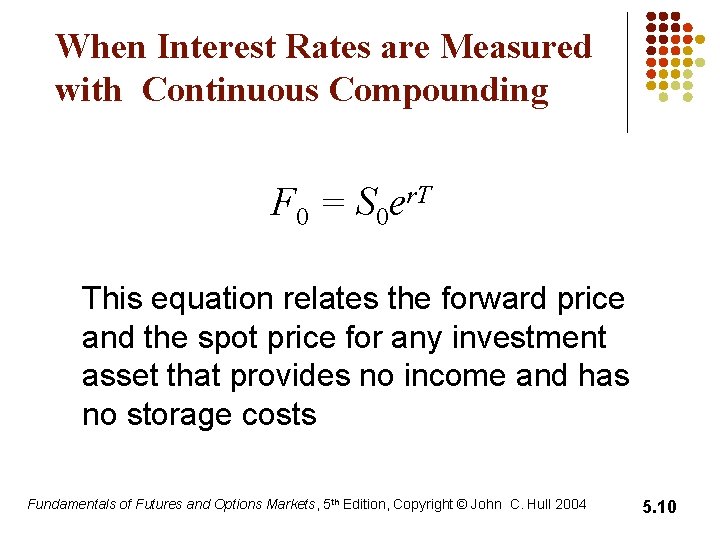
When Interest Rates are Measured with Continuous Compounding F 0 = S 0 er. T This equation relates the forward price and the spot price for any investment asset that provides no income and has no storage costs Fundamentals of Futures and Options Markets, 5 th Edition, Copyright © John C. Hull 2004 5. 10
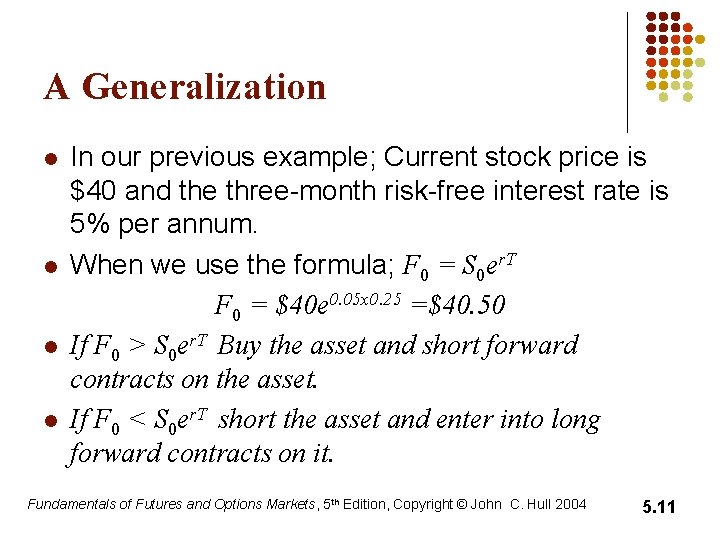
A Generalization l l In our previous example; Current stock price is $40 and the three-month risk-free interest rate is 5% per annum. When we use the formula; F 0 = S 0 er. T F 0 = $40 e 0. 05 x 0. 25 =$40. 50 If F 0 > S 0 er. T Buy the asset and short forward contracts on the asset. If F 0 < S 0 er. T short the asset and enter into long forward contracts on it. Fundamentals of Futures and Options Markets, 5 th Edition, Copyright © John C. Hull 2004 5. 11
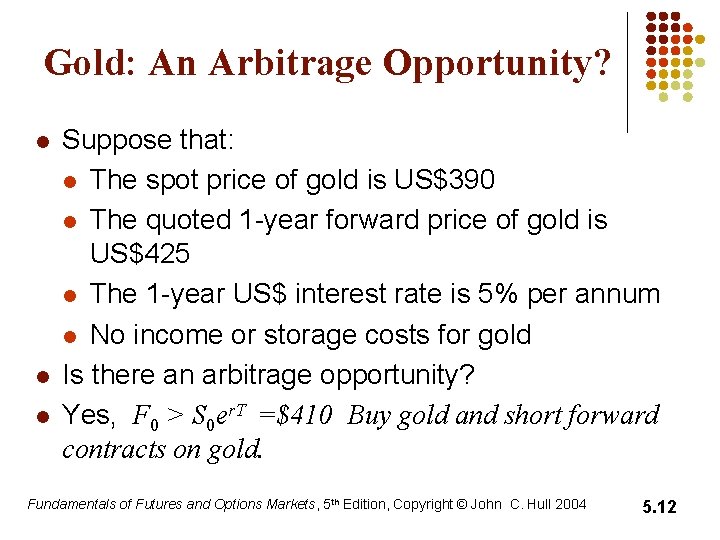
Gold: An Arbitrage Opportunity? l l l Suppose that: l The spot price of gold is US$390 l The quoted 1 -year forward price of gold is US$425 l The 1 -year US$ interest rate is 5% per annum l No income or storage costs for gold Is there an arbitrage opportunity? Yes, F 0 > S 0 er. T =$410 Buy gold and short forward contracts on gold. Fundamentals of Futures and Options Markets, 5 th Edition, Copyright © John C. Hull 2004 5. 12
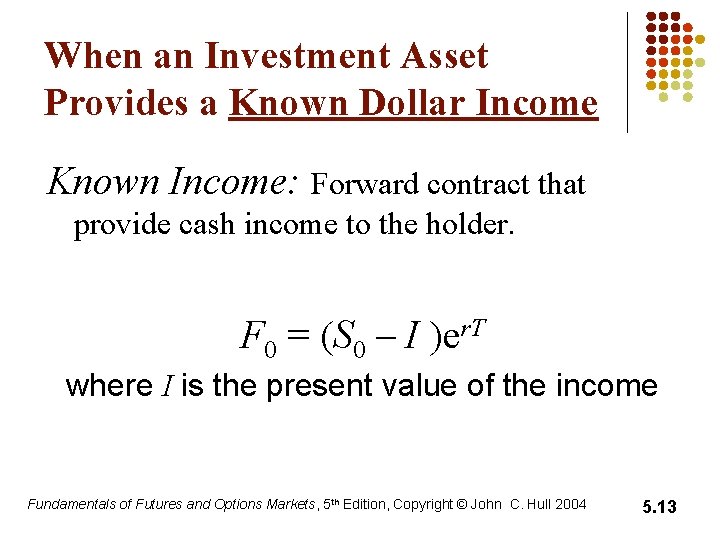
When an Investment Asset Provides a Known Dollar Income Known Income: Forward contract that provide cash income to the holder. F 0 = (S 0 – I )er. T where I is the present value of the income Fundamentals of Futures and Options Markets, 5 th Edition, Copyright © John C. Hull 2004 5. 13
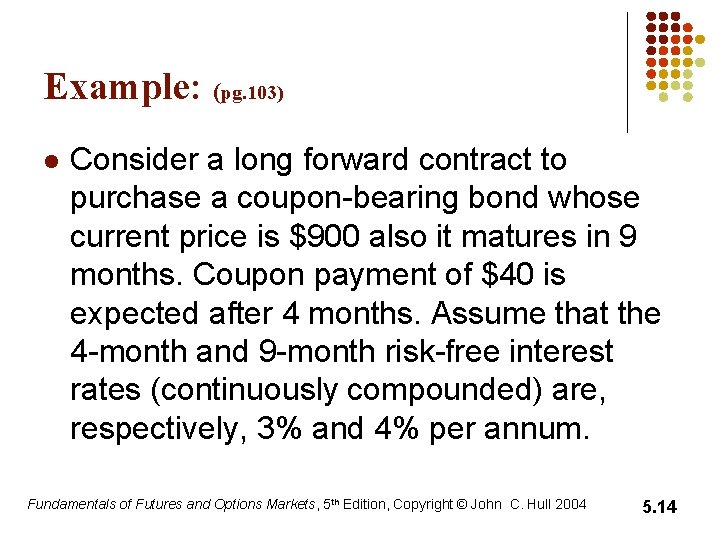
Example: (pg. 103) l Consider a long forward contract to purchase a coupon-bearing bond whose current price is $900 also it matures in 9 months. Coupon payment of $40 is expected after 4 months. Assume that the 4 -month and 9 -month risk-free interest rates (continuously compounded) are, respectively, 3% and 4% per annum. Fundamentals of Futures and Options Markets, 5 th Edition, Copyright © John C. Hull 2004 5. 14
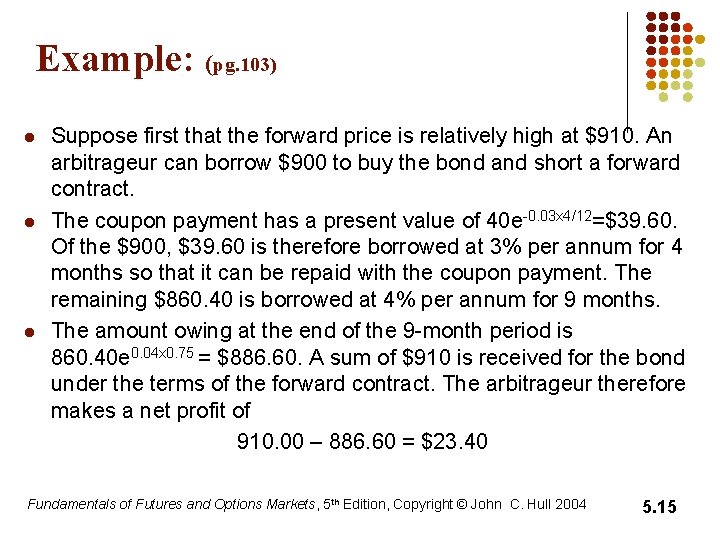
Example: (pg. 103) l l l Suppose first that the forward price is relatively high at $910. An arbitrageur can borrow $900 to buy the bond and short a forward contract. The coupon payment has a present value of 40 e-0. 03 x 4/12=$39. 60. Of the $900, $39. 60 is therefore borrowed at 3% per annum for 4 months so that it can be repaid with the coupon payment. The remaining $860. 40 is borrowed at 4% per annum for 9 months. The amount owing at the end of the 9 -month period is 860. 40 e 0. 04 x 0. 75 = $886. 60. A sum of $910 is received for the bond under the terms of the forward contract. The arbitrageur therefore makes a net profit of 910. 00 – 886. 60 = $23. 40 Fundamentals of Futures and Options Markets, 5 th Edition, Copyright © John C. Hull 2004 5. 15
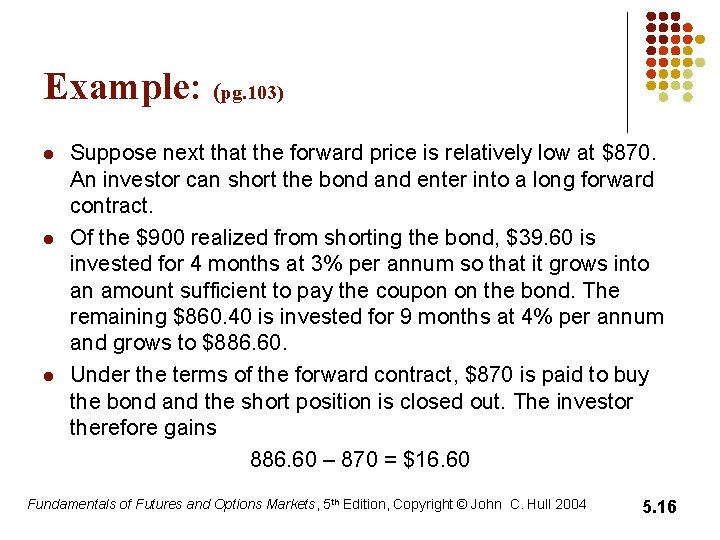
Example: (pg. 103) l l l Suppose next that the forward price is relatively low at $870. An investor can short the bond and enter into a long forward contract. Of the $900 realized from shorting the bond, $39. 60 is invested for 4 months at 3% per annum so that it grows into an amount sufficient to pay the coupon on the bond. The remaining $860. 40 is invested for 9 months at 4% per annum and grows to $886. 60. Under the terms of the forward contract, $870 is paid to buy the bond and the short position is closed out. The investor therefore gains 886. 60 – 870 = $16. 60 Fundamentals of Futures and Options Markets, 5 th Edition, Copyright © John C. Hull 2004 5. 16
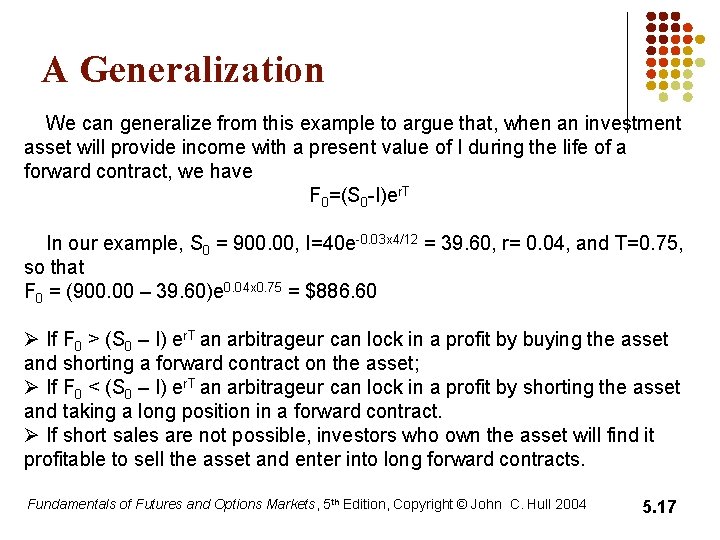
A Generalization We can generalize from this example to argue that, when an investment asset will provide income with a present value of I during the life of a forward contract, we have F 0=(S 0 -I)er. T In our example, S 0 = 900. 00, I=40 e-0. 03 x 4/12 = 39. 60, r= 0. 04, and T=0. 75, so that F 0 = (900. 00 – 39. 60)e 0. 04 x 0. 75 = $886. 60 Ø If F 0 > (S 0 – I) er. T an arbitrageur can lock in a profit by buying the asset and shorting a forward contract on the asset; Ø If F 0 < (S 0 – I) er. T an arbitrageur can lock in a profit by shorting the asset and taking a long position in a forward contract. Ø If short sales are not possible, investors who own the asset will find it profitable to sell the asset and enter into long forward contracts. Fundamentals of Futures and Options Markets, 5 th Edition, Copyright © John C. Hull 2004 5. 17
When an Investment Asset Provides a Known Yield l Do consider the situation where the asset underlying a forward contract provides a known yield rather than a known cash income. This means that the income is known when expressed as a percent of the asset’s price at the time the income is paid. Fundamentals of Futures and Options Markets, 5 th Edition, Copyright © John C. Hull 2004 5. 18
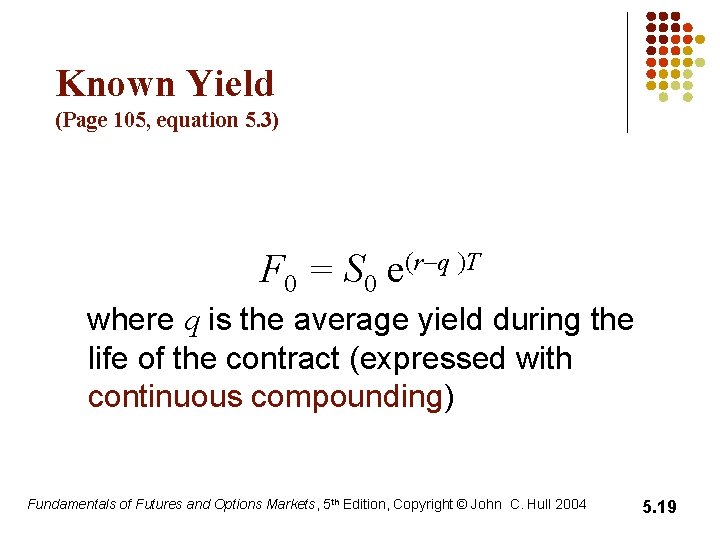
Known Yield (Page 105, equation 5. 3) F 0 = S 0 e(r–q )T where q is the average yield during the life of the contract (expressed with continuous compounding) Fundamentals of Futures and Options Markets, 5 th Edition, Copyright © John C. Hull 2004 5. 19
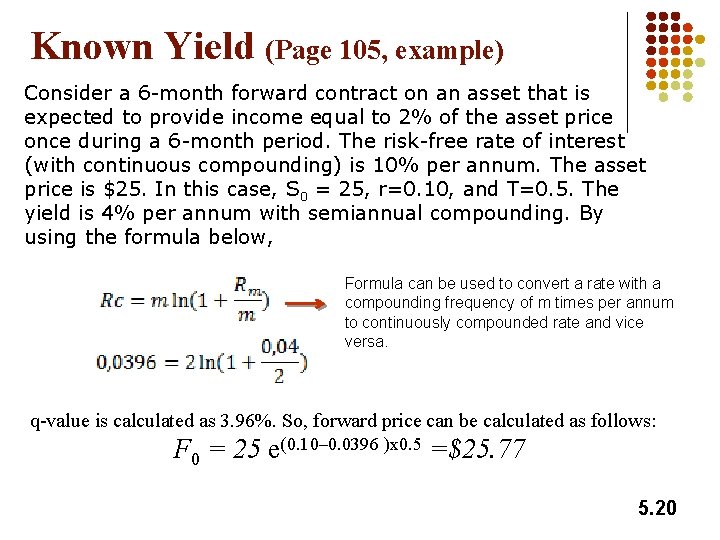
Known Yield (Page 105, example) Consider a 6 -month forward contract on an asset that is expected to provide income equal to 2% of the asset price once during a 6 -month period. The risk-free rate of interest (with continuous compounding) is 10% per annum. The asset price is $25. In this case, S 0 = 25, r=0. 10, and T=0. 5. The yield is 4% per annum with semiannual compounding. By using the formula below, Formula can be used to convert a rate with a compounding frequency of m times per annum to continuously compounded rate and vice versa. q-value is calculated as 3. 96%. So, forward price can be calculated as follows: F 0 = 25 e(0. 10– 0. 0396 )x 0. 5 =$25. 77 5. 20
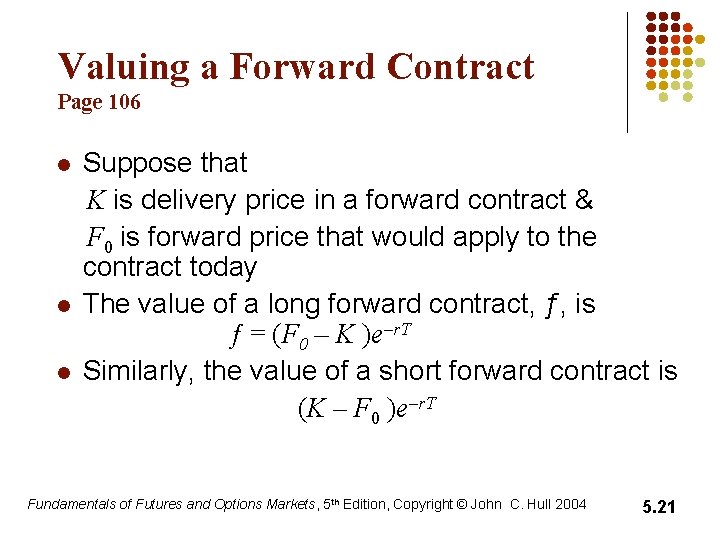
Valuing a Forward Contract Page 106 l l l Suppose that K is delivery price in a forward contract & F 0 is forward price that would apply to the contract today The value of a long forward contract, ƒ, is ƒ = (F 0 – K )e–r. T Similarly, the value of a short forward contract is (K – F 0 )e–r. T Fundamentals of Futures and Options Markets, 5 th Edition, Copyright © John C. Hull 2004 5. 21
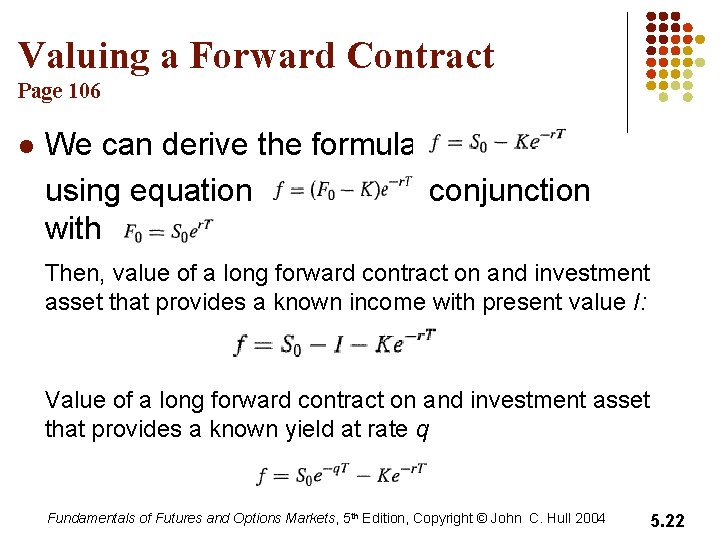
Valuing a Forward Contract Page 106 l We can derive the formula using equation in conjunction with Then, value of a long forward contract on and investment asset that provides a known income with present value I: Value of a long forward contract on and investment asset that provides a known yield at rate q Fundamentals of Futures and Options Markets, 5 th Edition, Copyright © John C. Hull 2004 5. 22
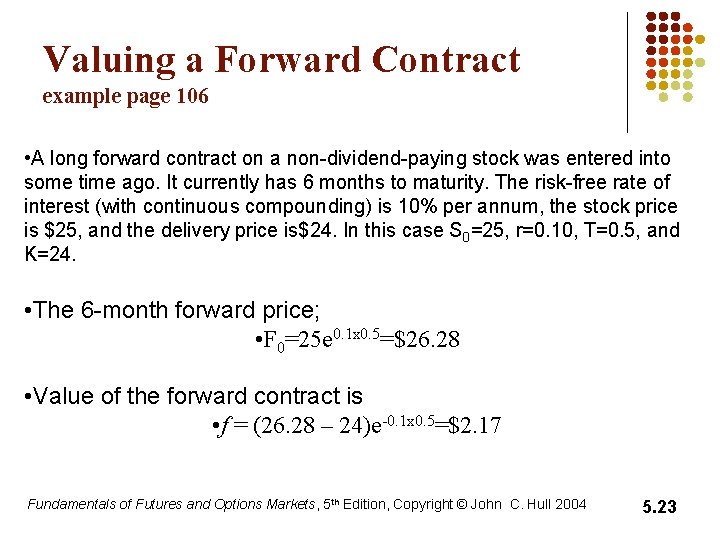
Valuing a Forward Contract example page 106 • A long forward contract on a non-dividend-paying stock was entered into some time ago. It currently has 6 months to maturity. The risk-free rate of interest (with continuous compounding) is 10% per annum, the stock price is $25, and the delivery price is$24. In this case S 0=25, r=0. 10, T=0. 5, and K=24. • The 6 -month forward price; • F 0=25 e 0. 1 x 0. 5=$26. 28 • Value of the forward contract is • f = (26. 28 – 24)e-0. 1 x 0. 5=$2. 17 Fundamentals of Futures and Options Markets, 5 th Edition, Copyright © John C. Hull 2004 5. 23
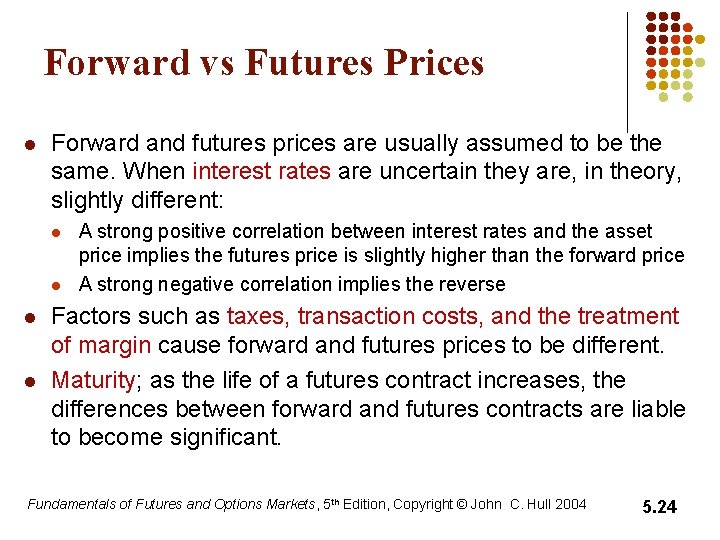
Forward vs Futures Prices l Forward and futures prices are usually assumed to be the same. When interest rates are uncertain they are, in theory, slightly different: l l A strong positive correlation between interest rates and the asset price implies the futures price is slightly higher than the forward price A strong negative correlation implies the reverse Factors such as taxes, transaction costs, and the treatment of margin cause forward and futures prices to be different. Maturity; as the life of a futures contract increases, the differences between forward and futures contracts are liable to become significant. Fundamentals of Futures and Options Markets, 5 th Edition, Copyright © John C. Hull 2004 5. 24
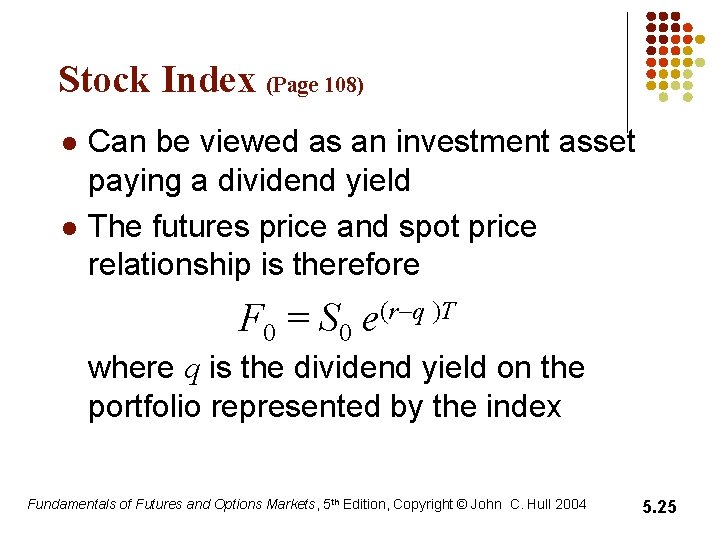
Stock Index (Page 108) l l Can be viewed as an investment asset paying a dividend yield The futures price and spot price relationship is therefore F 0 = S 0 e(r–q )T where q is the dividend yield on the portfolio represented by the index Fundamentals of Futures and Options Markets, 5 th Edition, Copyright © John C. Hull 2004 5. 25
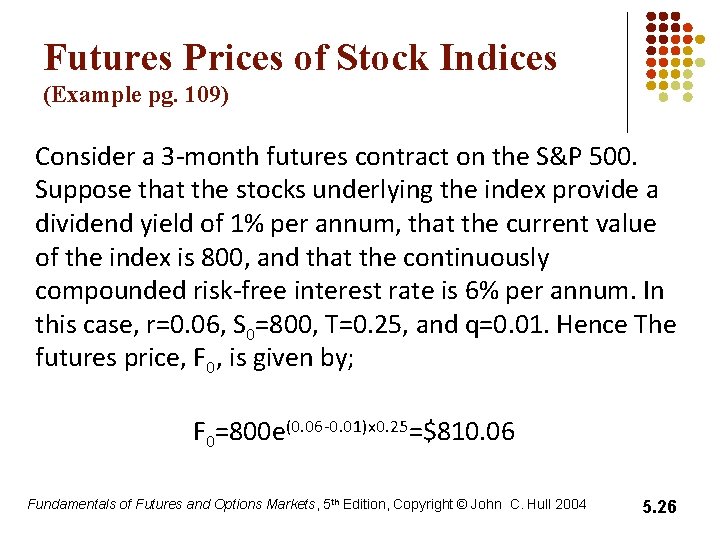
Futures Prices of Stock Indices (Example pg. 109) Consider a 3 -month futures contract on the S&P 500. Suppose that the stocks underlying the index provide a dividend yield of 1% per annum, that the current value of the index is 800, and that the continuously compounded risk-free interest rate is 6% per annum. In this case, r=0. 06, S 0=800, T=0. 25, and q=0. 01. Hence The futures price, F 0, is given by; F 0=800 e(0. 06 -0. 01)x 0. 25=$810. 06 Fundamentals of Futures and Options Markets, 5 th Edition, Copyright © John C. Hull 2004 5. 26
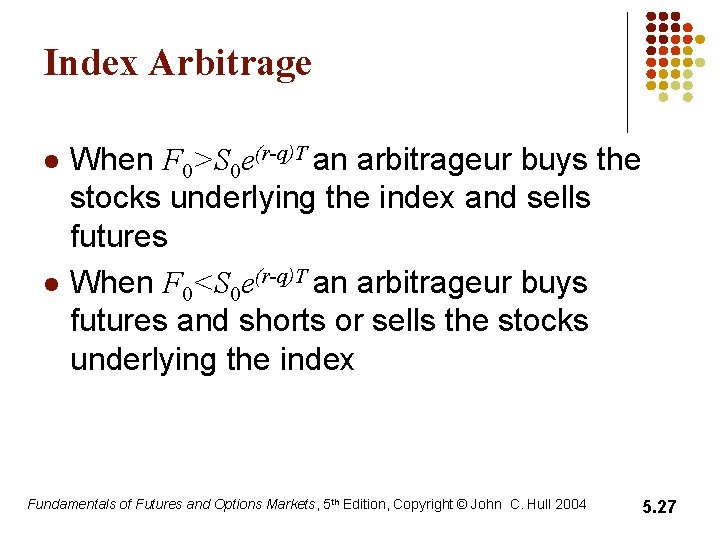
Index Arbitrage l l When F 0>S 0 e(r-q)T an arbitrageur buys the stocks underlying the index and sells futures When F 0<S 0 e(r-q)T an arbitrageur buys futures and shorts or sells the stocks underlying the index Fundamentals of Futures and Options Markets, 5 th Edition, Copyright © John C. Hull 2004 5. 27
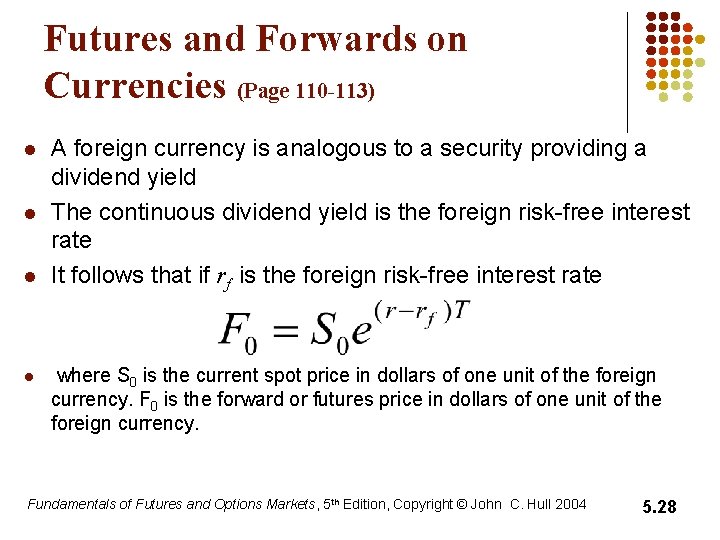
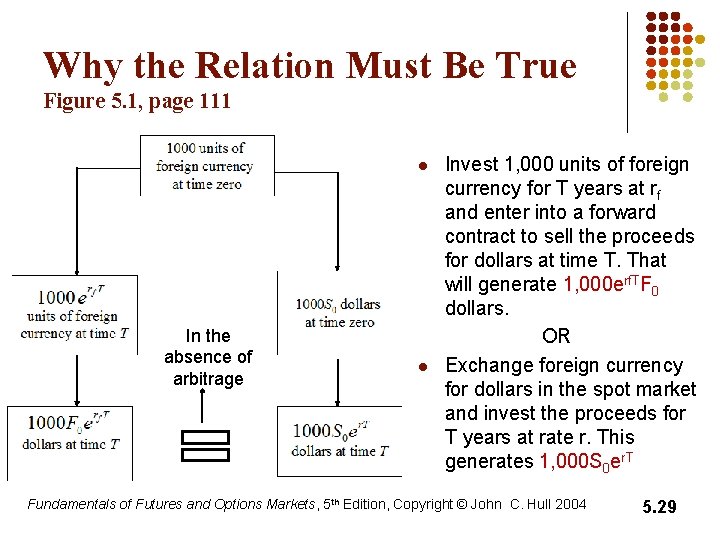
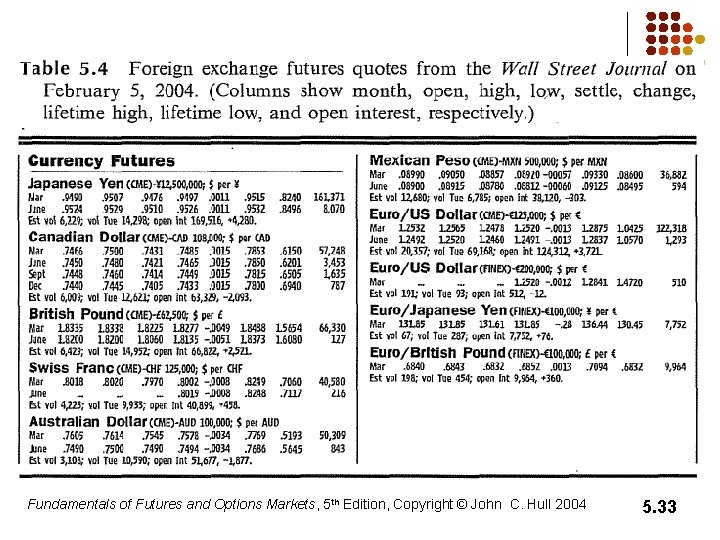
Futures and Forwards on Currencies (Page 110 -113) l l A foreign currency is analogous to a security providing a dividend yield The continuous dividend yield is the foreign risk-free interest rate It follows that if rf is the foreign risk-free interest rate where S 0 is the current spot price in dollars of one unit of the foreign currency. F 0 is the forward or futures price in dollars of one unit of the foreign currency. Fundamentals of Futures and Options Markets, 5 th Edition, Copyright © John C. Hull 2004 5. 28
Why the Relation Must Be True Figure 5. 1, page 111 l In the absence of arbitrage l Invest 1, 000 units of foreign currency for T years at rf and enter into a forward contract to sell the proceeds for dollars at time T. That will generate 1, 000 erf. TF 0 dollars. OR Exchange foreign currency for dollars in the spot market and invest the proceeds for T years at rate r. This generates 1, 000 S 0 er. T Fundamentals of Futures and Options Markets, 5 th Edition, Copyright © John C. Hull 2004 5. 29
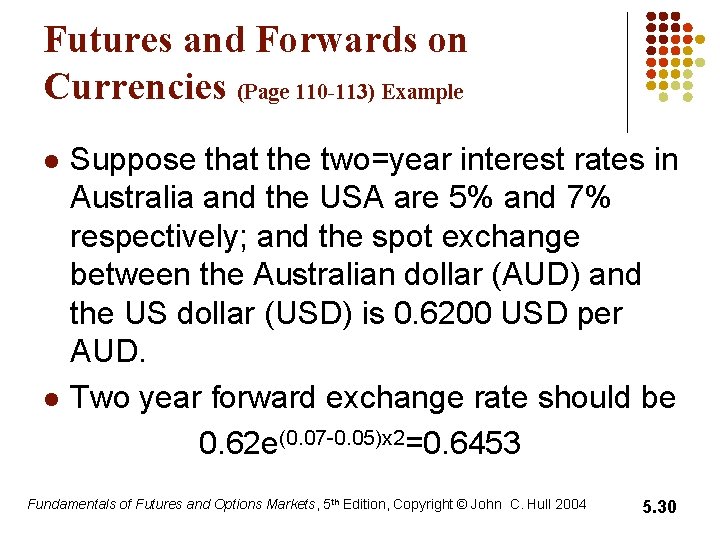
Futures and Forwards on Currencies (Page 110 -113) Example l l Suppose that the two=year interest rates in Australia and the USA are 5% and 7% respectively; and the spot exchange between the Australian dollar (AUD) and the US dollar (USD) is 0. 6200 USD per AUD. Two year forward exchange rate should be 0. 62 e(0. 07 -0. 05)x 2=0. 6453 Fundamentals of Futures and Options Markets, 5 th Edition, Copyright © John C. Hull 2004 5. 30
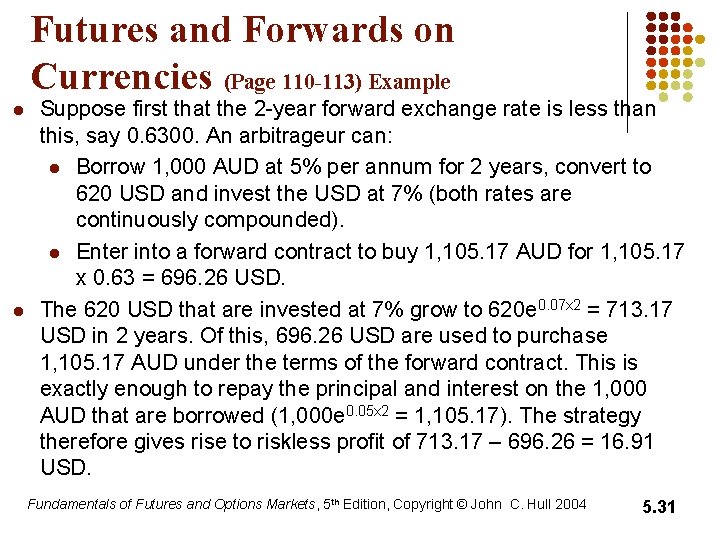
Futures and Forwards on Currencies (Page 110 -113) Example l l Suppose first that the 2 -year forward exchange rate is less than this, say 0. 6300. An arbitrageur can: l Borrow 1, 000 AUD at 5% per annum for 2 years, convert to 620 USD and invest the USD at 7% (both rates are continuously compounded). l Enter into a forward contract to buy 1, 105. 17 AUD for 1, 105. 17 x 0. 63 = 696. 26 USD. The 620 USD that are invested at 7% grow to 620 e 0. 07 x 2 = 713. 17 USD in 2 years. Of this, 696. 26 USD are used to purchase 1, 105. 17 AUD under the terms of the forward contract. This is exactly enough to repay the principal and interest on the 1, 000 AUD that are borrowed (1, 000 e 0. 05 x 2 = 1, 105. 17). The strategy therefore gives rise to riskless profit of 713. 17 – 696. 26 = 16. 91 USD. Fundamentals of Futures and Options Markets, 5 th Edition, Copyright © John C. Hull 2004 5. 31
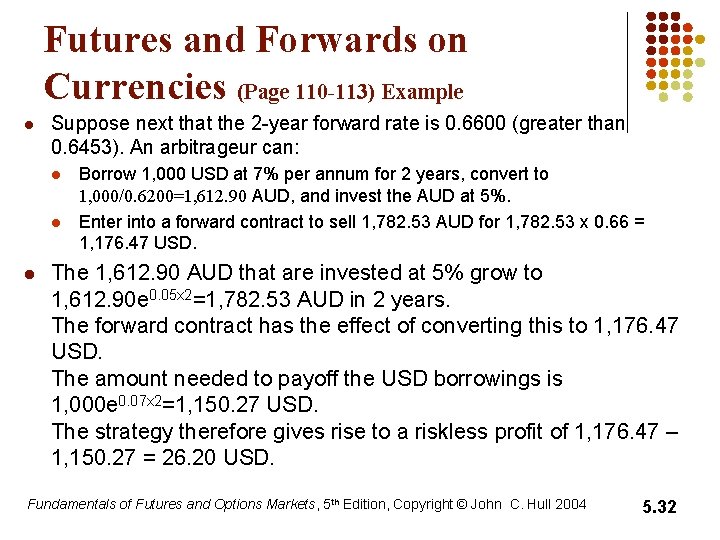
Futures and Forwards on Currencies (Page 110 -113) Example l Suppose next that the 2 -year forward rate is 0. 6600 (greater than 0. 6453). An arbitrageur can: l l l Borrow 1, 000 USD at 7% per annum for 2 years, convert to 1, 000/0. 6200=1, 612. 90 AUD, and invest the AUD at 5%. Enter into a forward contract to sell 1, 782. 53 AUD for 1, 782. 53 x 0. 66 = 1, 176. 47 USD. The 1, 612. 90 AUD that are invested at 5% grow to 1, 612. 90 e 0. 05 x 2=1, 782. 53 AUD in 2 years. The forward contract has the effect of converting this to 1, 176. 47 USD. The amount needed to payoff the USD borrowings is 1, 000 e 0. 07 x 2=1, 150. 27 USD. The strategy therefore gives rise to a riskless profit of 1, 176. 47 – 1, 150. 27 = 26. 20 USD. Fundamentals of Futures and Options Markets, 5 th Edition, Copyright © John C. Hull 2004 5. 32
Fundamentals of Futures and Options Markets, 5 th Edition, Copyright © John C. Hull 2004 5. 33
Futures on Commodities l l Future contracts on commodities… First we consider the futures prices of commodities that are investment assets such as gold and silver. Then, we will move on to consider the futures prices of consumption assets. Fundamentals of Futures and Options Markets, 5 th Edition, Copyright © John C. Hull 2004 5. 34
Income and Storage Costs l Gold and silver can provide income to the holder however, like other commodities they also have storage costs. Fundamentals of Futures and Options Markets, 5 th Edition, Copyright © John C. Hull 2004 5. 35
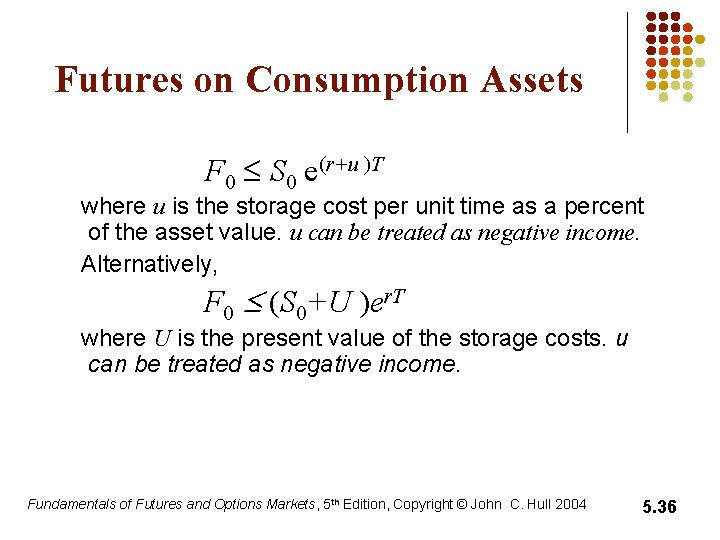
Futures on Consumption Assets F 0 S 0 e(r+u )T where u is the storage cost per unit time as a percent of the asset value. u can be treated as negative income. Alternatively, F 0 (S 0+U )er. T where U is the present value of the storage costs. u can be treated as negative income. Fundamentals of Futures and Options Markets, 5 th Edition, Copyright © John C. Hull 2004 5. 36
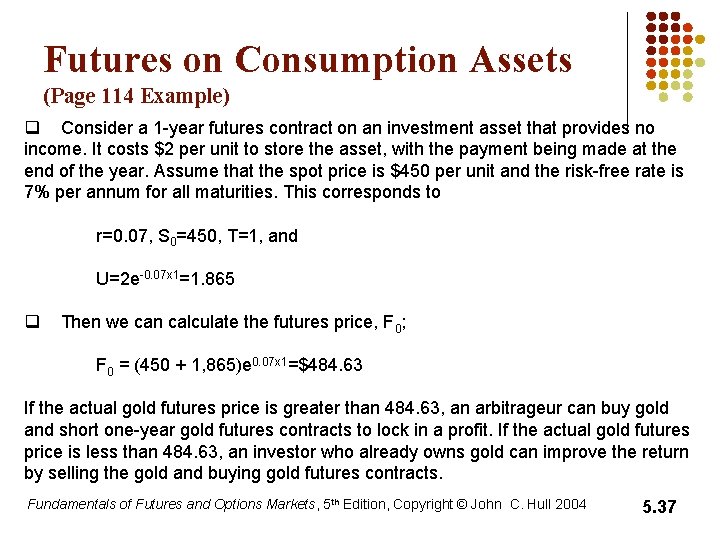
Futures on Consumption Assets (Page 114 Example) q Consider a 1 -year futures contract on an investment asset that provides no income. It costs $2 per unit to store the asset, with the payment being made at the end of the year. Assume that the spot price is $450 per unit and the risk-free rate is 7% per annum for all maturities. This corresponds to r=0. 07, S 0=450, T=1, and U=2 e-0. 07 x 1=1. 865 q Then we can calculate the futures price, F 0; F 0 = (450 + 1, 865)e 0. 07 x 1=$484. 63 If the actual gold futures price is greater than 484. 63, an arbitrageur can buy gold and short one-year gold futures contracts to lock in a profit. If the actual gold futures price is less than 484. 63, an investor who already owns gold can improve the return by selling the gold and buying gold futures contracts. Fundamentals of Futures and Options Markets, 5 th Edition, Copyright © John C. Hull 2004 5. 37
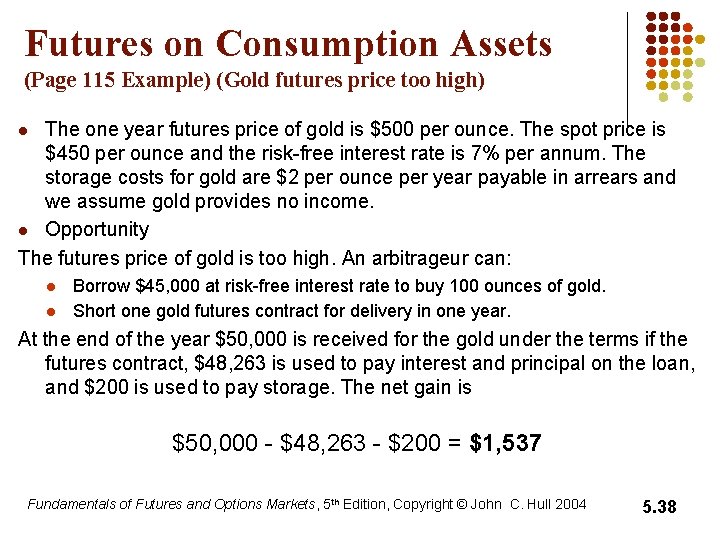
Futures on Consumption Assets (Page 115 Example) (Gold futures price too high) The one year futures price of gold is $500 per ounce. The spot price is $450 per ounce and the risk-free interest rate is 7% per annum. The storage costs for gold are $2 per ounce per year payable in arrears and we assume gold provides no income. l Opportunity The futures price of gold is too high. An arbitrageur can: l l l Borrow $45, 000 at risk-free interest rate to buy 100 ounces of gold. Short one gold futures contract for delivery in one year. At the end of the year $50, 000 is received for the gold under the terms if the futures contract, $48, 263 is used to pay interest and principal on the loan, and $200 is used to pay storage. The net gain is $50, 000 - $48, 263 - $200 = $1, 537 Fundamentals of Futures and Options Markets, 5 th Edition, Copyright © John C. Hull 2004 5. 38
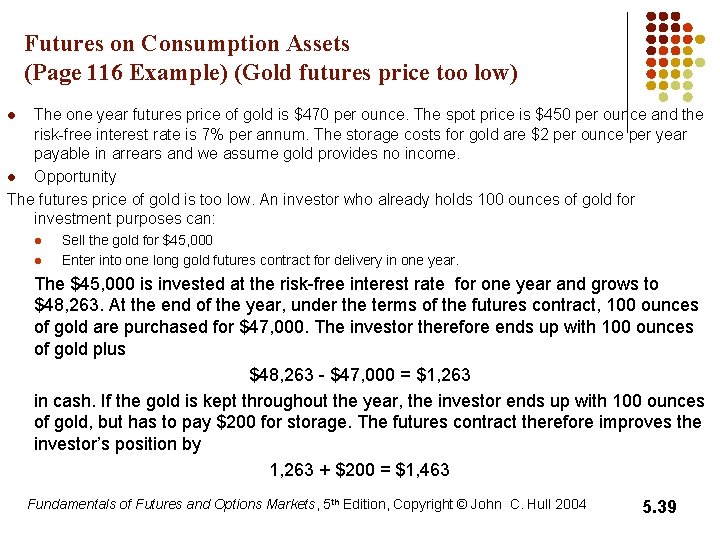
Futures on Consumption Assets (Page 116 Example) (Gold futures price too low) The one year futures price of gold is $470 per ounce. The spot price is $450 per ounce and the risk-free interest rate is 7% per annum. The storage costs for gold are $2 per ounce per year payable in arrears and we assume gold provides no income. l Opportunity The futures price of gold is too low. An investor who already holds 100 ounces of gold for investment purposes can: l l l Sell the gold for $45, 000 Enter into one long gold futures contract for delivery in one year. The $45, 000 is invested at the risk-free interest rate for one year and grows to $48, 263. At the end of the year, under the terms of the futures contract, 100 ounces of gold are purchased for $47, 000. The investor therefore ends up with 100 ounces of gold plus $48, 263 - $47, 000 = $1, 263 in cash. If the gold is kept throughout the year, the investor ends up with 100 ounces of gold, but has to pay $200 for storage. The futures contract therefore improves the investor’s position by 1, 263 + $200 = $1, 463 Fundamentals of Futures and Options Markets, 5 th Edition, Copyright © John C. Hull 2004 5. 39