Data Security and Encryption CSE 348 1 Lecture




- Slides: 34
Data Security and Encryption (CSE 348) 1
Lecture # 3 2
Review • Security concepts: – confidentiality, integrity, availability • • Security attacks, services, mechanisms Models for network (access) security Classical Encryption Techniques Symmetric Cipher Model 3
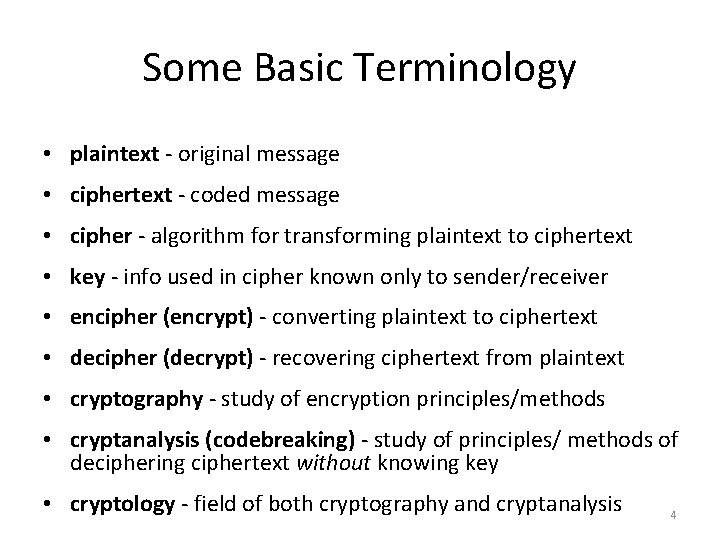
Some Basic Terminology • plaintext - original message • ciphertext - coded message • cipher - algorithm for transforming plaintext to ciphertext • key - info used in cipher known only to sender/receiver • encipher (encrypt) - converting plaintext to ciphertext • decipher (decrypt) - recovering ciphertext from plaintext • cryptography - study of encryption principles/methods • cryptanalysis (codebreaking) - study of principles/ methods of deciphering ciphertext without knowing key • cryptology - field of both cryptography and cryptanalysis 4
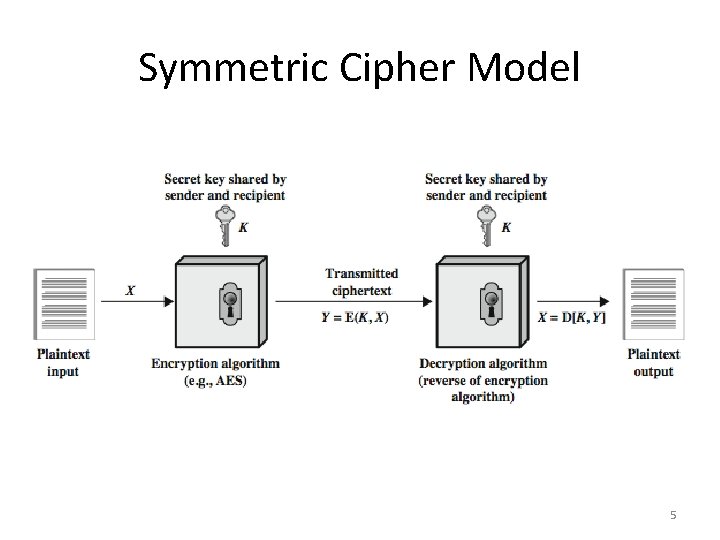
Symmetric Cipher Model 5
Cryptanalytic Attacks Ø ciphertext only l only know algorithm & ciphertext, is statistical, know or can identify plaintext Ø known plaintext l know/suspect plaintext & ciphertext Ø chosen plaintext l select plaintext and obtain ciphertext Ø chosen ciphertext l select ciphertext and obtain plaintext Ø chosen text l select plaintext or ciphertext to en/decrypt 6
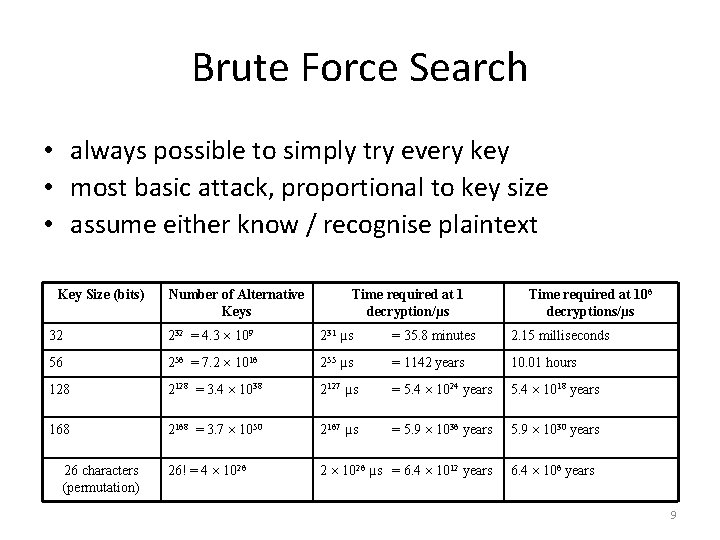
Brute Force Search • Brute-force attack involves trying every possible key until an intelligible translation of the ciphertext into plaintext is obtained • On average, half of all possible keys must be tried to achieve success • Different time is required to conduct a bruteforce attack, for various common key sizes 7
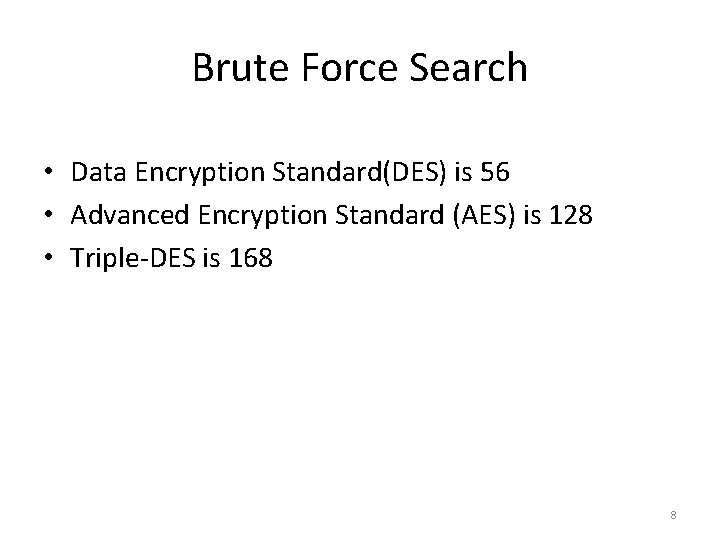
Brute Force Search • Data Encryption Standard(DES) is 56 • Advanced Encryption Standard (AES) is 128 • Triple-DES is 168 8
Brute Force Search • always possible to simply try every key • most basic attack, proportional to key size • assume either know / recognise plaintext Key Size (bits) Number of Alternative Keys Time required at 1 decryption/µs Time required at 106 decryptions/µs 32 232 = 4. 3 109 231 µs = 35. 8 minutes 2. 15 milliseconds 56 256 = 7. 2 1016 255 µs = 1142 years 10. 01 hours 128 2128 = 3. 4 1038 2127 µs = 5. 4 1024 years 5. 4 1018 years 168 2168 = 3. 7 1050 2167 µs = 5. 9 1036 years 5. 9 1030 years 26! = 4 1026 2 1026 µs = 6. 4 1012 years 26 characters (permutation) 6. 4 106 years 9
Brute Force Search • Users of an encryption algorithm can strive for is an algorithm that meets one or both of the following criteria: • The cost of breaking the cipher exceeds the value of the encrypted information • The time required to break the cipher exceeds the useful lifetime of the information 10
Brute Force Search • An encryption scheme is said to be computationally secure • if either of the foregoing two criteria are met • Unfortunately, it is very difficult to estimate the amount of effort required to cryptanalyze ciphertext successfully 11
Brute Force Search • For each key size, the results are shown assuming that it takes 1 μs to perform a single decryption • which is a reasonable order of magnitude for today’s machines • With the use of massively parallel organizations of microprocessors, it may be possible to achieve processing rates many orders of magnitude greater 12
Brute Force Search • The final column of Table considers the results for a system that can process 1 million keys per microsecond • And this performance level, DES can no longer be considered computationally secure. 13
Classical Substitution Ciphers • In this section and the next, we examine a sampling of what might be called classical encryption techniques • A study of these techniques enables us to illustrate the basic approaches to symmetric encryption used today • and the types of cryptanalytic attacks that must be anticipated 14
Classical Substitution Ciphers • The two basic building blocks of all encryption technique are substitution and transposition • We examine these next. Finally, we discuss a system that combine both substitution and transposition. 15
Classical Substitution Ciphers • where letters of plaintext are replaced by other letters or by numbers or symbols • or if plaintext is viewed as a sequence of bits, then substitution involves replacing plaintext bit patterns with ciphertext bit patterns 16
Caesar Cipher • Substitution ciphers form the first of the fundamental building blocks • Core idea is to replace one basic unit (letter/byte) with another • Whilst the early Greeks described several substitution ciphers 17
Caesar Cipher • First attested use in military affairs of one was by Julius Caesar • Still call any cipher using a simple letter shift a caesar cipher, not just those with shift 3. 18
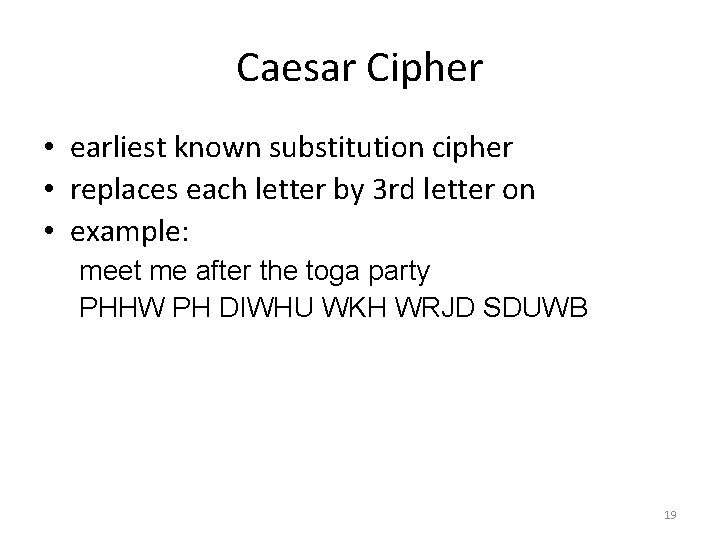
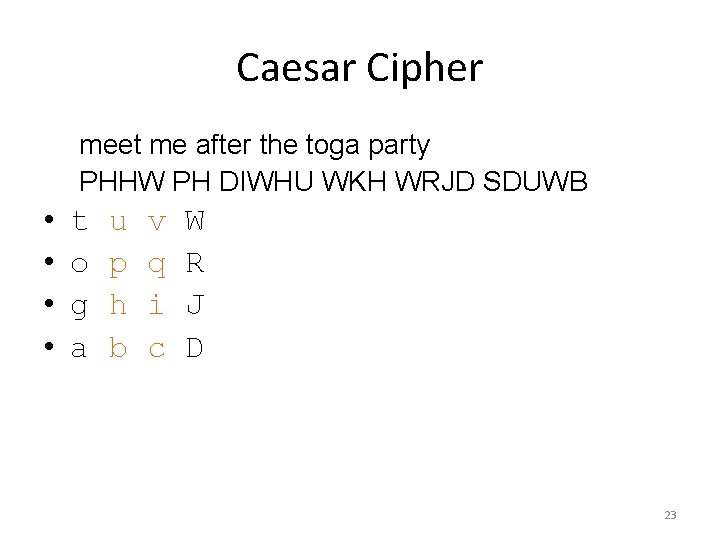
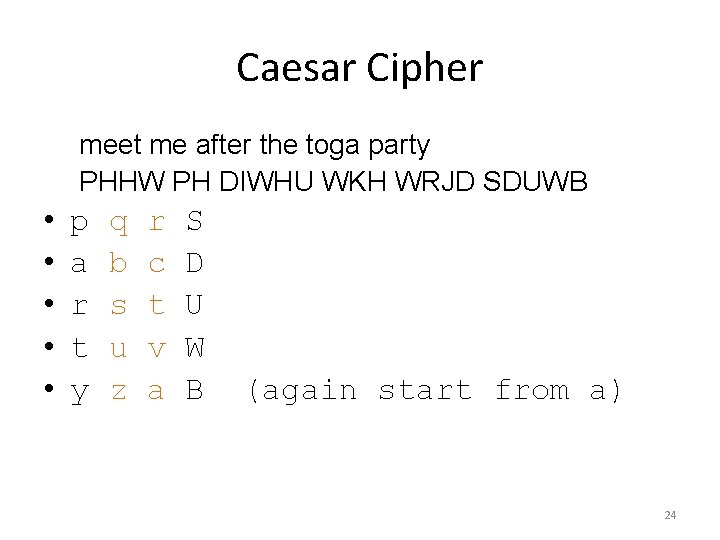
Caesar Cipher • earliest known substitution cipher • replaces each letter by 3 rd letter on • example: meet me after the toga party PHHW PH DIWHU WKH WRJD SDUWB 19
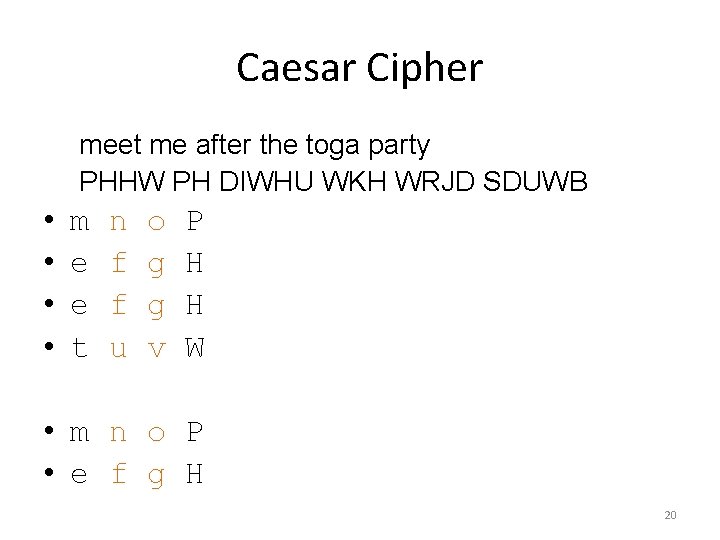
Caesar Cipher meet me after the toga party PHHW PH DIWHU WKH WRJD SDUWB • • m e e t n f f u o g g v P H H W • m n o P • e f g H 20
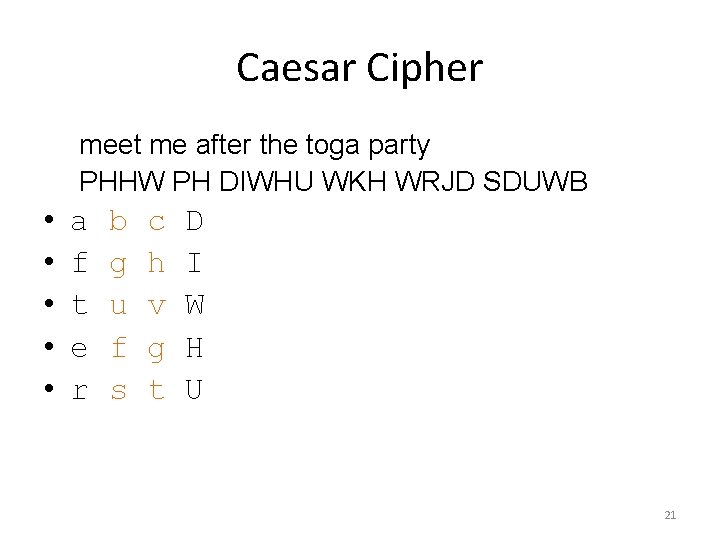
Caesar Cipher meet me after the toga party PHHW PH DIWHU WKH WRJD SDUWB • • • a f t e r b g u f s c h v g t D I W H U 21
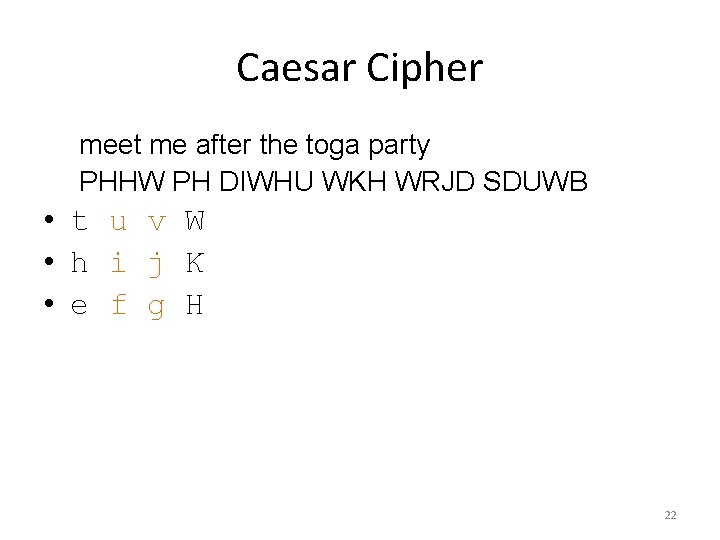
Caesar Cipher meet me after the toga party PHHW PH DIWHU WKH WRJD SDUWB • t u v W • h i j K • e f g H 22
Caesar Cipher meet me after the toga party PHHW PH DIWHU WKH WRJD SDUWB • • t o g a u p h b v q i c W R J D 23
Caesar Cipher meet me after the toga party PHHW PH DIWHU WKH WRJD SDUWB • • • p a r t y q b s u z r c t v a S D U W B (again start from a) 24
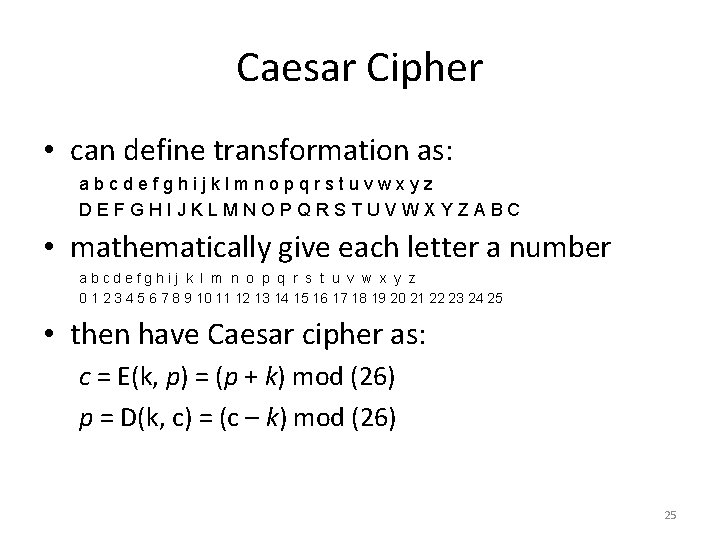
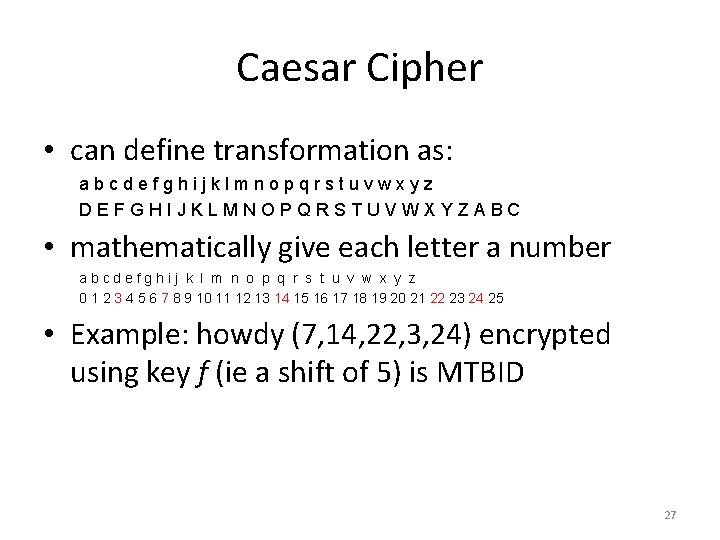
Caesar Cipher • can define transformation as: abcdefghijklmnopqrstuvwxyz DEFGHIJKLMNOPQRSTUVWXYZABC • mathematically give each letter a number abcdefghij k l m n o p q r s t u v w x y z 0 1 2 3 4 5 6 7 8 9 10 11 12 13 14 15 16 17 18 19 20 21 22 23 24 25 • then have Caesar cipher as: c = E(k, p) = (p + k) mod (26) p = D(k, c) = (c – k) mod (26) 25
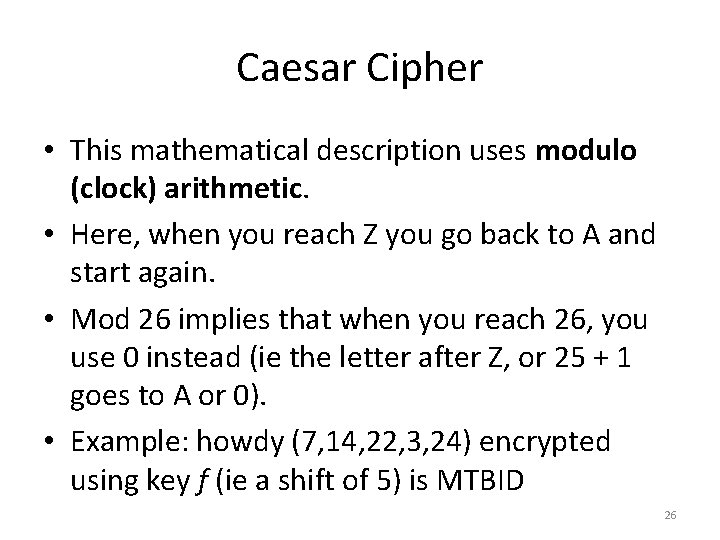
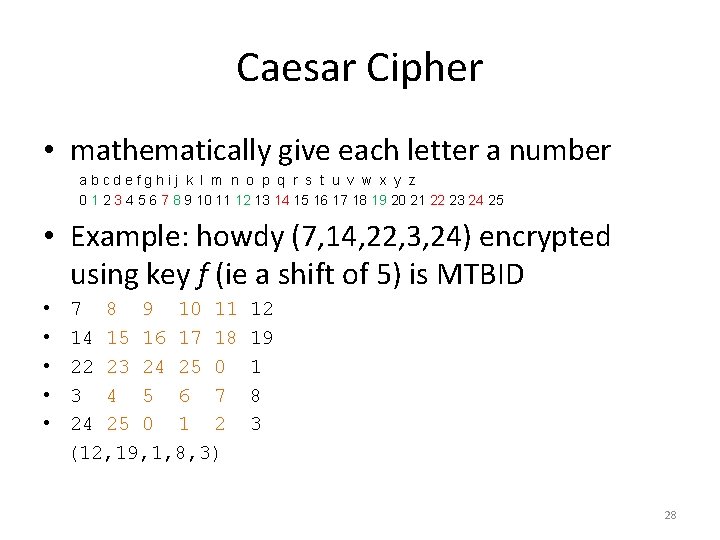
Caesar Cipher • This mathematical description uses modulo (clock) arithmetic. • Here, when you reach Z you go back to A and start again. • Mod 26 implies that when you reach 26, you use 0 instead (ie the letter after Z, or 25 + 1 goes to A or 0). • Example: howdy (7, 14, 22, 3, 24) encrypted using key f (ie a shift of 5) is MTBID 26
Caesar Cipher • can define transformation as: abcdefghijklmnopqrstuvwxyz DEFGHIJKLMNOPQRSTUVWXYZABC • mathematically give each letter a number abcdefghij k l m n o p q r s t u v w x y z 0 1 2 3 4 5 6 7 8 9 10 11 12 13 14 15 16 17 18 19 20 21 22 23 24 25 • Example: howdy (7, 14, 22, 3, 24) encrypted using key f (ie a shift of 5) is MTBID 27
Caesar Cipher • mathematically give each letter a number abcdefghij k l m n o p q r s t u v w x y z 0 1 2 3 4 5 6 7 8 9 10 11 12 13 14 15 16 17 18 19 20 21 22 23 24 25 • Example: howdy (7, 14, 22, 3, 24) encrypted using key f (ie a shift of 5) is MTBID • • • 7 8 9 10 11 14 15 16 17 18 22 23 24 25 0 3 4 5 6 7 24 25 0 1 2 (12, 19, 1, 8, 3) 12 19 1 8 3 28
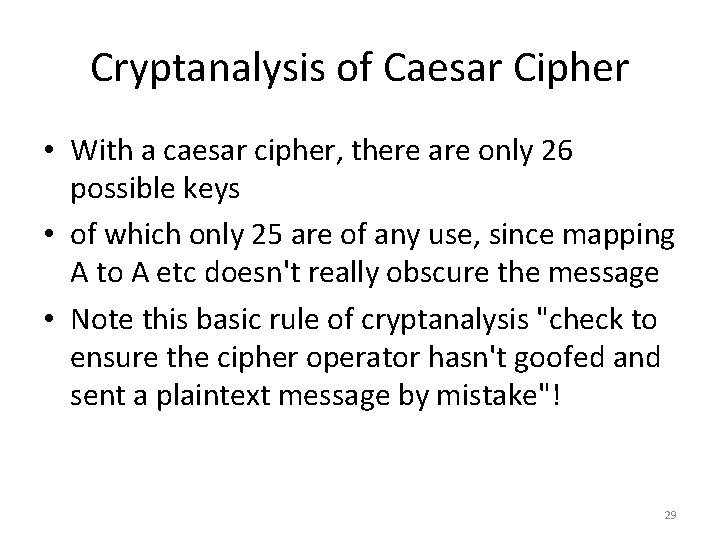
Cryptanalysis of Caesar Cipher • With a caesar cipher, there are only 26 possible keys • of which only 25 are of any use, since mapping A to A etc doesn't really obscure the message • Note this basic rule of cryptanalysis "check to ensure the cipher operator hasn't goofed and sent a plaintext message by mistake"! 29
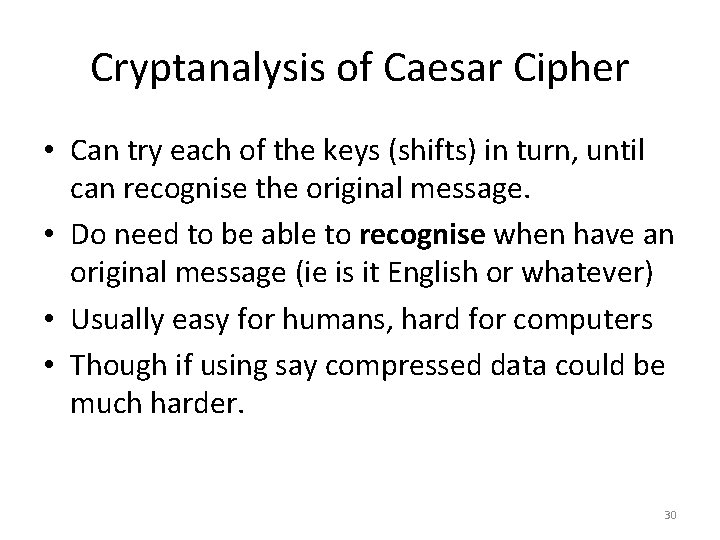
Cryptanalysis of Caesar Cipher • Can try each of the keys (shifts) in turn, until can recognise the original message. • Do need to be able to recognise when have an original message (ie is it English or whatever) • Usually easy for humans, hard for computers • Though if using say compressed data could be much harder. 30
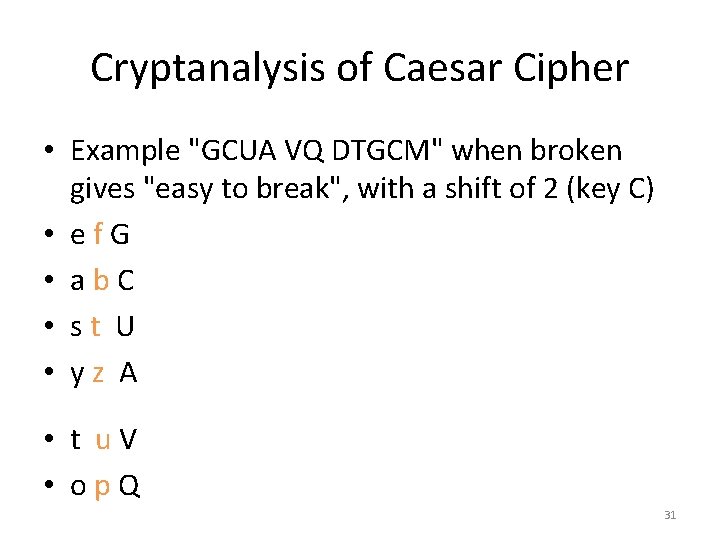
Cryptanalysis of Caesar Cipher • Example "GCUA VQ DTGCM" when broken gives "easy to break", with a shift of 2 (key C) • ef. G • ab. C • st U • yz A • t u. V • op. Q 31
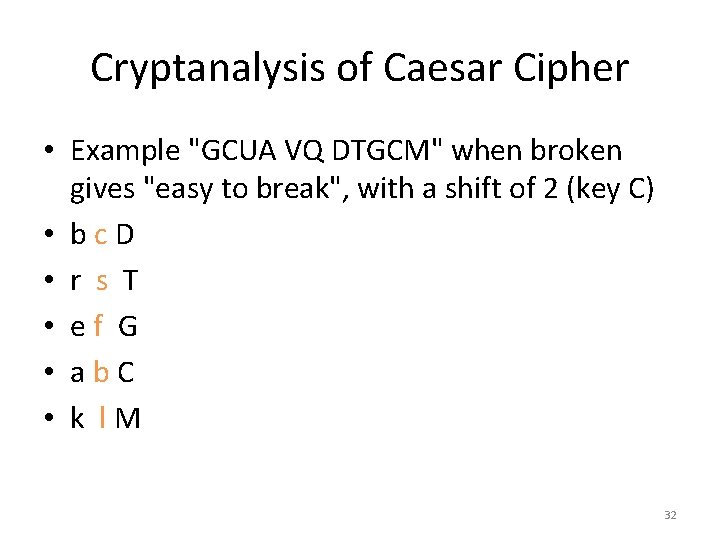
Cryptanalysis of Caesar Cipher • Example "GCUA VQ DTGCM" when broken gives "easy to break", with a shift of 2 (key C) • bc. D • r s T • ef G • ab. C • k l. M 32
Cryptanalysis of Caesar Cipher Ø only have 26 possible ciphers l A maps to A, B, . . Z Ø could simply try each in turn Ø a brute force search Ø given ciphertext, just try all shifts of letters Ø do need to recognize when have plaintext Ø eg. break ciphertext "GCUA VQ DTGCM" 33
Summary • have considered: – classical cipher techniques and terminology – Brute Force • Cryptanalysis of Brute Force – Caesar Cipher • Cryptanalysis of Caesar Cipher 34