Current Trends in Electronic Data Interchange EDI NEMUG




- Slides: 29
Current Trends in Electronic Data Interchange (EDI) NEMUG November, 2008 Faith Lamprey Aurora Technologies (401) 765 -3721 aurora@auroratechedi. com www. auroratechedi. com
Agenda n n n n EDI Terminology Item Synchronization RFID AS 3/AS 4 EDI vs XML New X 12 Envelope Future of EDI
Terminology n n GS 1, the global organization that manages standards and guidelines for several industries, including retail and grocery, publishes GS 1 General Specifications Glossary of Terms can be downloaded with (www. gs 1. org/docs/barcode/GS 1_Standards_Glossary_of_Terms. pdf)
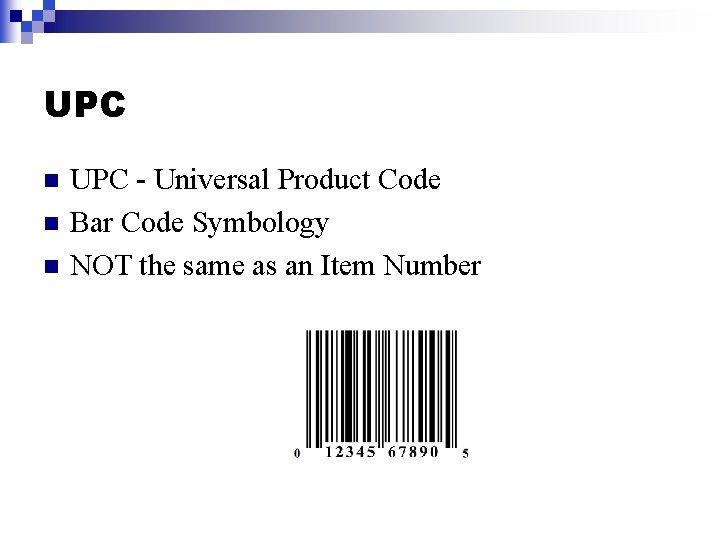
UPC n n n UPC - Universal Product Code Bar Code Symbology NOT the same as an Item Number
GTIN n GTIN – Global Trade Identification Number ¨ Any item (product or service) upon which there is a need to retrieve pre -defined information and that may be priced, or ordered, or invoiced at any point in any supply chain ¨ One type of GTIN is GTIN-12 (made up of twelve digits), assigned by brand owners in the U. S. for trade items that are an each, inner pack, standard case or even unit load (more on “unit load” later) ¨ Each unit of measure needs a separate GTIN
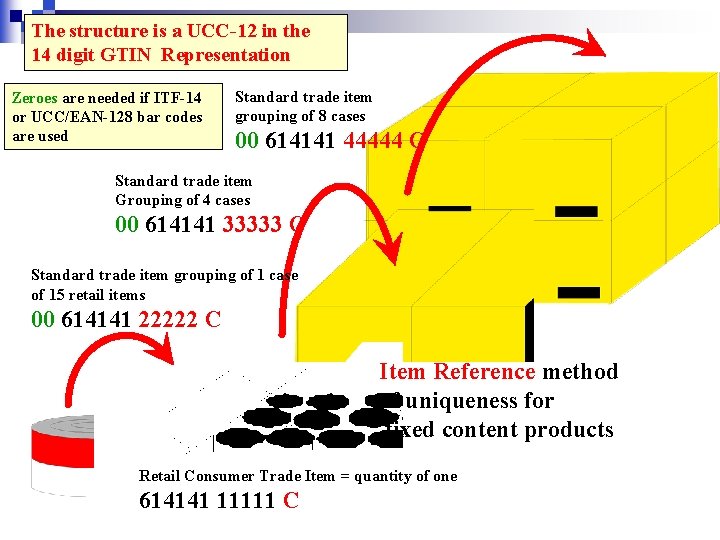
The structure is a UCC-12 in the 14 digit GTIN Representation Zeroes are needed if ITF-14 or UCC/EAN-128 bar codes are used Standard trade item grouping of 8 cases 00 614141 44444 C Standard trade item Grouping of 4 cases 00 614141 33333 C Standard trade item grouping of 1 case of 15 retail items 00 614141 22222 C Item Reference method of uniqueness for fixed content products Retail Consumer Trade Item = quantity of one 614141 11111 C
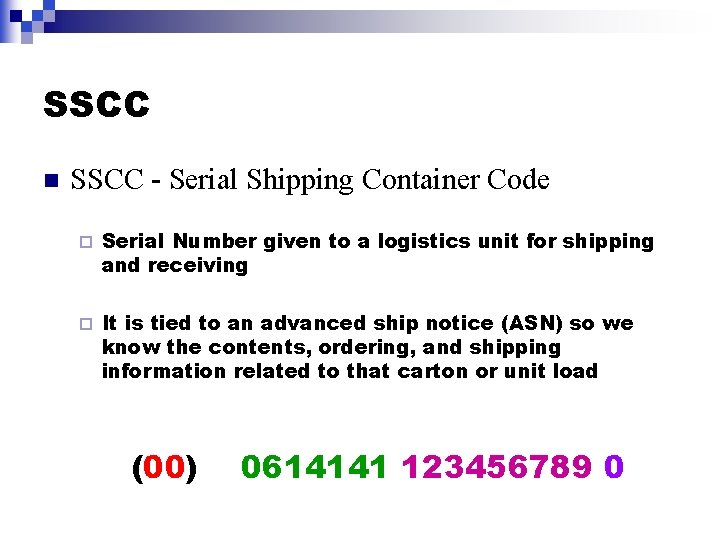
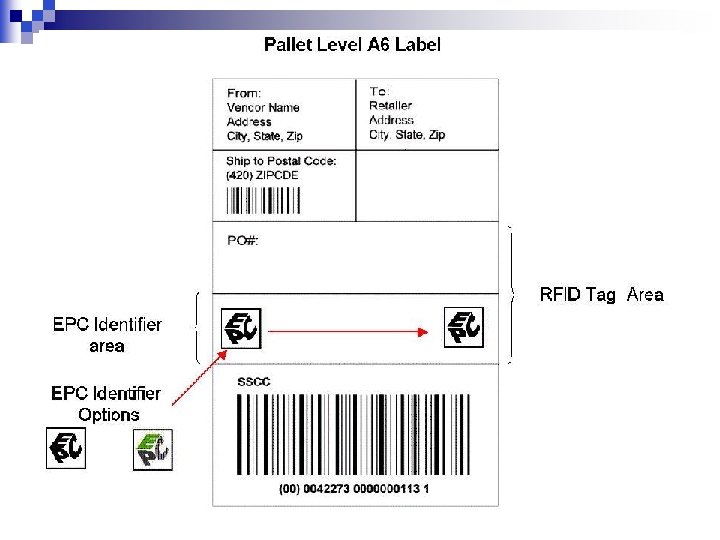
SSCC n SSCC - Serial Shipping Container Code ¨ Serial Number given to a logistics unit for shipping and receiving ¨ It is tied to an advanced ship notice (ASN) so we know the contents, ordering, and shipping information related to that carton or unit load (00) 0 0614141 123456789 0
EPC n n EPC is the acronym for Electronic Product Code The structure of the data on a tag
EPC Format Header EPC Manager Number Object Class Serial Number • Header - identifies the length, type, structure, version, and generation of the EPC • EPC Manager Number - entity responsible for maintaining the subsequent partitions (company prefix) • Object Class - identifies a class of objects (item reference number) • Serial Number - identifies the instance
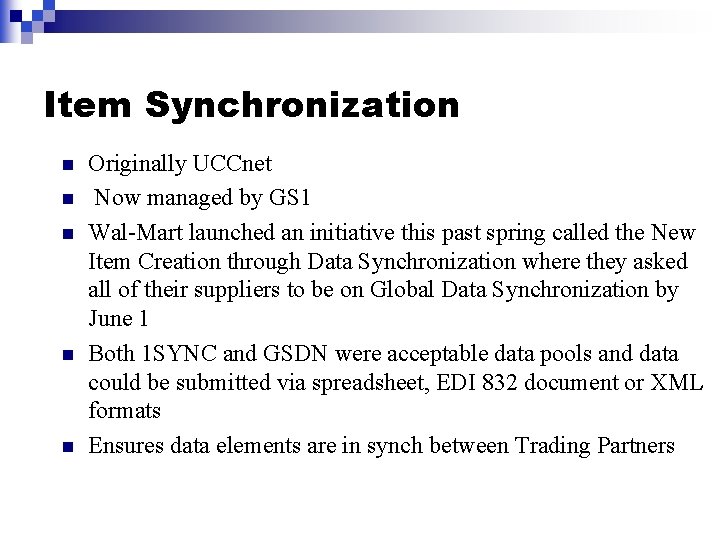
Item Synchronization n n Originally UCCnet Now managed by GS 1 Wal-Mart launched an initiative this past spring called the New Item Creation through Data Synchronization where they asked all of their suppliers to be on Global Data Synchronization by June 1 Both 1 SYNC and GSDN were acceptable data pools and data could be submitted via spreadsheet, EDI 832 document or XML formats Ensures data elements are in synch between Trading Partners
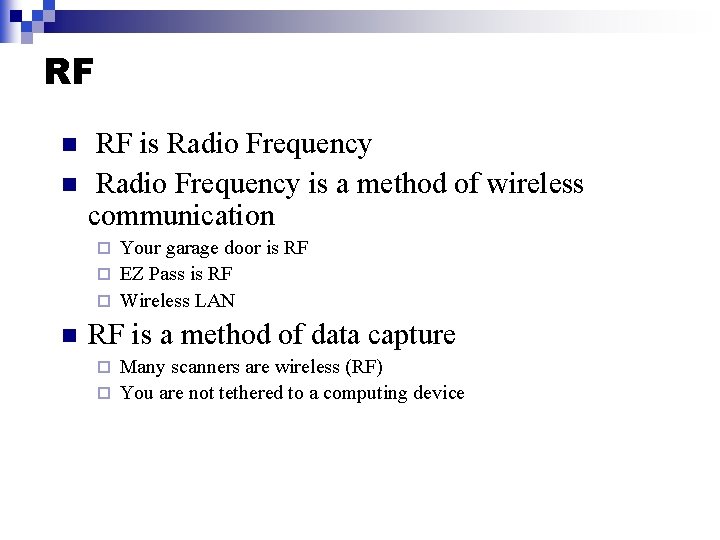
RF n n RF is Radio Frequency is a method of wireless communication Your garage door is RF ¨ EZ Pass is RF ¨ Wireless LAN ¨ n RF is a method of data capture Many scanners are wireless (RF) ¨ You are not tethered to a computing device ¨
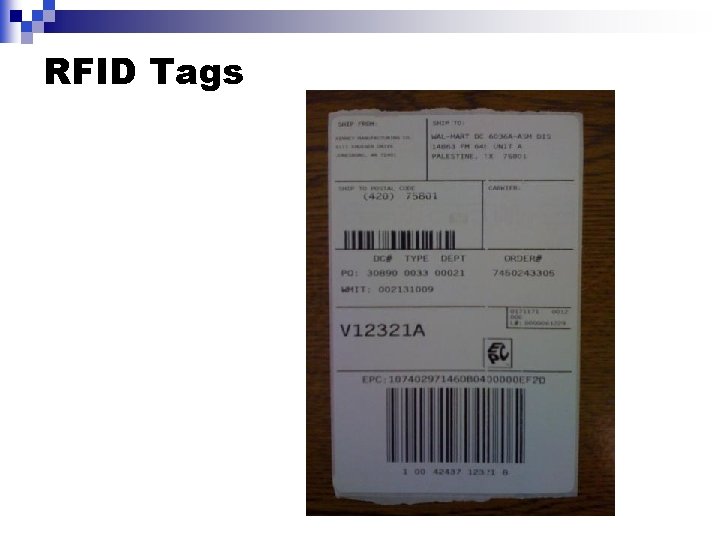
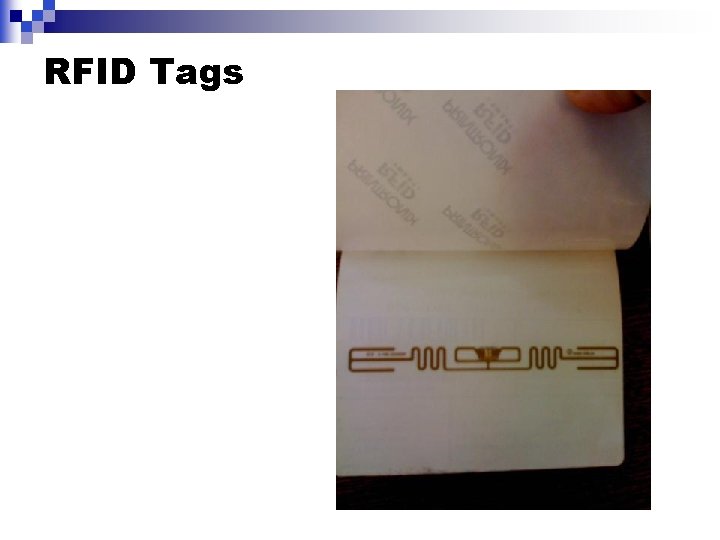
RF n n Uses an RF tag that contains the new EPC (Electronic Product Code) Tags: Chip and antenna inside a traditional label ¨ Built into a plastic or rubber RF tag ¨ Chips built into packaging ¨
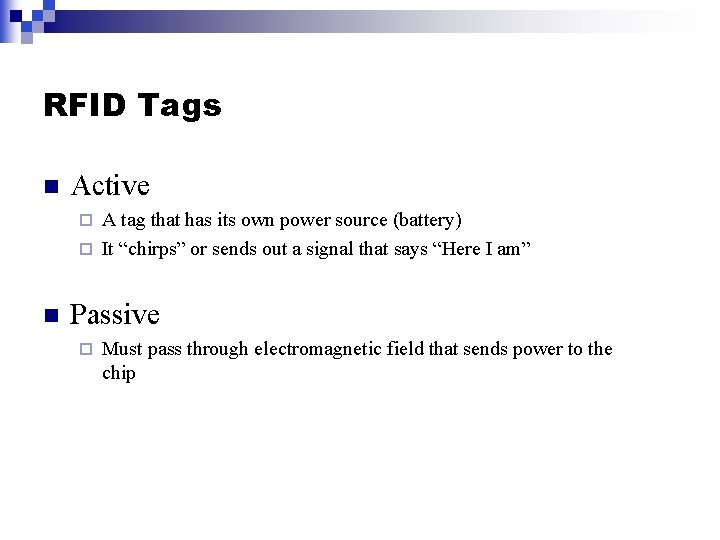
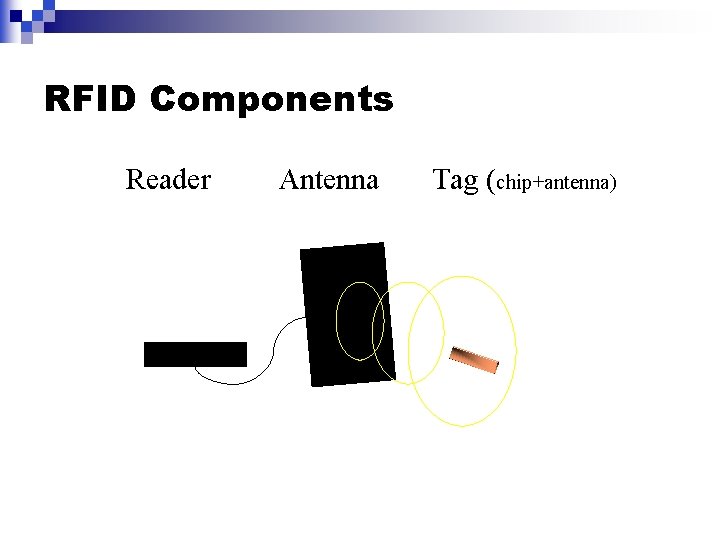
RFID Tags n Active A tag that has its own power source (battery) ¨ It “chirps” or sends out a signal that says “Here I am” ¨ n Passive ¨ Must pass through electromagnetic field that sends power to the chip
RFID Components Reader Antenna Tag (chip+antenna)
RF Chips n n n Static – serial numbers pre-written Write Once – Read Many (WORM) Write and add information Write and over-write Types Smart Cards ¨ Smart Chips ¨ Rubber tags in a cow’s ear ¨ Tags built into containers, packaging, pallets ¨
RFID Tags
RFID Tags
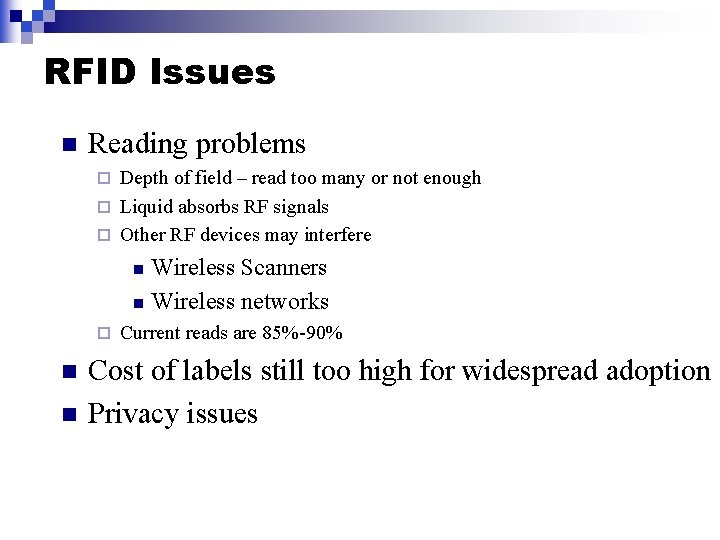
RFID Issues n Reading problems Depth of field – read too many or not enough ¨ Liquid absorbs RF signals ¨ Other RF devices may interfere ¨ Wireless Scanners n Wireless networks n ¨ n n Current reads are 85%-90% Cost of labels still too high for widespread adoption Privacy issues
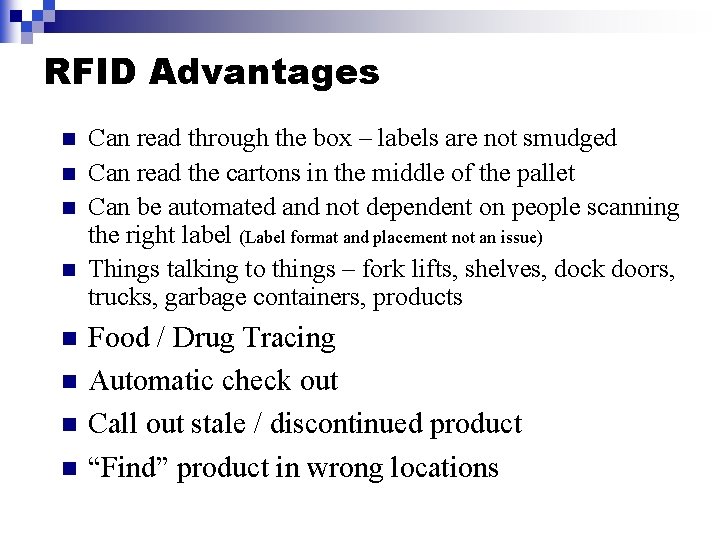
RFID Advantages n n n n Can read through the box – labels are not smudged Can read the cartons in the middle of the pallet Can be automated and not dependent on people scanning the right label (Label format and placement not an issue) Things talking to things – fork lifts, shelves, dock doors, trucks, garbage containers, products Food / Drug Tracing Automatic check out Call out stale / discontinued product “Find” product in wrong locations
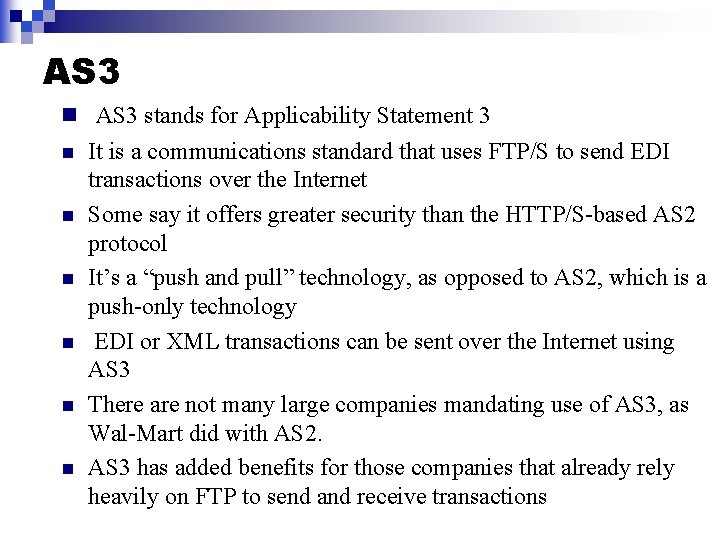
AS 3 n AS 3 stands for Applicability Statement 3 n n n It is a communications standard that uses FTP/S to send EDI transactions over the Internet Some say it offers greater security than the HTTP/S-based AS 2 protocol It’s a “push and pull” technology, as opposed to AS 2, which is a push-only technology EDI or XML transactions can be sent over the Internet using AS 3 There are not many large companies mandating use of AS 3, as Wal-Mart did with AS 2. AS 3 has added benefits for those companies that already rely heavily on FTP to send and receive transactions
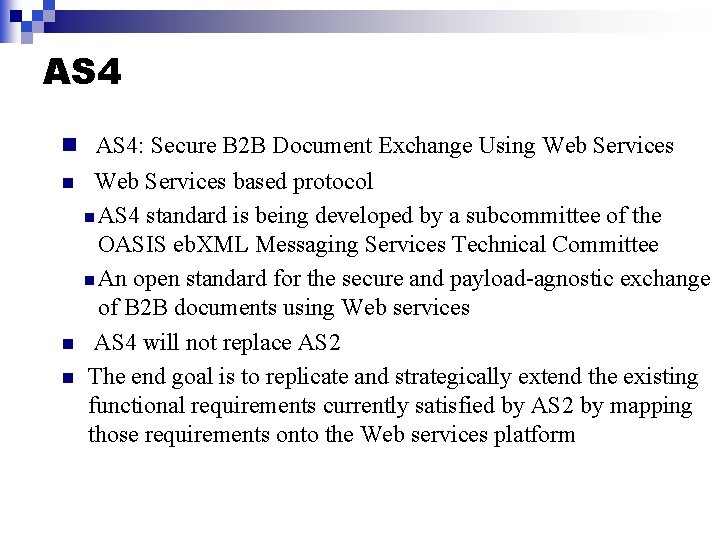
AS 4 n AS 4: Secure B 2 B Document Exchange Using Web Services n n n Web Services based protocol n AS 4 standard is being developed by a subcommittee of the OASIS eb. XML Messaging Services Technical Committee n An open standard for the secure and payload-agnostic exchange of B 2 B documents using Web services AS 4 will not replace AS 2 The end goal is to replicate and strategically extend the existing functional requirements currently satisfied by AS 2 by mapping those requirements onto the Web services platform
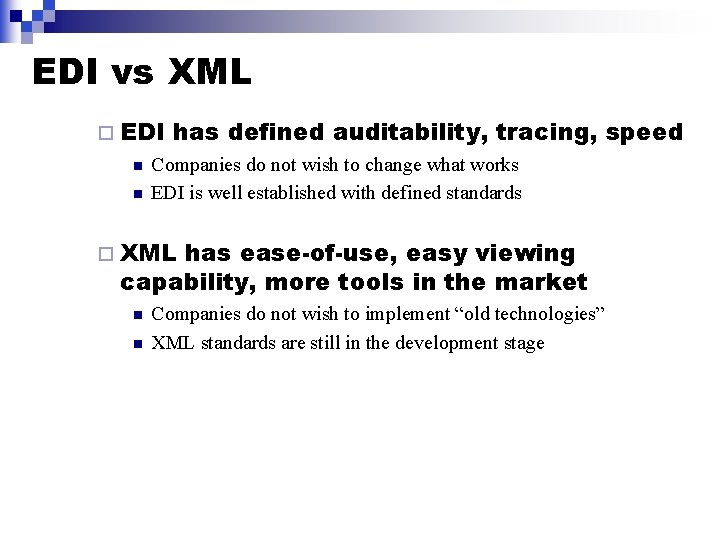
EDI vs XML ¨ EDI n n has defined auditability, tracing, speed Companies do not wish to change what works EDI is well established with defined standards ¨ XML has ease-of-use, easy viewing capability, more tools in the market n n Companies do not wish to implement “old technologies” XML standards are still in the development stage
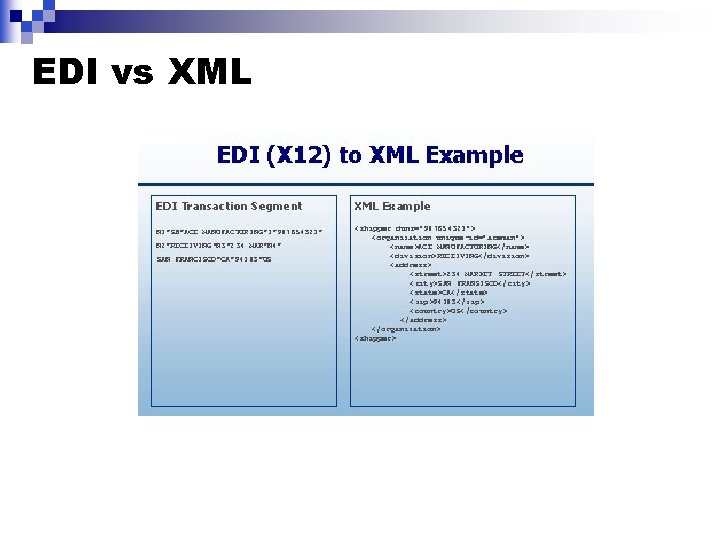
EDI vs XML
New X 12 Envelope n n n ANSI X 12 is the most commonly used B 2 B standard Increasing use of EDI globally requires continued development Innovation by businesses continue to drive EDI document development and enhancements
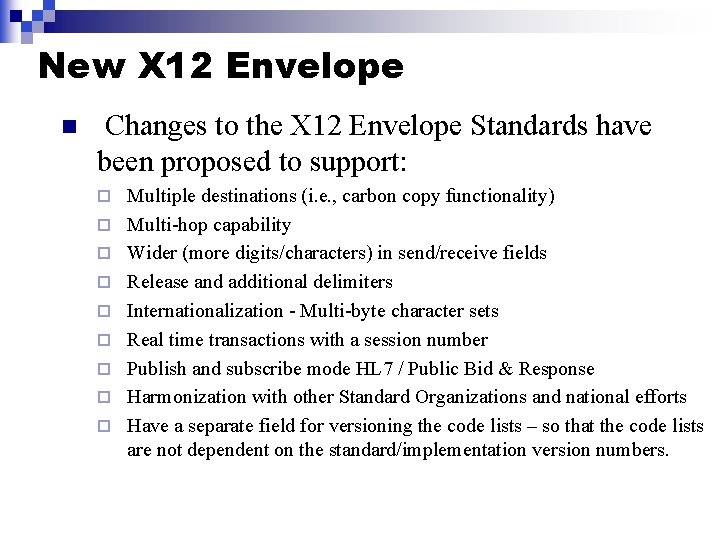
New X 12 Envelope n Changes to the X 12 Envelope Standards have been proposed to support: ¨ ¨ ¨ ¨ ¨ Multiple destinations (i. e. , carbon copy functionality) Multi-hop capability Wider (more digits/characters) in send/receive fields Release and additional delimiters Internationalization - Multi-byte character sets Real time transactions with a session number Publish and subscribe mode HL 7 / Public Bid & Response Harmonization with other Standard Organizations and national efforts Have a separate field for versioning the code lists – so that the code lists are not dependent on the standard/implementation version numbers.
Future of EDI n n n EDI is experiencing an increase in usage as more companies use it to exchange business documents 85 -90% of all B 2 B transaction volumes are based on EDI (2007 study by Forrester Research, B 2 B Integration Trends: Message Formats) XML is growing quickly but remain, at best, 15% of B 2 B traffic.
Why has EDI not been replaced with another Technology? n n EDI is a mature standard (is reliable and has wide-spread use) EDI is working – Don’t fix what isn’t broken! EDI is less expensive than implementing newer technologies EDI is ubiquitous – it is everywhere! ¨ HIPAA mandates the use of EDI for secure exchange of medical information (they just changed the law to update to a higher version of the standard!)
Why has EDI not been replaced with another Technology? n n n EDI is not industry specific EDI is network protocol independent, allowing it to work with newer protocol standards like AS 2 While new technologies and techniques like XML will surely increase in usage, EDI is here to stay!
The End www. auroratechedi. com