
COMMUNITYBASED EDUCATION CURRENT TRENDS AND CHALLENGES Medical Education
COMMUNITY-BASED EDUCATION CURRENT TRENDS AND CHALLENGES Medical Education Rounds Centre for Medical Education Mc. Gill University May 11, 2006 -05 -11 Mc. Gill Paul Grand’Maison, MD, MSc, FCFPC, FCAHS Vice Dean for Undergraduate Medical Education Faculty of Medicine and Health Sciences University of Sherbrooke
OBJECTIVE To provide a framework for discussion regarding community-based medical education and the possibility of its implementation 2006 -05 -11 Mc. Gill Paul Grand’Maison
OBJECTIVE • Not to undervalue urban medicine or training in academic health centres • Consider the value of training in community sites for all students and for the population 2006 -05 -11 Mc. Gill Paul Grand’Maison
2006 -05 -11 Mc. Gill Paul Grand’Maison
CONTENT OF THE PRESENTATION • What, why, how …CBE • Evolution in CBE • Promises and challenges for those involved • Outside campuses for UGME • General lessons 2006 -05 -11 Mc. Gill Paul Grand’Maison
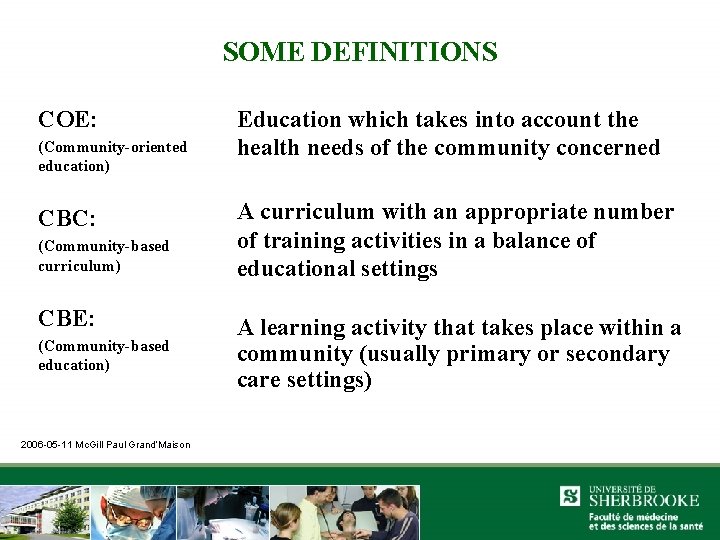
SOME DEFINITIONS COE: (Community-oriented education) CBC: (Community-based curriculum) CBE: (Community-based education) 2006 -05 -11 Mc. Gill Paul Grand’Maison Education which takes into account the health needs of the community concerned A curriculum with an appropriate number of training activities in a balance of educational settings A learning activity that takes place within a community (usually primary or secondary care settings)
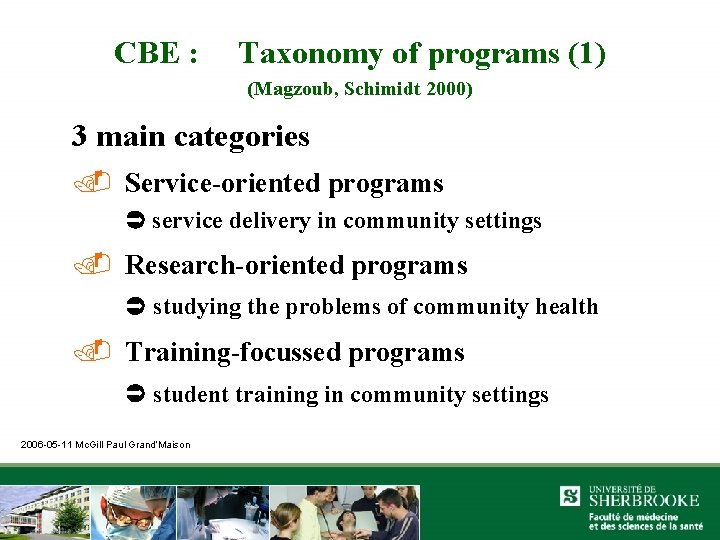
CBE : Taxonomy of programs (1) (Magzoub, Schimidt 2000) 3 main categories. Service-oriented programs service delivery in community settings . Research-oriented programs studying the problems of community health . Training-focussed programs student training in community settings 2006 -05 -11 Mc. Gill Paul Grand’Maison
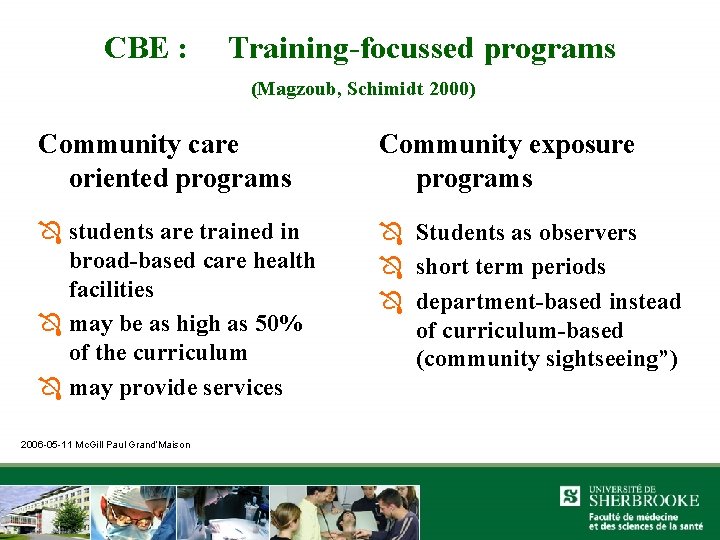
CBE : Training-focussed programs (Magzoub, Schimidt 2000) Community care oriented programs Community exposure programs Ô students are trained in broad-based care health facilities Ô may be as high as 50% of the curriculum Ô may provide services Ô Students as observers Ô short term periods Ô department-based instead of curriculum-based (community sightseeing”) 2006 -05 -11 Mc. Gill Paul Grand’Maison
CBE : IN: WHAT ? in a community with the use of its multiple settings and opportunities TOWARDS: focus on patient and community needs and integration of populational issues WITH: active participation of members and resources of the community 2006 -05 -11 Mc. Gill Paul Grand’Maison
CBE - DME Distributed Medical Education The new buzz word for identifying medical education activities outside academic health centres 2006 -05 -11 Mc. Gill Paul Grand’Maison
CBE: Why • Social accountability re: correcting maldistribution of physicians and meeting communities’ needs • Relevance of education • Impact on practice, health care services and health of the population 2006 -05 -11 Mc. Gill Paul Grand’Maison
WHO: social accountability Medical schools’ obligation to direct their education, research and service activities towards addressing the priority health concerns of the community, region, and/or nation they have a mandate to serve WHO 1995 2006 -05 -11 Mc. Gill Paul Grand’Maison
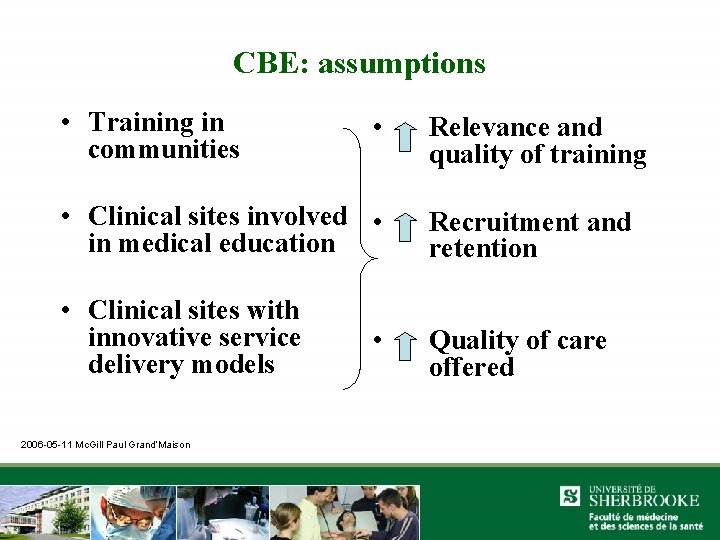
CBE: assumptions • Training in communities • Relevance and quality of training • Clinical sites involved • in medical education Recruitment and retention • Clinical sites with innovative service delivery models Quality of care offered 2006 -05 -11 Mc. Gill Paul Grand’Maison •
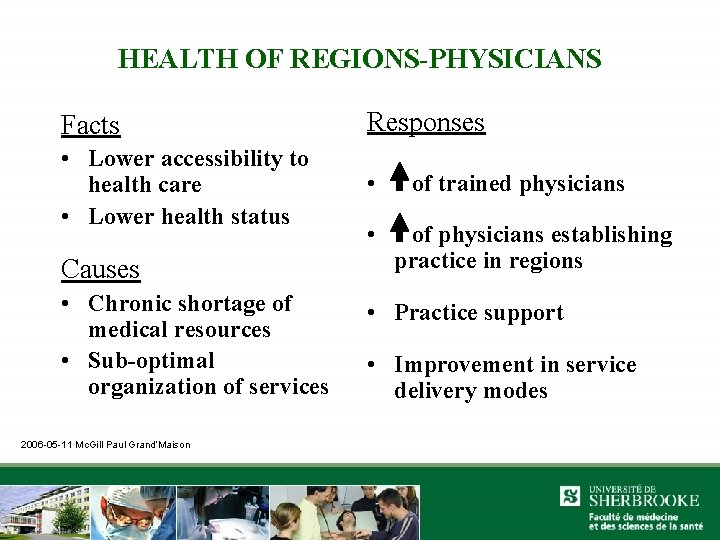
HEALTH OF REGIONS-PHYSICIANS Facts Responses • Lower accessibility to health care • Lower health status • Causes • Chronic shortage of medical resources • Sub-optimal organization of services 2006 -05 -11 Mc. Gill Paul Grand’Maison • of trained physicians of physicians establishing practice in regions • Practice support • Improvement in service delivery modes
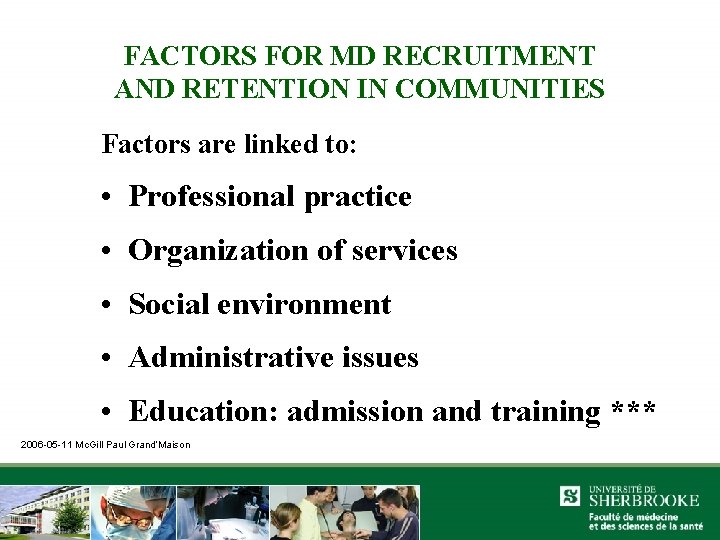
FACTORS FOR MD RECRUITMENT AND RETENTION IN COMMUNITIES Factors are linked to: • Professional practice • Organization of services • Social environment • Administrative issues • Education: admission and training *** 2006 -05 -11 Mc. Gill Paul Grand’Maison
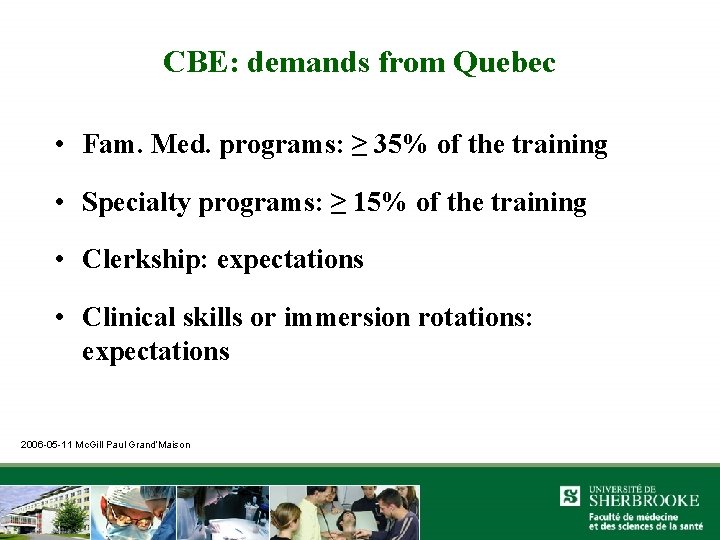
CBE: demands from Quebec • Fam. Med. programs: ≥ 35% of the training • Specialty programs: ≥ 15% of the training • Clerkship: expectations • Clinical skills or immersion rotations: expectations 2006 -05 -11 Mc. Gill Paul Grand’Maison
CBE: support from QUEBEC • Rotations in regions ≥ 50 km from a medical school – Teachers: remuneration – Students: travelling, lodging, food – Faculty: development and support of teaching milieu, faculty development – Sites: infrastructure and library • Significant support for the establishment of Family Medicine units in regions • Support for implementation of outside campuses 2006 -05 -11 Mc. Gill Paul Grand’Maison
WHY CBE: “alignment of planets” • • • Need for a better distribution of the workforce Change in urban practice Successful experience in Family Medicine Technology as an enabler New focus on learning theories such as adult learning, experiential learning, service learning • Governments’ support 2006 -05 -11 Mc. Gill Paul Grand’Maison
CBE: positive experiences • UGME – From short clinical immersion – To whole program in communities • PGME – Family medicine training – Specialty training 2006 -05 -11 Mc. Gill Paul Grand’Maison
CBE: various sites Large univ cities (Montreal) Regional cities (Hull) Small cities (Cowansville) Rural/remote (Val D’Or, Malartic) Highly remote (Kuujuuak) 2006 -05 -11 Mc. Gill Paul Grand’Maison - Univ hospitals, affiliated hospitals or CLSC - Regional hospitals - Smaller hospitals - Community health centers
CBE: activities in UGME (1) • Clinical immersion (1 to 3 weeks) in communities (may be remote and rural) sites during preclinical training • Summer rotations • Learning clinical skills in community hospitals • Elective clerkship • Compulsory clerkship: ≥ 1 discipline 2006 -05 -11 Mc. Gill Paul Grand’Maison
CBE: activities in UGME (2) • A full-year integrated clerkship – Continuous learning of disciplines instead of finite rotations – UBC (2005), NOSM (2007) • Preclinical education in regions – USA: WWAMI, Illinois – Canada: USask ( ), UBC (2004), Ude. M (2004), NOSM (2005), Ude. S (2006), others 2006 -05 -11 Mc. Gill Paul Grand’Maison
CBE: activities in PGME • Family medicine – – – Electives in FM C-based FM unit A full FM unit Specialty rotations for FM residence (optional-regular) Whole 24 month program • Specialties (focus on broad based specialties) – Electives – Regular rotations: 1 to 6 -12 months 2006 -05 -11 Mc. Gill Paul Grand’Maison
CBE: added value when … • Early in the training program • Continuously / repetitively • Various and complementary sites • Diverse and complementary sites 2006 -05 -11 Mc. Gill Paul Grand’Maison
Survey of Distributed Medical Education Activities at Canadian Faculties of Medicine 2006 -05 -11 Mc. Gill Paul Grand’Maison May 3, 2006
Summary • Definitions of distributed medical education are broad • Activities appear to be extensive • Virtually every student and resident will experience some DME 2006 -05 -11 Mc. Gill Paul Grand’Maison
Successes • The development of key partnerships, and collaborations with distant sites and communities • Faculty enthusiasm and student satisfaction • The successful development of new, expanded, high-quality educational programs that will better prepare learners and support physicians in practice 2006 -05 -11 Mc. Gill Paul Grand’Maison
Challenges • The recruitment, development, and support of faculty and preceptors at distant sites • Students and residents’ concerns about disruption of their life, isolation and career opportunities • The challenge of developing and maintaining good quality programs • Measurement of impact 2006 -05 -11 Mc. Gill Paul Grand’Maison
COMMUNITY-BASED EDUCATION PROMISES CHALLENGES For all those involved 2006 -05 -11 Mc. Gill Paul Grand’Maison
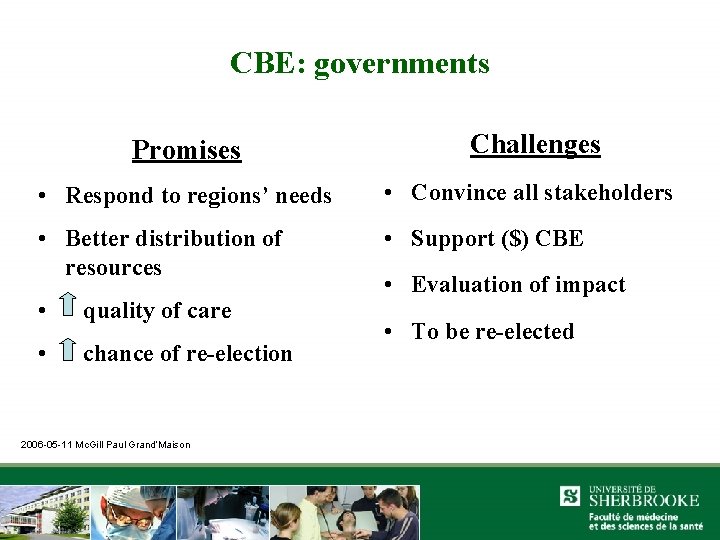
CBE: governments Promises Challenges • Respond to regions’ needs • Convince all stakeholders • Better distribution of resources • Support ($) CBE • quality of care • chance of re-election 2006 -05 -11 Mc. Gill Paul Grand’Maison • Evaluation of impact • To be re-elected
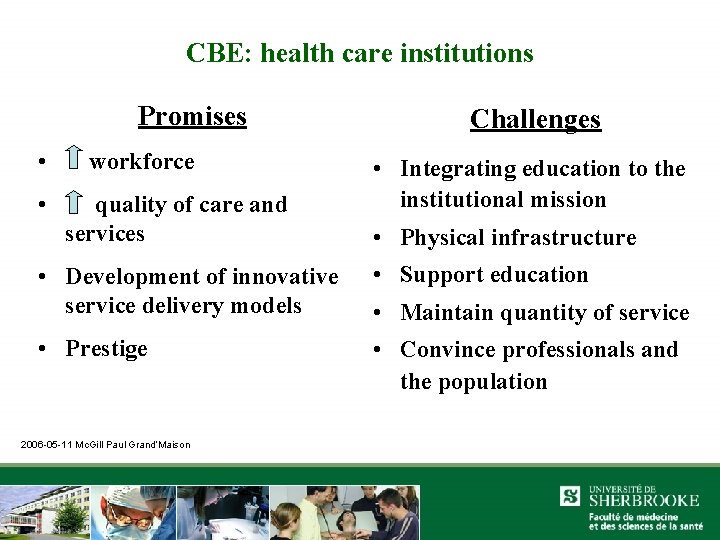
CBE: health care institutions Promises • • workforce quality of care and services Challenges • Integrating education to the institutional mission • Physical infrastructure • Development of innovative service delivery models • Support education • Prestige • Convince professionals and the population 2006 -05 -11 Mc. Gill Paul Grand’Maison • Maintain quantity of service
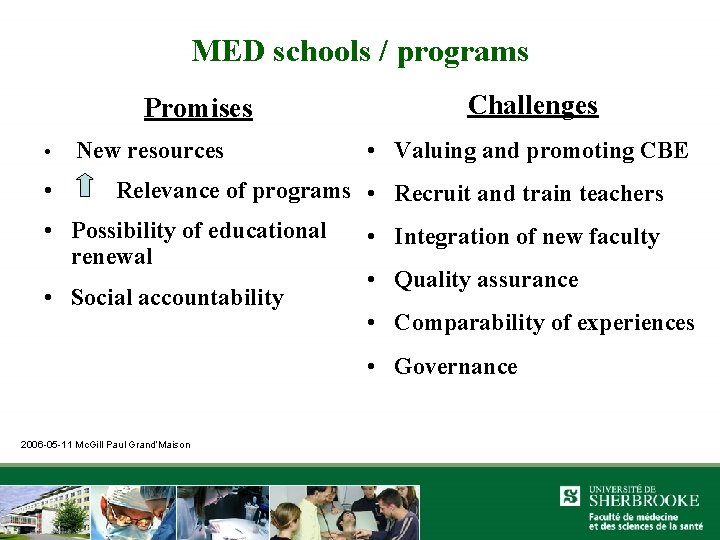
MED schools / programs Promises • • New resources Challenges • Valuing and promoting CBE Relevance of programs • Recruit and train teachers • Possibility of educational renewal • Social accountability • Integration of new faculty • Quality assurance • Comparability of experiences • Governance 2006 -05 -11 Mc. Gill Paul Grand’Maison
CBE: teaching physicians Pomises • • • recruitment of future colleagues motivation at work maintenance of competence • University linked • A recognition 2006 -05 -11 Mc. Gill Paul Grand’Maison Challenges • Becoming a teacher • Integrating teaching in an already heavy workload • Improve professional competence • Accept to be observed and challenged • Faculty development
CBE : WHO are the teachers ? • Clinical professionals • Professionals in other disciplines • Patients • Community members or groups * Importance of support, faculty development programs, recognition of status and compensation 2006 -05 -11 Mc. Gill Paul Grand’Maison
CBE : WHAT to teach ? • Wide variety of problems • Basic but also advanced skills • Population-based sciences • Working with other professionals • The community, its characteristics, needs, resources, service delivery system • What it is to live and to be a health professional in the community ? 2006 -05 -11 Mc. Gill Paul Grand’Maison
CBE: HOW to teach ? • Know objectives and consider levels of training • Establish mutual goals • Case based learning • Support independent and experiential learning • Feedback • Role modeling • Using information technology • Enthusiasm 2006 -05 -11 Mc. Gill Paul Grand’Maison
CBE: teachers • • A need of champions and teams Selection, recruitment Promotion, academic career (mentoring) Department/univ belonging Remuneration Benefits: CME credit, library, etc. Watch for burn out 2006 -05 -11 Mc. Gill Paul Grand’Maison
CBE: faculty development • • Program needs: clear expectations/requirements Teachers’ needs (levels of experience) Timely and continuous Multiple methods: workshops, peer coaching, SDL activities, etc. • Linked with CPD in clinical practice • Challenges: reaching teachers, remaining relevant, completing evaluation 2006 -05 -11 Mc. Gill Paul Grand’Maison
CBE: students Promises • Relevance of education • Variability of health problems • “Real life” experiences • Competencies not optimally learned otherwise • Knowledge of communities and of being a MD in these • Interest for practicing in community 2006 -05 -11 Mc. Gill Paul Grand’Maison Challenges • Keen to take on new challenges • Adapt themselves to various sites • Moving/Lodging • Personal and family life • Autonomy and self directed learning • Take initiative and responsibility
CBE : HOW to learn ? • Initiative / independent learning • Experiential learning • From all professionals • Solicit feedback from teachers • Self evaluation • Increase use of information technology • Generalize to other situations 2006 -05 -11 Mc. Gill Paul Grand’Maison
CBE: learners’ issues • Quality of education • Evaluation: fairness • Financial support • Emotional support • Opportunity for research • Ca. RMS match 2006 -05 -11 Mc. Gill Paul Grand’Maison
CBE: populations / communities Promises • Medical resources • Response to needs Challenges • Education becomes an integrated part of their health care institutions • Influence the training of future physicians • Accept to interact with students • Increase consideration of community health determinants • Involve community in the support of students 2006 -05 -11 Mc. Gill Paul Grand’Maison
CBE: comparability of education • Meeting standards and goals versus standardization of process • Demands for accreditation (LCME: ED 8, ED 2) • Ground on core principles and objectives • Should be a multiple way exchange • Final measure: students’ success 2006 -05 -11 Mc. Gill Paul Grand’Maison
CBE: information technology • Learning objectives should drive the technology and not the reverse • Technology to support: – Communication – Learning: web sites, access to library, e-learning – Administration – Assessment of teaching and learning 2006 -05 -11 Mc. Gill Paul Grand’Maison
CBE: governance • One university program • Needs clarification of expectations re: – Administrative issues – Teaching and learning issues – Assessment • Clear lines of communication • Use evaluation and feedback wisely 2006 -05 -11 Mc. Gill Paul Grand’Maison
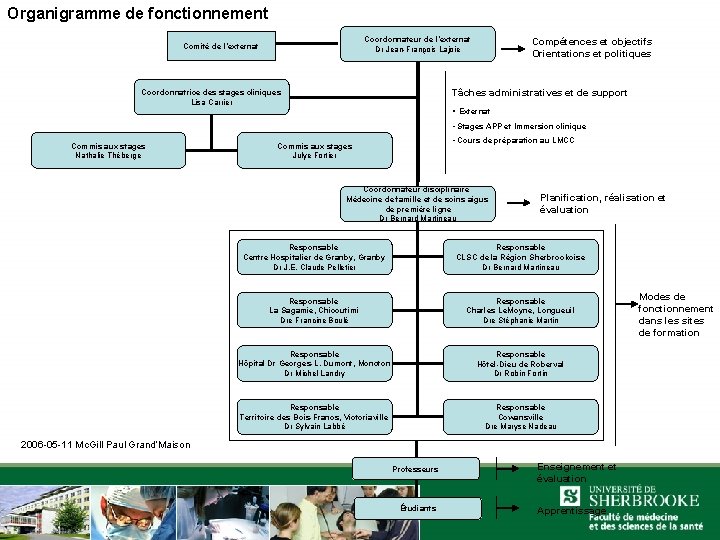
Organigramme de fonctionnement Coordonnateur de l’externat Dr Jean-François Lajoie Comité de l’externat Compétences et objectifs Orientations et politiques Tâches administratives et de support Coordonnatrice des stages cliniques Lisa Carrier • Externat • Stages APP et Immersion clinique Commis aux stages Nathalie Théberge • Cours de préparation au LMCC Commis aux stages Julye Fortier Coordonnateur disciplinaire Médecine de famille et de soins aigus de première ligne Dr Bernard Martineau Planification, réalisation et évaluation Responsable Centre Hospitalier de Granby, Granby Dr J. E. Claude Pelletier Responsable CLSC de la Région Sherbrookoise Dr Bernard Martineau Responsable La Sagamie, Chicoutimi Dre Francine Boulé Responsable Charles Le. Moyne, Longueuil Dre Stéphanie Martin Responsable Hôpital Dr Georges-L. Dumont, Moncton Dr Michel Landry Responsable Hôtel-Dieu de Roberval Dr Robin Fortin Responsable Territoire des Bois-Francs, Victoriaville Dr Sylvain Labbé Responsable Cowansville Dre Maryse Nadeau 2006 -05 -11 Mc. Gill Paul Grand’Maison Professeurs Étudiants Enseignement et évaluation Apprentissage Modes de fonctionnement dans les sites de formation
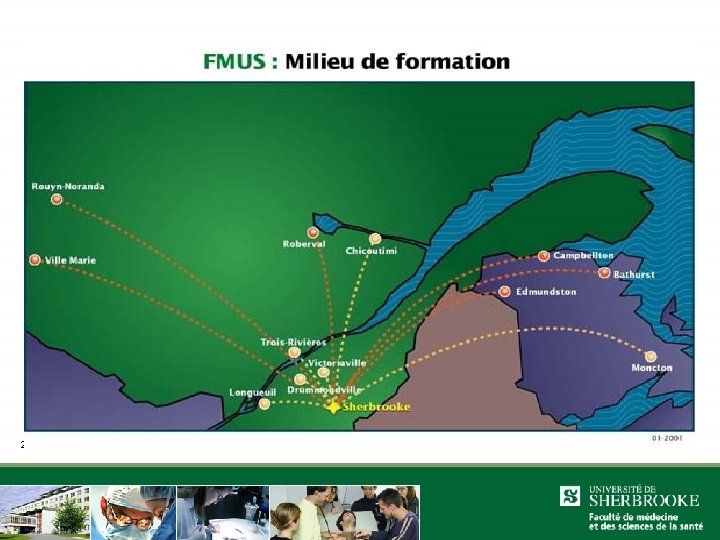
CBE at Sherbrooke FMSS • Long term orientation towards communities • A WHO PAHO Collaboration Centre on “education and practice of health professionals responding to community needs” • UGME: preclinical years and clerkship • PGME: Family Medicine and specialty 2006 -05 -11 Mc. Gill Paul Grand’Maison
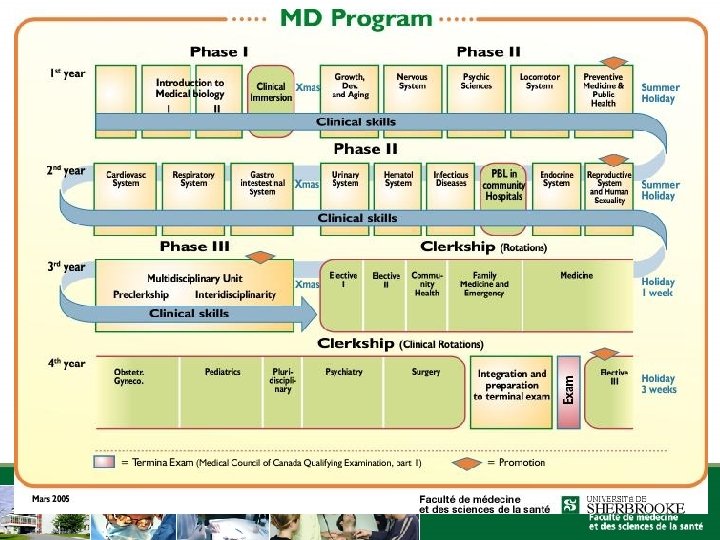
2006 -05 -11 Mc. Gill Paul Grand’Maison
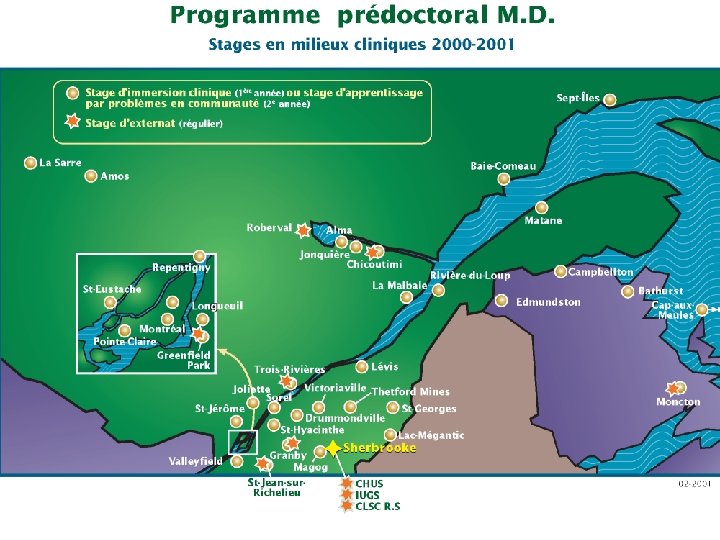
Milieux de formation immersion clinique – APP communauté • Prés. De G. W. 22 avril 2006 -05 -11 Mc. Gill Paul Grand’Maison
2006 -05 -11 Mc. Gill Paul Grand’Maison
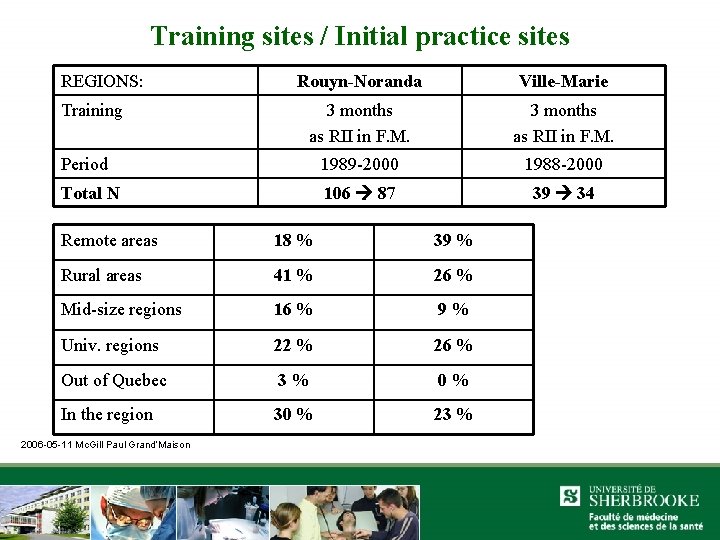
Training sites / Initial practice sites REGIONS: Rouyn-Noranda Ville-Marie 3 months as RII in F. M. Period 1989 -2000 1988 -2000 Total N 106 87 39 34 Training Remote areas 18 % 39 % Rural areas 41 % 26 % Mid-size regions 16 % 9% Univ. regions 22 % 26 % Out of Quebec 3% 0% In the region 30 % 23 % 2006 -05 -11 Mc. Gill Paul Grand’Maison
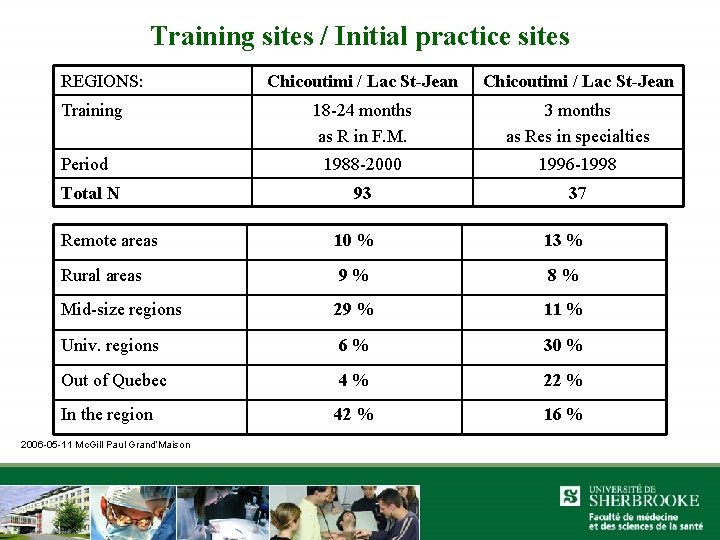
Training sites / Initial practice sites REGIONS: Chicoutimi / Lac St-Jean 18 -24 months as R in F. M. 3 months as Res in specialties 1988 -2000 1996 -1998 93 37 Remote areas 10 % 13 % Rural areas 9% 8% Mid-size regions 29 % 11 % Univ. regions 6% 30 % Out of Quebec 4% 22 % In the region 42 % 16 % Training Period Total N 2006 -05 -11 Mc. Gill Paul Grand’Maison
CBE at Sherbrooke: major actions • Francophone New Brunswick students • Saguenay – Lac-St-Jean • Hôpital Charles-Le. Moyne • 2 outside campuses for UGME in 2006 – Saguenay – Moncton 2006 -05 -11 Mc. Gill Paul Grand’Maison
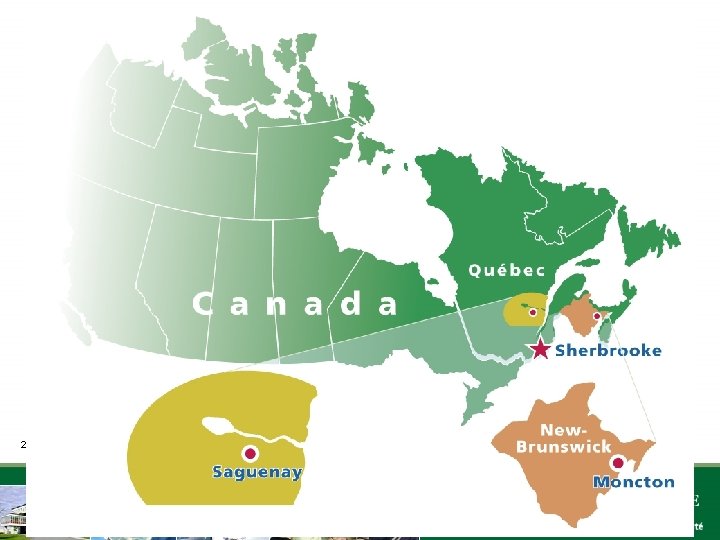
Sherbrooke MD Program 1 program, 3 sites Sherbrooke, Saguenay, Moncton 2006 -05 -11 Mc. Gill Paul Grand’Maison
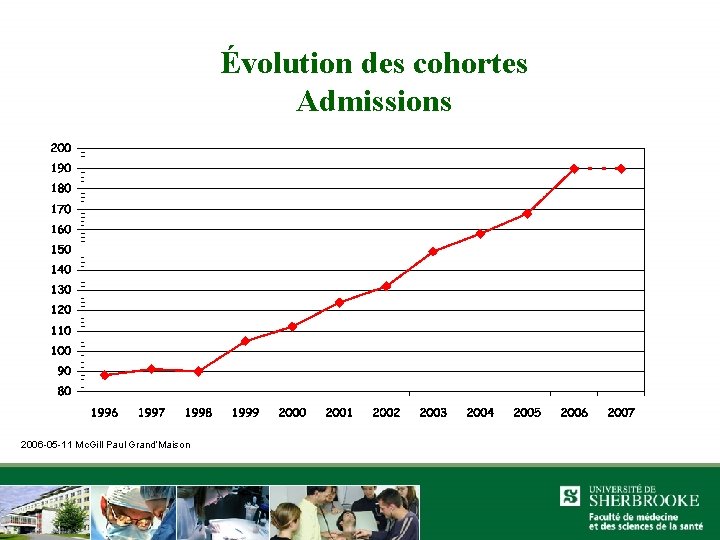
Évolution des cohortes Admissions 2006 -05 -11 Mc. Gill Paul Grand’Maison
2006 -05 -11 Mc. Gill Paul Grand’Maison
MD Program: Admission 2006 • Moncton: 24 (all from New Brunswick) • Saguenay: 24 (all from Quebec) • Sherbrooke: 146 (from Quebec, Maritimes, West of Canada) • Multiple collaborators: university, teaching hospital, regional health authority, physicians, community 2006 -05 -11 Mc. Gill Paul Grand’Maison
CBE: current trends and challenges Lessons and conclusion 2006 -05 -11 Mc. Gill Paul Grand’Maison
CBE: general objectives • relevance of education • Educate all students about health care in the communities • Train a larger number of students • Better meet population and community needs • Better distribution re: types and sites of practice • Recruit and retain 2006 -05 -11 Mc. Gill Paul Grand’Maison
CBE : for WHOM ? • For ALL students • For those with an interest or commitment to work in community sites • For all students who will be working in large cities, but need to have a knowledge of what it is to practice in communities so that they will be better prepared to support community physicians 2006 -05 -11 Mc. Gill Paul Grand’Maison
CBE: general impact • Improving medical workforce for serving communities • quality of health care and services in communities • health of the population • Social impact and sustainability of communities 2006 -05 -11 Mc. Gill Paul Grand’Maison
WILLIAM OSLER I think safe to say that in a hospital with students in the wards, the patients are more carefully looked after, their diseases are more fully studied and few mistakes made 2006 -05 -11 Mc. Gill Paul Grand’Maison
GENERAL CHALLENGES • Prepare our students to learn in the community • Prepare teachers to teach in the community • Governance and comparability • To go further than just the community hospital • To optimize COE • Evaluation 2006 -05 -11 Mc. Gill Paul Grand’Maison
CBE : Evaluation • Evaluation of teaching and learning process and results • • The WHYs – Recruitment / Retention – Quality of practice – Populational health status Long term stability of the program 2006 -05 -11 Mc. Gill Paul Grand’Maison
CONDITIONS OF SUCCESS • Start small • Clear and shared objectives • An efficient organizational, governance and support structure • Communication, partnerships, commitment • Long term actions • Prioritization: family medicine and broad-base specialties 2006 -05 -11 Mc. Gill Paul Grand’Maison
CONDITIONS OF SUCCESS • High standards (and maintain them) • Monitoring and assessment • $$$ • Leaders and leadership • Share successes 2006 -05 -11 Mc. Gill Paul Grand’Maison
Rules for innovation in medical education (Paul Grand’Maison, 2004) Daring in vision Wisdom in decision Determination in action Rigor in evaluation Scholarship in dissemination 2006 -05 -11 Mc. Gill Paul Grand’Maison 2005 -05 -01. PGM. EFPO. Saskatoon
2006 -05 -11 Mc. Gill Paul Grand’Maison
- Slides: 68