CSE 105 THEORY OF COMPUTATION Fall 2019 https
- Slides: 22
CSE 105 THEORY OF COMPUTATION Fall 2019 https: //cseweb. ucsd. edu/classes/fa 19/cse 105 -a/
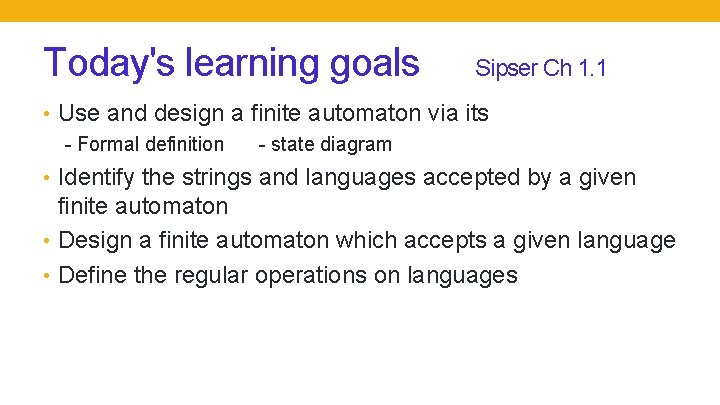
Today's learning goals Sipser Ch 1. 1 • Use and design a finite automaton via its - Formal definition - state diagram • Identify the strings and languages accepted by a given finite automaton • Design a finite automaton which accepts a given language • Define the regular operations on languages
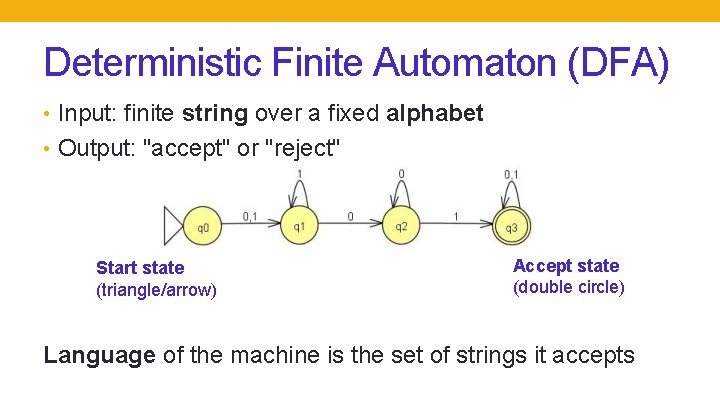
Deterministic Finite Automaton (DFA) • Input: finite string over a fixed alphabet • Output: "accept" or "reject" Start state (triangle/arrow) Accept state (double circle) Language of the machine is the set of strings it accepts
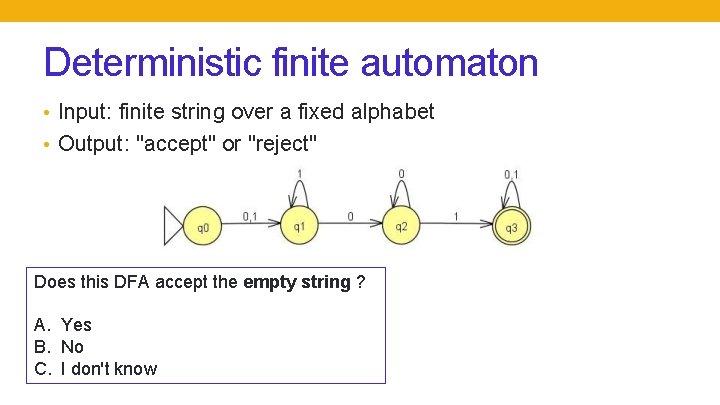
Deterministic finite automaton • Input: finite string over a fixed alphabet • Output: "accept" or "reject" Does this DFA accept the empty string ? A. Yes B. No C. I don't know
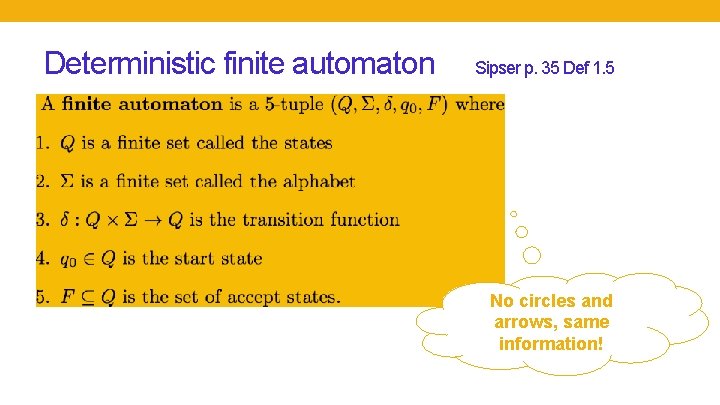
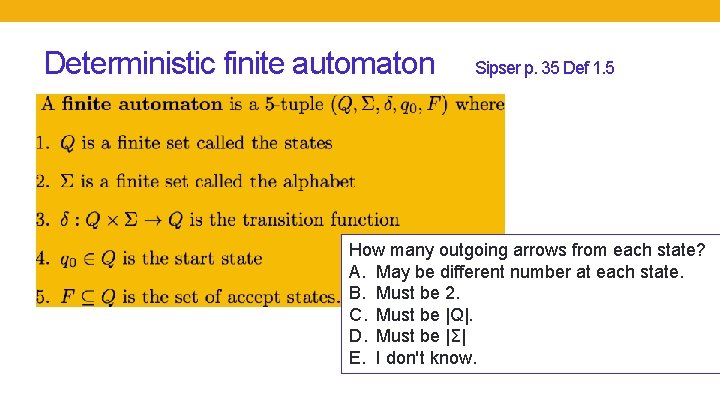
Deterministic finite automaton Sipser p. 35 Def 1. 5 No circles and arrows, same information!
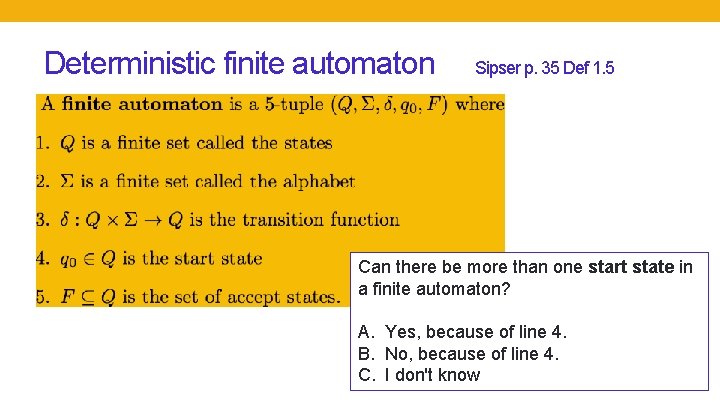
Deterministic finite automaton Sipser p. 35 Def 1. 5 Can there be more than one start state in a finite automaton? A. Yes, because of line 4. B. No, because of line 4. C. I don't know
Deterministic finite automaton Sipser p. 35 Def 1. 5 How many outgoing arrows from each state? A. May be different number at each state. B. Must be 2. C. Must be |Q|. D. Must be |Σ| E. I don't know.
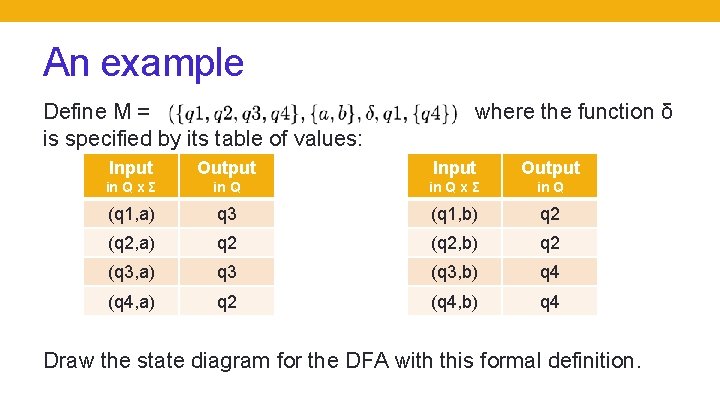
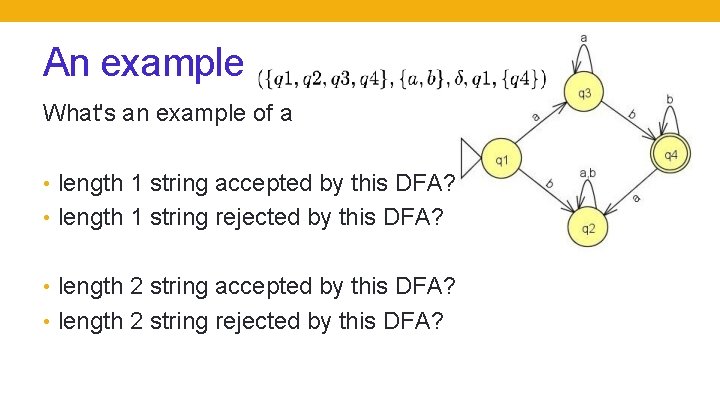
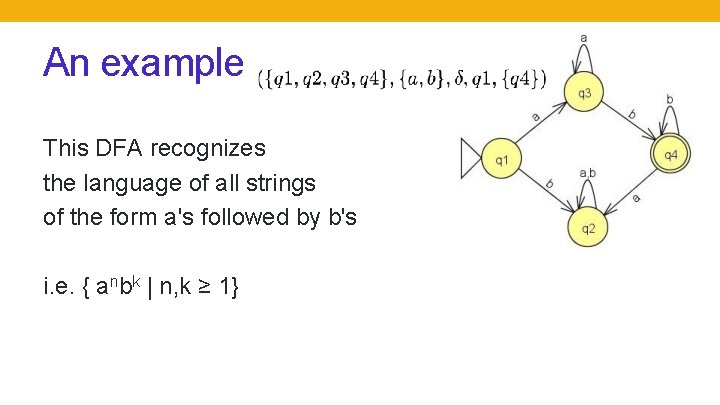
An example Define M = is specified by its table of values: where the function δ Input Output in Q x Σ in Q (q 1, a) q 3 (q 1, b) q 2 (q 2, a) q 2 (q 2, b) q 2 (q 3, a) q 3 (q 3, b) q 4 (q 4, a) q 2 (q 4, b) q 4 Draw the state diagram for the DFA with this formal definition.
An example What's an example of a • length 1 string accepted by this DFA? • length 1 string rejected by this DFA? • length 2 string accepted by this DFA? • length 2 string rejected by this DFA?
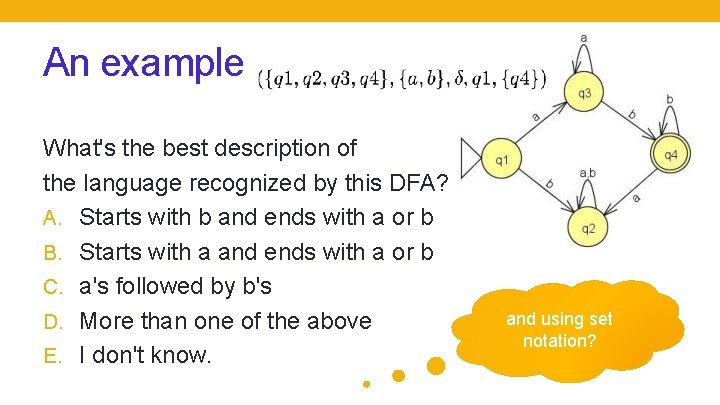
An example What's the best description of the language recognized by this DFA? A. Starts with b and ends with a or b B. Starts with a and ends with a or b C. a's followed by b's D. More than one of the above E. I don't know. and using set notation?
An example This DFA recognizes the language of all strings of the form a's followed by b's i. e. { anbk | n, k ≥ 1}
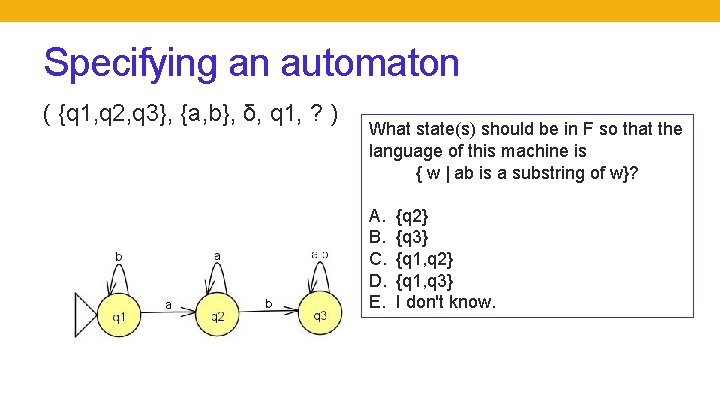
Specifying an automaton ( {q 1, q 2, q 3}, {a, b}, δ, q 1, ? ) What state(s) should be in F so that the language of this machine is { w | ab is a substring of w}? A. B. C. D. E. {q 2} {q 3} {q 1, q 2} {q 1, q 3} I don't know.
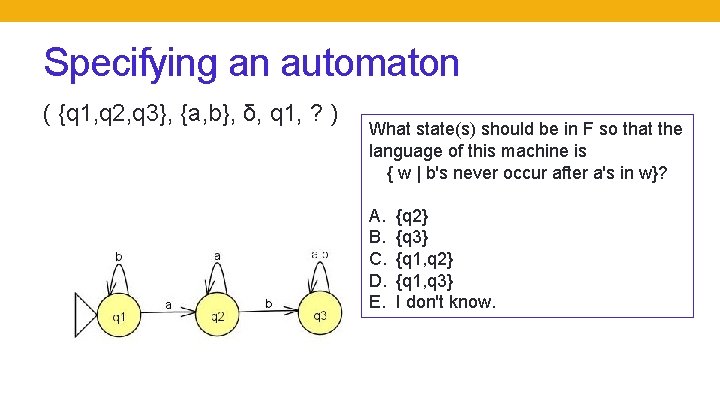
Specifying an automaton ( {q 1, q 2, q 3}, {a, b}, δ, q 1, ? ) What state(s) should be in F so that the language of this machine is { w | b's never occur after a's in w}? A. B. C. D. E. {q 2} {q 3} {q 1, q 2} {q 1, q 3} I don't know.
Building DFA Typical questions Define a DFA which recognizes the given language L. or Prove that the (given) language L is regular.
Building DFA Example Define a DFA which recognizes { w | w has at least 2 a's}
Building DFA Example Define a DFA which recognizes { w | w has at most 2 a's}
Building DFA Remember States are our only (computer) memory. Design and pick states with specific roles / tasks in mind. "Have not seen any of desired pattern yet" "Trap state"
Justification? To prove that the DFA we build, M, actually recognizes the language L WTS L(M) = L (1) Is every string accepted by M in L? (2) Is every string from L accepted by M? or contrapositive version: Is every string rejected by M not in L.
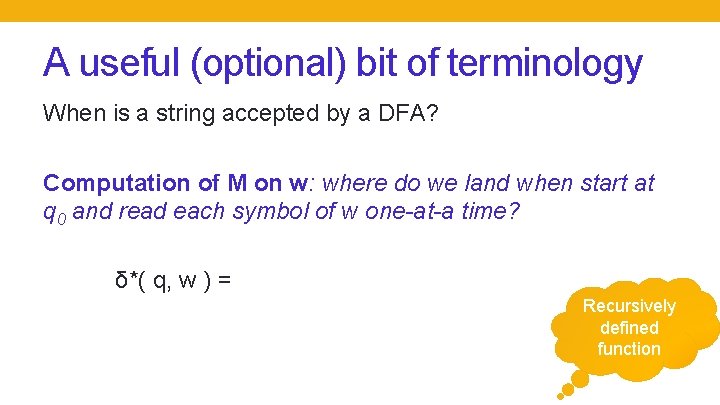
A useful (optional) bit of terminology When is a string accepted by a DFA? Computation of M on w: where do we land when start at q 0 and read each symbol of w one-at-a time? δ*( q, w ) = Recursively defined function
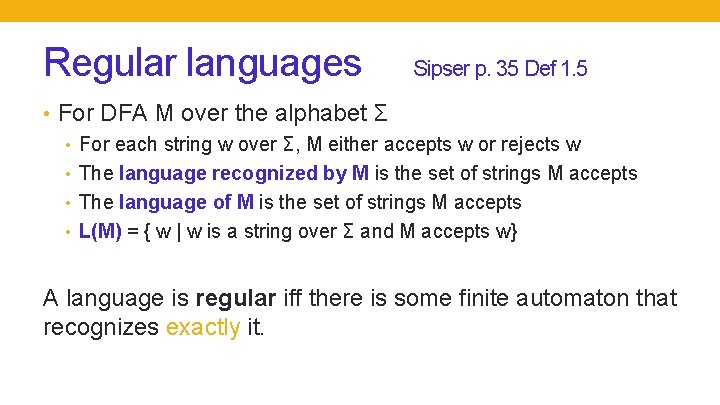
Regular languages Sipser p. 35 Def 1. 5 • For DFA M over the alphabet Σ • For each string w over Σ, M either accepts w or rejects w • The language recognized by M is the set of strings M accepts • The language of M is the set of strings M accepts • L(M) = { w | w is a string over Σ and M accepts w} A language is regular iff there is some finite automaton that recognizes exactly it.
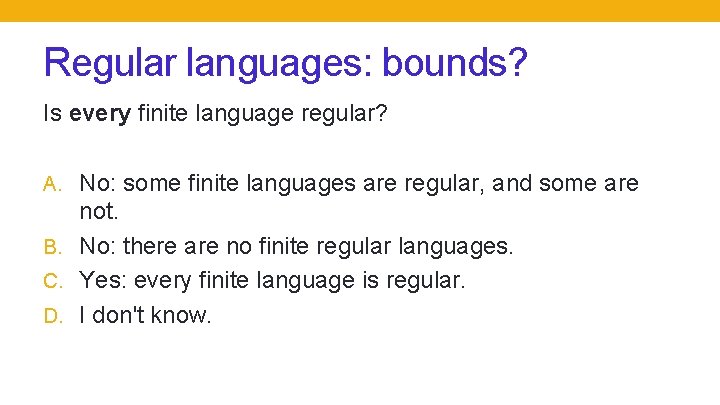
Regular languages: bounds? Is every finite language regular? A. No: some finite languages are regular, and some are not. B. No: there are no finite regular languages. C. Yes: every finite language is regular. D. I don't know.
For next time • Complete Review Quiz 1 by Friday night • Continue working on Homework 1 due Monday night • Set up course tools: Gradescope, Piazza • Find group members • Read all the questions • Start working • Review CSE 20 / Math 109 / CSE 21 / Sipser Ch 0 as needed.