CS 4670 5670 Computer Vision Noah Snavely Lecture


- Slides: 24
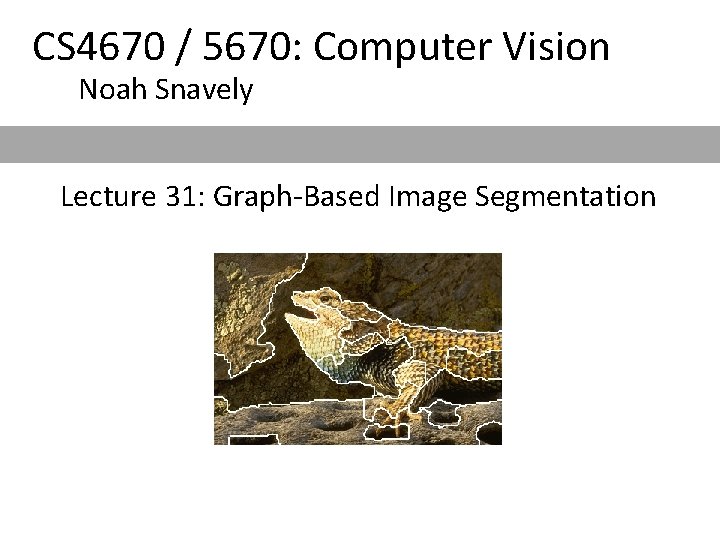
CS 4670 / 5670: Computer Vision Noah Snavely Lecture 31: Graph-Based Image Segmentation
Announcements • Project 4 due Friday • Project 4 artifacts due Monday • Project demos Monday – Signup on CMS soon
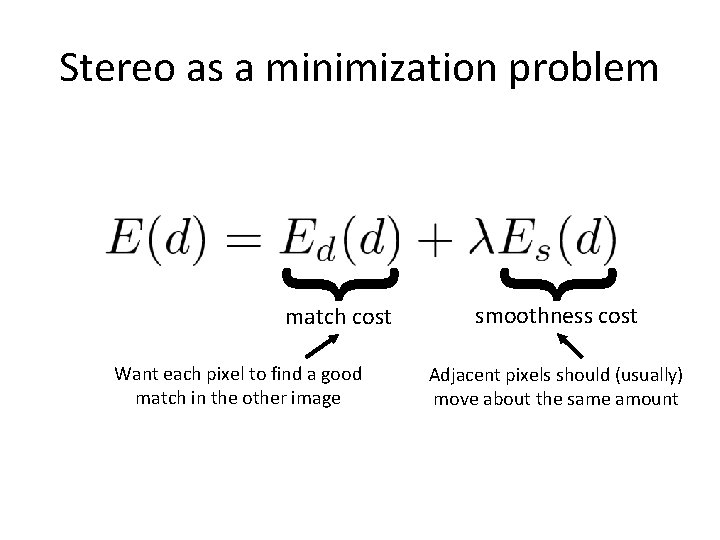
match cost Want each pixel to find a good match in the other image { { Stereo as a minimization problem smoothness cost Adjacent pixels should (usually) move about the same amount
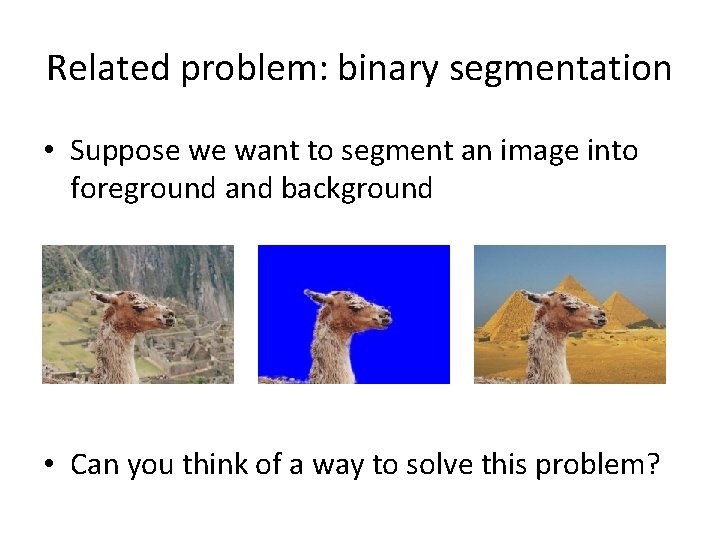
Related problem: binary segmentation • Suppose we want to segment an image into foreground and background • Can you think of a way to solve this problem?
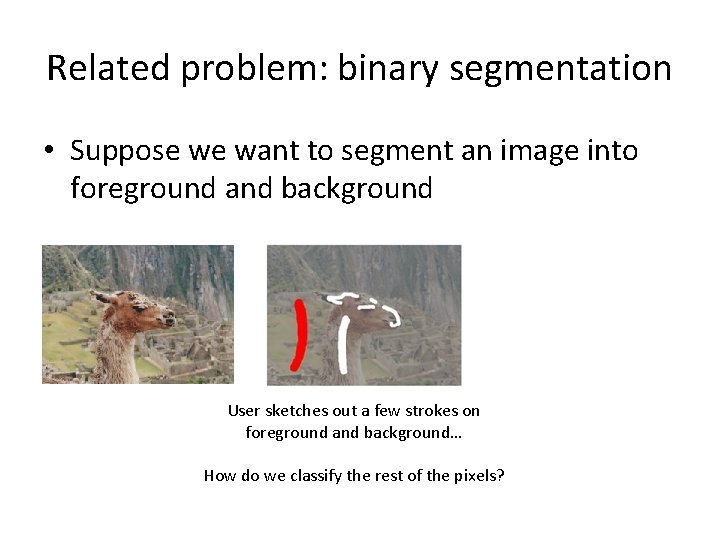
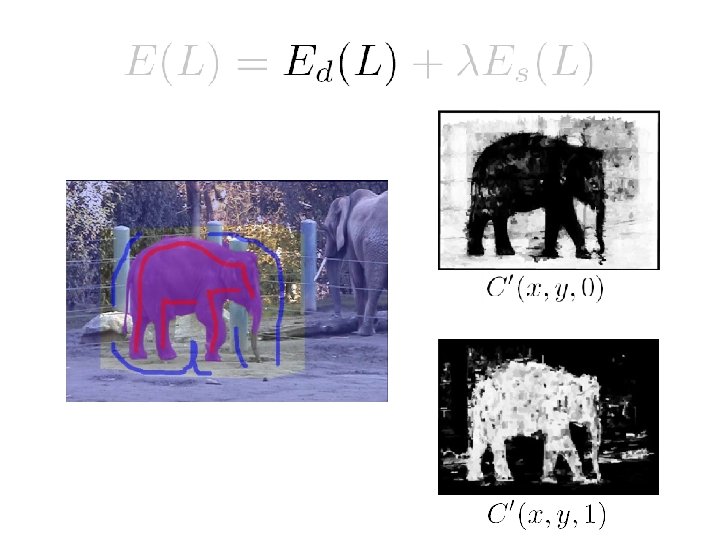
Related problem: binary segmentation • Suppose we want to segment an image into foreground and background User sketches out a few strokes on foreground and background… How do we classify the rest of the pixels?
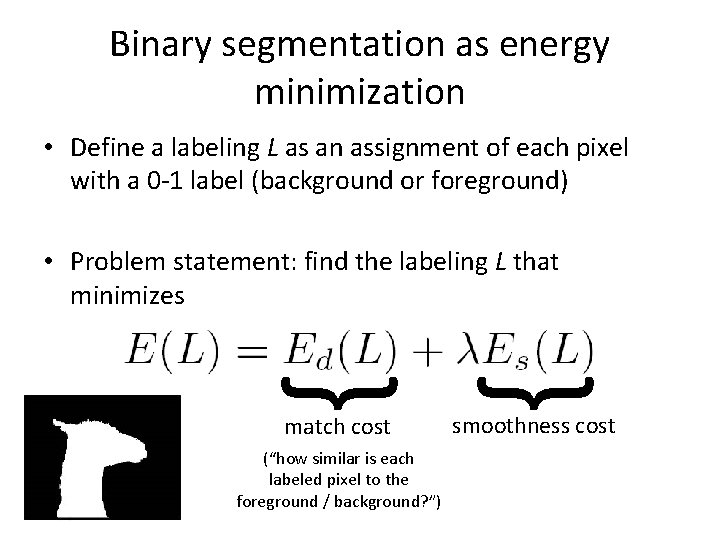
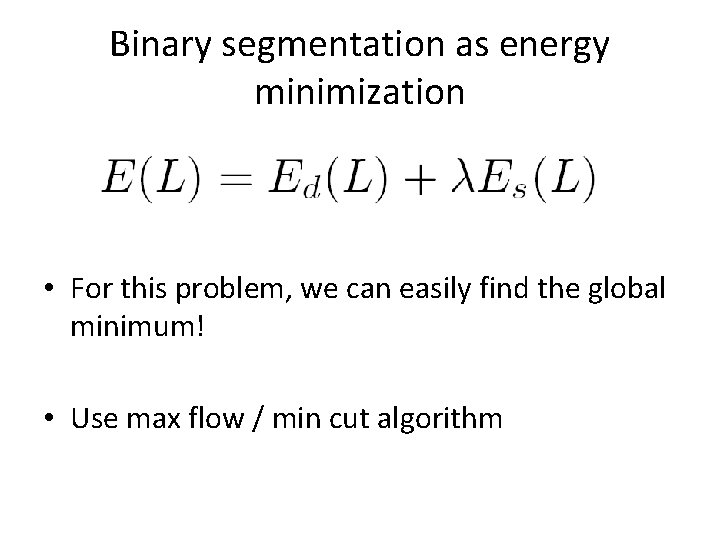
Binary segmentation as energy minimization • Define a labeling L as an assignment of each pixel with a 0 -1 label (background or foreground) { { • Problem statement: find the labeling L that minimizes match cost (“how similar is each labeled pixel to the foreground / background? ”) smoothness cost
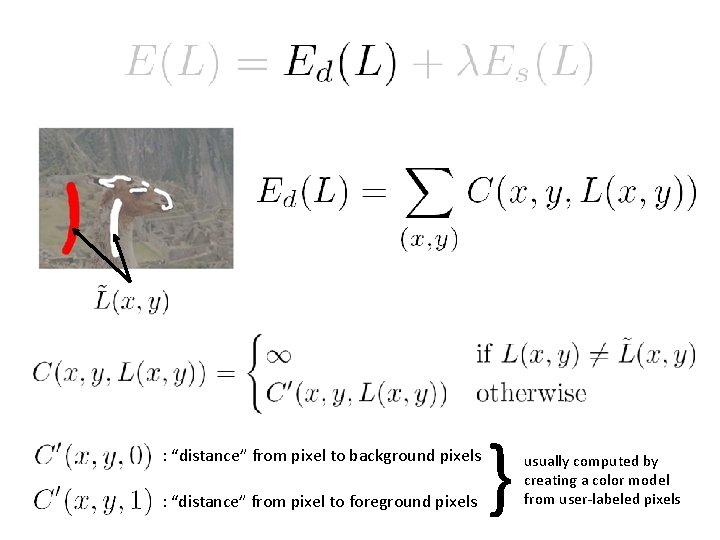
: “distance” from pixel to foreground pixels { : “distance” from pixel to background pixels usually computed by creating a color model from user-labeled pixels
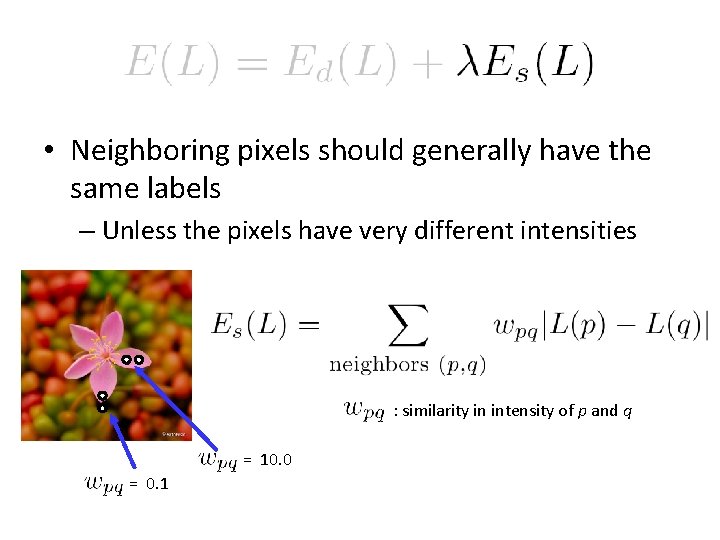
• Neighboring pixels should generally have the same labels – Unless the pixels have very different intensities : similarity in intensity of p and q = 10. 0 = 0. 1
Binary segmentation as energy minimization • For this problem, we can easily find the global minimum! • Use max flow / min cut algorithm
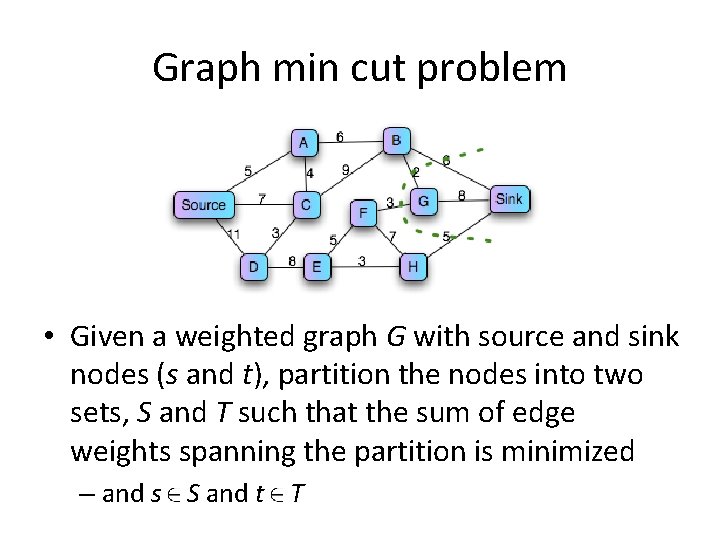
Graph min cut problem • Given a weighted graph G with source and sink nodes (s and t), partition the nodes into two sets, S and T such that the sum of edge weights spanning the partition is minimized – and s S and t T
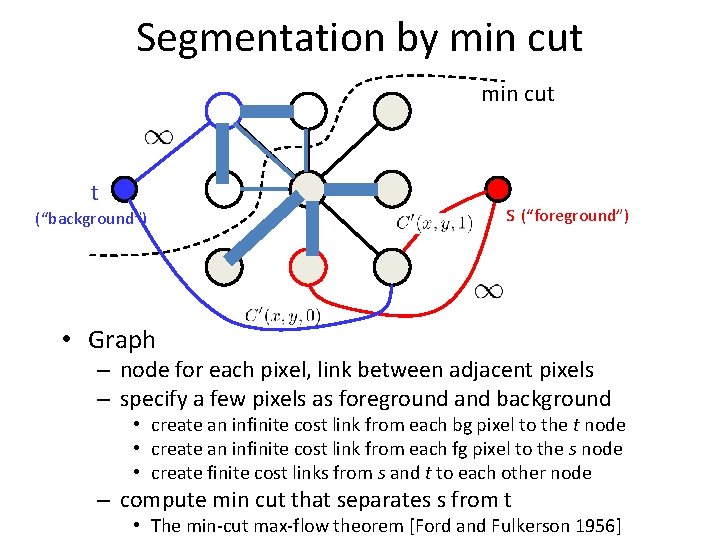
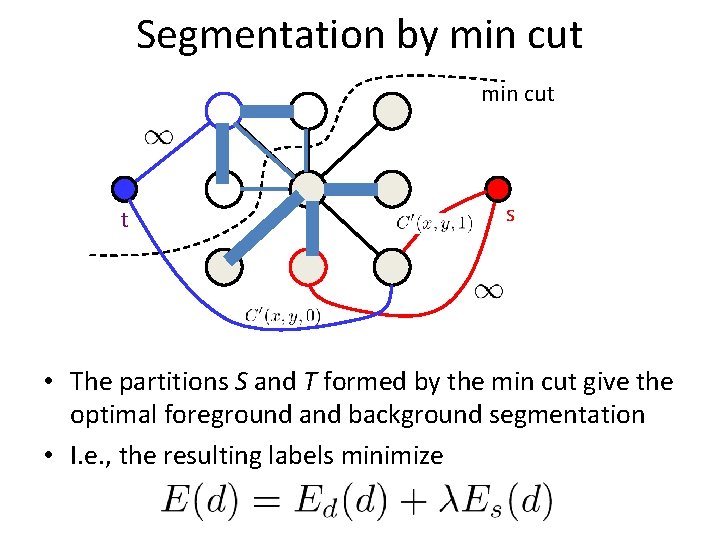
Segmentation by min cut t (“background”) s (“foreground”) • Graph – node for each pixel, link between adjacent pixels – specify a few pixels as foreground and background • create an infinite cost link from each bg pixel to the t node • create an infinite cost link from each fg pixel to the s node • create finite cost links from s and t to each other node – compute min cut that separates s from t • The min-cut max-flow theorem [Ford and Fulkerson 1956]
Segmentation by min cut t s • The partitions S and T formed by the min cut give the optimal foreground and background segmentation • I. e. , the resulting labels minimize
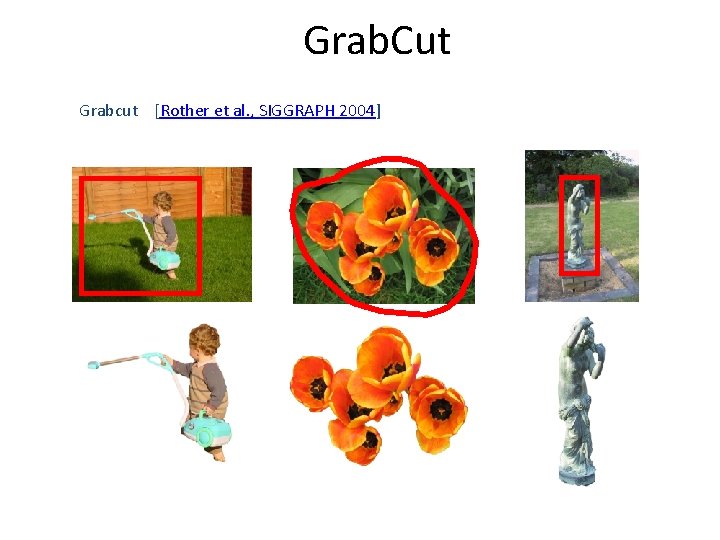
Grab. Cut Grabcut [Rother et al. , SIGGRAPH 2004]
Is user-input required? Our visual system is proof that automatic methods are possible • classical image segmentation methods are automatic Argument for user-directed methods? • only user knows desired scale/object of interest
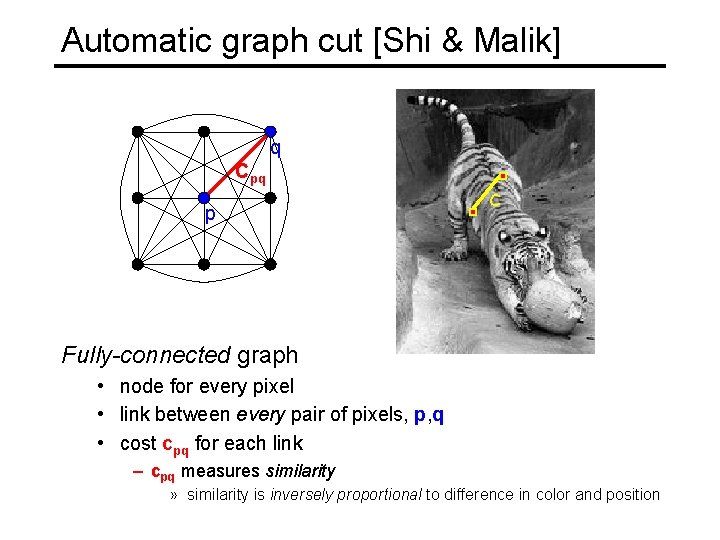
Automatic graph cut [Shi & Malik] q Cpq p c Fully-connected graph • node for every pixel • link between every pair of pixels, p, q • cost cpq for each link – cpq measures similarity » similarity is inversely proportional to difference in color and position
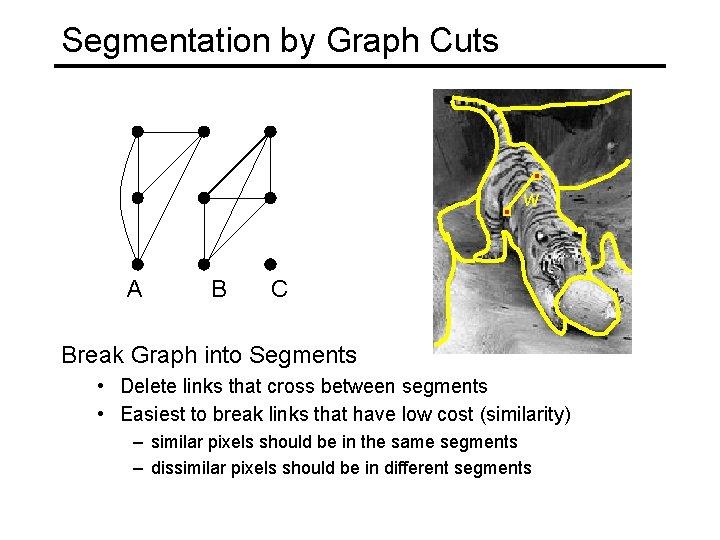
Segmentation by Graph Cuts w A B C Break Graph into Segments • Delete links that cross between segments • Easiest to break links that have low cost (similarity) – similar pixels should be in the same segments – dissimilar pixels should be in different segments
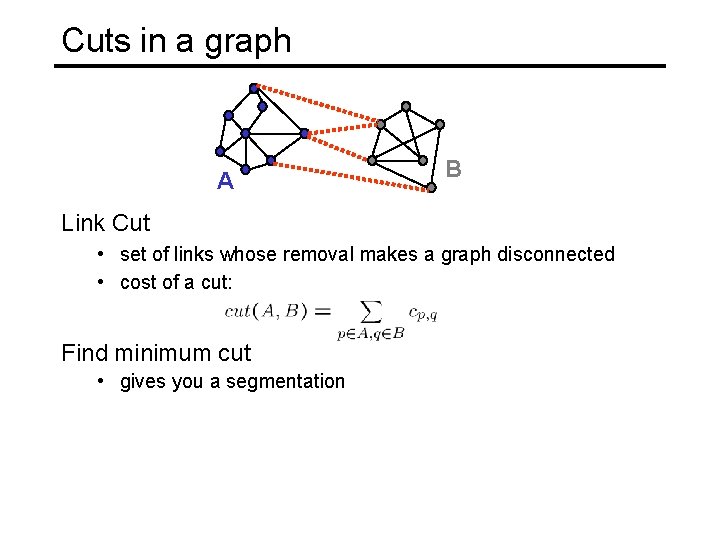
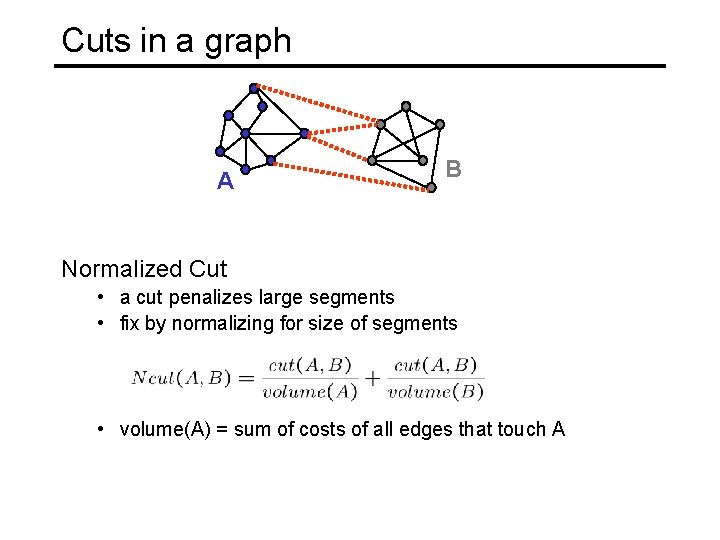
Cuts in a graph A B Link Cut • set of links whose removal makes a graph disconnected • cost of a cut: Find minimum cut • gives you a segmentation
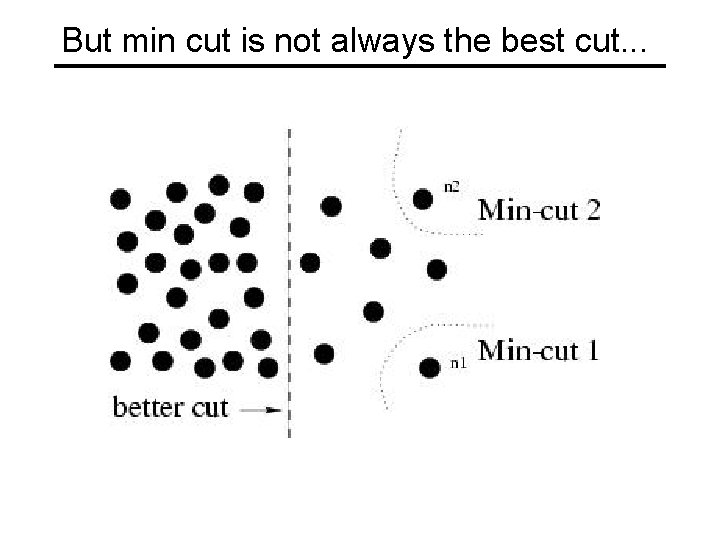
But min cut is not always the best cut. . .
Cuts in a graph A B Normalized Cut • a cut penalizes large segments • fix by normalizing for size of segments • volume(A) = sum of costs of all edges that touch A
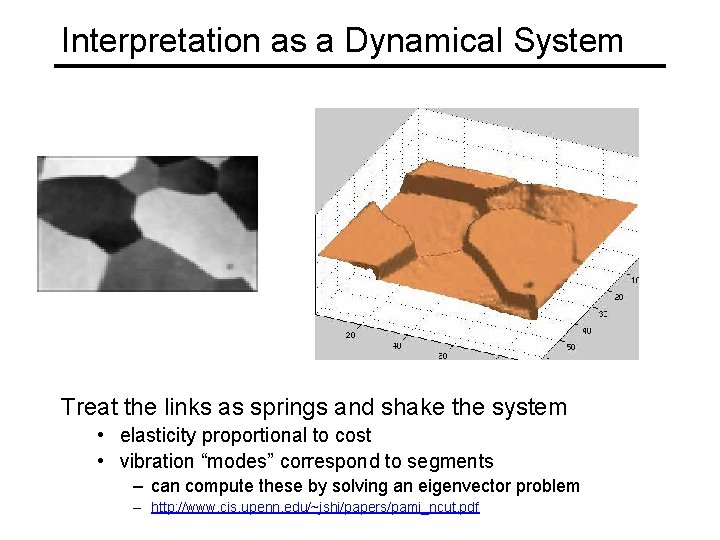
Interpretation as a Dynamical System Treat the links as springs and shake the system • elasticity proportional to cost • vibration “modes” correspond to segments – can compute these by solving an eigenvector problem – http: //www. cis. upenn. edu/~jshi/papers/pami_ncut. pdf
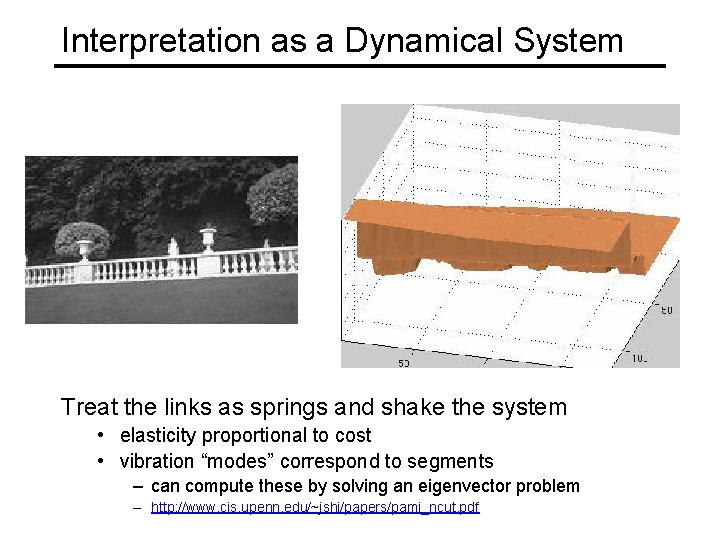
Interpretation as a Dynamical System Treat the links as springs and shake the system • elasticity proportional to cost • vibration “modes” correspond to segments – can compute these by solving an eigenvector problem – http: //www. cis. upenn. edu/~jshi/papers/pami_ncut. pdf
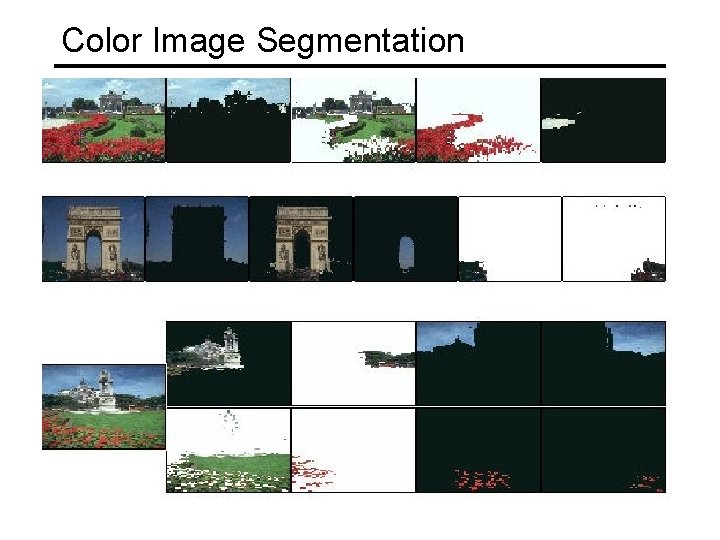
Color Image Segmentation
Questions?