
Interpolation Prof Noah Snavely CS 1114 http www





- Slides: 33
Interpolation Prof. Noah Snavely CS 1114 http: //www. cs. cornell. edu/courses/cs 1114
Administrivia § Assignment 3 due tomorrow by 5 pm – Please sign up for a demo slot § Assignment 4 will be posted tomorrow evening § Quiz 3 next Thursday 2
Today: back to images § This photo is too small: § Might need this forensics: http: //www. youtube. com/watch? v=3 uo. M 5 kf. ZIQ 0 3
Zooming § First consider a black and white image (one intensity value per pixel) § We want to blow it up to poster size (say, zoom in by a factor of 16) § First try: repeat each row 16 times, then repeat each column 16 times 4
Zooming: First attempt 5
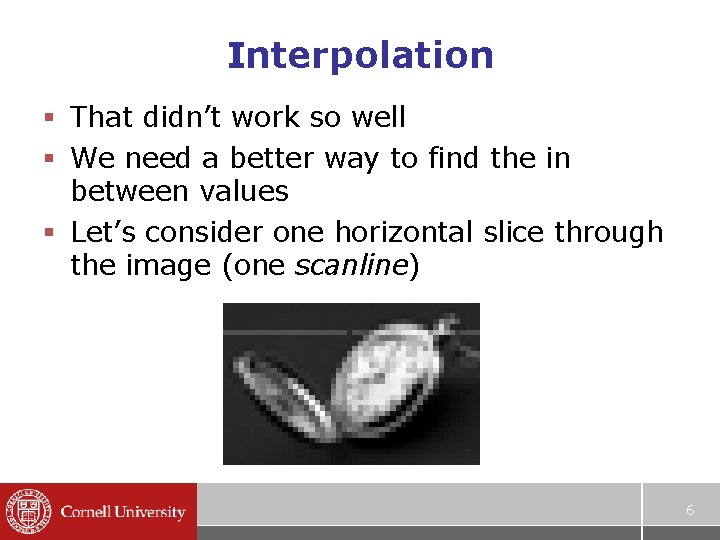
Interpolation § That didn’t work so well § We need a better way to find the in between values § Let’s consider one horizontal slice through the image (one scanline) 6
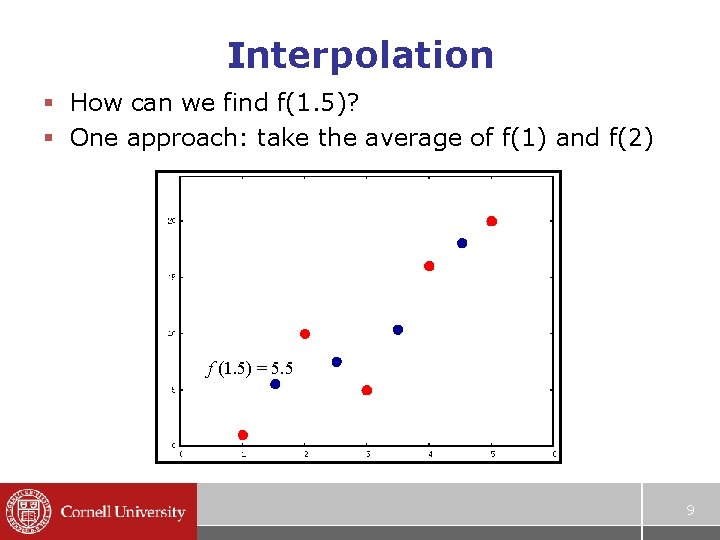
Interpolation § Problem statement: § We are given the values of a function f at a few locations, e. g. , f(1), f(2), f(3), … § Want to find the rest of the values – What is f(1. 5)? § This is called interpolation § We need some kind of model that predicts how the function behaves 7
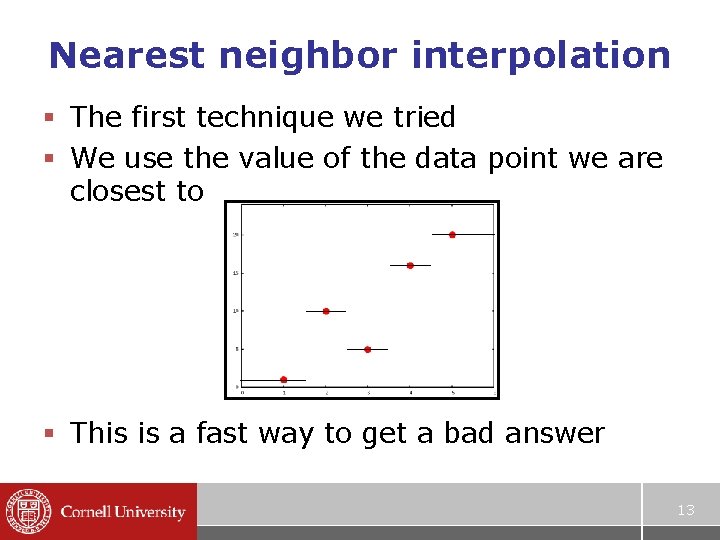
Interpolation § Example: f(1) = 1, f(2) = 10, f(3) = 5 , f(4) = 16, f(5) = 20 8
Interpolation § How can we find f(1. 5)? § One approach: take the average of f(1) and f(2) f (1. 5) = 5. 5 9
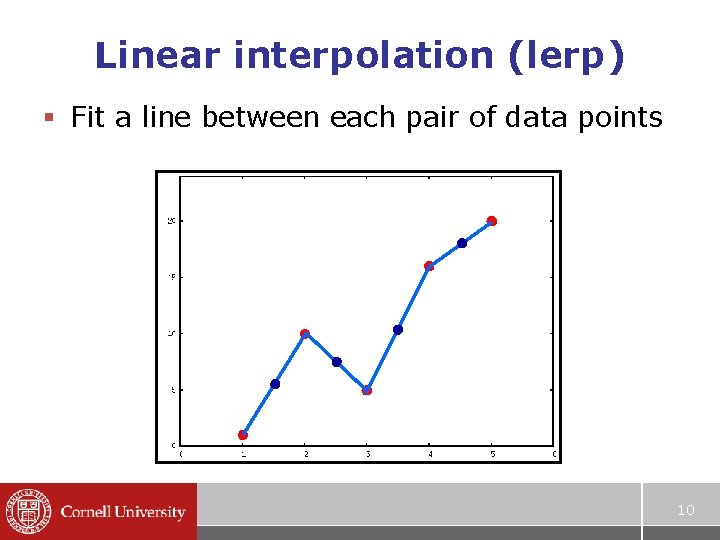
Linear interpolation (lerp) § Fit a line between each pair of data points 10
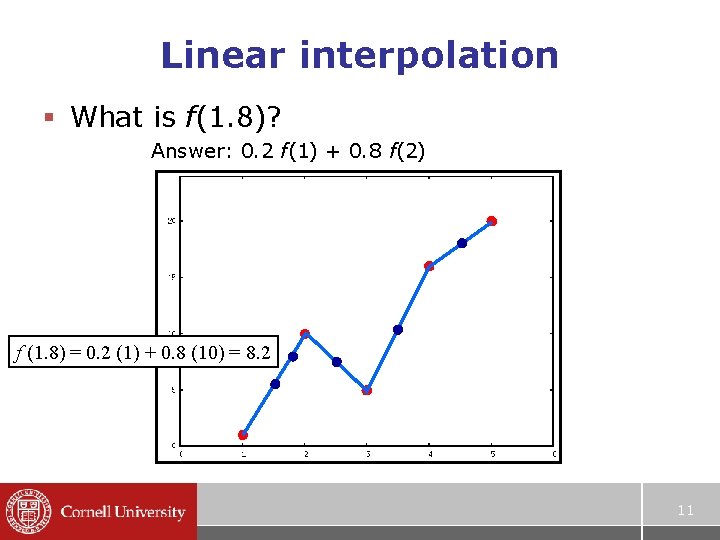
Linear interpolation § What is f(1. 8)? Answer: 0. 2 f(1) + 0. 8 f(2) f (1. 8) = 0. 2 (1) + 0. 8 (10) = 8. 2 11
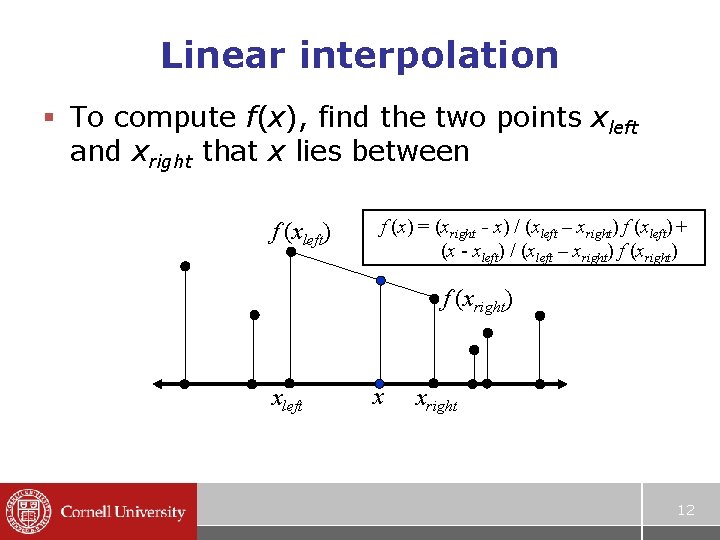
Linear interpolation § To compute f(x), find the two points xleft and xright that x lies between f (xleft) f (x) = (xright - x) / (xleft – xright) f (xleft) + (x - xleft) / (xleft – xright) f (xright) xleft x xright 12
Nearest neighbor interpolation § The first technique we tried § We use the value of the data point we are closest to § This is a fast way to get a bad answer 13
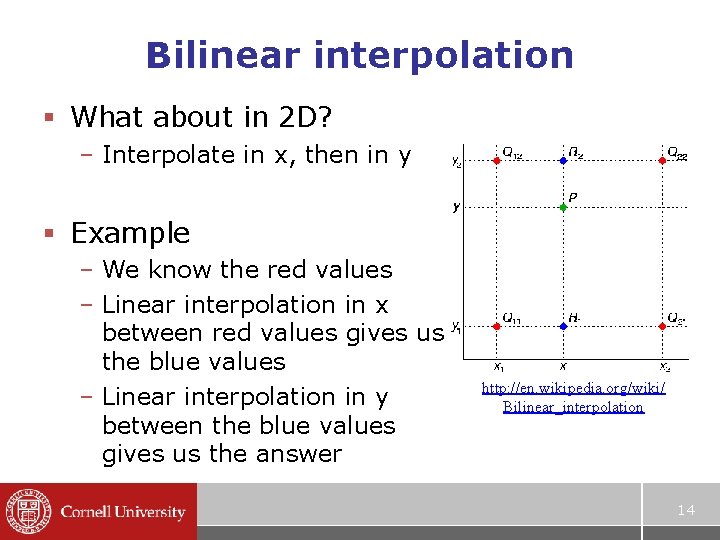
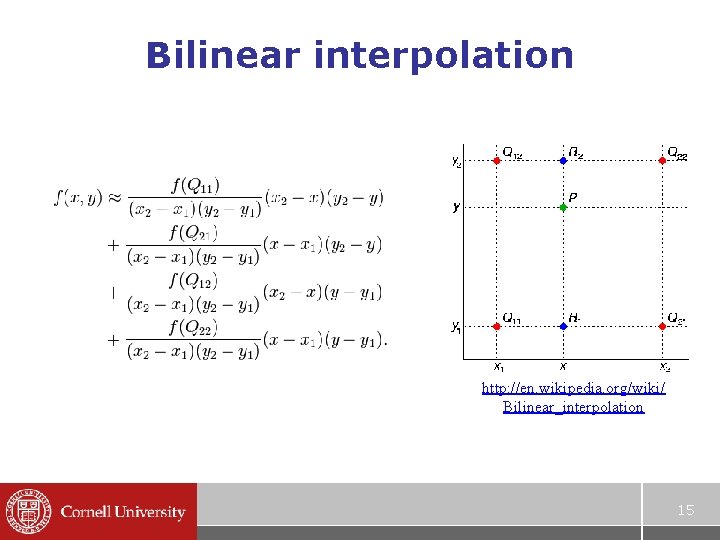
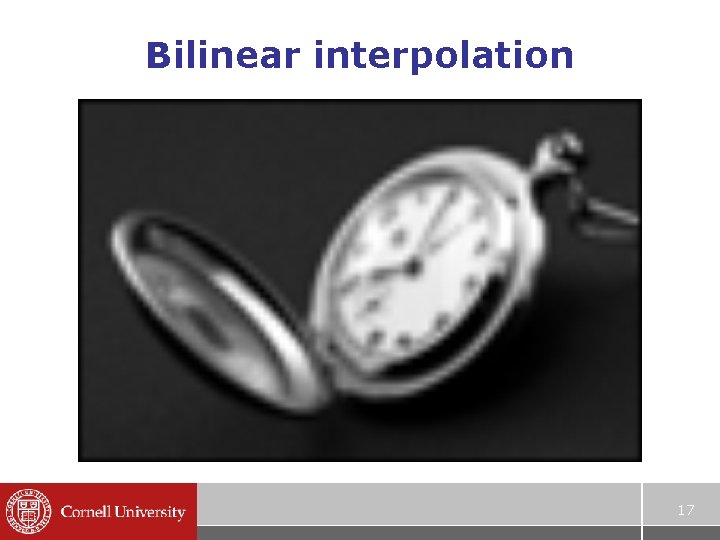
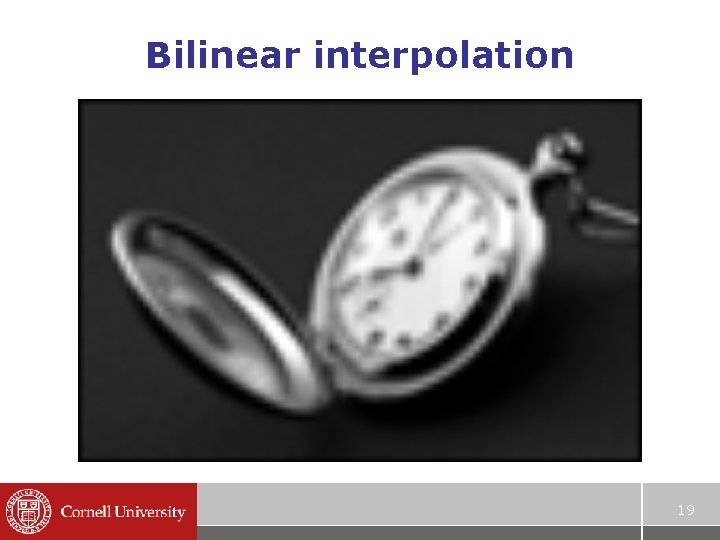
Bilinear interpolation § What about in 2 D? – Interpolate in x, then in y § Example – We know the red values – Linear interpolation in x between red values gives us the blue values – Linear interpolation in y between the blue values gives us the answer http: //en. wikipedia. org/wiki/ Bilinear_interpolation 14
Bilinear interpolation http: //en. wikipedia. org/wiki/ Bilinear_interpolation 15
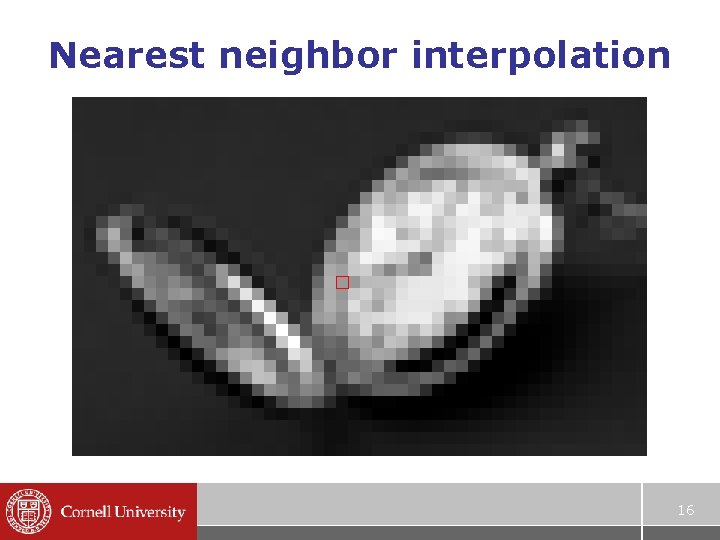
Nearest neighbor interpolation 16
Bilinear interpolation 17
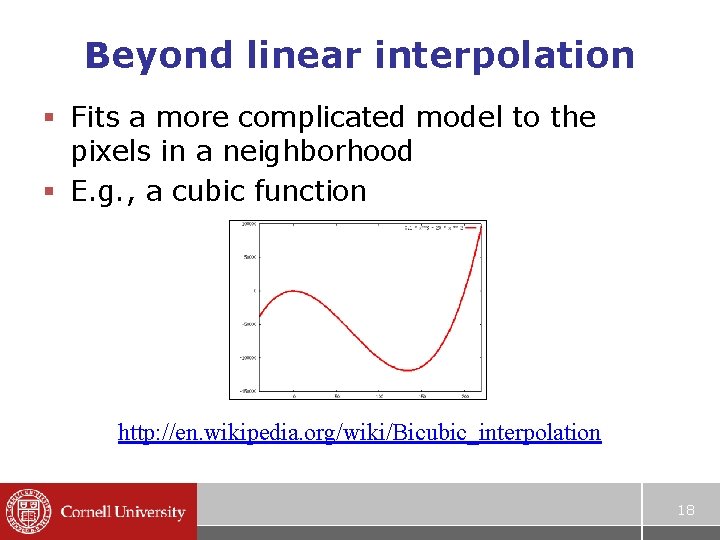
Beyond linear interpolation § Fits a more complicated model to the pixels in a neighborhood § E. g. , a cubic function http: //en. wikipedia. org/wiki/Bicubic_interpolation 18
Bilinear interpolation 19
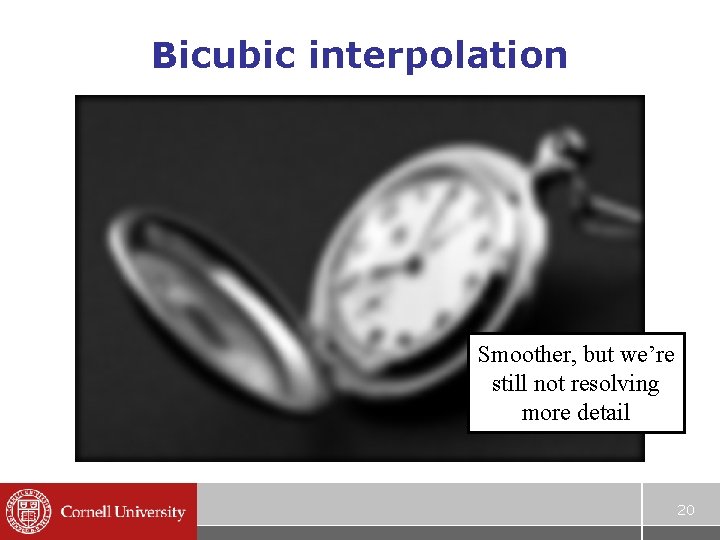
Bicubic interpolation Smoother, but we’re still not resolving more detail 20
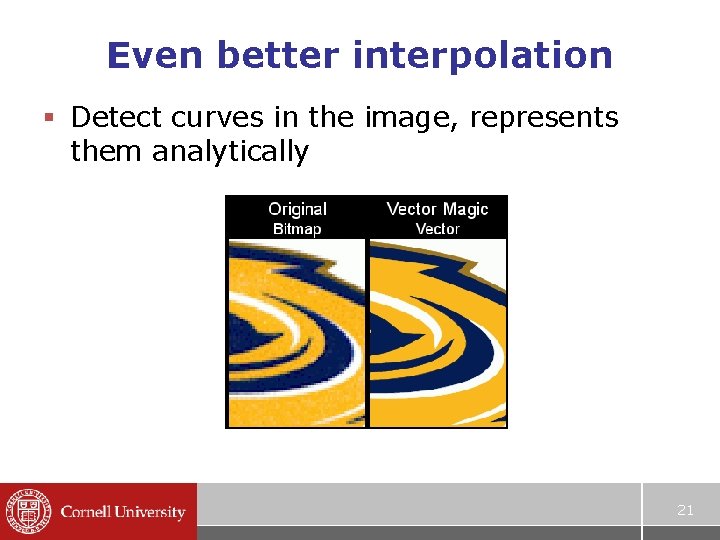
Even better interpolation § Detect curves in the image, represents them analytically 21
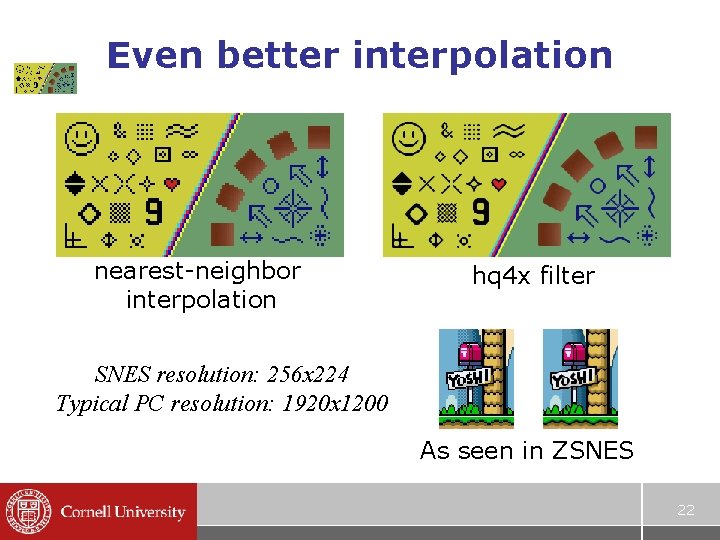
Even better interpolation nearest-neighbor interpolation hq 4 x filter SNES resolution: 256 x 224 Typical PC resolution: 1920 x 1200 As seen in ZSNES 22
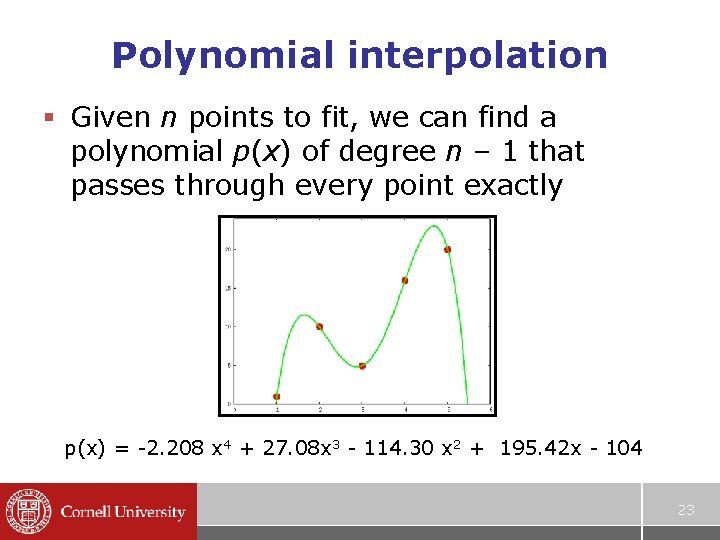
Polynomial interpolation § Given n points to fit, we can find a polynomial p(x) of degree n – 1 that passes through every point exactly p(x) = -2. 208 x 4 + 27. 08 x 3 - 114. 30 x 2 + 195. 42 x - 104 23
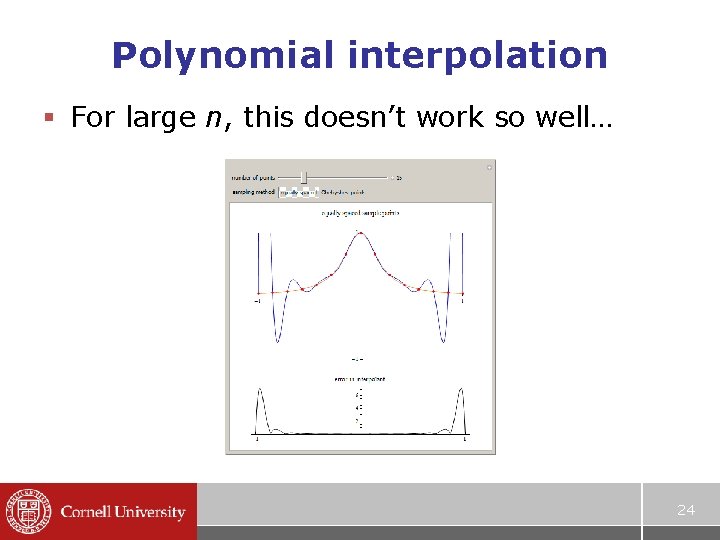
Polynomial interpolation § For large n, this doesn’t work so well… 24
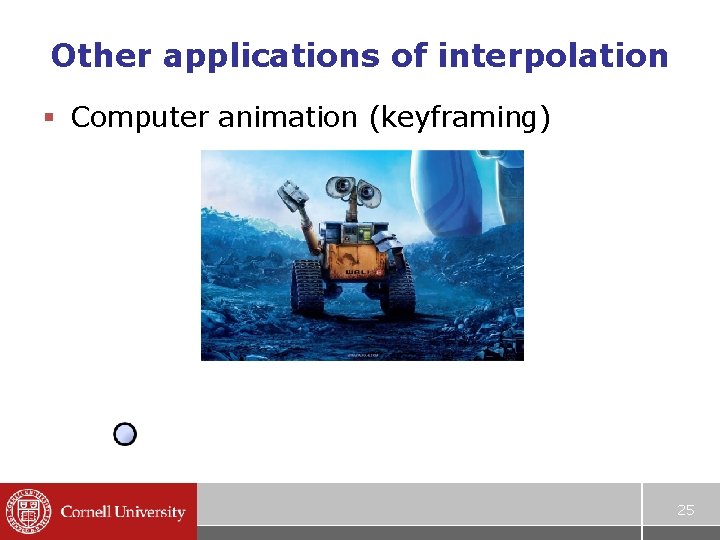
Other applications of interpolation § Computer animation (keyframing) 25
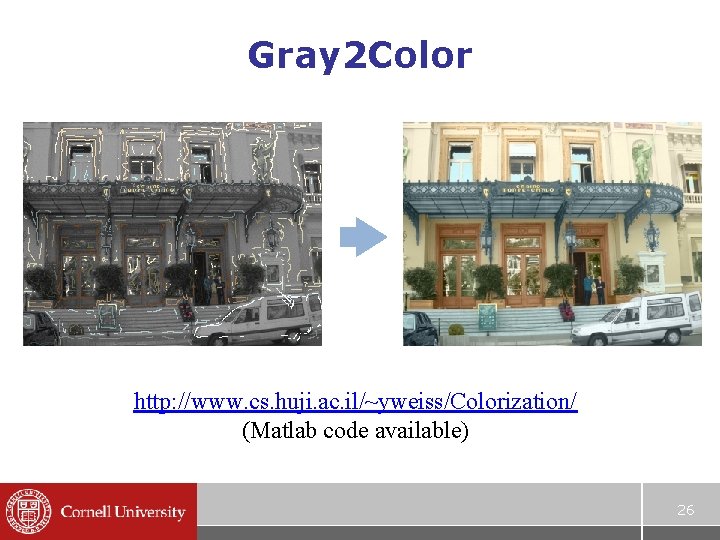
Gray 2 Color http: //www. cs. huji. ac. il/~yweiss/Colorization/ (Matlab code available) 26
Limits of interpolation § Can you prove that it is impossible to interpolate correctly? § Suppose I claim to have a correct way to produce an image with 4 x as many pixels – Correct, in this context, means that it gives what a better camera would have captured – Can you prove this cannot work? § Related to impossibility of compression 27
Example algorithm that can’t exist § Consider a compression algorithm, like zip – Take a file F, produce a smaller version F’ – Given F’, we can uncompress to recover F – This is lossless compression, because we can “invert” it • MP 3, JPEG, MPEG, etc. are not lossless § Claim: there is no such algorithm that always produces a smaller file F’ for every input file F 28
Proof of claim (by contradiction) § Pick a file F, produce F’ by compression – F’ is smaller than F, by assumption § Now run compression on F’ – Get an even smaller file, F’’ § At the end, you’ve got a file with only a single byte (a number from 0 to 255) – Yet by repeatedly uncompressing this you can eventually get F § However, there are more than 256 different files F that you could start with! 29
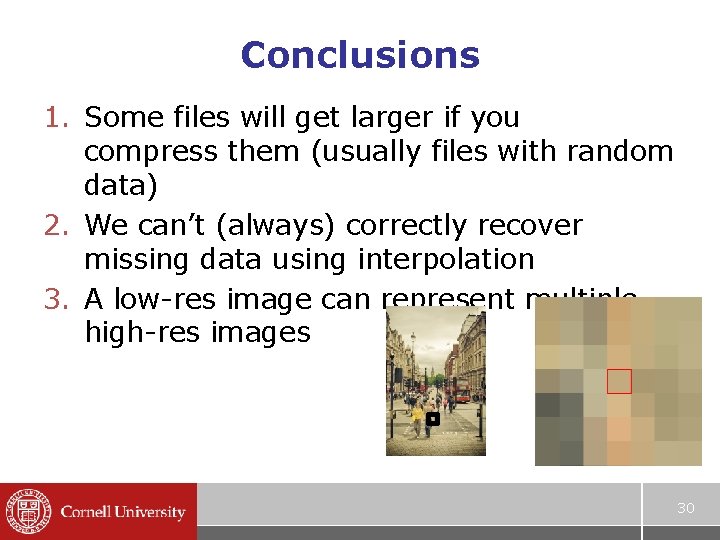
Conclusions 1. Some files will get larger if you compress them (usually files with random data) 2. We can’t (always) correctly recover missing data using interpolation 3. A low-res image can represent multiple high-res images 30
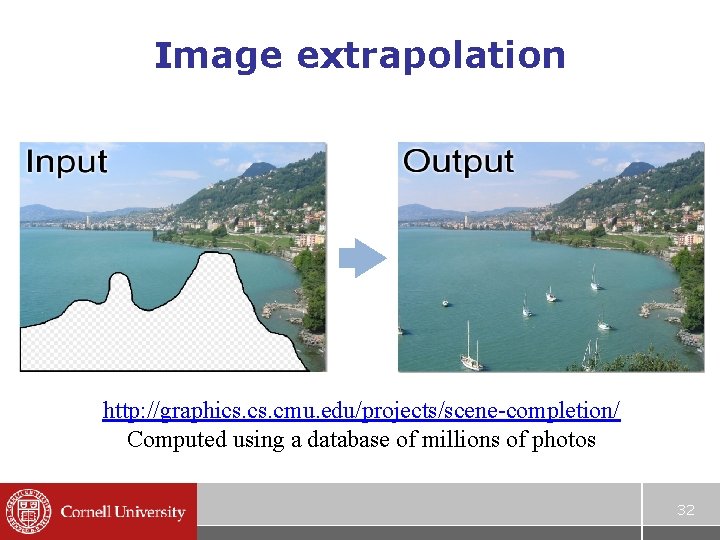
Extrapolation § Suppose you only know the values f(1), f(2), f(3), f(4) of a function – What is f(5)? § This problem is called extrapolation – Much harder than interpolation: what is outside the image? – For the particular case of temporal data, extrapolation is called prediction (what will the value of MSFT stock be tomorrow? ) – If you have a good model, this can work well 31
Image extrapolation http: //graphics. cmu. edu/projects/scene-completion/ Computed using a database of millions of photos 32
Questions? 33