
CS 4670 Computer Vision Noah Snavely Lecture 14



- Slides: 37
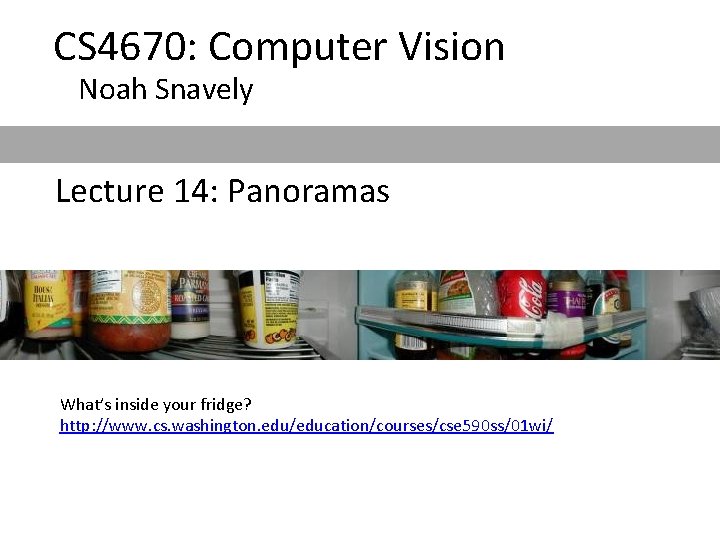
CS 4670: Computer Vision Noah Snavely Lecture 14: Panoramas What’s inside your fridge? http: //www. cs. washington. edu/education/courses/cse 590 ss/01 wi/
Reading • Szeliski Chapter 9
Announcements • Project 2 a due today, 8: 59 pm • Project 2 b out today • Take-home prelim after Fall break
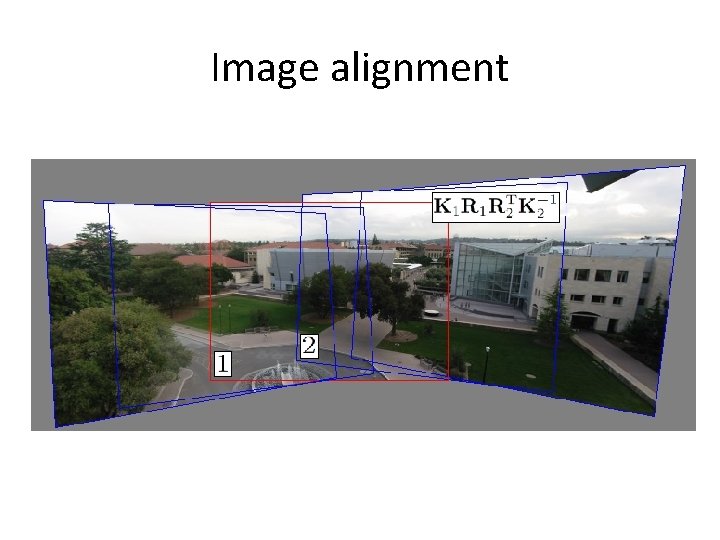
Image alignment
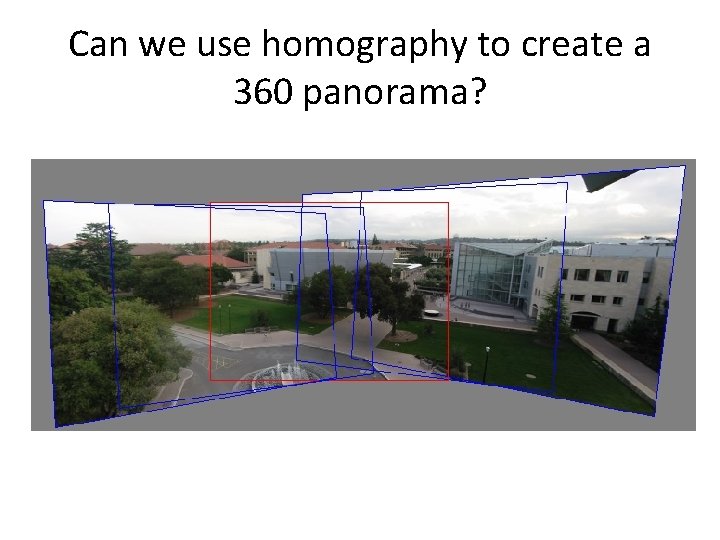
Can we use homography to create a 360 panorama?
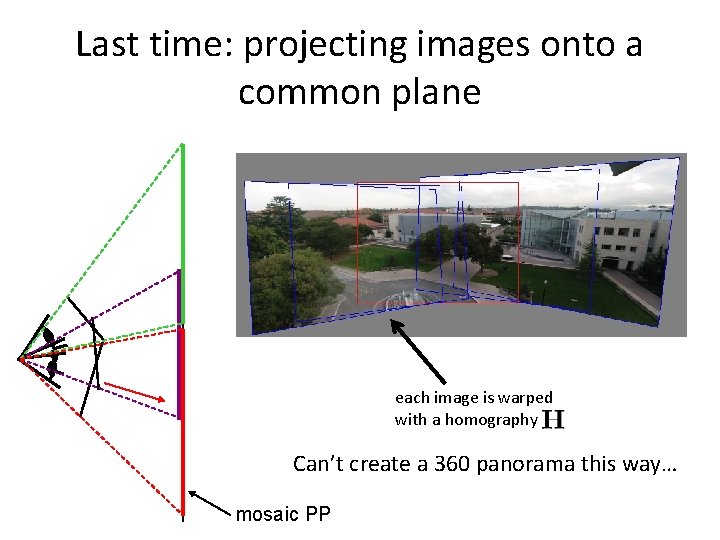
Last time: projecting images onto a common plane each image is warped with a homography Can’t create a 360 panorama this way… mosaic PP
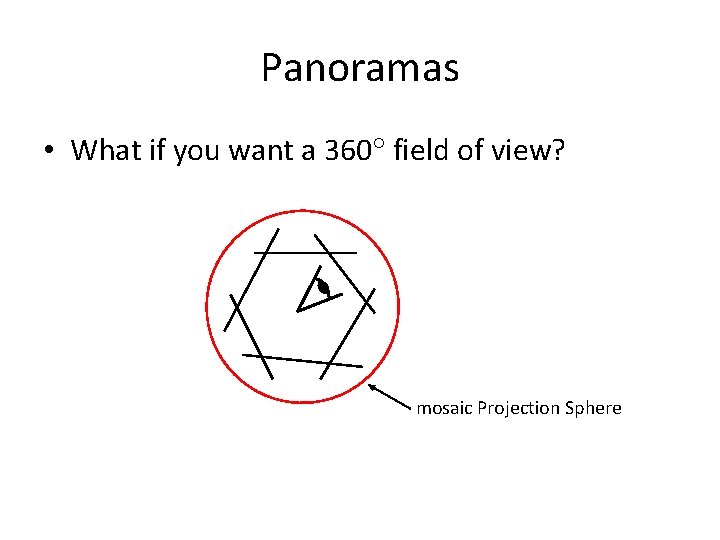
Panoramas • What if you want a 360 field of view? mosaic Projection Sphere
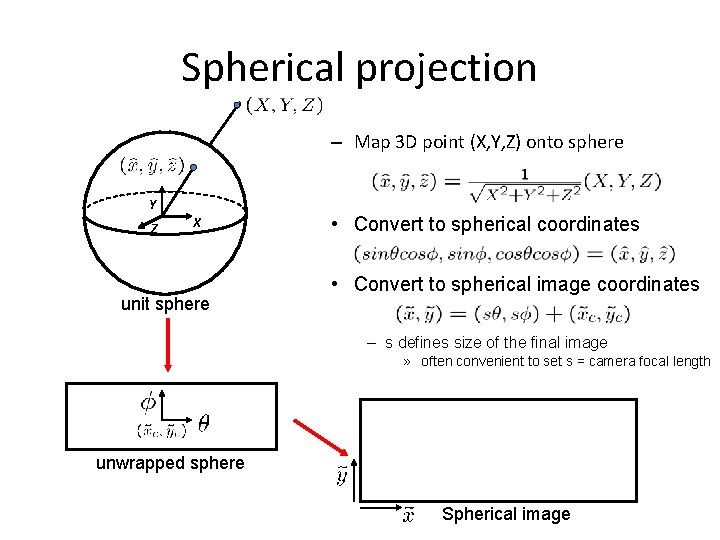
Spherical projection – Map 3 D point (X, Y, Z) onto sphere Y Z X unit sphere • Convert to spherical coordinates • Convert to spherical image coordinates – s defines size of the final image » often convenient to set s = camera focal length unwrapped sphere Spherical image
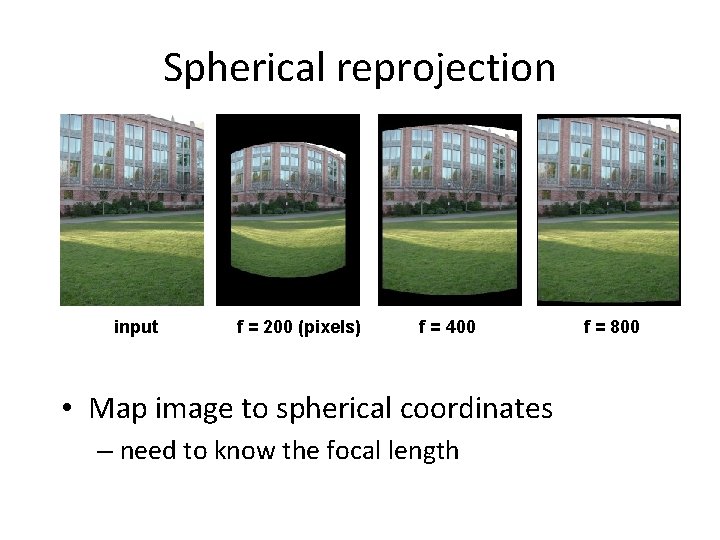
Spherical reprojection input f = 200 (pixels) f = 400 • Map image to spherical coordinates – need to know the focal length f = 800
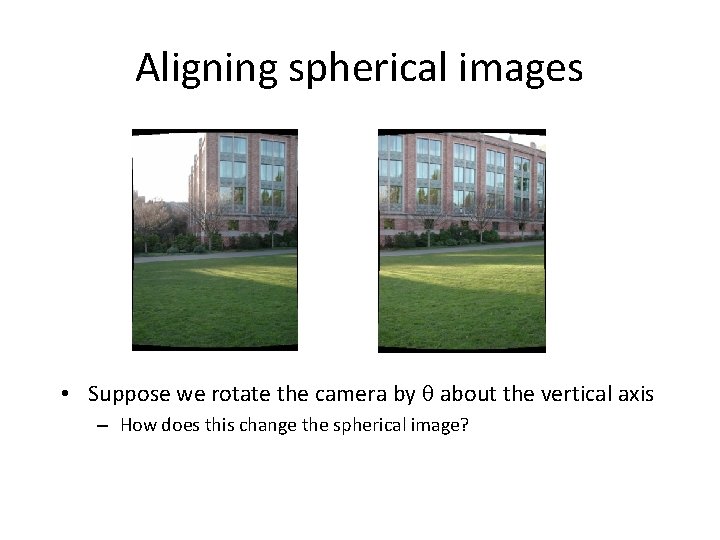
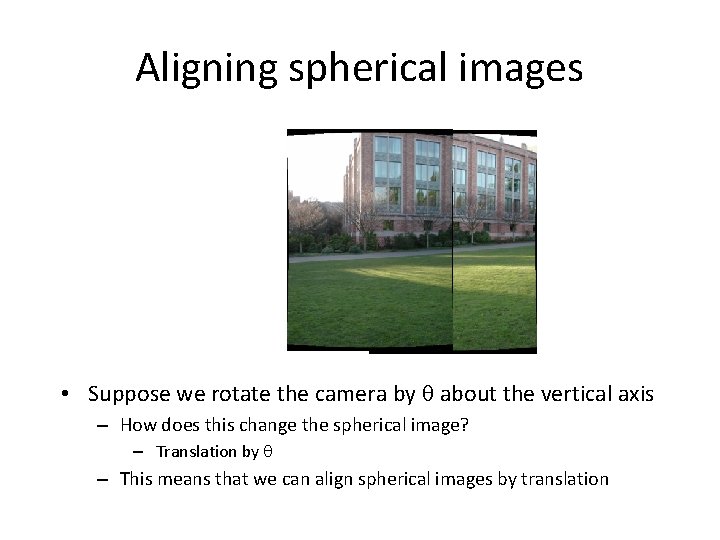
Aligning spherical images • Suppose we rotate the camera by about the vertical axis – How does this change the spherical image?
Aligning spherical images • Suppose we rotate the camera by about the vertical axis – How does this change the spherical image? – Translation by – This means that we can align spherical images by translation
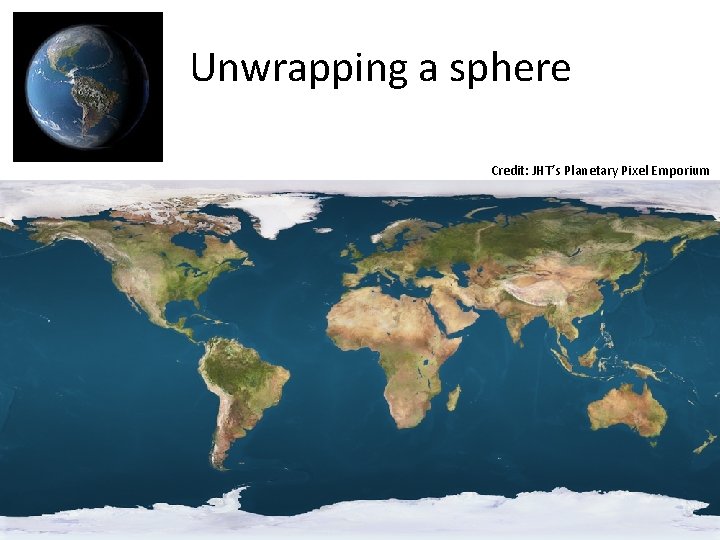
Unwrapping a sphere Credit: JHT’s Planetary Pixel Emporium
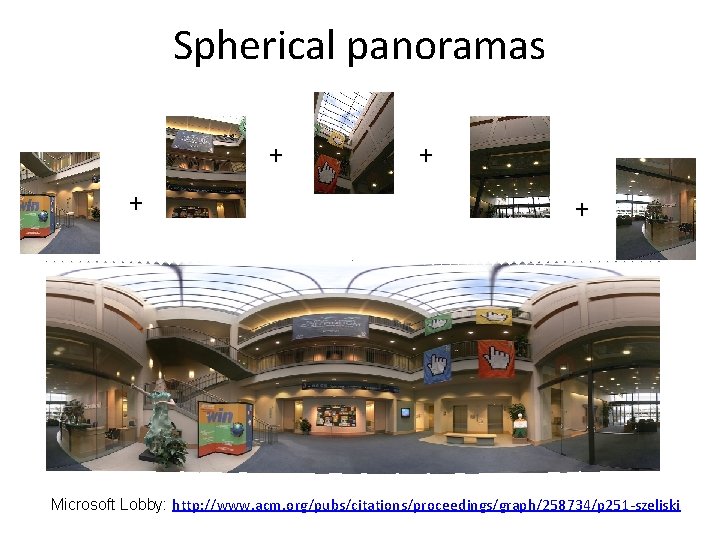
Spherical panoramas + + Microsoft Lobby: http: //www. acm. org/pubs/citations/proceedings/graph/258734/p 251 -szeliski
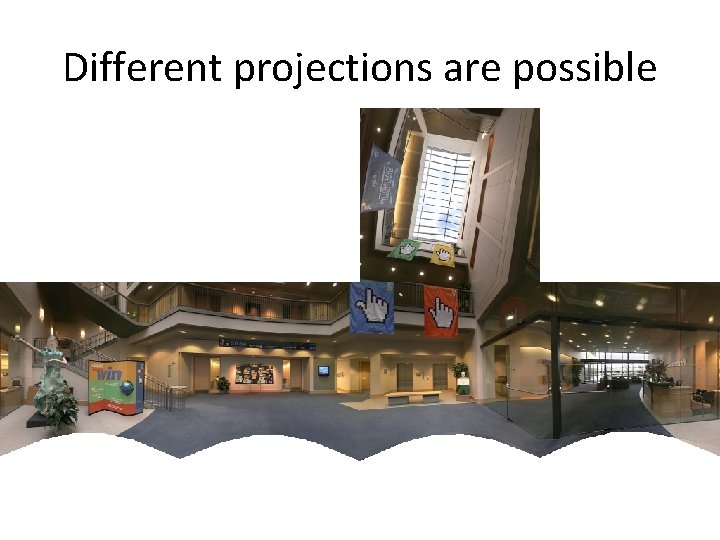
Different projections are possible
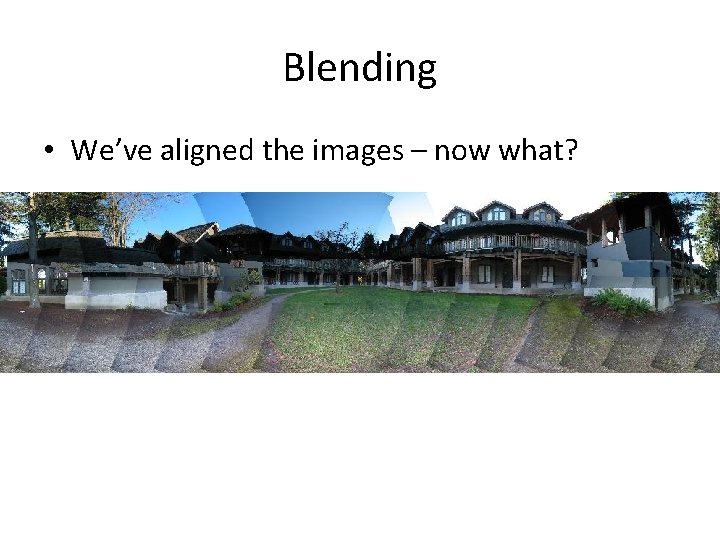
Blending • We’ve aligned the images – now what?
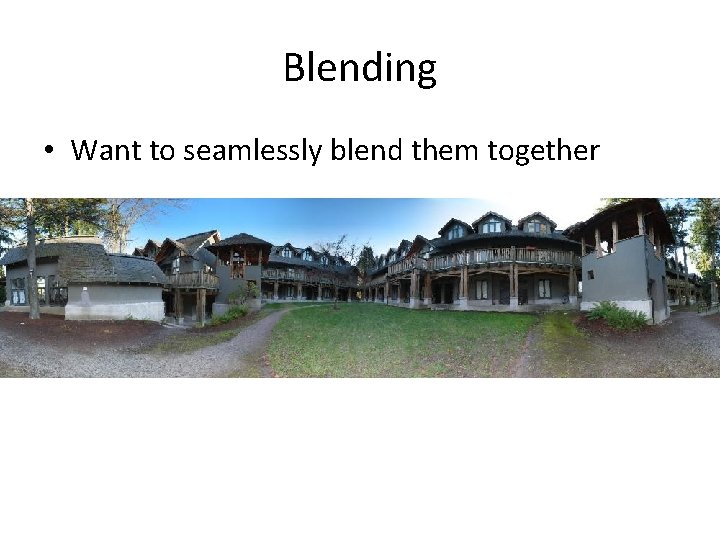
Blending • Want to seamlessly blend them together
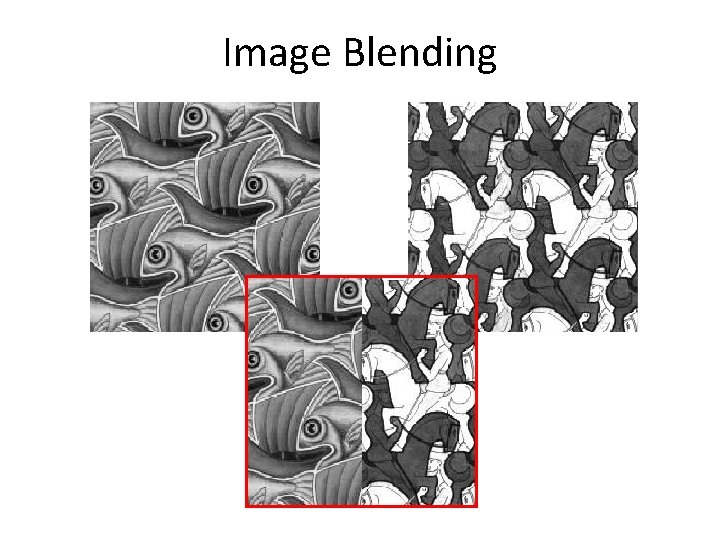
Image Blending
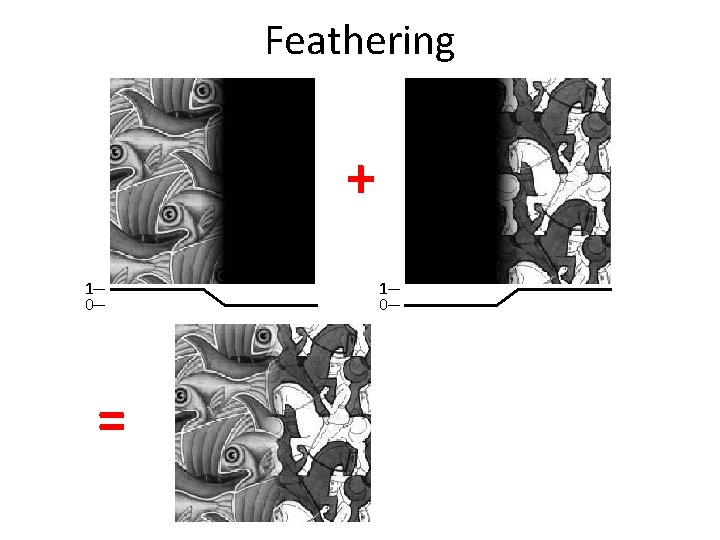
Feathering + 1 0 =
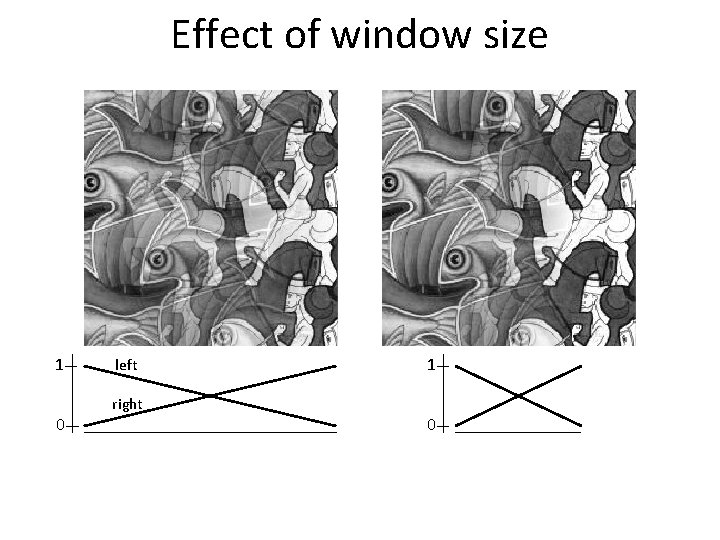
Effect of window size 1 0 left right 1 0
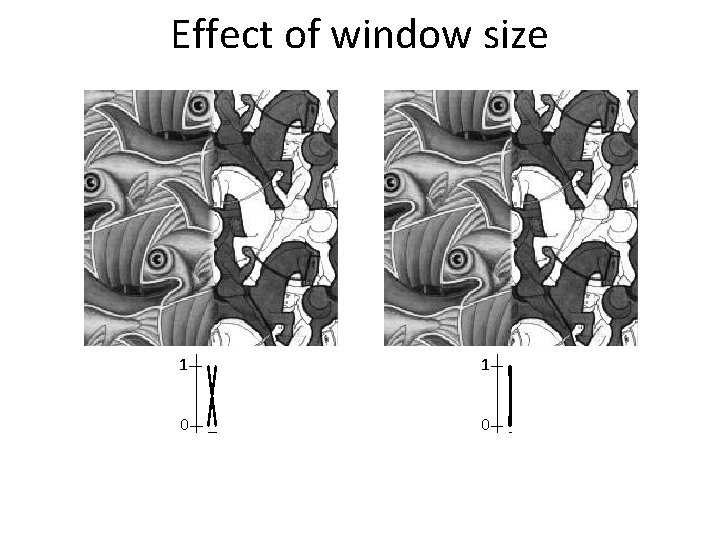
Effect of window size 1 1 0 0
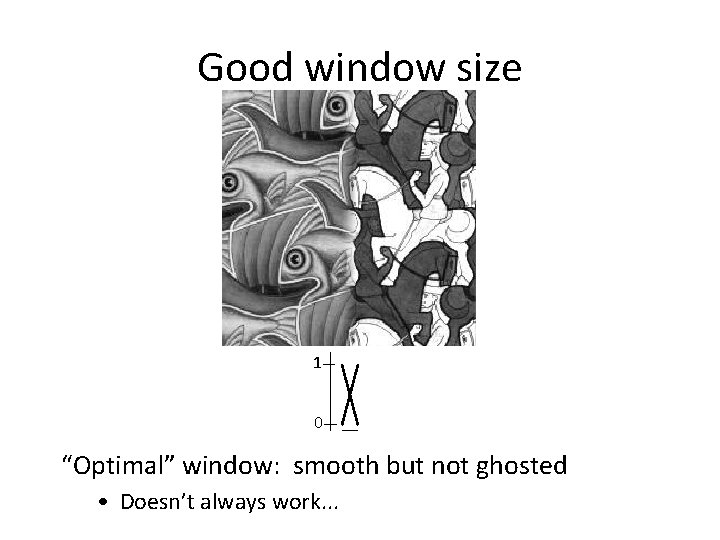
Good window size 1 0 “Optimal” window: smooth but not ghosted • Doesn’t always work. . .
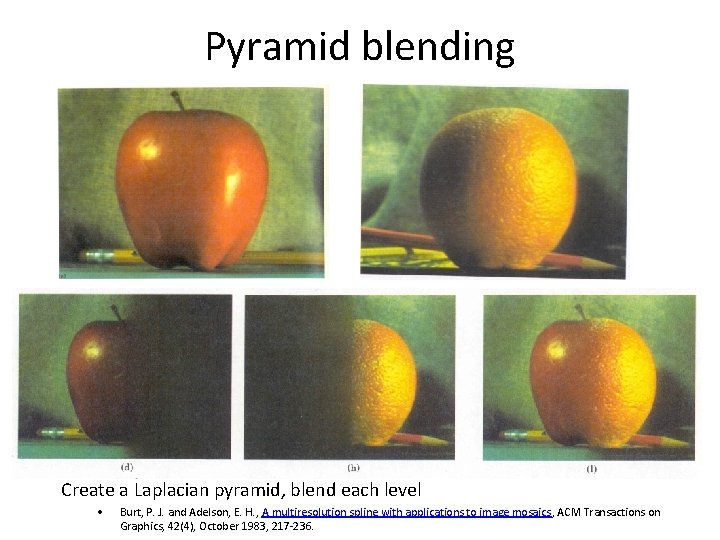
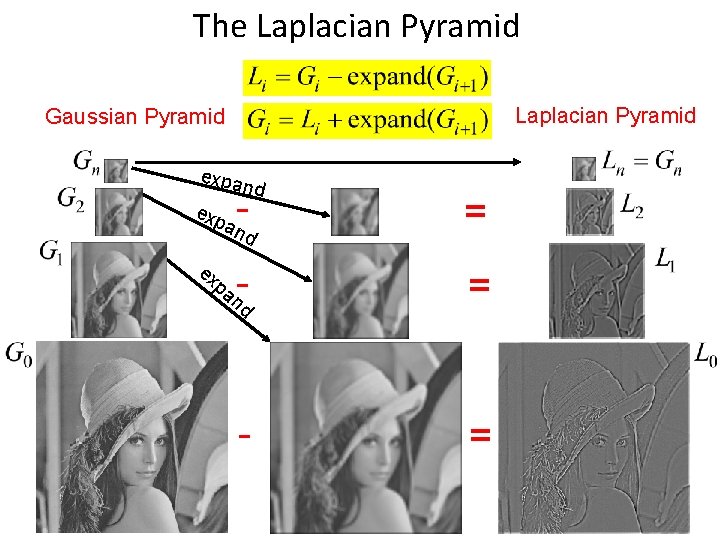
Pyramid blending Create a Laplacian pyramid, blend each level • Burt, P. J. and Adelson, E. H. , A multiresolution spline with applications to image mosaics, ACM Transactions on Graphics, 42(4), October 1983, 217 -236.
The Laplacian Pyramid Gaussian Pyramid expa n exp ex - d an = nd - = pa d
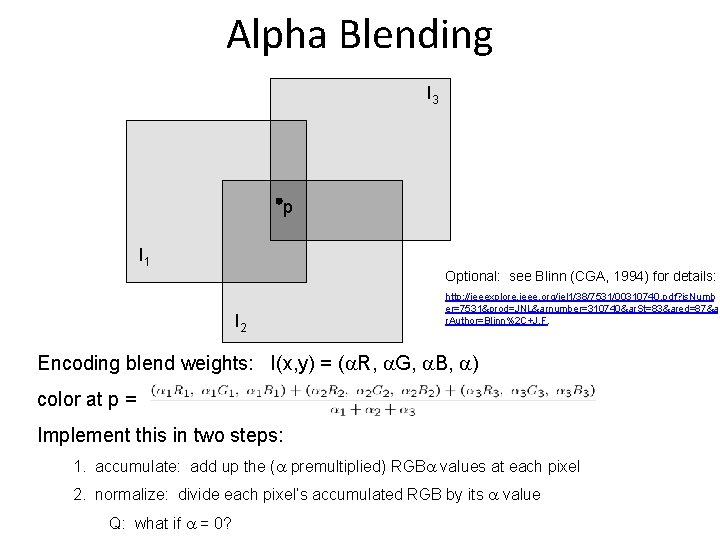
Alpha Blending I 3 p I 1 Optional: see Blinn (CGA, 1994) for details: I 2 http: //ieeexplore. ieee. org/iel 1/38/7531/00310740. pdf? is. Numb er=7531&prod=JNL&arnumber=310740&ar. St=83&ared=87&a r. Author=Blinn%2 C+J. F. Encoding blend weights: I(x, y) = ( R, G, B, ) color at p = Implement this in two steps: 1. accumulate: add up the ( premultiplied) RGB values at each pixel 2. normalize: divide each pixel’s accumulated RGB by its value Q: what if = 0?
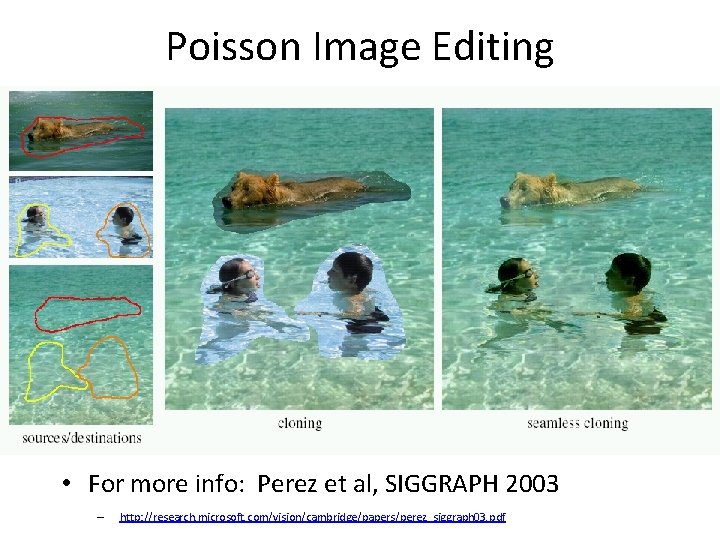
Poisson Image Editing • For more info: Perez et al, SIGGRAPH 2003 – http: //research. microsoft. com/vision/cambridge/papers/perez_siggraph 03. pdf
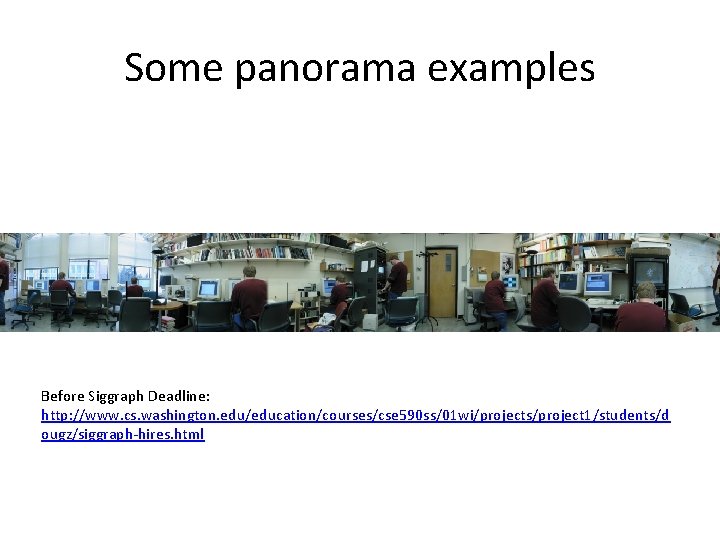
Some panorama examples Before Siggraph Deadline: http: //www. cs. washington. edu/education/courses/cse 590 ss/01 wi/projects/project 1/students/d ougz/siggraph-hires. html
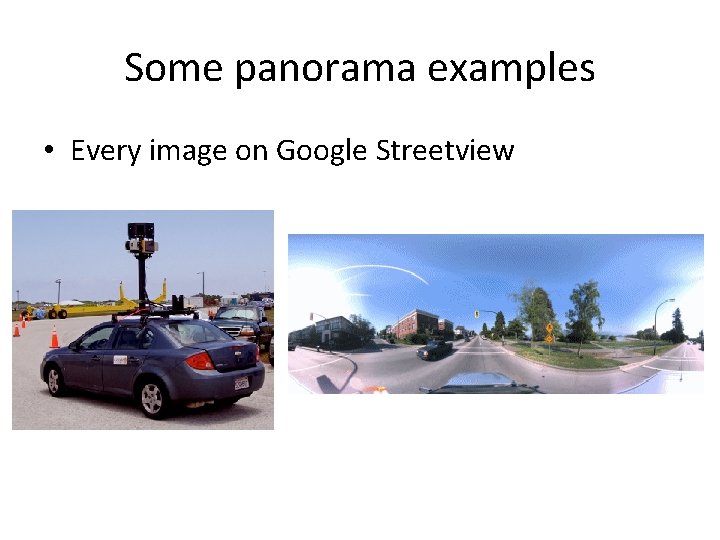
Some panorama examples • Every image on Google Streetview
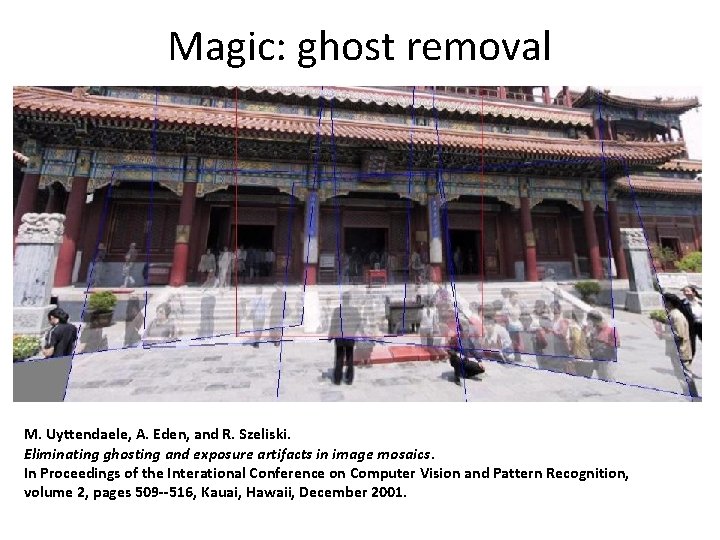
Magic: ghost removal M. Uyttendaele, A. Eden, and R. Szeliski. Eliminating ghosting and exposure artifacts in image mosaics. In Proceedings of the Interational Conference on Computer Vision and Pattern Recognition, volume 2, pages 509 --516, Kauai, Hawaii, December 2001.
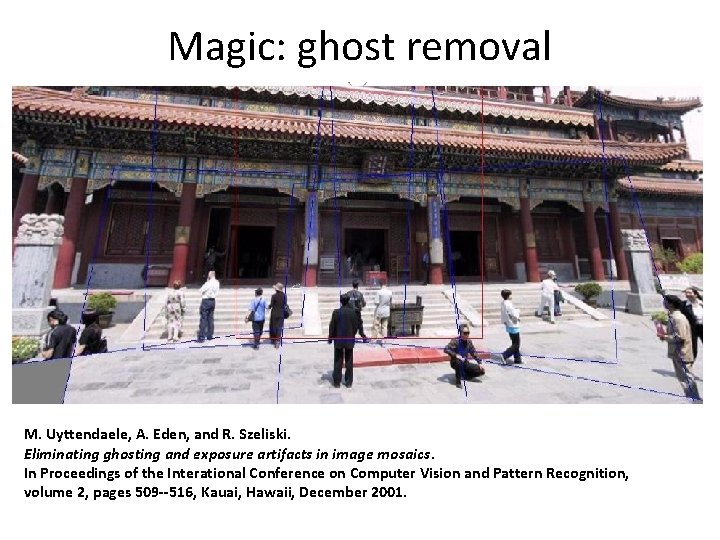
Magic: ghost removal M. Uyttendaele, A. Eden, and R. Szeliski. Eliminating ghosting and exposure artifacts in image mosaics. In Proceedings of the Interational Conference on Computer Vision and Pattern Recognition, volume 2, pages 509 --516, Kauai, Hawaii, December 2001.
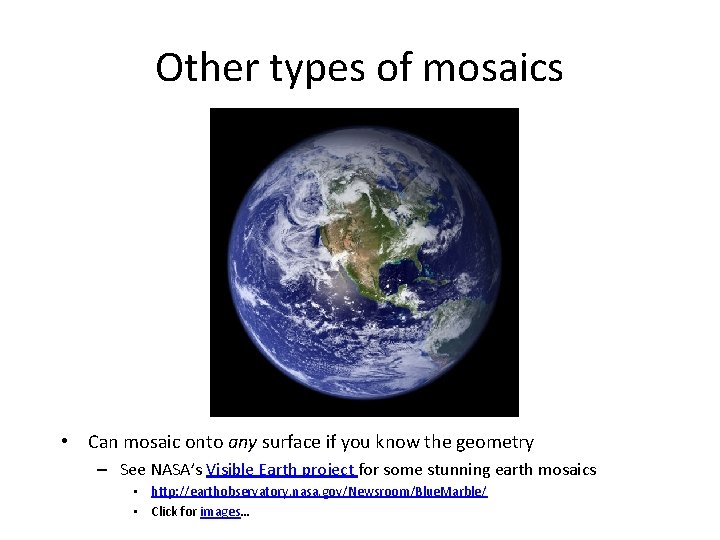
Other types of mosaics • Can mosaic onto any surface if you know the geometry – See NASA’s Visible Earth project for some stunning earth mosaics • http: //earthobservatory. nasa. gov/Newsroom/Blue. Marble/ • Click for images…
Questions?
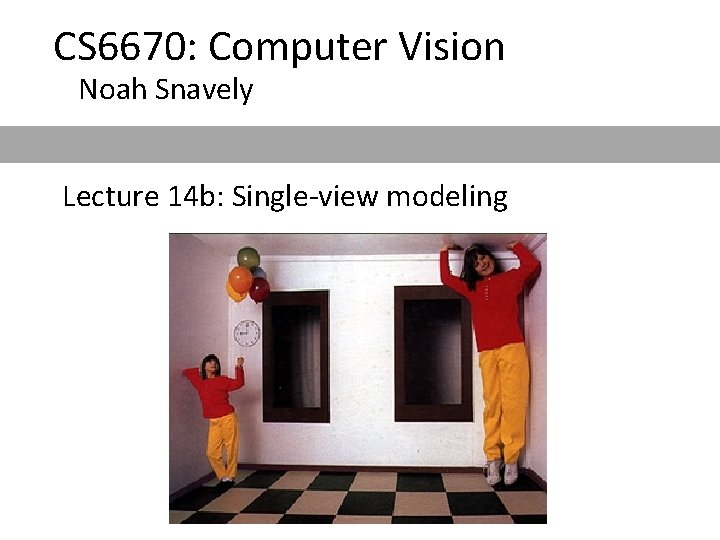
CS 6670: Computer Vision Noah Snavely Lecture 14 b: Single-view modeling
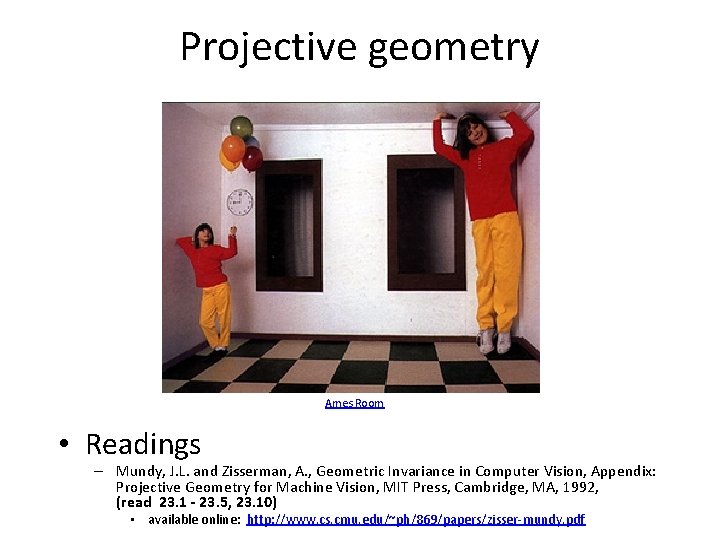
Projective geometry Ames Room • Readings – Mundy, J. L. and Zisserman, A. , Geometric Invariance in Computer Vision, Appendix: Projective Geometry for Machine Vision, MIT Press, Cambridge, MA, 1992, (read 23. 1 - 23. 5, 23. 10) • available online: http: //www. cs. cmu. edu/~ph/869/papers/zisser-mundy. pdf
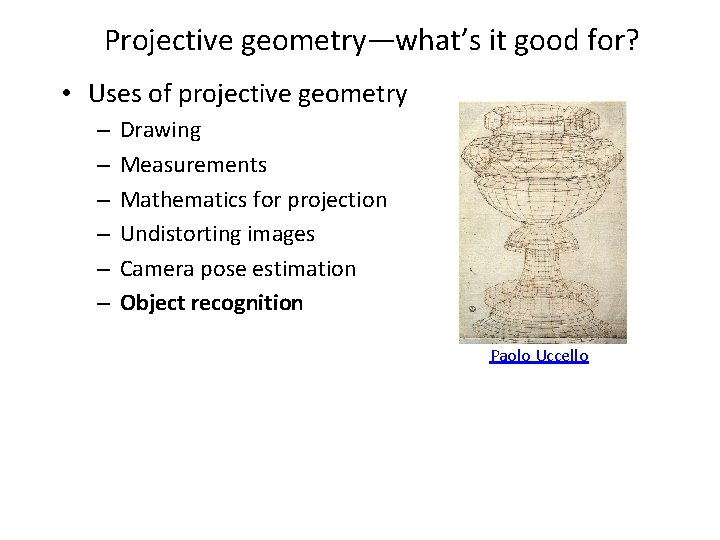
Projective geometry—what’s it good for? • Uses of projective geometry – – – Drawing Measurements Mathematics for projection Undistorting images Camera pose estimation Object recognition Paolo Uccello
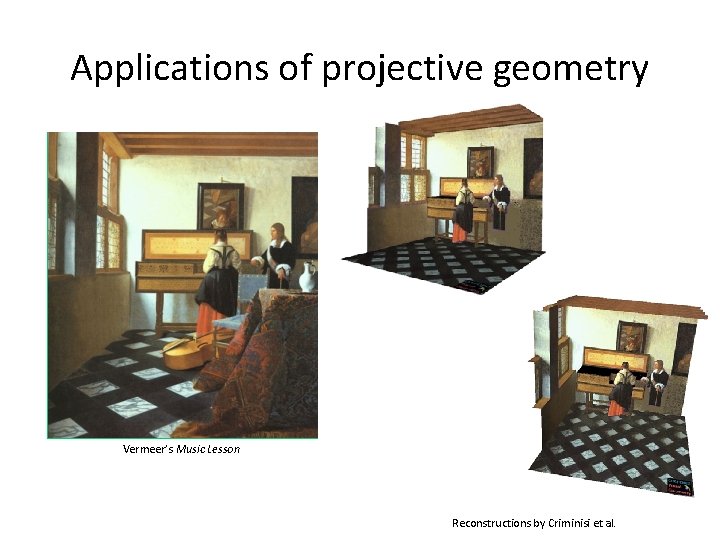
Applications of projective geometry Vermeer’s Music Lesson Reconstructions by Criminisi et al.
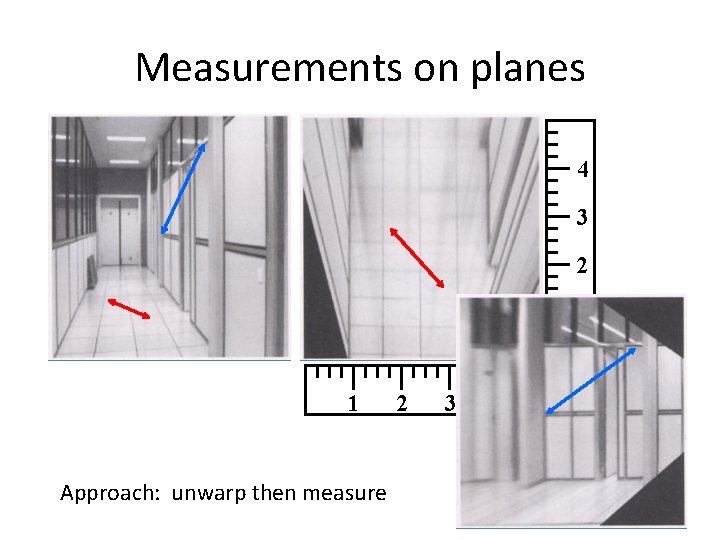
Measurements on planes 4 3 2 1 1 Approach: unwarp then measure 2 3 4
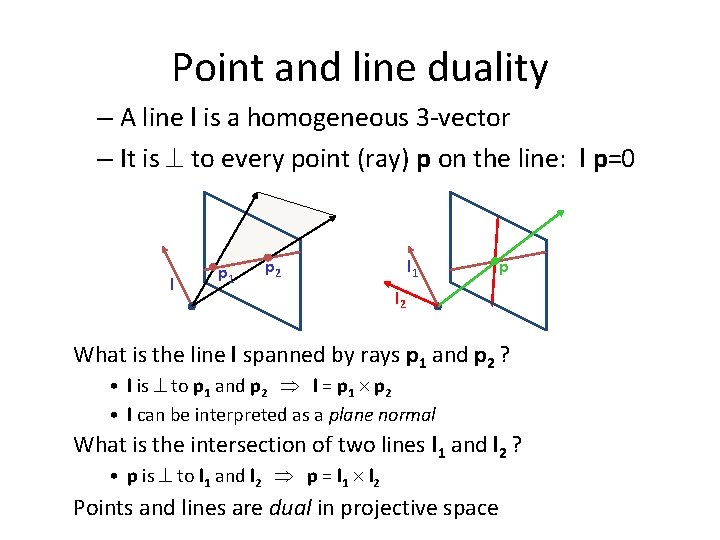
Point and line duality – A line l is a homogeneous 3 -vector – It is to every point (ray) p on the line: l p=0 l p 1 p 2 l 1 p l 2 What is the line l spanned by rays p 1 and p 2 ? • l is to p 1 and p 2 l = p 1 p 2 • l can be interpreted as a plane normal What is the intersection of two lines l 1 and l 2 ? • p is to l 1 and l 2 p = l 1 l 2 Points and lines are dual in projective space