CS 440ECE 448 Lecture 15 Linear Classifiers Mark

- Slides: 38
CS 440/ECE 448 Lecture 15: Linear Classifiers Mark Hasegawa-Johnson, 3/2018 Including Slides by Svetlana Lazebnik, 10/2016
Linear Classifiers • Naïve Bayes/Bo. W classifiers • Linear Classifiers in General • Perceptron • Differential Perceptron/Neural Net
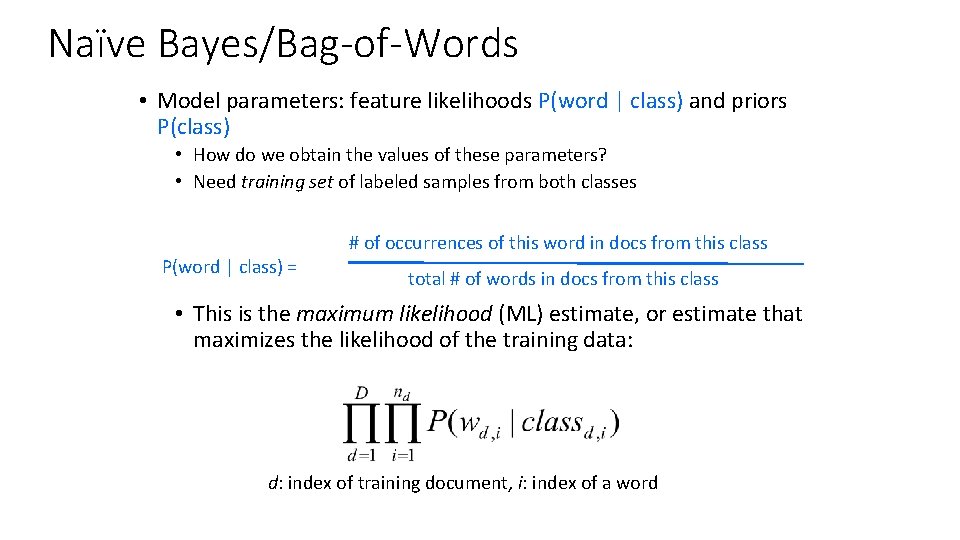
Naïve Bayes/Bag-of-Words • Model parameters: feature likelihoods P(word | class) and priors P(class) • How do we obtain the values of these parameters? • Need training set of labeled samples from both classes P(word | class) = # of occurrences of this word in docs from this class total # of words in docs from this class • This is the maximum likelihood (ML) estimate, or estimate that maximizes the likelihood of the training data: d: index of training document, i: index of a word
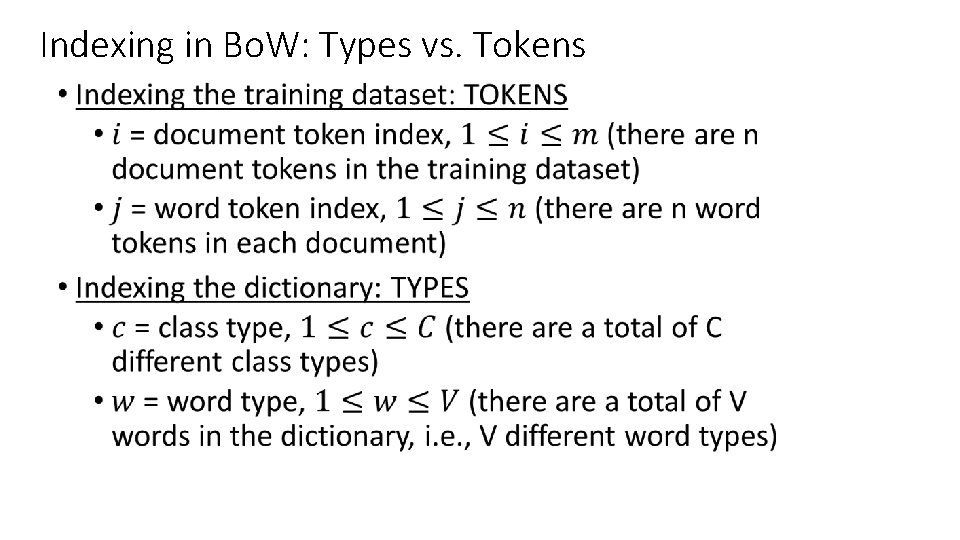
Indexing in Bo. W: Types vs. Tokens •
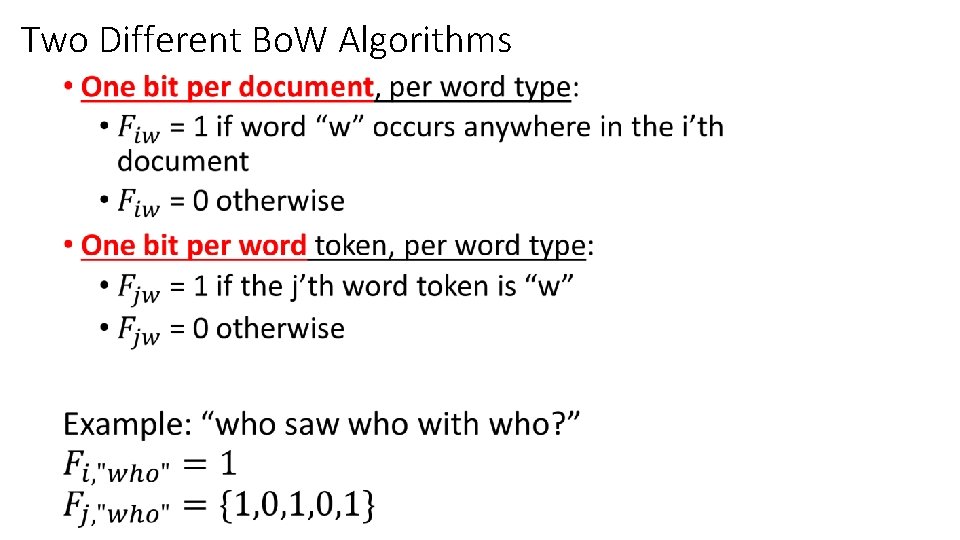
Two Different Bo. W Algorithms •
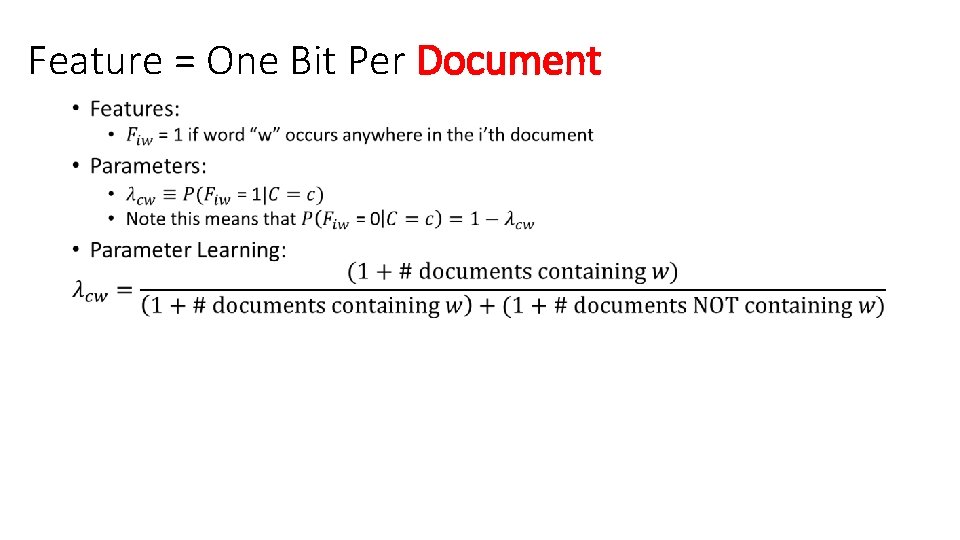
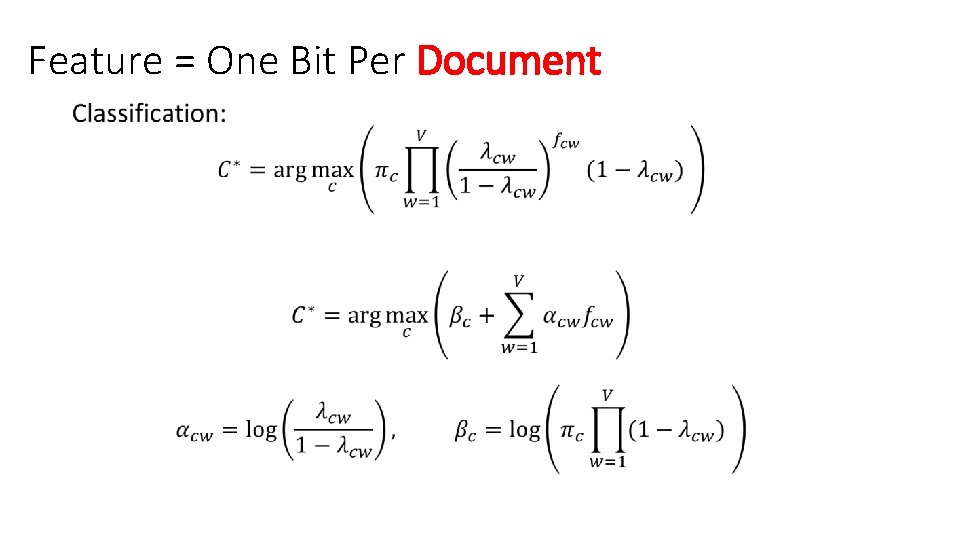
Feature = One Bit Per Document •
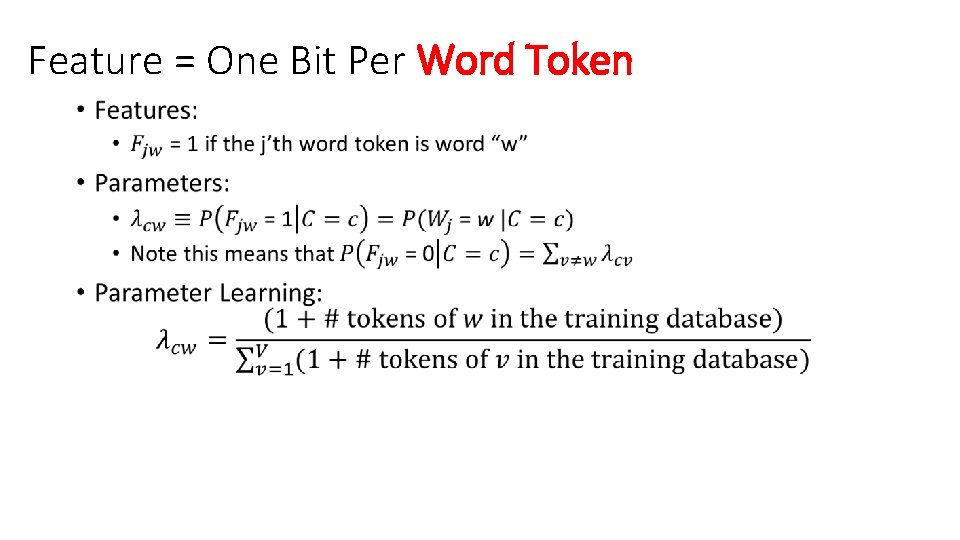
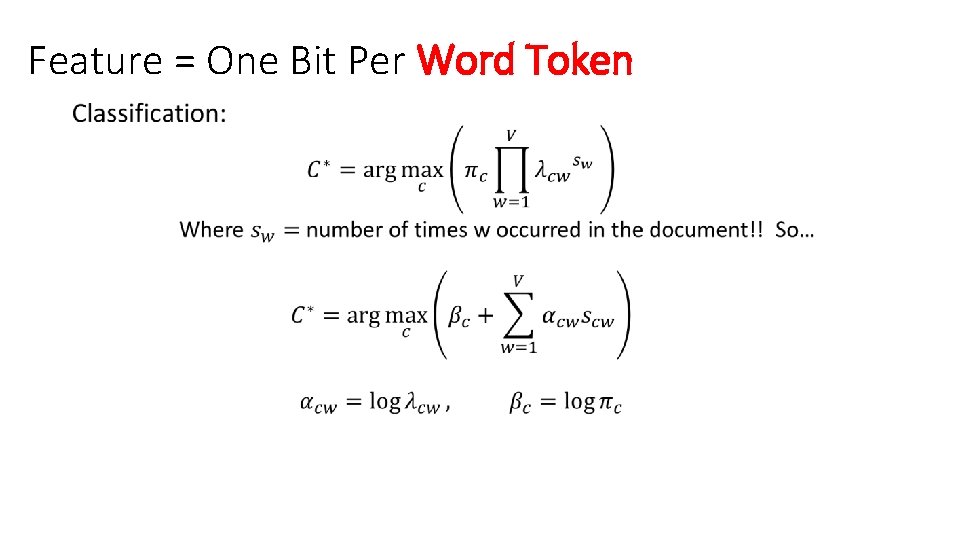
Feature = One Bit Per Word Token •
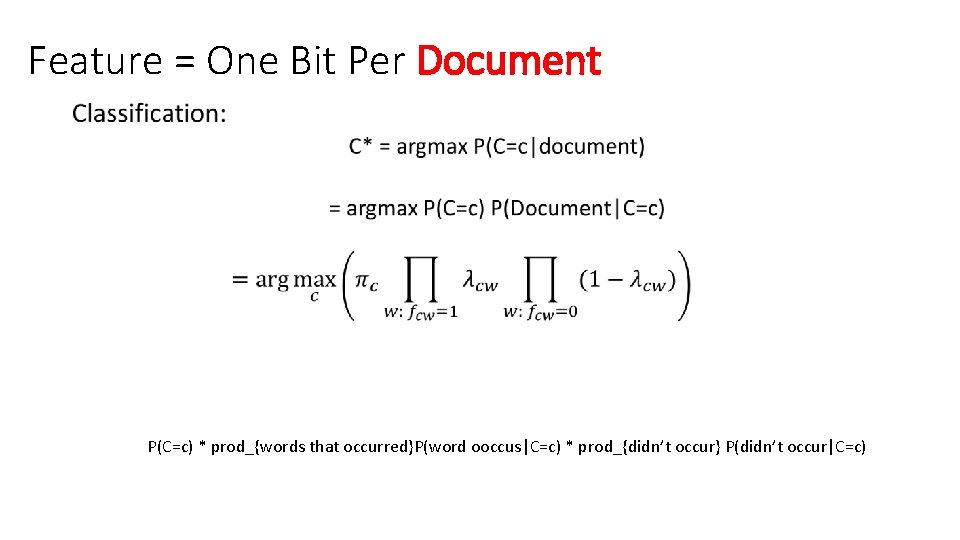
Feature = One Bit Per Document • P(C=c) * prod_{words that occurred}P(word ooccus|C=c) * prod_{didn’t occur} P(didn’t occur|C=c)
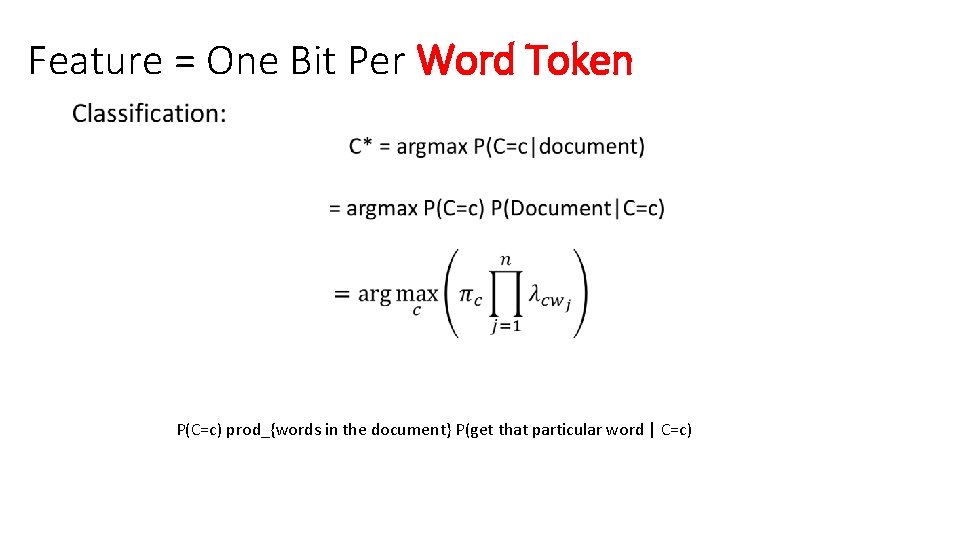
Feature = One Bit Per Word Token • P(C=c) prod_{words in the document} P(get that particular word | C=c)
Feature = One Bit Per Document •
Feature = One Bit Per Word Token •
Linear Classifiers • Naïve Bayes/Bo. W classifiers • Linear Classifiers in General • Perceptron • Differential Perceptron/Neural Net
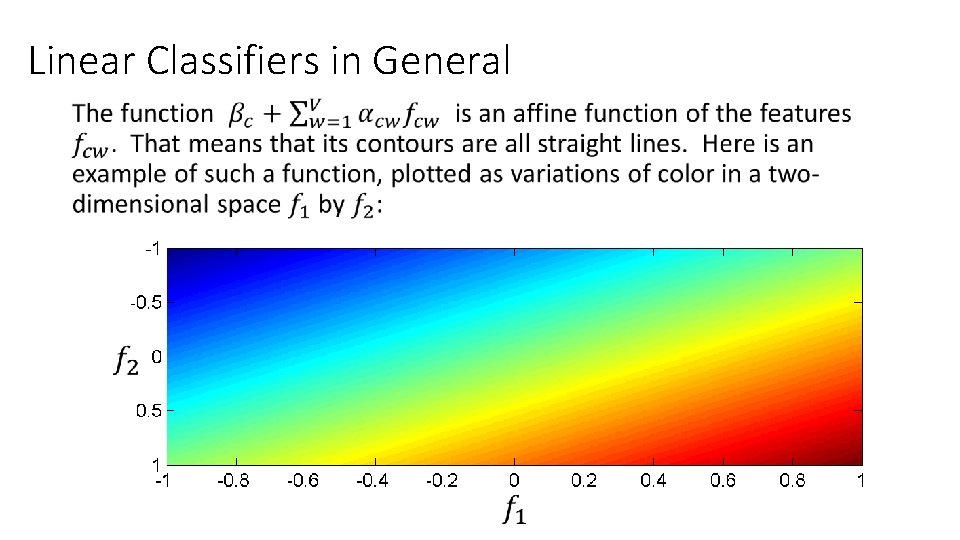
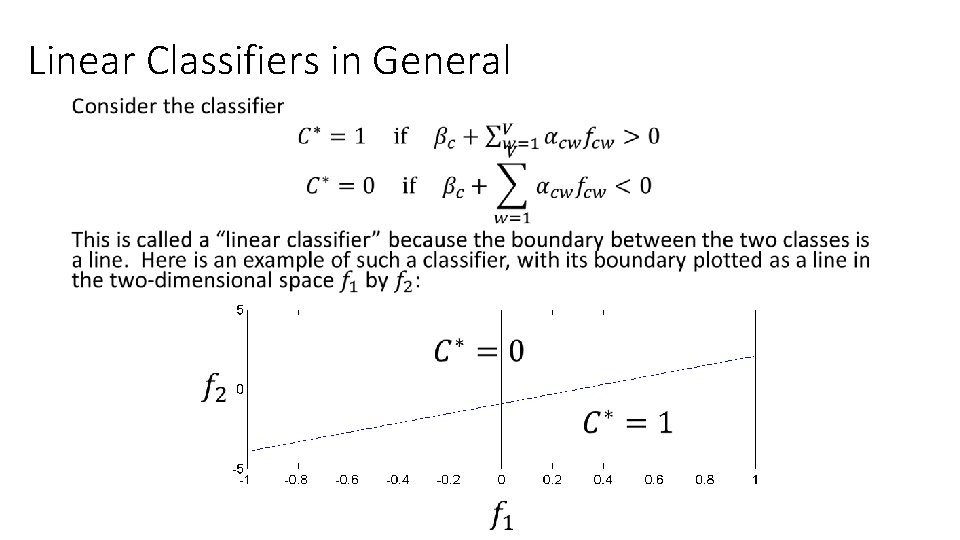
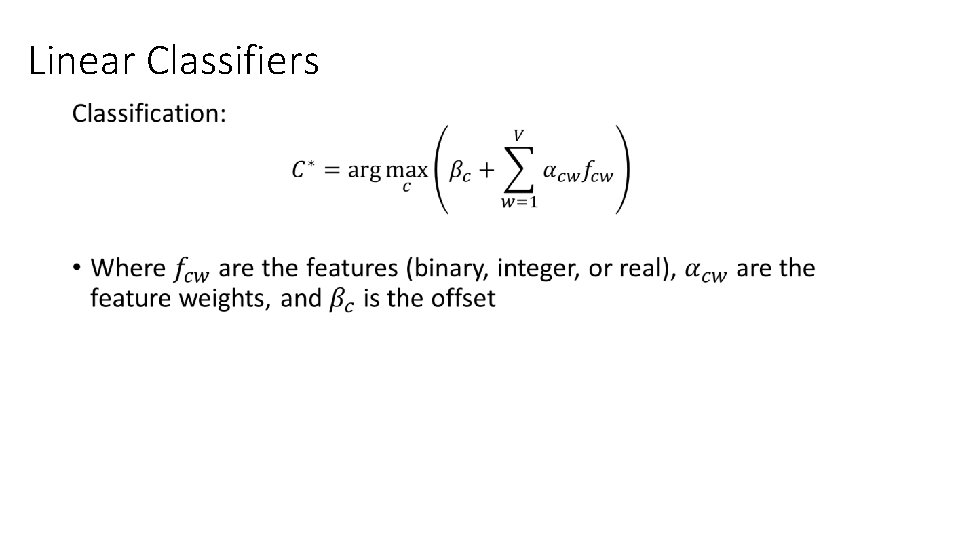
Linear Classifiers in General •
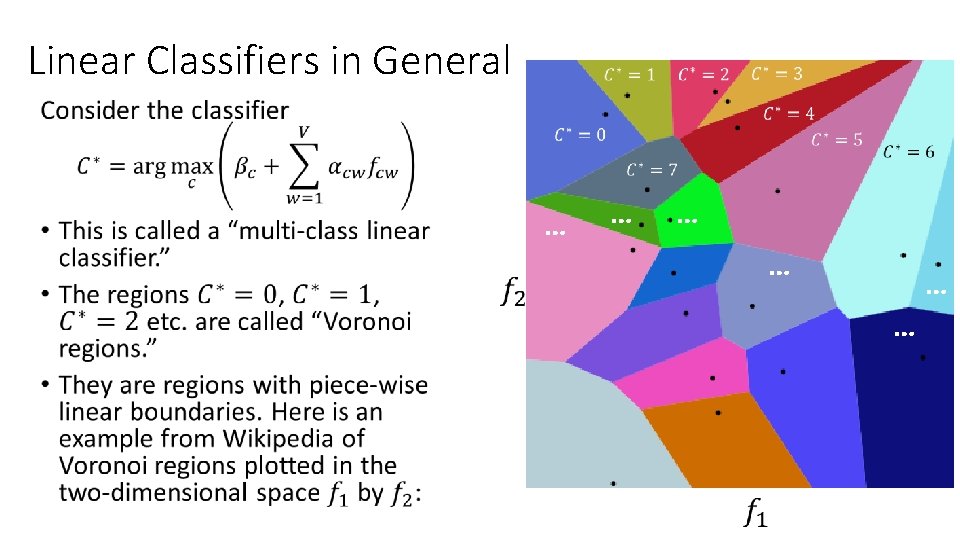
Linear Classifiers in General •
Linear Classifiers in General • … … …
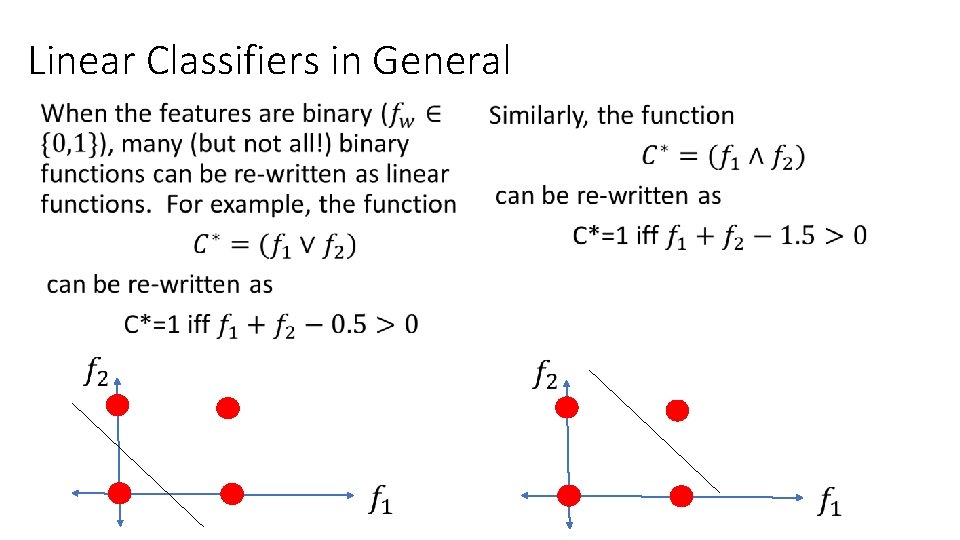
Linear Classifiers in General •
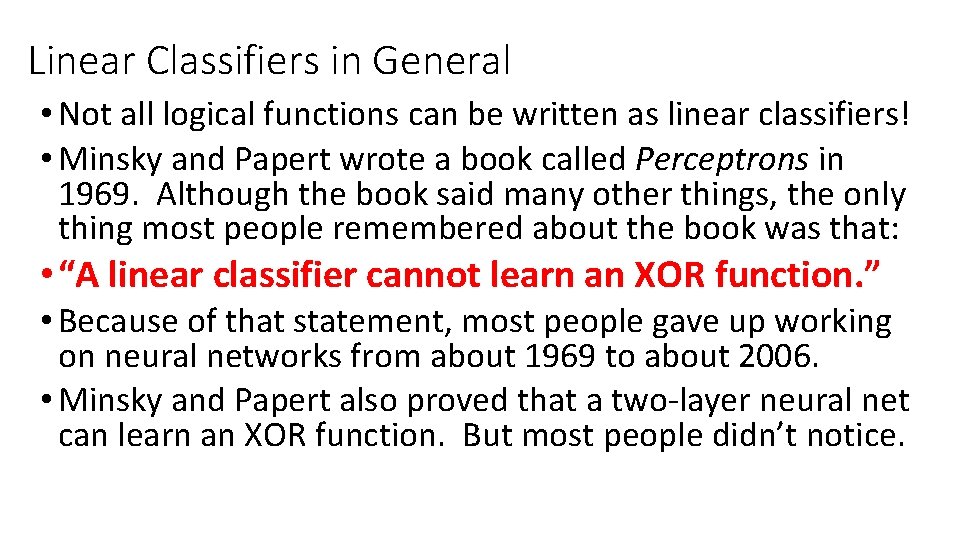
Linear Classifiers in General • Not all logical functions can be written as linear classifiers! • Minsky and Papert wrote a book called Perceptrons in 1969. Although the book said many other things, the only thing most people remembered about the book was that: • “A linear classifier cannot learn an XOR function. ” • Because of that statement, most people gave up working on neural networks from about 1969 to about 2006. • Minsky and Papert also proved that a two-layer neural net can learn an XOR function. But most people didn’t notice.
Linear Classifiers •
Linear Classifiers • Naïve Bayes/Bo. W classifiers • Linear Classifiers in General • Perceptron • Differential Perceptron/Neural Net
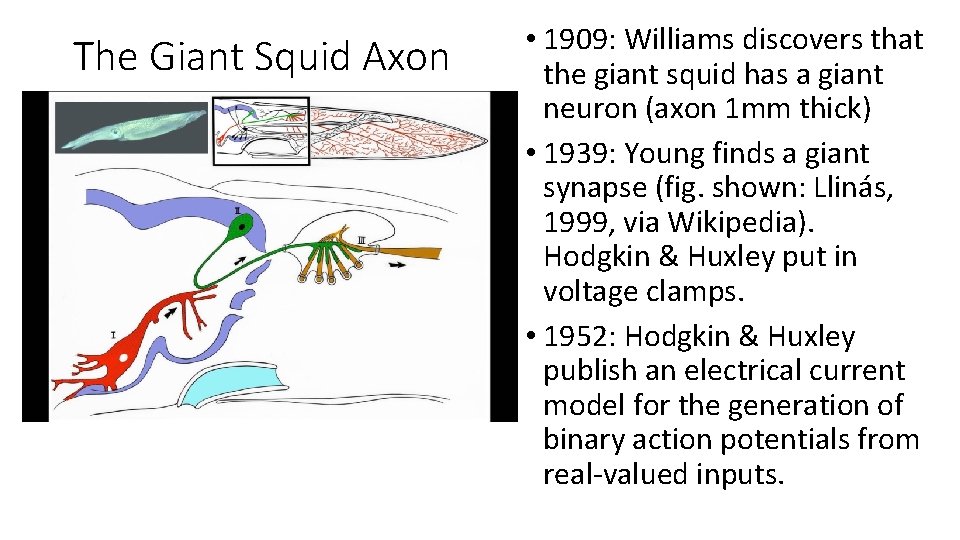
The Giant Squid Axon • 1909: Williams discovers that the giant squid has a giant neuron (axon 1 mm thick) • 1939: Young finds a giant synapse (fig. shown: Llinás, 1999, via Wikipedia). Hodgkin & Huxley put in voltage clamps. • 1952: Hodgkin & Huxley publish an electrical current model for the generation of binary action potentials from real-valued inputs.
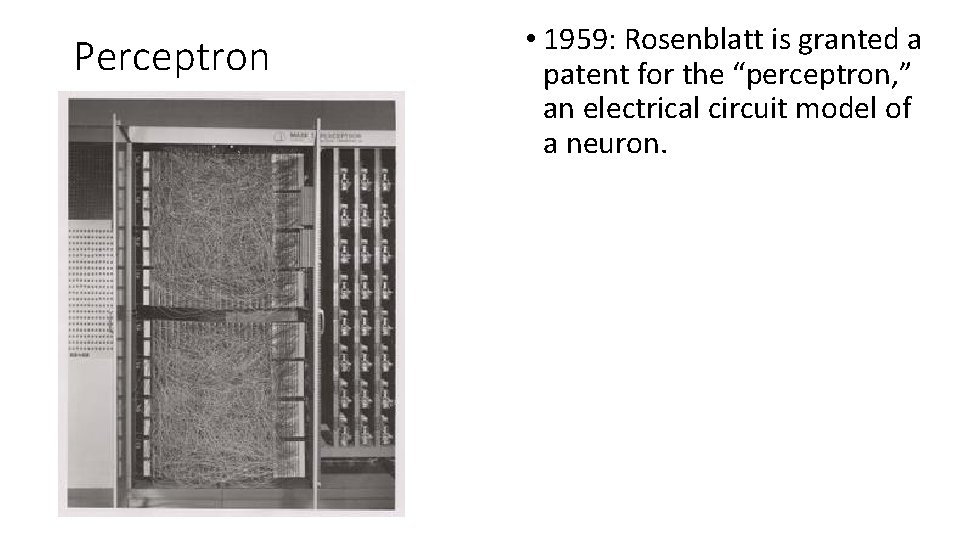
Perceptron • 1959: Rosenblatt is granted a patent for the “perceptron, ” an electrical circuit model of a neuron.
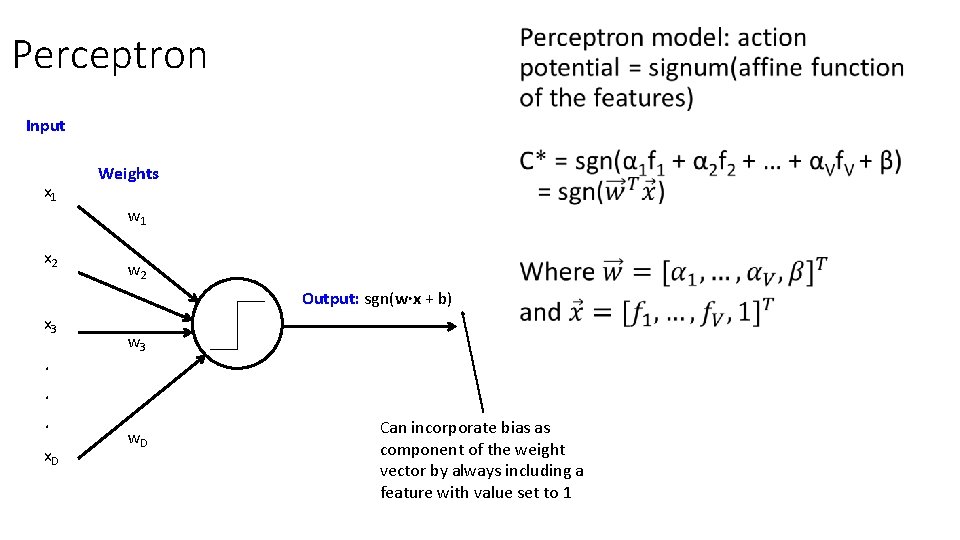
• Perceptron Input x 1 x 2 Weights w 1 w 2 Output: sgn(w x + b) x 3 . . . x. D w 3 w. D Can incorporate bias as component of the weight vector by always including a feature with value set to 1
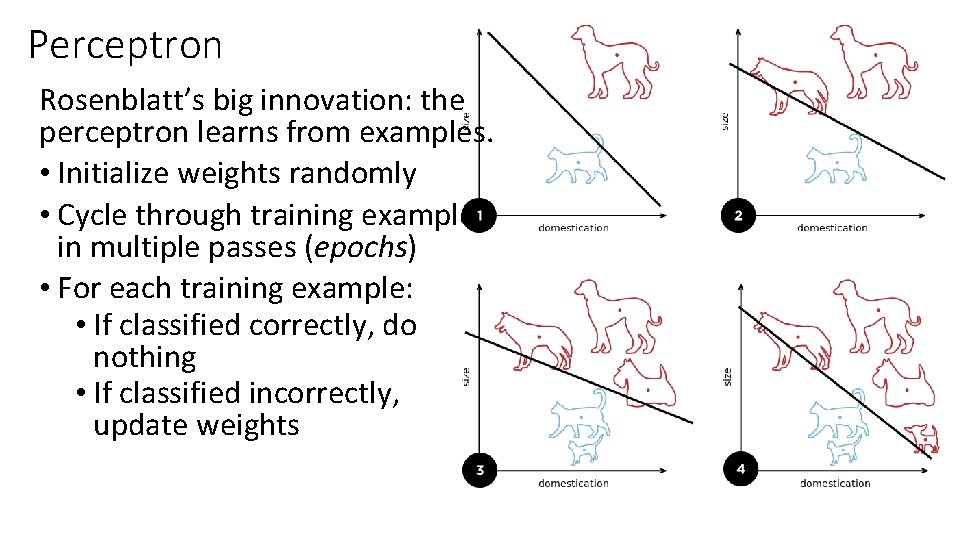
Perceptron Rosenblatt’s big innovation: the perceptron learns from examples. • Initialize weights randomly • Cycle through training examples in multiple passes (epochs) • For each training example: • If classified correctly, do nothing • If classified incorrectly, update weights
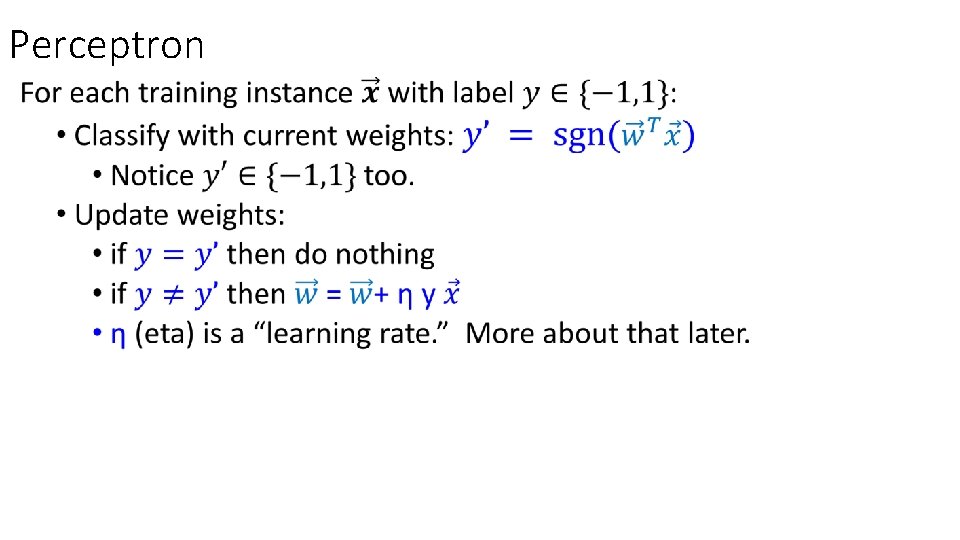
Perceptron •
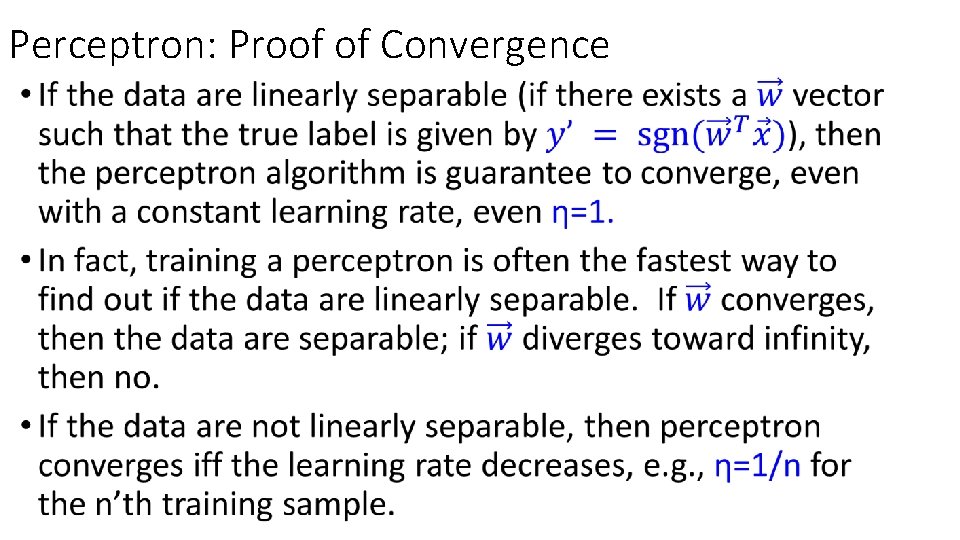
Perceptron: Proof of Convergence •
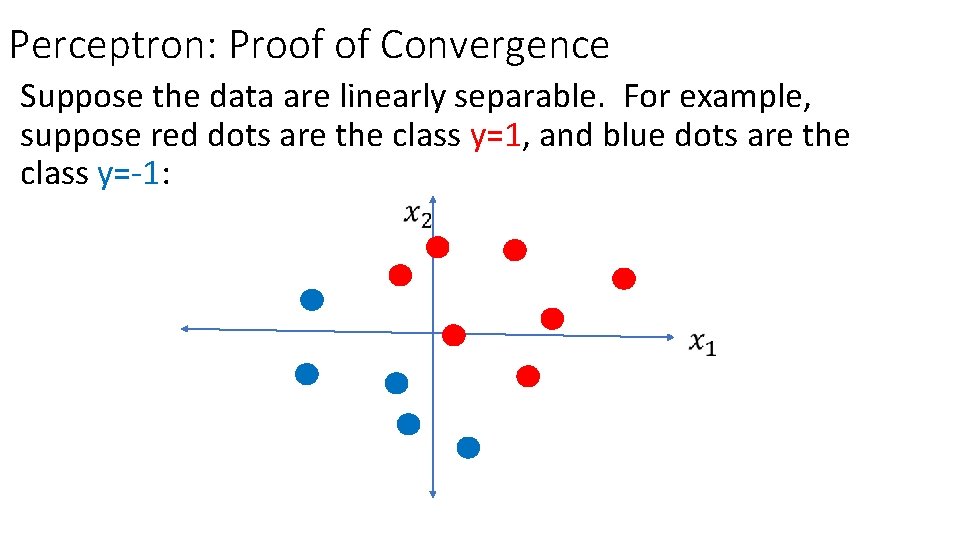
Perceptron: Proof of Convergence Suppose the data are linearly separable. For example, suppose red dots are the class y=1, and blue dots are the class y=-1:
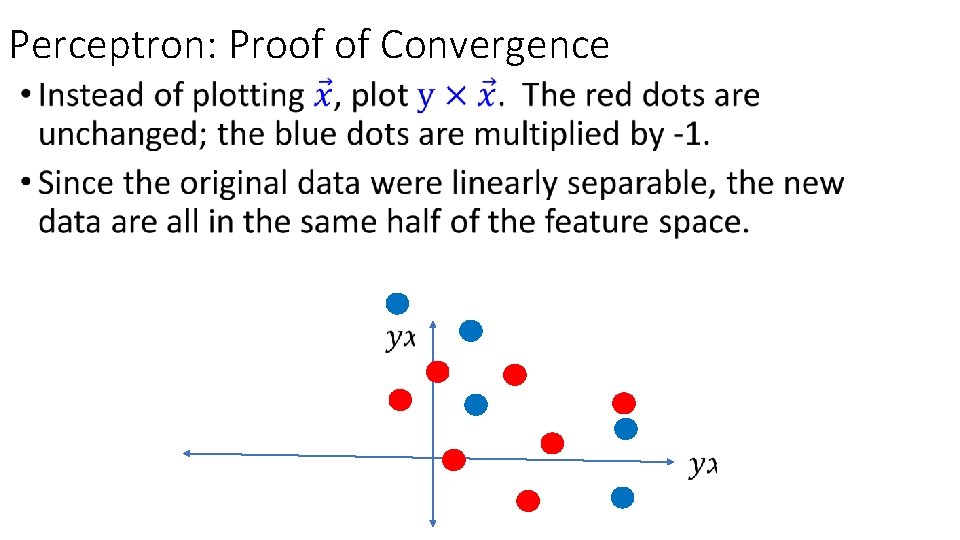
Perceptron: Proof of Convergence •
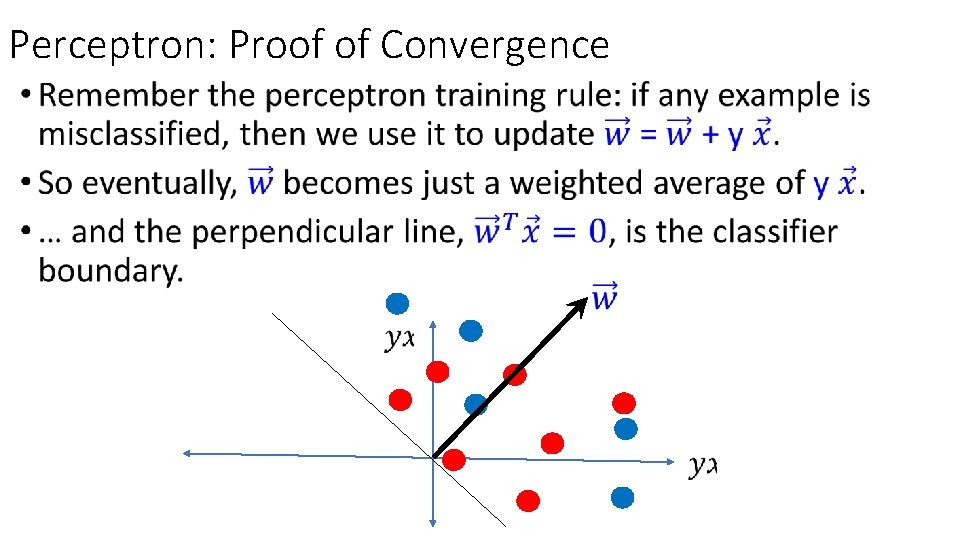
Perceptron: Proof of Convergence •
Perceptron: Proof of Convergence • If the data are not linearly separable, then perceptron converges iff the learning rate decreases, e. g. , η=1/n for the n’th training sample.
Implementation details • Bias (add feature dimension with value fixed to 1) vs. no bias • Initialization of weights: all zeros vs. random • Learning rate decay function • Number of epochs (passes through the training data) • Order of cycling through training examples (random)
Multi-class perceptrons • One-vs-others framework: Need to keep a weight vector wc for each class c • Decision rule: c = argmaxc wc x • Update rule: suppose example from class c gets misclassified as c’ • Update for c: wc + η x • Update for c’: wc’ – η x • Update for all classes other than c and c’: no change
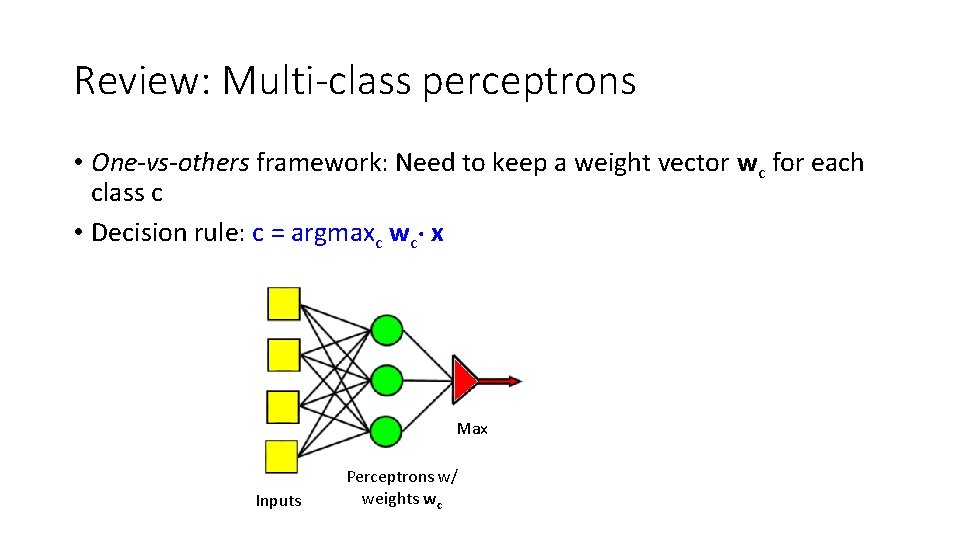
Review: Multi-class perceptrons • One-vs-others framework: Need to keep a weight vector wc for each class c • Decision rule: c = argmaxc wc x Max Inputs Perceptrons w/ weights wc
Linear Classifiers • Naïve Bayes/Bo. W classifiers • Linear Classifiers in General • Perceptron • Differential Perceptron/Neural Net
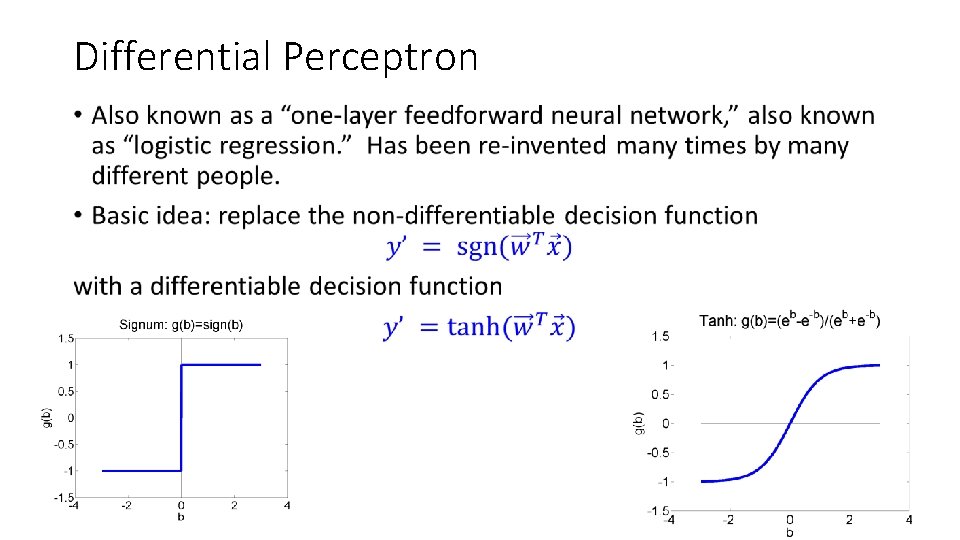
Differential Perceptron •
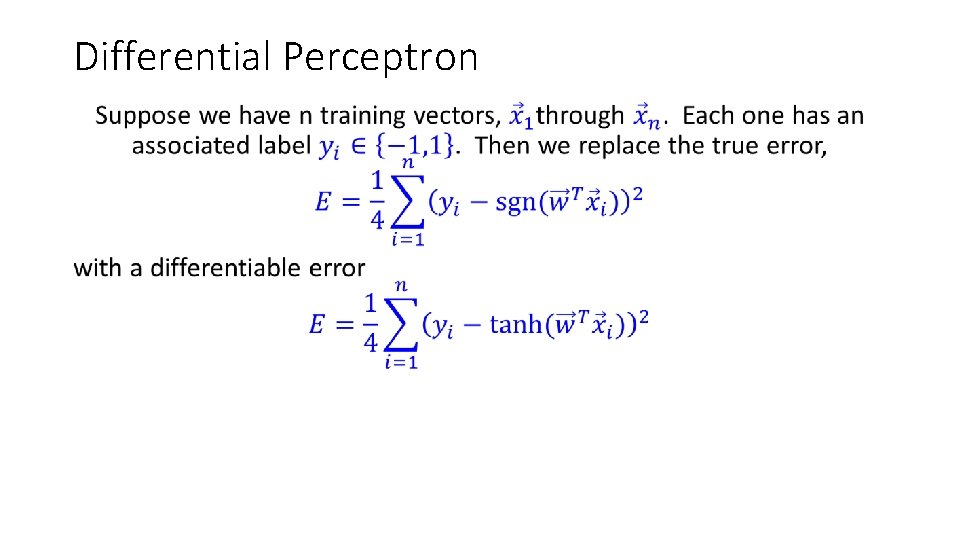
Differential Perceptron •
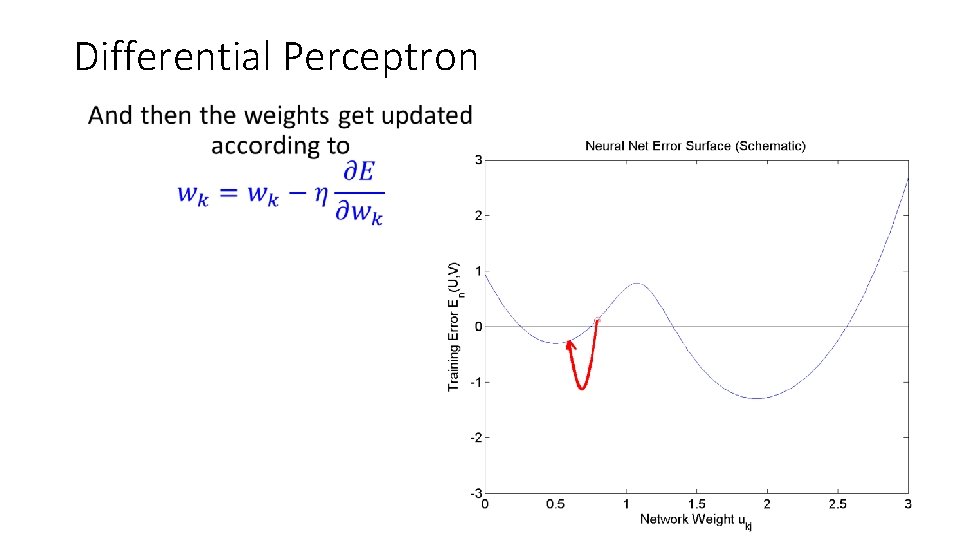
Differential Perceptron •
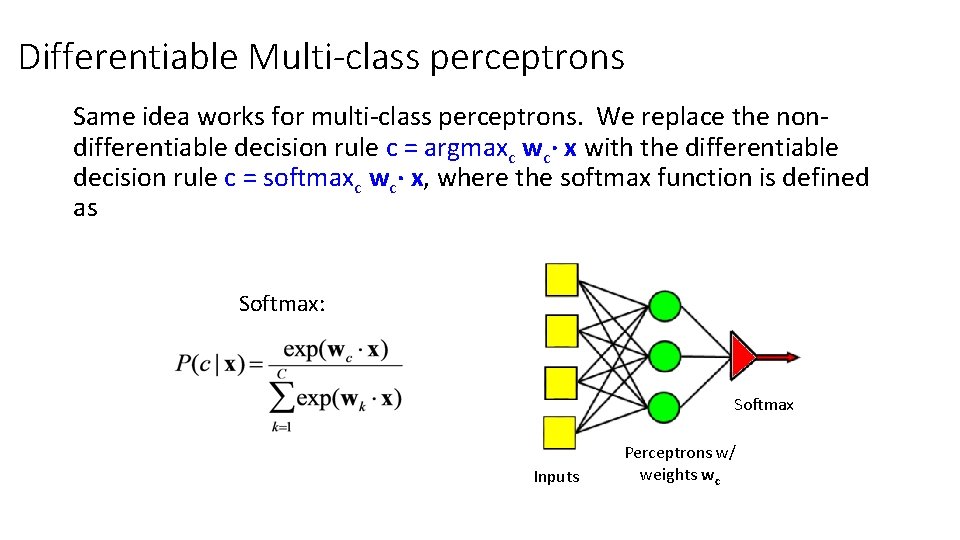
Differentiable Multi-class perceptrons Same idea works for multi-class perceptrons. We replace the nondifferentiable decision rule c = argmaxc wc x with the differentiable decision rule c = softmaxc wc x, where the softmax function is defined as Softmax: Softmax Inputs Perceptrons w/ weights wc
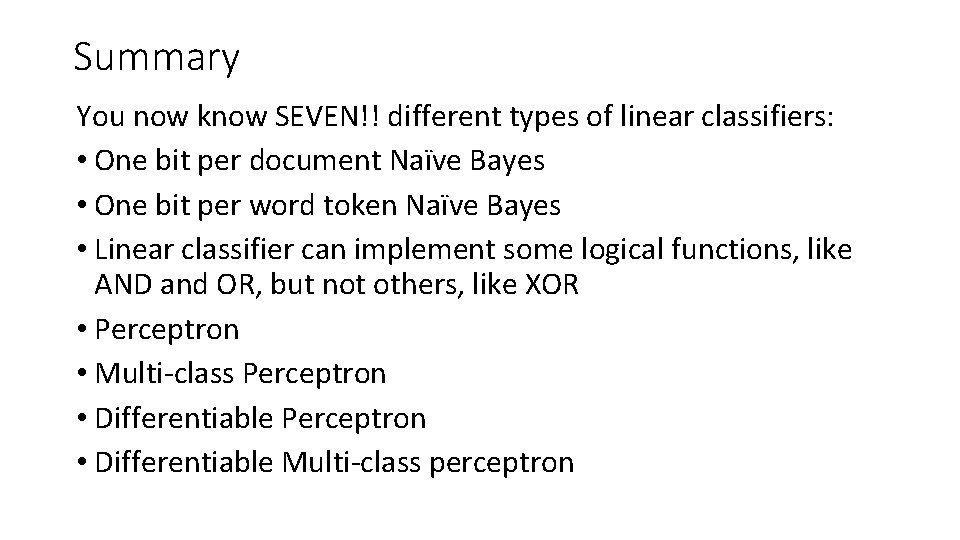
Summary You now know SEVEN!! different types of linear classifiers: • One bit per document Naïve Bayes • One bit per word token Naïve Bayes • Linear classifier can implement some logical functions, like AND and OR, but not others, like XOR • Perceptron • Multi-class Perceptron • Differentiable Multi-class perceptron