CS 430536 Computer Graphics I Circle Drawing and
- Slides: 22
CS 430/536 Computer Graphics I Circle Drawing and Clipping Week 3, Lecture 6 David Breen, William Regli and Maxim Peysakhov Geometric and Intelligent Computing Laboratory Department of Computer Science Drexel University http: //gicl. cs. drexel. edu 1
Outline • Scan conversion of circles • Clipping circles • Scan conversion of ellipses 2
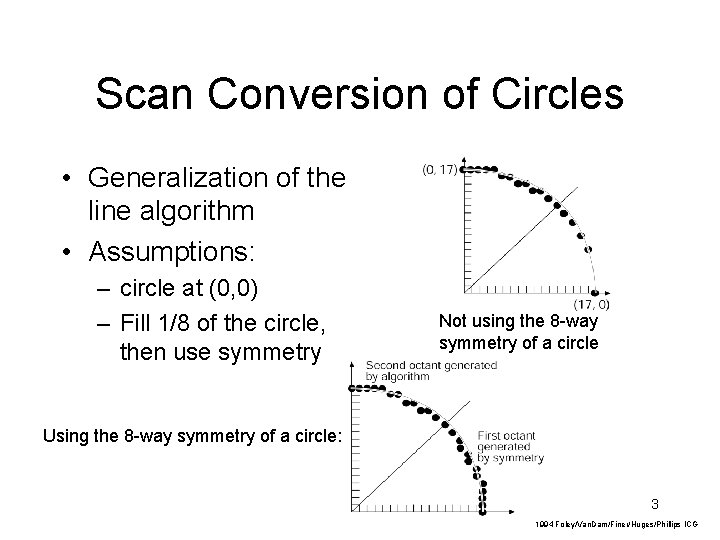
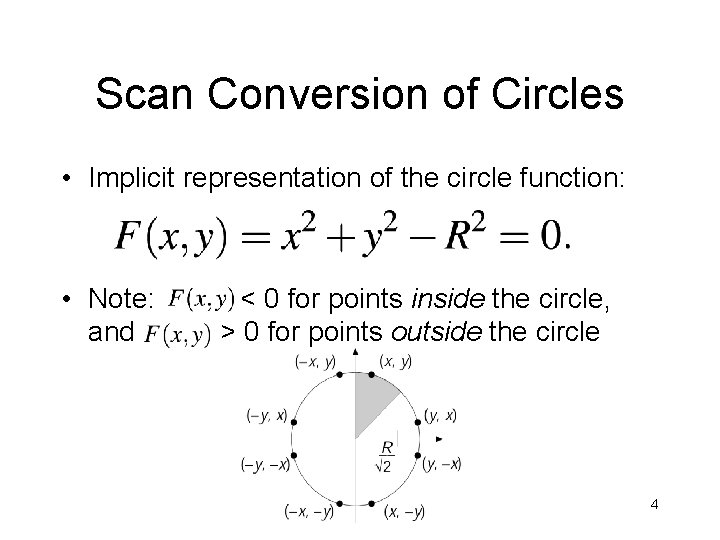
Scan Conversion of Circles • Generalization of the line algorithm • Assumptions: – circle at (0, 0) – Fill 1/8 of the circle, then use symmetry Not using the 8 -way symmetry of a circle Using the 8 -way symmetry of a circle: 3 1994 Foley/Van. Dam/Finer/Huges/Phillips ICG
Scan Conversion of Circles • Implicit representation of the circle function: • Note: < 0 for points inside the circle, and > 0 for points outside the circle 4
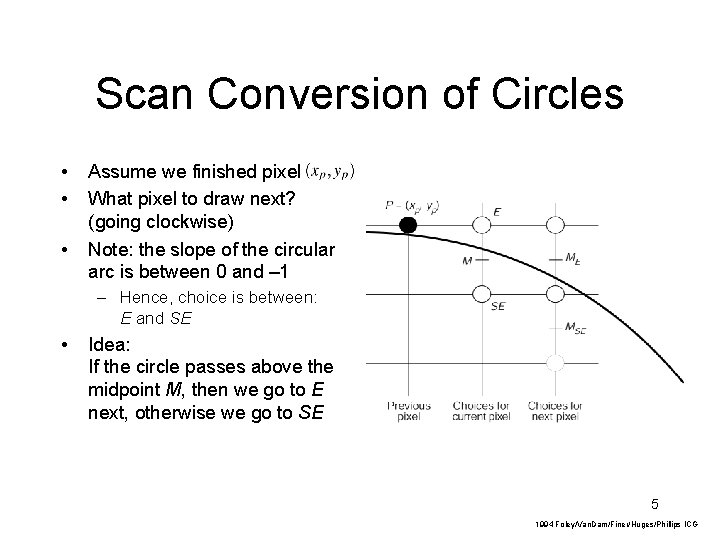
Scan Conversion of Circles • • • Assume we finished pixel What pixel to draw next? (going clockwise) Note: the slope of the circular arc is between 0 and – 1 – Hence, choice is between: E and SE • Idea: If the circle passes above the midpoint M, then we go to E next, otherwise we go to SE 5 1994 Foley/Van. Dam/Finer/Huges/Phillips ICG
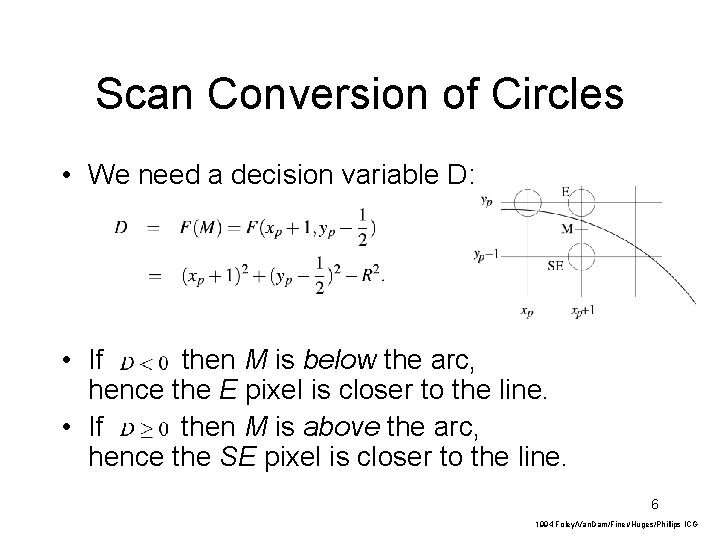
Scan Conversion of Circles • We need a decision variable D: • If then M is below the arc, hence the E pixel is closer to the line. • If then M is above the arc, hence the SE pixel is closer to the line. 6 1994 Foley/Van. Dam/Finer/Huges/Phillips ICG
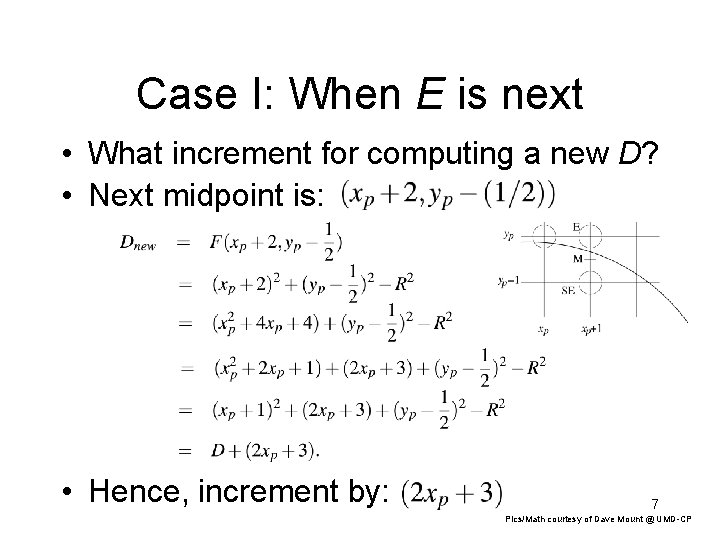
Case I: When E is next • What increment for computing a new D? • Next midpoint is: • Hence, increment by: 7 Pics/Math courtesy of Dave Mount @ UMD-CP
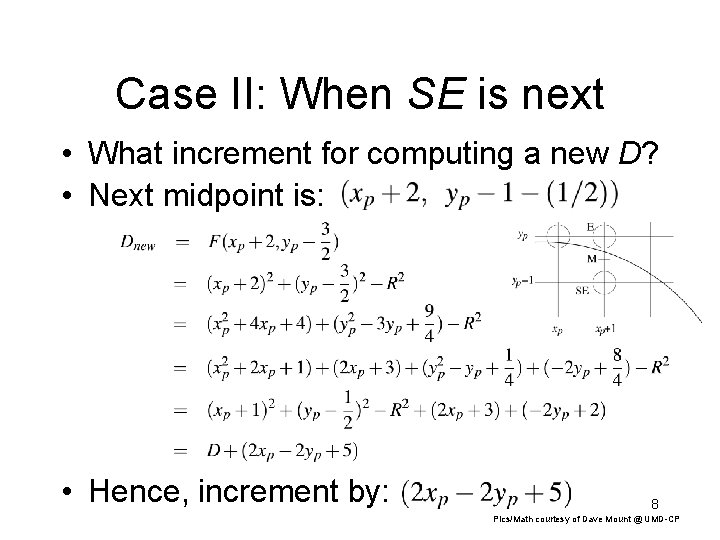
Case II: When SE is next • What increment for computing a new D? • Next midpoint is: • Hence, increment by: 8 Pics/Math courtesy of Dave Mount @ UMD-CP
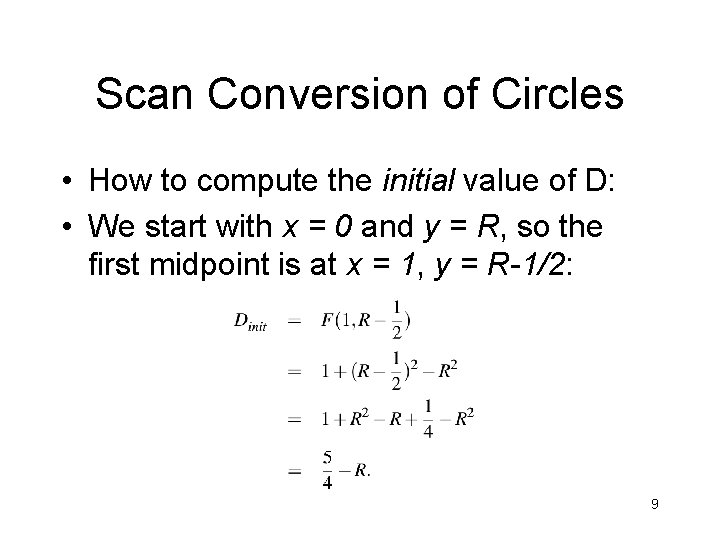
Scan Conversion of Circles • How to compute the initial value of D: • We start with x = 0 and y = R, so the first midpoint is at x = 1, y = R-1/2: 9
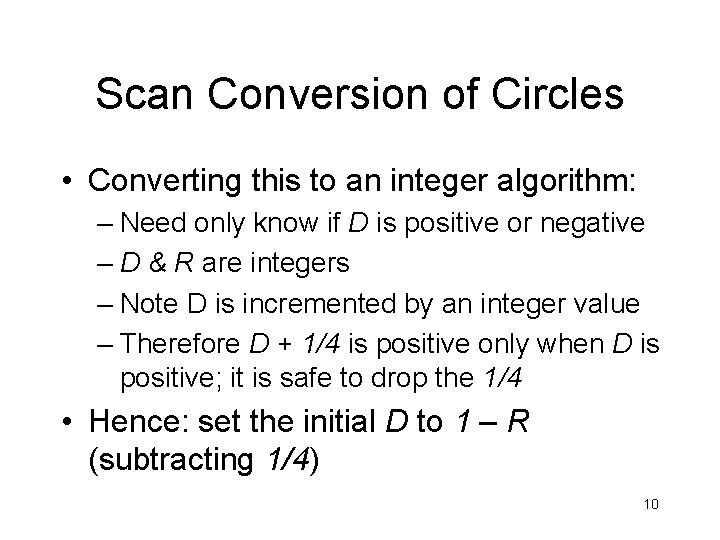
Scan Conversion of Circles • Converting this to an integer algorithm: – Need only know if D is positive or negative – D & R are integers – Note D is incremented by an integer value – Therefore D + 1/4 is positive only when D is positive; it is safe to drop the 1/4 • Hence: set the initial D to 1 – R (subtracting 1/4) 10
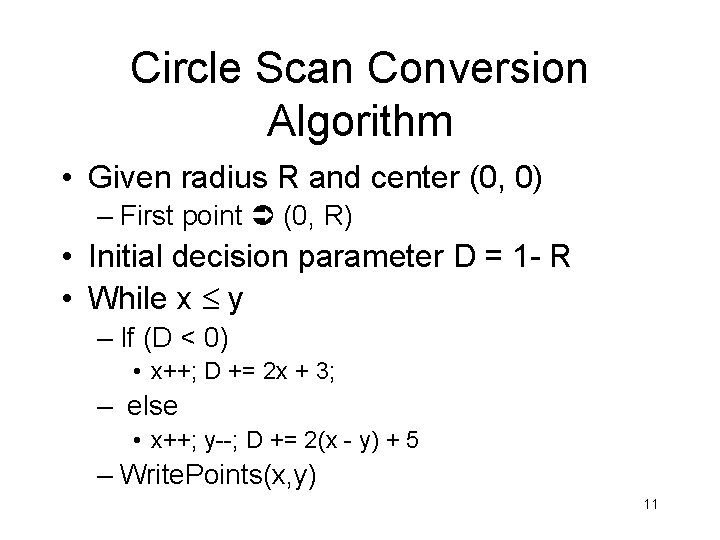
Circle Scan Conversion Algorithm • Given radius R and center (0, 0) – First point (0, R) • Initial decision parameter D = 1 - R • While x y – If (D < 0) • x++; D += 2 x + 3; – else • x++; y--; D += 2(x - y) + 5 – Write. Points(x, y) 11
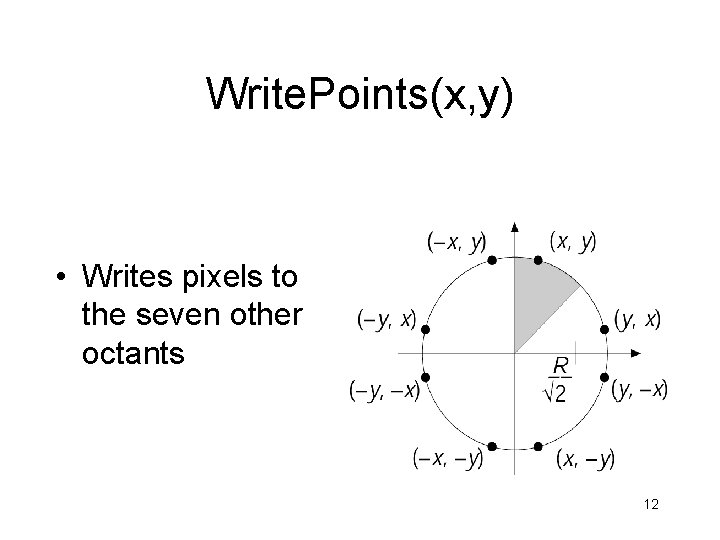
Write. Points(x, y) • Writes pixels to the seven other octants 12
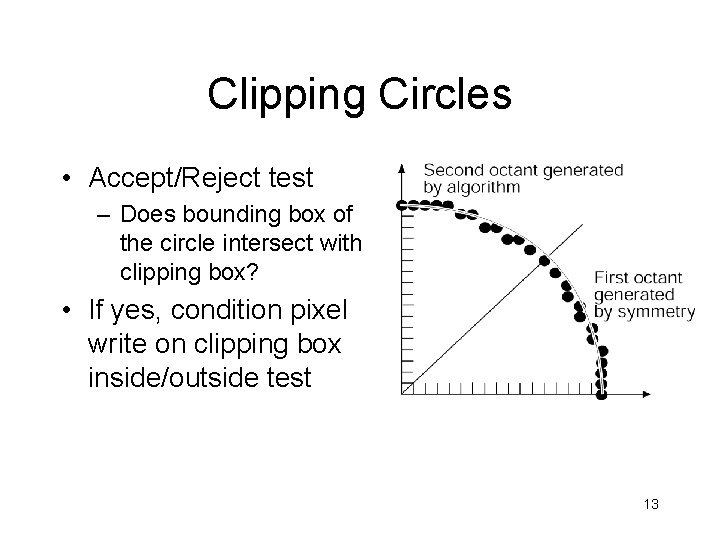
Clipping Circles • Accept/Reject test – Does bounding box of the circle intersect with clipping box? • If yes, condition pixel write on clipping box inside/outside test 13
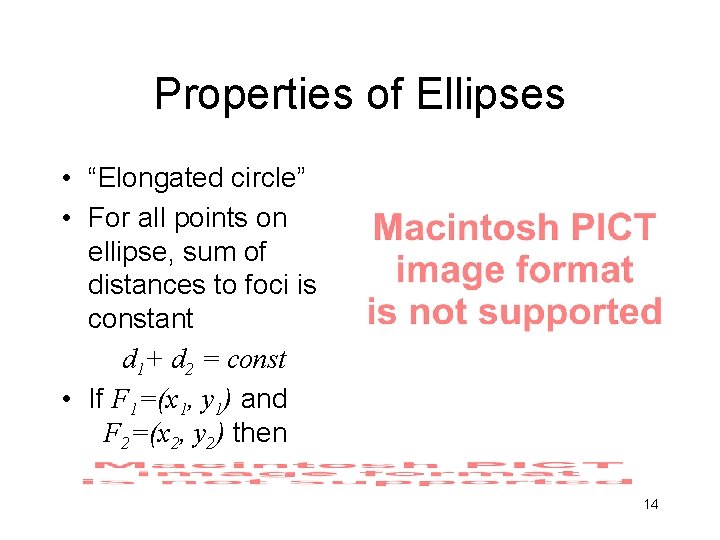
Properties of Ellipses • “Elongated circle” • For all points on ellipse, sum of distances to foci is constant d 1+ d 2 = const • If F 1=(x 1, y 1) and F 2=(x 2, y 2) then 14
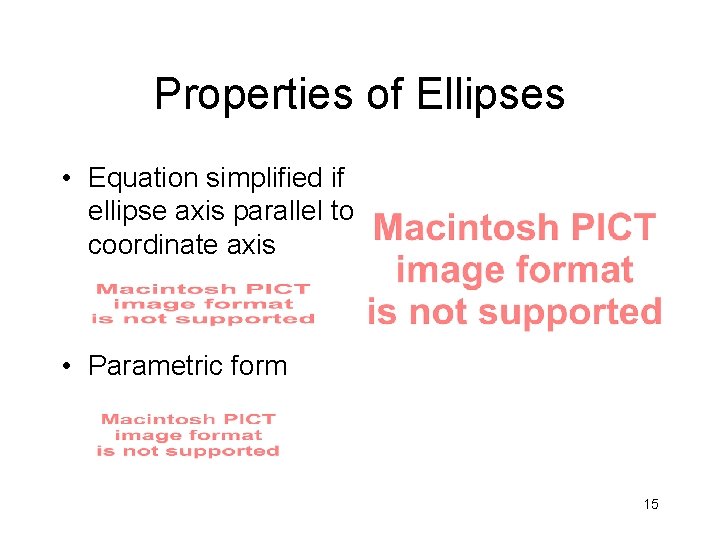
Properties of Ellipses • Equation simplified if ellipse axis parallel to coordinate axis • Parametric form 15
Symmetry Considerations • 4 -way symmetry • Unit steps in x until reach region boundary • Switch to unit steps in y • Step in x while • Switch to steps in y when 16
Midpoint Algorithm (initializing) • Similar to circles • The initial value for region 1 • The initial value for region 2 • We have initial values, now we need the increments 17 1994 Foley/Van. Dam/Finer/Huges/Phillips ICG
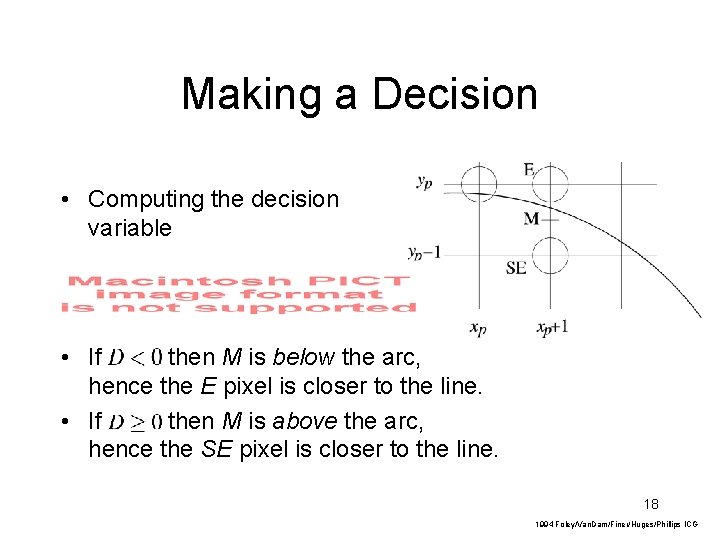
Making a Decision • Computing the decision variable • If then M is below the arc, hence the E pixel is closer to the line. • If then M is above the arc, hence the SE pixel is closer to the line. 18 1994 Foley/Van. Dam/Finer/Huges/Phillips ICG
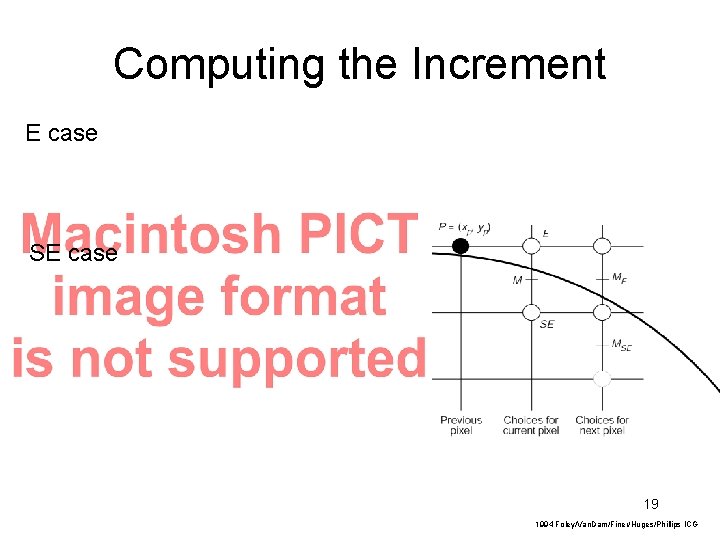
Computing the Increment E case SE case 19 1994 Foley/Van. Dam/Finer/Huges/Phillips ICG
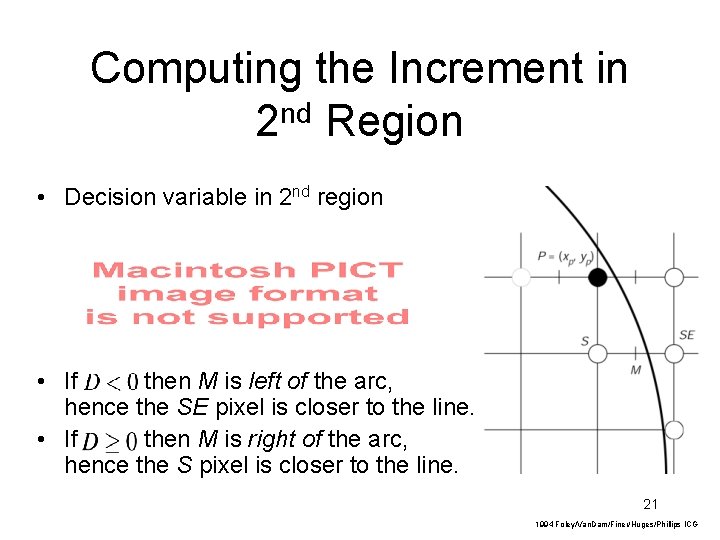
Computing the Increment in 2 nd Region • Decision variable in 2 nd region • If then M is left of the arc, hence the SE pixel is closer to the line. • If then M is right of the arc, hence the S pixel is closer to the line. 21 1994 Foley/Van. Dam/Finer/Huges/Phillips ICG
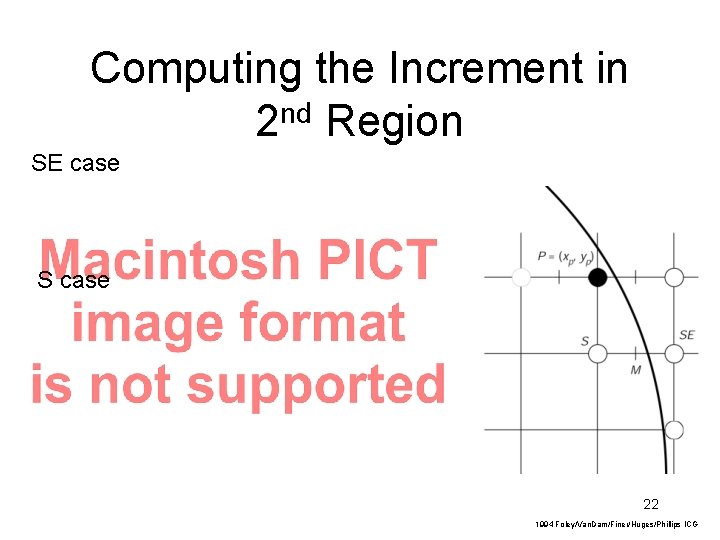
Computing the Increment in 2 nd Region SE case S case 22 1994 Foley/Van. Dam/Finer/Huges/Phillips ICG
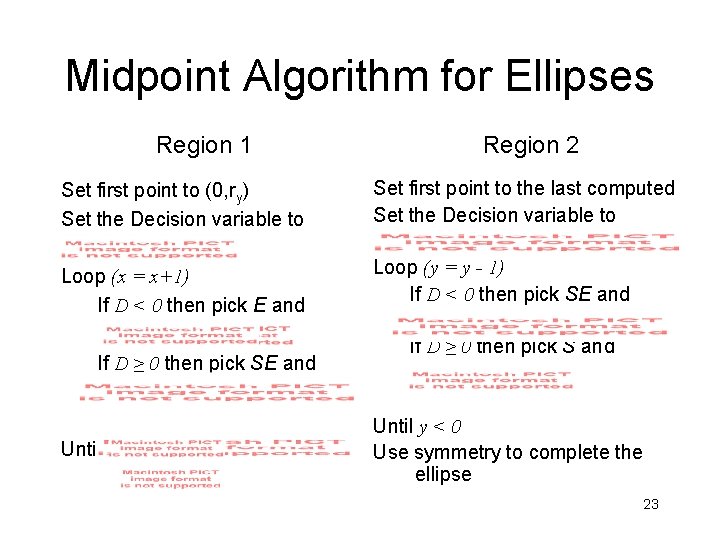
Midpoint Algorithm for Ellipses Region 1 Region 2 Set first point to (0, ry) Set the Decision variable to Set first point to the last computed Set the Decision variable to Loop (x = x+1) If D < 0 then pick E and Loop (y = y - 1) If D < 0 then pick SE and If D ≥ 0 then pick SE and Until If D ≥ 0 then pick S and Until y < 0 Use symmetry to complete the ellipse 23