CS 3214 Introduction to Computer Systems Lecture 21


- Slides: 30
CS 3214 Introduction to Computer Systems Lecture 21 Godmar Back
Announcements • Read Chapter 10 • Exercise 11 due Nov 12 • Project 4 – Should complete before Thanksgiving, but will accept submissions without using late days until Nov 24 – Don’t procrastinate. A memory allocator is easily something you can sink 100 hours into with no results to show – an option you don’t have – zero room for error on this project • Gave preliminary heads up on whether Project 3 meets minimum requirements – Peter will give definite by this weekend, he said – Please check your submissions that you have tests for all minimum functionality. If not, you have until the end of the semester to submit a version that meets minimum requirements CS 3214 Fall 2009 10/7/2020 2
Some of the following slides are taken with permission from Complete Powerpoint Lecture Notes for Computer Systems: A Programmer's Perspective (CS: APP) Randal E. Bryant and David R. O'Hallaron http: //csapp. cs. cmu. edu/public/lectures. html Part 2 MEMORY MANAGEMENT CS 3214 Fall 2009 10/7/2020 3
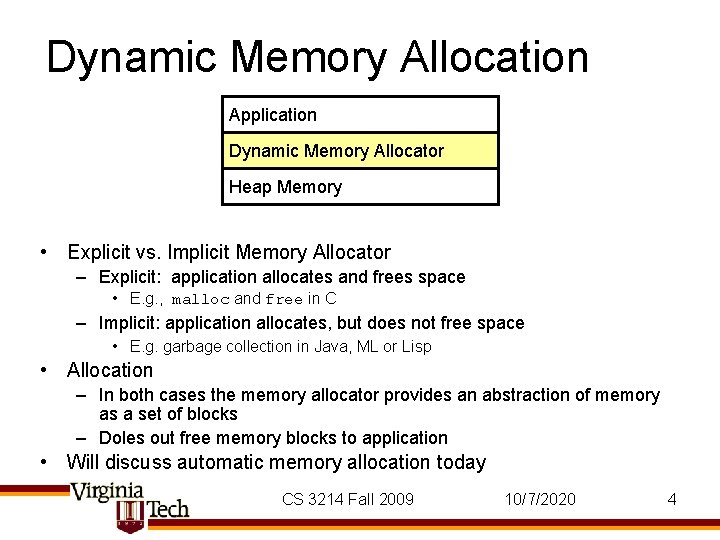
Dynamic Memory Allocation Application Dynamic Memory Allocator Heap Memory • Explicit vs. Implicit Memory Allocator – Explicit: application allocates and frees space • E. g. , malloc and free in C – Implicit: application allocates, but does not free space • E. g. garbage collection in Java, ML or Lisp • Allocation – In both cases the memory allocator provides an abstraction of memory as a set of blocks – Doles out free memory blocks to application • Will discuss automatic memory allocation today CS 3214 Fall 2009 10/7/2020 4
Implicit Memory Management • Motivation: manually (or explicitly) reclaiming memory is difficult: – Too early: risk access-after-free errors – Too late: memory leaks • Requires principled design – Programmer must reason about ownership of objects • Difficult & error prone, especially in the presence of object sharing • Complicates design of APIs CS 3214 Fall 2009 10/7/2020 5
Manual Reference Counting • Idea: keep track of how many references there are to each object in a reference counter stored with each object – Copy a reference to an object globalvar = q • increment count: “addref” – Remove a reference p = NULL • decrement count: “release” • Uses set of rules programmers must follow – E. g. , must ‘release’ reference obtained from OUT parameter in function call – Must ‘addref’ when storing into global – May not have to use addref/release for references copied within one function • Programmer must use addref/release correctly – Still somewhat error prone, but rules are such that correctness of the code can be established locally without consulting the API documentation of any functions being called; parameter annotations (IN, INOUT, return value) imply reference counting rules • Used in Microsoft COM & Netscape XPCOM CS 3214 Fall 2009 10/7/2020 6
Automatic Reference Counting • Idea: force automatic reference count updates when pointers are assigned/copied • Most common variant: – C++ “smart pointers” – C++ allows programmer to interpose on assignments and copies via operator overloading/special purpose constructors. • Disadvantage of all reference counting schemes is their inability to handle cycles – But great advantage is immediate reclamation: no “drag” between last access & reclamation CS 3214 Fall 2009 10/7/2020 7
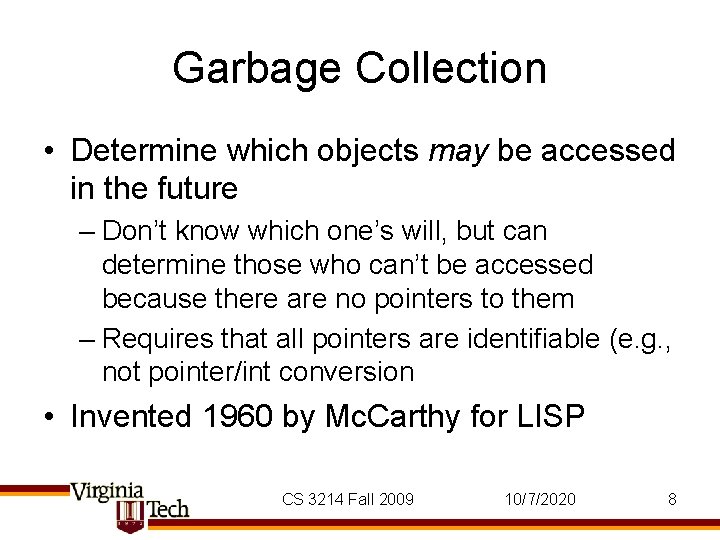
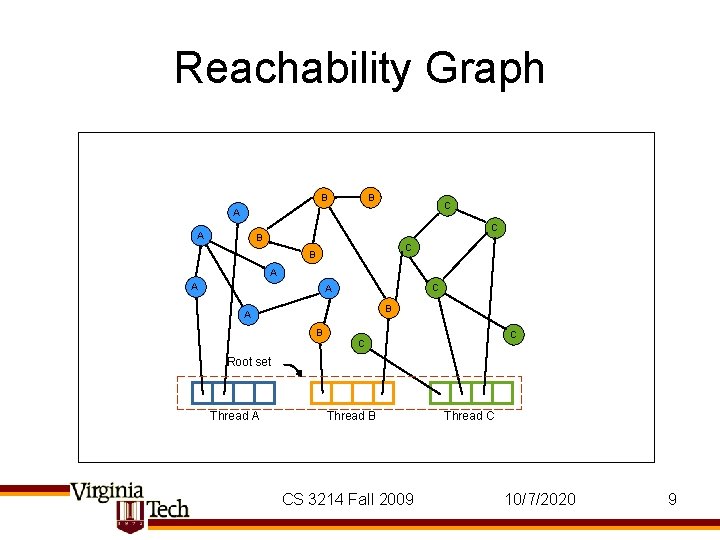
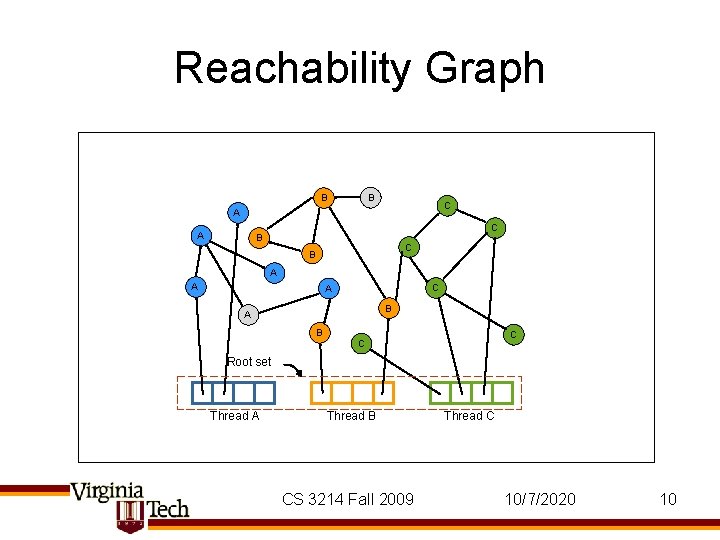
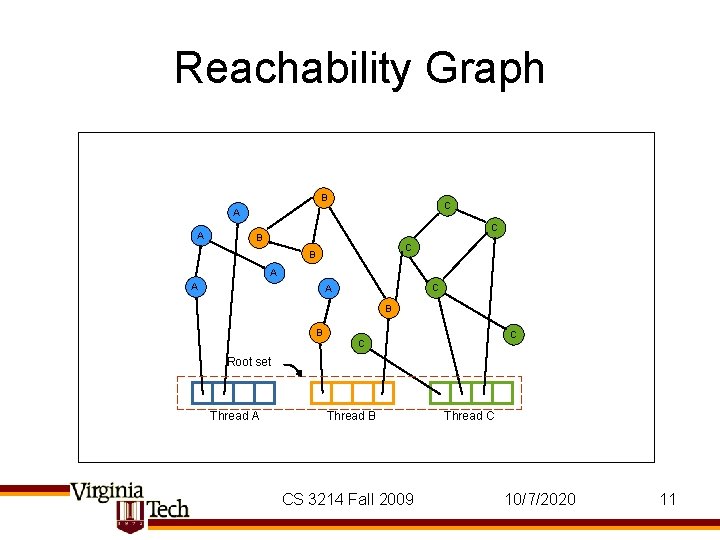
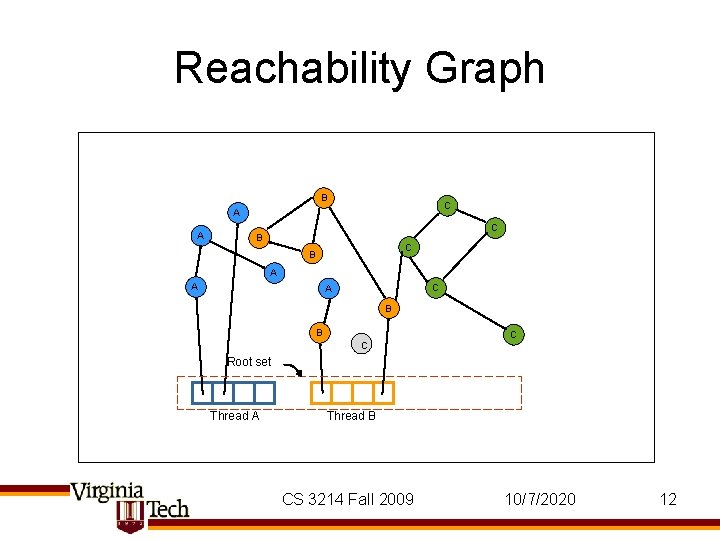
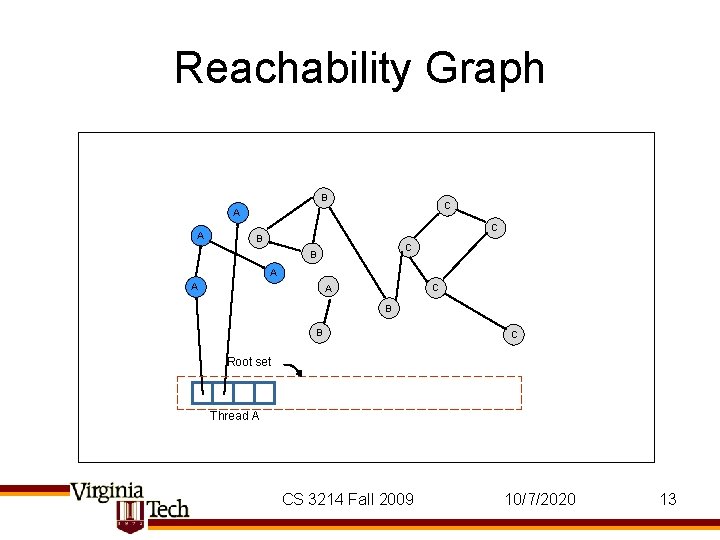
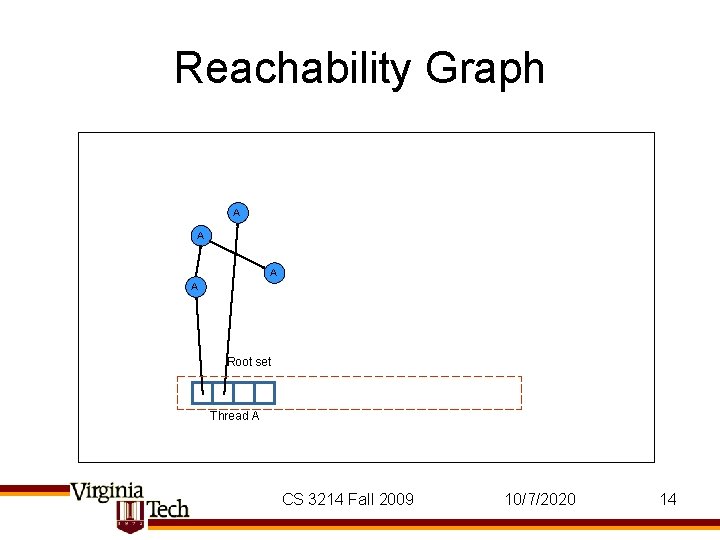
Garbage Collection • Determine which objects may be accessed in the future – Don’t know which one’s will, but can determine those who can’t be accessed because there are no pointers to them – Requires that all pointers are identifiable (e. g. , not pointer/int conversion • Invented 1960 by Mc. Carthy for LISP CS 3214 Fall 2009 10/7/2020 8
Reachability Graph B B C A A C B A A C A B C C Root set Thread A Thread B CS 3214 Fall 2009 Thread C 10/7/2020 9
Reachability Graph B B C A A C B A A C A B C C Root set Thread A Thread B CS 3214 Fall 2009 Thread C 10/7/2020 10
Reachability Graph B C A A C B A A C A B B C C Root set Thread A Thread B CS 3214 Fall 2009 Thread C 10/7/2020 11
Reachability Graph B C A A C B A A C A B B C C Root set Thread A Thread B CS 3214 Fall 2009 10/7/2020 12
Reachability Graph B C A A C B A A C A B B C Root set Thread A CS 3214 Fall 2009 10/7/2020 13
Reachability Graph A A Root set Thread A CS 3214 Fall 2009 10/7/2020 14
Application Programmer’s Perspective • Tuning garbage collection parameters • Dealing with Memory Leaks • Garbage collection in mixed language environments – C code must coordinate with the garbage collection system in place CS 3214 Fall 2009 10/7/2020 15
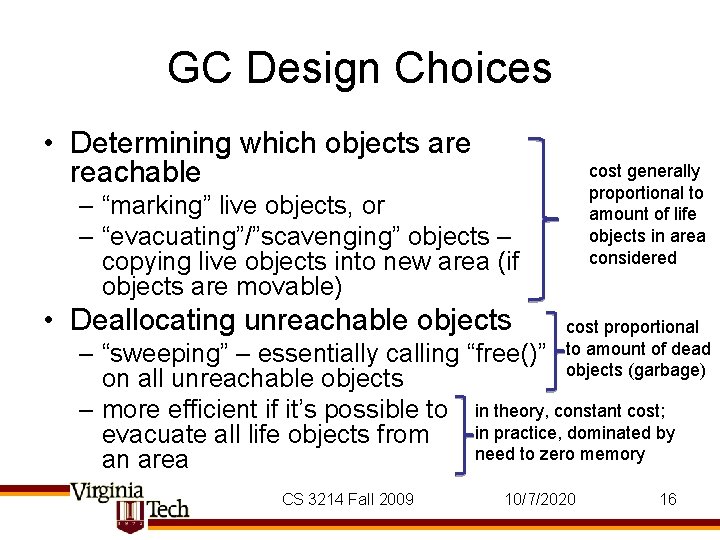
GC Design Choices • Determining which objects are reachable cost generally proportional to amount of life objects in area considered – “marking” live objects, or – “evacuating”/”scavenging” objects – copying live objects into new area (if objects are movable) • Deallocating unreachable objects cost proportional to amount of dead objects (garbage) – “sweeping” – essentially calling “free()” on all unreachable objects – more efficient if it’s possible to in theory, constant cost; in practice, dominated by evacuate all life objects from need to zero memory an area CS 3214 Fall 2009 10/7/2020 16
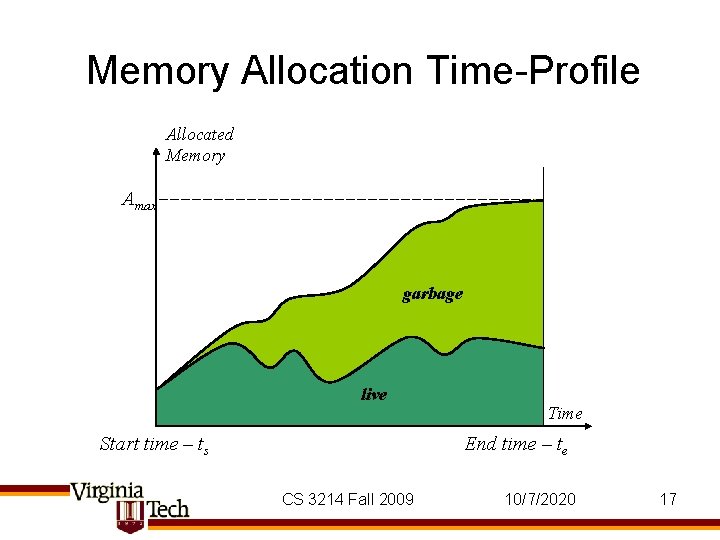
Memory Allocation Time-Profile Allocated Memory Amax garbage live Start time – ts Time End time – te CS 3214 Fall 2009 10/7/2020 17
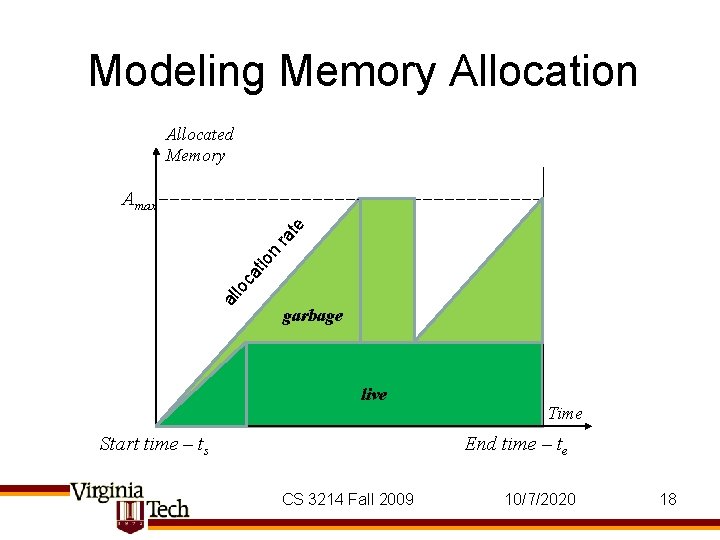
Modeling Memory Allocation Allocated Memory al lo ca t io n ra te Amax garbage live Start time – ts Time End time – te CS 3214 Fall 2009 10/7/2020 18
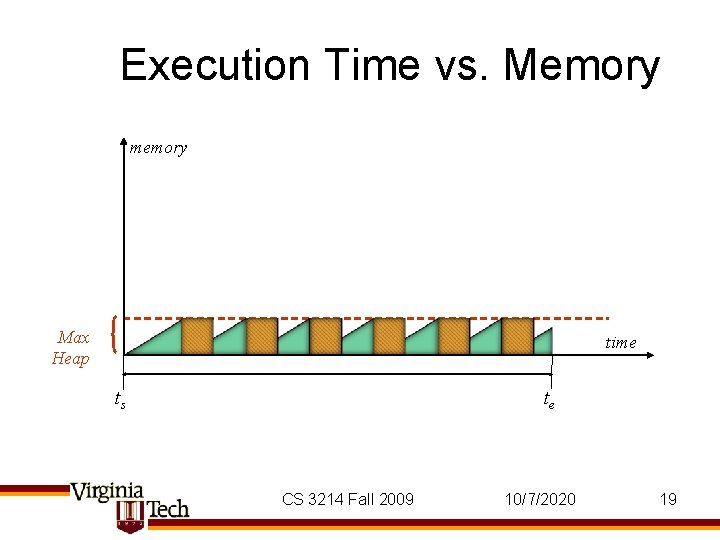
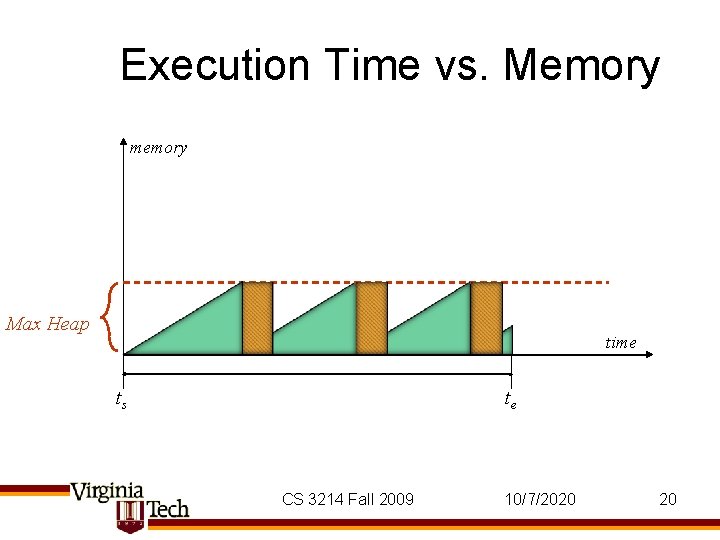
Execution Time vs. Memory memory Max Heap time ts te CS 3214 Fall 2009 10/7/2020 19
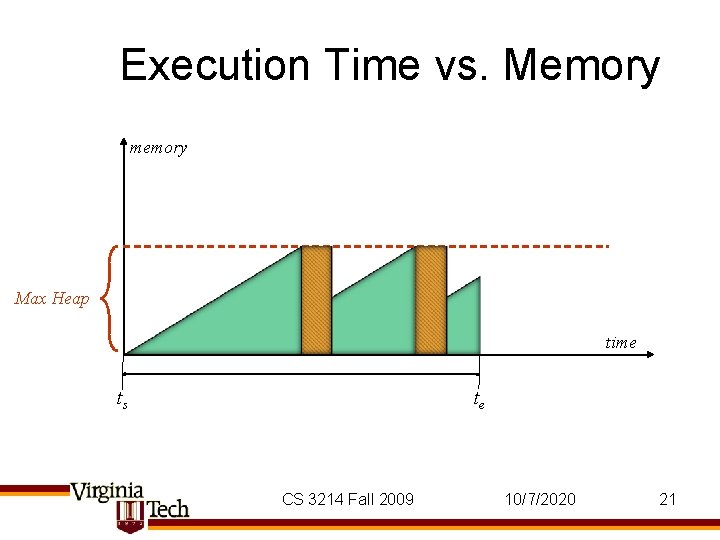
Execution Time vs. Memory memory Max Heap time ts te CS 3214 Fall 2009 10/7/2020 20
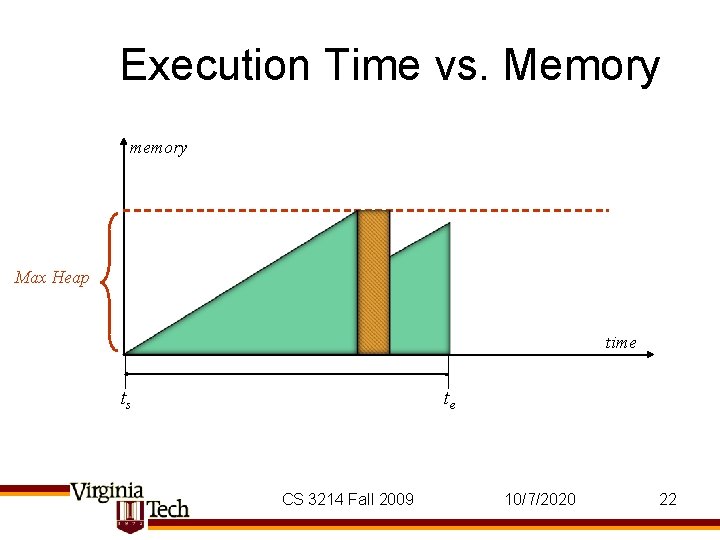
Execution Time vs. Memory memory Max Heap time ts te CS 3214 Fall 2009 10/7/2020 21
Execution Time vs. Memory memory Max Heap time ts te CS 3214 Fall 2009 10/7/2020 22
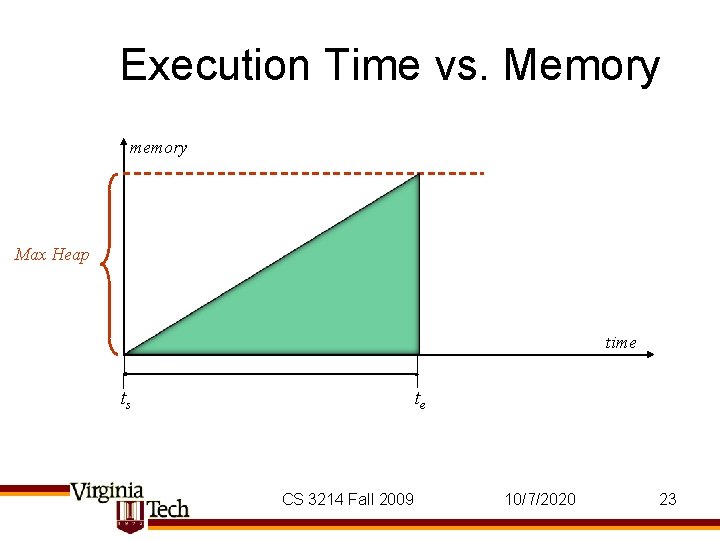
Execution Time vs. Memory memory Max Heap time ts te CS 3214 Fall 2009 10/7/2020 23
Heap Size vs. GC Frequency • All else being equal, smaller maximum heap sizes necessitate more frequent collections – Rule of thumb: need between 1. 5 x and 2. 5 x times the size of the live heap to limit collection overhead to 5 -15% for applications with reasonable allocation rates – Performance degradation occurs when live heap size approaches maximum heap size CS 3214 Fall 2009 10/7/2020 24
Infant Mortality Source: http: //java. sun. com/docs/hotspot/gc 5. 0/gc_tuning_5. html CS 3214 Fall 2009 10/7/2020 25
Generational Collection • Observation: “most objects die young” • Allocate objects in separate area (“nursery”, “Eden space”, collect area when run out of space – Will typically have to evacuate few survivors – “minor garbage collection” • But: must treat all pointers into Eden as roots – Typically, requires cooperation of the mutator threads to record assignments: if ‘b’ is young, and ‘a’ is old, a. x = b must add a root for ‘b’. • Aka “write barrier” CS 3214 Fall 2009 10/7/2020 26
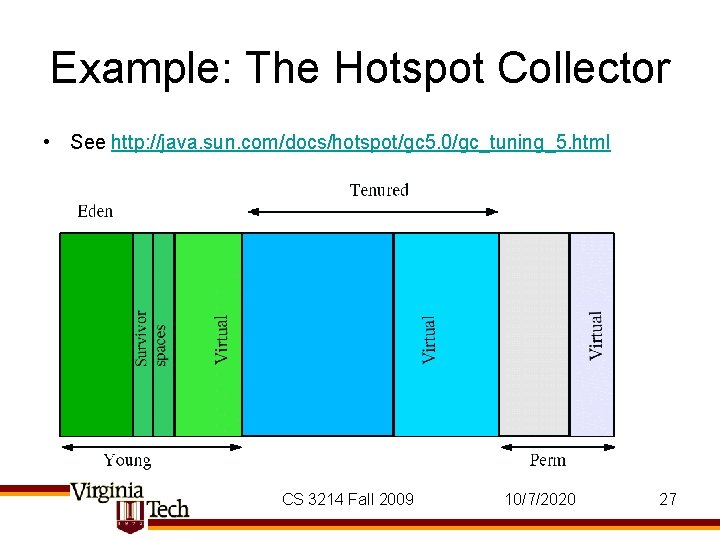
Example: The Hotspot Collector • See http: //java. sun. com/docs/hotspot/gc 5. 0/gc_tuning_5. html CS 3214 Fall 2009 10/7/2020 27
When to collect • “Stop-the-world” – All mutators stop while collection is ongoing • Incremental – Mutators perform small chunks of marking during each allocation • Concurrent/Parallel – Garbage collection happens in concurrently running thread – requires some kind of synchronization between mutator & collector CS 3214 Fall 2009 10/7/2020 28
Precise vs. Conservative Collectors • Precise collectors keep only objects alive that are in fact part of reachability graph • Conservative collectors may keep objects alive that aren’t – Reason typically that they do not know where pointers are stored, must conservatively guess • In-between forms: some systems assume precise knowledge of heap objects, but not stack frame layouts – Can be expensive to keep track of where references are stored on the stack, particularly in fully preemptive environments • Conservatism makes GC usable for languages such as C, but prevents moving/compacting of objects CS 3214 Fall 2009 10/7/2020 29
Memory Leaks • Objects that remain reachable, but will not be accessed in the future – Due to application semantics • Will ultimately lead to out-of-memory condition – But will degrade performance before that • Common problem, particularly in multilayer frameworks – Heap profilers can help CS 3214 Fall 2009 10/7/2020 30