
CS 3214 Computer Systems Lecture 14 Godmar Back
CS 3214 Computer Systems Lecture 14 Godmar Back
Announcements • Project 3 due Mar 24 • Exercise 7 due Mar 25 CS 3214 Spring 2010 11/26/2020 2
Some of the following slides are taken with permission from Complete Powerpoint Lecture Notes for Computer Systems: A Programmer's Perspective (CS: APP) Randal E. Bryant and David R. O'Hallaron http: //csapp. cs. cmu. edu/public/lectures. html Part 1 LINKING AND LOADING CS 3214 Spring 2010 11/26/2020 3
Topics • • • Static linking Object files Static libraries Loading Dynamic linking of shared libraries • Linking is a mundane topic – Full of quirks and seemingly arbitrary rules – But worth learning, IMO – Necessary for any C and interlanguage programming practice CS 3214 Spring 2010 11/26/2020 4
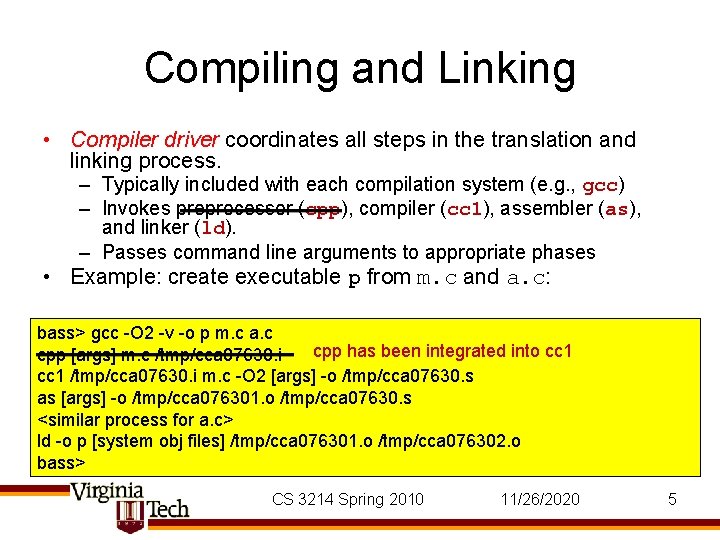
Compiling and Linking • Compiler driver coordinates all steps in the translation and linking process. – Typically included with each compilation system (e. g. , gcc) – Invokes preprocessor (cpp), compiler (cc 1), assembler (as), and linker (ld). – Passes command line arguments to appropriate phases • Example: create executable p from m. c and a. c: bass> gcc -O 2 -v -o p m. c a. c cpp has been integrated into cc 1 cpp [args] m. c /tmp/cca 07630. i cc 1 /tmp/cca 07630. i m. c -O 2 [args] -o /tmp/cca 07630. s as [args] -o /tmp/cca 076301. o /tmp/cca 07630. s <similar process for a. c> ld -o p [system obj files] /tmp/cca 076301. o /tmp/cca 076302. o bass> CS 3214 Spring 2010 11/26/2020 5
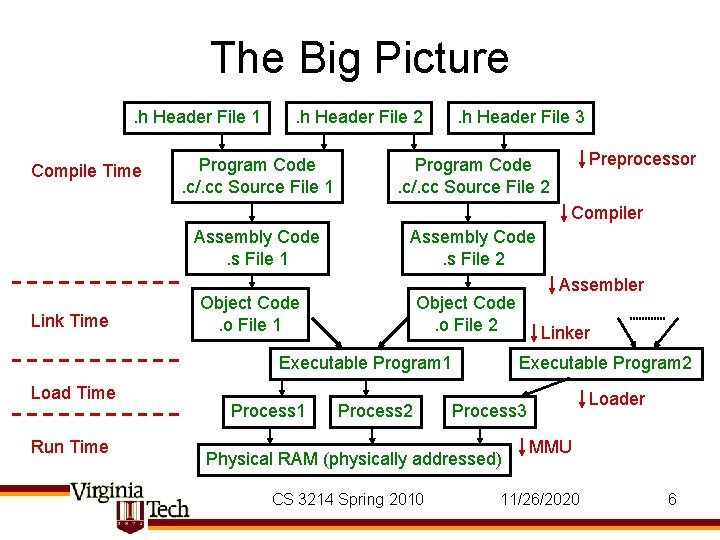
The Big Picture. h Header File 1 Compile Time . h Header File 2 Program Code. c/. cc Source File 1 . h Header File 3 Preprocessor Program Code. c/. cc Source File 2 Compiler Assembly Code. s File 1 Link Time Assembly Code. s File 2 Object Code. o File 1 Object Code. o File 2 Executable Program 1 Load Time Run Time Process 1 Assembler Process 2 Executable Program 2 Loader Process 3 Physical RAM (physically addressed) CS 3214 Spring 2010 Linker MMU 11/26/2020 6
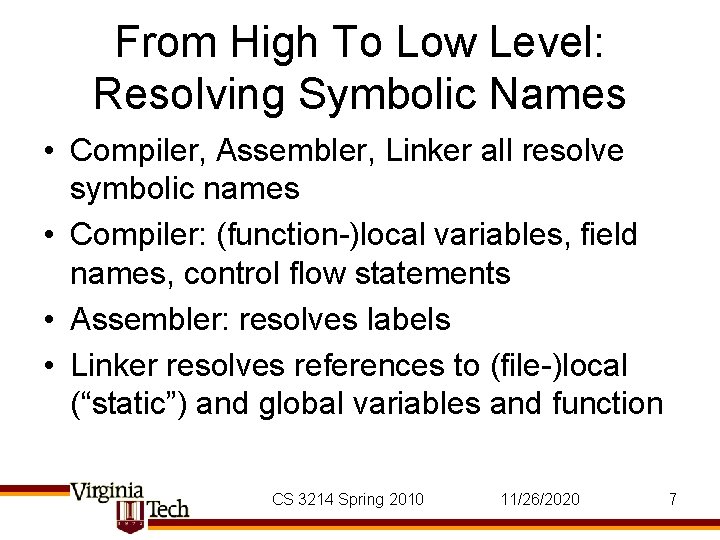
From High To Low Level: Resolving Symbolic Names • Compiler, Assembler, Linker all resolve symbolic names • Compiler: (function-)local variables, field names, control flow statements • Assembler: resolves labels • Linker resolves references to (file-)local (“static”) and global variables and function CS 3214 Spring 2010 11/26/2020 7

Linker Puzzles code 1. c code 2. c int x; p 1() {} int x; p 2() {} int x; int y; p 1() {} double x; p 2() {} int x=7; int y=5; p 1() {} double x; p 2() {} int x=7; p 1() {} int x; p 2() {} Question for each example: Will it link? If so, will it run? If so, what will happen? CS 3214 Spring 2010 11/26/2020 8
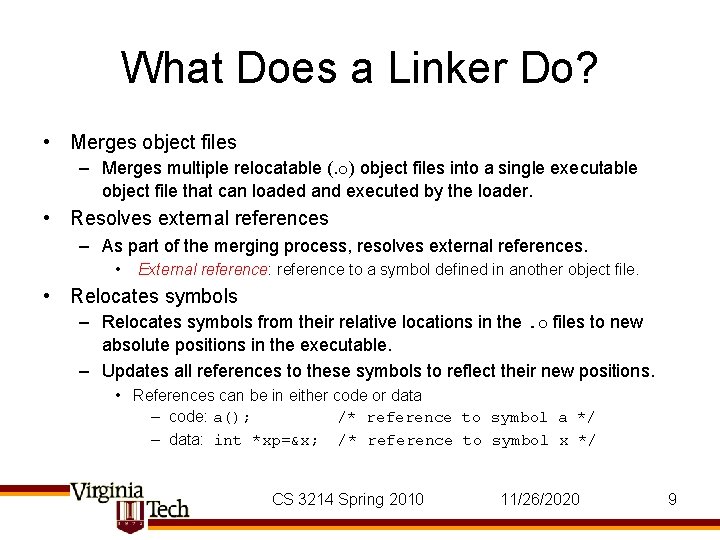
What Does a Linker Do? • Merges object files – Merges multiple relocatable (. o) object files into a single executable object file that can loaded and executed by the loader. • Resolves external references – As part of the merging process, resolves external references. • External reference: reference to a symbol defined in another object file. • Relocates symbols – Relocates symbols from their relative locations in the. o files to new absolute positions in the executable. – Updates all references to these symbols to reflect their new positions. • References can be in either code or data – code: a(); /* reference to symbol a */ – data: int *xp=&x; /* reference to symbol x */ CS 3214 Spring 2010 11/26/2020 9
Why Linkers? • Modularity – Program can be written as a collection of smaller source files, rather than one monolithic mass. – Can build libraries of common functions (more on this later) • e. g. , Math library, standard C library • Efficiency – Time: • Change one source file, compile, and then relink. • No need to recompile other source files. – Space: • Libraries of common functions can be aggregated into a single archive file. . . • Yet executable files and running memory images contain only code for the modules whose functions they actually use CS 3214 Spring 2010 11/26/2020 10
Executable and Linkable Format (ELF) • Standard binary format for object files • Derives from AT&T System V Unix – Later adopted by BSD Unix variants and Linux • One unified format for – Relocatable object files (. o), – Executable object files – Shared object files (. so) • Generic name: ELF binaries • Better support for shared libraries than old a. out formats. CS 3214 Spring 2010 11/26/2020 11
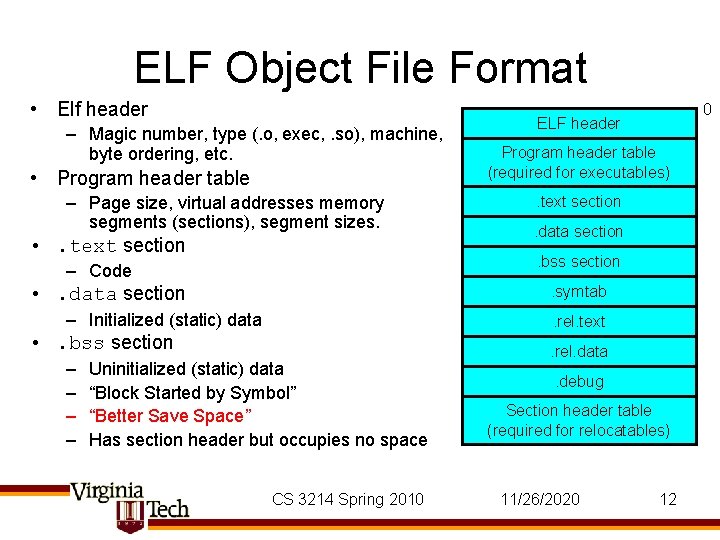
ELF Object File Format • Elf header – Magic number, type (. o, exec, . so), machine, byte ordering, etc. • Program header table – Page size, virtual addresses memory segments (sections), segment sizes. • . text section ELF header Program header table (required for executables). text section. data section. bss section – Code • . data section . symtab – Initialized (static) data . rel. text • . bss section – – 0 Uninitialized (static) data “Block Started by Symbol” “Better Save Space” Has section header but occupies no space CS 3214 Spring 2010 . rel. data. debug Section header table (required for relocatables) 11/26/2020 12
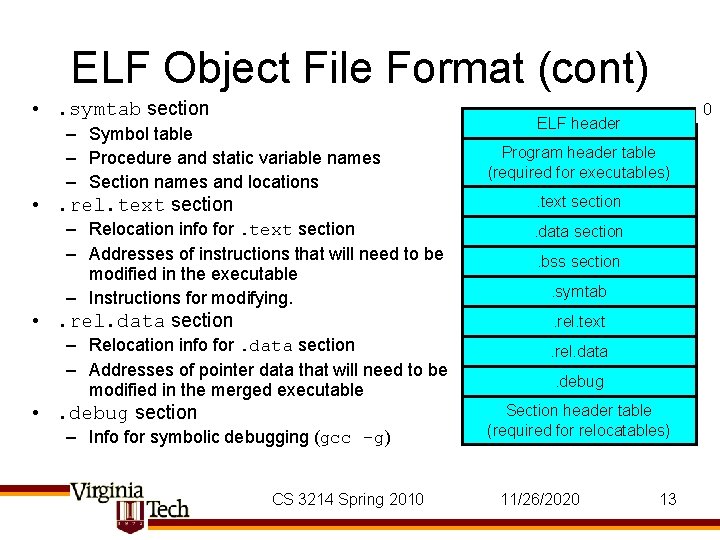
ELF Object File Format (cont) • . symtab section – Symbol table – Procedure and static variable names – Section names and locations 0 ELF header Program header table (required for executables). text section • . rel. text section – Relocation info for. text section – Addresses of instructions that will need to be modified in the executable – Instructions for modifying. • . rel. data section. bss section. symtab. rel. text – Relocation info for. data section – Addresses of pointer data that will need to be modified in the merged executable • . debug section – Info for symbolic debugging (gcc -g) CS 3214 Spring 2010 . rel. data. debug Section header table (required for relocatables) 11/26/2020 13
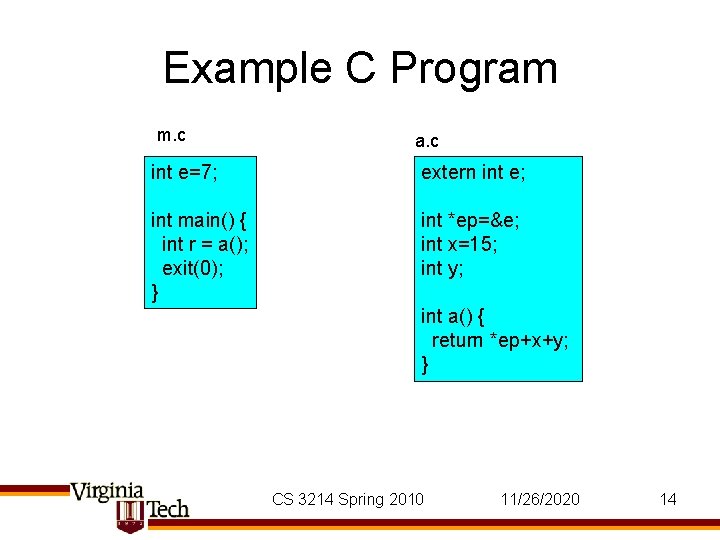
Example C Program m. c a. c int e=7; extern int e; int main() { int r = a(); exit(0); } int *ep=&e; int x=15; int y; int a() { return *ep+x+y; } CS 3214 Spring 2010 11/26/2020 14
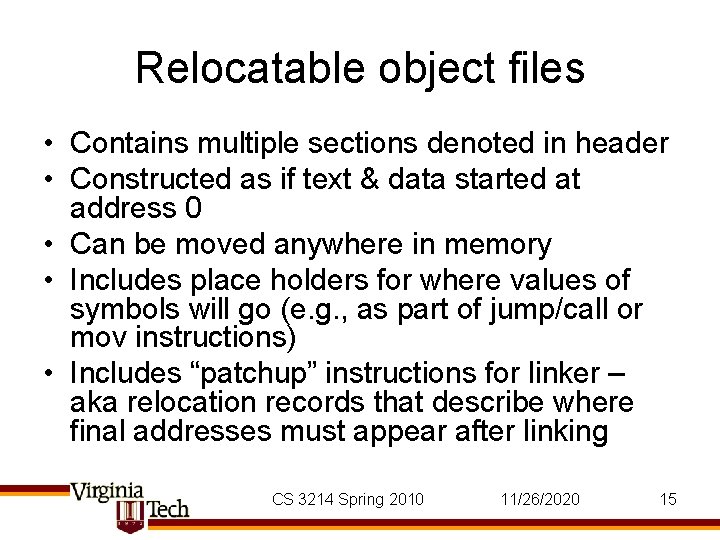
Relocatable object files • Contains multiple sections denoted in header • Constructed as if text & data started at address 0 • Can be moved anywhere in memory • Includes place holders for where values of symbols will go (e. g. , as part of jump/call or mov instructions) • Includes “patchup” instructions for linker – aka relocation records that describe where final addresses must appear after linking CS 3214 Spring 2010 11/26/2020 15
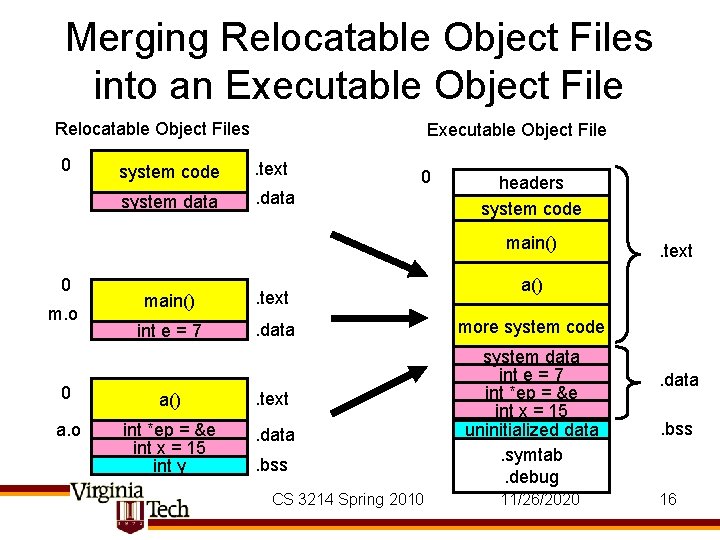
Merging Relocatable Object Files into an Executable Object File Relocatable Object Files 0 Executable Object File system code . text system data 0 headers system code main() 0 m. o main() . text int e = 7 . data 0 a() . text a. o int *ep = &e int x = 15 int y . data. bss CS 3214 Spring 2010 . text a() more system code system data int e = 7 int *ep = &e int x = 15 uninitialized data. symtab. debug 11/26/2020 . data. bss 16
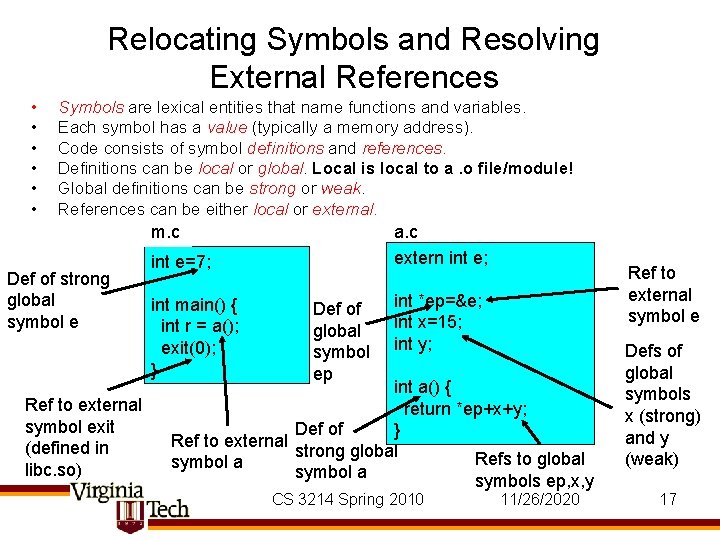
Relocating Symbols and Resolving External References • • • Symbols are lexical entities that name functions and variables. Each symbol has a value (typically a memory address). Code consists of symbol definitions and references. Definitions can be local or global. Local is local to a. o file/module! Global definitions can be strong or weak. References can be either local or external. m. c Def of strong global symbol e Ref to external symbol exit (defined in libc. so) a. c extern int e; int e=7; int main() { int r = a(); exit(0); } Def of global symbol ep Ref to external symbol e int *ep=&e; int x=15; int y; int a() { return *ep+x+y; Def of } Ref to external strong global Refs to global symbol a symbols ep, x, y CS 3214 Spring 2010 11/26/2020 Defs of global symbols x (strong) and y (weak) 17
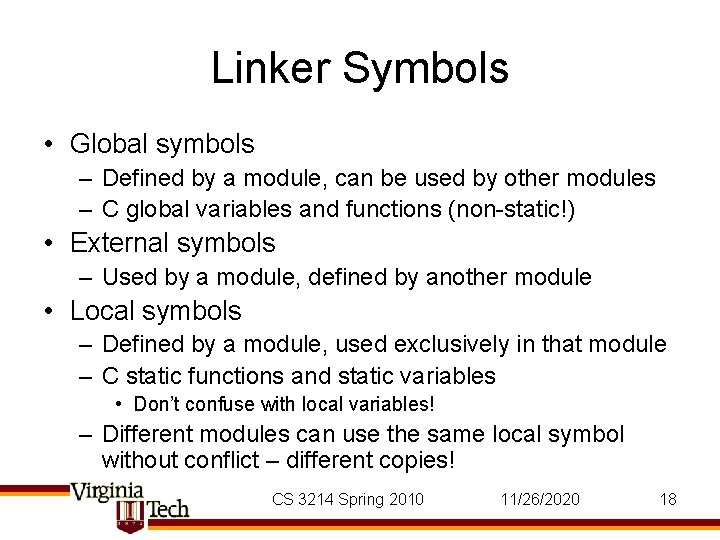
Linker Symbols • Global symbols – Defined by a module, can be used by other modules – C global variables and functions (non-static!) • External symbols – Used by a module, defined by another module • Local symbols – Defined by a module, used exclusively in that module – C static functions and static variables • Don’t confuse with local variables! – Different modules can use the same local symbol without conflict – different copies! CS 3214 Spring 2010 11/26/2020 18
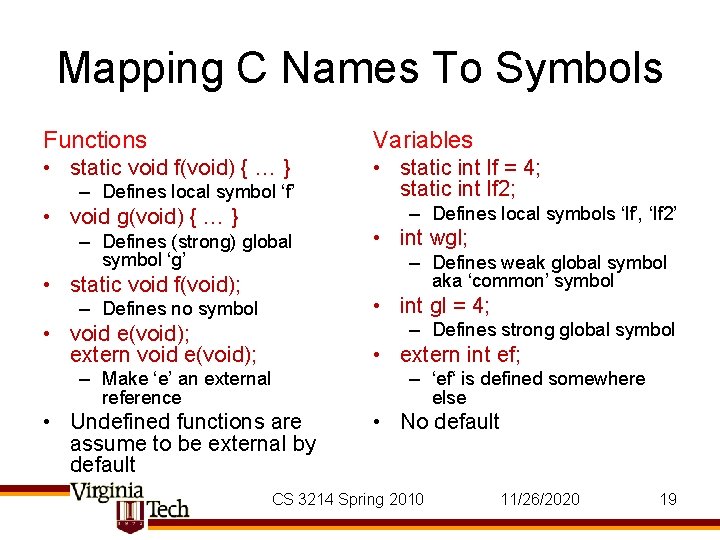
Mapping C Names To Symbols Functions Variables • static void f(void) { … } • static int lf = 4; static int lf 2; – Defines local symbol ‘f’ • void g(void) { … } – Defines (strong) global symbol ‘g’ • static void f(void); – Defines local symbols ‘lf’, ‘lf 2’ • int wgl; – Defines weak global symbol aka ‘common’ symbol • int gl = 4; – Defines no symbol – Defines strong global symbol • void e(void); extern void e(void); • extern int ef; – Make ‘e’ an external reference • Undefined functions are assume to be external by default – ‘ef‘ is defined somewhere else • No default CS 3214 Spring 2010 11/26/2020 19
Aside: Assembler Rules • Symbols became labels at the assembler level • Default here is local, must say “. global” to make it global – Reversed from C, where default is global and must say “static” to make local CS 3214 Spring 2010 11/26/2020 20
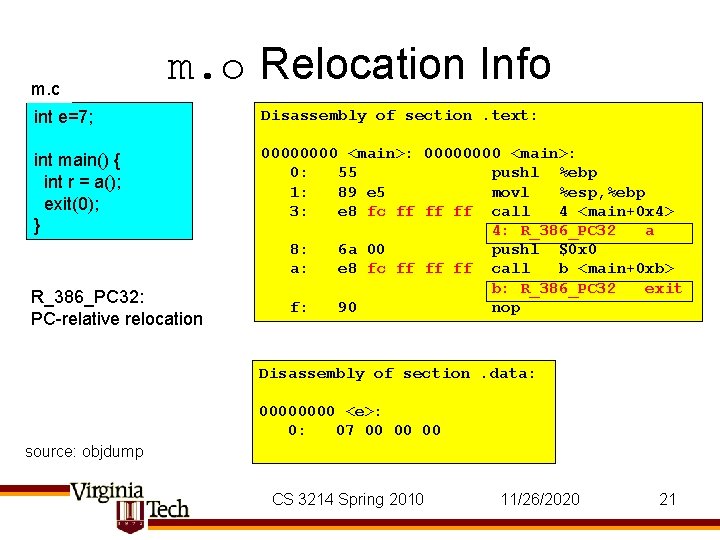
m. c m. o Relocation Info int e=7; Disassembly of section. text: int main() { int r = a(); exit(0); } 00000000 <main>: 0: 55 pushl %ebp 1: 89 e 5 movl %esp, %ebp 3: e 8 fc ff ff ff call 4 <main+0 x 4> 4: R_386_PC 32 a 8: 6 a 00 pushl $0 x 0 a: e 8 fc ff ff ff call b <main+0 xb> b: R_386_PC 32 exit f: 90 nop R_386_PC 32: PC-relative relocation Disassembly of section. data: 0000 <e>: 0: 07 00 00 00 source: objdump CS 3214 Spring 2010 11/26/2020 21
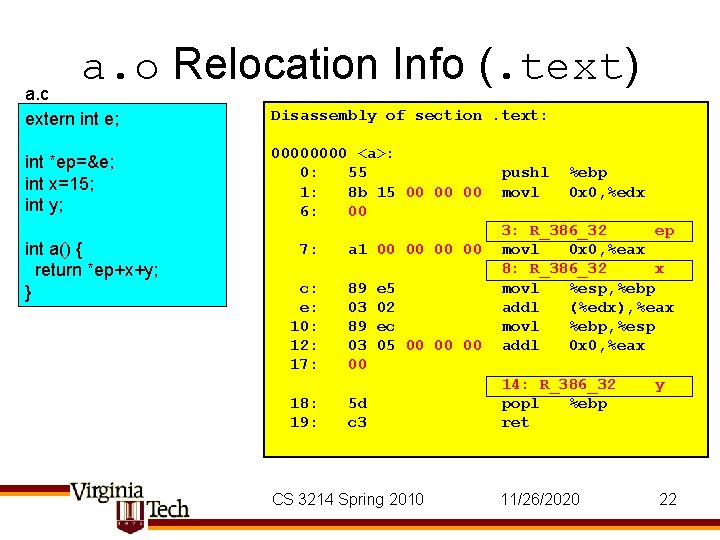
a. o Relocation Info (. text) a. c extern int e; Disassembly of section. text: int *ep=&e; int x=15; int y; 0000 <a>: 0: 55 1: 8 b 15 00 00 00 6: 00 int a() { return *ep+x+y; } 7: c: e: 10: 12: 17: 18: 19: a 1 00 00 89 03 00 e 5 02 ec 05 00 00 00 5 d c 3 CS 3214 Spring 2010 pushl movl %ebp 0 x 0, %edx 3: R_386_32 ep movl 0 x 0, %eax 8: R_386_32 x movl %esp, %ebp addl (%edx), %eax movl %ebp, %esp addl 0 x 0, %eax 14: R_386_32 popl %ebp ret y 11/26/2020 22
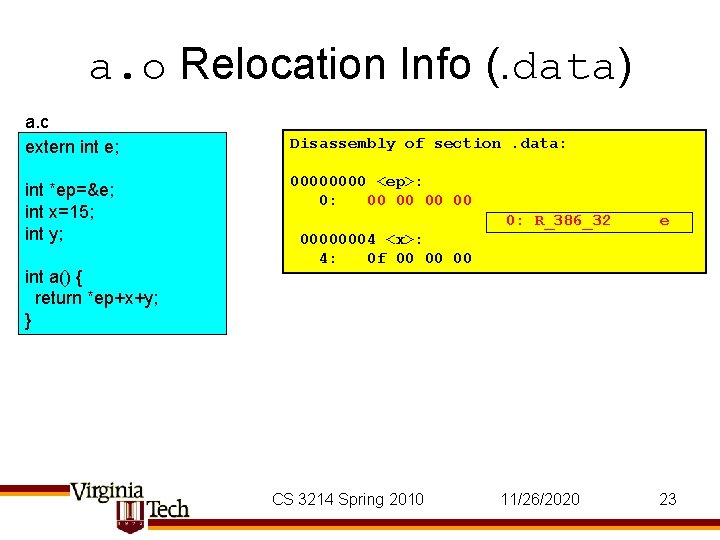
a. o Relocation Info (. data) a. c extern int e; int *ep=&e; int x=15; int y; int a() { return *ep+x+y; } Disassembly of section. data: 0000 <ep>: 0: 00 00 0: R_386_32 e 00000004 <x>: 4: 0 f 00 00 00 CS 3214 Spring 2010 11/26/2020 23
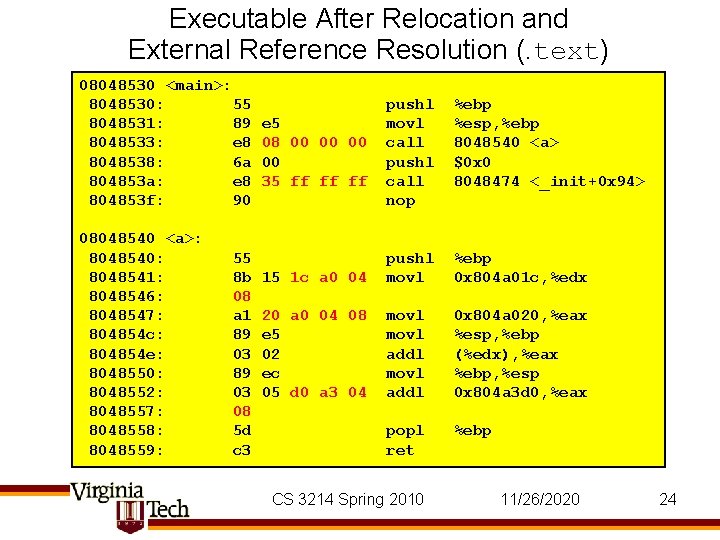
Executable After Relocation and External Reference Resolution (. text) 08048530 <main>: 8048530: 55 8048531: 89 8048533: e 8 8048538: 6 a 804853 a: e 8 804853 f: 90 08048540 <a>: 8048540: 8048541: 8048546: 8048547: 804854 c: 804854 e: 8048550: 8048552: 8048557: 8048558: 8048559: 55 8 b 08 a 1 89 03 08 5 d c 3 pushl movl call pushl call nop %ebp %esp, %ebp 8048540 <a> $0 x 0 8048474 <_init+0 x 94> 15 1 c a 0 04 pushl movl %ebp 0 x 804 a 01 c, %edx 20 a 0 04 08 e 5 02 ec 05 d 0 a 3 04 movl addl 0 x 804 a 020, %eax %esp, %ebp (%edx), %eax %ebp, %esp 0 x 804 a 3 d 0, %eax popl ret %ebp e 5 08 00 00 35 ff ff ff CS 3214 Spring 2010 11/26/2020 24
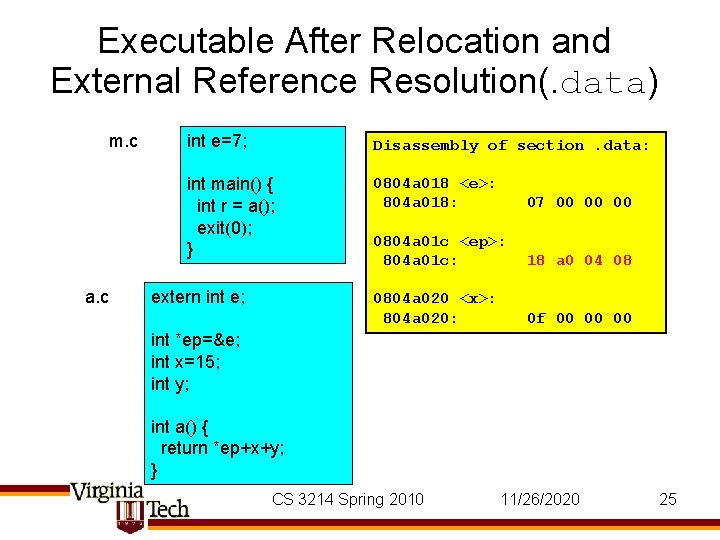
Executable After Relocation and External Reference Resolution(. data) m. c a. c int e=7; Disassembly of section. data: int main() { int r = a(); exit(0); } 0804 a 018 <e>: 804 a 018: 07 00 00 00 0804 a 01 c <ep>: 804 a 01 c: 18 a 0 04 08 0804 a 020 <x>: 804 a 020: 0 f 00 00 00 extern int e; int *ep=&e; int x=15; int y; int a() { return *ep+x+y; } CS 3214 Spring 2010 11/26/2020 25
Linker’s Symbol Rules • Rule 1. A strong symbol can only appear once. • Rule 2. A weak symbol can be overridden by a strong symbol of the same name. – references to the weak symbol resolve to the strong symbol. • Rule 3. If there are multiple weak symbols of the same name, the linker can pick an arbitrary one. CS 3214 Spring 2010 11/26/2020 26
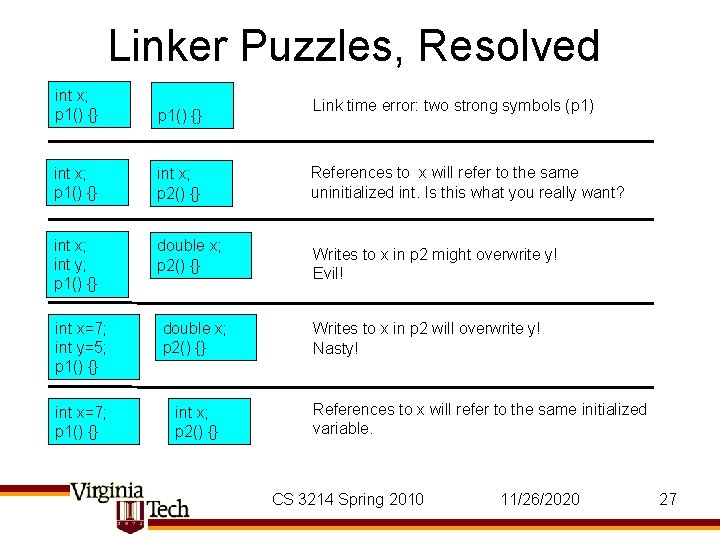
Linker Puzzles, Resolved int x; p 1() {} int x; p 2() {} int x; int y; p 1() {} double x; p 2() {} int x=7; int y=5; p 1() {} double x; p 2() {} int x=7; p 1() {} int x; p 2() {} Link time error: two strong symbols (p 1) References to x will refer to the same uninitialized int. Is this what you really want? Writes to x in p 2 might overwrite y! Evil! Writes to x in p 2 will overwrite y! Nasty! References to x will refer to the same initialized variable. CS 3214 Spring 2010 11/26/2020 27
Practical Considerations • Variables: – Avoid global variables (of course!) – Place ‘extern’ declaration in header file, chose exactly one. c file for definition • (If appropriate) initialize global variable to make symbol strong – If you followed these rules, -Wl, --warn-common should be quiet • Functions – Make static whenever possible – Use consistent prefix for public functions, e. g. : • file. c exports file_open, file_close, file_read, file_write • strlen. c contains strlen() – Don’t ignore “implicit declaration warnings” – Declare global functions in header files • Consider –Wmissing-prototypes CS 3214 Spring 2010 11/26/2020 28
Practical Considerations (2) • Never define variables in header files • Consider – If defined non-static • w/o initialization, e. g. int x; – will link and refer to same variable – unclear if this is intended (because of multiple weak symbol rule) • w/ initialization, e. g. int x = 5; – gives linker error “multiply defined” once. h is included in multiple. c files – If defined static, e. g. static int x; • w/ or w/o initialization – Will compile and link, but each. c file has its own copy – This is practically never what you want CS 3214 Spring 2010 11/26/2020 29
Practical Considerations (3) • Defining functions in header files • Ok for static functions – (non-static would give conflicting strong symbols) • Potential disadvantage: if function is not inlined, code will be duplicated in each. o module – If inlined, no penalty • Remember that compiler needs to see function definition in same compilation unit to inline – Solution: define all functions you wish to inline statically in. h files – Define all small functions in. h files CS 3214 Spring 2010 11/26/2020 30
- Slides: 30