ECOR 1010 Introduction to Engineering The Systems Engineering




- Slides: 23
ECOR 1010 Introduction to Engineering The Systems Engineering Tradition at Carleton U D. L. Bailey Department of Systems and Computer Engineering Carleton University November 2007 • • • Copyright © 2000 - 2007 D. L. Bailey. Additional slides added Nov. 2005, Copyright © 2005 T. W. Pearce. For use in ECOR 1010 only. May not be distributed outside the Faculty of Engineering, Carleton University, Ottawa, Canada, without permission. 1
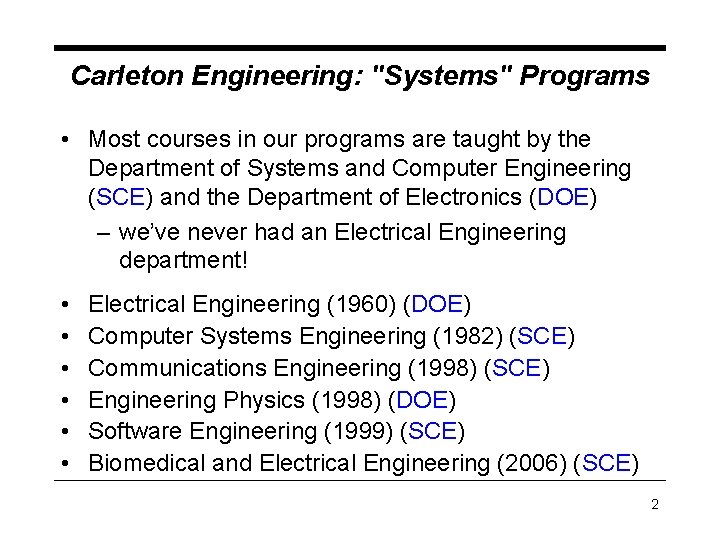
Carleton Engineering: "Systems" Programs • Most courses in our programs are taught by the Department of Systems and Computer Engineering (SCE) and the Department of Electronics (DOE) – we’ve never had an Electrical Engineering department! • • • Electrical Engineering (1960) (DOE) Computer Systems Engineering (1982) (SCE) Communications Engineering (1998) (SCE) Engineering Physics (1998) (DOE) Software Engineering (1999) (SCE) Biomedical and Electrical Engineering (2006) (SCE) 2
What is Systems Engineering? • Stereotypes abound. . . • Do you have “The Knack”? 3
Did You Know? 4
Engineering Education • “Preparing students for jobs that don't yet exist. . . • . . . using technologies that haven't yet been invented • . . . to solve problems we don't even know are problems” 5
What Do Systems Engineers Do? • Develop systems that acquire, transmit, store, retrieve, and process information – – – – a heartbeat a vehicle's speed a cell phone call a simulation of an amplifier circuit a distributed filesystem MMORPG and MMORTS games etc. , etc. 6
What Will You Work On After Graduating? • Difficult to predict. . . • What problems will need solving 4 years from now? 10 years from now? • Some technologies that did not exist (or were in their infancies) when I started in industry – CDs, DVDs, i. Pod, laptop computers, cell phones, portable medical diagnostic devices, the Internet, WWW, personal computer applications (word processing, spreadsheets, CAD) – Python, Ruby, Java, C++, C#, Groovy, Visual Basic, MATLAB, Mathematica, Maple, ECMAScript (Java. Script), HTML, XML, . . . 7
What Will You Work On After Graduating? • Some areas of opportunity – ubitquous computing • computers are everywhere • desktop PCs are statistically non-existent – portable, wireless medical devices – organization, search, & retrieval of information on the Web is painful - your generation of graduates will be the ones that design WWW 2 – "programming for everyone" - will require major changes to current software technologies 8
Preparing For a Career, Not a Job • The 3 P's – Principles (most important) – Processes – Products (evolve rapidly - life cycle often 18 months to 2 years, or less) 9
Preparing For a Career, Not a Job • Don't overspecialize at the undergraduate level • A solid understanding of fundamental engineering principles and design (modeling) skills is much more important than immersing yourself in the latest hot technology • Communication and teamwork skills! • Learn how to learn 10
11
So, Just What is a System? a system converts inputs. . . to outputs 12
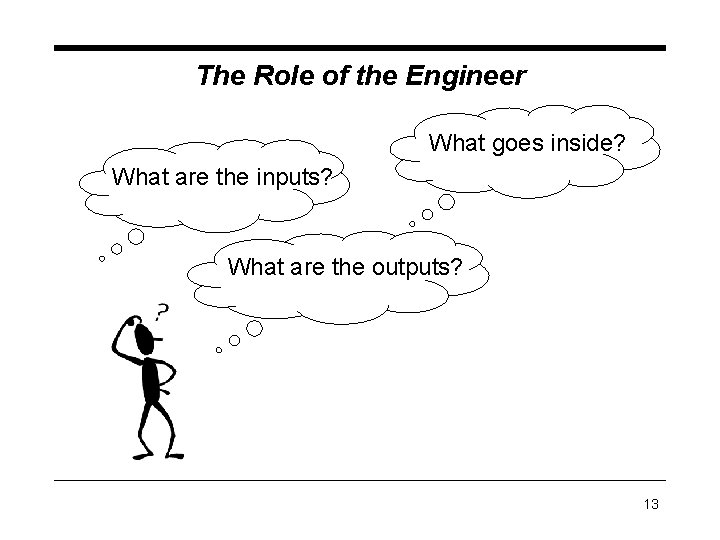
The Role of the Engineer What goes inside? What are the inputs? What are the outputs? 13
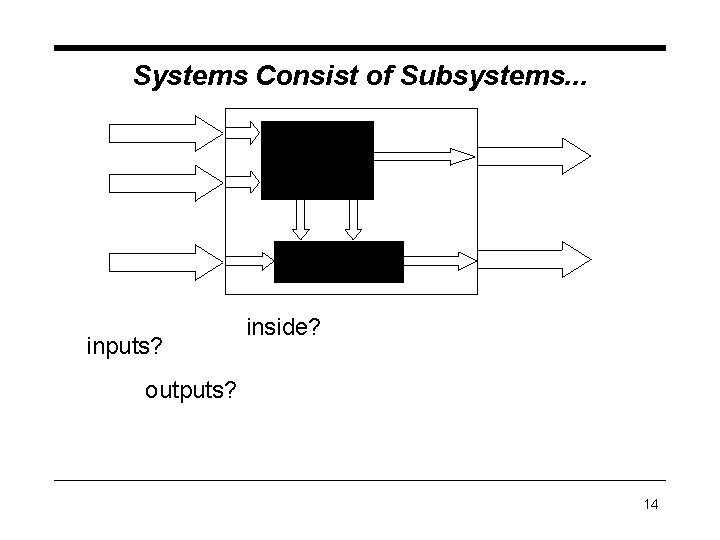
Systems Consist of Subsystems. . . inputs? inside? outputs? 14
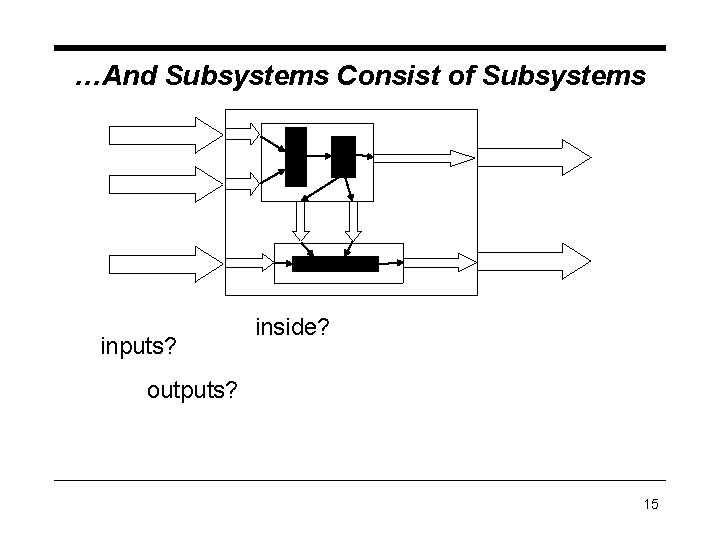
…And Subsystems Consist of Subsystems inputs? inside? outputs? 15
Systems Can Be Complex • Many systems are so complex that no one person can comprehend them in their entirety • How can you think & talk about a system you want to build before the system is actually built? • Design abstract models. . . 16
What is a Model? • A model is a simplification of reality – sketches – 3 D models (may involve architects and industrial designers) – blueprints, schematics (increasing use of CAD tools in all disciplines) – analytical (mathematical) models (increasing use of tools; e. g. , Matlab, Maple) – computer programs (algorithmic models) – simulations 17
Models Help Us Deal With Complexity • Models let us focus on the important stuff, hide (ignore? ) the rest • We often design multiple models with different levels of abstraction, often dealing with different aspects of the system – some models are detailed – some models ignore (most) details and instead focus on the “big picture” • You weren't taught this in high school! • Learning how to model is one of the most important aspects of an engineering education 18
Systems Span Engineering Disciplines • Systems aren’t just the domain of SCE • Many of the topics taught in courses offered by Electronics, Mechanical & Aerospace Engineering, and Civil & Environmental Engineering deal with systems • Many systems projects involve engineers (and other specialists) from several disciplines working in teams 19
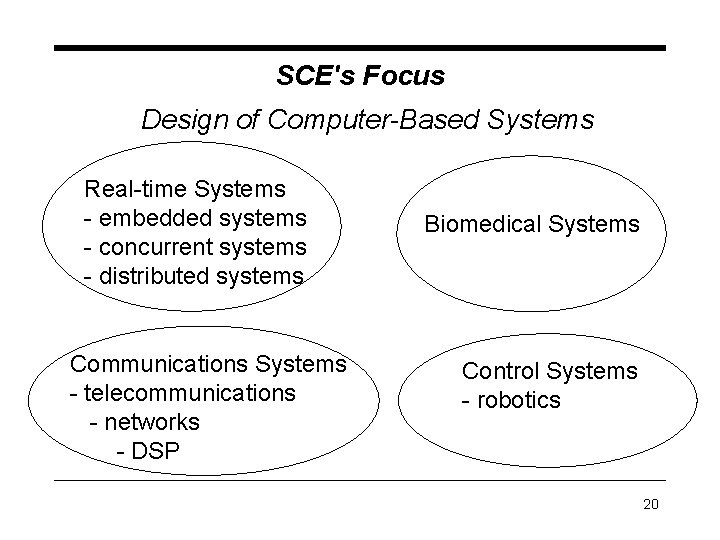
SCE's Focus Design of Computer-Based Systems Real-time Systems - embedded systems - concurrent systems - distributed systems Communications Systems - telecommunications - networks - DSP Biomedical Systems Control Systems - robotics 20
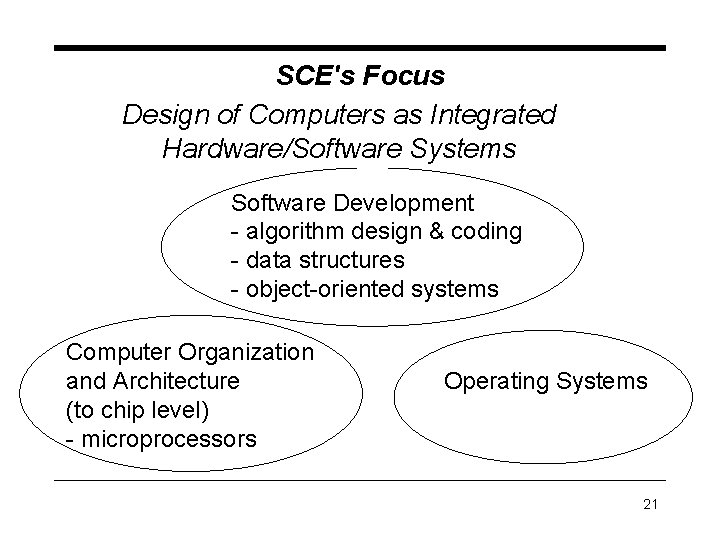
SCE's Focus Design of Computers as Integrated Hardware/Software Systems Software Development - algorithm design & coding - data structures - object-oriented systems Computer Organization and Architecture (to chip level) - microprocessors Operating Systems 21
Putting it All Together: 4 th Year Projects • SCE: www. sce. carleton. ca/courses/sysc-4907 – Proposal – Progress report – Oral presentation – Poster fair – Final report 22
SCE Through the Years • Over the years, SCE has been known as: – Division of Computing, Communications, Control and Power Systems (CCCP) – Division/Department of Systems Engineering – Department of Systems Engineering and Computer Science – Department of Systems and Computer Engineering 23