High energy cosmic rays neutrino astronomy Eli Waxman
![Cosmic accelerators log [d. J/d. E] E-2. 7 Galactic Protons E-3 Source: Supernovae(? )](https://slidetodoc.com/presentation_image/0093db0eeddeb6c9e7c37088c2ad42f1/image-3.jpg "Cosmic accelerators log [d. J/d. E] E-2. 7 Galactic Protons E-3 Source: Supernovae(? )")
![Composition Auger 2010 [Wilk & Wlodarczyk 10] Hi. Res 2010 Hi. Res 2005](https://slidetodoc.com/presentation_image/0093db0eeddeb6c9e7c37088c2ad42f1/image-5.jpg "Composition Auger 2010 [Wilk & Wlodarczyk 10] Hi. Res 2010 Hi. Res 2005")
![GRB Model Predictions [Miralda-Escude & EW 96]](https://slidetodoc.com/presentation_image/0093db0eeddeb6c9e7c37088c2ad42f1/image-16.jpg "GRB Model Predictions [Miralda-Escude & EW 96]")
- Slides: 39
High energy cosmic rays & neutrino astronomy Eli Waxman Weizmann Institute
X-Galactic/Ultra-high energy (e>1019 e. V)
Cosmic accelerators log [d. J/d. E] E-2. 7 Galactic Protons E-3 Source: Supernovae(? ) X-Galactic Heavy Nuclei Source? Light Nuclei? Lighter Source? 1 106 1010 Cosmic-ray E [Ge. V] [Blandford & Eichler, Phys. Rep. 87; Axford, Ap. JS 94; Nagano & Watson, Rev. Mod. Phys. 00]
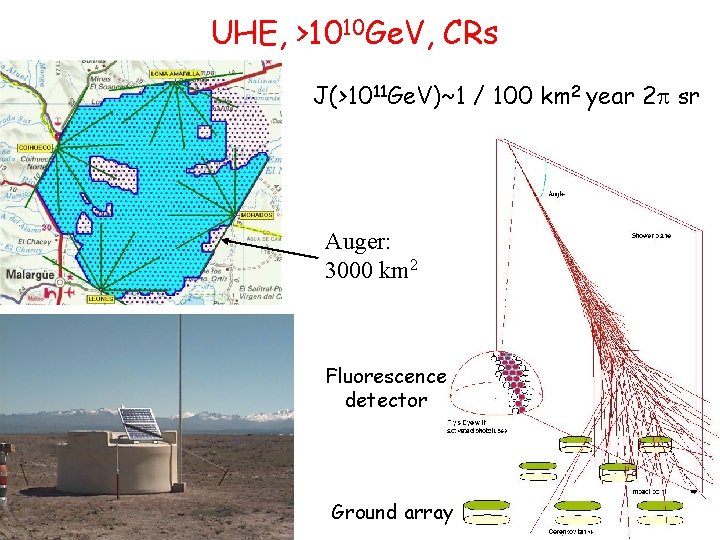
UHE, >1010 Ge. V, CRs J(>1011 Ge. V)~1 / 100 km 2 year 2 p sr 3, 000 km 2 Auger: 3000 km 2 Fluorescence detector Ground array
Composition Auger 2010 [Wilk & Wlodarczyk 10] Hi. Res 2010 Hi. Res 2005
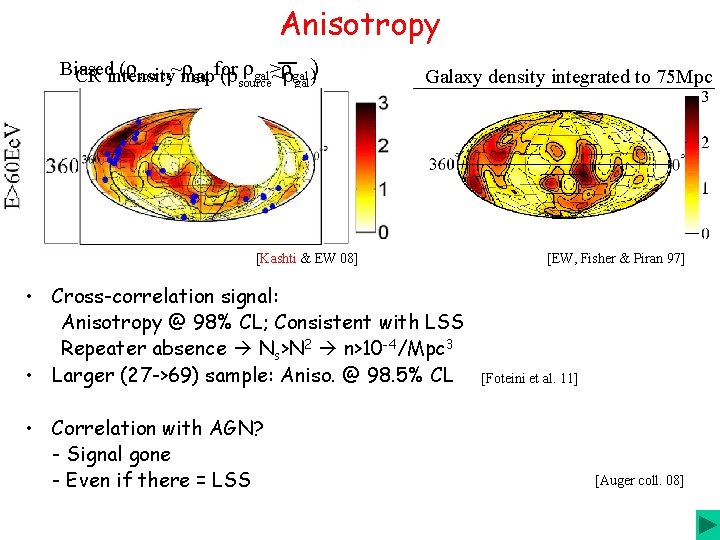
Anisotropy Biased (rsource~map rgal for rgal>~rrgal )) CR intensity (rsource gal Galaxy density integrated to 75 Mpc [Kashti & EW 08] • Cross-correlation signal: Anisotropy @ 98% CL; Consistent with LSS Repeater absence Ns>N 2 n>10 -4/Mpc 3 • Larger (27 ->69) sample: Aniso. @ 98. 5% CL • Correlation with AGN? - Signal gone - Even if there = LSS [EW, Fisher & Piran 97] [Foteini et al. 11] [Auger coll. 08]
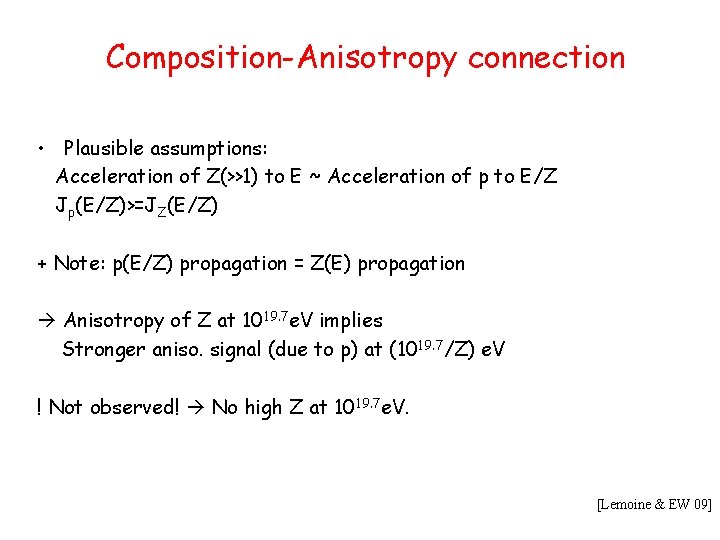
Composition-Anisotropy connection • Plausible assumptions: Acceleration of Z(>>1) to E ~ Acceleration of p to E/Z Jp(E/Z)>=JZ(E/Z) + Note: p(E/Z) propagation = Z(E) propagation Anisotropy of Z at 1019. 7 e. V implies Stronger aniso. signal (due to p) at (1019. 7/Z) e. V ! Not observed! No high Z at 1019. 7 e. V. [Lemoine & EW 09]
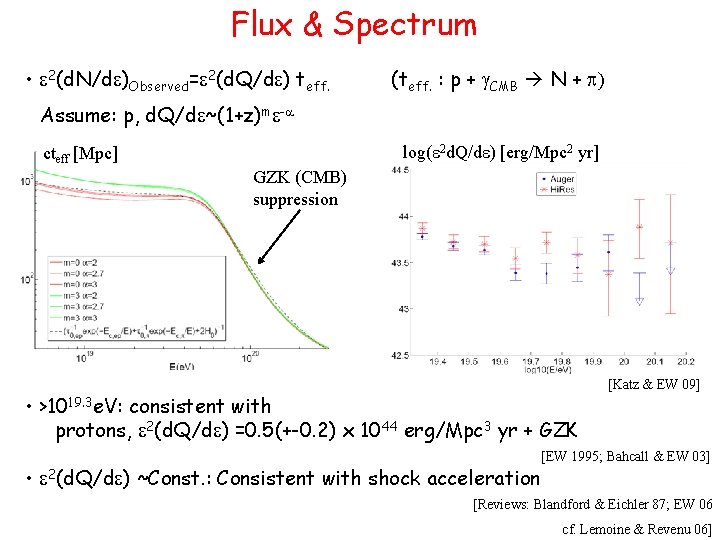
Flux & Spectrum • e 2(d. N/de)Observed=e 2(d. Q/de) teff. (teff. : p + g. CMB N + p) Assume: p, d. Q/de~(1+z)me-a log(e 2 d. Q/de) [erg/Mpc 2 yr] cteff [Mpc] GZK (CMB) suppression • >1019. 3 e. V: consistent with protons, e 2(d. Q/de) =0. 5(+-0. 2) x 1044 erg/Mpc 3 yr + GZK • e 2(d. Q/de) ~Const. : Consistent with shock acceleration [Katz & EW 09] [EW 1995; Bahcall & EW 03] [Reviews: Blandford & Eichler 87; EW 06 cf. Lemoine & Revenu 06]
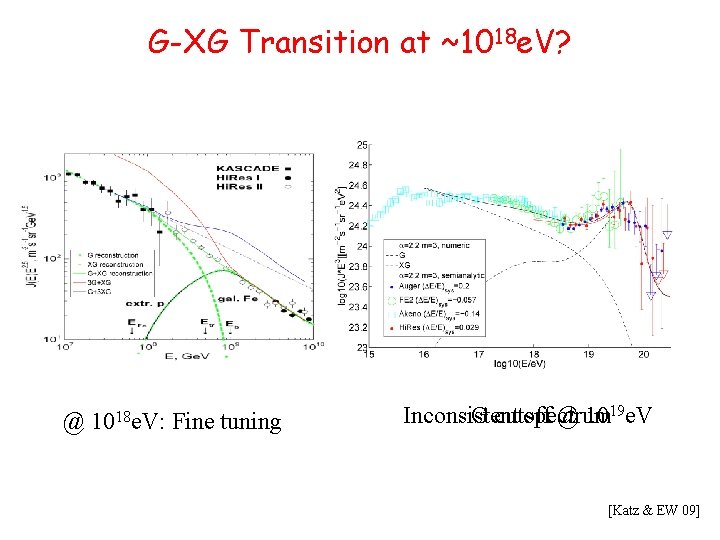
G-XG Transition at ~1018 e. V? @ 1018 e. V: Fine tuning Inconsistent G cutoff spectrum @ 1019 e. V [Katz & EW 09]
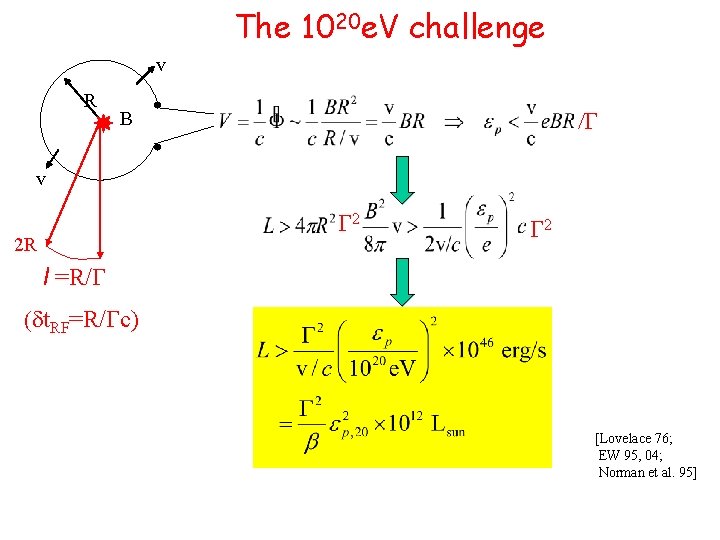
The 1020 e. V challenge v R /G B v G 2 2 R G 2 l =R/G (dt. RF=R/Gc) [Lovelace 76; EW 95, 04; Norman et al. 95]
What do we know about >1019 e. V CRs? • • J(>1011 Ge. V)~1 / 100 km 2 year 2 p sr Most likely X-Galactic (RL=e/e. B=40 ep, 20 kpc) (An)isotropy: 2 s, consistent with LSS Composition? Hi. Res- p, Auger- becoming heavier(? ), Anisotropy suggests p Production rate & spectrum: protons, e 2(d. Q/de) ~0. 5(+-)0. 2 x 1044 erg/Mpc 3 yr + GZK No “repeaters”: Nsource>NCR 2 n(@ 1019. 7 e. V) > 10 -4/Mpc 3 Acceleration (expanding flow): Confinement L>LB>1012 (G 2/b) (e/Z 1020 e. V)2 Lsun Synch. losses G > 102. 5 (L 52)1/10 (dt/10 ms)-1/5 !! No L>1012 Lsun at d<d. GZK Transient Sources
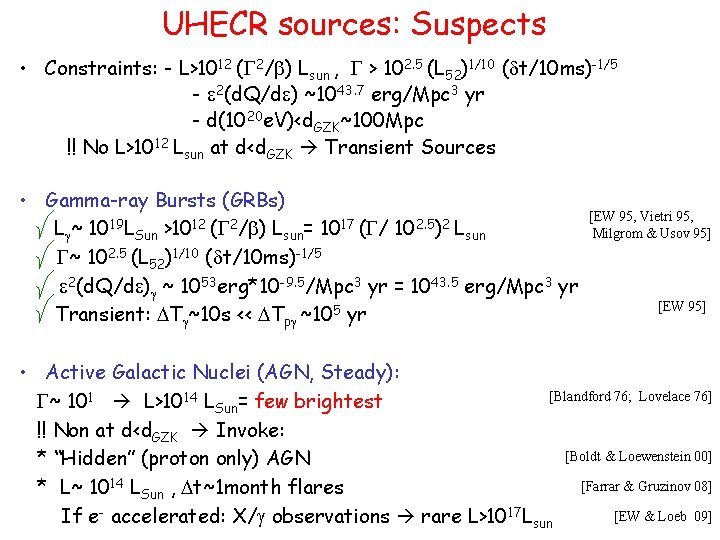
UHECR sources: Suspects • Constraints: - L>1012 (G 2/b) Lsun , G > 102. 5 (L 52)1/10 (dt/10 ms)-1/5 - e 2(d. Q/de) ~1043. 7 erg/Mpc 3 yr - d(1020 e. V)<d. GZK~100 Mpc !! No L>1012 Lsun at d<d. GZK Transient Sources • Gamma-ray Bursts (GRBs) Lg~ 1019 LSun >1012 (G 2/b) Lsun= 1017 (G/ 102. 5)2 Lsun G~ 102. 5 (L 52)1/10 (dt/10 ms)-1/5 e 2(d. Q/de)g ~ 1053 erg*10 -9. 5/Mpc 3 yr = 1043. 5 erg/Mpc 3 yr Transient: DTg~10 s << DTpg ~105 yr [EW 95, Vietri 95, Milgrom & Usov 95] [EW 95] • Active Galactic Nuclei (AGN, Steady): [Blandford 76; Lovelace 76] G~ 101 L>1014 LSun= few brightest !! Non at d<d. GZK Invoke: [Boldt & Loewenstein 00] * “Hidden” (proton only) AGN [Farrar & Gruzinov 08] * L~ 1014 LSun , Dt~1 month flares [EW & Loeb 09] If e- accelerated: X/g observations rare L>1017 Lsun
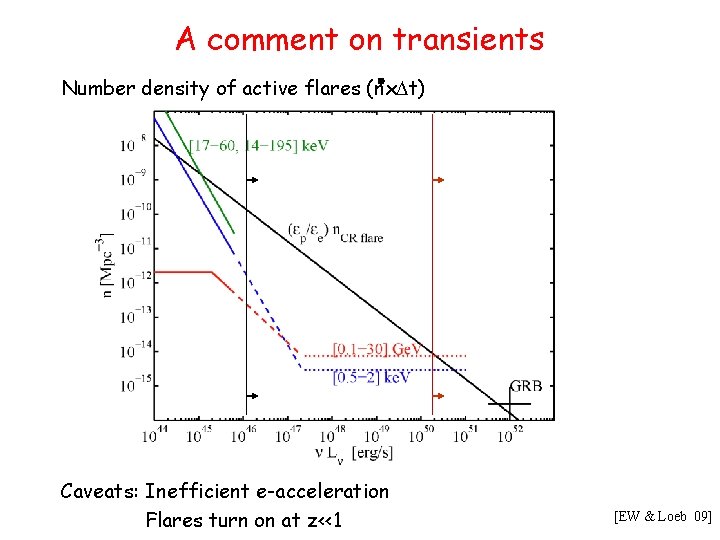
A comment on transients Number density of active flares (nx. Dt) Caveats: Inefficient e-acceleration Flares turn on at z<<1 [EW & Loeb 09]
Two comments • “Qg, Me. V, GRB~10 -2 QUHECR” [e. g. Wick et al. 04 ; Berezinsky 08; Eichler et al 10] - Discrepancy due mainly to Assuming UHECRs X-Galactic above ~1018 e. V (instead of ~ 1019 e. V) • Magnetars? [Hillas 84; Arons 03]
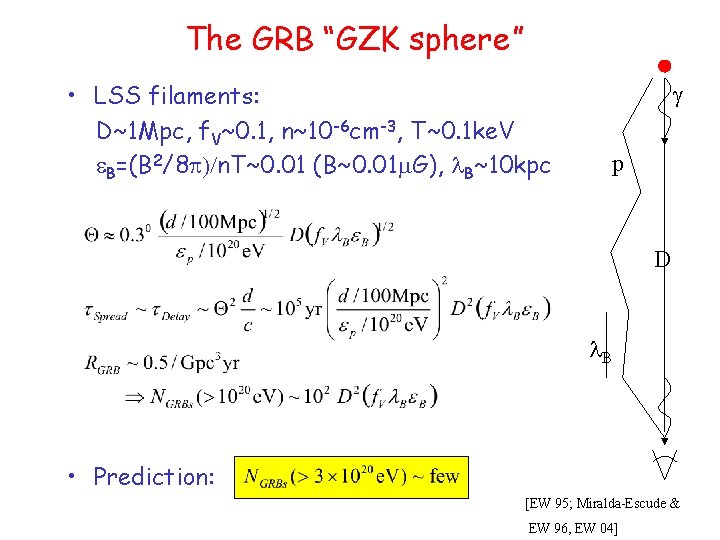
The GRB “GZK sphere” • LSS filaments: D~1 Mpc, f. V~0. 1, n~10 -6 cm-3, T~0. 1 ke. V e. B=(B 2/8 p)/n. T~0. 01 (B~0. 01 m. G), l. B~10 kpc g p D l. B • Prediction: [EW 95; Miralda-Escude & EW 96, EW 04]
GRB Model Predictions [Miralda-Escude & EW 96]
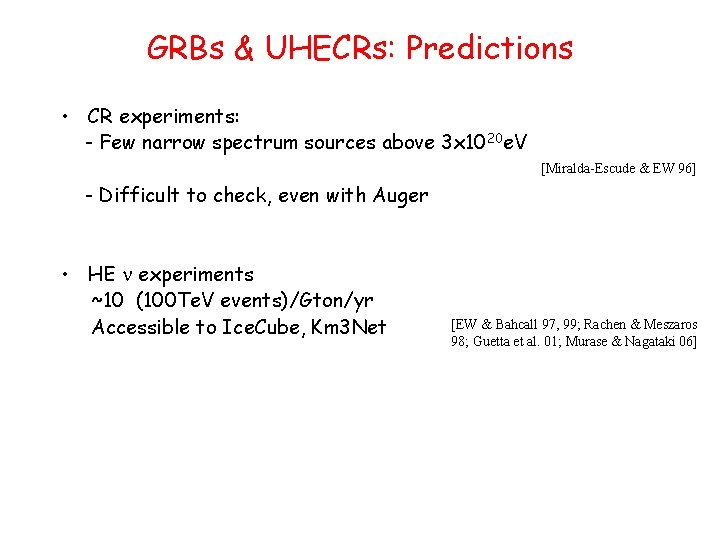
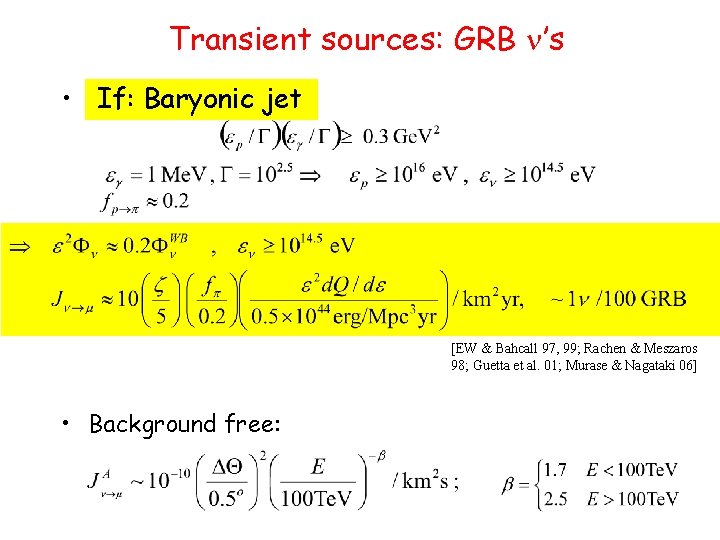
GRBs & UHECRs: Predictions • CR experiments: - Few narrow spectrum sources above 3 x 10²⁰ e. V [Miralda-Escude & EW 96] - Difficult to check, even with Auger • HE n experiments ~10 (100 Te. V events)/Gton/yr Accessible to Ice. Cube, Km 3 Net [EW & Bahcall 97, 99; Rachen & Meszaros 98; Guetta et al. 01; Murase & Nagataki 06]
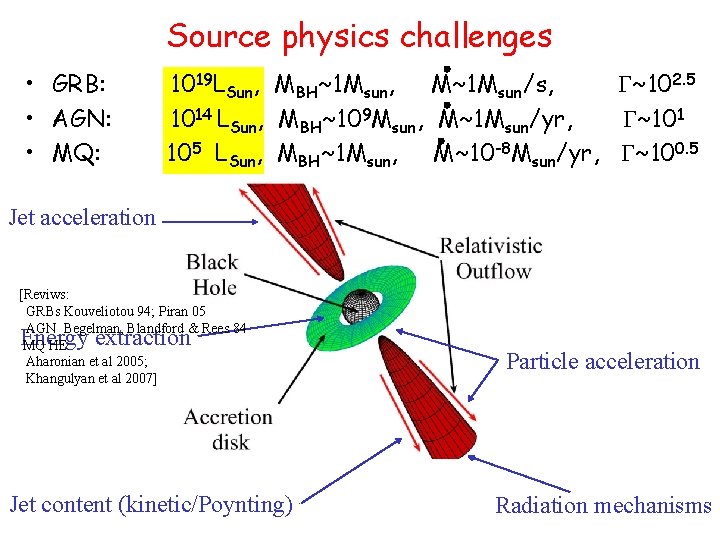
Source physics challenges • GRB: • AGN: • MQ: 1019 LSun, MBH~1 Msun, M~1 Msun/s, G~102. 5 1014 LSun, MBH~109 Msun, M~1 Msun/yr, G~101 105 LSun, MBH~1 Msun, M~10 -8 Msun/yr, G~100. 5 Jet acceleration [Reviws: GRBs Kouveliotou 94; Piran 05 AGN Begelman, Blandford & Rees 84 MQ HE: Aharonian et al 2005; Khangulyan et al 2007] Energy extraction Jet content (kinetic/Poynting) Particle acceleration Radiation mechanisms
Particle acceleration mechanism: (Mildly) Relativistic Collisionless Shocks?
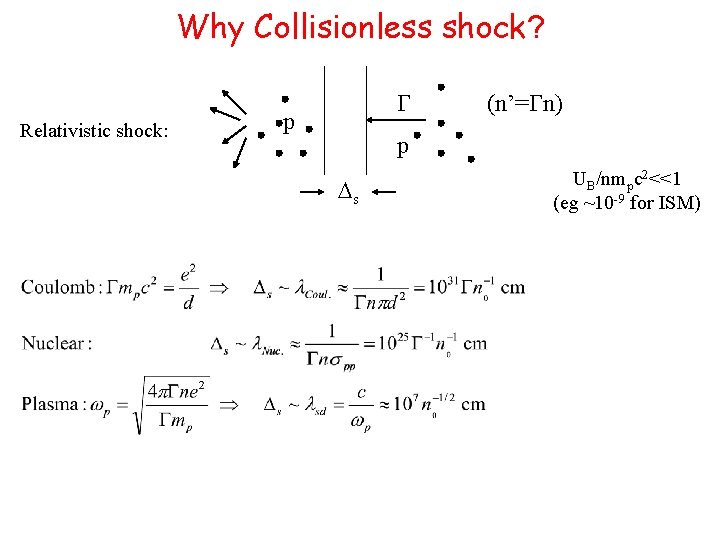
Why Collisionless shock? Relativistic shock: G p (n’=Gn) p Ds UB/nmpc 2<<1 (eg ~10 -9 for ISM)
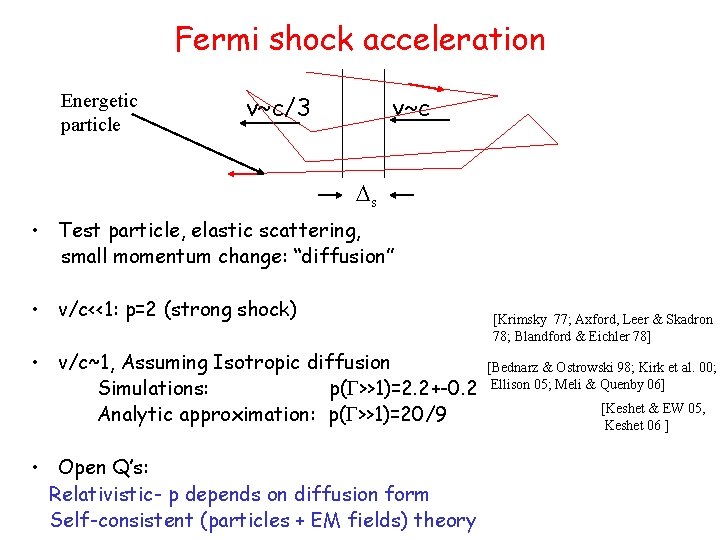
Fermi shock acceleration Energetic particle v~c/3 v~c Ds • Test particle, elastic scattering, small momentum change: “diffusion” • v/c<<1: p=2 (strong shock) • v/c~1, Assuming Isotropic diffusion Simulations: p(G>>1)=2. 2+-0. 2 Analytic approximation: p(G>>1)=20/9 • Open Q’s: Relativistic- p depends on diffusion form Self-consistent (particles + EM fields) theory [Krimsky 77; Axford, Leer & Skadron 78; Blandford & Eichler 78] [Bednarz & Ostrowski 98; Kirk et al. 00; Ellison 05; Meli & Quenby 06] [Keshet & EW 05, Keshet 06 ]
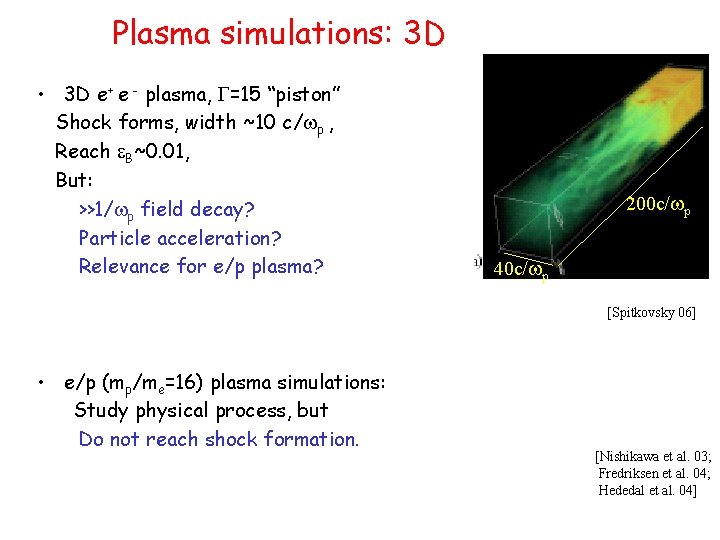
Plasma simulations: 3 D • 3 D e+ e - plasma, G=15 “piston” Shock forms, width ~10 c/wp , Reach e. B~0. 01, But: >>1/wp field decay? Particle acceleration? Relevance for e/p plasma? 200 c/wp 40 c/wp [Spitkovsky 06] • e/p (mp/me=16) plasma simulations: Study physical process, but Do not reach shock formation. [Nishikawa et al. 03; Fredriksen et al. 04; Hededal et al. 04]
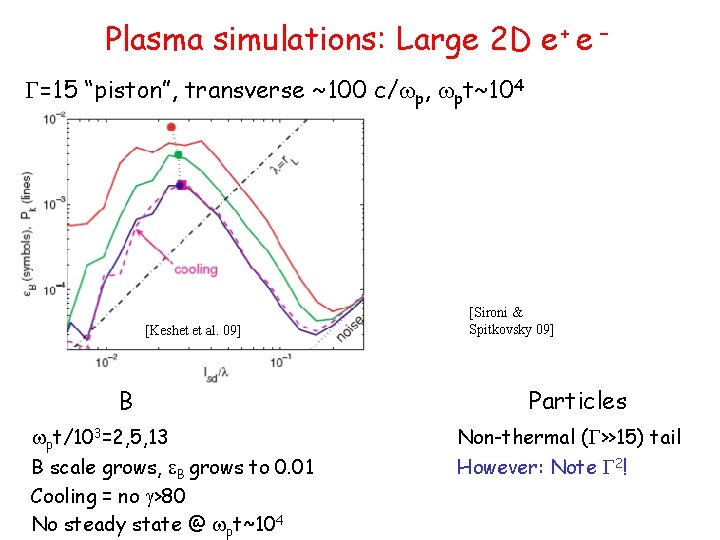
Plasma simulations: Large 2 D e+ e – G=15 “piston”, transverse ~100 c/wp, wpt~104 [Keshet et al. 09] B wpt/103=2, 5, 13 B scale grows, e. B grows to 0. 01 Cooling = no g>80 No steady state @ wpt~104 [Sironi & Spitkovsky 09] Particles Non-thermal (G>>15) tail However: Note G 2!
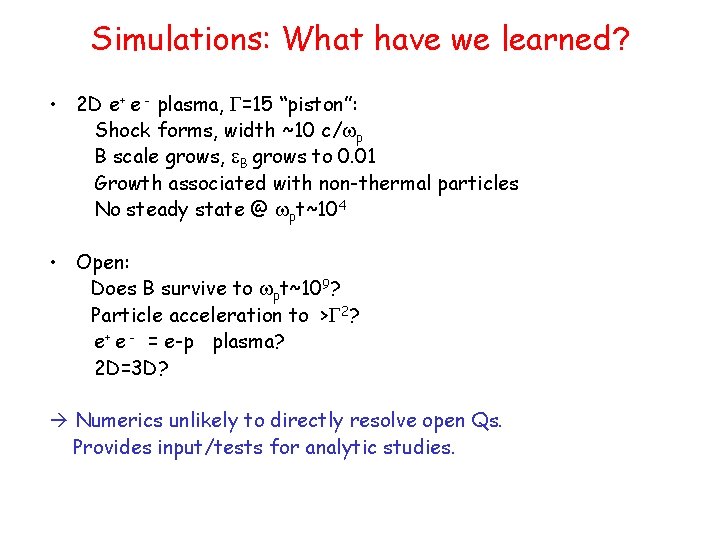
Simulations: What have we learned? • 2 D e+ e - plasma, G=15 “piston”: Shock forms, width ~10 c/wp B scale grows, e. B grows to 0. 01 Growth associated with non-thermal particles No steady state @ wpt~104 • Open: Does B survive to wpt~109? Particle acceleration to >G 2? e+ e - = e-p plasma? 2 D=3 D? Numerics unlikely to directly resolve open Qs. Provides input/tests for analytic studies.
High energy neutrinos
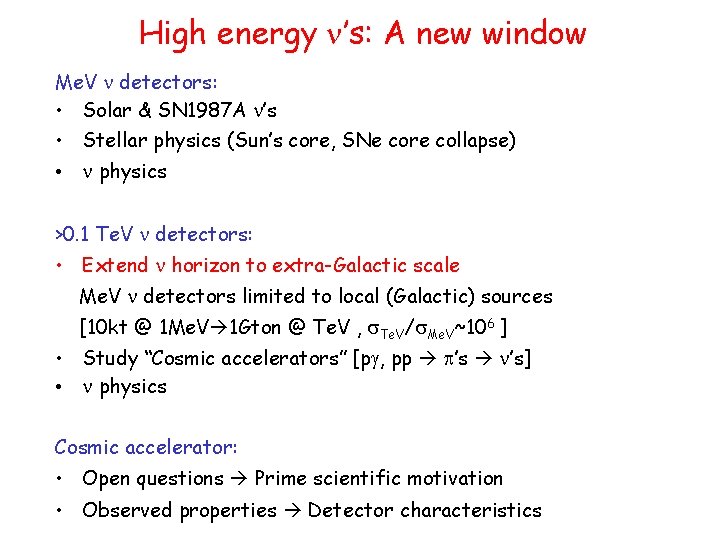
High energy n’s: A new window Me. V n detectors: • Solar & SN 1987 A n’s • Stellar physics (Sun’s core, SNe core collapse) • n physics >0. 1 Te. V n detectors: • Extend n horizon to extra-Galactic scale Me. V n detectors limited to local (Galactic) sources [10 kt @ 1 Me. V 1 Gton @ Te. V , s. Te. V/s. Me. V~106 ] • Study “Cosmic accelerators” [pg, pp p’s n’s] • n physics Cosmic accelerator: • Open questions Prime scientific motivation • Observed properties Detector characteristics
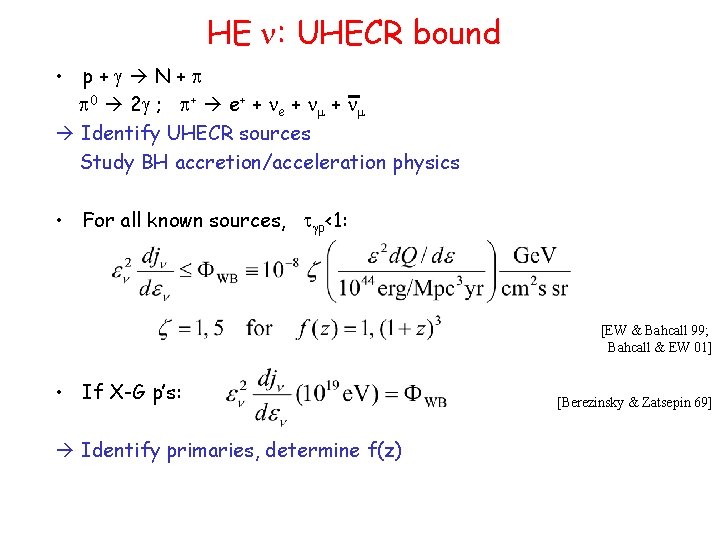
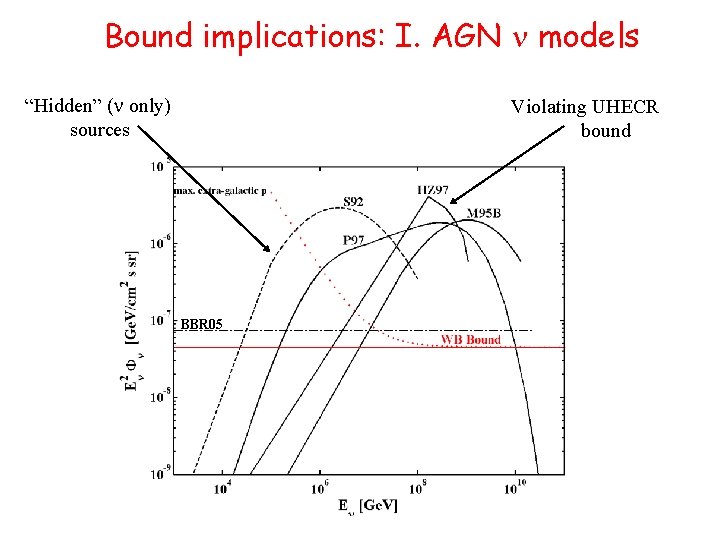
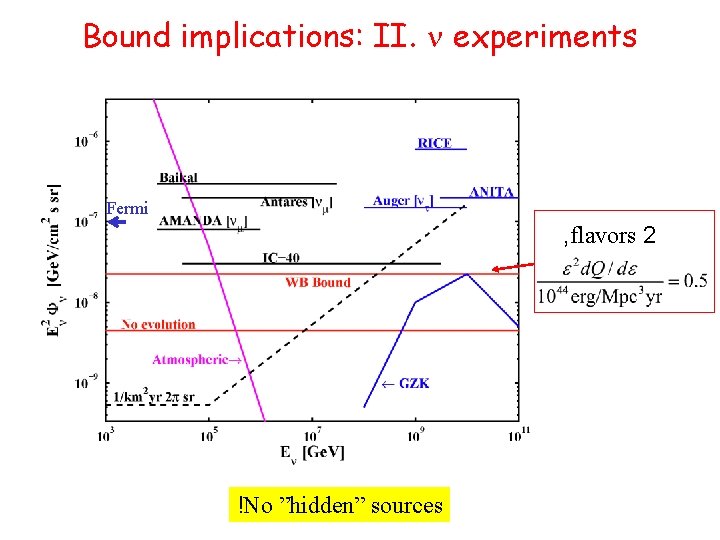
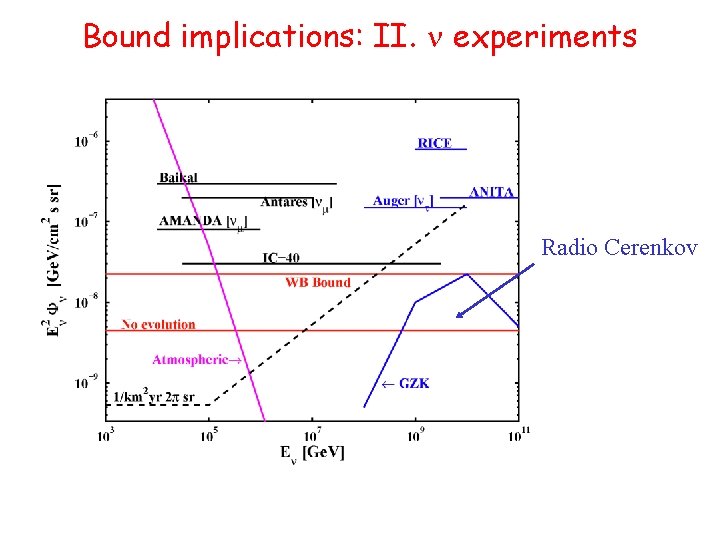
HE n: UHECR bound • p+g N+p p 0 2 g ; p+ e+ + ne + nm Identify UHECR sources Study BH accretion/acceleration physics • For all known sources, tgp<1: [EW & Bahcall 99; Bahcall & EW 01] • If X-G p’s: Identify primaries, determine f(z) [Berezinsky & Zatsepin 69]
Bound implications: I. AGN n models “Hidden” (n only) sources Violating UHECR bound BBR 05
Bound implications: II. n experiments Fermi , flavors 2 !No ”hidden” sources
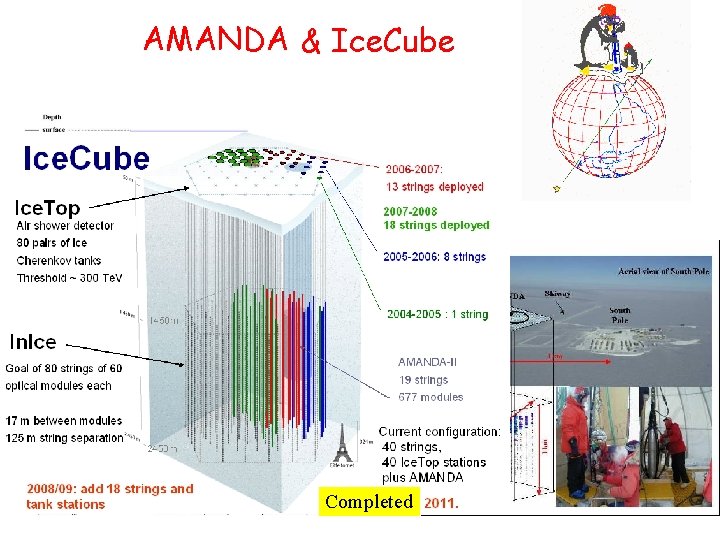
AMANDA & Ice. Cube Completed
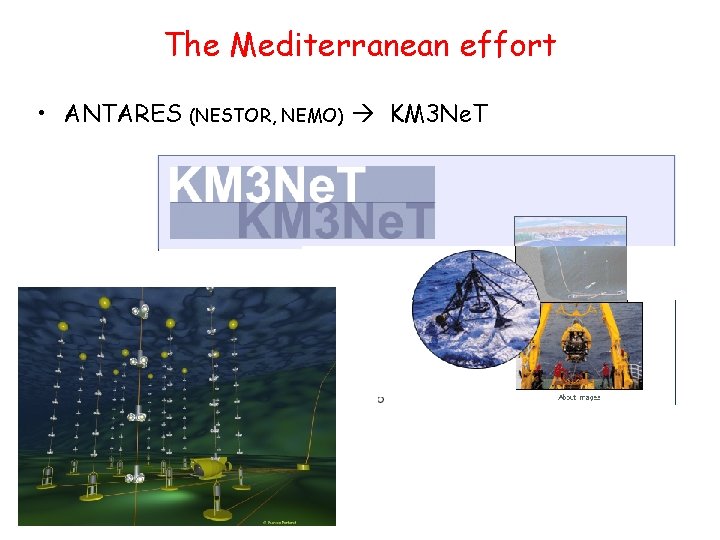
The Mediterranean effort • ANTARES (NESTOR, NEMO) KM 3 Ne. T
Bound implications: II. n experiments Radio Cerenkov
Transient sources: GRB n’s • If: Baryonic jet [EW & Bahcall 97, 99; Rachen & Meszaros 98; Guetta et al. 01; Murase & Nagataki 06] • Background free:
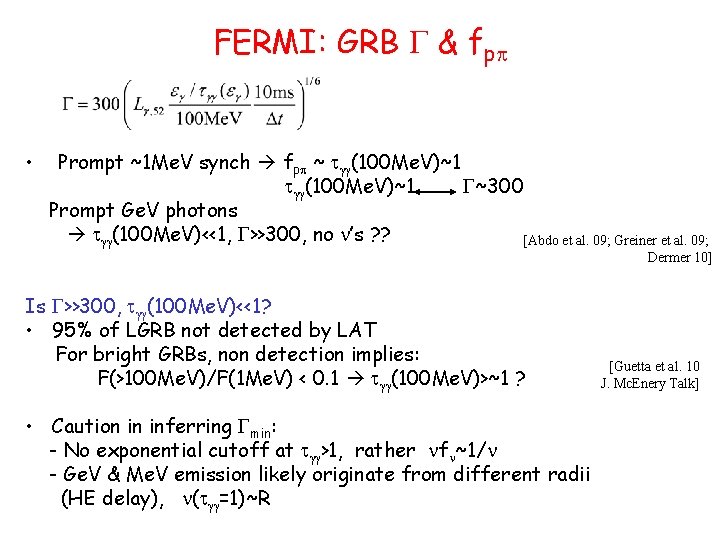
FERMI: GRB G & fpp • Prompt ~1 Me. V synch fpp ~ tgg(100 Me. V)~1 G~300 Prompt Ge. V photons tgg(100 Me. V)<<1, G>>300, no n’s ? ? [Abdo et al. 09; Greiner et al. 09; Dermer 10] Is G>>300, tgg(100 Me. V)<<1? • 95% of LGRB not detected by LAT For bright GRBs, non detection implies: F(>100 Me. V)/F(1 Me. V) < 0. 1 tgg(100 Me. V)>~1 ? • Caution in inferring Gmin: - No exponential cutoff at tgg>1, rather nfn~1/n - Ge. V & Me. V emission likely originate from different radii (HE delay), n(tgg=1)~R [Guetta et al. 10 J. Mc. Enery Talk]
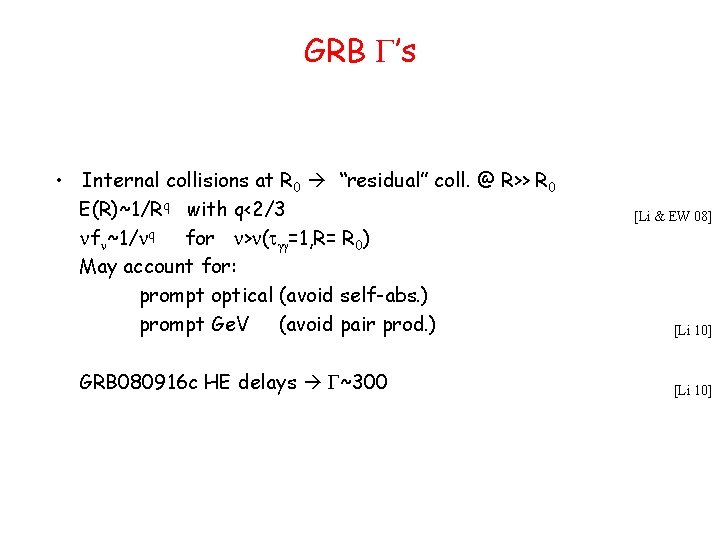
GRB G’s • Internal collisions at R 0 “residual” coll. @ R>> R 0 E(R)~1/Rq with q<2/3 nfn~1/nq for n>n(tgg=1, R= R 0) May account for: prompt optical (avoid self-abs. ) prompt Ge. V (avoid pair prod. ) GRB 080916 c HE delays G~300 [Li & EW 08] [Li 10]
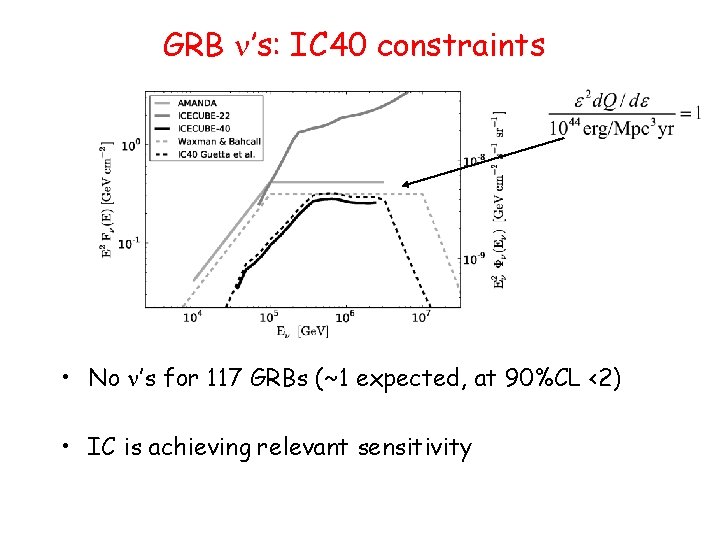
GRB n’s: IC 40 constraints • No n’s for 117 GRBs (~1 expected, at 90%CL <2) • IC is achieving relevant sensitivity
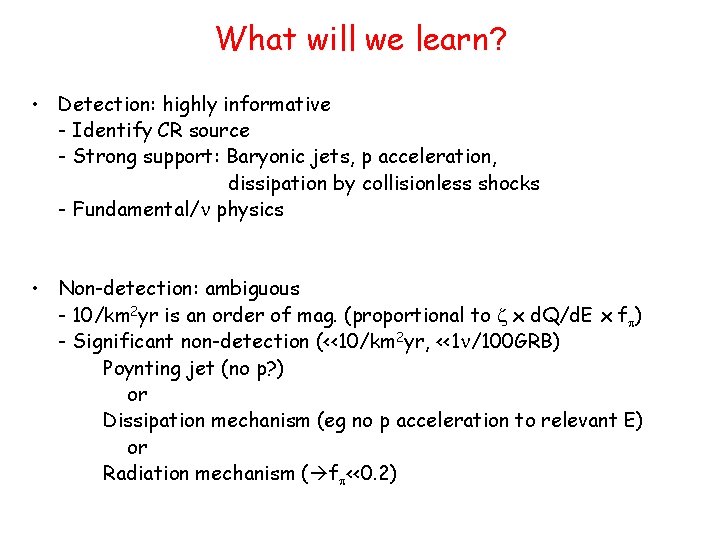
What will we learn? • Detection: highly informative - Identify CR source - Strong support: Baryonic jets, p acceleration, dissipation by collisionless shocks - Fundamental/n physics • Non-detection: ambiguous - 10/km 2 yr is an order of mag. (proportional to z x d. Q/d. E x fp) - Significant non-detection (<<10/km 2 yr, <<1 n/100 GRB) Poynting jet (no p? ) or Dissipation mechanism (eg no p acceleration to relevant E) or Radiation mechanism ( fp<<0. 2)
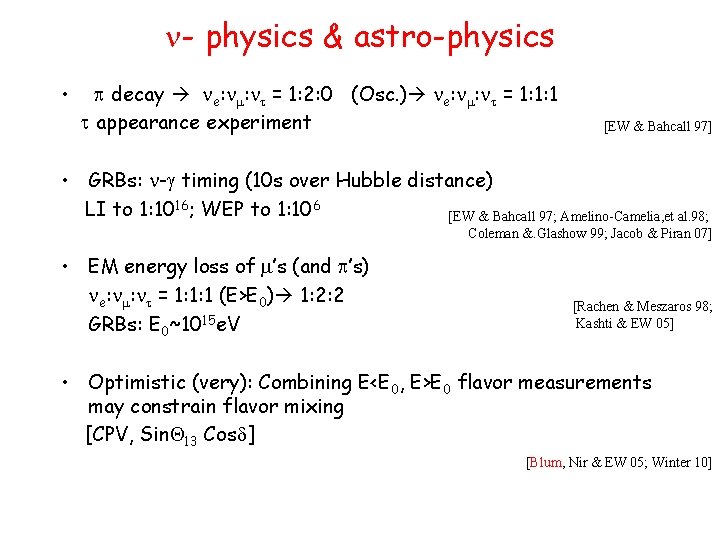
n- physics & astro-physics • p decay ne: nm: nt = 1: 2: 0 (Osc. ) ne: nm: nt = 1: 1: 1 t appearance experiment [EW & Bahcall 97] • GRBs: n-g timing (10 s over Hubble distance) LI to 1: 1016; WEP to 1: 106 [EW & Bahcall 97; Amelino-Camelia, et al. 98; Coleman &. Glashow 99; Jacob & Piran 07] • EM energy loss of m’s (and p’s) ne: nm: nt = 1: 1: 1 (E>E 0) 1: 2: 2 GRBs: E 0~1015 e. V [Rachen & Meszaros 98; Kashti & EW 05] • Optimistic (very): Combining E<E 0, E>E 0 flavor measurements may constrain flavor mixing [CPV, Sin. Q 13 Cosd] [Blum, Nir & EW 05; Winter 10]
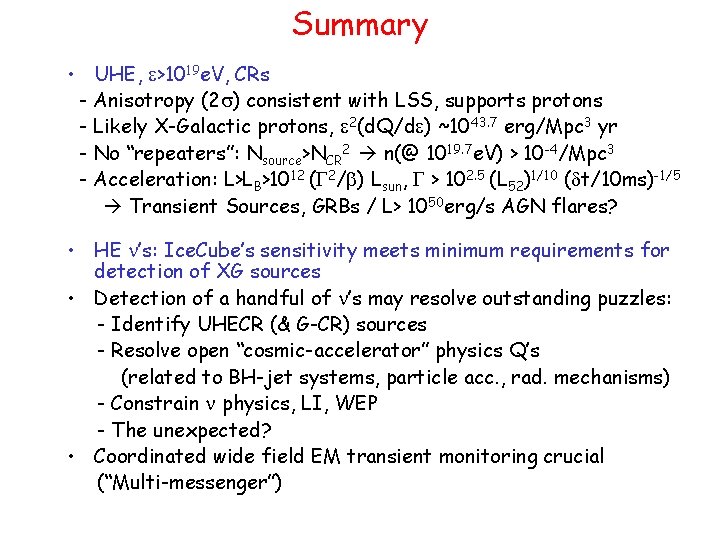
Summary • UHE, e>1019 e. V, CRs - Anisotropy (2 s) consistent with LSS, supports protons - Likely X-Galactic protons, e 2(d. Q/de) ~1043. 7 erg/Mpc 3 yr - No “repeaters”: Nsource>NCR 2 n(@ 1019. 7 e. V) > 10 -4/Mpc 3 - Acceleration: L>LB>1012 (G 2/b) Lsun, G > 102. 5 (L 52)1/10 (dt/10 ms)-1/5 Transient Sources, GRBs / L> 1050 erg/s AGN flares? • HE n’s: Ice. Cube’s sensitivity meets minimum requirements for detection of XG sources • Detection of a handful of n’s may resolve outstanding puzzles: - Identify UHECR (& G-CR) sources - Resolve open “cosmic-accelerator” physics Q’s (related to BH-jet systems, particle acc. , rad. mechanisms) - Constrain n physics, LI, WEP - The unexpected? • Coordinated wide field EM transient monitoring crucial (“Multi-messenger”)