COSC 3406 Computer Organization Kalpdrum Passi www cs
- Slides: 18
COSC 3406: Computer Organization Kalpdrum Passi ( www. cs. laurentian. ca/kpassi/cosc 3406. html )
Chapter 1 Computer Abstractions and Technology
The Computer Revolution ° Progress in computer technology • Underpinned by Moore’s Law ° Makes novel applications feasible • Computers in automobiles • Cell phones • Human genome project • World Wide Web • Search Engines ° Computers are pervasive
Classes of Computers ° Personal computers • General purpose, variety of software • Subject to cost/performance tradeoff ° Server computers • Network based • High capacity, performance, reliability • Range from small servers to building sized
Classes of Computers ° Personal computers • General purpose, variety of software • Subject to cost/performance tradeoff ° Server computers • Network based • High capacity, performance, reliability • Range from small servers to building sized
Classes of Computers ° Supercomputers • High-end scientific and engineering calculations • Highest capability but represent a small fraction of the overall computer market ° Embedded computers • Hidden as components of systems • Stringent power/performance/cost constraints
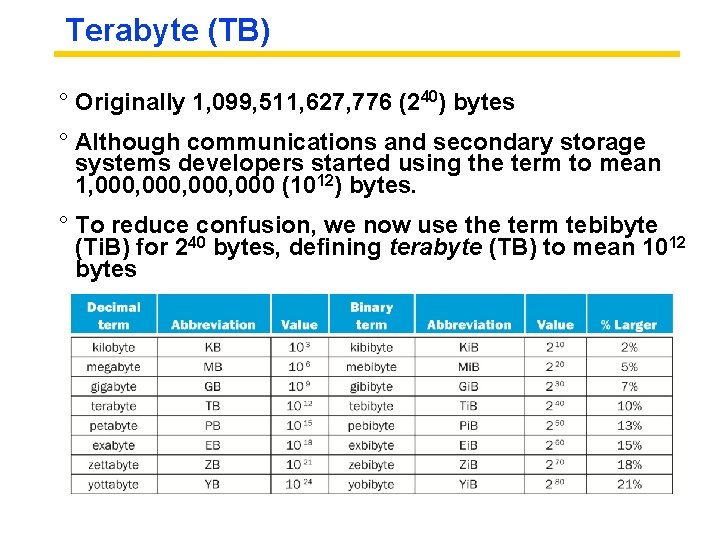
Terabyte (TB) ° Originally 1, 099, 511, 627, 776 (240) bytes ° Although communications and secondary storage systems developers started using the term to mean 1, 000, 000 (1012) bytes. ° To reduce confusion, we now use the term tebibyte (Ti. B) for 240 bytes, defining terabyte (TB) to mean 1012 bytes
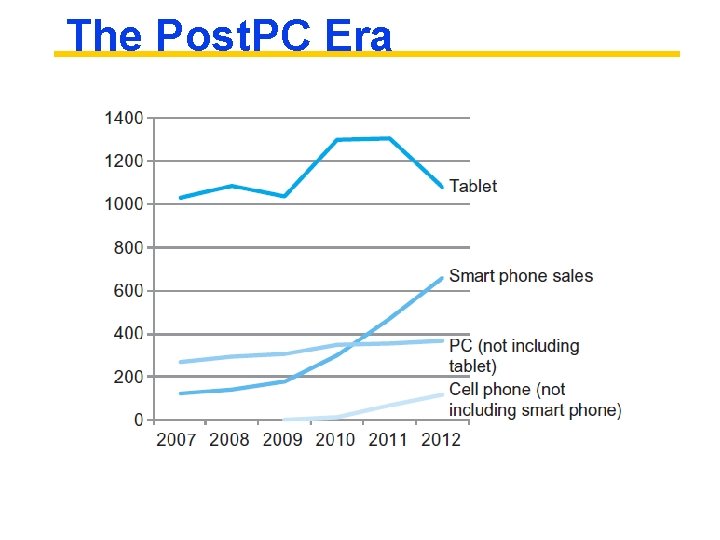
The Post. PC Era
The Post. PC Era n Personal Mobile Device (PMD) n n n Battery operated Connects to the Internet Hundreds of dollars Smart phones, tablets, electronic glasses Cloud computing n n Warehouse Scale Computers (WSC) Software as a Service (Saa. S) Portion of software run on a PMD and a portion run in the Cloud Amazon and Google
What You Will Learn ° How programs are translated into the machine language • And how the hardware executes them ° The hardware/software interface ° What determines program performance • And how it can be improved ° How hardware designers improve performance ° What is parallel processing
Understanding Performance ° Algorithm • Determines number of operations executed ° Programming language, compiler, architecture • Determine number of machine instructions executed per operation ° Processor and memory system • Determine how fast instructions are executed ° I/O system (including OS) • Determines how fast I/O operations are executed
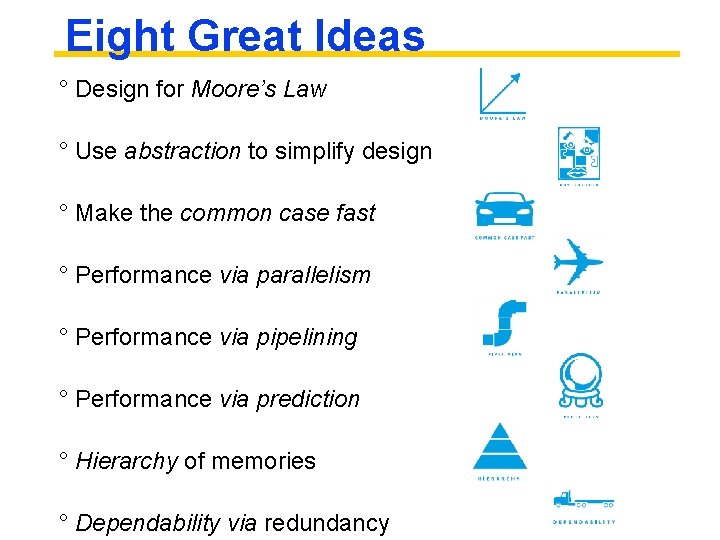
Eight Great Ideas ° Design for Moore’s Law ° Use abstraction to simplify design ° Make the common case fast ° Performance via parallelism ° Performance via pipelining ° Performance via prediction ° Hierarchy of memories ° Dependability via redundancy
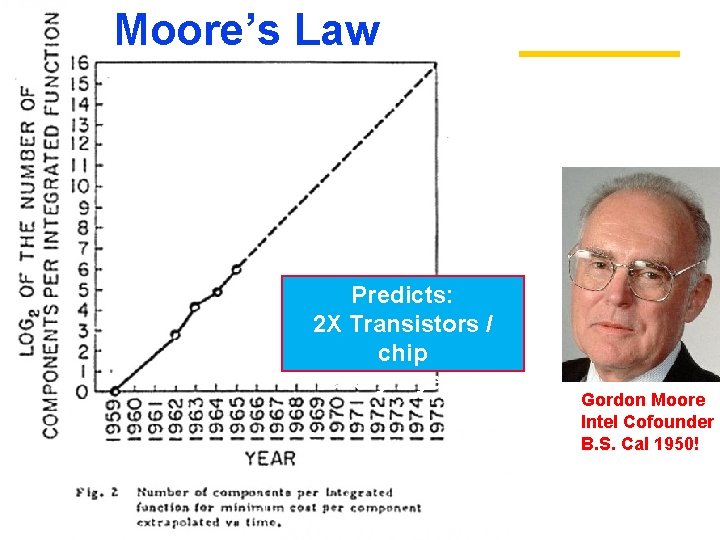
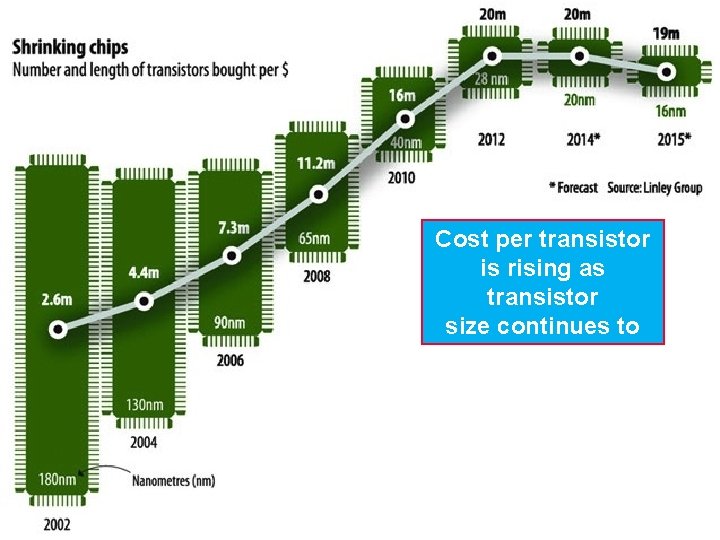
Moore’s Law Predicts: 2 X Transistors / chip every 2 years Gordon Moore Intel Cofounder B. S. Cal 1950!
End of Moore’s Law? Cost per transistor is rising as transistor size continues to shrink
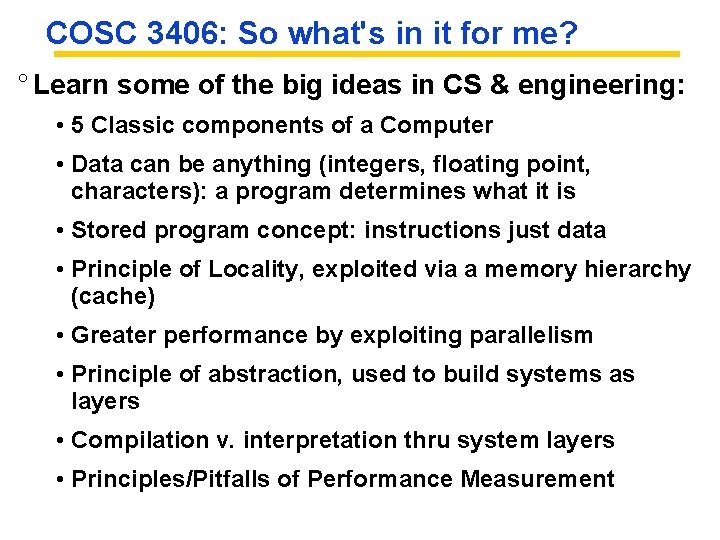
COSC 3406: So what's in it for me? ° Learn some of the big ideas in CS & engineering: • 5 Classic components of a Computer • Data can be anything (integers, floating point, characters): a program determines what it is • Stored program concept: instructions just data • Principle of Locality, exploited via a memory hierarchy (cache) • Greater performance by exploiting parallelism • Principle of abstraction, used to build systems as layers • Compilation v. interpretation thru system layers • Principles/Pitfalls of Performance Measurement
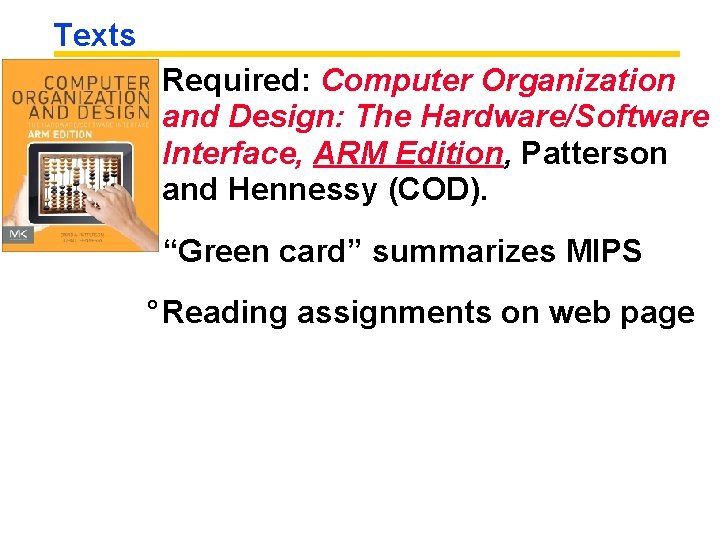
Texts ° Required: Computer Organization and Design: The Hardware/Software Interface, ARM Edition, Patterson and Hennessy (COD). ° “Green card” summarizes MIPS ° Reading assignments on web page
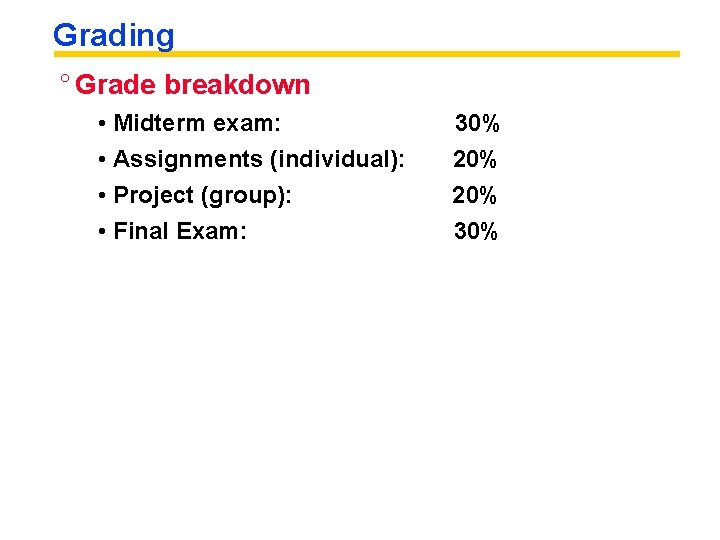
Grading ° Grade breakdown • Midterm exam: • Assignments (individual): • Project (group): • Final Exam: 30% 20% 30%
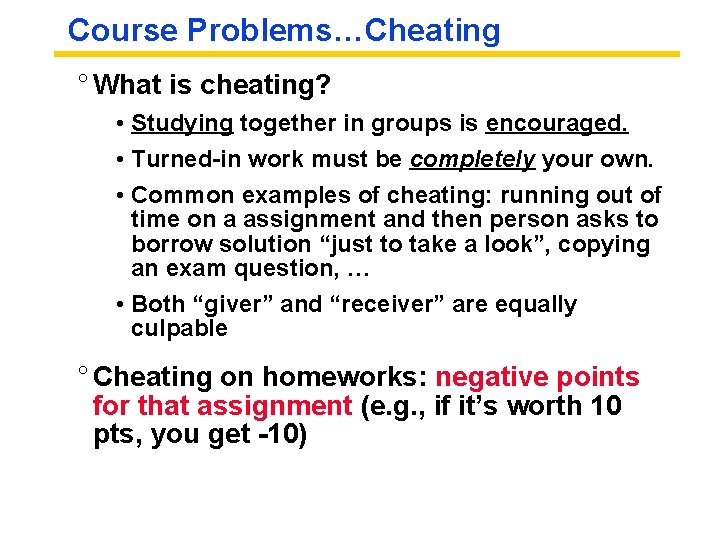
Course Problems…Cheating ° What is cheating? • Studying together in groups is encouraged. • Turned-in work must be completely your own. • Common examples of cheating: running out of time on a assignment and then person asks to borrow solution “just to take a look”, copying an exam question, … • Both “giver” and “receiver” are equally culpable ° Cheating on homeworks: negative points for that assignment (e. g. , if it’s worth 10 pts, you get -10)