Copyright 2011 Pearson Education Inc Upper Saddle River
- Slides: 35
Copyright © 2011 Pearson Education, Inc. , Upper Saddle River, NJ 07458. All rights reserved.
Chapter 2: Inequality: Poverty and Wealth Copyright © 2011 Pearson Education, Inc. , Upper Saddle River, NJ 07458. All rights reserved.
Defining Economic Inequality n Social Stratification • To rank individuals based on objective criteria, often wealth, power, and/or prestige • Naturally creates inequality n Income • Refers to the money received for work or through investments n Wealth • Refers to all material possessions including income Copyright © 2011 Pearson Education, Inc. , Upper Saddle River, NJ 07458. All rights reserved.
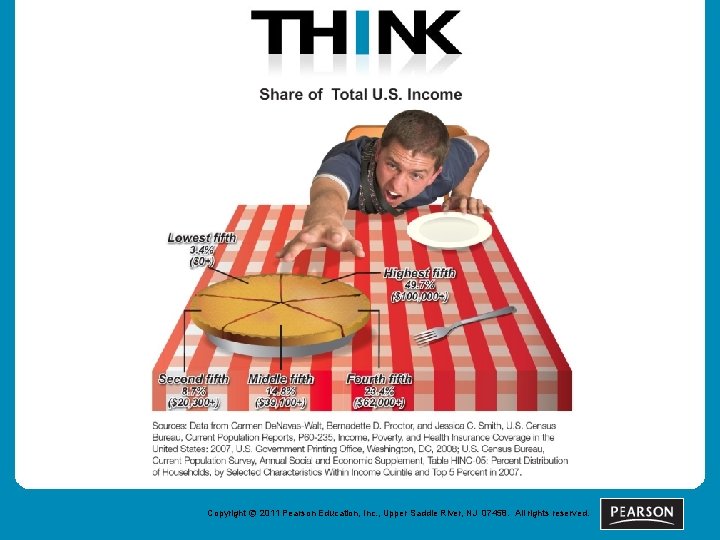
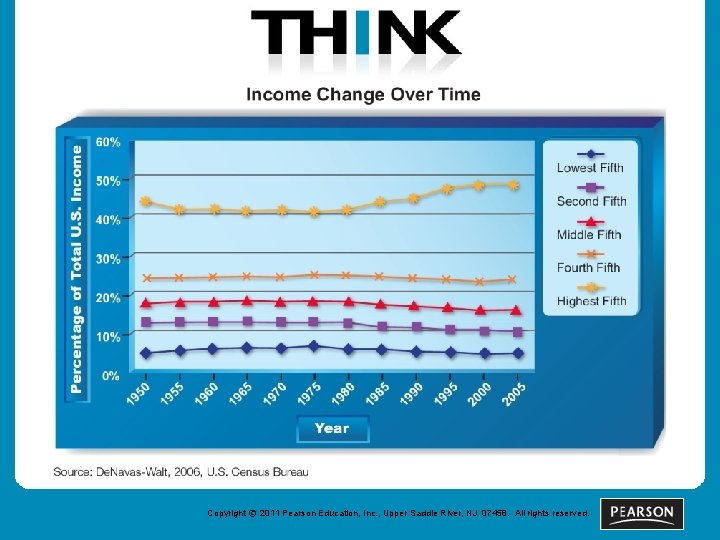
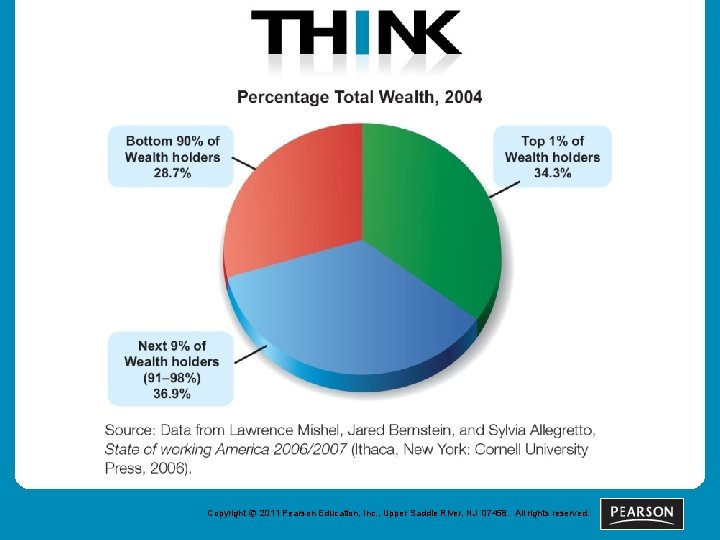
Continued n Income Distribution • About 60 percent of Americans receives less than 27 percent of the nation’s income • The wealthiest fifth of the population receive nearly 50 percent of the money • If country’s income was divided equally, each group would receive 20 percent • Median n Distribution is the midpoint of all the numbers ranked from lowest to highest Copyright © 2011 Pearson Education, Inc. , Upper Saddle River, NJ 07458. All rights reserved.
Copyright © 2011 Pearson Education, Inc. , Upper Saddle River, NJ 07458. All rights reserved.
Copyright © 2011 Pearson Education, Inc. , Upper Saddle River, NJ 07458. All rights reserved.
Copyright © 2011 Pearson Education, Inc. , Upper Saddle River, NJ 07458. All rights reserved.
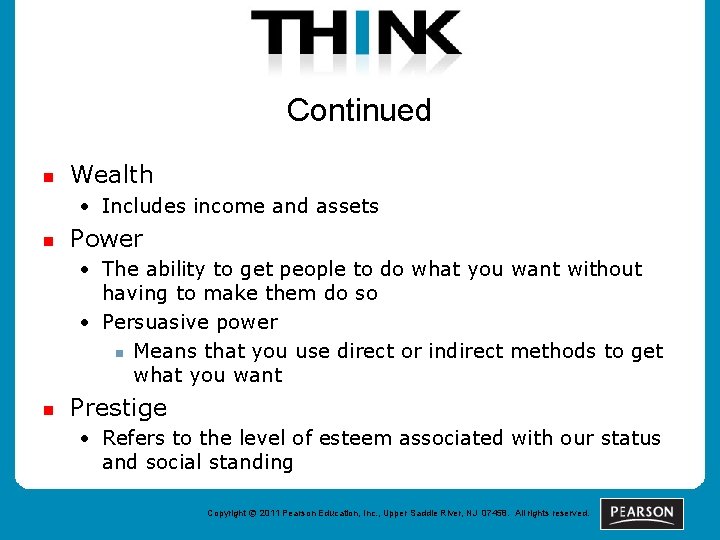
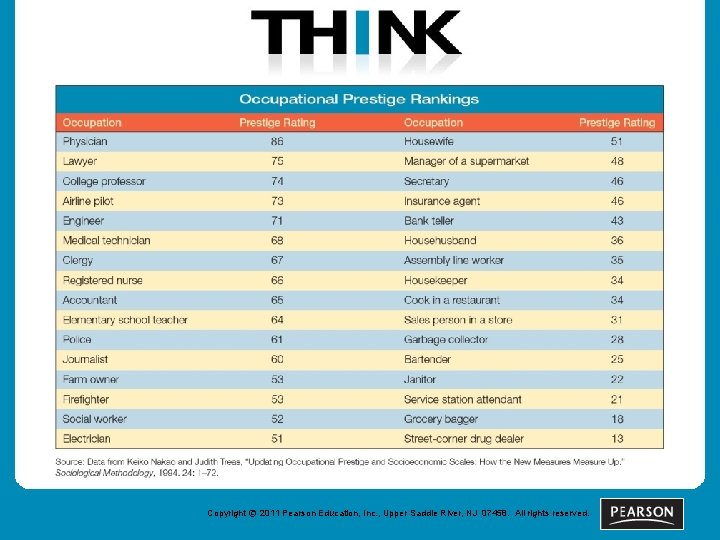
Continued n Wealth • Includes income and assets n Power • The ability to get people to do what you want without having to make them do so • Persuasive power n Means that you use direct or indirect methods to get what you want n Prestige • Refers to the level of esteem associated with our status and social standing Copyright © 2011 Pearson Education, Inc. , Upper Saddle River, NJ 07458. All rights reserved.
Copyright © 2011 Pearson Education, Inc. , Upper Saddle River, NJ 07458. All rights reserved.
Copyright © 2011 Pearson Education, Inc. , Upper Saddle River, NJ 07458. All rights reserved.
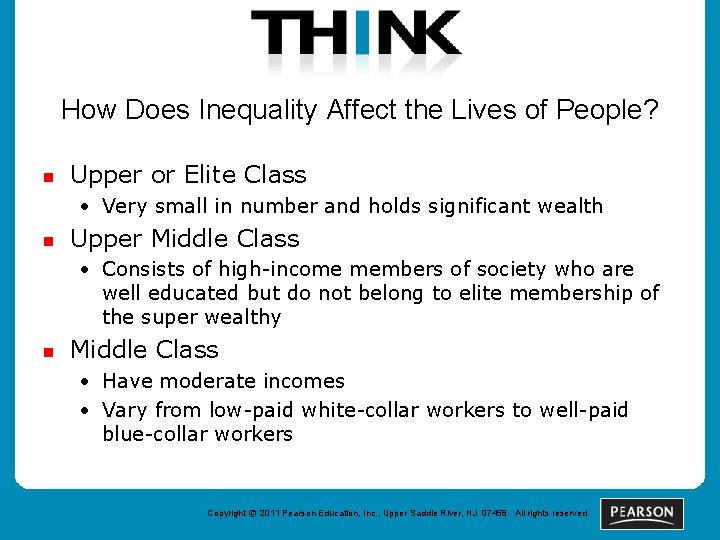
How Does Inequality Affect the Lives of People? n Upper or Elite Class • Very small in number and holds significant wealth n Upper Middle Class • Consists of high-income members of society who are well educated but do not belong to elite membership of the super wealthy n Middle Class • Have moderate incomes • Vary from low-paid white-collar workers to well-paid blue-collar workers Copyright © 2011 Pearson Education, Inc. , Upper Saddle River, NJ 07458. All rights reserved.
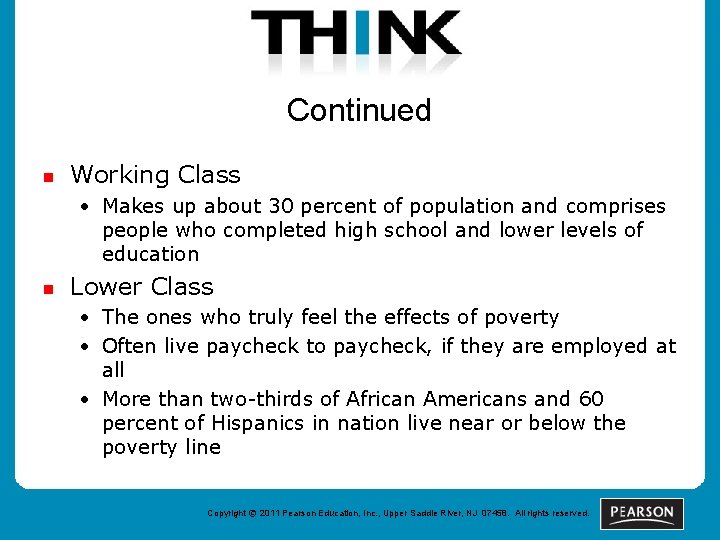
Continued n Working Class • Makes up about 30 percent of population and comprises people who completed high school and lower levels of education n Lower Class • The ones who truly feel the effects of poverty • Often live paycheck to paycheck, if they are employed at all • More than two-thirds of African Americans and 60 percent of Hispanics in nation live near or below the poverty line Copyright © 2011 Pearson Education, Inc. , Upper Saddle River, NJ 07458. All rights reserved.
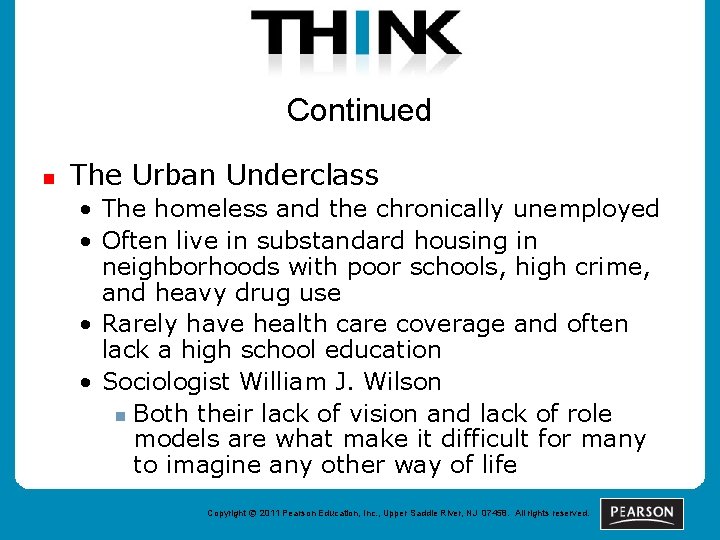
Continued n The Urban Underclass • The homeless and the chronically unemployed • Often live in substandard housing in neighborhoods with poor schools, high crime, and heavy drug use • Rarely have health care coverage and often lack a high school education • Sociologist William J. Wilson n Both their lack of vision and lack of role models are what make it difficult for many to imagine any other way of life Copyright © 2011 Pearson Education, Inc. , Upper Saddle River, NJ 07458. All rights reserved.
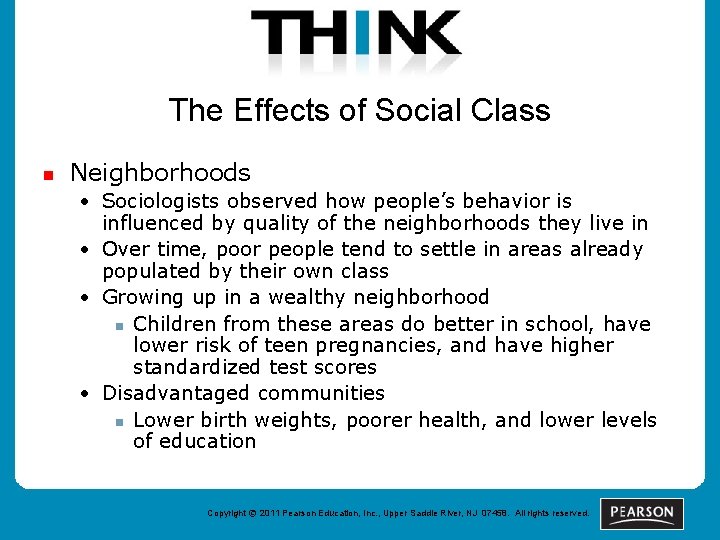
The Effects of Social Class n Neighborhoods • Sociologists observed how people’s behavior is influenced by quality of the neighborhoods they live in • Over time, poor people tend to settle in areas already populated by their own class • Growing up in a wealthy neighborhood n Children from these areas do better in school, have lower risk of teen pregnancies, and have higher standardized test scores • Disadvantaged communities n Lower birth weights, poorer health, and lower levels of education Copyright © 2011 Pearson Education, Inc. , Upper Saddle River, NJ 07458. All rights reserved.
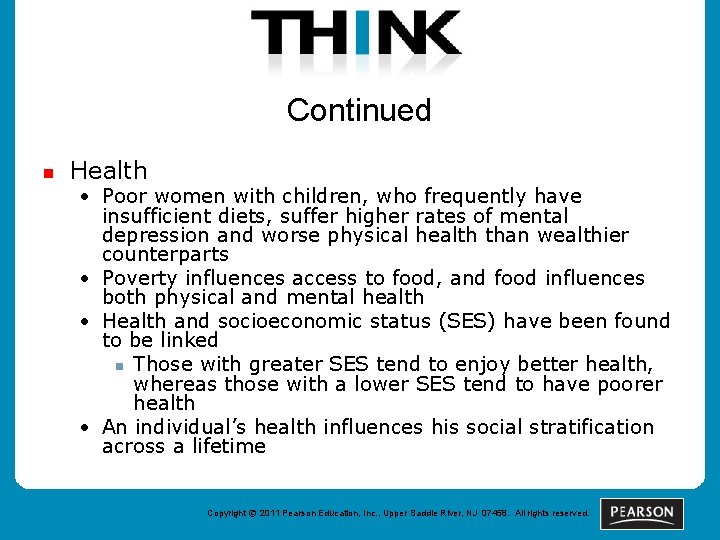
Continued n Health • Poor women with children, who frequently have insufficient diets, suffer higher rates of mental depression and worse physical health than wealthier counterparts • Poverty influences access to food, and food influences both physical and mental health • Health and socioeconomic status (SES) have been found to be linked n Those with greater SES tend to enjoy better health, whereas those with a lower SES tend to have poorer health • An individual’s health influences his social stratification across a lifetime Copyright © 2011 Pearson Education, Inc. , Upper Saddle River, NJ 07458. All rights reserved.
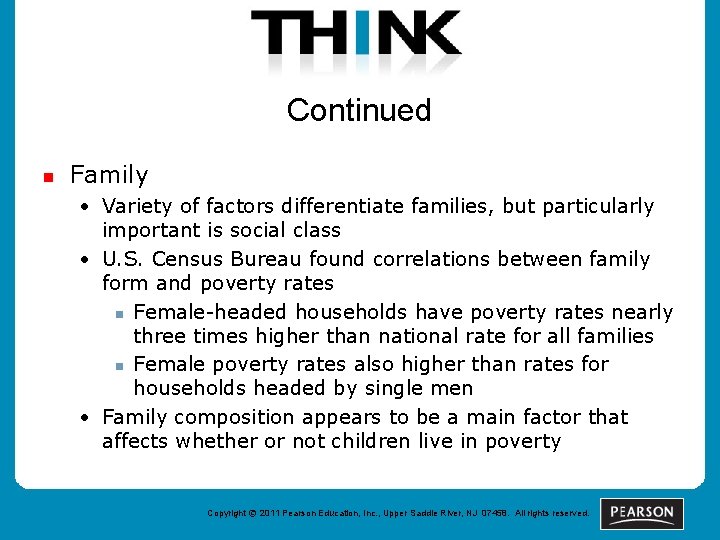
Continued n Family • Variety of factors differentiate families, but particularly important is social class • U. S. Census Bureau found correlations between family form and poverty rates n Female-headed households have poverty rates nearly three times higher than national rate for all families n Female poverty rates also higher than rates for households headed by single men • Family composition appears to be a main factor that affects whether or not children live in poverty Copyright © 2011 Pearson Education, Inc. , Upper Saddle River, NJ 07458. All rights reserved.
Continued n Education • In US, free 12 -year education is available to every child regardless of family or class • Not all educational opportunities are the same • Jonathan Kozol n Schools in urban communities frequently lack basic educational supplies n Suburban schools often have a surplus of supplies and staff n Dramatic differences lay in structure of system • Places with higher property taxes receive more educational funding • Poor urban areas need more help but actually get less Copyright © 2011 Pearson Education, Inc. , Upper Saddle River, NJ 07458. All rights reserved.
Continued n Social Mobility • Term that describes ability to change social classes • Horizontal Mobility n Refers to moving within same status category • Intragenerational Mobility n Occurs when individual changes social standing, especially in the workforce • Intergenerational Mobility n Refers to change family members make from one social class to next through generations Copyright © 2011 Pearson Education, Inc. , Upper Saddle River, NJ 07458. All rights reserved.
Continued • Structural Mobility n Occurs when social changes cause many people to change social status simultaneously • Exchange Mobility n Suggests that within the United States, each social class contains a relatively fixed number of people Copyright © 2011 Pearson Education, Inc. , Upper Saddle River, NJ 07458. All rights reserved.
Copyright © 2011 Pearson Education, Inc. , Upper Saddle River, NJ 07458. All rights reserved.
History of Poverty n n Throughout human history, there have always been people who are poor Elizabethan “Poor Law” of 1601 • First real law dealing with “welfare and poverty” in Britain • Attempted to accomplish four things: n Separate church from delivery of social services n Eliminate begging and crime in streets n Bring social assistance under government control n Set standards to determine those eligible to receive help and amount of help they should receive Copyright © 2011 Pearson Education, Inc. , Upper Saddle River, NJ 07458. All rights reserved.
Continued n n n Welfare in US largely left to local areas Because of large numbers of injured soldiers and increases in immigration, need to help poor became greater than many localities could handle Two welfare ideas arose • Settlement house movement • Charity Organization Society n Key historical event in the United States in a discussion of poverty is the Great Depression of 1929 Copyright © 2011 Pearson Education, Inc. , Upper Saddle River, NJ 07458. All rights reserved.
How Does the United States Define Poverty? n Transitional Poverty • Temporary state that occurs when someone goes without a job for a short period of time n Marginal Poverty • Occurs when person lacks stable employment n Residual Poverty • This type is chronic and multigenerational n Relative Poverty • State that occurs when we compare our financial standing and material possessions to those around us Copyright © 2011 Pearson Education, Inc. , Upper Saddle River, NJ 07458. All rights reserved.
Copyright © 2011 Pearson Education, Inc. , Upper Saddle River, NJ 07458. All rights reserved.
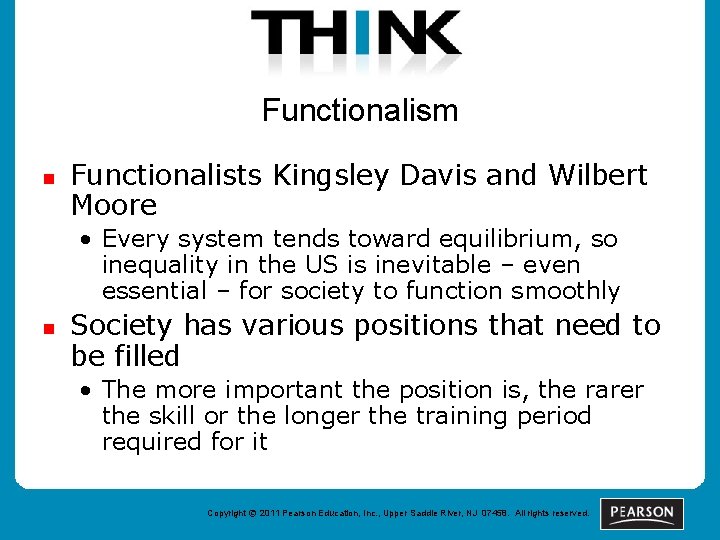
Functionalism n Functionalists Kingsley Davis and Wilbert Moore • Every system tends toward equilibrium, so inequality in the US is inevitable – even essential – for society to function smoothly n Society has various positions that need to be filled • The more important the position is, the rarer the skill or the longer the training period required for it Copyright © 2011 Pearson Education, Inc. , Upper Saddle River, NJ 07458. All rights reserved.
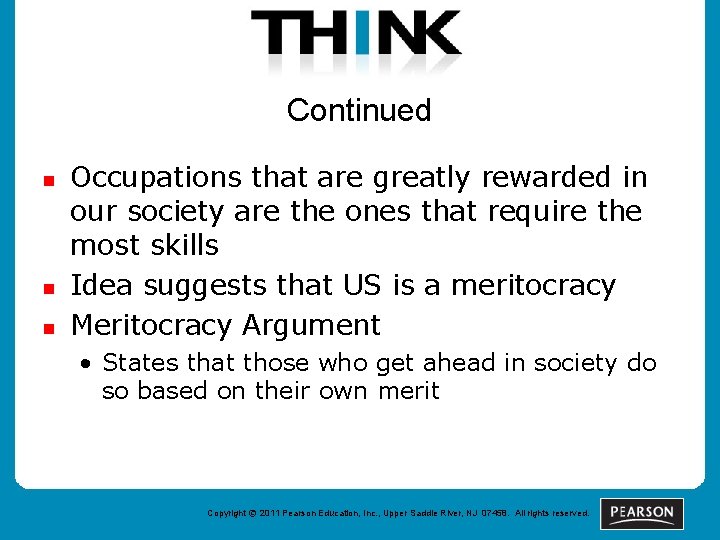
Continued n n n Occupations that are greatly rewarded in our society are the ones that require the most skills Idea suggests that US is a meritocracy Meritocracy Argument • States that those who get ahead in society do so based on their own merit Copyright © 2011 Pearson Education, Inc. , Upper Saddle River, NJ 07458. All rights reserved.
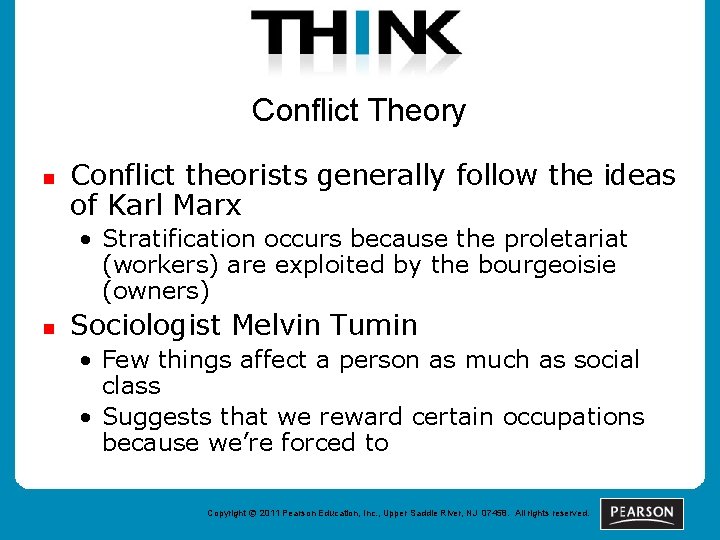
Conflict Theory n Conflict theorists generally follow the ideas of Karl Marx • Stratification occurs because the proletariat (workers) are exploited by the bourgeoisie (owners) n Sociologist Melvin Tumin • Few things affect a person as much as social class • Suggests that we reward certain occupations because we’re forced to Copyright © 2011 Pearson Education, Inc. , Upper Saddle River, NJ 07458. All rights reserved.
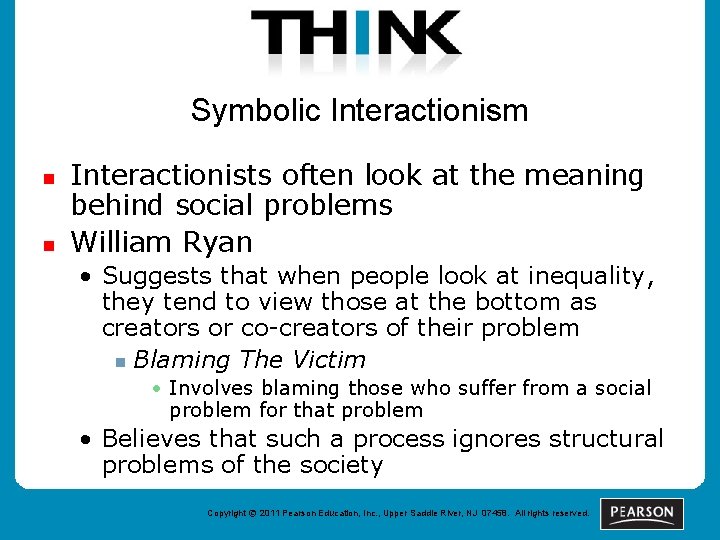
Symbolic Interactionism n n Interactionists often look at the meaning behind social problems William Ryan • Suggests that when people look at inequality, they tend to view those at the bottom as creators or co-creators of their problem n Blaming The Victim • Involves blaming those who suffer from a social problem for that problem • Believes that such a process ignores structural problems of the society Copyright © 2011 Pearson Education, Inc. , Upper Saddle River, NJ 07458. All rights reserved.
Continued n Sociologist William J. Wilson (2009) • Suggests that mentality of blaming the victim prevents us from actually seeing social structural problems that lead to inequality Copyright © 2011 Pearson Education, Inc. , Upper Saddle River, NJ 07458. All rights reserved.
The Welfare System n n n There is a harsh social stigma associated with those who receive welfare Until 1996, U. S. welfare system run as an entitlement program 1996, President Bill Clinton signed Personal Responsibility and Work Opportunity Reconciliation Act • Created Temporary Assistance to Needy Families (TANF) program, which changed welfare system drastically Copyright © 2011 Pearson Education, Inc. , Upper Saddle River, NJ 07458. All rights reserved.
Continued n Through TANF program • Person only allowed to receive government assistance for total of five years and only up to two years at a time n Person’s children will not receive aid throughout their childhood • Recent data show that two-thirds of those who were on Aid to Families with Dependent Children (program in effect before TANF) were never on the program longer than two years Copyright © 2011 Pearson Education, Inc. , Upper Saddle River, NJ 07458. All rights reserved.
Continued n One of the driving forces behind TANF was emphasis on job training for the poor • Because TANF assistance only lasts for two years at a time, long-term training options, such as obtaining college degree, are impossible • Data show that transition from welfare to work usually results in jobs that don’t pay a living wage Copyright © 2011 Pearson Education, Inc. , Upper Saddle River, NJ 07458. All rights reserved.
Continued n Two separate philosophies that guide the U. S. welfare system • Residual Welfare n System of relief intended for people with jobs whose earnings are not enough to support them • Institutional Welfare n Part of first line of defense against poverty n Assistance offered on preventive basis, and no time limit is imposed Copyright © 2011 Pearson Education, Inc. , Upper Saddle River, NJ 07458. All rights reserved.
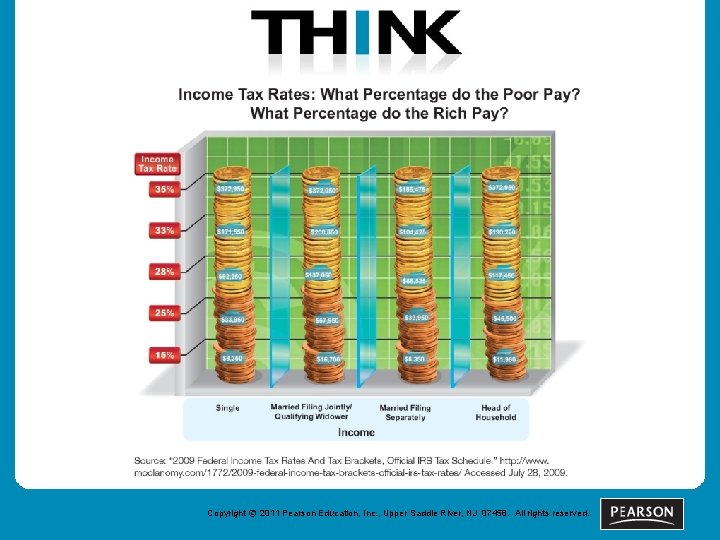
Taxation n United States makes use of two separate forms of taxation: • Progressive Taxation n A system in which people who earn more pay higher taxes • Regressive Taxation n A system that taxes everyone the same percentage of money, but results in poor paying a higher percentage than rich Copyright © 2011 Pearson Education, Inc. , Upper Saddle River, NJ 07458. All rights reserved.
Copyright © 2011 Pearson Education, Inc. , Upper Saddle River, NJ 07458. All rights reserved.