Contrastive Analysis of English Chinese Teaching Plan Teaching
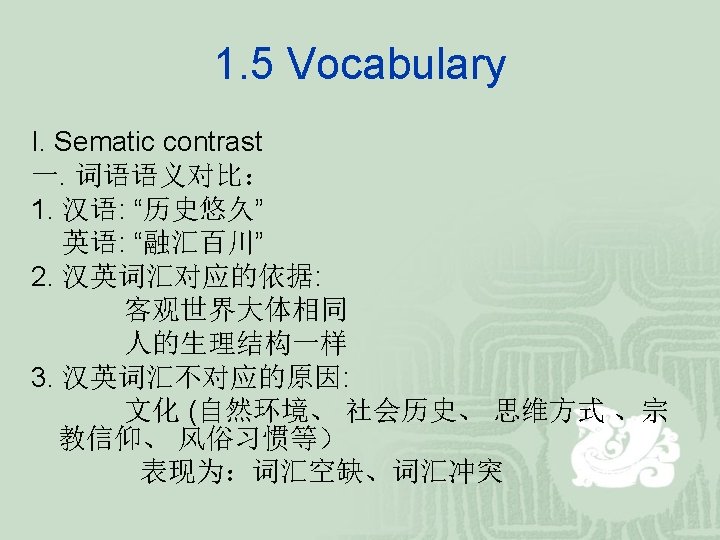
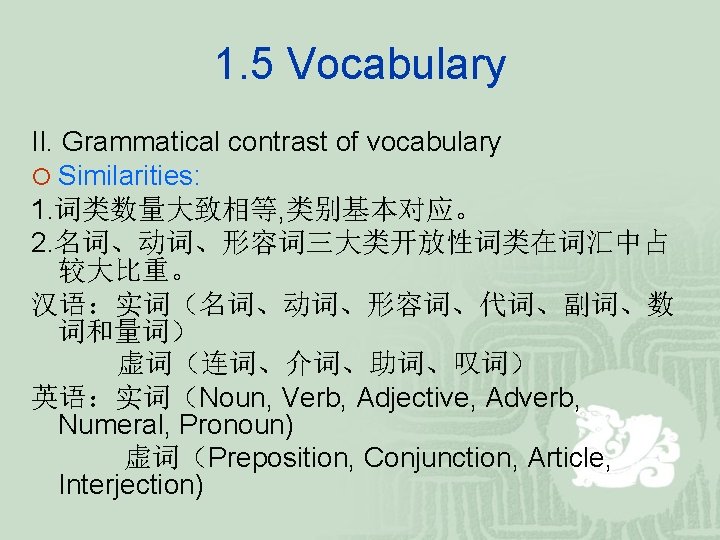
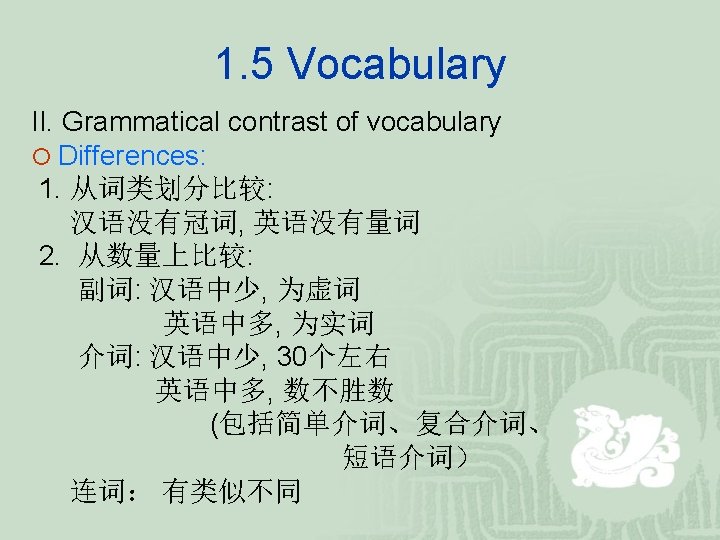
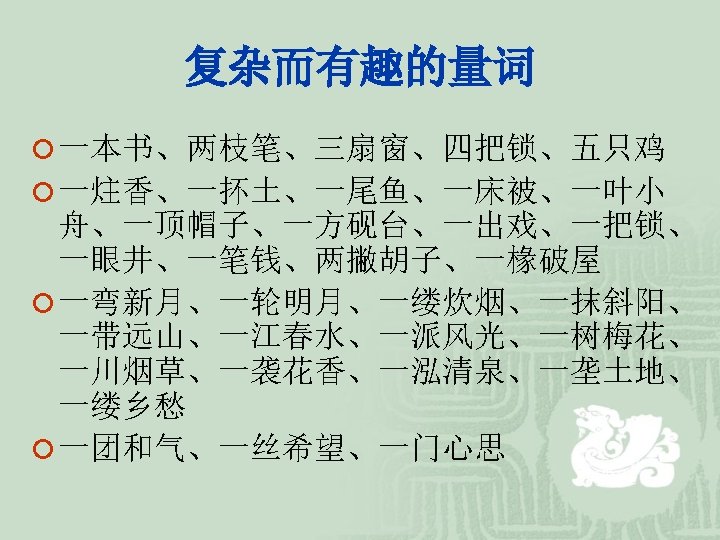

- Slides: 84
Contrastive Analysis of English & Chinese
Teaching Plan Teaching Contents: ¡ 1. An introduction to Chinese language from the views of language family, Language types, Writing system, Phonetics, Vocabulary, Word order, Function words, Sentence structure, Style, etc. ¡ 2. An introduction to English language from the views of language family, Language types, Writing system, Phonetics, Vocabulary, Word order, Function words, Sentence structure, Style, etc. ¡ 3. Comparison and Contrast of C-E languages
Teaching Plan Teaching Aims: ¡ To make students get the general idea about Chinese and English languages and their similarities and differences Teaching Focus: ¡ The similarities of C-E languages ¡ The differences between C-E languages Teaching Methods: ¡ teacher-oriented lecturing ¡ Discussion (group work, then class work) Teaching Approaches: ¡ Multi-media aided. Teaching Procedures:
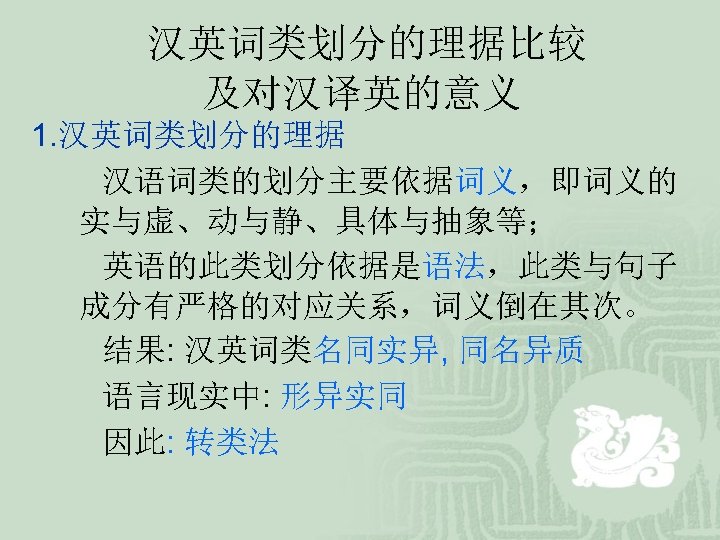
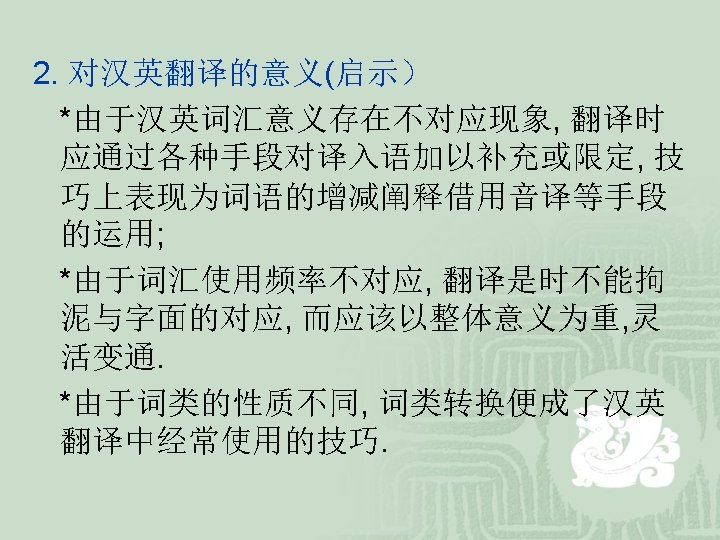
1 Introduction of language families ¡ English ---- the Germanic branch of the Indo -European(印欧语系 ) language family; ¡ Chinese ---- the Sino-Tibetan(汉臧语系) language family
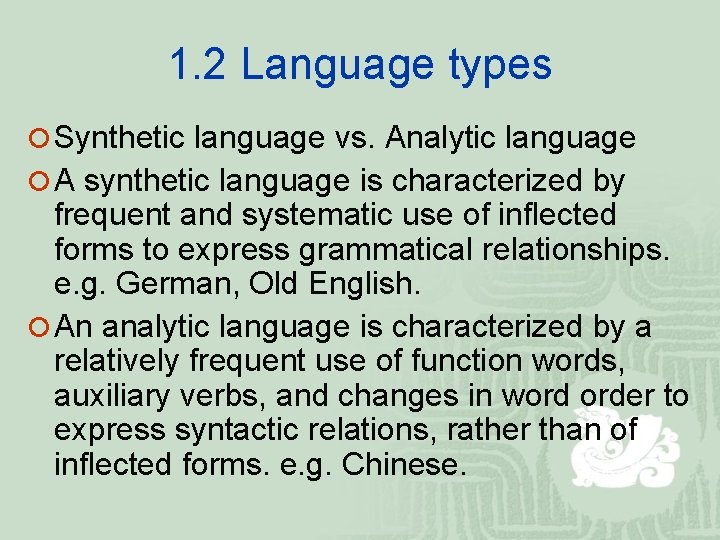
1. 2 Language types ¡ Synthetic language vs. Analytic language ¡ A synthetic language is characterized by frequent and systematic use of inflected forms to express grammatical relationships. e. g. German, Old English. ¡ An analytic language is characterized by a relatively frequent use of function words, auxiliary verbs, and changes in word order to express syntactic relations, rather than of inflected forms. e. g. Chinese.
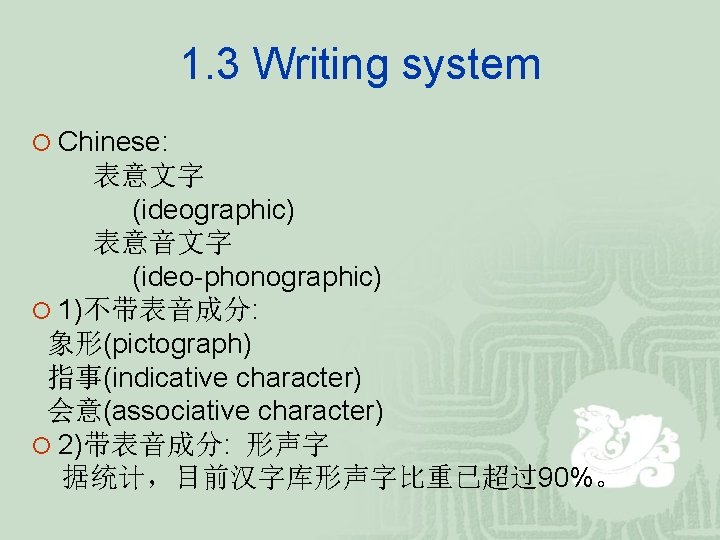
1. 3 Writing system ¡ Chinese: 表意文字 (ideographic) 表意音文字 (ideo-phonographic) ¡ 1)不带表音成分: 象形(pictograph) 指事(indicative character) 会意(associative character) ¡ 2)带表音成分: 形声字 据统计,目前汉字库形声字比重已超过90%。
1. 3 Writing system ¡ English: 拼音文字(alphabetic) ¡ 由 26个字母构成词语。 ¡ 不表意。
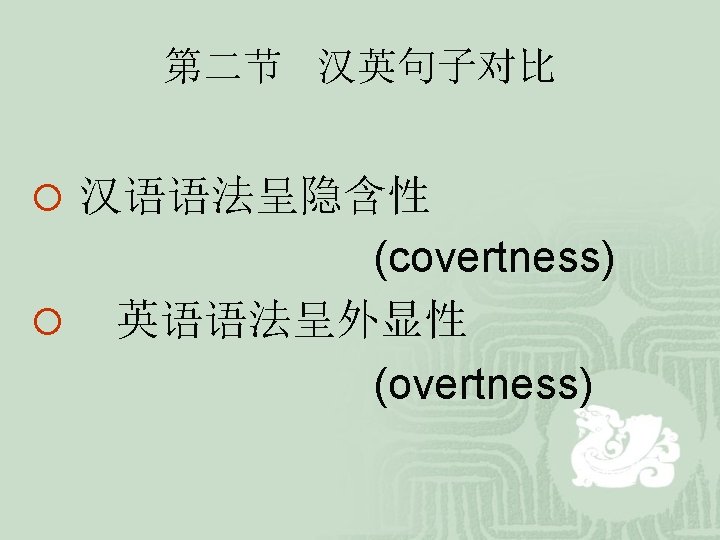
1. 4 Phonetics ¡Chinese is tone language. (声调语 言) ¡English is intonation language. (语 调语言)
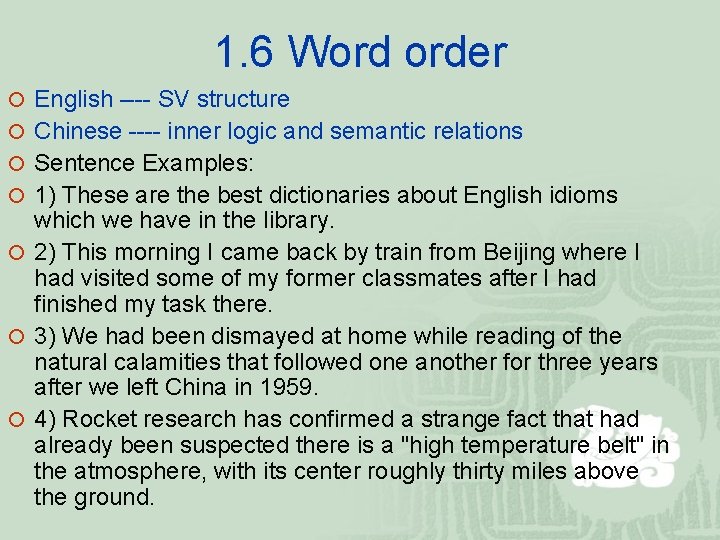
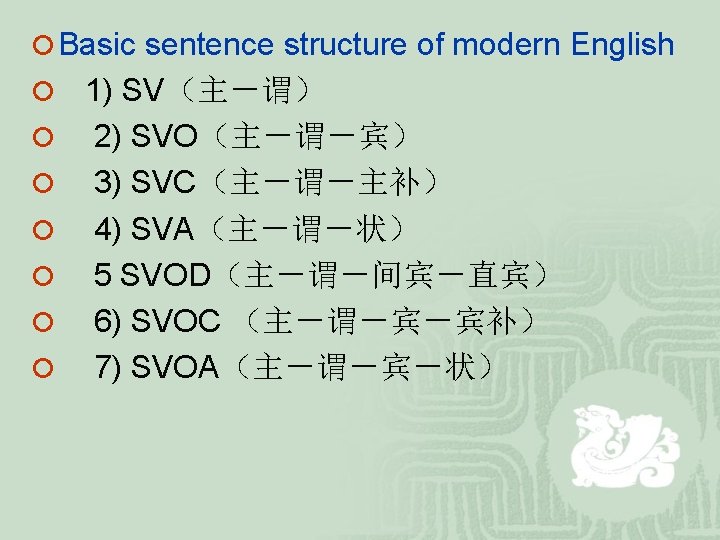
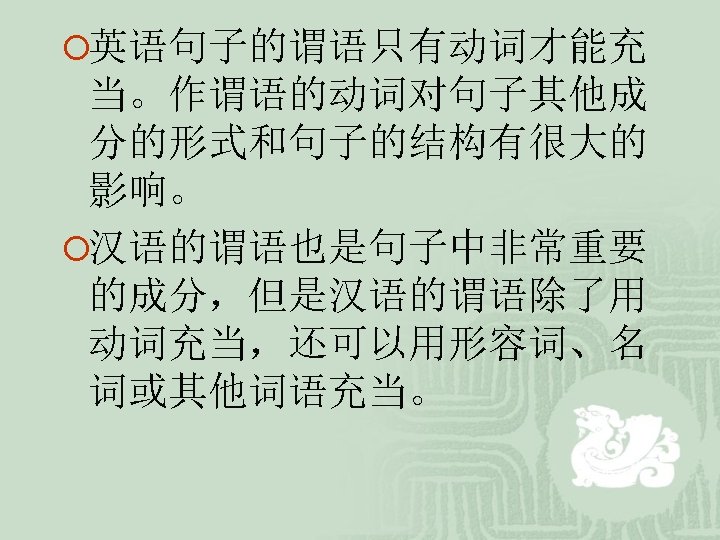
1. 6 Word order ¡ English ---- SV structure ¡ Chinese ---- inner logic and semantic relations ¡ Sentence Examples: ¡ 1) These are the best dictionaries about English idioms which we have in the library. ¡ 2) This morning I came back by train from Beijing where I had visited some of my former classmates after I had finished my task there. ¡ 3) We had been dismayed at home while reading of the natural calamities that followed one another for three years after we left China in 1959. ¡ 4) Rocket research has confirmed a strange fact that had already been suspected there is a "high temperature belt" in the atmosphere, with its center roughly thirty miles above the ground.
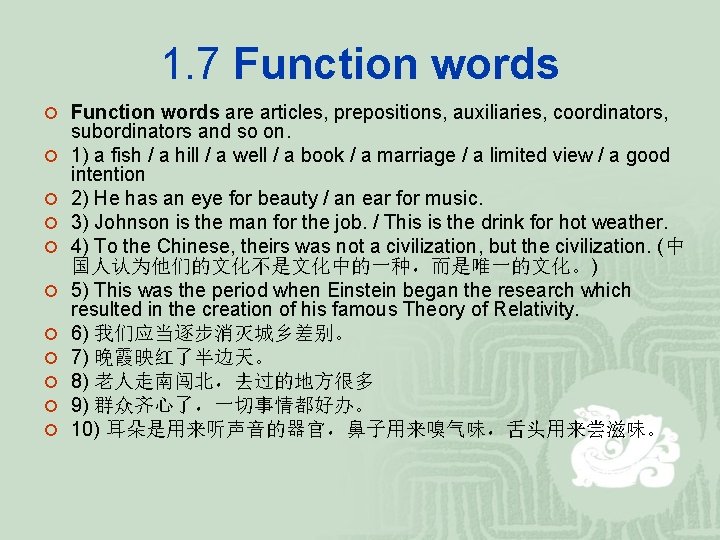
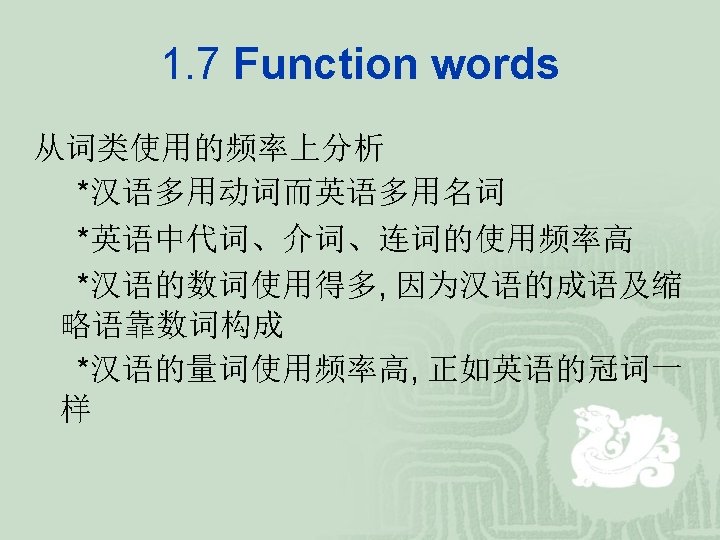
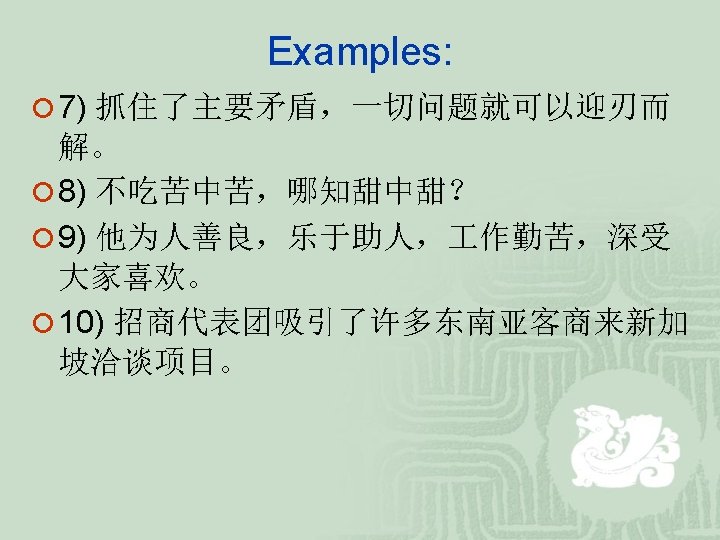
1. 7 Function words ¡ Function words are articles, prepositions, auxiliaries, coordinators, ¡ ¡ ¡ ¡ ¡ subordinators and so on. 1) a fish / a hill / a well / a book / a marriage / a limited view / a good intention 2) He has an eye for beauty / an ear for music. 3) Johnson is the man for the job. / This is the drink for hot weather. 4) To the Chinese, theirs was not a civilization, but the civilization. (中 国人认为他们的文化不是文化中的一种,而是唯一的文化。) 5) This was the period when Einstein began the research which resulted in the creation of his famous Theory of Relativity. 6) 我们应当逐步消灭城乡差别。 7) 晚霞映红了半边天。 8) 老人走南闯北,去过的地方很多 9) 群众齐心了,一切事情都好办。 10) 耳朵是用来听声音的器官,鼻子用来嗅气味,舌头用来尝滋味。
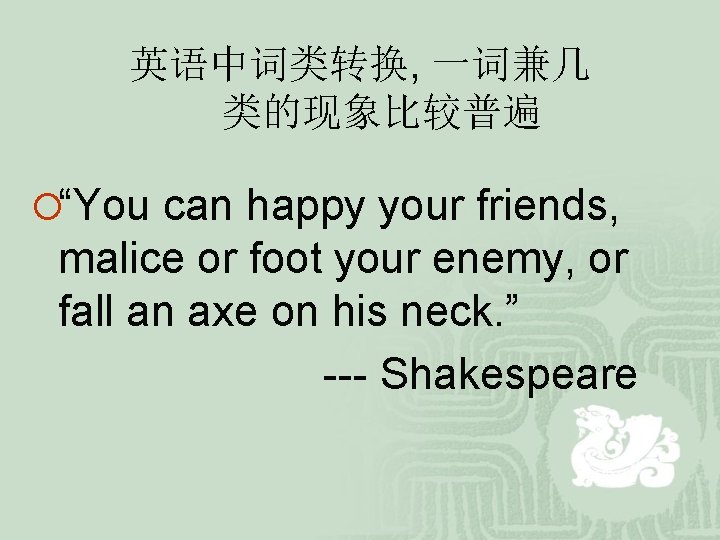
英语中词类转换, 一词兼几 类的现象比较普遍 ¡“You can happy your friends, malice or foot your enemy, or fall an axe on his neck. ” --- Shakespeare
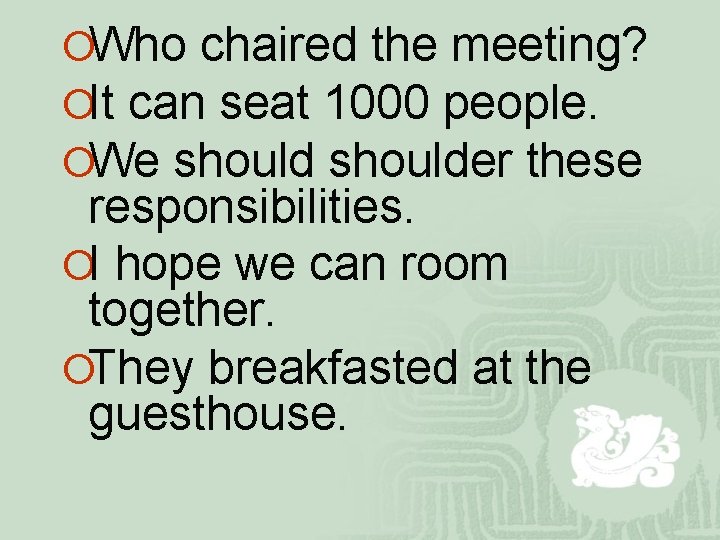
¡Who chaired the meeting? ¡It can seat 1000 people. ¡We shoulder these responsibilities. ¡I hope we can room together. ¡They breakfasted at the guesthouse.
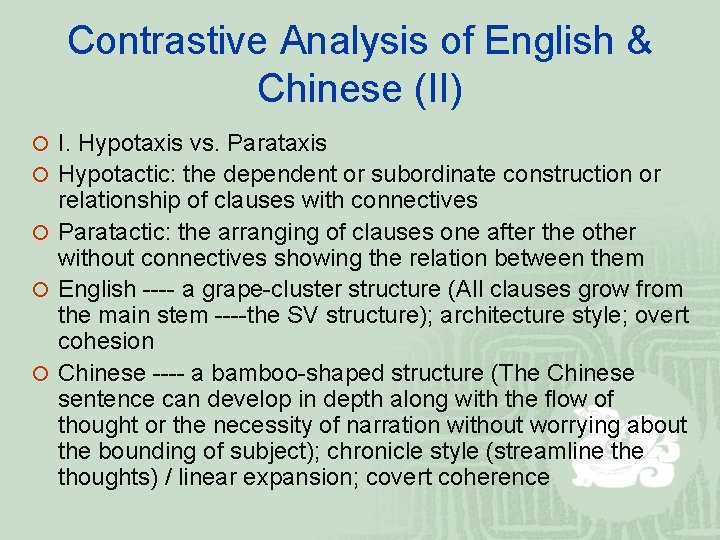
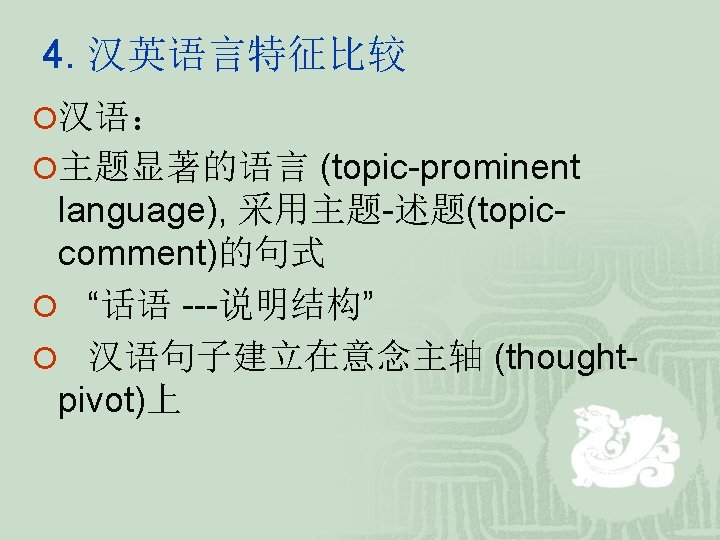
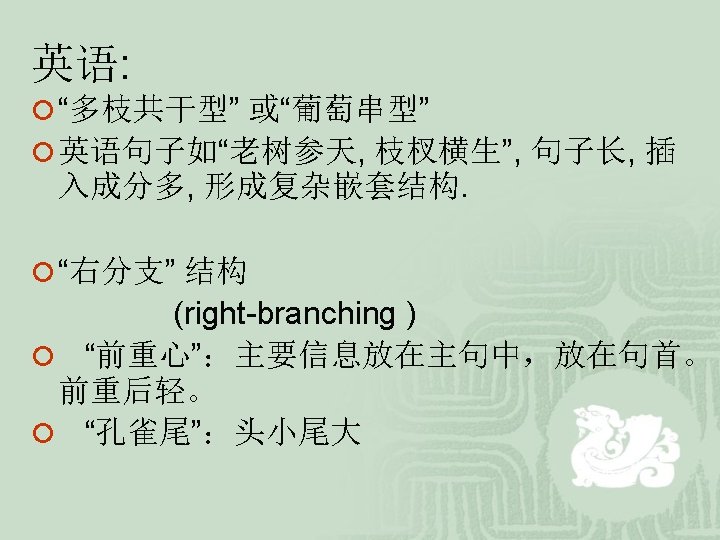
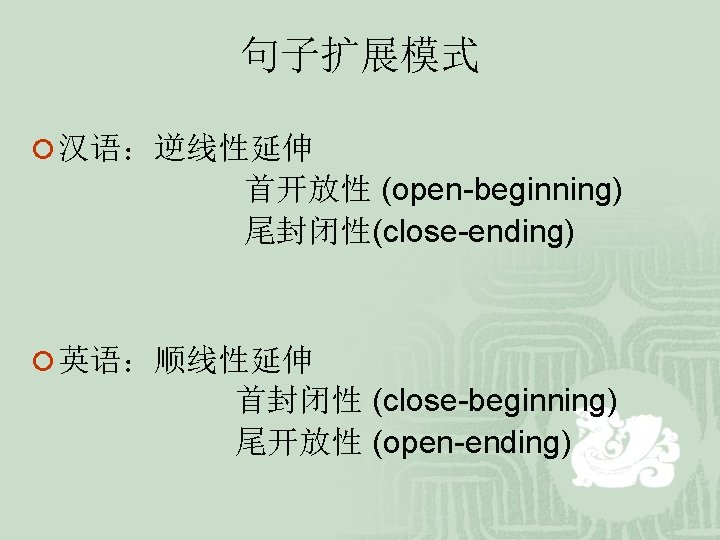
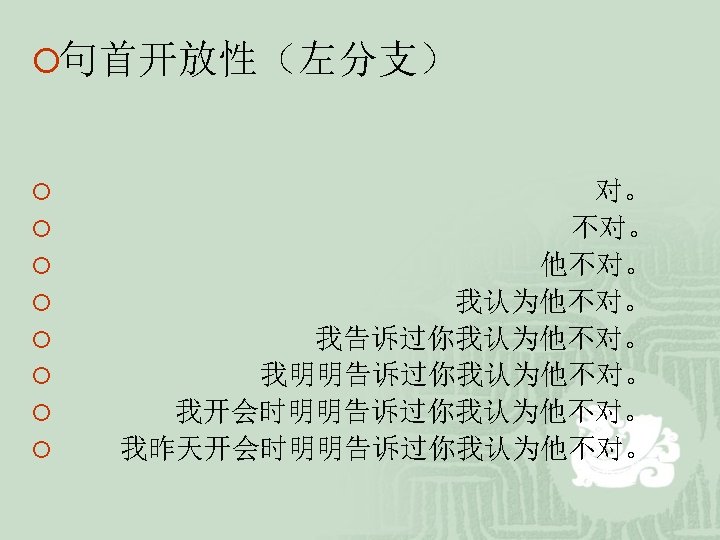
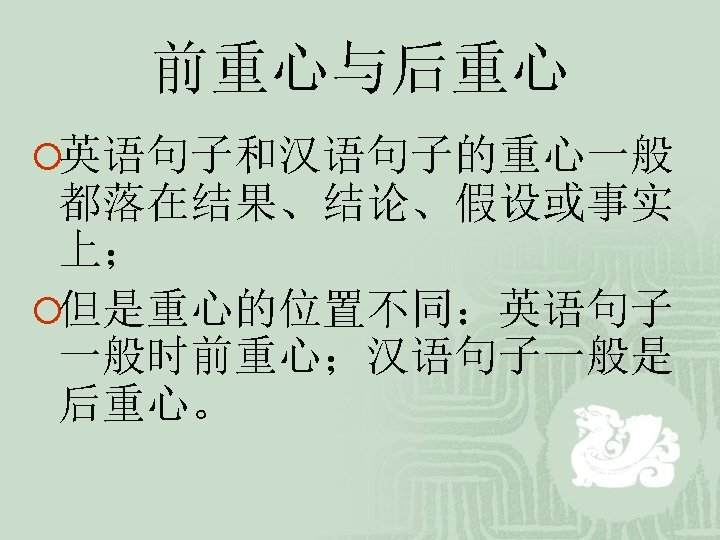
Contrastive Analysis of English & Chinese (II) ¡ I. Hypotaxis vs. Parataxis ¡ Hypotactic: the dependent or subordinate construction or relationship of clauses with connectives ¡ Paratactic: the arranging of clauses one after the other without connectives showing the relation between them ¡ English ---- a grape-cluster structure (All clauses grow from the main stem ----the SV structure); architecture style; overt cohesion ¡ Chinese ---- a bamboo-shaped structure (The Chinese sentence can develop in depth along with the flow of thought or the necessity of narration without worrying about the bounding of subject); chronicle style (streamline thoughts) / linear expansion; covert coherence
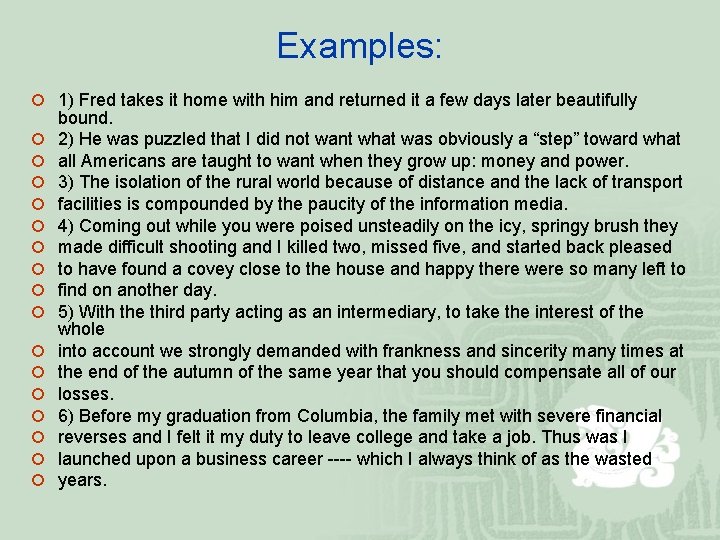
Examples: ¡ 1) Fred takes it home with him and returned it a few days later beautifully ¡ ¡ ¡ ¡ bound. 2) He was puzzled that I did not want what was obviously a “step” toward what all Americans are taught to want when they grow up: money and power. 3) The isolation of the rural world because of distance and the lack of transport facilities is compounded by the paucity of the information media. 4) Coming out while you were poised unsteadily on the icy, springy brush they made difficult shooting and I killed two, missed five, and started back pleased to have found a covey close to the house and happy there were so many left to find on another day. 5) With the third party acting as an intermediary, to take the interest of the whole into account we strongly demanded with frankness and sincerity many times at the end of the autumn of the same year that you should compensate all of our losses. 6) Before my graduation from Columbia, the family met with severe financial reverses and I felt it my duty to leave college and take a job. Thus was I launched upon a business career ---- which I always think of as the wasted years.
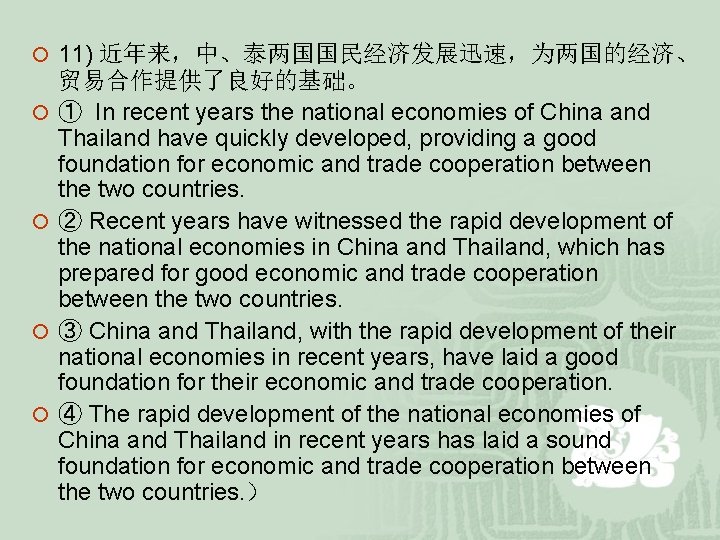
¡ 11) 近年来,中、泰两国国民经济发展迅速,为两国的经济、 ¡ ¡ 贸易合作提供了良好的基础。 ① In recent years the national economies of China and Thailand have quickly developed, providing a good foundation for economic and trade cooperation between the two countries. ② Recent years have witnessed the rapid development of the national economies in China and Thailand, which has prepared for good economic and trade cooperation between the two countries. ③ China and Thailand, with the rapid development of their national economies in recent years, have laid a good foundation for their economic and trade cooperation. ④ The rapid development of the national economies of China and Thailand in recent years has laid a sound foundation for economic and trade cooperation between the two countries. )
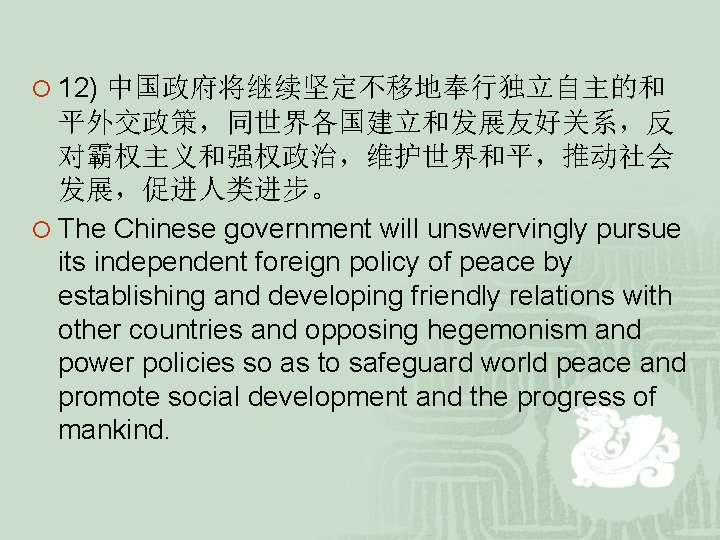
¡ 12) 中国政府将继续坚定不移地奉行独立自主的和 平外交政策,同世界各国建立和发展友好关系,反 对霸权主义和强权政治,维护世界和平,推动社会 发展,促进人类进步。 ¡ The Chinese government will unswervingly pursue its independent foreign policy of peace by establishing and developing friendly relations with other countries and opposing hegemonism and power policies so as to safeguard world peace and promote social development and the progress of mankind.
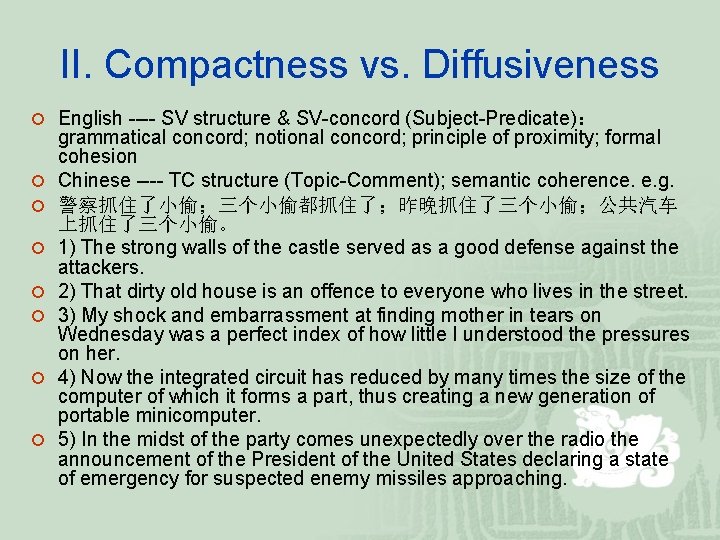
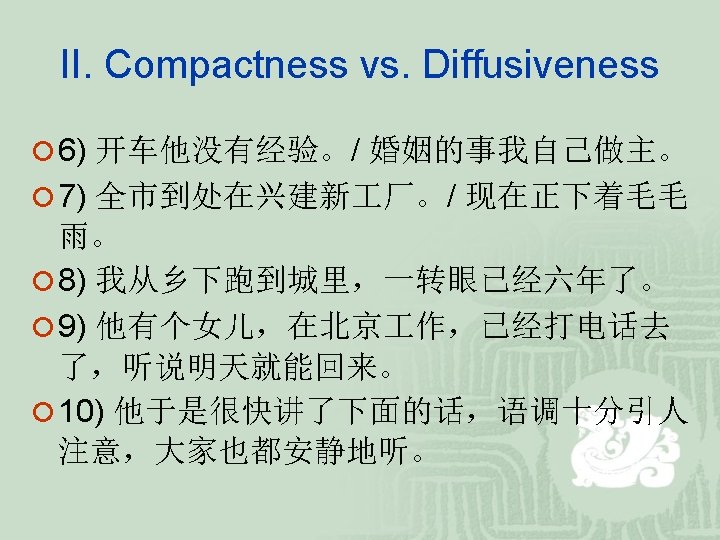
II. Compactness vs. Diffusiveness ¡ English ---- SV structure & SV-concord (Subject-Predicate): ¡ ¡ ¡ ¡ grammatical concord; notional concord; principle of proximity; formal cohesion Chinese ---- TC structure (Topic-Comment); semantic coherence. e. g. 警察抓住了小偷;三个小偷都抓住了;昨晚抓住了三个小偷;公共汽车 上抓住了三个小偷。 1) The strong walls of the castle served as a good defense against the attackers. 2) That dirty old house is an offence to everyone who lives in the street. 3) My shock and embarrassment at finding mother in tears on Wednesday was a perfect index of how little I understood the pressures on her. 4) Now the integrated circuit has reduced by many times the size of the computer of which it forms a part, thus creating a new generation of portable minicomputer. 5) In the midst of the party comes unexpectedly over the radio the announcement of the President of the United States declaring a state of emergency for suspected enemy missiles approaching.
¡ 只有四婶,因为后来雇用的女 ,大抵非懒即馋, 或者馋而且懒,左右不如意,所以也还提起祥林嫂。 ¡ Only my aunt, because the maids taken on afterwards turned out to be lazy or greedy, or both, none of them satisfied her, still spoke of Xianglin’s Wife. ¡ My aunt was the only one who still spoke of Xianglin’s Wife. This was because most of the maids taken on afterwards turned out to be lazy or greedy, or both, none of them giving satisfaction. (杨宪益、戴乃迭译)
¡ ①I have come across a great many young friends, ②bright and diligent, ③do exceedingly well in studies, ④but they are rather weak in Chinese, ⑤even can’t write a smooth Chinese letter. ⑥When asked why, they’ll say they are not interested in Chinese.
¡I have come across a great many bright and diligent young friends who have done exceedingly well in their studies, but are rather weak in Chinese. They cannot even write a letter in correct Chinese. When I asked them why, they said they were not interested in the Chinese language.
¡ The isolation of the rural world, because of distance and the lack of transport facilities, is compounded by the paucity of the information media. ¡ 由于距离远,又缺乏交通 具,使农村 社会与外界隔绝,而这种隔绝,又由于通讯 具不足而变得更加严重。 ¡ Because there is a great distance and there are not enough transport facilities, the rural world is isolated. This isolation has become more serious because there are not enough information media.
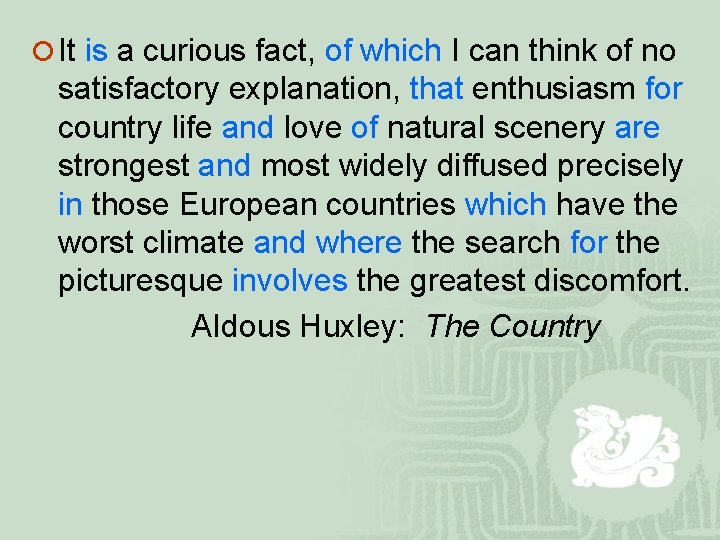
¡ It is a curious fact, of which I can think of no satisfactory explanation, that enthusiasm for country life and love of natural scenery are strongest and most widely diffused precisely in those European countries which have the worst climate and where the search for the picturesque involves the greatest discomfort. AIdous Huxley: The Country
译文主语的选择 ¡原文:这件事你不用操心。 译文1: This you don’t need to worry. 译文2: You don’t need to worry about this.
¡ 3. This is not something you need to worry about. ¡ 4. It is unnecessary for you to worry about this. ¡ 5. There is no need to worry about this.
我的头疼的要命 ¡My head aches badly. ¡My head is killing me. ¡I have a terrible headache. ¡I have a splitting headache. ¡I have a migraine.
中国的人均农业土地面积比不上世界 上其它许多国家 ¡ China’s per capita agricultural land cannot compare with that of many other countries in the world. ¡ In its amount of agricultural land per capita, China compares unfavorably with many other countries. ¡ China compares unfavorably with many other countries in terms of per capita agricultural land.
懒惰的人不会成功 ¡A lazy person will never succeed. ¡Laziness makes it impossible for one to succeed. ¡Laziness makes success impossible.
这位母亲很为有个聪明漂亮的女儿而 骄傲 ¡The mother is very proud to have an intelligent and pretty daughter. ¡The intelligence and beauty of the daughter makes her mother very proud.
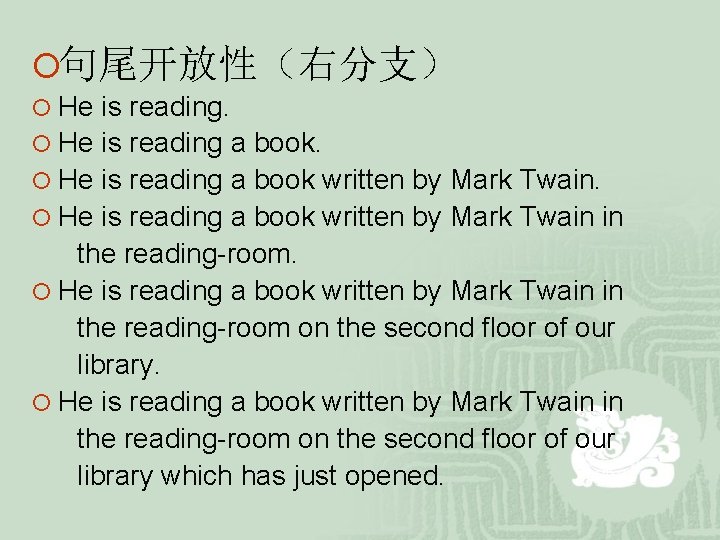
¡句尾开放性(右分支) ¡ He is reading a book written by Mark Twain in the reading-room on the second floor of our library which has just opened.
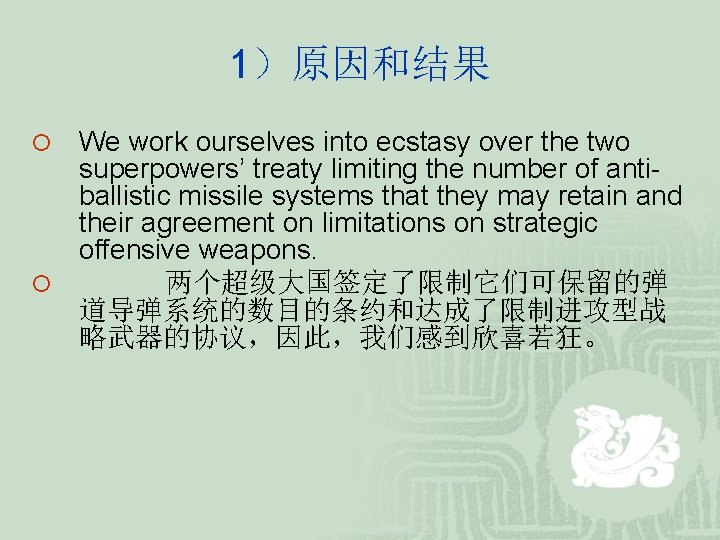
1)原因和结果 We work ourselves into ecstasy over the two superpowers’ treaty limiting the number of antiballistic missile systems that they may retain and their agreement on limitations on strategic offensive weapons. ¡ 两个超级大国签定了限制它们可保留的弹 道导弹系统的数目的条约和达成了限制进攻型战 略武器的协议,因此,我们感到欣喜若狂。 ¡
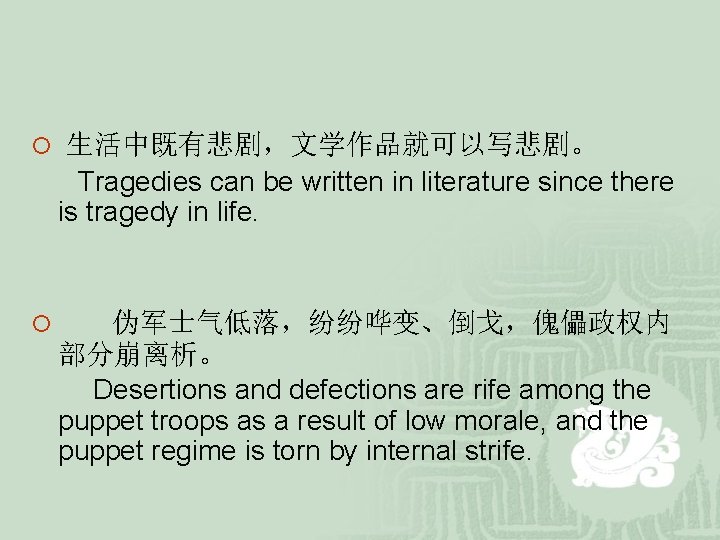
¡ 生活中既有悲剧,文学作品就可以写悲剧。 Tragedies can be written in literature since there is tragedy in life. ¡ 伪军士气低落,纷纷哗变、倒戈,傀儡政权内 部分崩离析。 Desertions and defections are rife among the puppet troops as a result of low morale, and the puppet regime is torn by internal strife.
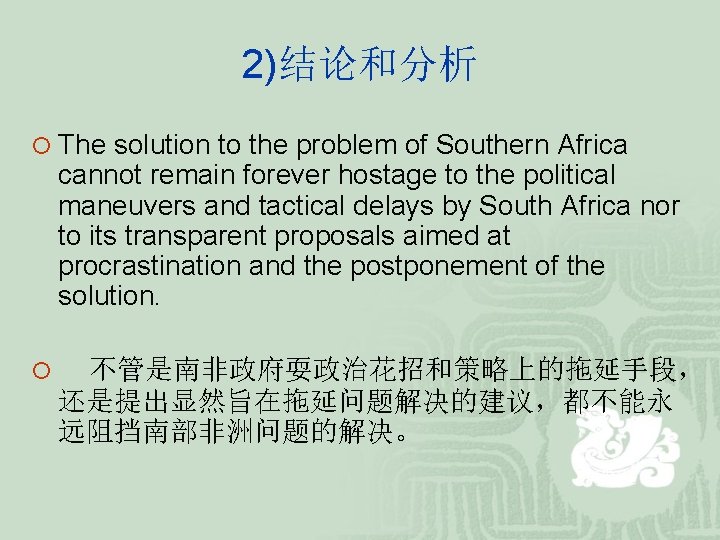
2)结论和分析 ¡ The solution to the problem of Southern Africa cannot remain forever hostage to the political maneuvers and tactical delays by South Africa nor to its transparent proposals aimed at procrastination and the postponement of the solution. ¡ 不管是南非政府耍政治花招和策略上的拖延手段, 还是提出显然旨在拖延问题解决的建议,都不能永 远阻挡南部非洲问题的解决。
¡ 揭穿这种老八股,老教条的丑态给人民看, 号召人民起来反对老八股,老教条,这就是 五四运动时期的一个极大的功绩。 ¡ A tremendous achievement of the May 4 th Movement was its public exposure of the ugliness of old stereotype and the old dogma and its call to the people to rise against them.
3)假设和前提 ¡ 小国人民敢于起来斗争,敢于拿起武器,掌握 自己国家的命运,就一定能够战胜大国的侵略。 ¡ The people of a small country can certainly defeat aggression by a big country, if only they dare to rise in struggle, dare to take up arms and grasp in their own hands the destiny of their own country.
¡ 例如:曾国藩的故事 “屡战屡败” (He was repeatedly defeated though he fought over and over again. ) ¡ “屡败屡战”( He fought over and over again though he was repeatedly defeated. ) ¡
Contrastive Analysis of English & Chinese (III)
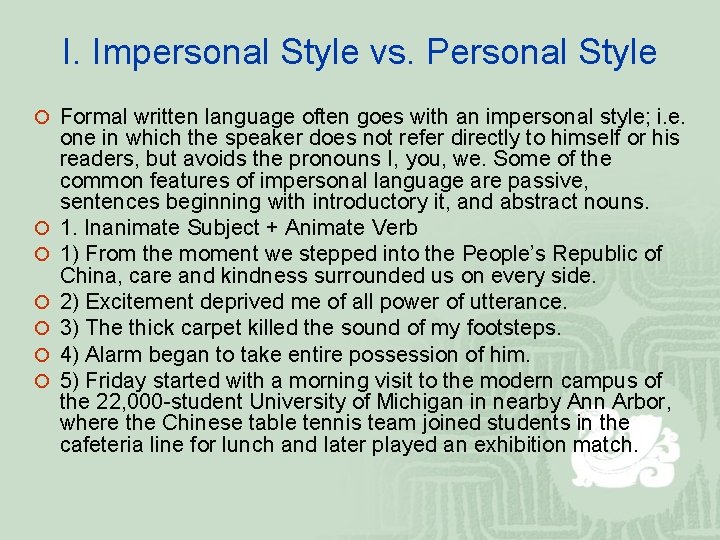
I. Impersonal Style vs. Personal Style ¡ Formal written language often goes with an impersonal style; i. e. ¡ ¡ ¡ one in which the speaker does not refer directly to himself or his readers, but avoids the pronouns I, you, we. Some of the common features of impersonal language are passive, sentences beginning with introductory it, and abstract nouns. 1. Inanimate Subject + Animate Verb 1) From the moment we stepped into the People’s Republic of China, care and kindness surrounded us on every side. 2) Excitement deprived me of all power of utterance. 3) The thick carpet killed the sound of my footsteps. 4) Alarm began to take entire possession of him. 5) Friday started with a morning visit to the modern campus of the 22, 000 -student University of Michigan in nearby Ann Arbor, where the Chinese table tennis team joined students in the cafeteria line for lunch and later played an exhibition match.
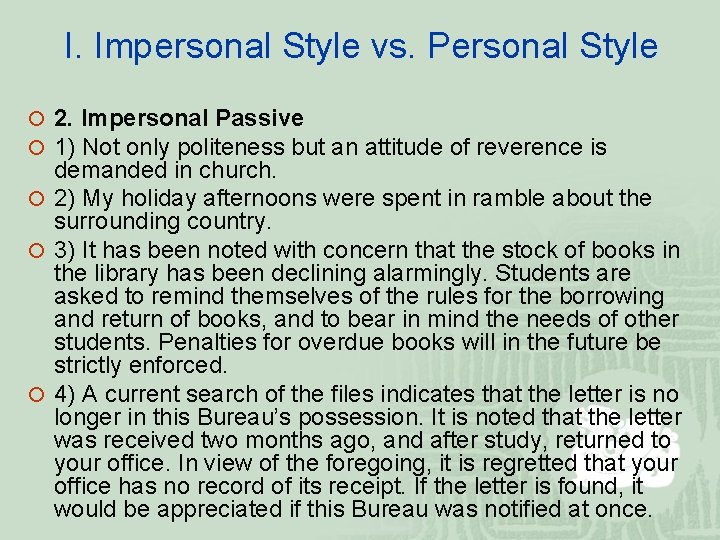
I. Impersonal Style vs. Personal Style ¡ 2. Impersonal Passive ¡ 1) Not only politeness but an attitude of reverence is demanded in church. ¡ 2) My holiday afternoons were spent in ramble about the surrounding country. ¡ 3) It has been noted with concern that the stock of books in the library has been declining alarmingly. Students are asked to remind themselves of the rules for the borrowing and return of books, and to bear in mind the needs of other students. Penalties for overdue books will in the future be strictly enforced. ¡ 4) A current search of the files indicates that the letter is no longer in this Bureau’s possession. It is noted that the letter was received two months ago, and after study, returned to your office. In view of the foregoing, it is regretted that your office has no record of its receipt. If the letter is found, it would be appreciated if this Bureau was notified at once.
II. Abstraction vs. Concretization ¡ English ---- the tendency of nominalization (the excessive ¡ ¡ ¡ ¡ ¡ use of abstract nouns) Chinese ---- high concretization in its notions and imagery 1) The stars twinkled in transparent clarity. 2) I marveled at the relentless determination of the rain. 3) He had surfaced with less visibility in the policy decisions. 4) The growing awareness by millions of people of their intolerable conditions of life had prompted them to revote. 5) The lack of figures may prove to be an obstacle to the efficiency of the whole of the proposed statistical content of the exercise. 6) No year passes now without evidence of the truth of the statement that the work of government is becoming increasingly difficult.
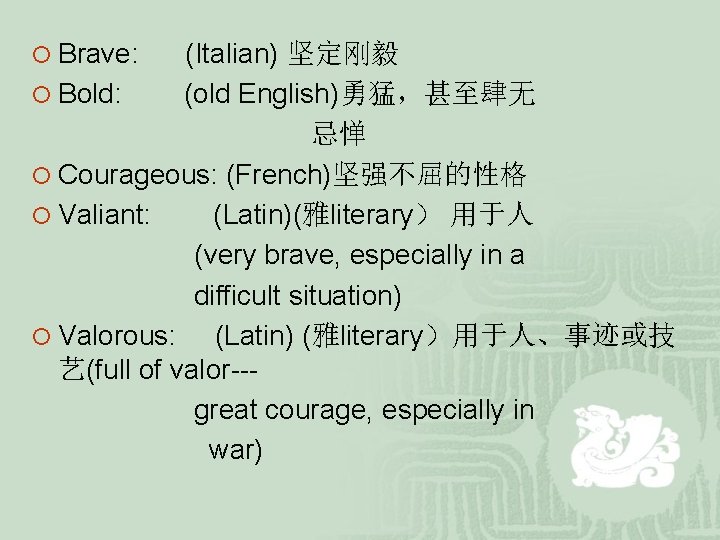
¡ Brave: (Italian) 坚定刚毅 ¡ Bold: (old English)勇猛,甚至肆无 忌惮 ¡ Courageous: (French)坚强不屈的性格 ¡ Valiant: (Latin)(雅literary) 用于人 (very brave, especially in a difficult situation) ¡ Valorous: (Latin) (雅literary)用于人、事迹或技 艺(full of valor--great courage, especially in war)
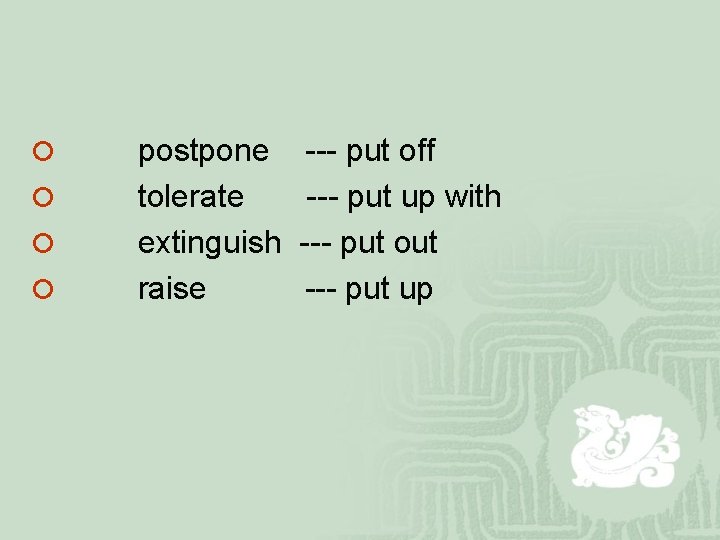
¡ ¡ postpone tolerate extinguish raise --- put off --- put up with --- put out --- put up
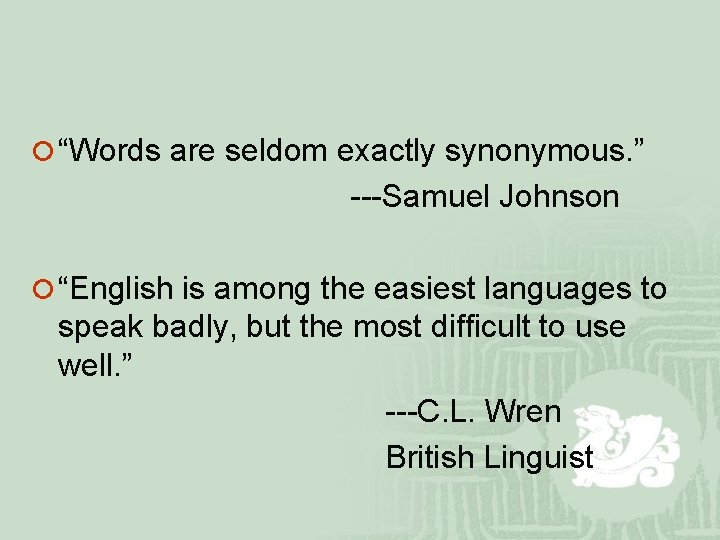
¡ “Words are seldom exactly synonymous. ” ---Samuel Johnson ¡ “English is among the easiest languages to speak badly, but the most difficult to use well. ” ---C. L. Wren British Linguist
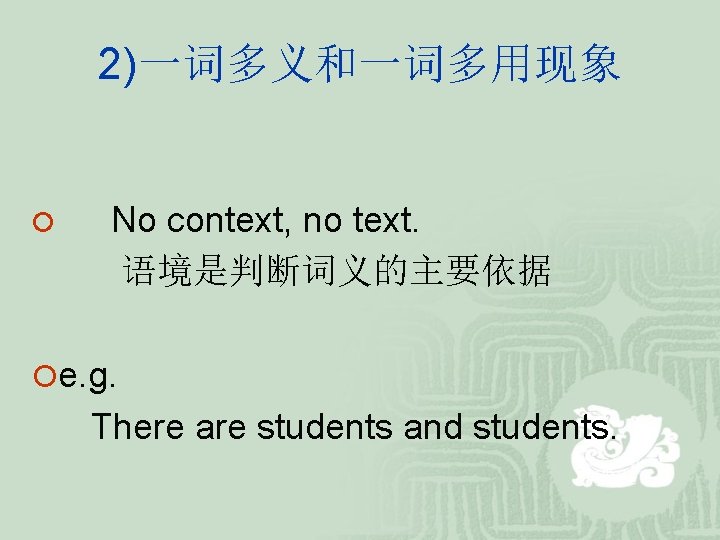
2)一词多义和一词多用现象 ¡ No context, no text. 语境是判断词义的主要依据 ¡e. g. There are students and students.
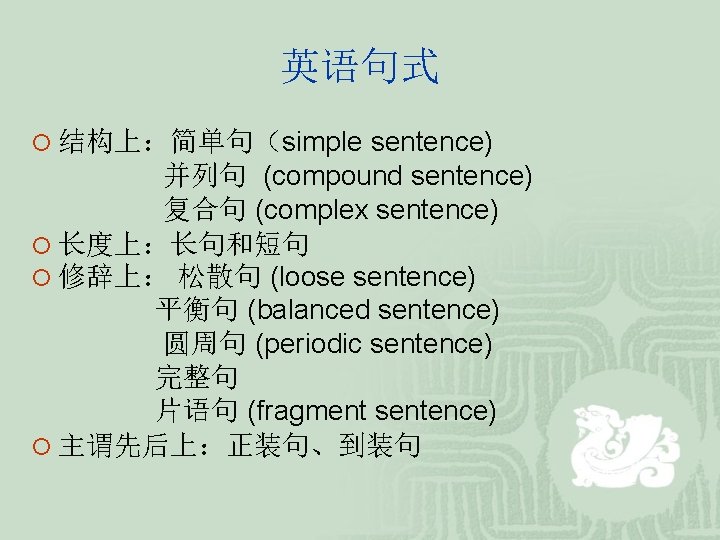
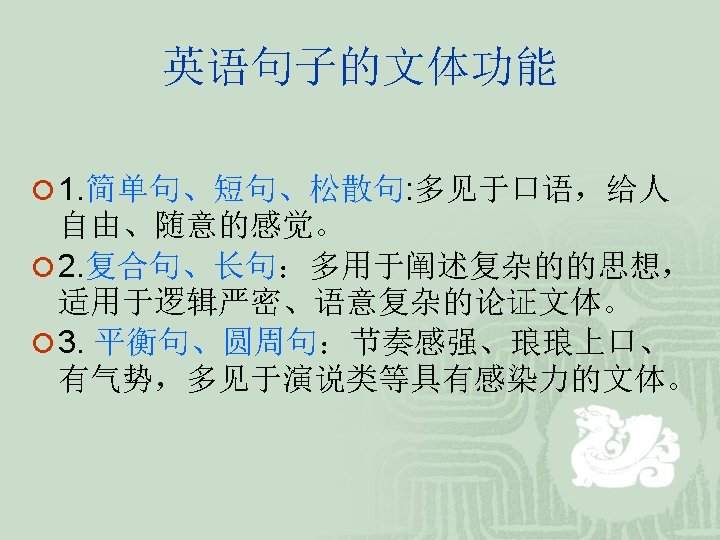
英语句式 ¡ 结构上:简单句(simple sentence) 并列句 (compound sentence) 复合句 (complex sentence) ¡ 长度上:长句和短句 ¡ 修辞上: 松散句 (loose sentence) 平衡句 (balanced sentence) 圆周句 (periodic sentence) 完整句 片语句 (fragment sentence) ¡ 主谓先后上:正装句、到装句