Conditioner and Health Monitor for Use in Conjunction

- Slides: 24
Conditioner and Health Monitor for Use in Conjunction with a Non Deterministic Random Bit Generator G. Richard Newell Senior Principal Product Architect Actel Corporation for Crypt. Archi 2009 Hardware testing performed by James Vorgert Actel Area Technical Manager Actel Corporation © 2009 1
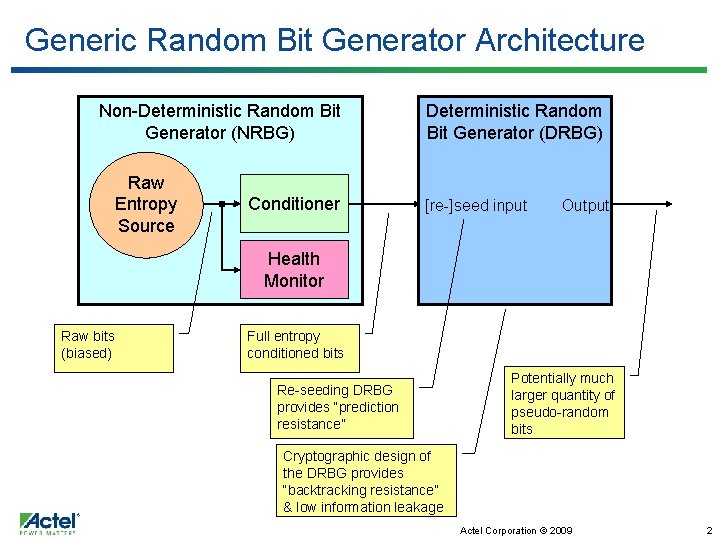
Generic Random Bit Generator Architecture Non Deterministic Random Bit Generator (NRBG) Raw Entropy Source Conditioner Deterministic Random Bit Generator (DRBG) [re ]seed input Output Health Monitor Raw bits (biased) Full entropy conditioned bits Re seeding DRBG provides “prediction resistance” Potentially much larger quantity of pseudo random bits Cryptographic design of the DRBG provides “backtracking resistance” & low information leakage Actel Corporation © 2009 2
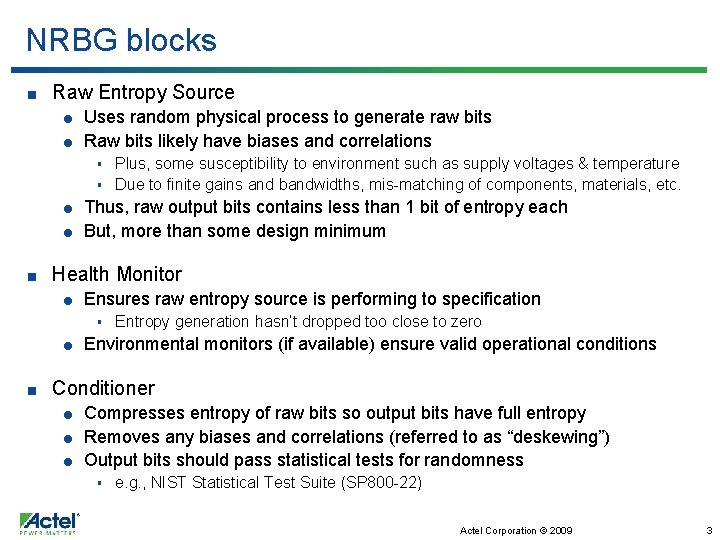
NRBG blocks Raw Entropy Source Uses random physical process to generate raw bits Raw bits likely have biases and correlations § § Thus, raw output bits contains less than 1 bit of entropy each But, more than some design minimum Health Monitor Ensures raw entropy source is performing to specification § Plus, some susceptibility to environment such as supply voltages & temperature Due to finite gains and bandwidths, mis matching of components, materials, etc. Entropy generation hasn’t dropped too close to zero Environmental monitors (if available) ensure valid operational conditions Conditioner Compresses entropy of raw bits so output bits have full entropy Removes any biases and correlations (referred to as “deskewing”) Output bits should pass statistical tests for randomness § e. g. , NIST Statistical Test Suite (SP 800 22) Actel Corporation © 2009 3
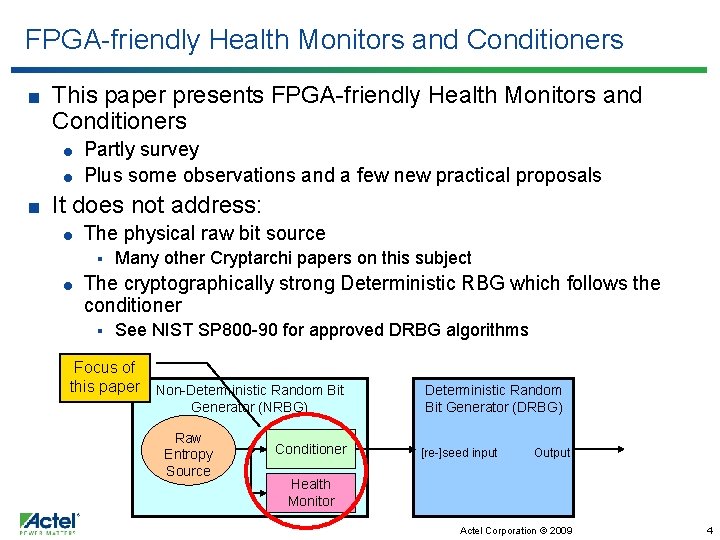
FPGA friendly Health Monitors and Conditioners This paper presents FPGA friendly Health Monitors and Conditioners Partly survey Plus some observations and a few new practical proposals It does not address: The physical raw bit source § Many other Cryptarchi papers on this subject The cryptographically strong Deterministic RBG which follows the conditioner § See NIST SP 800 90 for approved DRBG algorithms Focus of this paper Non Deterministic Random Bit Generator (NRBG) Raw Entropy Source Conditioner Deterministic Random Bit Generator (DRBG) [re ]seed input Output Health Monitor Actel Corporation © 2009 4
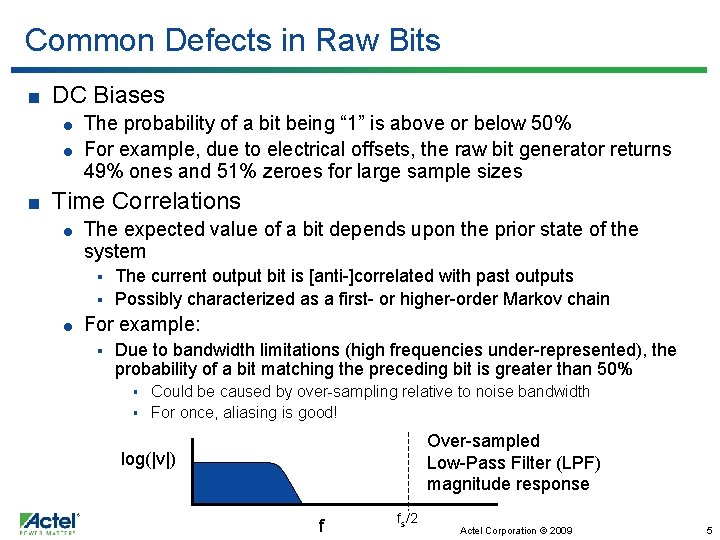
Common Defects in Raw Bits DC Biases The probability of a bit being “ 1” is above or below 50% For example, due to electrical offsets, the raw bit generator returns 49% ones and 51% zeroes for large sample sizes Time Correlations The expected value of a bit depends upon the prior state of the system § § The current output bit is [anti ]correlated with past outputs Possibly characterized as a first or higher order Markov chain For example: § Due to bandwidth limitations (high frequencies under represented), the probability of a bit matching the preceding bit is greater than 50% § § Could be caused by over sampling relative to noise bandwidth For once, aliasing is good! Over sampled Low Pass Filter (LPF) magnitude response log(|v|) f fs/2 Actel Corporation © 2009 5
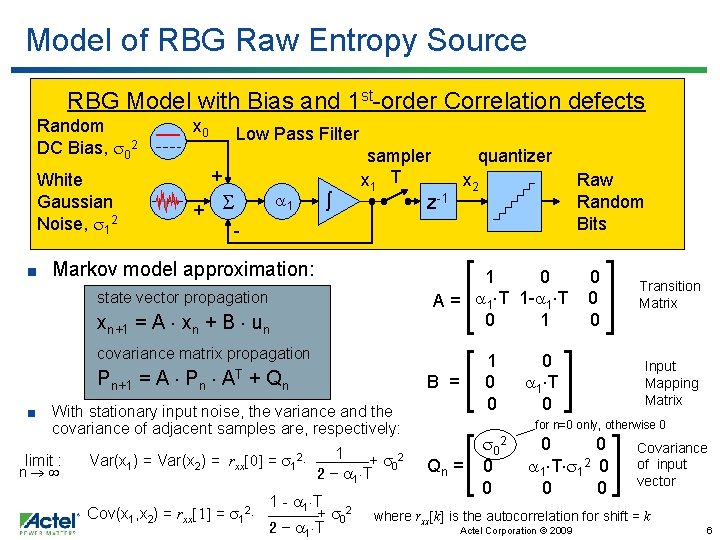
Model of RBG Raw Entropy Source RBG Model with Bias and 1 st order Correlation defects Random DC Bias, s 02 White Gaussian Noise, s 12 x 0 Low Pass Filter + a 1 + S sampler x 1 T quantizer z 1 x 2 Markov model approximation: 1 0 A = a 1 T 1 a 1 T 0 1 state vector propagation xn+1 = A xn + B un covariance matrix propagation Pn+1 = A Pn AT + Qn 1 0 0 B = With stationary input noise, the variance and the covariance of adjacent samples are, respectively: limit : n Raw Random Bits 1 Var(x 1) = Var(x 2) = rxx[0] = s 12 + s 0 2 2 - a 1 T Cov(x 1, x 2) = rxx[1] = s 12 1 a 1 T 2 + s 0 2 - a 1 T 0 0 a 1 T 0 Transition Matrix Input Mapping Matrix for n=0 only, otherwise 0 Qn = s 0 2 0 0 a 1 T s 12 0 0 0 Covariance of input vector where rxx[k] is the autocorrelation for shift = k Actel Corporation © 2009 6
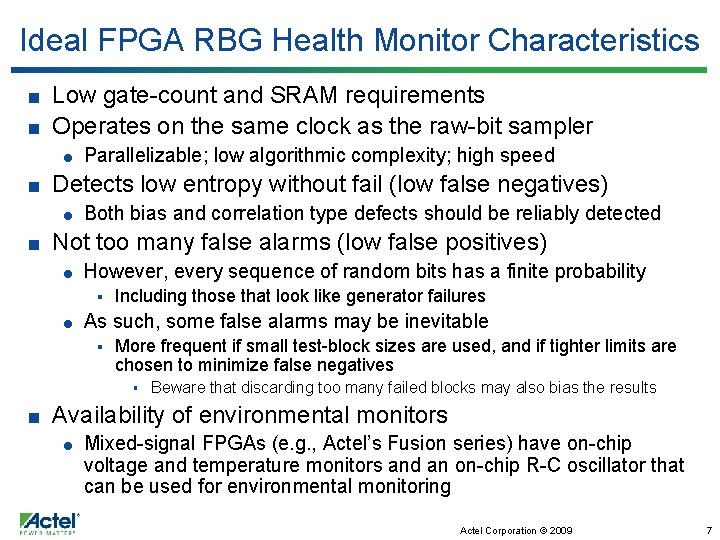
Ideal FPGA RBG Health Monitor Characteristics Low gate count and SRAM requirements Operates on the same clock as the raw bit sampler Detects low entropy without fail (low false negatives) Parallelizable; low algorithmic complexity; high speed Both bias and correlation type defects should be reliably detected Not too many false alarms (low false positives) However, every sequence of random bits has a finite probability § Including those that look like generator failures As such, some false alarms may be inevitable § More frequent if small test block sizes are used, and if tighter limits are chosen to minimize false negatives § Beware that discarding too many failed blocks may also bias the results Availability of environmental monitors Mixed signal FPGAs (e. g. , Actel’s Fusion series) have on chip voltage and temperature monitors and an on chip R C oscillator that can be used for environmental monitoring Actel Corporation © 2009 7
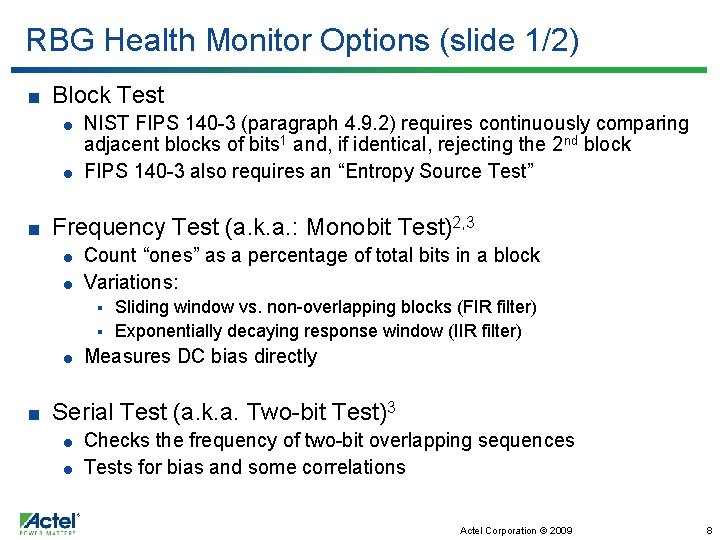
RBG Health Monitor Options (slide 1/2) Block Test NIST FIPS 140 3 (paragraph 4. 9. 2) requires continuously comparing adjacent blocks of bits 1 and, if identical, rejecting the 2 nd block FIPS 140 3 also requires an “Entropy Source Test” Frequency Test (a. k. a. : Monobit Test)2, 3 Count “ones” as a percentage of total bits in a block Variations: § § Sliding window vs. non overlapping blocks (FIR filter) Exponentially decaying response window (IIR filter) Measures DC bias directly Serial Test (a. k. a. Two bit Test)3 Checks the frequency of two bit overlapping sequences Tests for bias and some correlations Actel Corporation © 2009 8
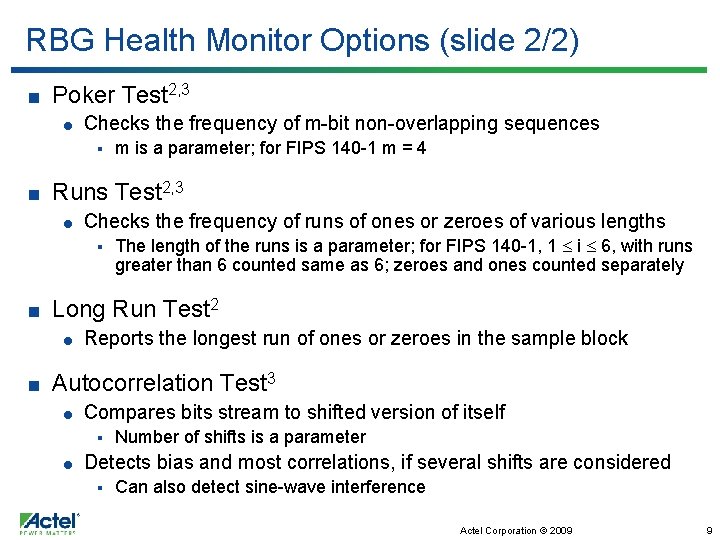
RBG Health Monitor Options (slide 2/2) Poker Test 2, 3 Checks the frequency of m bit non overlapping sequences § Runs Test 2, 3 Checks the frequency of runs of ones or zeroes of various lengths § The length of the runs is a parameter; for FIPS 140 1, 1 i 6, with runs greater than 6 counted same as 6; zeroes and ones counted separately Long Run Test 2 m is a parameter; for FIPS 140 1 m = 4 Reports the longest run of ones or zeroes in the sample block Autocorrelation Test 3 Compares bits stream to shifted version of itself § Number of shifts is a parameter Detects bias and most correlations, if several shifts are considered § Can also detect sine wave interference Actel Corporation © 2009 9
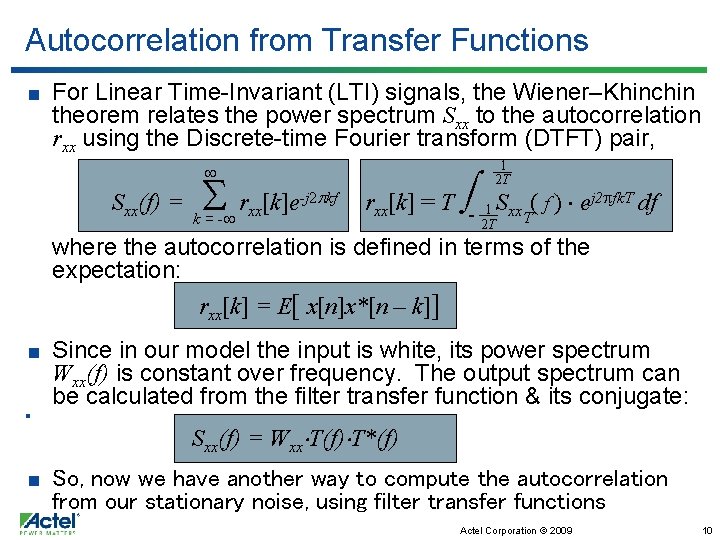
Autocorrelation from Transfer Functions For Linear Time Invariant (LTI) signals, the Wiener–Khinchin theorem relates the power spectrum Sxx to the autocorrelation rxx using the Discrete time Fourier transform (DTFT) pair, Sxx(f) = Sr k = -j 2 pkf [k]e xx rxx[k] = T 1 2 T S ( f ) ej 2 pfk. T df 1 xx T 2 T where the autocorrelation is defined in terms of the expectation: rxx[k] = E[ x[n]x*[n – k]] Since in our model the input is white, its power spectrum Wxx(f) is constant over frequency. The output spectrum can be calculated from the filter transfer function & its conjugate: Sxx(f) = Wxx T(f) T*(f) So, now we have another way to compute the autocorrelation from our stationary noise, using filter transfer functions Actel Corporation © 2009 10
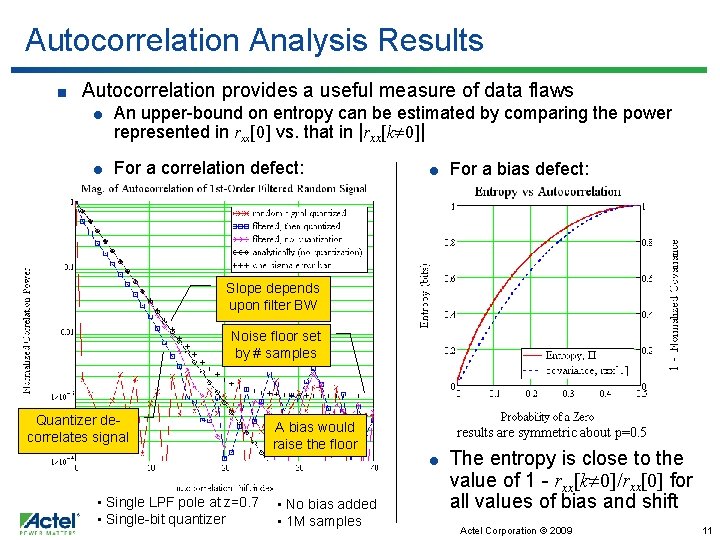
Autocorrelation Analysis Results Autocorrelation provides a useful measure of data flaws An upper bound on entropy can be estimated by comparing the power represented in rxx[0] vs. that in |rxx[k 0]| For a correlation defect: For a bias defect: Slope depends upon filter BW Quantizer de correlates signal 1 Noise floor set by # samples A bias would raise the floor results are symmetric about p=0. 5 • Single LPF pole at z=0. 7 • Single bit quantizer • No bias added • 1 M samples The entropy is close to the value of 1 rxx[k 0]/rxx[0] for all values of bias and shift Actel Corporation © 2009 11
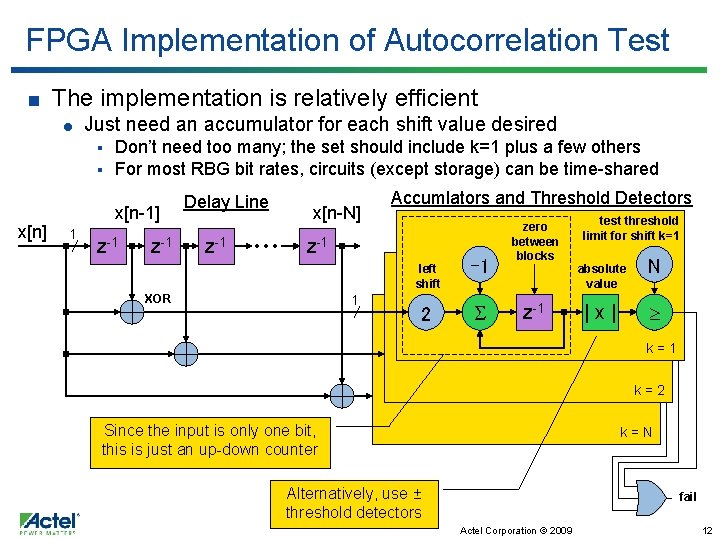
FPGA Implementation of Autocorrelation Test The implementation is relatively efficient Just need an accumulator for each shift value desired § § x[n] Don’t need too many; the set should include k=1 plus a few others For most RBG bit rates, circuits (except storage) can be time shared x[n 1] 1 z 1 Delay Line z 1 x[n N] Accumlators and Threshold Detectors z 1 left shift XOR 1 2 -1 S zero between blocks z 1 test threshold limit for shift k=1 absolute value |x| N k=1 k=2 Since the input is only one bit, this is just an up down counter k=N Alternatively, use ± threshold detectors fail Actel Corporation © 2009 12
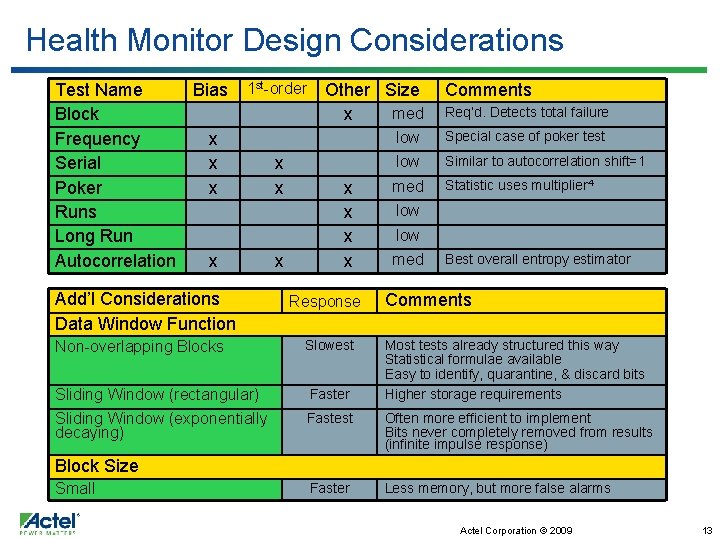
Health Monitor Design Considerations Test Name Bias Block Frequency x Serial x Poker x Runs Long Run Autocorrelation x 1 st order Add’l Considerations Data Window Function Non overlapping Blocks Sliding Window (rectangular) Sliding Window (exponentially decaying) x x x Other Size med x x x Response Slowest Faster Comments Req’d. Detects total failure low Special case of poker test low Similar to autocorrelation shift=1 med Statistic uses multiplier 4 low med Best overall entropy estimator Comments Most tests already structured this way Statistical formulae available Easy to identify, quarantine, & discard bits Higher storage requirements Fastest Often more efficient to implement Bits never completely removed from results (infinite impulse response) Faster Less memory, but more false alarms Block Size Small Actel Corporation © 2009 13
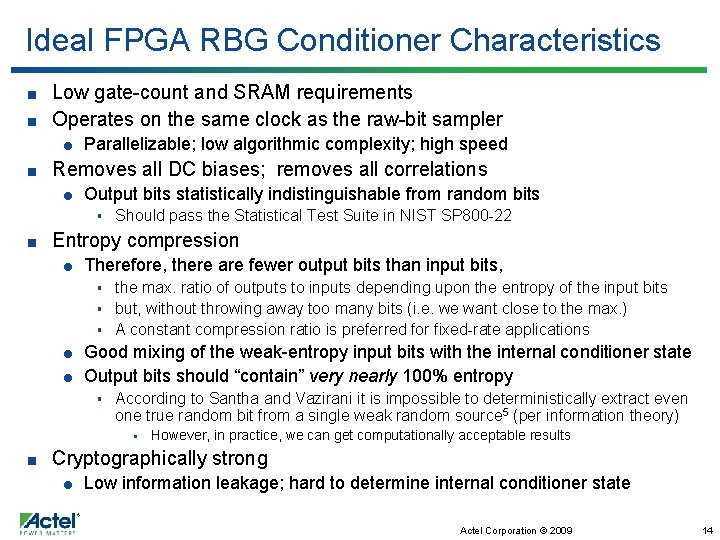
Ideal FPGA RBG Conditioner Characteristics Low gate count and SRAM requirements Operates on the same clock as the raw bit sampler Parallelizable; low algorithmic complexity; high speed Removes all DC biases; removes all correlations Output bits statistically indistinguishable from random bits § Should pass the Statistical Test Suite in NIST SP 800 22 Entropy compression Therefore, there are fewer output bits than input bits, § § § the max. ratio of outputs to inputs depending upon the entropy of the input bits but, without throwing away too many bits (i. e. we want close to the max. ) A constant compression ratio is preferred for fixed rate applications Good mixing of the weak entropy input bits with the internal conditioner state Output bits should “contain” very nearly 100% entropy § According to Santha and Vazirani it is impossible to deterministically extract even one true random bit from a single weak random source 5 (per information theory) § However, in practice, we can get computationally acceptable results Cryptographically strong Low information leakage; hard to determine internal conditioner state Actel Corporation © 2009 14
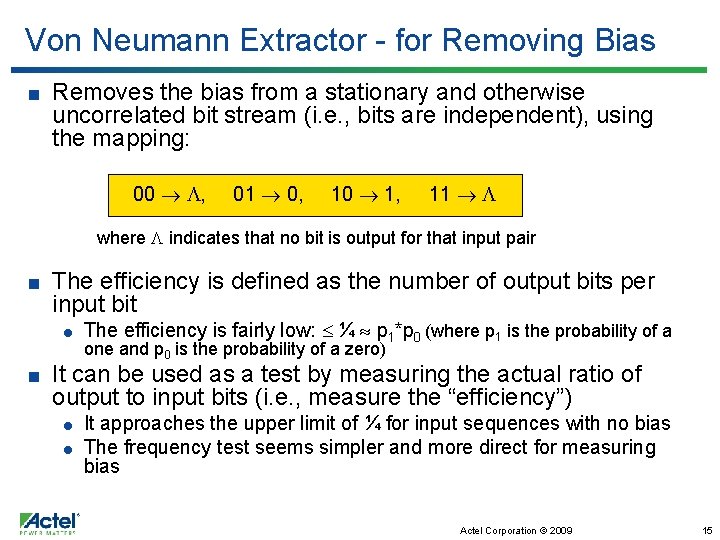
Von Neumann Extractor for Removing Bias Removes the bias from a stationary and otherwise uncorrelated bit stream (i. e. , bits are independent), using the mapping: 00 , 01 0, 10 1, 11 where indicates that no bit is output for that input pair The efficiency is defined as the number of output bits per input bit The efficiency is fairly low: ¼ p 1*p 0 (where p 1 is the probability of a one and p 0 is the probability of a zero) It can be used as a test by measuring the actual ratio of output to input bits (i. e. , measure the “efficiency”) It approaches the upper limit of ¼ for input sequences with no bias The frequency test seems simpler and more direct for measuring bias Actel Corporation © 2009 15
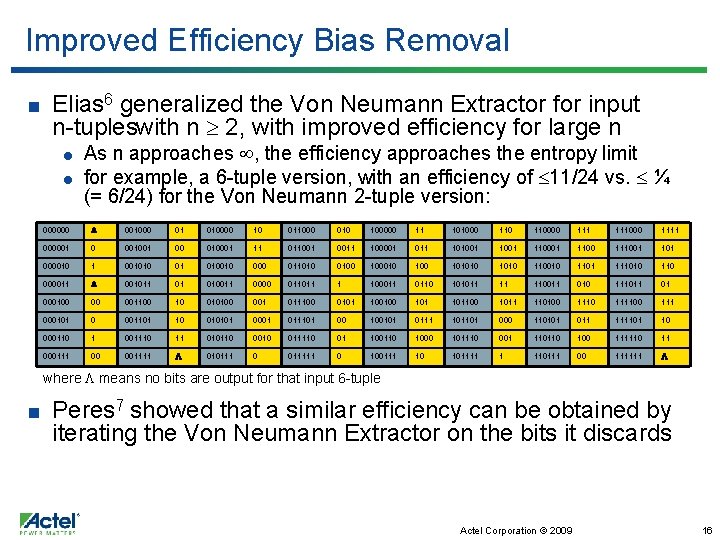
Improved Efficiency Bias Removal Elias 6 generalized the Von Neumann Extractor for input n tupleswith n 2, with improved efficiency for large n As n approaches , the efficiency approaches the entropy limit for example, a 6 tuple version, with an efficiency of 11/24 vs. ¼ (= 6/24) for the Von Neumann 2 tuple version: 000000 001000 01 010000 10 011000 010 100000 11 101000 110000 111000 1111 000001 0 001001 00 010001 11 011001 0011 100001 011 101001 110001 1100 111001 101 000010 1 001010 01 010010 000 011010 0100 100010 101010 110010 1101 111010 110 000011 001011 01 010011 0000 011011 1 100011 0110 101011 11 110011 010 111011 01 000100 00 001100 10 010100 001 011100 0101 100100 101100 1011 110100 111100 111 000101 0 001101 10 010101 0001 011101 00 100101 0111 101101 000 110101 011 111101 10 000110 1 001110 11 010110 0010 011110 01 100110 1000 101110 001 110110 100 111110 11 000111 00 001111 010111 0 011111 0 100111 10 101111 1 110111 00 111111 where means no bits are output for that input 6 tuple Peres 7 showed that a similar efficiency can be obtained by iterating the Von Neumann Extractor on the bits it discards Actel Corporation © 2009 16
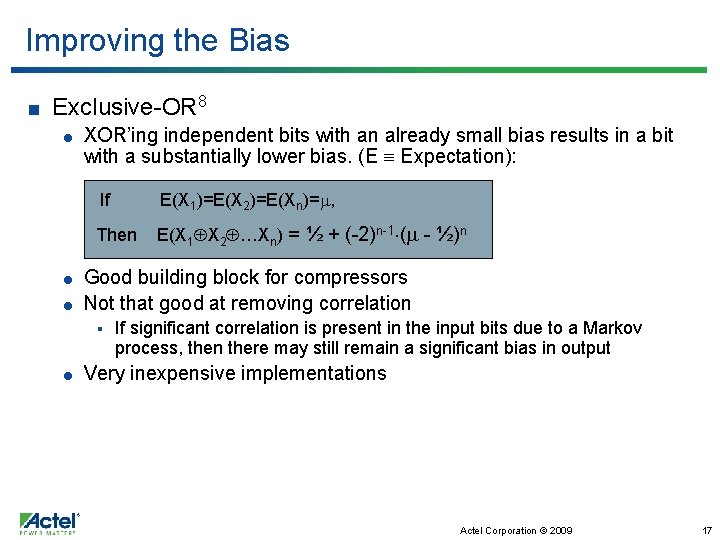
Improving the Bias Exclusive OR 8 XOR’ing independent bits with an already small bias results in a bit with a substantially lower bias. (E Expectation): If E(X 1)=E(X 2)=E(Xn)= , Then E(X 1 X 2 …Xn) = ½ + ( 2)n 1 ( ½)n Good building block for compressors Not that good at removing correlation § If significant correlation is present in the input bits due to a Markov process, then there may still remain a significant bias in output Very inexpensive implementations Actel Corporation © 2009 17
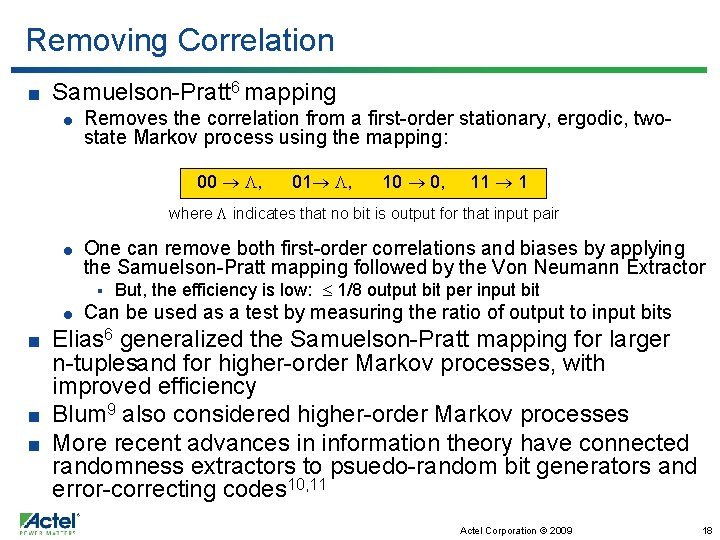
Removing Correlation Samuelson Pratt 6 mapping Removes the correlation from a first order stationary, ergodic, two state Markov process using the mapping: 00 , 01 , 10 0, 11 1 where indicates that no bit is output for that input pair One can remove both first order correlations and biases by applying the Samuelson Pratt mapping followed by the Von Neumann Extractor § But, the efficiency is low: 1/8 output bit per input bit Can be used as a test by measuring the ratio of output to input bits Elias 6 generalized the Samuelson Pratt mapping for larger n tuplesand for higher order Markov processes, with improved efficiency Blum 9 also considered higher order Markov processes More recent advances in information theory have connected randomness extractors to psuedo random bit generators and error correcting codes 10, 11 Actel Corporation © 2009 18
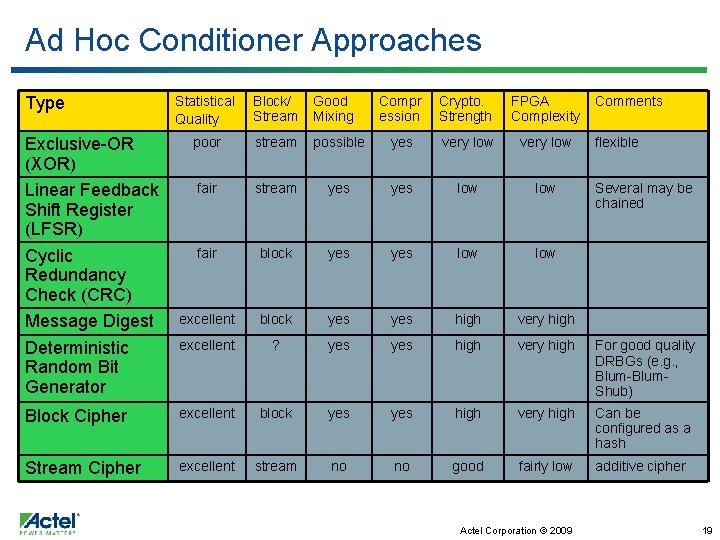
Ad Hoc Conditioner Approaches Type Compr ession Crypto. Strength FPGA Complexity possible yes very low stream yes low fair block yes low excellent block yes high very high excellent ? yes high very high For good quality DRBGs (e. g. , Blum Shub) Block Cipher excellent block yes high very high Can be configured as a hash Stream Cipher excellent stream no no good fairly low additive cipher Exclusive OR (XOR) Linear Feedback Shift Register (LFSR) Cyclic Redundancy Check (CRC) Message Digest Deterministic Random Bit Generator Statistical Quality Block/ Stream Good Mixing poor stream fair Actel Corporation © 2009 Comments flexible Several may be chained 19
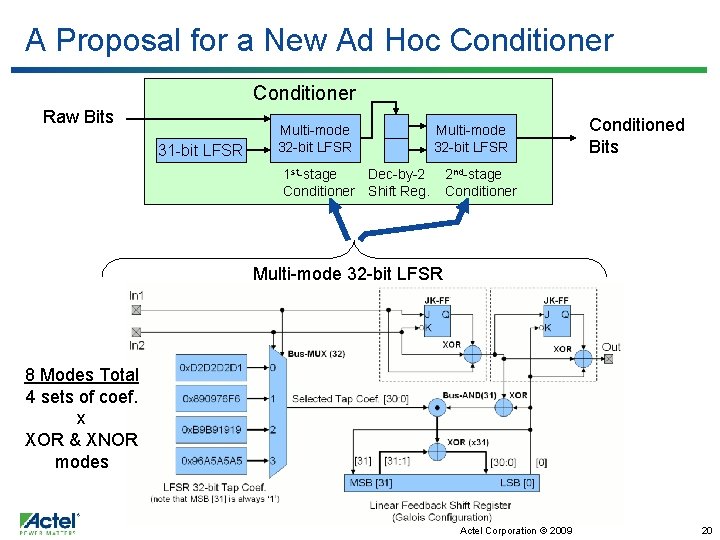
A Proposal for a New Ad Hoc Conditioner Raw Bits 31 bit LFSR Multi mode 32 bit LFSR 1 st stage Dec by 2 Conditioner Shift Reg. Conditioned Bits 2 nd stage Conditioner Multi mode 32 bit LFSR 8 Modes Total 4 sets of coef. x XOR & XNOR modes Actel Corporation © 2009 20
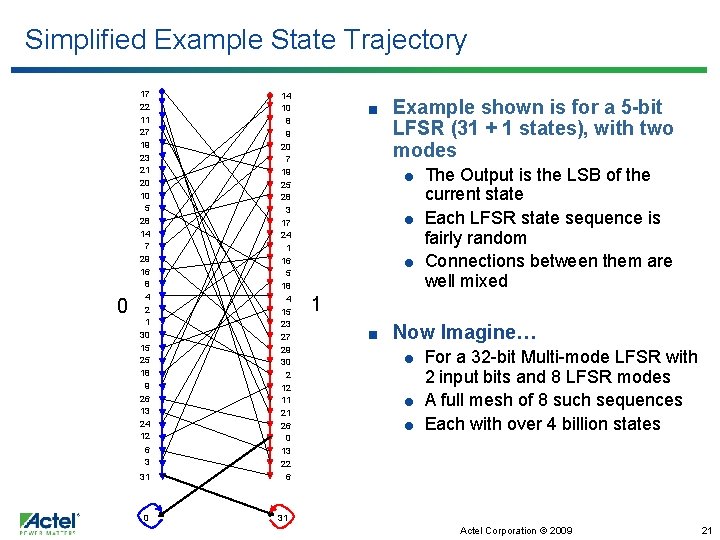
Simplified Example State Trajectory 0 17 22 11 27 19 23 21 20 10 5 28 14 7 29 16 8 4 2 1 30 15 25 18 9 26 13 24 12 6 3 31 0 14 10 8 9 20 7 19 25 28 3 17 24 1 16 5 18 4 15 23 27 29 30 2 12 11 21 26 0 13 22 6 Example shown is for a 5 -bit LFSR (31 + 1 states), with two modes The Output is the LSB of the current state Each LFSR state sequence is fairly random Connections between them are well mixed 1 Now Imagine… For a 32 bit Multi mode LFSR with 2 input bits and 8 LFSR modes A full mesh of 8 such sequences Each with over 4 billion states 31 Actel Corporation © 2009 21
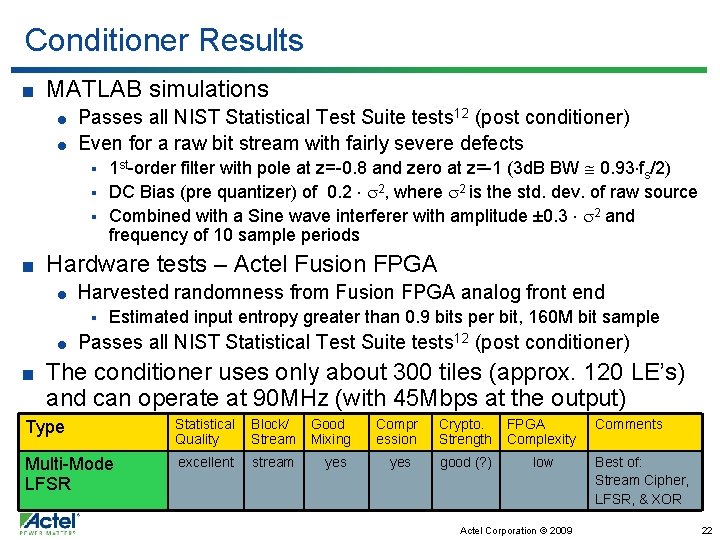
Conditioner Results MATLAB simulations Passes all NIST Statistical Test Suite tests 12 (post conditioner) Even for a raw bit stream with fairly severe defects § § § Hardware tests – Actel Fusion FPGA Harvested randomness from Fusion FPGA analog front end § 1 st order filter with pole at z= 0. 8 and zero at z= 1 (3 d. B BW 0. 93 fs/2) DC Bias (pre quantizer) of 0. 2 s 2, where s 2 is the std. dev. of raw source Combined with a Sine wave interferer with amplitude ± 0. 3 s 2 and frequency of 10 sample periods Estimated input entropy greater than 0. 9 bits per bit, 160 M bit sample Passes all NIST Statistical Test Suite tests 12 (post conditioner) The conditioner uses only about 300 tiles (approx. 120 LE’s) and can operate at 90 MHz (with 45 Mbps at the output) Type Statistical Quality Block/ Stream Good Mixing Multi Mode LFSR excellent stream yes Compr ession Crypto. Strength FPGA Complexity yes good (? ) low Actel Corporation © 2009 Comments Best of: Stream Cipher, LFSR, & XOR 22
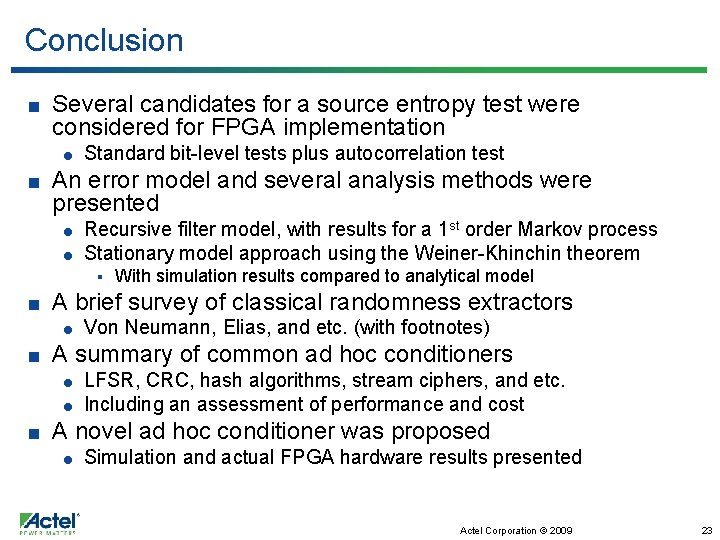
Conclusion Several candidates for a source entropy test were considered for FPGA implementation Standard bit level tests plus autocorrelation test An error model and several analysis methods were presented Recursive filter model, with results for a 1 st order Markov process Stationary model approach using the Weiner Khinchin theorem § A brief survey of classical randomness extractors Von Neumann, Elias, and etc. (with footnotes) A summary of common ad hoc conditioners With simulation results compared to analytical model LFSR, CRC, hash algorithms, stream ciphers, and etc. Including an assessment of performance and cost A novel ad hoc conditioner was proposed Simulation and actual FPGA hardware results presented Actel Corporation © 2009 23
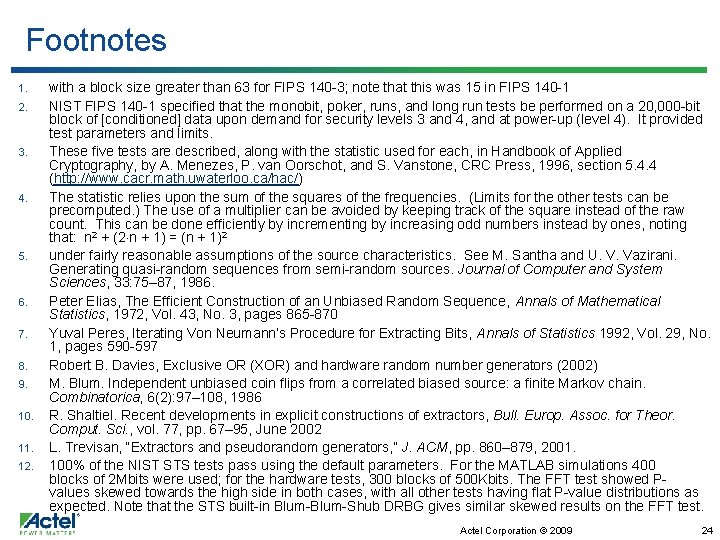
Footnotes 1. 2. 3. 4. 5. 6. 7. 8. 9. 10. 11. 12. with a block size greater than 63 for FIPS 140 3; note that this was 15 in FIPS 140 1 NIST FIPS 140 1 specified that the monobit, poker, runs, and long run tests be performed on a 20, 000 bit block of [conditioned] data upon demand for security levels 3 and 4, and at power up (level 4). It provided test parameters and limits. These five tests are described, along with the statistic used for each, in Handbook of Applied Cryptography, by A. Menezes, P. van Oorschot, and S. Vanstone, CRC Press, 1996, section 5. 4. 4 (http: //www. cacr. math. uwaterloo. ca/hac/) The statistic relies upon the sum of the squares of the frequencies. (Limits for the other tests can be precomputed. ) The use of a multiplier can be avoided by keeping track of the square instead of the raw count. This can be done efficiently by incrementing by increasing odd numbers instead by ones, noting that: n 2 + (2 n + 1) = (n + 1)2 under fairly reasonable assumptions of the source characteristics. See M. Santha and U. V. Vazirani. Generating quasi random sequences from semi random sources. Journal of Computer and System Sciences, 33: 75– 87, 1986. Peter Elias, The Efficient Construction of an Unbiased Random Sequence, Annals of Mathematical Statistics, 1972, Vol. 43, No. 3, pages 865 870 Yuval Peres, Iterating Von Neumann’s Procedure for Extracting Bits, Annals of Statistics 1992, Vol. 29, No. 1, pages 590 597 Robert B. Davies, Exclusive OR (XOR) and hardware random number generators (2002) M. Blum. Independent unbiased coin flips from a correlated biased source: a finite Markov chain. Combinatorica, 6(2): 97– 108, 1986 R. Shaltiel. Recent developments in explicit constructions of extractors, Bull. Europ. Assoc. for Theor. Comput. Sci. , vol. 77, pp. 67– 95, June 2002 L. Trevisan, “Extractors and pseudorandom generators, ” J. ACM, pp. 860– 879, 2001. 100% of the NIST STS tests pass using the default parameters. For the MATLAB simulations 400 blocks of 2 Mbits were used; for the hardware tests, 300 blocks of 500 Kbits. The FFT test showed P values skewed towards the high side in both cases, with all other tests having flat P value distributions as expected. Note that the STS built in Blum Shub DRBG gives similar skewed results on the FFT test. Actel Corporation © 2009 24