Computer Graphics CSE 167 Win 17 Lecture 19

- Slides: 46
Computer Graphics CSE 167 [Win 17], Lecture 19: High Quality Rendering Ravi Ramamoorthi http: //viscomp. ucsd. edu/classes/cse 167/wi 17
Summary § This is the final lecture of CSE 167 § Good luck on HW 4, written assignment § Please consider CSE 163 (mine), CSE 168 spring § Encouraged to take both, no conflict in timings § Also CSE 190 VR (Schulze) [may need CSE 165] § CSE 163: Advanced Graphics (Ramamoorthi) § § Signal processing, geometry, rendering, imaging One stop advanced graphics course, continuation of 167 Image Processing, Meshes, Final project (3 homeworks) See website for course, similar to previous 190 s § CSE 168: Rendering (Rotenberg) § High-Quality rendering, focus of this lecture [fun, no test]
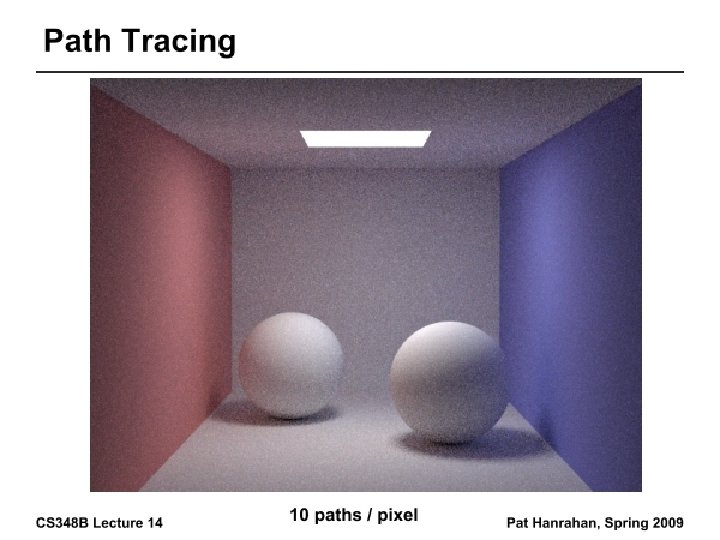
Monte Carlo Path Tracing § General solution to rendering and global illumination § Suitable for a variety of general scenes § Based on Monte Carlo methods § Enumerate all paths of light transport § Long history, traces back to rendering eqn Kajiya 86 § (More advanced topic: Slides from CSE 274) § Increasingly, basis for production rendering § Path tracing today real-time in hardware (for example, using NVIDIA’s Optix)
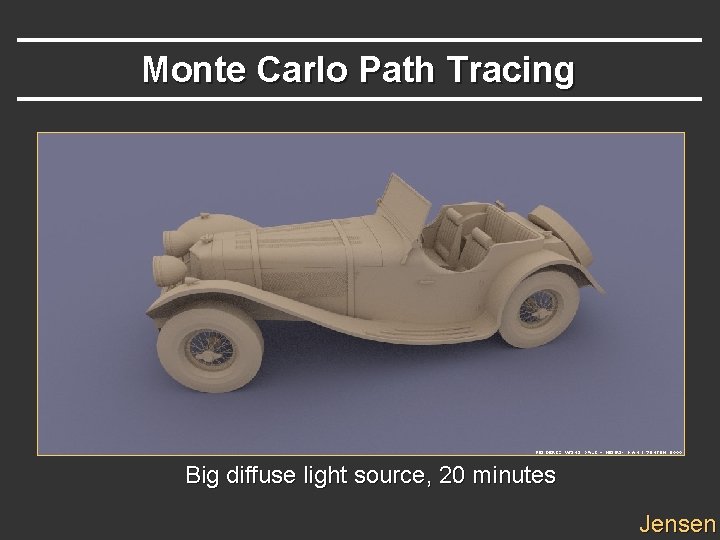
Monte Carlo Path Tracing Big diffuse light source, 20 minutes Jensen
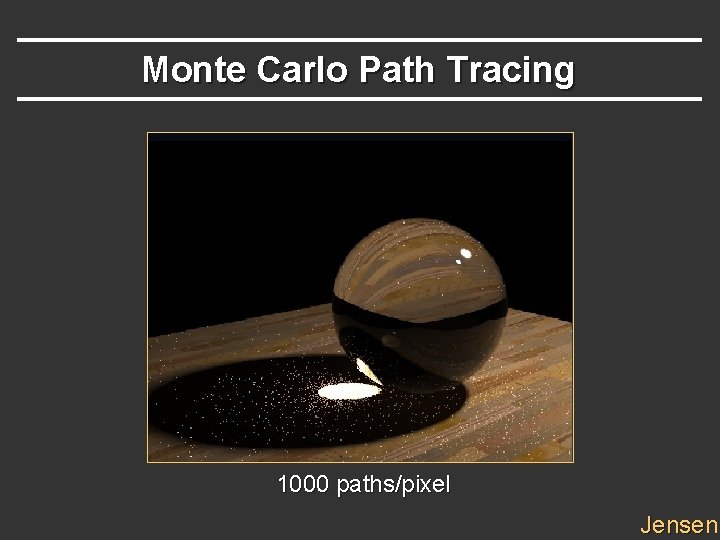
Monte Carlo Path Tracing 1000 paths/pixel Jensen
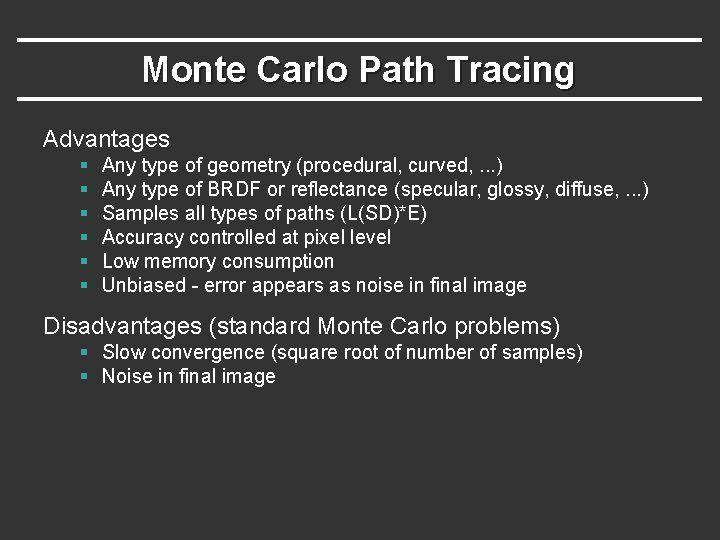
Monte Carlo Path Tracing Advantages § § § Any type of geometry (procedural, curved, . . . ) Any type of BRDF or reflectance (specular, glossy, diffuse, . . . ) Samples all types of paths (L(SD)*E) Accuracy controlled at pixel level Low memory consumption Unbiased - error appears as noise in final image Disadvantages (standard Monte Carlo problems) § Slow convergence (square root of number of samples) § Noise in final image
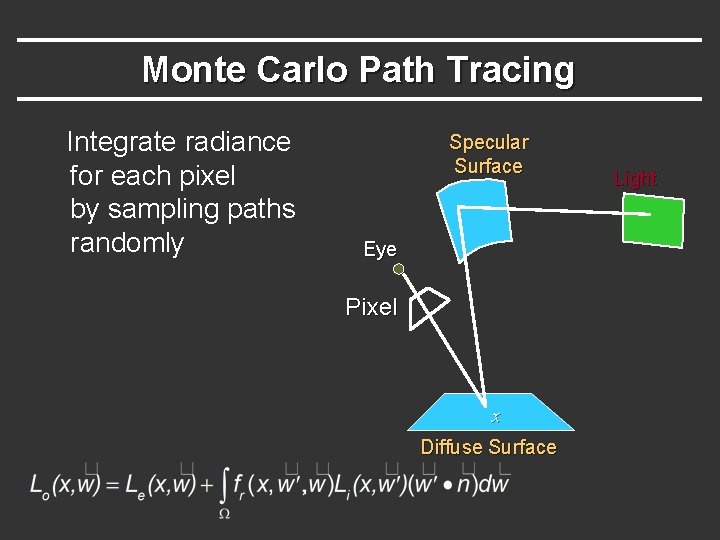
Monte Carlo Path Tracing Integrate radiance for each pixel by sampling paths randomly Specular Surface Eye Pixel x Diffuse Surface Light
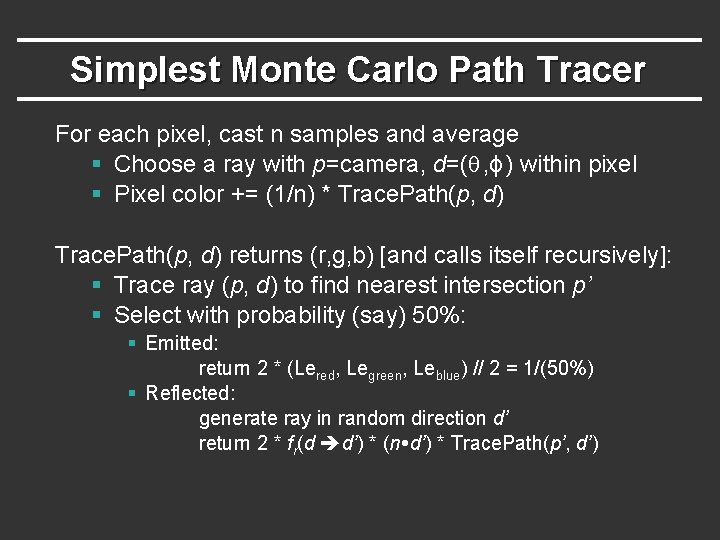
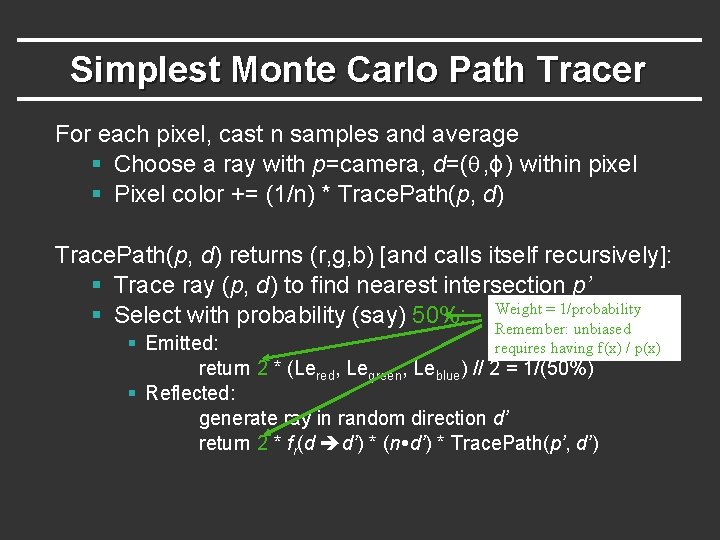
Simplest Monte Carlo Path Tracer For each pixel, cast n samples and average § Choose a ray with p=camera, d=(θ , ϕ ) within pixel § Pixel color += (1/n) * Trace. Path(p, d) returns (r, g, b) [and calls itself recursively]: § Trace ray (p, d) to find nearest intersection p’ § Select with probability (say) 50%: § Emitted: return 2 * (Lered, Legreen, Leblue) // 2 = 1/(50%) § Reflected: generate ray in random direction d’ return 2 * fr(d d’) * (n d’) * Trace. Path(p’, d’)
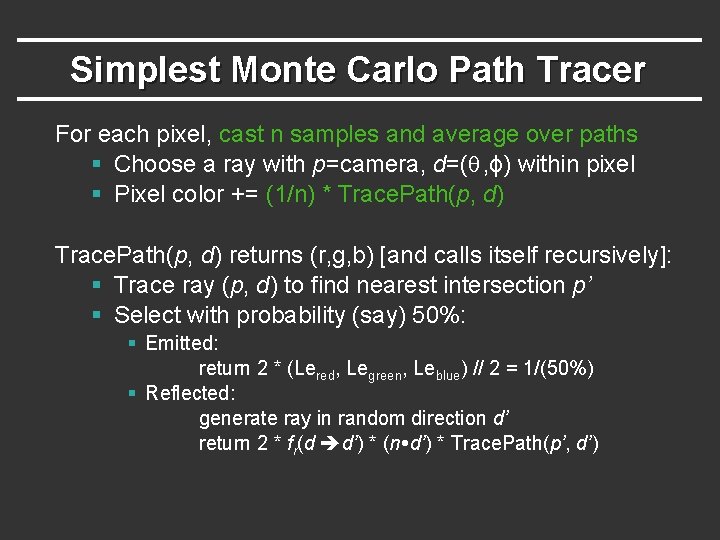
Simplest Monte Carlo Path Tracer For each pixel, cast n samples and average over paths § Choose a ray with p=camera, d=(θ , ϕ) within pixel § Pixel color += (1/n) * Trace. Path(p, d) returns (r, g, b) [and calls itself recursively]: § Trace ray (p, d) to find nearest intersection p’ § Select with probability (say) 50%: § Emitted: return 2 * (Lered, Legreen, Leblue) // 2 = 1/(50%) § Reflected: generate ray in random direction d’ return 2 * fr(d d’) * (n d’) * Trace. Path(p’, d’)
Simplest Monte Carlo Path Tracer For each pixel, cast n samples and average § Choose a ray with p=camera, d=(θ , ϕ ) within pixel § Pixel color += (1/n) * Trace. Path(p, d) returns (r, g, b) [and calls itself recursively]: § Trace ray (p, d) to find nearest intersection p’ = 1/probability § Select with probability (say) 50%: Weight Remember: unbiased § Emitted: requires having f(x) / p(x) return 2 * (Lered, Legreen, Leblue) // 2 = 1/(50%) § Reflected: generate ray in random direction d’ return 2 * fr(d d’) * (n d’) * Trace. Path(p’, d’)
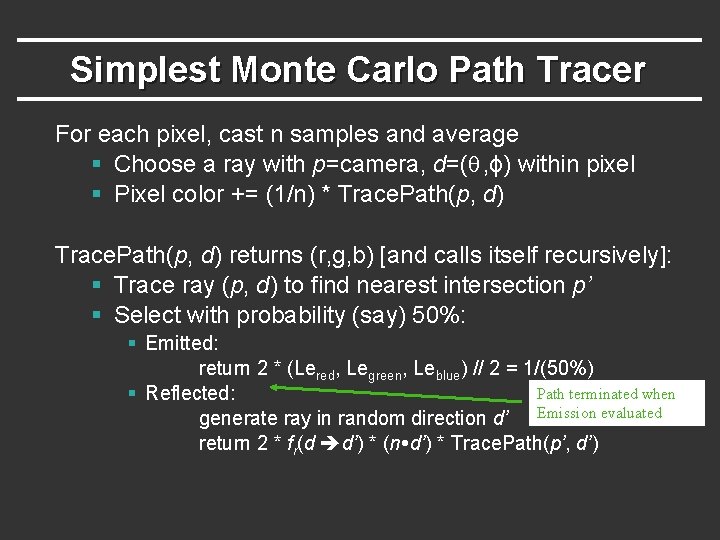
Simplest Monte Carlo Path Tracer For each pixel, cast n samples and average § Choose a ray with p=camera, d=(θ , ϕ) within pixel § Pixel color += (1/n) * Trace. Path(p, d) returns (r, g, b) [and calls itself recursively]: § Trace ray (p, d) to find nearest intersection p’ § Select with probability (say) 50%: § Emitted: return 2 * (Lered, Legreen, Leblue) // 2 = 1/(50%) Path terminated when § Reflected: generate ray in random direction d’ Emission evaluated return 2 * fr(d d’) * (n d’) * Trace. Path(p’, d’)
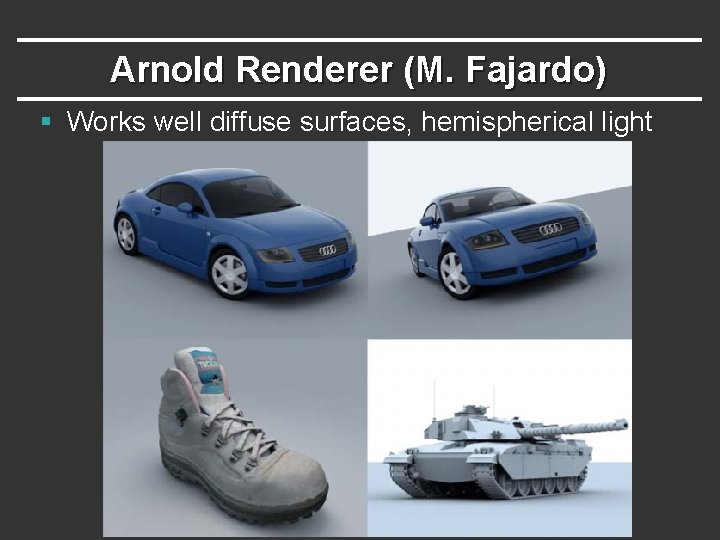
Arnold Renderer (M. Fajardo) § Works well diffuse surfaces, hemispherical light
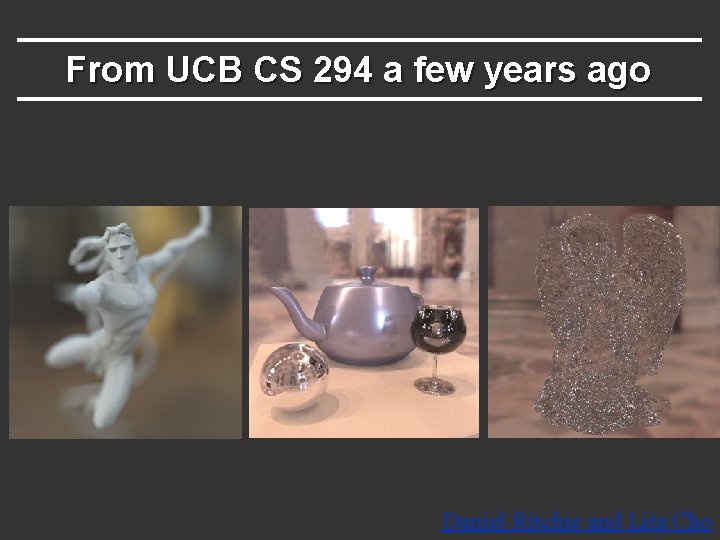
From UCB CS 294 a few years ago Daniel Ritchie and Lita Cho
Importance Sampling § Pick paths based on energy or expected contribution § More samples for high-energy paths § Don’t pick low-energy paths § At “macro” level, use to select between reflected vs emitted, or in casting more rays toward light sources § At “micro” level, importance sample the BRDF to pick ray directions § Tons of papers in 90 s on tricks to reduce variance in Monte Carlo rendering § Importance sampling now standard in production. I consulted on Pixar’s system for movies from 2012+
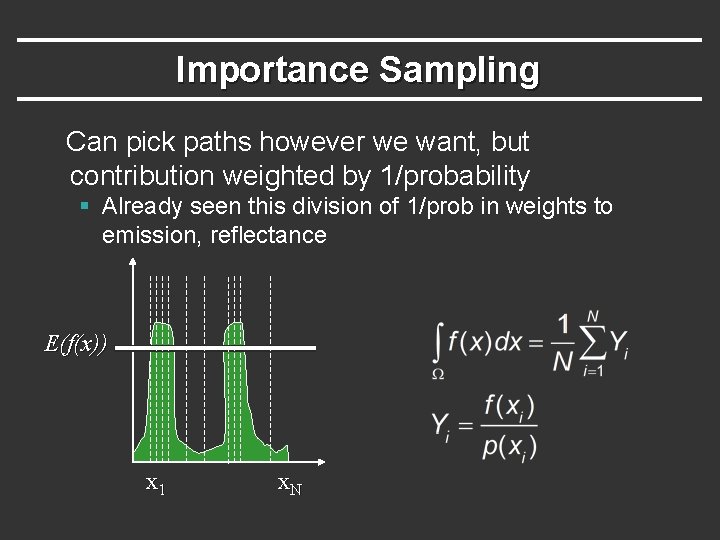
Importance Sampling Can pick paths however we want, but contribution weighted by 1/probability § Already seen this division of 1/prob in weights to emission, reflectance E(f(x)) x 1 x. N
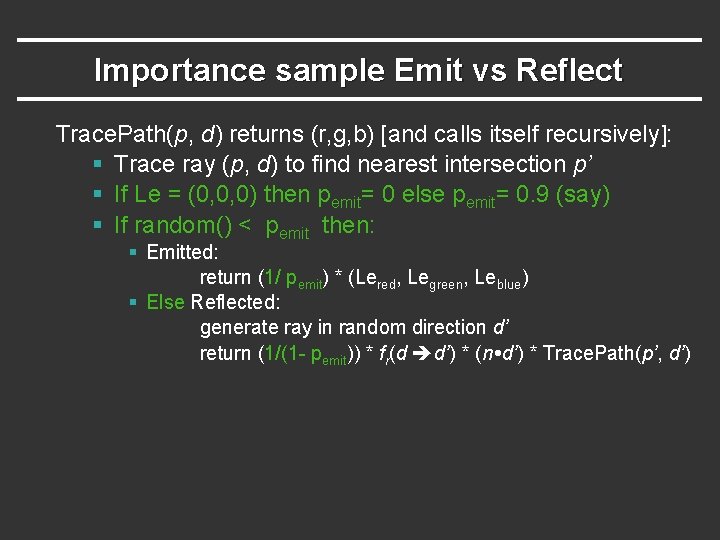
Importance sample Emit vs Reflect Trace. Path(p, d) returns (r, g, b) [and calls itself recursively]: § Trace ray (p, d) to find nearest intersection p’ § If Le = (0, 0, 0) then pemit= 0 else pemit= 0. 9 (say) § If random() < pemit then: § Emitted: return (1/ pemit) * (Lered, Legreen, Leblue) § Else Reflected: generate ray in random direction d’ return (1/(1 - pemit)) * fr(d d’) * (n d’) * Trace. Path(p’, d’)
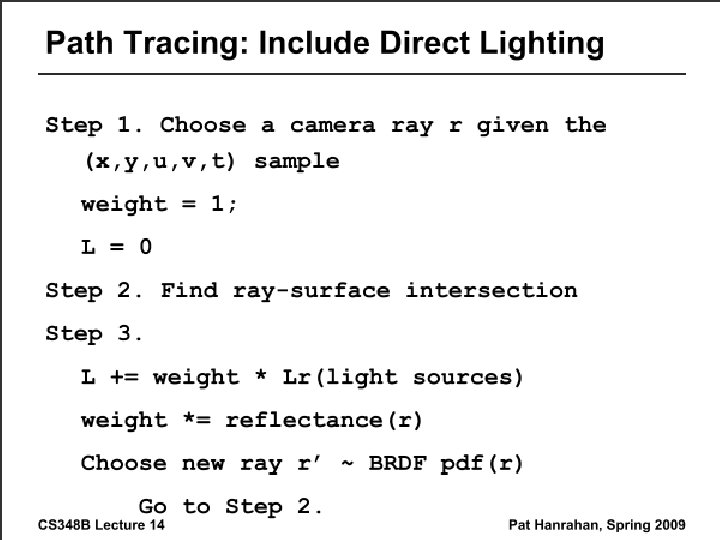
More variance reduction § Discussed “macro” importance sampling § Emitted vs reflected § How about “micro” importance sampling § Shoot rays towards light sources in scene § Distribute rays according to BRDF
Monte Carlo Extensions Unbiased § Bidirectional path tracing § Metropolis light transport Biased, but consistent § Noise filtering § Adaptive sampling § Irradiance caching
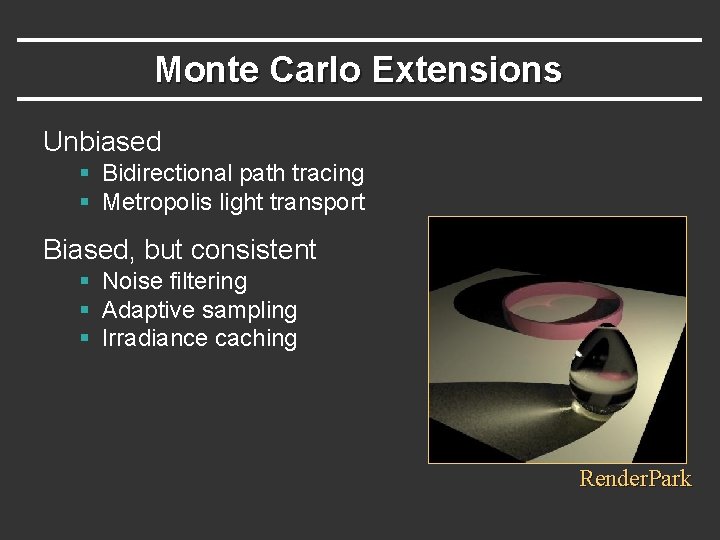
Monte Carlo Extensions Unbiased § Bidirectional path tracing § Metropolis light transport Biased, but consistent § Noise filtering § Adaptive sampling § Irradiance caching Render. Park
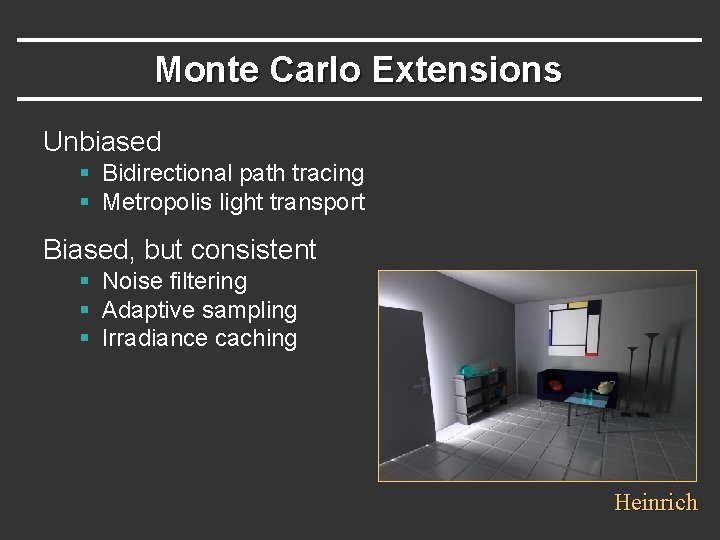
Monte Carlo Extensions Unbiased § Bidirectional path tracing § Metropolis light transport Biased, but consistent § Noise filtering § Adaptive sampling § Irradiance caching Heinrich
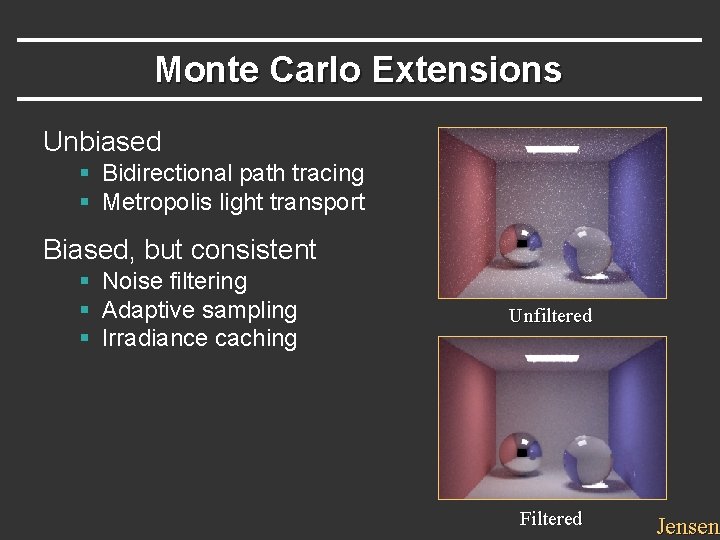
Monte Carlo Extensions Unbiased § Bidirectional path tracing § Metropolis light transport Biased, but consistent § Noise filtering § Adaptive sampling § Irradiance caching Unfiltered Filtered Jensen
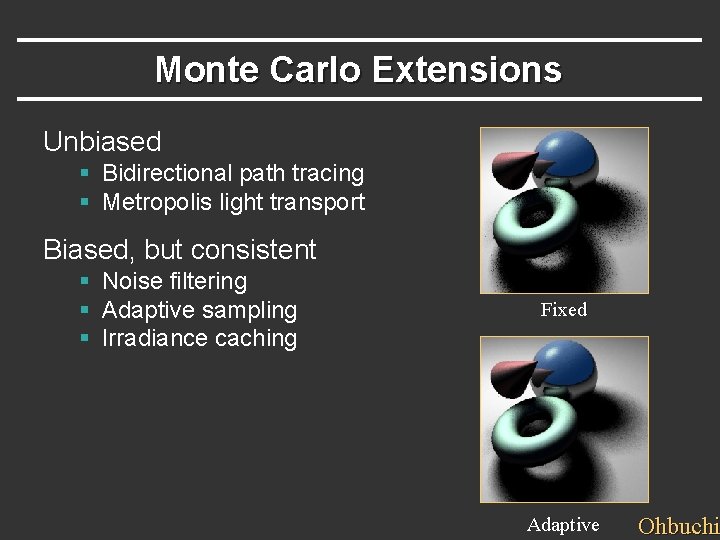
Monte Carlo Extensions Unbiased § Bidirectional path tracing § Metropolis light transport Biased, but consistent § Noise filtering § Adaptive sampling § Irradiance caching Fixed Adaptive Ohbuchi
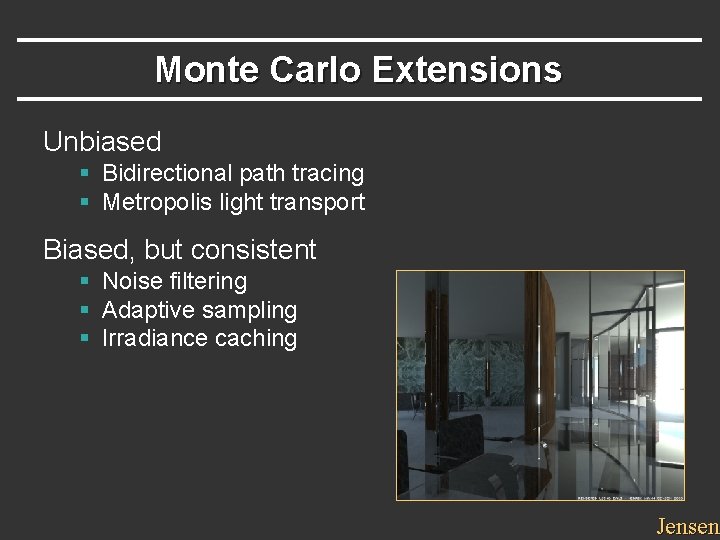
Monte Carlo Extensions Unbiased § Bidirectional path tracing § Metropolis light transport Biased, but consistent § Noise filtering § Adaptive sampling § Irradiance caching Jensen
Summary § Monte Carlo methods robust and simple (at least until nitty gritty details) for global illumination § Must handle many variance reduction methods in practice § Importance sampling, Bidirectional path tracing, Russian roulette etc. § Rich field with many papers, systems researched over last 20 years § Today, hardware for real-time ray, path tracing § Promising physically-based GPU approach
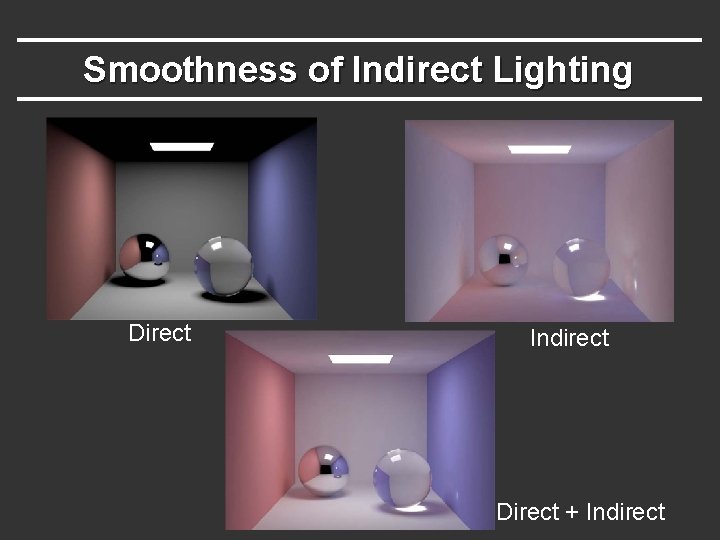
Smoothness of Indirect Lighting Direct Indirect Direct + Indirect
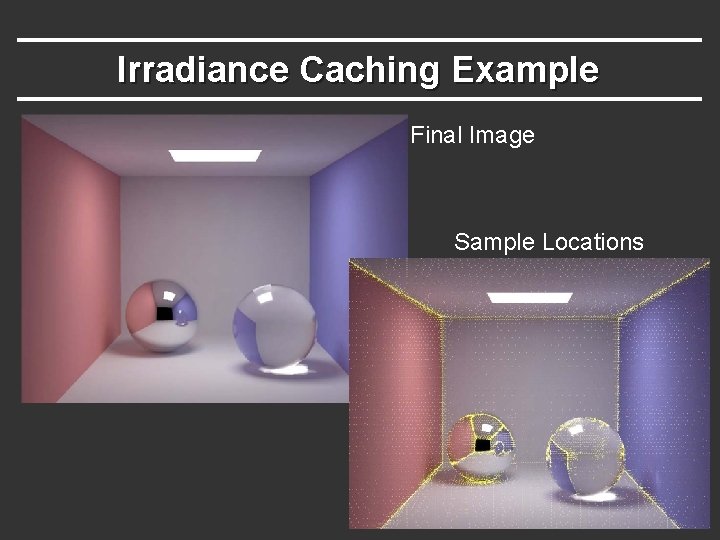
Irradiance Caching § Empirically, (diffuse) interreflections low frequency § Therefore, should be able to sample sparsely § Irradiance caching samples irradiance at few points on surfaces, and then interpolates § Ward, Rubinstein, Clear. SIGGRAPH 88, A ray tracing solution for diffuse interreflection
Irradiance Caching Example Final Image Sample Locations
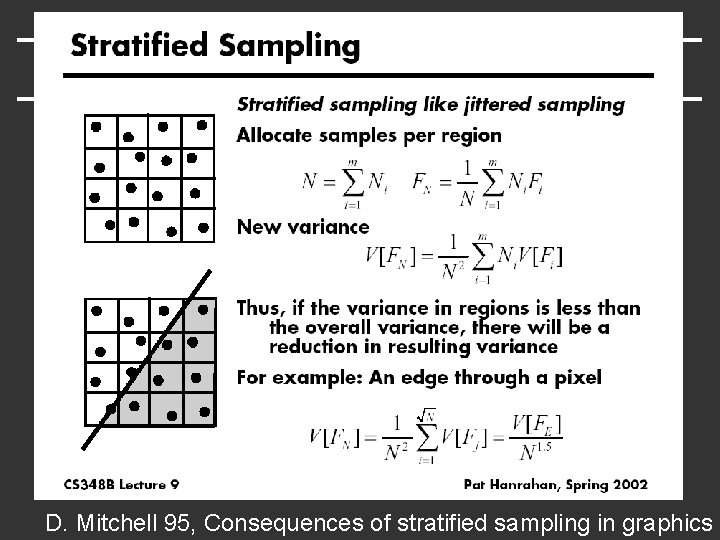
D. Mitchell 95, Consequences of stratified sampling in graphics
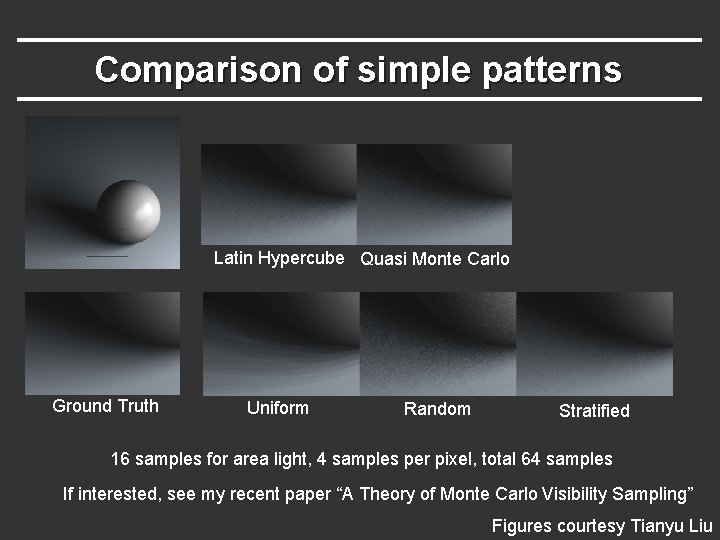
Comparison of simple patterns Latin Hypercube Quasi Monte Carlo Ground Truth Uniform Random Stratified 16 samples for area light, 4 samples per pixel, total 64 samples If interested, see my recent paper “A Theory of Monte Carlo Visibility Sampling” Figures courtesy Tianyu Liu
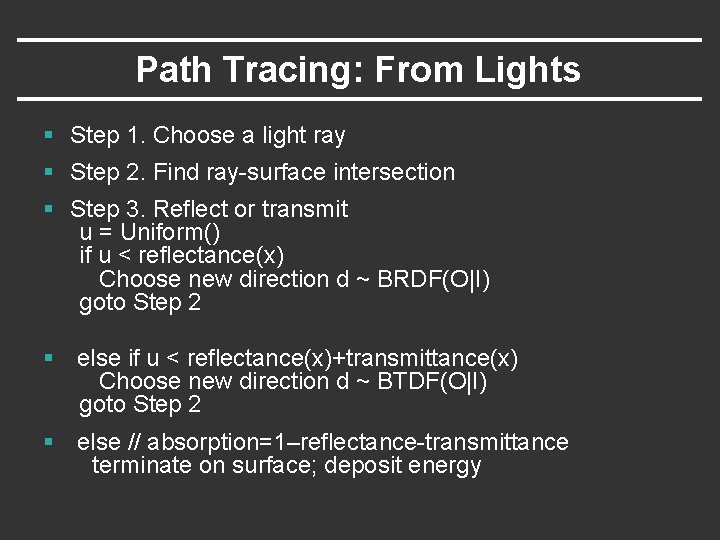
Path Tracing: From Lights § Step 1. Choose a light ray § Step 2. Find ray-surface intersection § Step 3. Reflect or transmit u = Uniform() if u < reflectance(x) Choose new direction d ~ BRDF(O|I) goto Step 2 § else if u < reflectance(x)+transmittance(x) Choose new direction d ~ BTDF(O|I) goto Step 2 § else // absorption=1–reflectance-transmittance terminate on surface; deposit energy
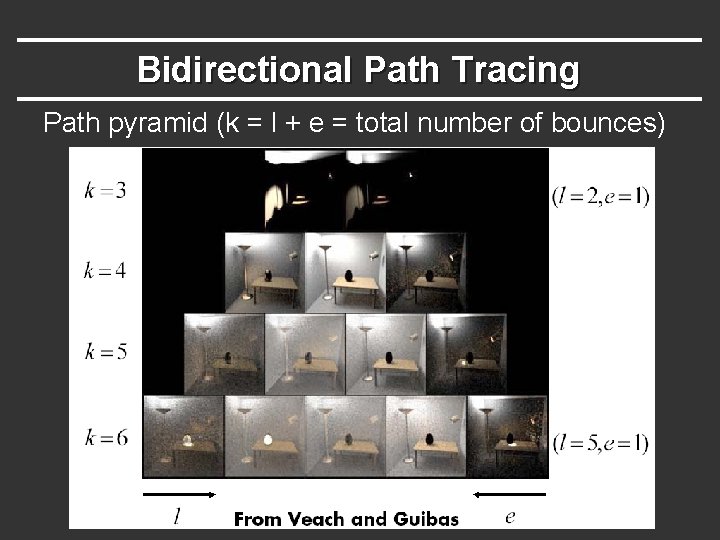
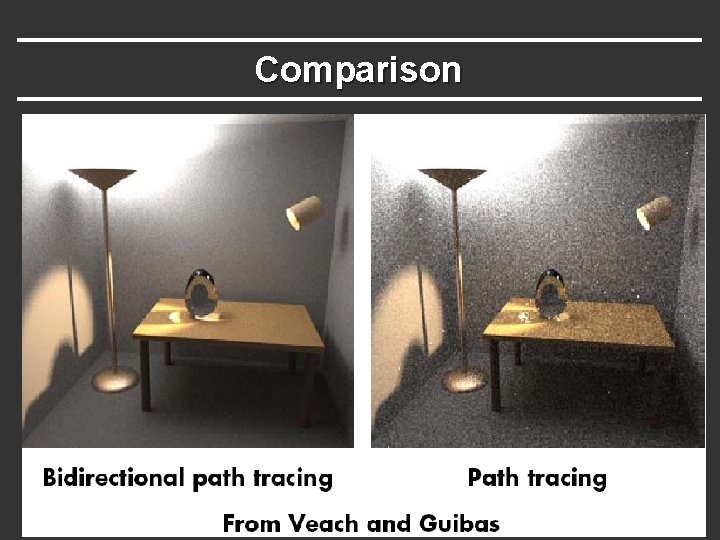
Bidirectional Path Tracing Path pyramid (k = l + e = total number of bounces)
Comparison
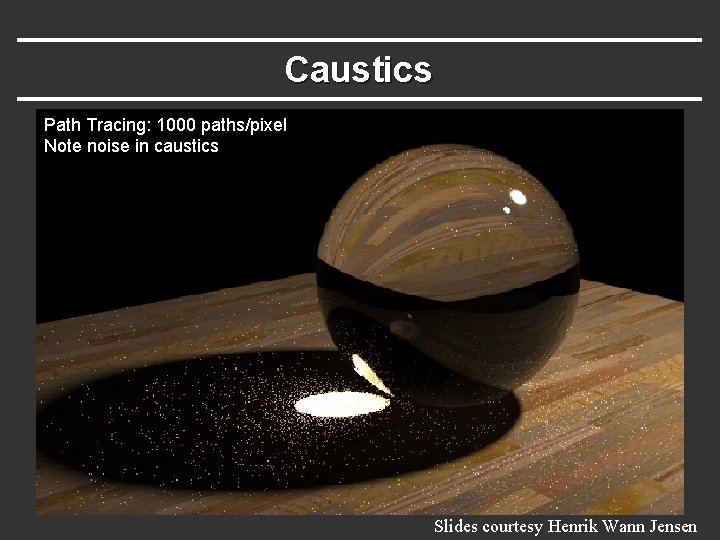
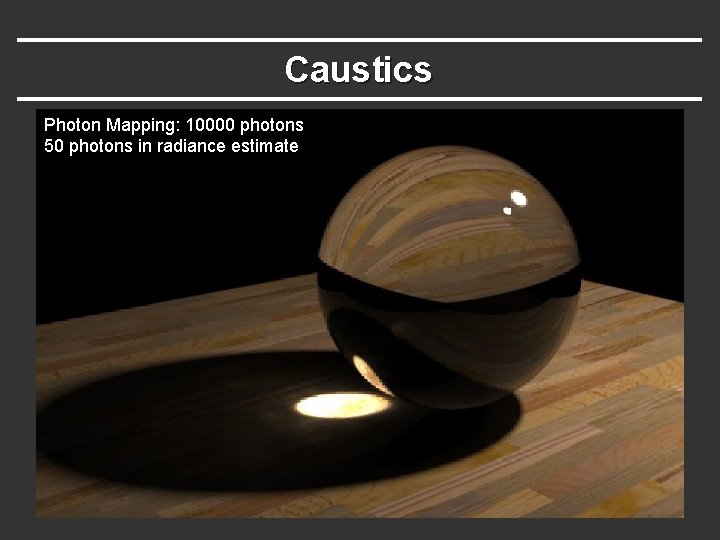
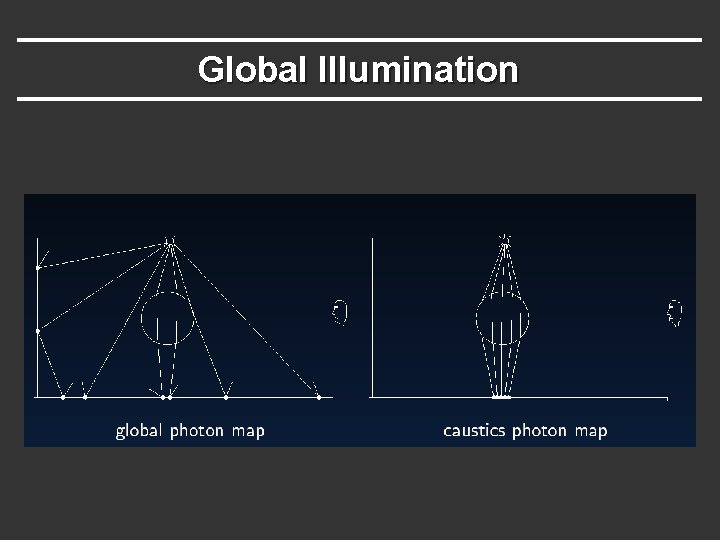
Why Photon Map? § Some visual effects like caustics hard with standard path tracing from eye § May usually miss light source altogether § Instead, store “photons” from light in kd-tree § Look-up into this as needed § Combines tracing from light source, and eye § Similar to bidirectional path tracing, but compute photon map only once for all eye rays § Global Illumination using Photon Maps H. Jensen. Rendering Techniques (EGSR 1996), pp 21 -30. (Also book: Realistic Image Synthesis using Photon Mapping)
Caustics Path Tracing: 1000 paths/pixel Note noise in caustics Slides courtesy Henrik Wann Jensen
Caustics Photon Mapping: 10000 photons 50 photons in radiance estimate
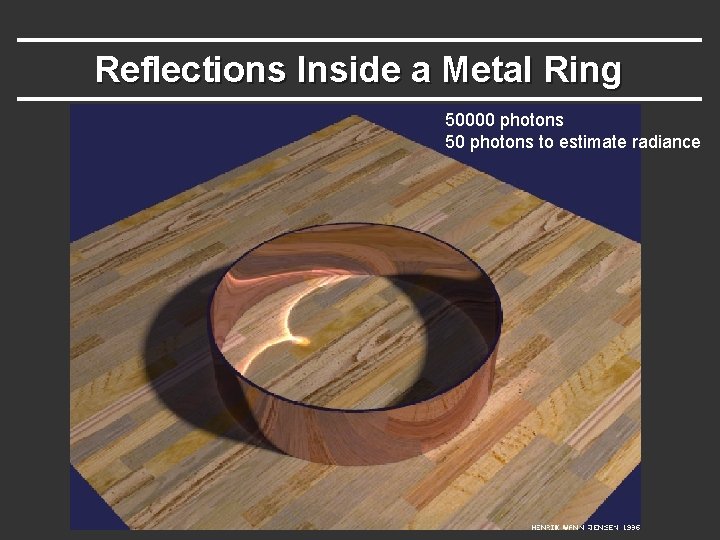
Reflections Inside a Metal Ring 50000 photons 50 photons to estimate radiance
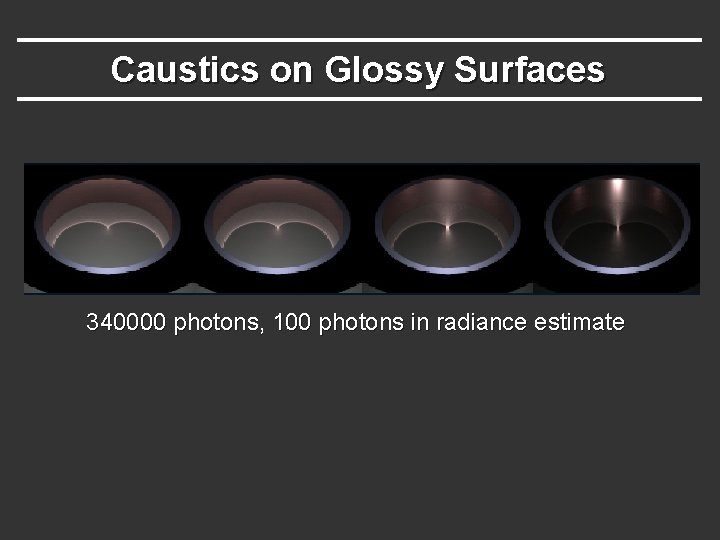
Caustics on Glossy Surfaces 340000 photons, 100 photons in radiance estimate
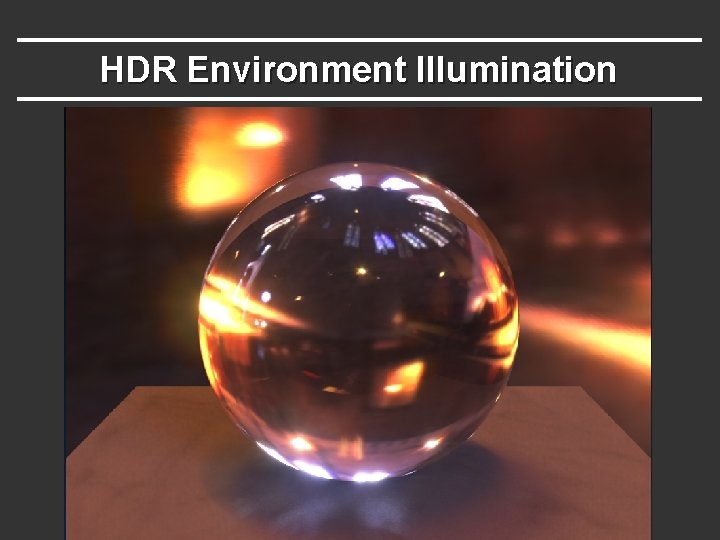
HDR Environment Illumination
Global Illumination
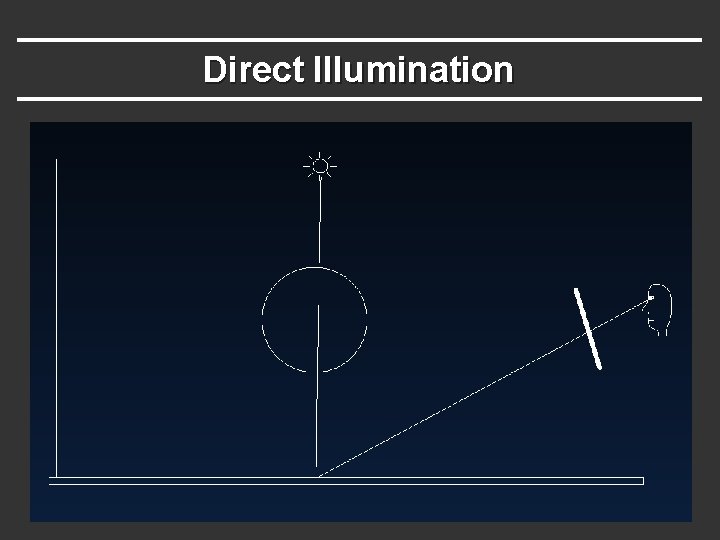
Direct Illumination
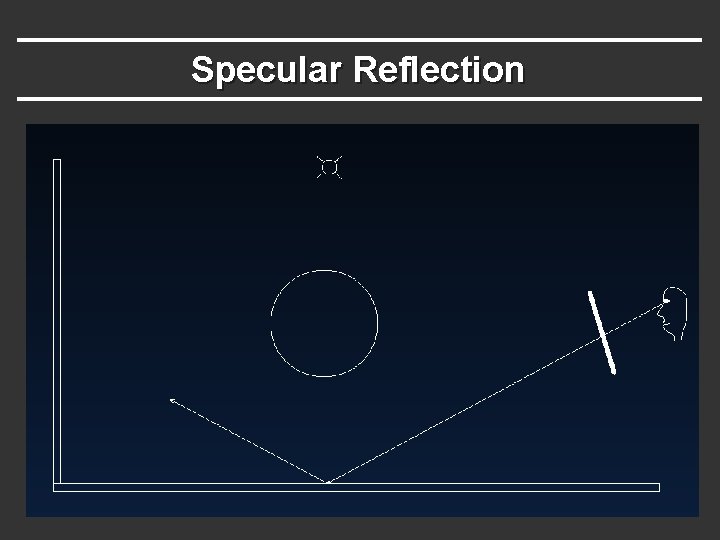
Specular Reflection
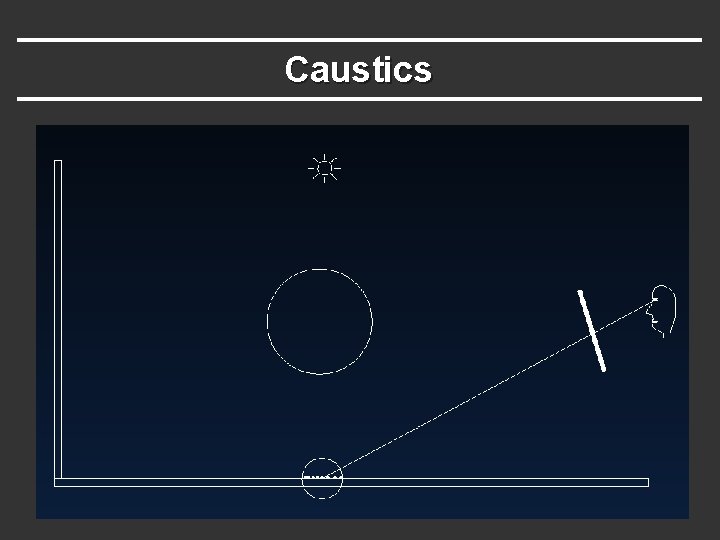
Caustics
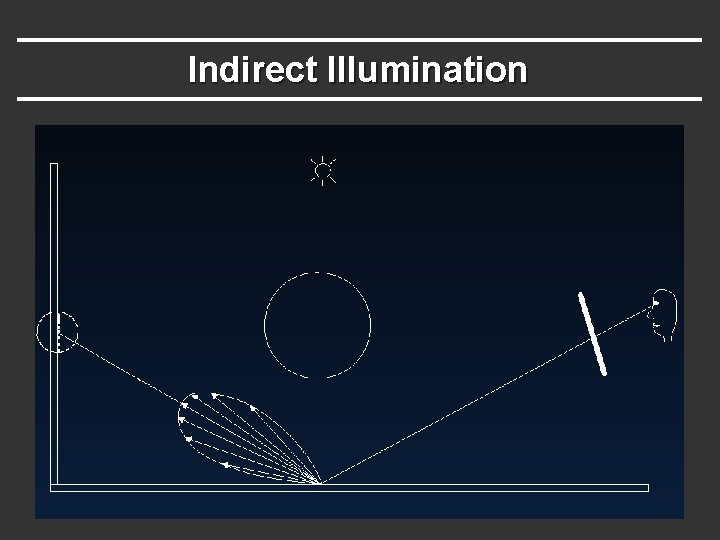
Indirect Illumination
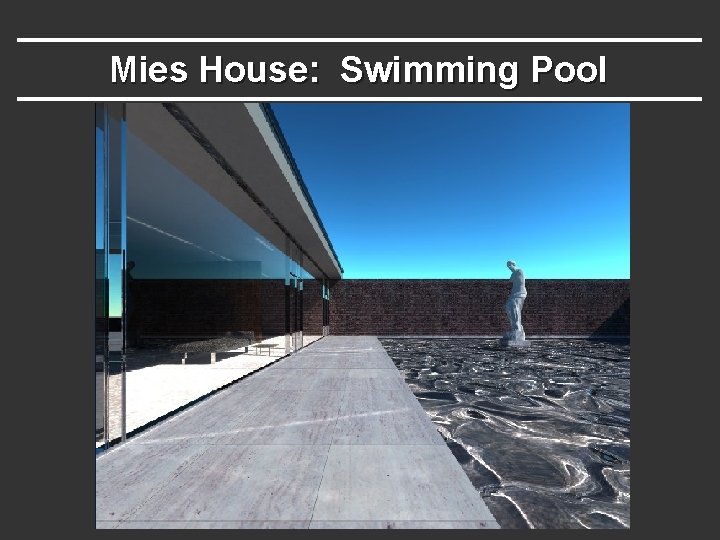
Mies House: Swimming Pool