College Preparation Seminar Shirdi Sai Parivaar Milpitas July






- Slides: 54
College Preparation Seminar Shirdi Sai Parivaar, Milpitas July 20, 2014
Agenda • Help high school students and parents understand • • College Admission Process and Financial Aid Last year’s seminar got good response Topics: o High School Preparation o Standardized Tests o Application Process o Career Paths, In college (get a head start!) o Financial Aid Information Presentation (first hour). Q&A (second hour) Please hold off any questions until Q&A
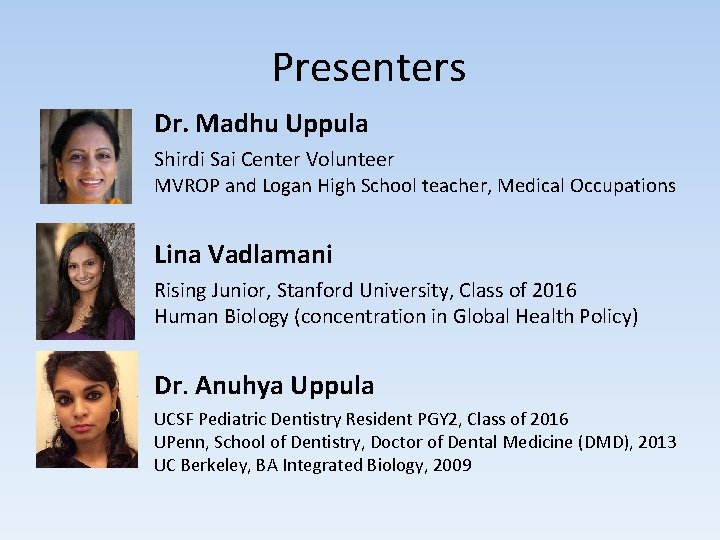
Presenters Dr. Madhu Uppula Shirdi Sai Center Volunteer MVROP and Logan High School teacher, Medical Occupations Lina Vadlamani Rising Junior, Stanford University, Class of 2016 Human Biology (concentration in Global Health Policy) Dr. Anuhya Uppula UCSF Pediatric Dentistry Resident PGY 2, Class of 2016 UPenn, School of Dentistry, Doctor of Dental Medicine (DMD), 2013 UC Berkeley, BA Integrated Biology, 2009
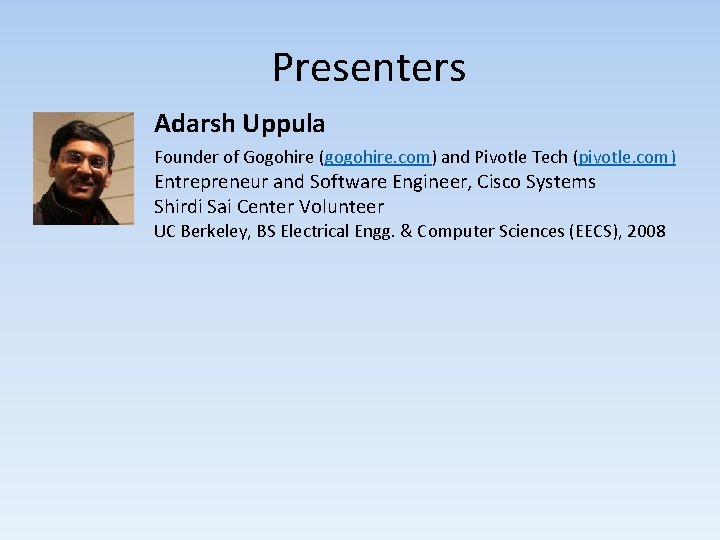
Presenters Adarsh Uppula Founder of Gogohire (gogohire. com) and Pivotle Tech (pivotle. com) Entrepreneur and Software Engineer, Cisco Systems Shirdi Sai Center Volunteer UC Berkeley, BS Electrical Engg. & Computer Sciences (EECS), 2008
High School Preparation
Freshman Year • Honors and AP courses- do well in them! • College prep courses • GPA: • Weighted GPA vs Non-weighted GPA • Honors and AP courses get extra point in weighted GPA calculations • What matters: 10 th grade onwards
Freshman Year • Extracurricular: activities/hobbies/clubsget involved in what piques your interest! • leadership positions • high school guidance counselor • internships or volunteer activities • download a sample college applicationread through it and know what colleges expect
Extracurriculars • • • Sports, School teams Musical Instruments Hobbies, School Clubs Volunteering Community service Jobs, job shadowing Better to have a few deep ones - colleges want to sense your passion in your interests, not a long list These will be helpful in your college essays Will help shape your interests and decide on a major
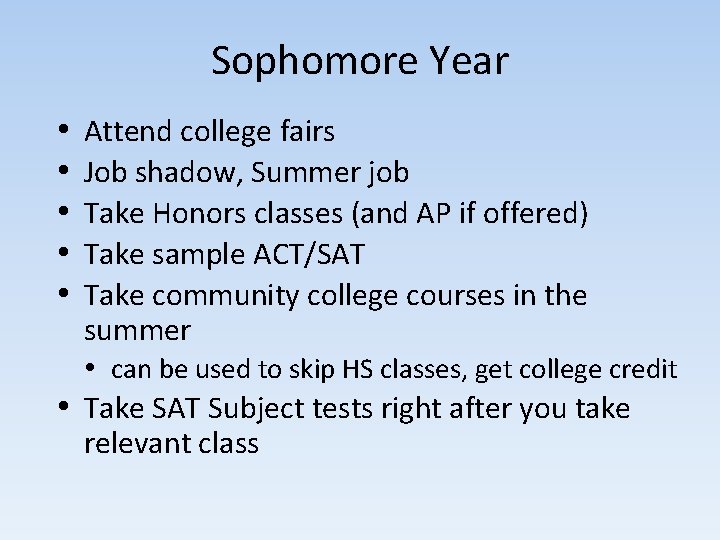
Sophomore Year • • • Attend college fairs Job shadow, Summer job Take Honors classes (and AP if offered) Take sample ACT/SAT Take community college courses in the summer • can be used to skip HS classes, get college credit • Take SAT Subject tests right after you take relevant class
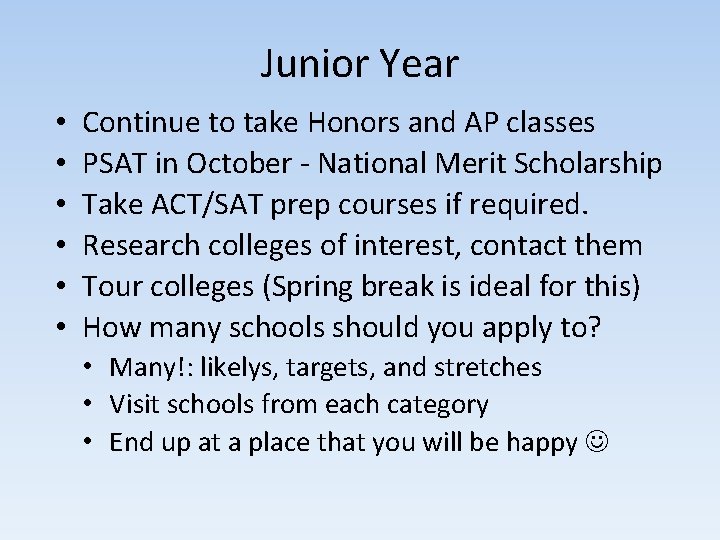
Junior Year • • • Continue to take Honors and AP classes PSAT in October - National Merit Scholarship Take ACT/SAT prep courses if required. Research colleges of interest, contact them Tour colleges (Spring break is ideal for this) How many schools should you apply to? • Many!: likelys, targets, and stretches • Visit schools from each category • End up at a place that you will be happy
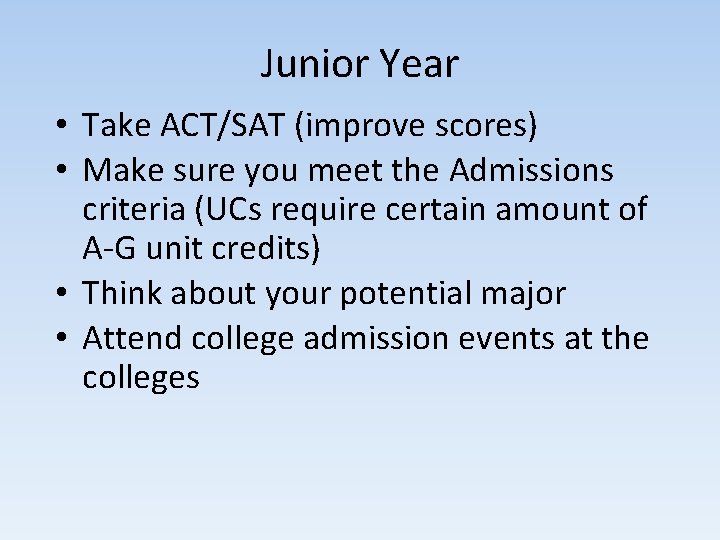
Junior Year • Take ACT/SAT (improve scores) • Make sure you meet the Admissions criteria (UCs require certain amount of A-G unit credits) • Think about your potential major • Attend college admission events at the colleges
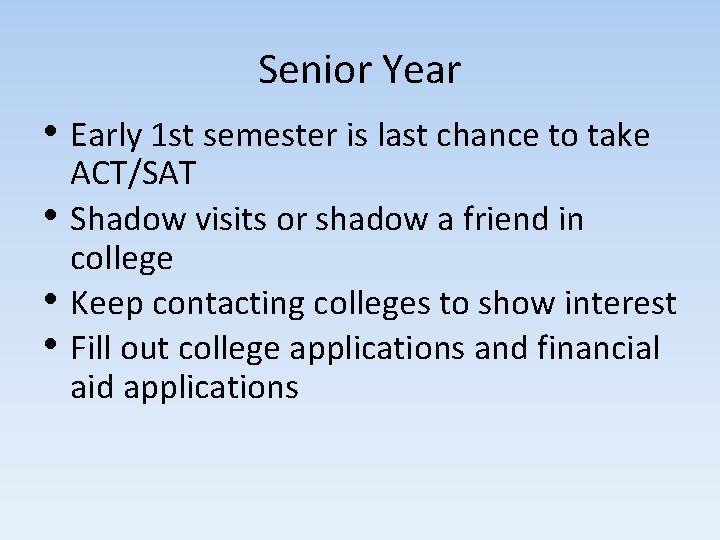
Senior Year • Early 1 st semester is last chance to take • • • ACT/SAT Shadow visits or shadow a friend in college Keep contacting colleges to show interest Fill out college applications and financial aid applications
Senior Year • Apply for eligible scholarships (apply to many) • Ask for recommendations early! • Beware of senioritis - colleges can revoke your • • admission or scholarship for poor grades Decide on a major, some colleges will require it March: Admission decisions received! • Revisit campuses and finalize • Early decision
Standardized Tests
SAT • STAR exams are HS requirement (colleges don't care) • PSAT - practice SAT, determines National Merit Scholarship status (will look great on application) • SAT Reasoning test - standard test. 2400 points • ACT plus Writing - alternative, different structure, try this too • SAT Subject tests • Sciences (Biology, Chemistry, Physics) • Languages (Spanish, French, etc. ) • Math (Level 1 and 2) • and more …
SAT Structure (<2016) SAT Writing (60 minutes – 49 questions) • 25 minutes - Essay • 25 minutes - 35 questions (Improving sentences and paragraphs, Identifying sentence errors) • 10 minutes - 14 questions (Improving sentences)
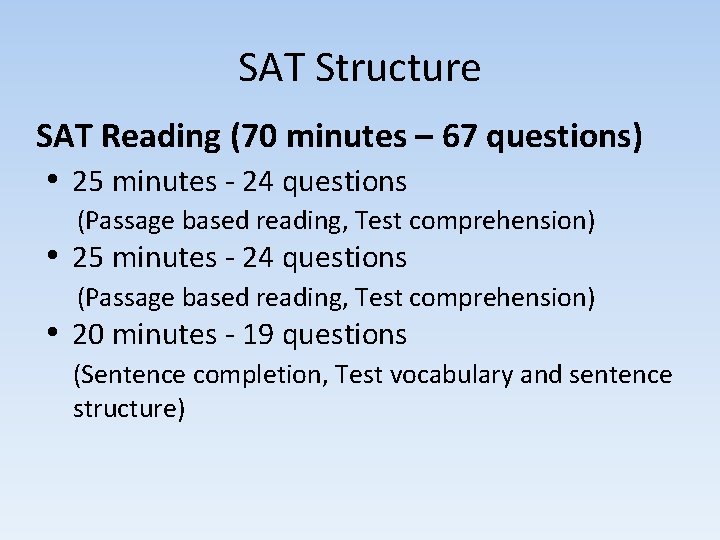
SAT Structure SAT Reading (70 minutes – 67 questions) • 25 minutes - 24 questions (Passage based reading, Test comprehension) • 20 minutes - 19 questions (Sentence completion, Test vocabulary and sentence structure)
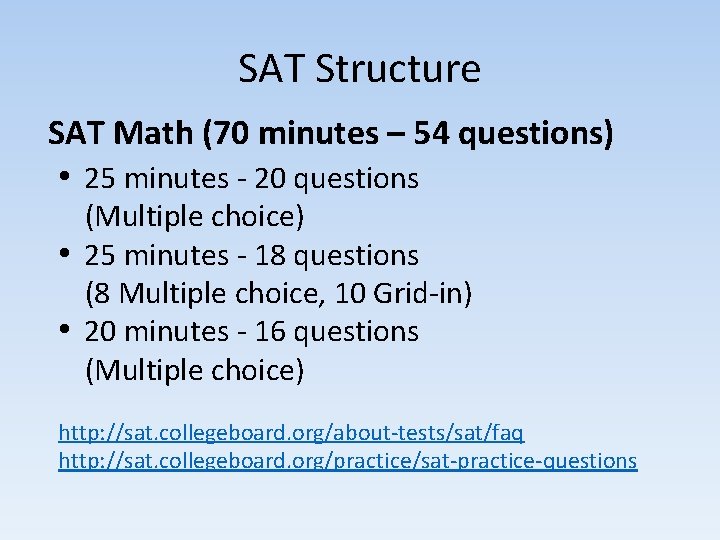
SAT Structure SAT Math (70 minutes – 54 questions) • 25 minutes - 20 questions (Multiple choice) • 25 minutes - 18 questions (8 Multiple choice, 10 Grid-in) • 20 minutes - 16 questions (Multiple choice) http: //sat. collegeboard. org/about-tests/sat/faq http: //sat. collegeboard. org/practice/sat-practice-questions
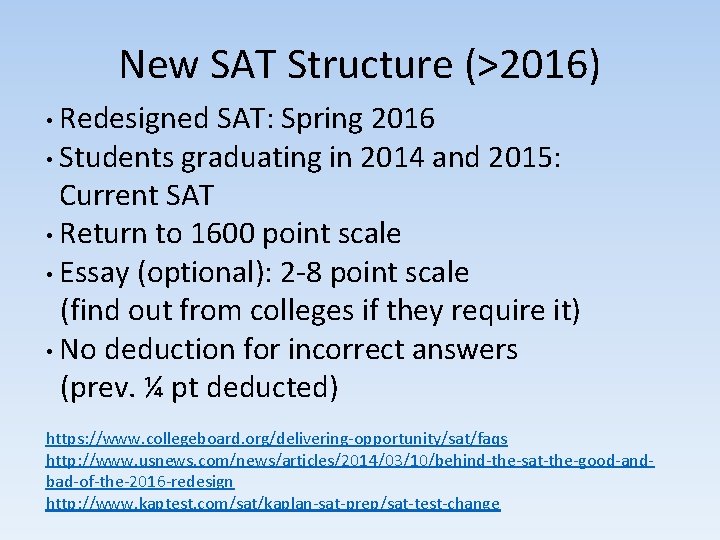
New SAT Structure (>2016) • Redesigned SAT: Spring 2016 • Students graduating in 2014 and 2015: Current SAT • Return to 1600 point scale • Essay (optional): 2 -8 point scale (find out from colleges if they require it) • No deduction for incorrect answers (prev. ¼ pt deducted) https: //www. collegeboard. org/delivering-opportunity/sat/faqs http: //www. usnews. com/news/articles/2014/03/10/behind-the-sat-the-good-andbad-of-the-2016 -redesign http: //www. kaptest. com/sat/kaplan-sat-prep/sat-test-change
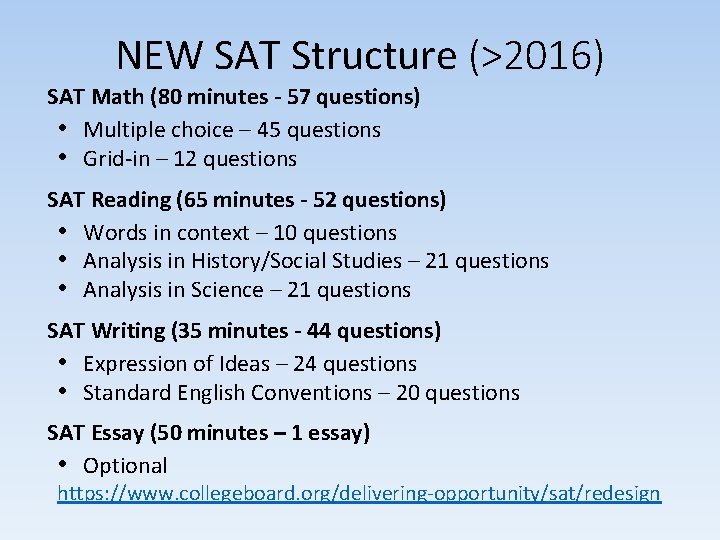
NEW SAT Structure (>2016) SAT Math (80 minutes - 57 questions) • Multiple choice – 45 questions • Grid-in – 12 questions SAT Reading (65 minutes - 52 questions) • Words in context – 10 questions • Analysis in History/Social Studies – 21 questions • Analysis in Science – 21 questions SAT Writing (35 minutes - 44 questions) • Expression of Ideas – 24 questions • Standard English Conventions – 20 questions SAT Essay (50 minutes – 1 essay) • Optional https: //www. collegeboard. org/delivering-opportunity/sat/redesign
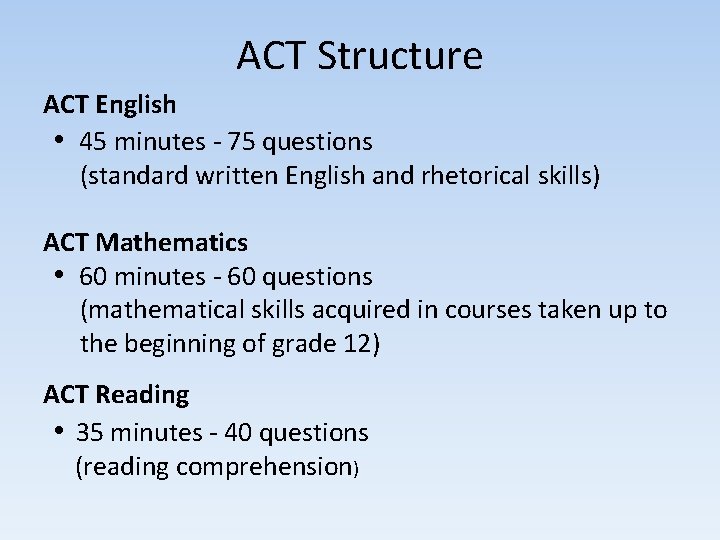
ACT Structure ACT English • 45 minutes - 75 questions (standard written English and rhetorical skills) ACT Mathematics • 60 minutes - 60 questions (mathematical skills acquired in courses taken up to the beginning of grade 12) ACT Reading • 35 minutes - 40 questions (reading comprehension)
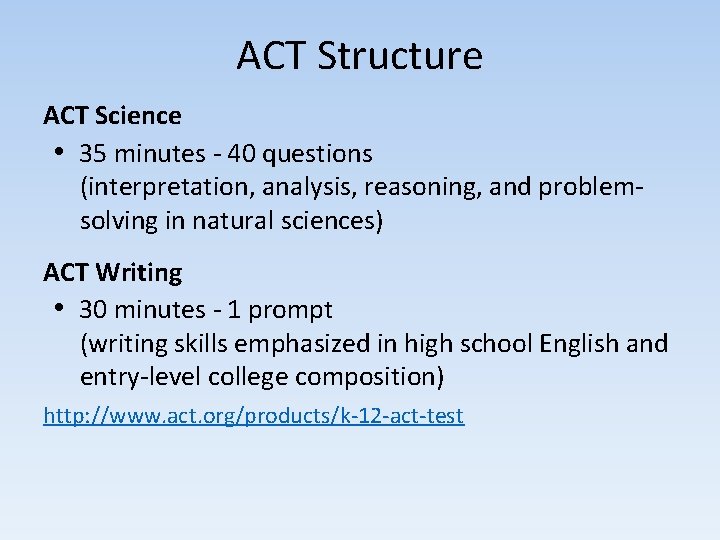
ACT Structure ACT Science • 35 minutes - 40 questions (interpretation, analysis, reasoning, and problemsolving in natural sciences) ACT Writing • 30 minutes - 1 prompt (writing skills emphasized in high school English and entry-level college composition) http: //www. act. org/products/k-12 -act-test
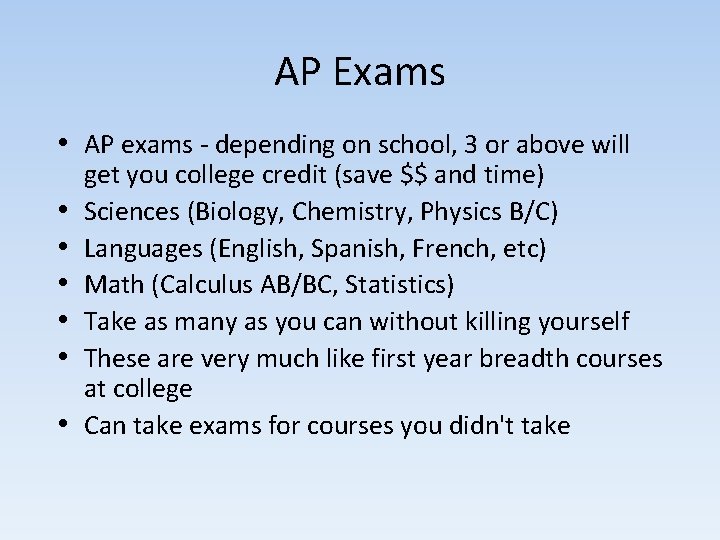
AP Exams • AP exams - depending on school, 3 or above will • • • get you college credit (save $$ and time) Sciences (Biology, Chemistry, Physics B/C) Languages (English, Spanish, French, etc) Math (Calculus AB/BC, Statistics) Take as many as you can without killing yourself These are very much like first year breadth courses at college Can take exams for courses you didn't take
Application Process
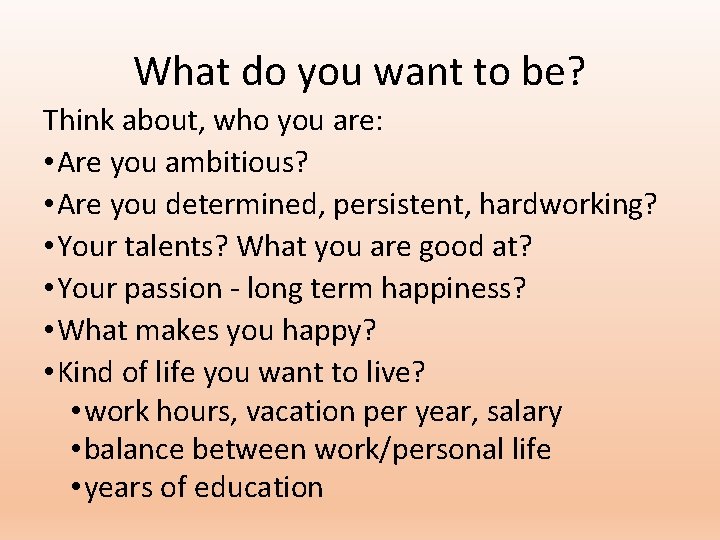
What do you want to be? Think about, who you are: • Are you ambitious? • Are you determined, persistent, hardworking? • Your talents? What you are good at? • Your passion - long term happiness? • What makes you happy? • Kind of life you want to live? • work hours, vacation per year, salary • balance between work/personal life • years of education
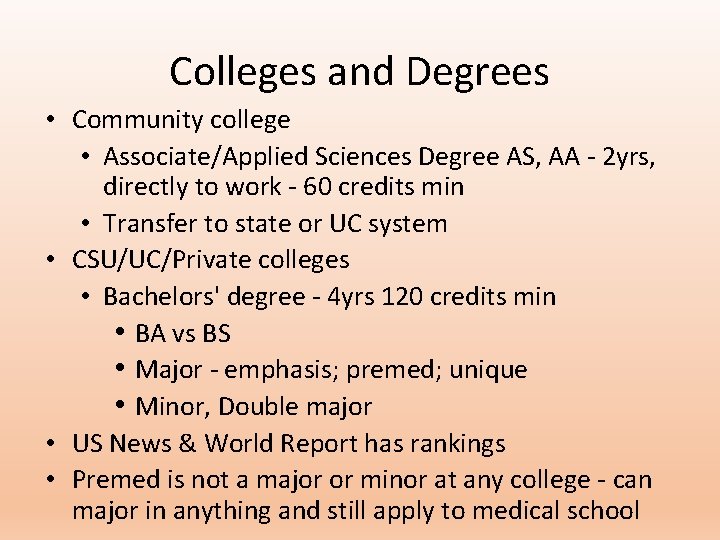
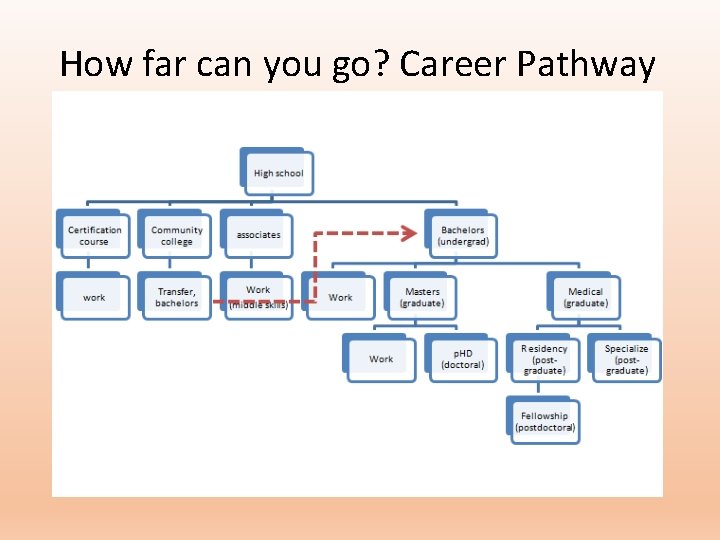
Colleges and Degrees • Community college • Associate/Applied Sciences Degree AS, AA - 2 yrs, directly to work - 60 credits min • Transfer to state or UC system • CSU/UC/Private colleges • Bachelors' degree - 4 yrs 120 credits min • BA vs BS • Major - emphasis; premed; unique • Minor, Double major • US News & World Report has rankings • Premed is not a major or minor at any college - can major in anything and still apply to medical school
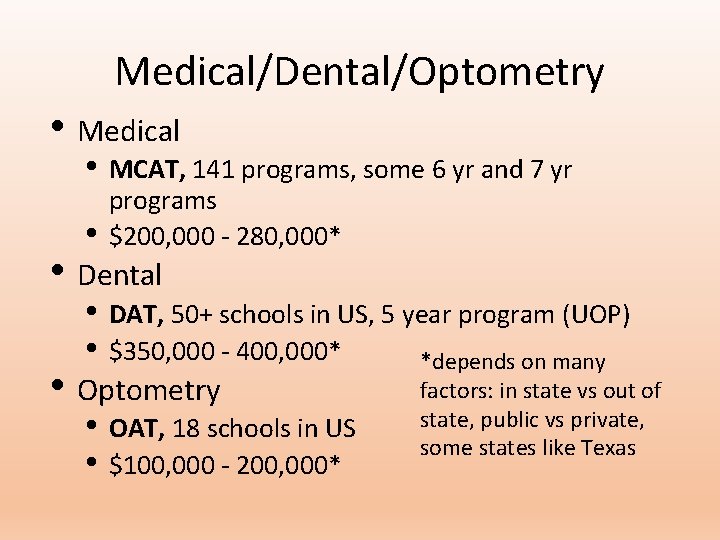
Medical/Dental/Optometry • Medical • MCAT, 141 programs, some 6 yr and 7 yr • programs $200, 000 - 280, 000* • Dental • DAT, 50+ schools in US, 5 year program (UOP) • $350, 000 - 400, 000* *depends on many • Optometry • OAT, 18 schools in US • $100, 000 - 200, 000* factors: in state vs out of state, public vs private, some states like Texas
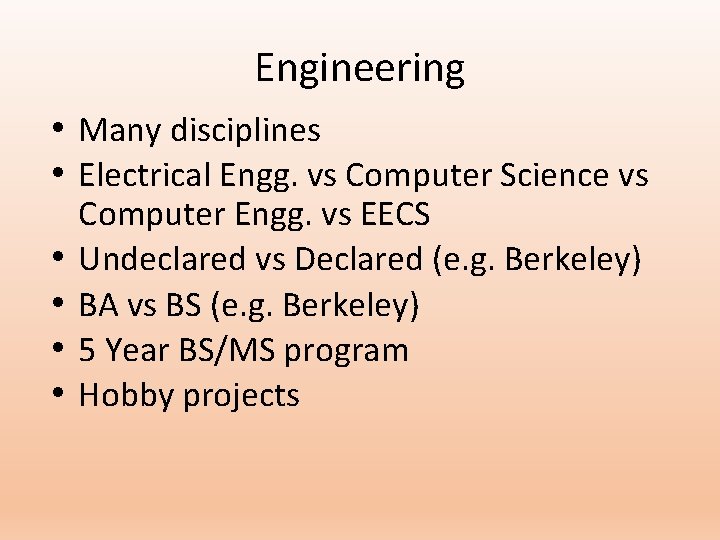
Engineering • Many disciplines • Electrical Engg. vs Computer Science vs • • Computer Engg. vs EECS Undeclared vs Declared (e. g. Berkeley) BA vs BS (e. g. Berkeley) 5 Year BS/MS program Hobby projects
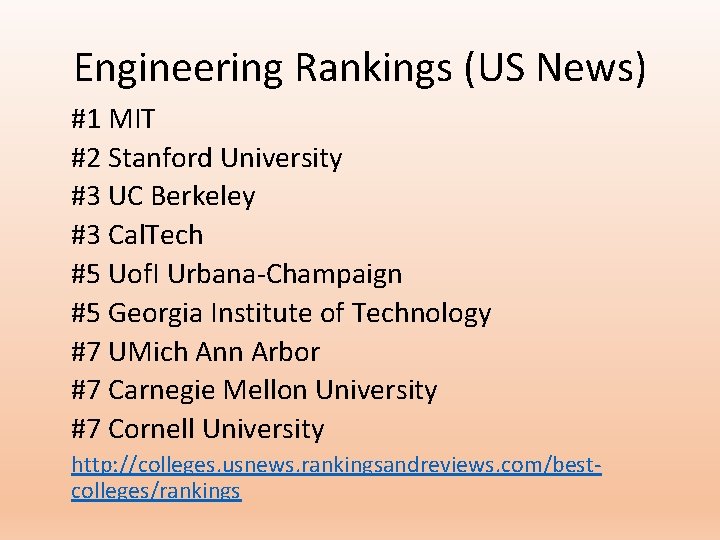
Engineering Rankings (US News) #1 MIT #2 Stanford University #3 UC Berkeley #3 Cal. Tech #5 Uof. I Urbana-Champaign #5 Georgia Institute of Technology #7 UMich Ann Arbor #7 Carnegie Mellon University #7 Cornell University http: //colleges. usnews. rankingsandreviews. com/bestcolleges/rankings
When people start talking about the future after graduation
How far can you go? Career Pathway
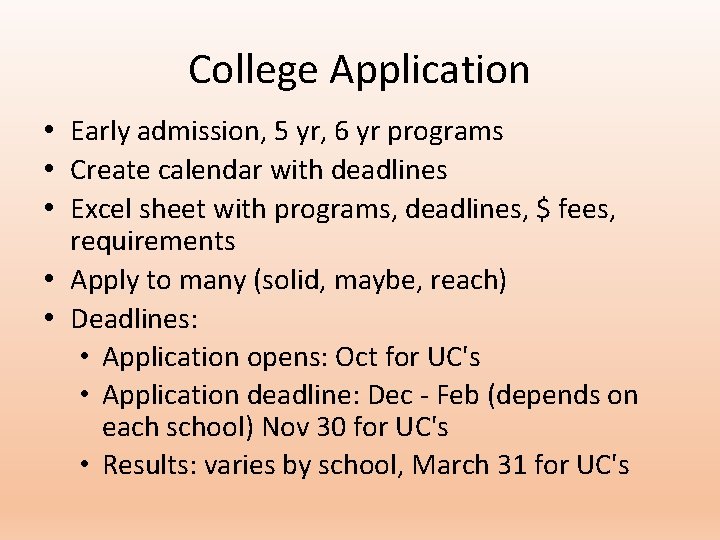
College Application • Early admission, 5 yr, 6 yr programs • Create calendar with deadlines • Excel sheet with programs, deadlines, $ fees, requirements • Apply to many (solid, maybe, reach) • Deadlines: • Application opens: Oct for UC's • Application deadline: Dec - Feb (depends on each school) Nov 30 for UC's • Results: varies by school, March 31 for UC's
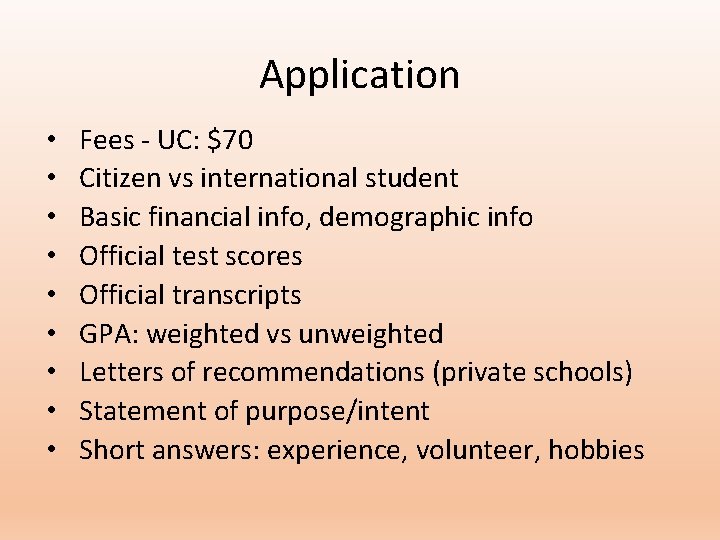
Application • • • Fees - UC: $70 Citizen vs international student Basic financial info, demographic info Official test scores Official transcripts GPA: weighted vs unweighted Letters of recommendations (private schools) Statement of purpose/intent Short answers: experience, volunteer, hobbies
Application (contd) Tip from college counselor: • Before looking at the essays, make a list of the most important things that you want the admissions officers to know. • For each application (which will have a unique set of short answers), map out how you are going to make sure that each of these things come across.
Personal Statement (UC) Prompt #1 Describe the world you come from — for example, your family, community or school — and tell us how your world has shaped your dreams and aspirations. Prompt #2 Tell us about a personal quality, talent, accomplishment, contribution or experience that is important to you. What about this quality or accomplishment makes you proud and how does it relate to the person you are? 1000 words total
Factors in admissions 1. 2. 3. 4. 5. 6. 7. 8. 9. Grades in college prep courses Strength of curriculum Standardized test scores Overall high school GPA Essay Teacher & counselor recommendations Extracurricular activities Class rank Student's demonstrated interest
College Visits • Spring break of junior year • Revisit after acceptance • Attend open house - stay with a senior on campus • Look for campus housing • Off campus - sharing • Commute from home if close by (advantages vs disadvantages)
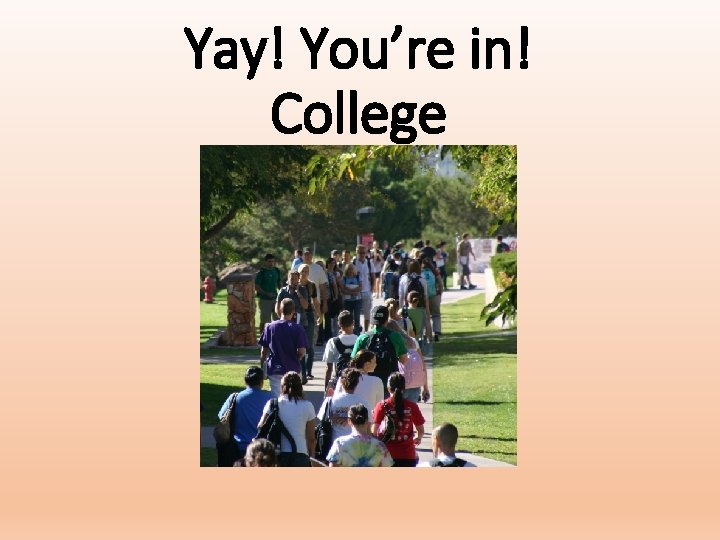
Yay! You’re in! College
In College • Curriculum- usually around 13 units minimum • • required (around 3 -4 courses) to be considered full time student Semester system or quarter system Taking a semester off College is different, you are on your own, little handholding Plan your own major You can minor, double major Housing (roommates) Beware the ‘Freshman 15’
Studying for a final for a class you haven’t paid attention in
In College • Auditing classes • Webcasts • If undeclared, take variety of courses early on so you can decide quickly, avoid graduating late • Buying books (half. com, on campus exchange programs) • Selecting courses and professors • Ratemyprofessor. com
Trying to get into an over-enrolled course
Graduation!
Knowing what you want
Financial Aid
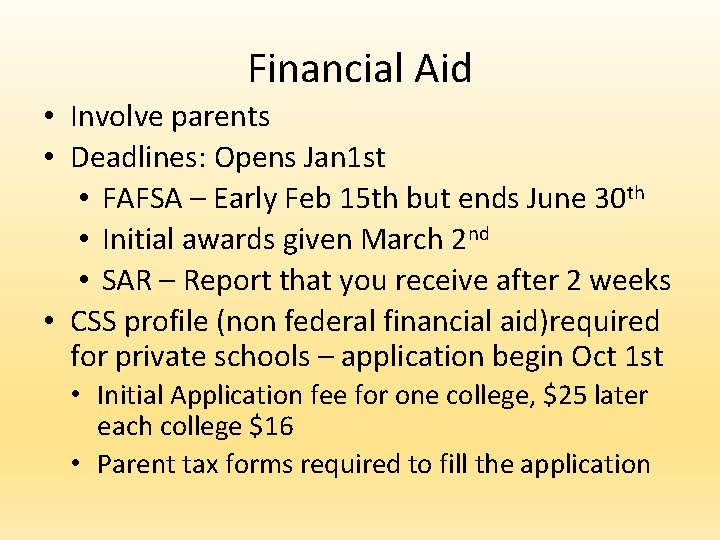
Financial Aid • Involve parents • Deadlines: Opens Jan 1 st • FAFSA – Early Feb 15 th but ends June 30 th • Initial awards given March 2 nd • SAR – Report that you receive after 2 weeks • CSS profile (non federal financial aid)required for private schools – application begin Oct 1 st • Initial Application fee for one college, $25 later each college $16 • Parent tax forms required to fill the application
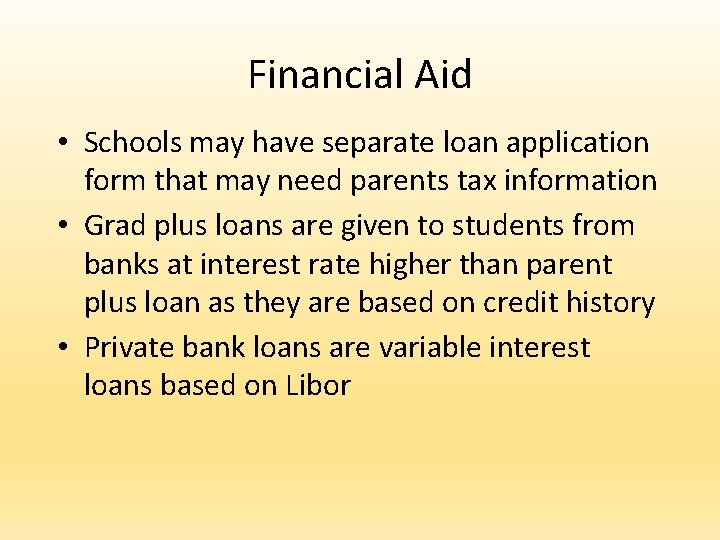
Financial Aid • Schools may have separate loan application form that may need parents tax information • Grad plus loans are given to students from banks at interest rate higher than parent plus loan as they are based on credit history • Private bank loans are variable interest loans based on Libor
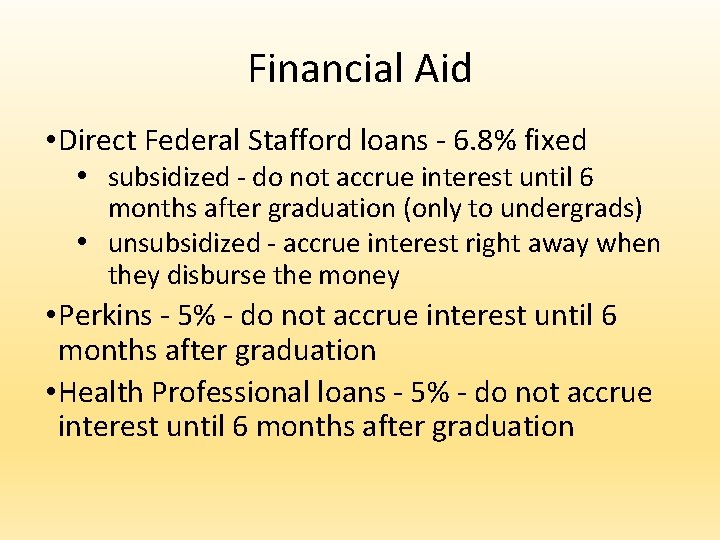
Financial Aid • Direct Federal Stafford loans - 6. 8% fixed • subsidized - do not accrue interest until 6 months after graduation (only to undergrads) • unsubsidized - accrue interest right away when they disburse the money • Perkins - 5% - do not accrue interest until 6 months after graduation • Health Professional loans - 5% - do not accrue interest until 6 months after graduation
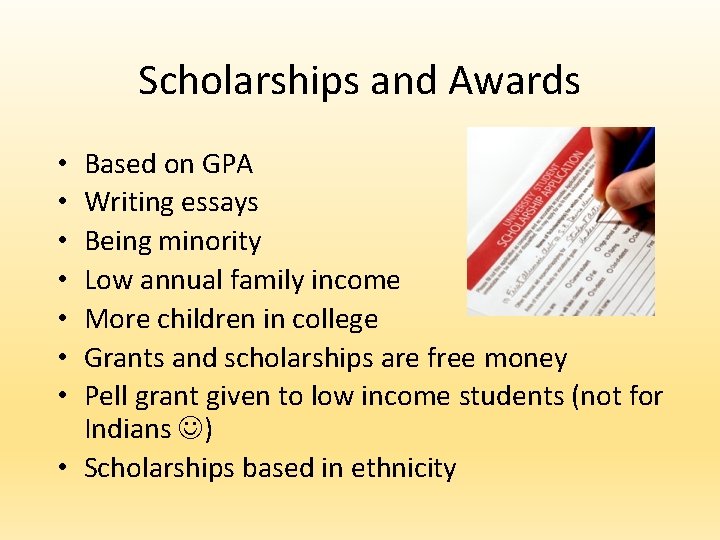
Scholarships and Awards Based on GPA Writing essays Being minority Low annual family income More children in college Grants and scholarships are free money Pell grant given to low income students (not for Indians ) • Scholarships based in ethnicity • •
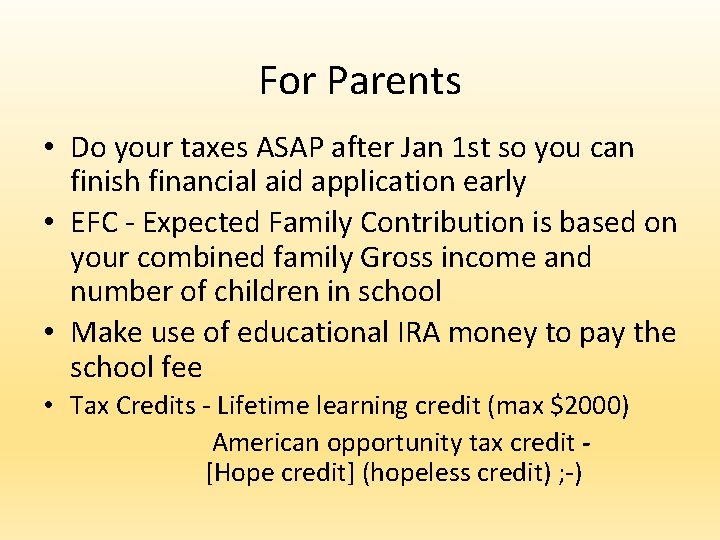
For Parents • Do your taxes ASAP after Jan 1 st so you can finish financial aid application early • EFC - Expected Family Contribution is based on your combined family Gross income and number of children in school • Make use of educational IRA money to pay the school fee • Tax Credits - Lifetime learning credit (max $2000) American opportunity tax credit [Hope credit] (hopeless credit) ; -)
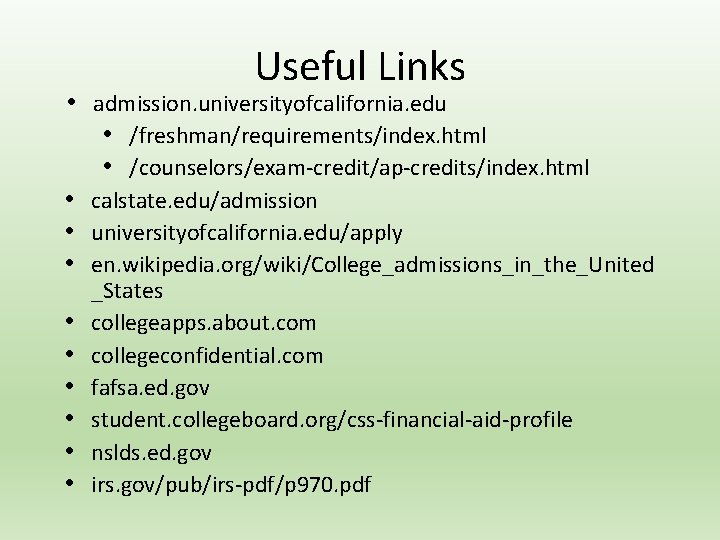
Useful Links • admission. universityofcalifornia. edu • /freshman/requirements/index. html • /counselors/exam-credit/ap-credits/index. html • calstate. edu/admission • universityofcalifornia. edu/apply • en. wikipedia. org/wiki/College_admissions_in_the_United • • • _States collegeapps. about. com collegeconfidential. com fafsa. ed. gov student. collegeboard. org/css-financial-aid-profile nslds. ed. gov irs. gov/pub/irs-pdf/p 970. pdf
Good luck on your journey! Link to this presentation: http: //uppula. com/docs/college_prep. pptx
Thank you!
Q&A Please use the mic