Cognitive and Motor Development There is a strong



- Slides: 43
Cognitive and Motor Development
There is a strong relationship between human intellectual function and movement: Any intellectual change is also accompanied by a change in motor function
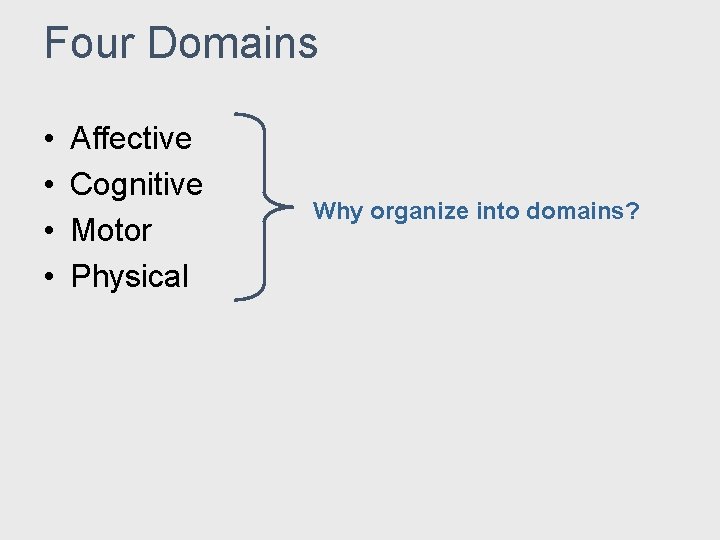
Four Domains • • Affective Cognitive Motor Physical Why organize into domains?
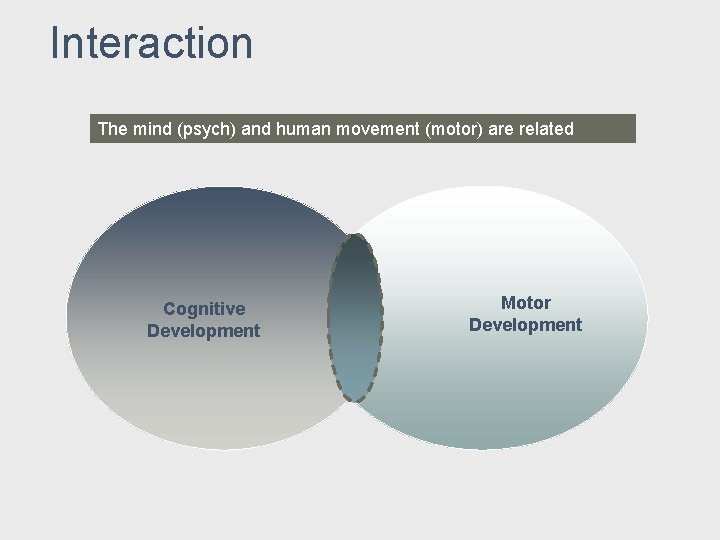
Interaction The mind (psych) and human movement (motor) are related Cognitive Development Motor Development
Psychomotor or Motor? • Motor – Refers to any form of human movement behavior • Reflex movement • Psychomotor – Movements initiated by an electrical impulse from higher brain centers
How does our gradually changing motor ability affect our cognitive development? How does our evolving cognitive development affect our motor development?
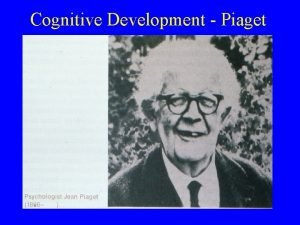
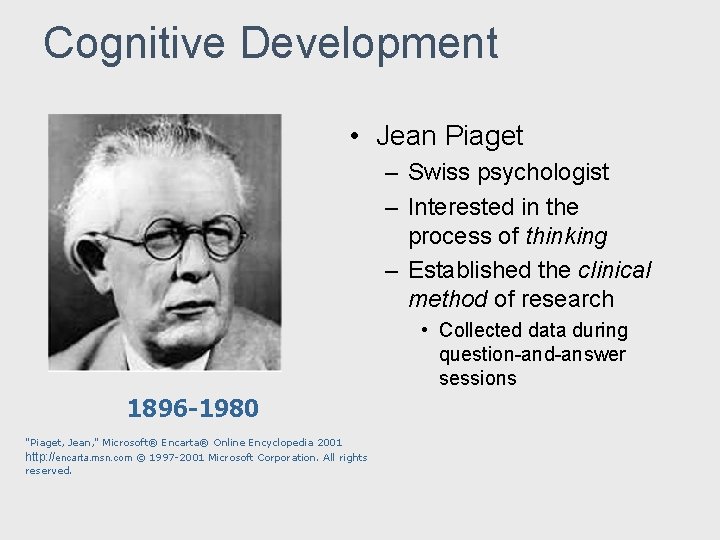
Cognitive Development • Jean Piaget – Swiss psychologist – Interested in the process of thinking – Established the clinical method of research • Collected data during question-and-answer sessions 1896 -1980 "Piaget, Jean, " Microsoft® Encarta® Online Encyclopedia 2001 http: //encarta. msn. com © 1997 -2001 Microsoft Corporation. All rights reserved.
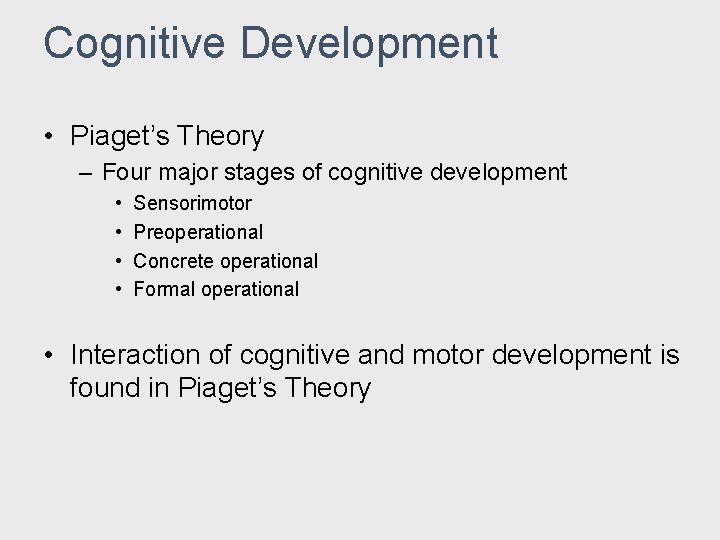
Cognitive Development • Piaget’s Theory – Four major stages of cognitive development • • Sensorimotor Preoperational Concrete operational Formal operational • Interaction of cognitive and motor development is found in Piaget’s Theory
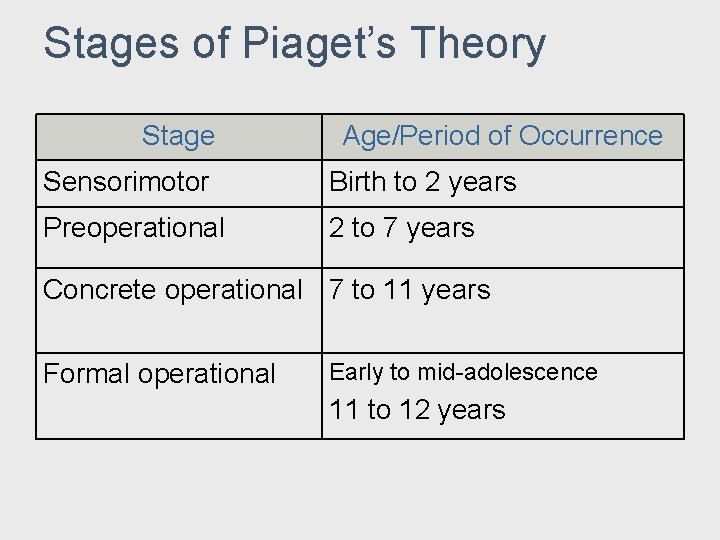
Stages of Piaget’s Theory Stage Age/Period of Occurrence Sensorimotor Birth to 2 years Preoperational 2 to 7 years Concrete operational 7 to 11 years Formal operational Early to mid-adolescence 11 to 12 years
Piaget’s Theory • Adaptation – Cognitive development occurs thorugh this process – Adjusting to the demands of the envirnoment and intellectualizing those adjustments – Two facets of adaptation • Assimilation • Accommodation
Piaget’s Theory • Assimilation – Process by which children attempt to interpret new experiences based upon their present interpretation of the world
Piaget’s Theory • Assimilation – Child tries to grab a large ball with one hand – His experiences of the past tell him that he can use one hand to grab hold of an object because it worked with rattles and smaller objects – The child assimilates his past experiences
Piaget’s Theory • Accommodation – Adjustments or modifications in the thinking process which will become a part of a child’s new cognitive repetoire – Using the same example, when the child is unable to grasp the ball, he may try to adjust or accommodate by using two hands or even adapting the one-handed grasp
Criticisms of Piaget’s Theory • • Theory lacks scientific control • Piaget used his own • children to study • Subjects were not studied across the lifespan • • Piaget may have underestimated a child’s • capabilities Theory does not discern between competency and performance Theory does not account for the influence of motivation and emotion Stages of developoment were too broad Developoment is described, but never explained
Criticisms of Piaget’s Theory • Most criticized aspect of theory is that formal operational thought can be achieved as early as 11 years of age – Did not account for adult development in his theory • Now known that cognitive development continues throughout adulthood
Criticisms of Piaget’s Theory If a child performed poorly on a task, Piaget attributed this to a lack of intellectual competency However, there a other reasons for not performing a task well: • • Lack of motivation Verbal ability Memory Lack of familiarity with task • Peer pressure • Social influences – Peers – Teachers – Siblings • Child’s emotional state
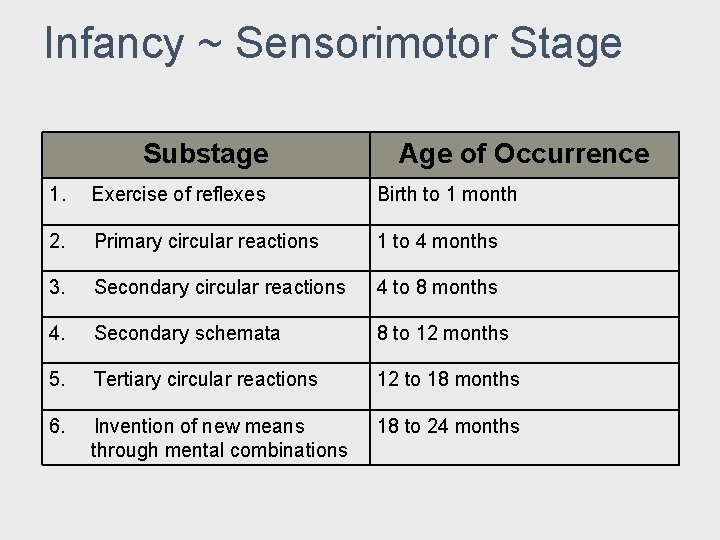
Infancy ~ Sensorimotor Stage • Intelligence develops as a result of movement actions and their consequences • Movement is critical to thought processes • Six substages
Infancy ~ Sensorimotor Stage Substage Age of Occurrence 1. Exercise of reflexes Birth to 1 month 2. Primary circular reactions 1 to 4 months 3. Secondary circular reactions 4 to 8 months 4. Secondary schemata 8 to 12 months 5. Tertiary circular reactions 12 to 18 months 6. Invention of new means through mental combinations 18 to 24 months
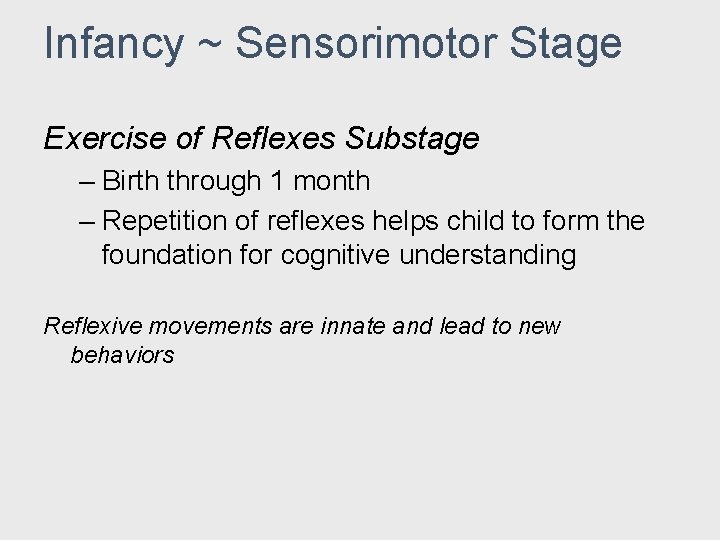
Infancy ~ Sensorimotor Stage Exercise of Reflexes Substage – Birth through 1 month – Repetition of reflexes helps child to form the foundation for cognitive understanding Reflexive movements are innate and lead to new behaviors
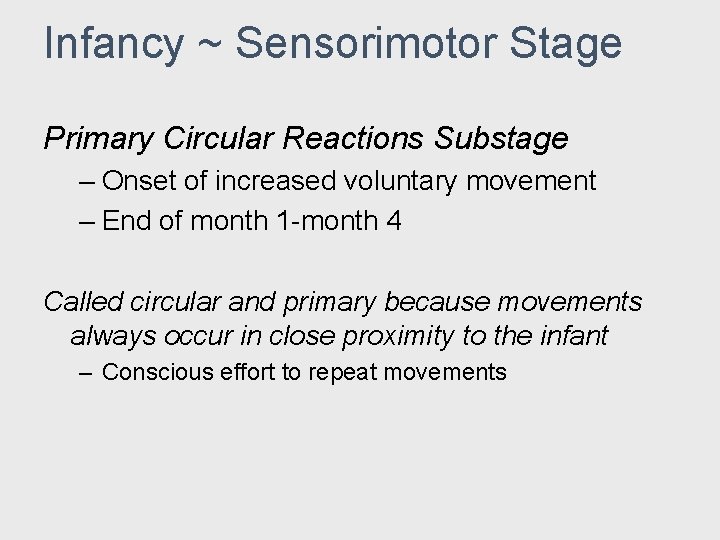
Infancy ~ Sensorimotor Stage Primary Circular Reactions Substage – Onset of increased voluntary movement – End of month 1 -month 4 Called circular and primary because movements always occur in close proximity to the infant – Conscious effort to repeat movements
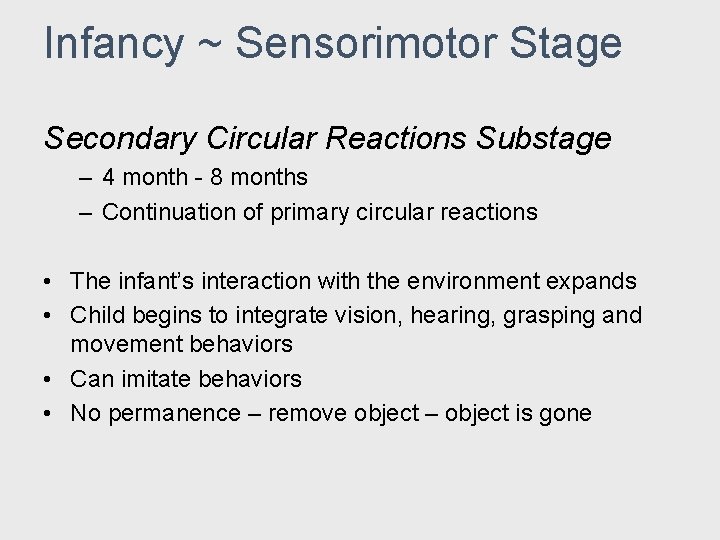
Infancy ~ Sensorimotor Stage Secondary Circular Reactions Substage – 4 month - 8 months – Continuation of primary circular reactions • The infant’s interaction with the environment expands • Child begins to integrate vision, hearing, grasping and movement behaviors • Can imitate behaviors • No permanence – remove object – object is gone
Infancy ~ Sensorimotor Stage Secondary schemata substage – 8 months to 1 year – Past movement actions applied to new situations – New behaviors emerge New behaviors are facilitated by increasing movement capabilities such as crawling and creeping which allow exploration of the environment
Infancy ~ Sensorimotor Stage Secondary schemata substage – Repetition of experimentation and trial-anderror exploration continue – Child can predict some actions and situations – Roll ball to child – he crudely roles it back – he anticipates you rolling the ball to him again – The ability to predict (Piaget) is the onset of intellectual reasoning
Infancy ~ Sensorimotor Stage Tertiary circular reactions substage – 1 year -11/2 years – Use of active experimentation to learn – Child realizes that discovery of an object and use of the object are separate entities – First level of visualizing an object beyond its immediate use
Infancy ~ Sensorimotor Stage Tertiary circular reactions substage – Child sees the ball and knows she can have fun, but also realizes she does not have to play with it right now – it will be there later – Can distinguish self from others – Seeks immediate family members for help • Social and emotional development
Infancy ~ Sensorimotor Stage Invention of new means through mental combinations substage – 11/2 years - 2 years – Child recognizes objects and others as independent from himslef – Child is beggining to understand properties of objects • Size, shape, color, texture, weight, use, etc.
Infancy ~ Sensorimotor Stage Invention of new means through mental combinations substage – Semimental functioning • “thinking with the body” is replaced with “thinking with the mind” – Child reflects
Summary: Infancy ~ Sensorimotor Stage • Increasing awareness of the difference between the self and others • Recognition that objects continue to exist even though they are no longer in view • Production of the mental images that allow the contemplation of the past, present, and future
Childhood ~ Preoperational Stage (2 -7 years) – Verbal communication begins to emerge – Language development is the most important aspect of Preoperational Stage – Linked to motor abilities – Children are unable to think logically
Childhood ~ Preoperational Stage (2 -7 years) Preconceptual substage (2 -4 years) – Ability to use symbols to represent someone or something in the child’s life – Pretend play common • Role play – Egocentrism • A serious deficiency in the Preconceptual substage § Play helps child to socialize and work with others
Childhood ~ Preoperational Stage (2 -7 years) Preconceptual substage (2 -4 years) – Flawed thinking • Drooping flower is sad – unrealistic – flawed thinking – Transductive reasoning • A form of flawed thinking • Incorrect assumptions • Missed breakfast, so it can’t be morning
Childhood ~ Preoperational Stage (2 -7 years) Intuitive substage (4 -7 years) – Reduced egocentrism – Improvement in the use of symbols – Child is incapable of “conservation” • Ability to realize that certain properties of a substance remain unchanged when the appearance is rearranged Child cannot consider multiple aspects of a problem
Later Childhood ~ Concrete Operational Stage (7 -11 years) – Must gain ability to conserve first – Enhanced ability to decenter attention from one variable in a problem solving situation – Reversibility ~ Able to mentally modify, organize, or even reverse thought processes
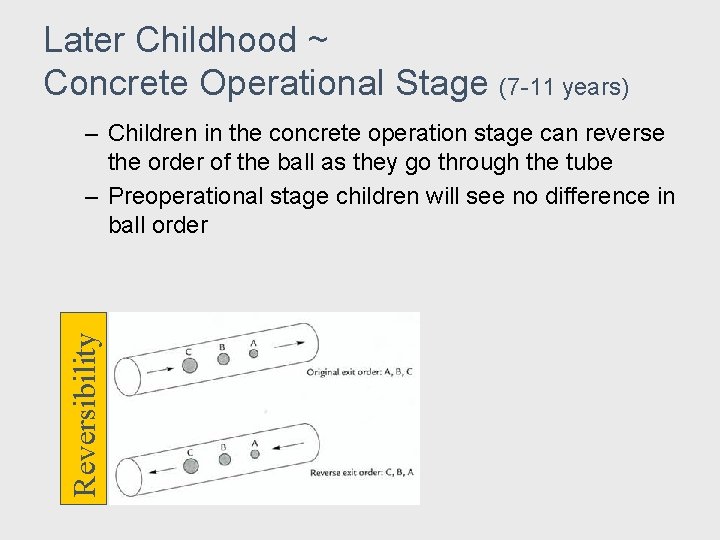
Later Childhood ~ Concrete Operational Stage (7 -11 years) Reversibility – Children in the concrete operation stage can reverse the order of the ball as they go through the tube – Preoperational stage children will see no difference in ball order
Later Childhood ~ Concrete Operational Stage (7 -11 years) • Seriation – Ability to arrange a set of variables by a certain characteristic • Child’s height can determine position in a game of basketball • Piaget emphasized that learning can be enhanced through movement
Later Childhood ~ Formal Operational Stage (11 -12 years) • Ability to consider ideas that are not based on observable objects or experiences • Abstract ideas are possible
Later Childhood ~ Formal Operational Stage (11 -12 years) • Interpropositional thought – Applicable to complex movement – A logical relationship exists between two propositions • Enhanced level of cognitive ability – Allows child to relate one or more parts of a proposition or situation to another part to arrive at a solution to a problem
Later Childhood ~ Formal Operational Stage (11 -12 years) • Hypothetical-deductive reasoning – A problem-solving style that allows child to choose between possible solutions and then pick the best one – Aids in emotional development and emerging values • Child ponders – “do I follow the crowd; do I want to be fit in”
Adulthood ~ Postformal Operations – Answers become more relative and less absolute – Thrive on detecting inconsistencies in ideas and attempt to reconcile them – Advanced thinking exists in a minority of people who are also highly educated and live in a culture that encourages new ideas and freethinking – New questions are discovered
Adulthood ~ Theories ~ Intellectual Development • A lifestyle that involves movement can play an important role in the effort to allay the decline of intellect • Physical activity increases motor neuron size and decreases neural synapse density • Reaction time and cognitive performance improve in those who exercise
Knowledge Development and Sport Performance Declarative knowledge – Factual information – What to do – Found in a novice performer Procedural knowledge – Production system – How to do something – Found in an expert performer
Knowledge Development and Sport Performance “development of sport-specific declarative knowledge is related to the development of cognitive decisionmaking skills or procedural knowledge, whereas development of shooting skill and dribbling skill are related to the motor execution components of control and execution” (French & Thomas, 1987)
Knowledge Development and Sport Performance In other words - children learn “what to do” in a given situation before they acquire the physical skills (how to do) to carry out their strategic plan successfully