
COGNITIVE DEVELOPMENT IN EARLY CHILDHOOD CHAPTER 9 PGS


- Slides: 19
COGNITIVE DEVELOPMENT IN EARLY CHILDHOOD CHAPTER 9: PGS. 317322, 328 -338, 341 -361 (Infants & Children)
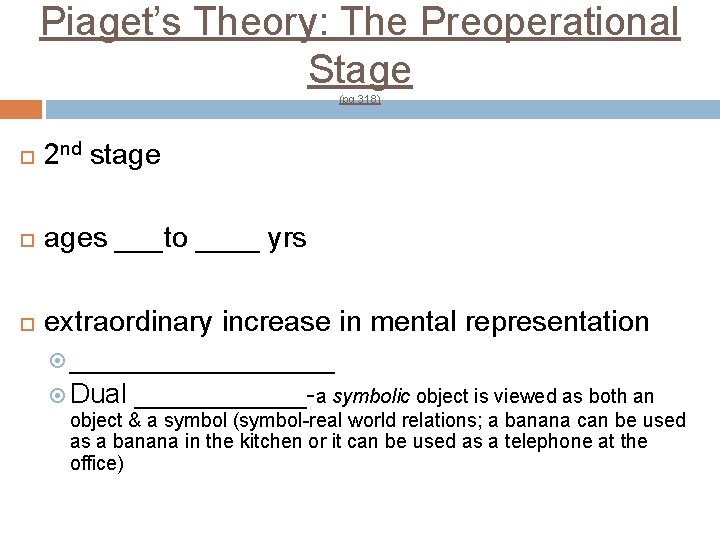
Piaget’s Theory: The Preoperational Stage (pg 318) 2 nd stage ages ___to ____ yrs extraordinary increase in mental representation _________ Dual ______-a symbolic object is viewed as both an object & a symbol (symbol-real world relations; a banana can be used as a banana in the kitchen or it can be used as a telephone at the office)
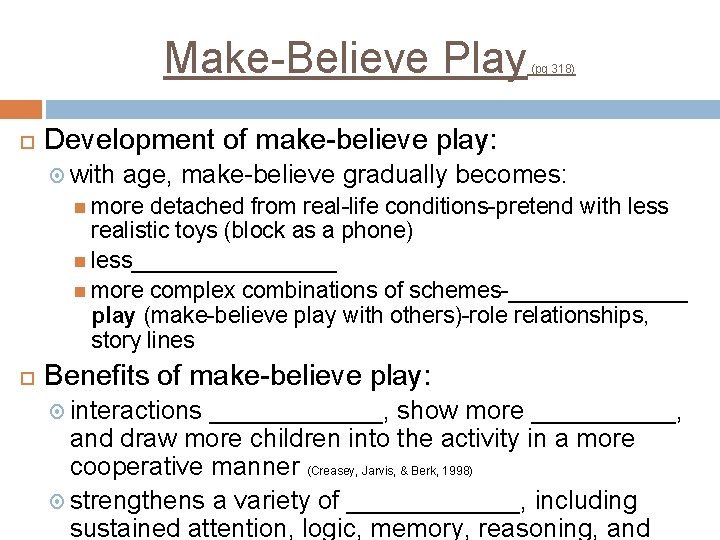
Make-Believe Play (pg 318) Development of make-believe play: with age, make-believe gradually becomes: more detached from real-life conditions-pretend with less realistic toys (block as a phone) less________ more complex combinations of schemes-_______ play (make-believe play with others)-role relationships, story lines Benefits of make-believe play: interactions ______, show more _____, and draw more children into the activity in a more cooperative manner (Creasey, Jarvis, & Berk, 1998) strengthens a variety of ______, including sustained attention, logic, memory, reasoning, and
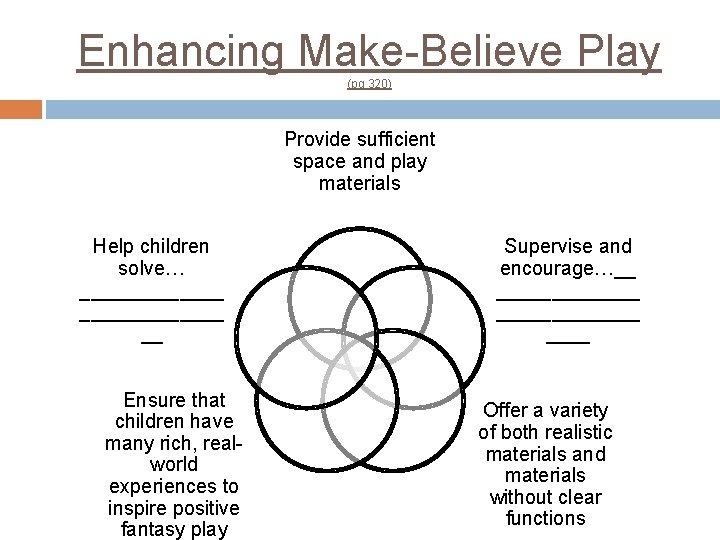
Enhancing Make-Believe Play (pg 320) Provide sufficient space and play materials Help children solve… _____________ __ Ensure that children have many rich, realworld experiences to inspire positive fantasy play Supervise and encourage…__ _____________ Offer a variety of both realistic materials and materials without clear functions
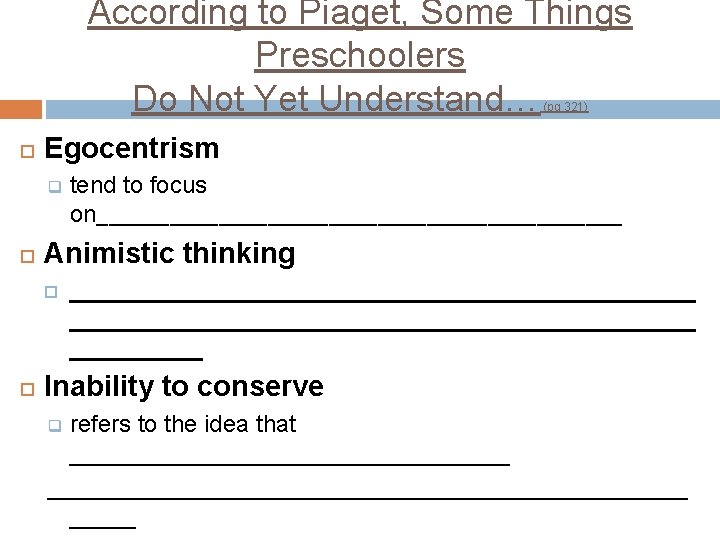
According to Piaget, Some Things Preschoolers Do Not Yet Understand… (pg 321) Egocentrism q Animistic thinking tend to focus on___________________________________________ _____ Inability to conserve refers to the idea that _________________________________________ q
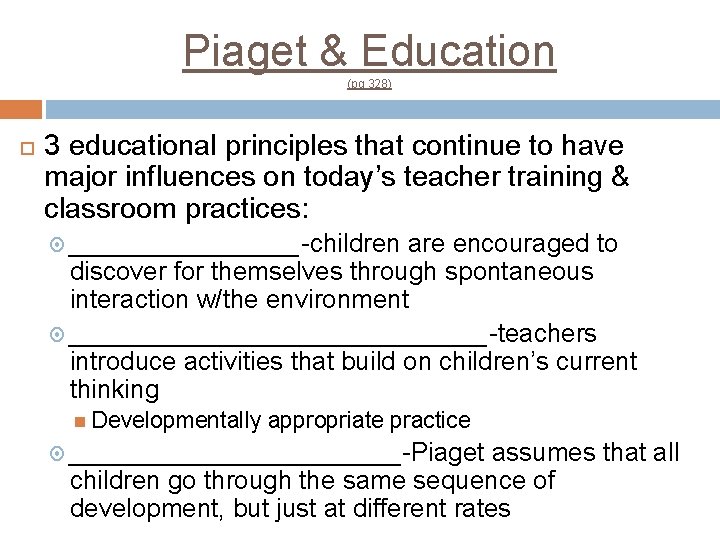
Piaget & Education (pg 328) 3 educational principles that continue to have major influences on today’s teacher training & classroom practices: ________-children are encouraged to discover for themselves through spontaneous interaction w/the environment _______________-teachers introduce activities that build on children’s current thinking Developmentally appropriate practice ____________-Piaget assumes that all children go through the same sequence of development, but just at different rates
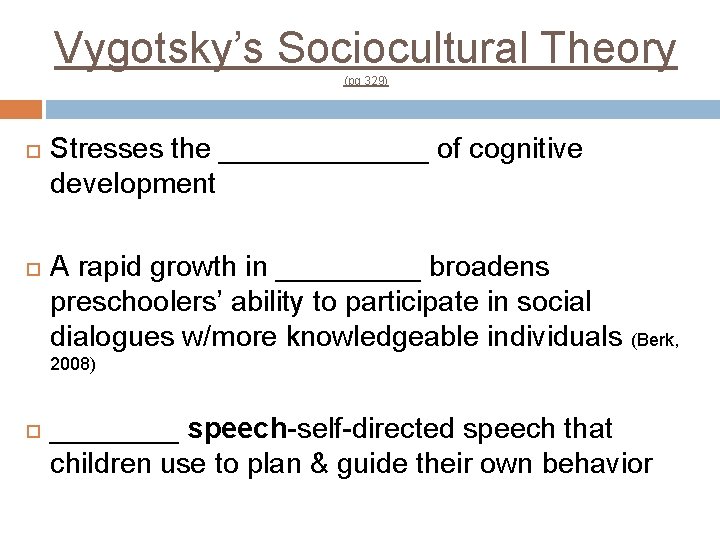
Vygotsky’s Sociocultural Theory (pg 329) Stresses the _______ of cognitive development A rapid growth in _____ broadens preschoolers’ ability to participate in social dialogues w/more knowledgeable individuals (Berk, 2008) ____ speech-self-directed speech that children use to plan & guide their own behavior
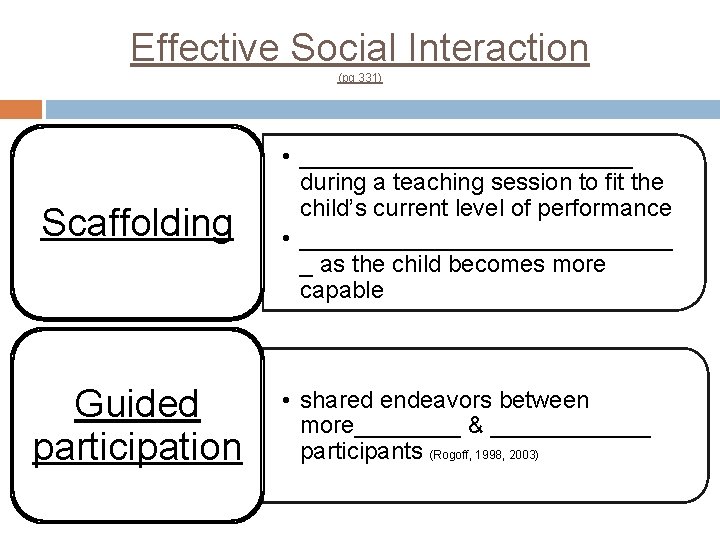
Effective Social Interaction (pg 331) Scaffolding Guided participation • _____________ during a teaching session to fit the child’s current level of performance • ______________ _ as the child becomes more capable • shared endeavors between more____ & ______ participants (Rogoff, 1998, 2003)
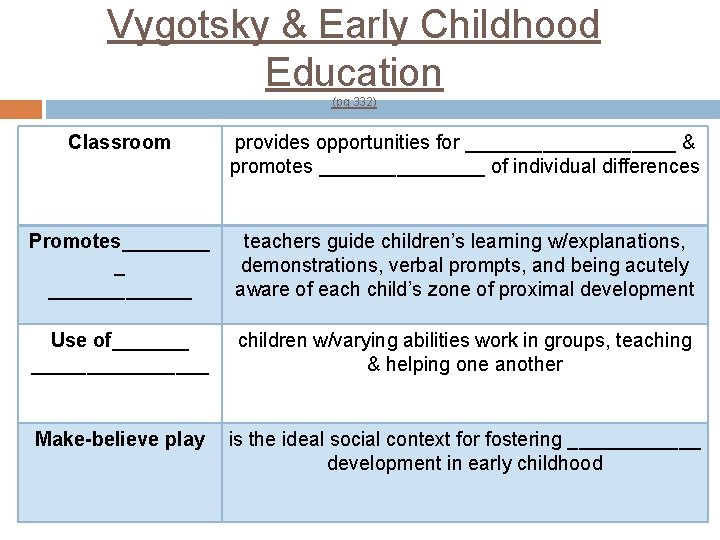
Vygotsky & Early Childhood Education (pg 332) Classroom provides opportunities for __________ & promotes ________ of individual differences Promotes____ _ _______ teachers guide children’s learning w/explanations, demonstrations, verbal prompts, and being acutely aware of each child’s zone of proximal development Use of________ children w/varying abilities work in groups, teaching & helping one another Make-believe play is the ideal social context for fostering ______ development in early childhood
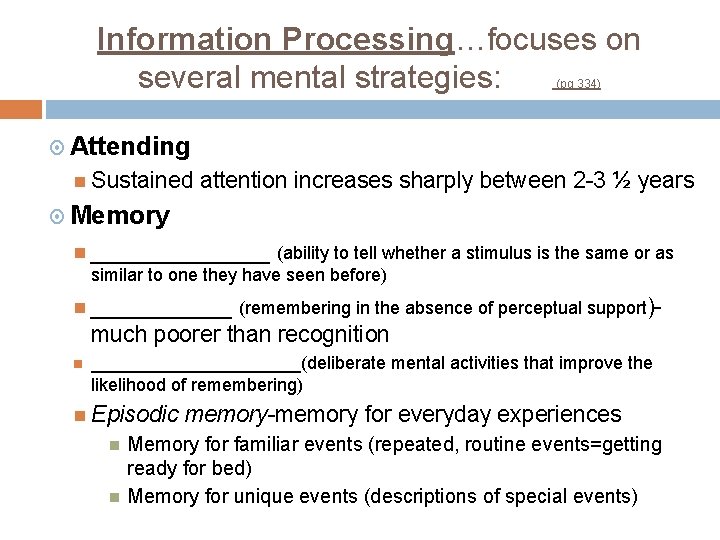
Information Processing…focuses on several mental strategies: (pg 334) Attending Sustained attention increases sharply between 2 -3 ½ years Memory _______ (ability to tell whether a stimulus is the same or as similar to one they have seen before) ______ (remembering in the absence of perceptual support)- much poorer than recognition ___________(deliberate mental activities that improve the likelihood of remembering) Episodic memory-memory for everyday experiences Memory for familiar events (repeated, routine events=getting ready for bed) Memory for unique events (descriptions of special events)
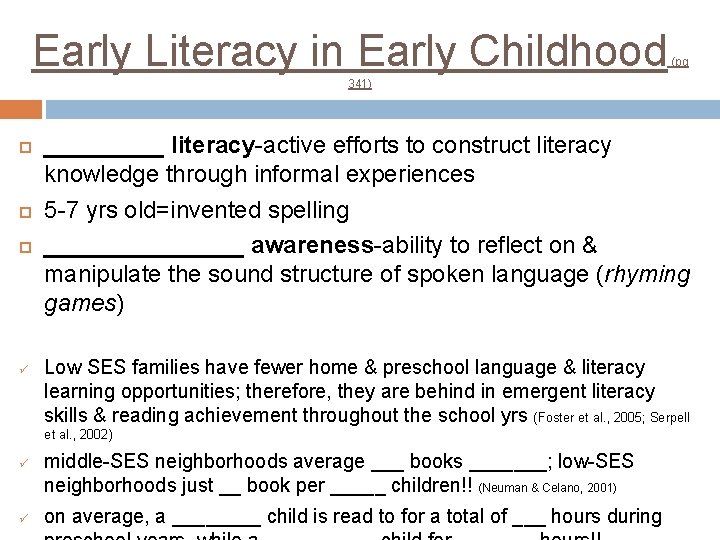
Early Literacy in Early Childhood (pg 341) ü _____ literacy-active efforts to construct literacy knowledge through informal experiences 5 -7 yrs old=invented spelling ________ awareness-ability to reflect on & manipulate the sound structure of spoken language (rhyming games) Low SES families have fewer home & preschool language & literacy learning opportunities; therefore, they are behind in emergent literacy skills & reading achievement throughout the school yrs (Foster et al. , 2005; Serpell et al. , 2002) ü ü middle-SES neighborhoods average ___ books _______; low-SES neighborhoods just __ book per _____ children!! (Neuman & Celano, 2001) on average, a ____ child is read to for a total of ___ hours during
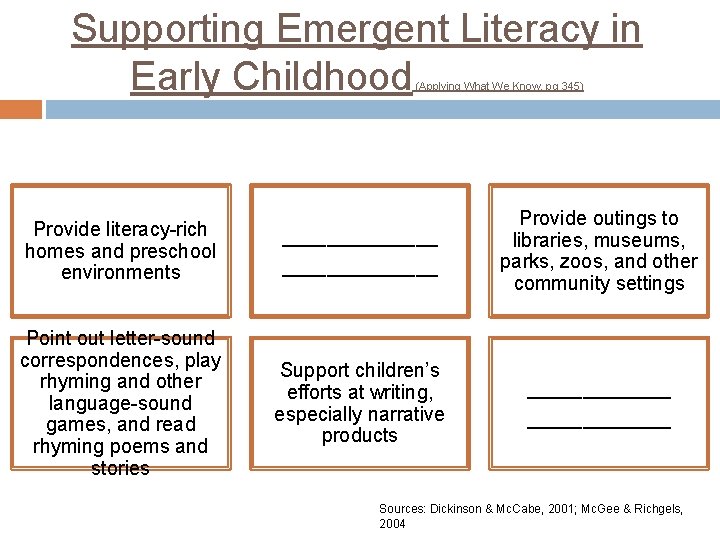
Supporting Emergent Literacy in Early Childhood (Applying What We Know, pg 345) Provide literacy-rich homes and preschool environments ______________ Provide outings to libraries, museums, parks, zoos, and other community settings Point out letter-sound correspondences, play rhyming and other language-sound games, and read rhyming poems and stories Support children’s efforts at writing, especially narrative products _____________ Sources: Dickinson & Mc. Cabe, 2001; Mc. Gee & Richgels, 2004
Mathematical Development in Early Childhood (pg 344) _______ Relationships between quantities (more or less than) 14 -16 months _______ Last number when counting is the total 3 ½ -4 yrs old ü ________ at kindergarten entry ______ math achievement years later , in elementary & secondary school (Duncan et al. , 2007; Geary, 2006 a) ü as with emergent literacy, children from ____ families begin kindergarten with considerably_________ than their higher. SES agemates—a gap due to differences in __________ (Berk, 2012) ü just a few sessions devoted to playing a number board game with an adult led to dramatic improvement in low-SES 4 -year olds’ number concepts and proficiency at counting 1 -10 (Siegler, 2009)
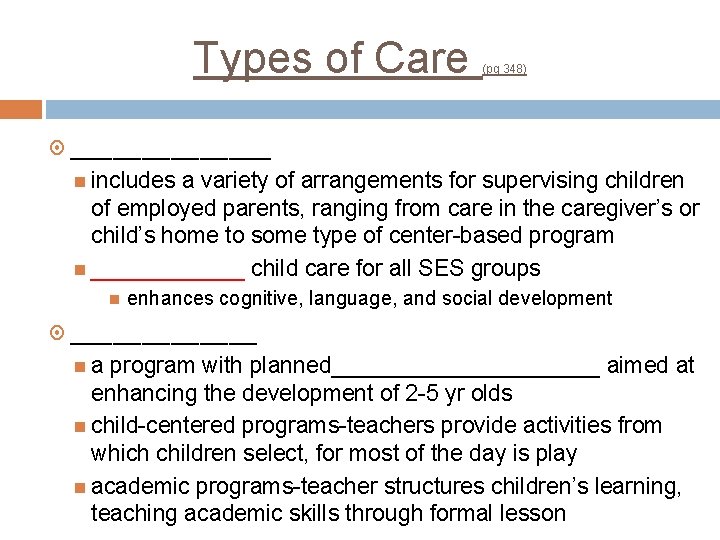
Types of Care (pg 348) _______ includes a variety of arrangements for supervising children of employed parents, ranging from care in the caregiver’s or child’s home to some type of center-based program ______ child care for all SES groups enhances cognitive, language, and social development _______ a program with planned___________ aimed at enhancing the development of 2 -5 yr olds child-centered programs-teachers provide activities from which children select, for most of the day is play academic programs-teacher structures children’s learning, teaching academic skills through formal lesson
Types of Care (pg 348) __________ for “at-risk” preschoolers and/or with developmental delays Project ______ (1965) 10% of children in Head Start must have qualifying delays Intermediate Unit classrooms/IU coming into child’s current program
Educational Media Facts… (pg 351) Television _______________ 40% of 3 month olds watch TV; 90% by age 2 the average U. S. ____ yr old watches TV/videos from ____ hrs/day; middle childhood=3 ½ hrs/day (Rideout & Hamel, 2006) _______ children watch more TV (fewer alternative forms of entertainment are available/affordable) children’s __________ are associated with gains in early literacy & math skills and academic progress in elementary school (Ennemoser & Schneider, 2007) one study reported a link between PS viewing of Sesame Street and other similar educational programs and getting higher grades, reading more books, & placing more value on achievement in high school (Anderson et al. , 2001)
Educational Media Facts…cont’d Computers ___% of 4 -6 yr olds have used a computer at one time or another; spend an average of an hour/day on it more _____ than girls are on the computer many classrooms offer computer _______, computer _____ & other literacy programs (Computer. Tots in child care centers) children spend more time using computers for______ video games designed for young children generally have specific educational goals, including literacy, math, science, colors, and other concepts (Garrison & Christakis, 2005)
Language Development in Early Childhood (pg 354) ________ Using different types of words ________ Verbs-go, run, broke Modifiers-red, round, sad 2 -3 yrs=simple sentence (sub-verb-obj order) 3 ½-4 yrs=use sub-verb-obj sentences, but with newly acquired verbs Add –s for plurals, use prepositions, & form various tenses of the verb to be _________ Pragmatics-the practical, social side of language begin to take turns, stay on the same topic, state their message clearly, & conform to cultural rules for social interaction 4 yrs=adjust speech to fit the age, sex, & social status of the listener (esp. in dramatic play)
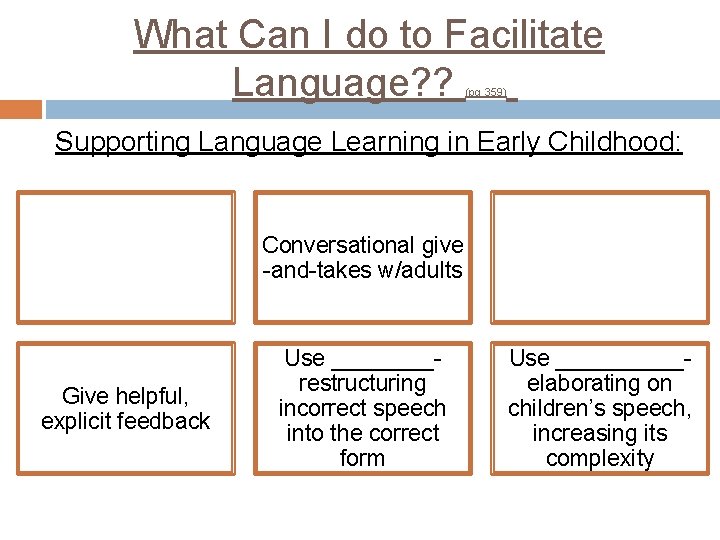
What Can I do to Facilitate Language? ? (pg 359) Supporting Language Learning in Early Childhood: Conversational give -and-takes w/adults Give helpful, explicit feedback Use ____restructuring incorrect speech into the correct form Use _____elaborating on children’s speech, increasing its complexity