Clinical decision support system Prof Ettore Lanzarone a


- Slides: 53
Clinical decision support system Prof. Ettore Lanzarone a. a. 2019/20 A presentation by Angela Ferrari Clinical decision support systems in breast cancer: a systematic review ” ”
TABLE of CONTENTS INTRODUCTION 01 METHOD 03 DISCUSSION CONCLUSIONS RESULTS 04 02 References
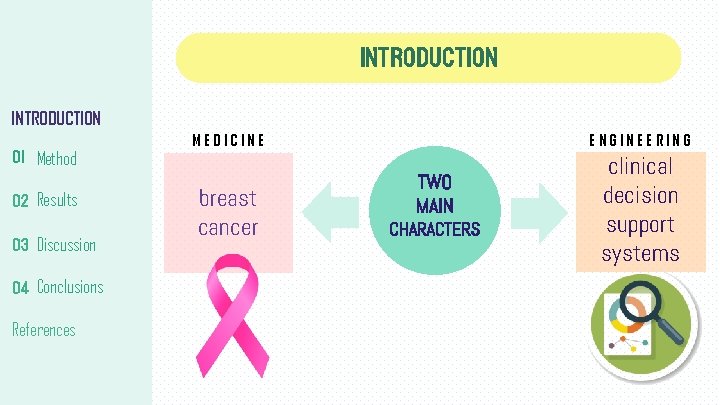
INTRODUCTION 01 Method 02 Results 03 Discussion 04 Conclusions References MEDICINE ENGINEERING breast cancer clinical decision support systems TWO MAIN CHARACTERS
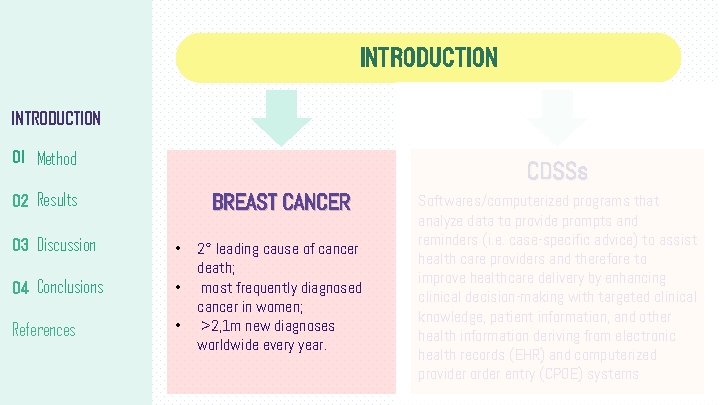
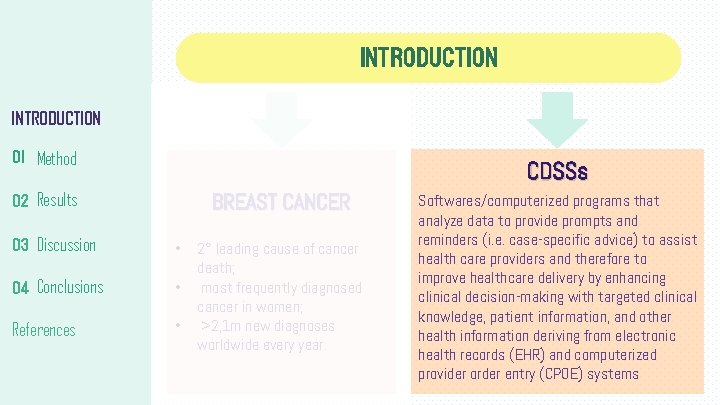
INTRODUCTION 01 Method CDSSs BREAST CANCER 02 Results 03 Discussion • 04 Conclusions • References • 2° leading cause of cancer death; most frequently diagnosed cancer in women; >2, 1 m new diagnoses worldwide every year. Softwares/computerized programs that analyze data to provide prompts and reminders (i. e. case-specific advice) to assist health care providers and therefore to improve healthcare delivery by enhancing clinical decision-making with targeted clinical knowledge, patient information, and other health information deriving from electronic health records (EHR) and computerized provider order entry (CPOE) systems
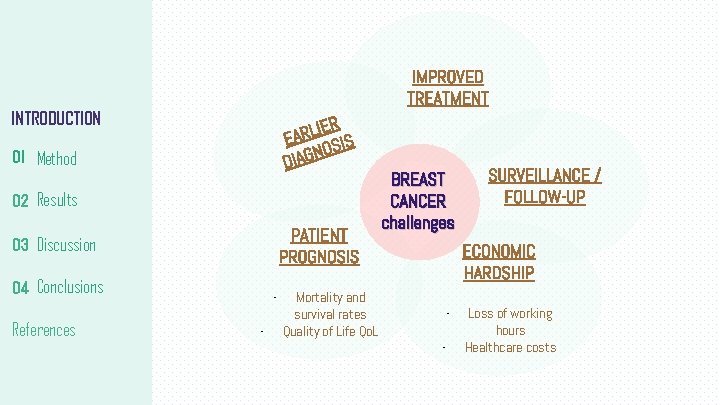
IMPROVED TREATMENT INTRODUCTION IER L R A E SIS O N G DIA 01 Method 02 Results PATIENT PROGNOSIS 03 Discussion 04 Conclusions References - Mortality and survival rates Quality of Life Qo. L BREAST CANCER challenges SURVEILLANCE / FOLLOW-UP ECONOMIC HARDSHIP - Loss of working hours Healthcare costs
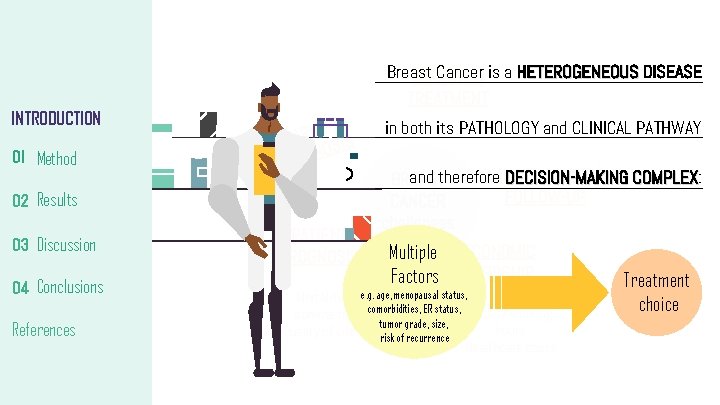
Breast Cancer is a HETEROGENEOUS DISEASE IMPROVED TREATMENT INTRODUCTION IER L R A E SIS O N G DIA 01 Method 02 Results PATIENT PROGNOSIS 03 Discussion 04 Conclusions References - in both its PATHOLOGY and CLINICAL PATHWAY SURVEILLANCE / and therefore DECISION-MAKING COMPLEX: COMPLEX BREAST FOLLOW-UP CANCER challenges ECONOMIC HARDSHIP Multiple Factors Mortality ande. g. age, menopausal status, - Loss of working survival rates comorbidities, ER status, tumor grade, size, hours Quality of Life Qo. L risk of recurrence - Healthcare costs Treatment choice
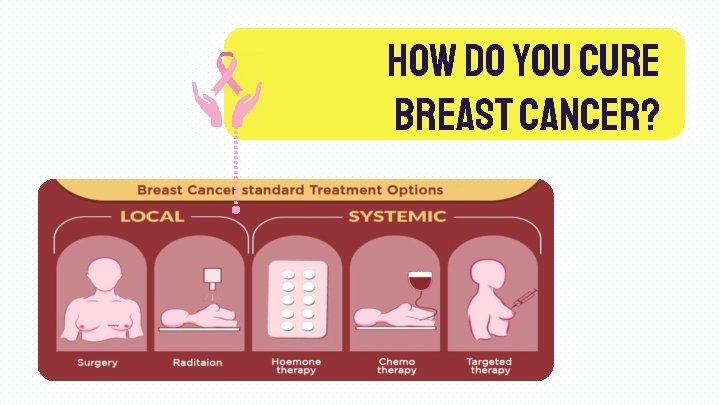
HOW do YOU cure breast cancer?
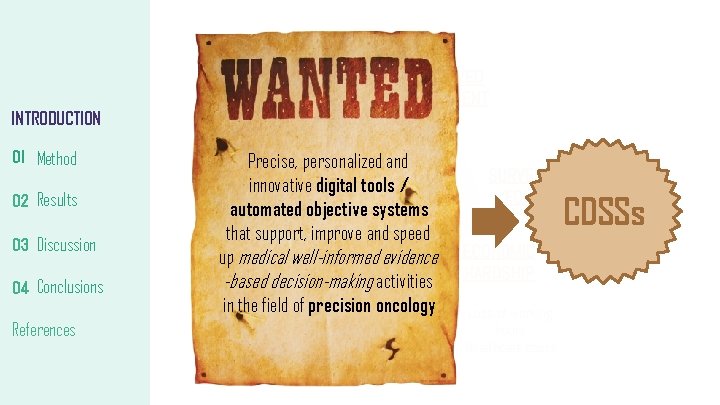
INTRODUCTION 01 Method 02 Results 03 Discussion 04 Conclusions References IMPROVED TREATMENT IER L R A E SIS O N G Precise, DIApersonalized and SURVEILLANCE / innovative digital tools. BREAST / FOLLOW-UP CANCER automated objective systems challenges that support, improve and speed PATIENT up medical. PROGNOSIS well-informed evidence ECONOMIC -based decision-making activities HARDSHIP CDSSs - Mortality and in the field of precision oncology survival rates - Quality of Life Qo. L - Loss of working hours Healthcare costs
INTRODUCTION 01 Method CDSSs BREAST CANCER 02 Results 03 Discussion • 04 Conclusions • References • 2° leading cause of cancer death; most frequently diagnosed cancer in women; >2, 1 m new diagnoses worldwide every year. Softwares/computerized programs that analyze data to provide prompts and reminders (i. e. case-specific advice) to assist health care providers and therefore to improve healthcare delivery by enhancing clinical decision-making with targeted clinical knowledge, patient information, and other health information deriving from electronic health records (EHR) and computerized provider order entry (CPOE) systems
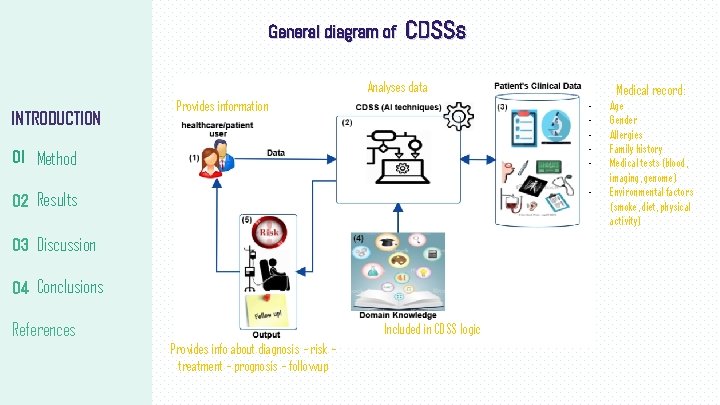
General diagram of CDSSs Analyses data INTRODUCTION Provides information Medical record: - 01 Method - 02 Results 03 Discussion 04 Conclusions References Included in CDSS logic Provides info about diagnosis – risk – treatment – prognosis – follow up Age Gender Allergies Family history Medical tests (blood, imaging, genome) Environmental factors (smoke, diet, physical activity)
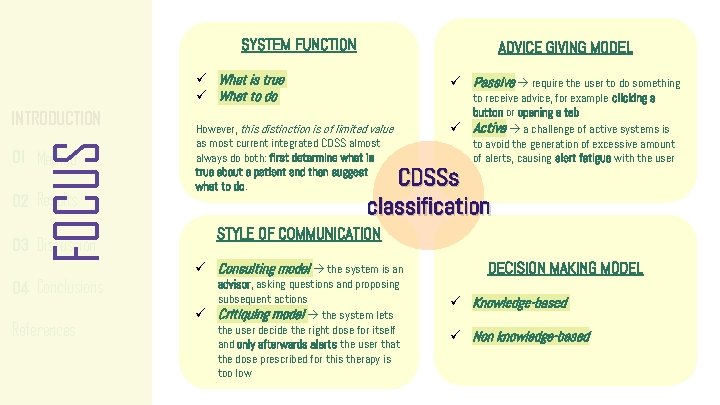
SYSTEM FUNCTION FOCUS INTRODUCTION 01 Method 02 Results ü What is true ü What to do ü Passive require the user to do something However, this distinction is of limited value as most current integrated CDSS almost always do both: first determine what is true about a patient and then suggest what to do. ü References to receive advice, for example clicking a button or opening a tab Active a challenge of active systems is to avoid the generation of excessive amount of alerts, causing alert fatigue with the user CDSSs classification STYLE OF COMMUNICATION 03 Discussion 04 Conclusions ADVICE GIVING MODEL ü Consulting model the system is an ü advisor, asking questions and proposing subsequent actions Critiquing model the system lets the user decide the right dose for itself and only afterwards alerts the user that the dose prescribed for this therapy is too low DECISION MAKING MODEL ü Knowledge-based ü Non knowledge-based
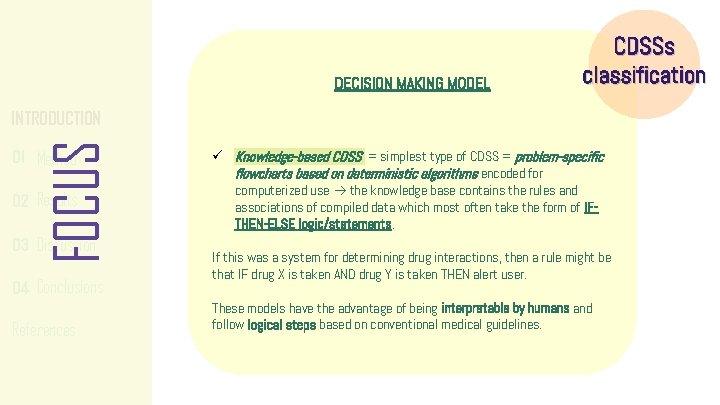
DECISION MAKING MODEL CDSSs classification FOCUS INTRODUCTION 01 Method 02 Results 03 Discussion 04 Conclusions References ü Knowledge-based CDSS = simplest type of CDSS = problem-specific flowcharts based on deterministic algorithms encoded for computerized use the knowledge base contains the rules and associations of compiled data which most often take the form of IFTHEN-ELSE logic/statements. If this was a system for determining drug interactions, then a rule might be that IF drug X is taken AND drug Y is taken THEN alert user. These models have the advantage of being interpretable by humans and follow logical steps based on conventional medical guidelines.
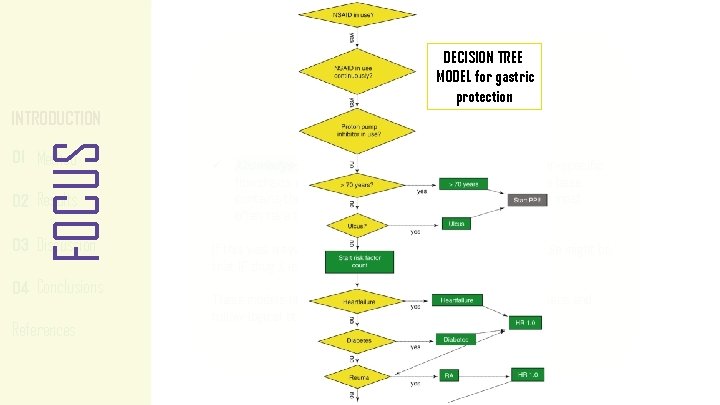
DECISION TREE MODEL for gastric DECISION MAKING MODEL protection FOCUS INTRODUCTION 01 Method 02 Results 03 Discussion 04 Conclusions References ü Knowledge-based CDSS = simplest type of CDSS = problem-specific flowcharts encoded for computerized use the knowledge base contains the rules and associations of compiled data which most often take the form of IF-THEN-ELSE logic/statements. If this was a system for determining drug interactions, then a rule might be that IF drug X is taken AND drug Y is taken THEN alert user. These models have the advantage of being interpretable by humans and follow logical steps based on conventional medical guidelines.
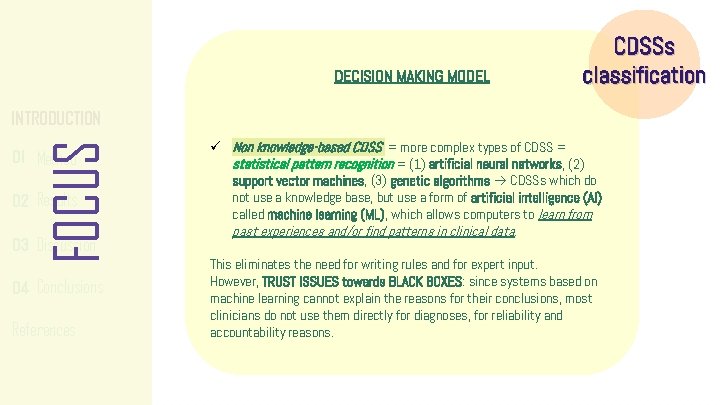
DECISION MAKING MODEL CDSSs classification FOCUS INTRODUCTION 01 Method 02 Results 03 Discussion 04 Conclusions References ü Non knowledge-based CDSS = more complex types of CDSS = statistical pattern recognition = (1) artificial neural networks, (2) support vector machines, (3) genetic algorithms CDSSs which do not use a knowledge base, but use a form of artificial intelligence (AI) called machine learning (ML), which allows computers to learn from past experiences and/or find patterns in clinical data. This eliminates the need for writing rules and for expert input. However, TRUST ISSUES towards BLACK BOXES: since systems based on machine learning cannot explain the reasons for their conclusions, most clinicians do not use them directly for diagnoses, for reliability and accountability reasons.
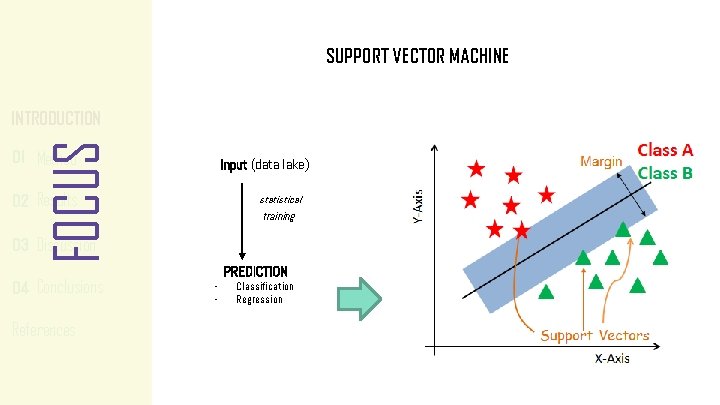
SUPPORT VECTOR MACHINE DECISION MAKING MODEL CDSSs classification FOCUS INTRODUCTION 01 Method 02 Results 03 Discussion 04 Conclusions References ü Non knowledge-based CDSS = more complex types of CDSS = artificial Input (data lake) neural networks, support vector machines, genetic algorithms CDSSs which do not use a knowledge base use a form of artificial statistical intelligence (AI) called machine learning (ML), which allows computers training to learn from past experiences and/or find patterns in clinical data. This eliminates the need for writing rules and for expert input. PREDICTION However, TRUST ISSUES towards BLACK BOXES: since systems based on Classification machine learning cannot explain the reasons for their conclusions, most Regression clinicians do not use them directly for diagnoses, for reliability and accountability reasons.
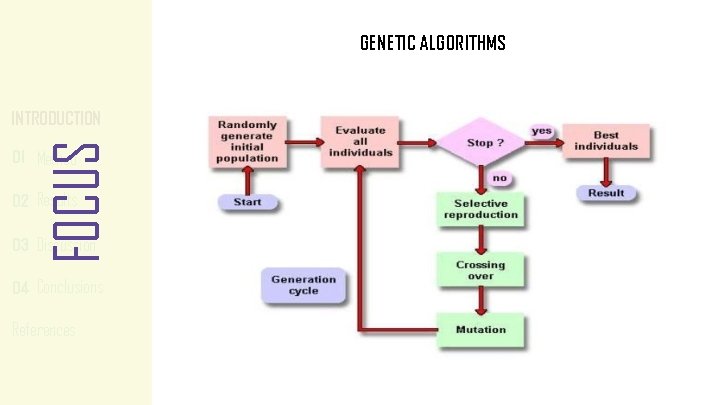
GENETIC ALGORITHMS DECISION MAKING MODEL CDSSs classification FOCUS INTRODUCTION 01 Method 02 Results 03 Discussion 04 Conclusions References ü Non knowledge-based CDSS = more complex types of CDSS = artificial neural networks, support vector machines, genetic algorithms CDSSs which do not use a knowledge base use a form of artificial intelligence (AI) called machine learning (ML), which allows computers to learn from past experiences and/or find patterns in clinical data. This eliminates the need for writing rules and for expert input. However, TRUST ISSUES towards BLACK BOXES: since systems based on machine learning cannot explain the reasons for their conclusions, most clinicians do not use them directly for diagnoses, for reliability and accountability reasons.
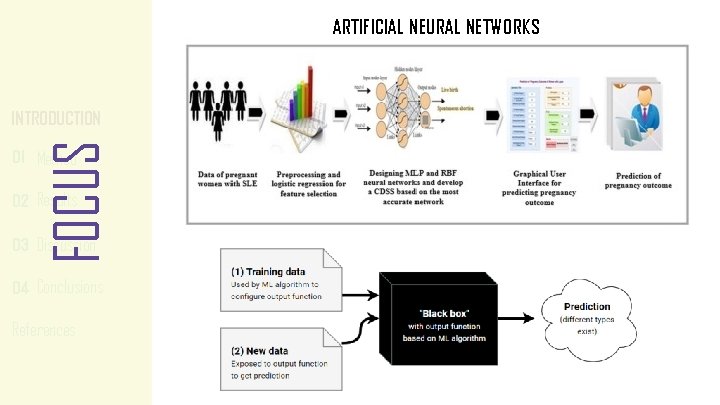
ARTIFICIAL NEURAL NETWORKS DECISION MAKING MODEL CDSSs classification FOCUS INTRODUCTION 01 Method 02 Results 03 Discussion 04 Conclusions References ü Non knowledge-based CDSS = more complex types of CDSS = artificial neural networks, support vector machines, genetic algorithms CDSSs which do not use a knowledge base use a form of artificial intelligence (AI) called machine learning (ML), which allows computers to learn from past experiences and/or find patterns in clinical data. This eliminates the need for writing rules and for expert input. However, TRUST ISSUES towards BLACK BOXES: since systems based on machine learning cannot explain the reasons for their conclusions, most clinicians do not use them directly for diagnoses, for reliability and accountability reasons.
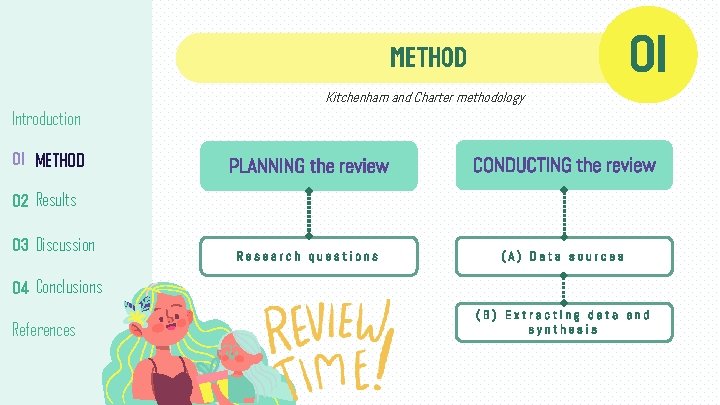
METHOD Kitchenham and Charter methodology 01 Introduction 01 METHOD PLANNING the review CONDUCTING the review Research questions (A) Data sources 02 Results 03 Discussion 04 Conclusions References (B) Extracting data and synthesis
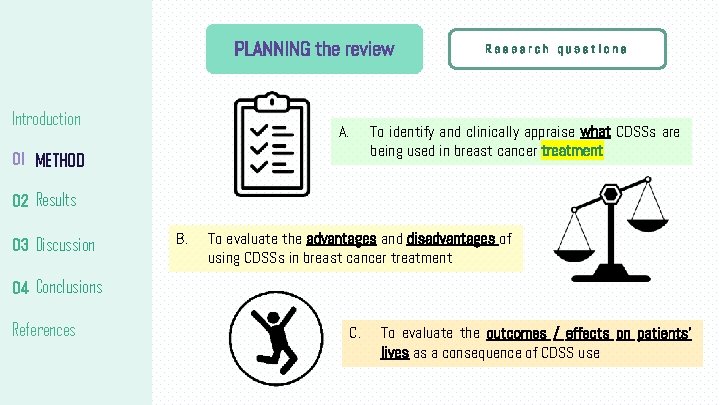
PLANNING the review Introduction A. 01 METHOD Research questions To identify and clinically appraise what CDSSs are being used in breast cancer treatment 02 Results 03 Discussion B. To evaluate the advantages and disadvantages of using CDSSs in breast cancer treatment 04 Conclusions References C. To evaluate the outcomes / effects on patients’ lives as a consequence of CDSS use
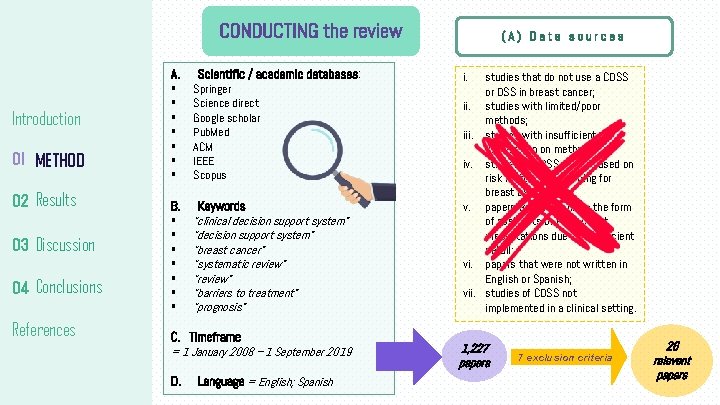
CONDUCTING the review A. Introduction 01 METHOD 02 Results 03 Discussion 04 Conclusions References Scientific / academic databases: § § § § Springer Science direct Google scholar Pub. Med ACM IEEE Scopus B. Keywords “clinical decision support system” “breast cancer” “systematic review” “barriers to treatment” “prognosis” § § § § C. Timeframe = 1 January 2008 – 1 September 2019 D. Language = English; Spanish (A) Data sources i. studies that do not use a CDSS or DSS in breast cancer; ii. studies with limited/poor methods; iii. studies with insufficient information on methods; iv. studies of CDSS that focused on risk factors or screening for breast cancer; v. papers available only in the form of abstracts or Power. Point presentations due to insufficient detail; vi. papers that were not written in English or Spanish; vii. studies of CDSS not implemented in a clinical setting. 1, 227 papers 7 exclusion criteria 26 relevant papers
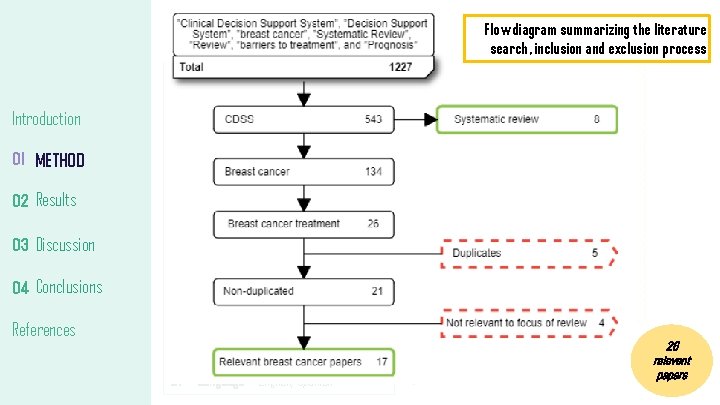
CONDUCTING the review A. Introduction 01 METHOD 02 Results 03 Discussion 04 Conclusions References Scientific / academic databases: § § § § Springer Science direct Google scholar Pub. Med ACM IEEE Scopus B. Keywords “clinical decision support system” “breast cancer” “systematic review” “barriers to treatment” “prognosis” § § § § C. Timeframe = 1 January 2008 – 1 September 2019 D. Language = English; Spanish Flow ( Adiagram ) D a t a summarizing s o u r c e s the literature search, inclusion and exclusion process i. studies that do not use a CDSS or DSS in breast cancer; ii. studies with limited/poor methods; iii. studies with insufficient information on methods; iv. studies of CDSS that focused on risk factors or screening for breast cancer; v. papers available only in the form of abstracts or Power. Point presentations due to insufficient detail; vi. papers that were not written in English or Spanish; vii. studies of CDSS not implemented in a clinical setting. 1, 227 papers 7 exclusion criteria 26 relevant papers
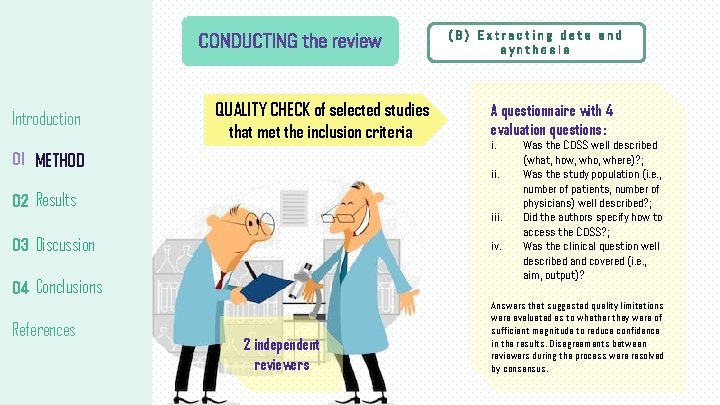
CONDUCTING the review Introduction QUALITY CHECK of selected studies that met the inclusion criteria 01 METHOD A questionnaire with 4 evaluation questions: i. ii. 02 Results iii. 03 Discussion iv. 04 Conclusions References (B) Extracting data and synthesis 2 independent reviewers Was the CDSS well described (what, how, who, where)? ; Was the study population (i. e. , number of patients, number of physicians) well described? ; Did the authors specify how to access the CDSS? ; Was the clinical question well described and covered (i. e. , aim, output)? Answers that suggested quality limitations were evaluated as to whether they were of sufficient magnitude to reduce confidence in the results. Disagreements between reviewers during the process were resolved by consensus.
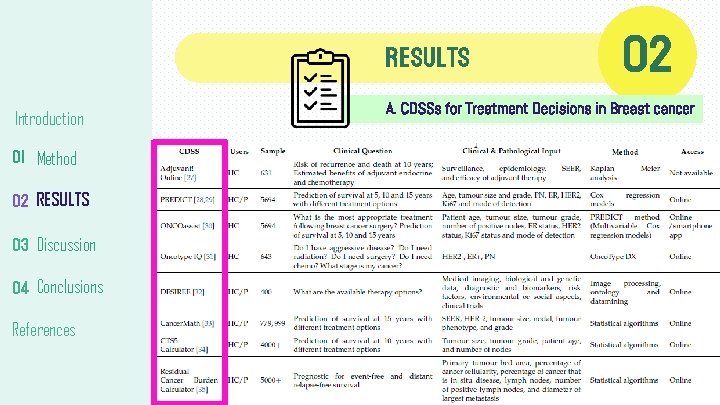
RESULTS Introduction 01 Method 02 RESULTS 03 Discussion 04 Conclusions References 02 A. CDSSs for Treatment Decisions in Breast cancer
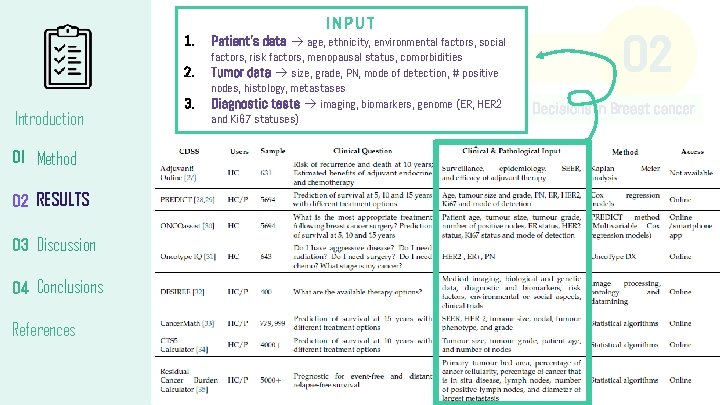
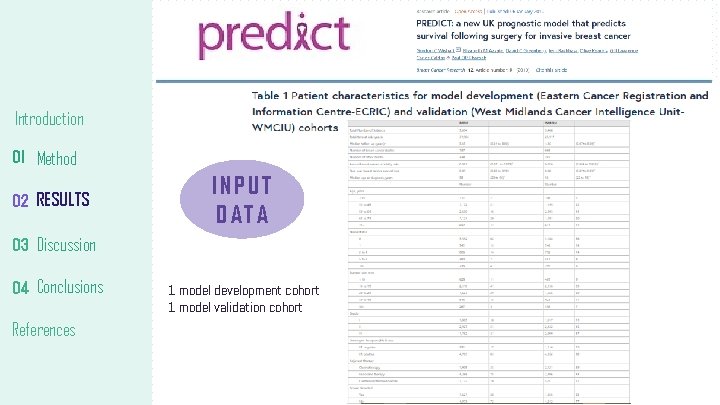
1. 2. Introduction 01 Method 02 RESULTS 03 Discussion 04 Conclusions References 3. INPUT Patient’s data age, ethnicity, environmental factors, social RESULTS factors, risk factors, menopausal status, comorbidities Tumor data size, grade, PN, mode of detection, # positive nodes, histology, metastases Diagnostic tests imaging, biomarkers, genome HER 2 A. CDSSs for(ER, Treatment and Ki 67 statuses) 02 Decisions in Breast cancer
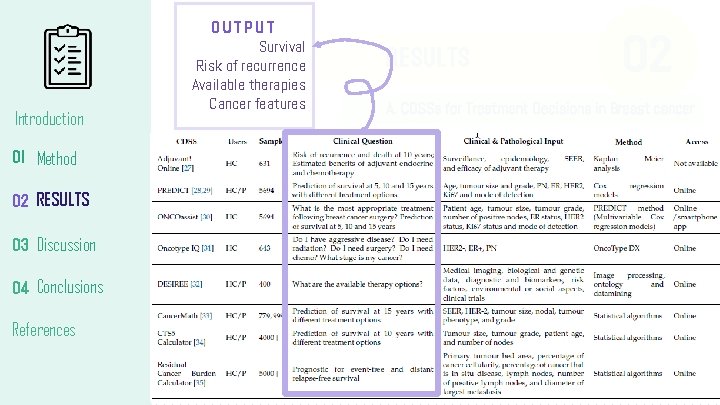
Introduction 01 Method 02 RESULTS 03 Discussion 04 Conclusions References OUTPUT Survival Risk of recurrence Available therapies Cancer features RESULTS 02 A. CDSSs for Treatment Decisions in Breast cancer
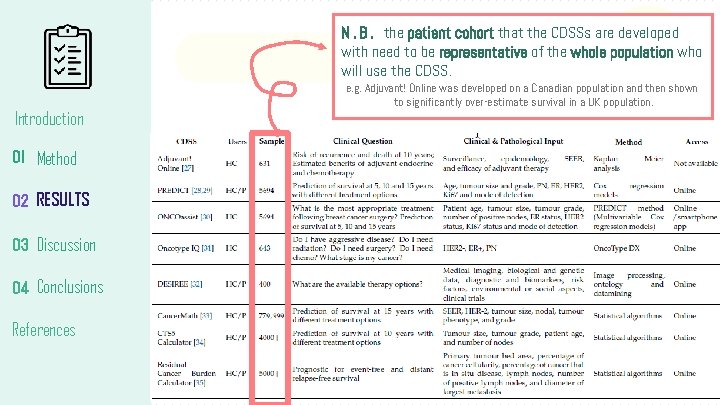
02 N. B. the patient cohort that the CDSSs are developed with need to be representative of the whole population who will use the CDSS. RESULTS Introduction 01 Method 02 RESULTS 03 Discussion 04 Conclusions References e. g. Adjuvant! Online was developed on a Canadian population and then shown to significantly over-estimate survival in a UK population. A. CDSSs for Treatment Decisions in Breast cancer
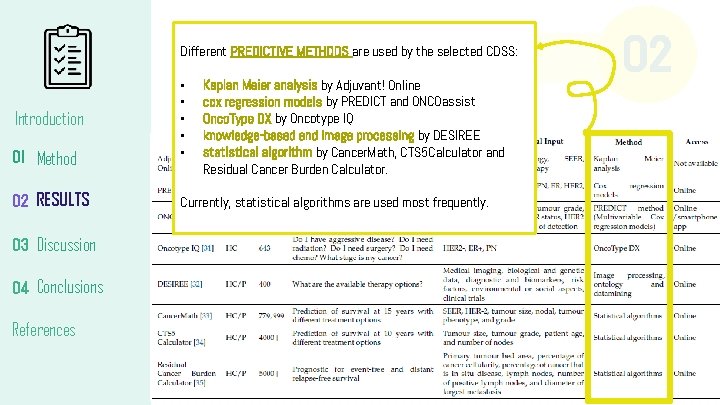
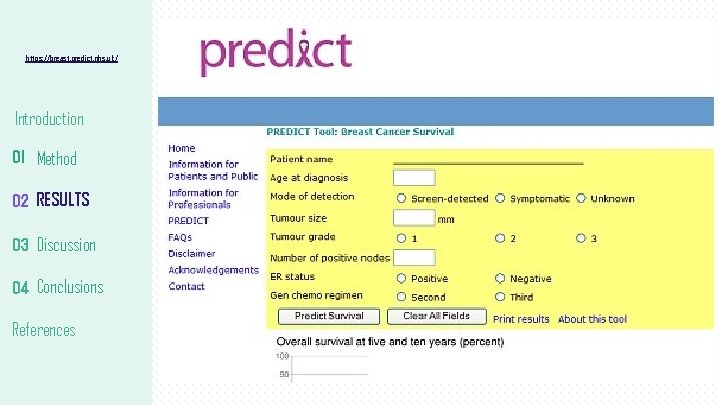
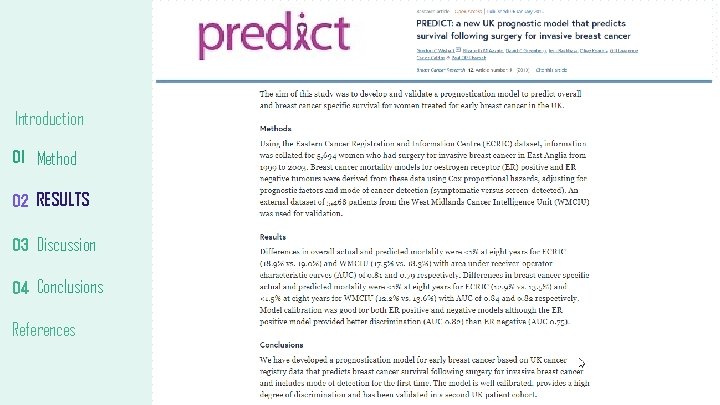
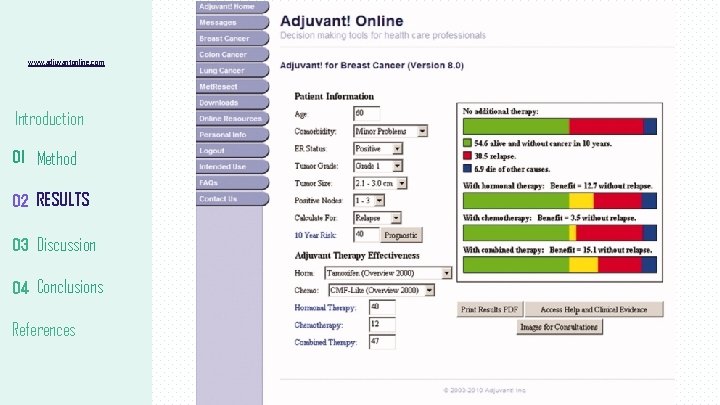
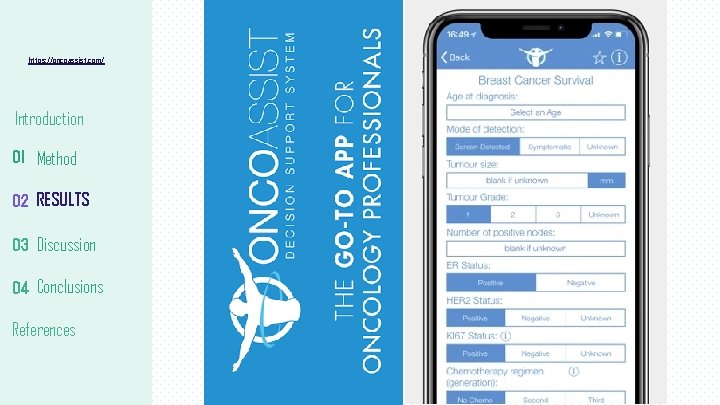
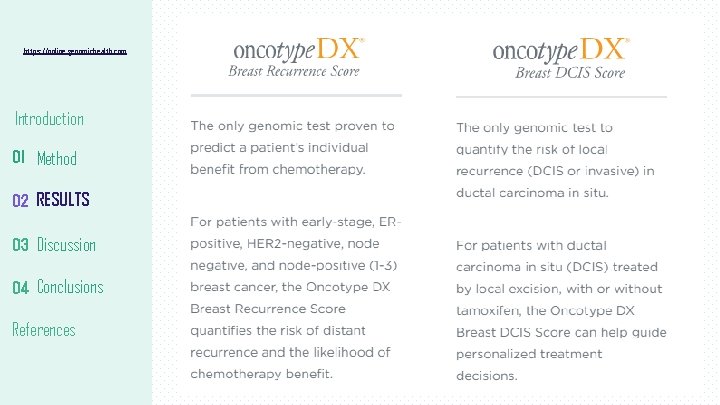
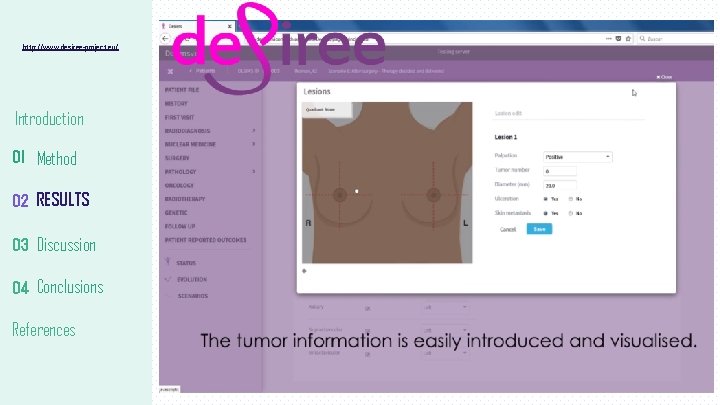
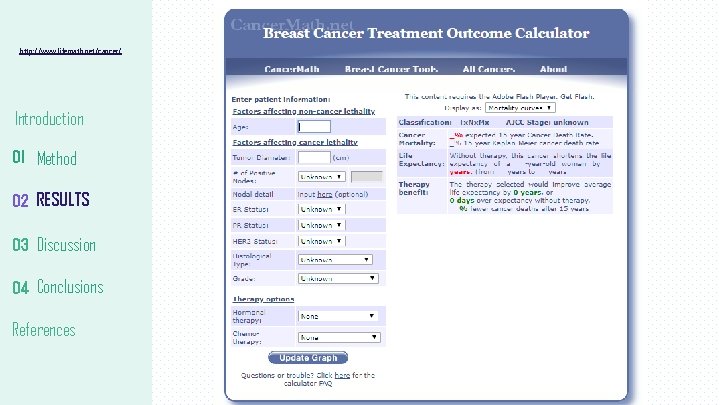
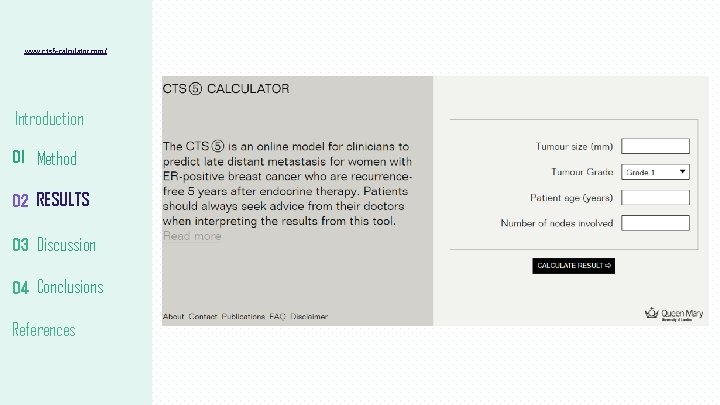
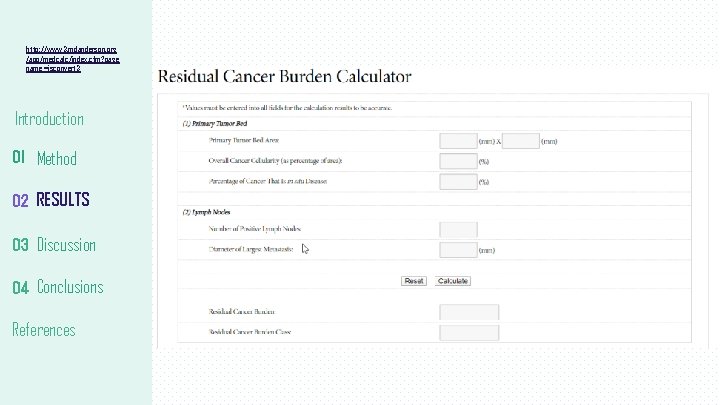
RESULTS Different PREDICTIVE METHODS are used by the selected CDSS: Introduction 01 Method 02 RESULTS 03 Discussion 04 Conclusions References • • • Kaplan Meier analysis by Adjuvant! Online cox regression models by PREDICT and ONCOassist Onco. Type DX by Oncotype IQ knowledge-based and image processing by DESIREE statistical algorithm by Cancer. Math, CTS 5 Calculator and Residual Cancer Burden Calculator. Currently, statistical algorithms are used most frequently. 02
https: //breast. predict. nhs. uk/ Introduction 01 Method 02 RESULTS 03 Discussion 04 Conclusions References
Introduction 01 Method 02 RESULTS INPUT DATA 03 Discussion 04 Conclusions References 1 model development cohort 1 model validation cohort
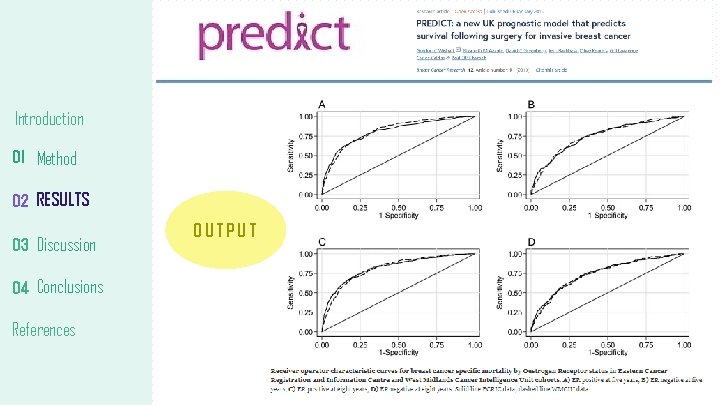
Introduction 01 Method 02 RESULTS 03 Discussion 04 Conclusions References OUTPUT
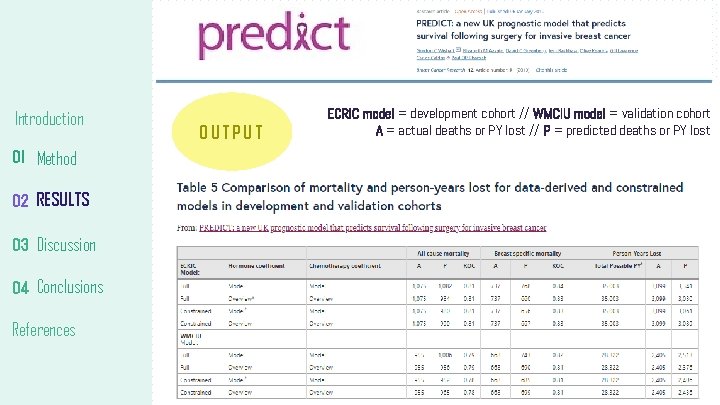
Introduction 01 Method 02 RESULTS 03 Discussion 04 Conclusions References OUTPUT ECRIC model = development cohort // WMCIU model = validation cohort A = actual deaths or PY lost // P = predicted deaths or PY lost
Introduction 01 Method 02 RESULTS 03 Discussion 04 Conclusions References
www. adjuvantonline. com Introduction 01 Method 02 RESULTS 03 Discussion 04 Conclusions References
https: //oncoassist. com/ Introduction 01 Method 02 RESULTS 03 Discussion 04 Conclusions References
https: //online. genomichealth. com Introduction 01 Method 02 RESULTS 03 Discussion 04 Conclusions References
http: //www. desiree-project. eu/ Introduction 01 Method 02 RESULTS 03 Discussion 04 Conclusions References DESIREE • • PURPOSE: INPUT: • OUTPUT: • Widely used tool by physicians due to its ease of use and access
http: //www. lifemath. net/cancer/ Introduction 01 Method 02 RESULTS 03 Discussion 04 Conclusions References
www. cts 5 -calculator. com/ Introduction 01 Method 02 RESULTS 03 Discussion 04 Conclusions References
http: //www 3. mdanderson. org /app/medcalc/index. cfm? page name=jsconvert 3 Introduction 01 Method 02 RESULTS 03 Discussion 04 Conclusions References
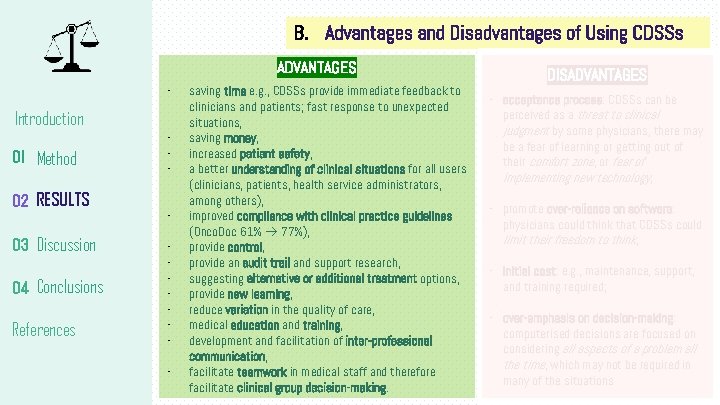
B. Advantages and Disadvantages of Using CDSSs ADVANTAGES - Introduction 01 Method 02 RESULTS 03 Discussion 04 Conclusions References - saving time e. g. , CDSSs provide immediate feedback to clinicians and patients; fast response to unexpected situations, saving money, increased patient safety, a better understanding of clinical situations for all users (clinicians, patients, health service administrators, among others), improved compliance with clinical practice guidelines (Onco. Doc 61% 77%), provide control, provide an audit trail and support research, suggesting alternative or additional treatment options, provide new learning, reduce variation in the quality of care, medical education and training, development and facilitation of inter-professional communication, facilitate teamwork in medical staff and therefore facilitate clinical group decision-making. DISADVANTAGES - acceptance process: CDSSs can be perceived as a threat to clinical judgment by some physicians, there may be a fear of learning or getting out of their comfort zone, or fear of implementing new technology; - promote over-reliance on software: physicians could think that CDSSs could limit their freedom to think; - initial cost: e. g. , maintenance, support, and training required; - over-emphasis on decision-making: computerised decisions are focused on considering all aspects of a problem all the time, which may not be required in many of the situations
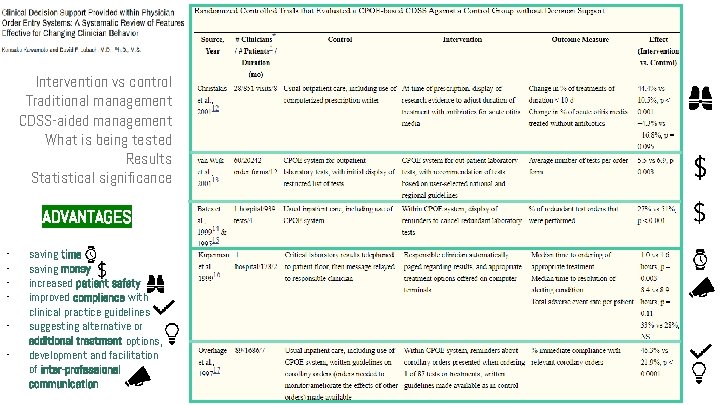
B. Advantages and Disadvantages of Using CDSSs Intervention vs control Traditional management. Introduction CDSS-aided management What is being tested 01 Method Results. Statistical significance 02 RESULTS ADVANTAGES 03 Discussion saving time saving money increased patient safety Conclusions 04 improved compliance with clinical practice guidelines - References suggesting alternative or additional treatment options, development and facilitation of inter-professional communication - ADVANTAGES saving time e. g. , CDSSs provide immediate feedback to clinicians and patients; fast response to unexpected situations, saving money, a better understanding of clinical situations for all users (clinicians, patients, health service administrators, among others), improved compliance with clinical practice guidelines (Onco. Doc 61% 77%), provide control, provide an audit trail and support research, suggesting alternative or additional treatment options, provide new learning, reduce variation in the quality of care, medical education and training, development and facilitation of inter-professional communication, facilitate teamwork in medical staff and therefore facilitate clinical group decision-making. DISADVANTAGES - acceptance process: CDSSs can be perceived as a threat to clinical judgment by some physicians, there may be a fear of learning or getting out of their comfort zone, or fear of implementing new technology; - promote over-reliance on software: physicians could think that CDSSs could limit their freedom to think; - initial cost: e. g. , maintenance, support, and training required; - over-emphasis on decision-making: computerised decisions are focused on considering all aspects of a problem all the time, which may not be required in many of the situations
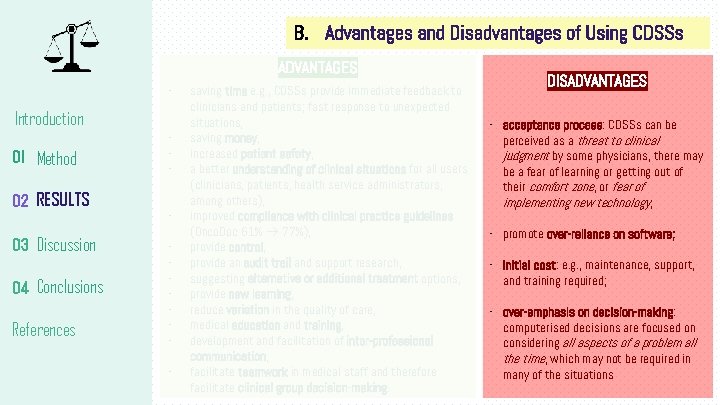
B. Advantages and Disadvantages of Using CDSSs ADVANTAGES - Introduction 01 Method 02 RESULTS 03 Discussion 04 Conclusions References - saving time e. g. , CDSSs provide immediate feedback to clinicians and patients; fast response to unexpected situations, saving money, increased patient safety, a better understanding of clinical situations for all users (clinicians, patients, health service administrators, among others), improved compliance with clinical practice guidelines (Onco. Doc 61% 77%), provide control, provide an audit trail and support research, suggesting alternative or additional treatment options, provide new learning, reduce variation in the quality of care, medical education and training, development and facilitation of inter-professional communication, facilitate teamwork in medical staff and therefore facilitate clinical group decision-making. DISADVANTAGES - acceptance process: CDSSs can be perceived as a threat to clinical judgment by some physicians, there may be a fear of learning or getting out of their comfort zone, or fear of implementing new technology; - promote over-reliance on software; - initial cost: e. g. , maintenance, support, and training required; - over-emphasis on decision-making: computerised decisions are focused on considering all aspects of a problem all the time, which may not be required in many of the situations
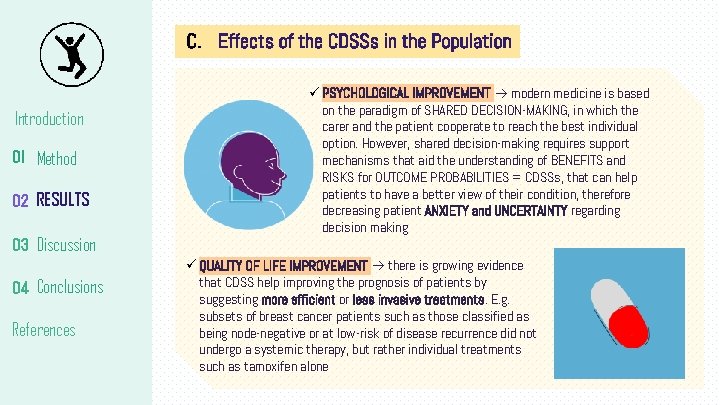
C. Effects of the CDSSs in the Population Introduction 01 Method 02 RESULTS 03 Discussion 04 Conclusions References ü PSYCHOLOGICAL IMPROVEMENT modern medicine is based on the paradigm of SHARED DECISION-MAKING, in which the carer and the patient cooperate to reach the best individual option. However, shared decision-making requires support mechanisms that aid the understanding of BENEFITS and RISKS for OUTCOME PROBABILITIES = CDSSs, that can help patients to have a better view of their condition, therefore decreasing patient ANXIETY and UNCERTAINTY regarding decision making ü QUALITY OF LIFE IMPROVEMENT there is growing evidence that CDSS help improving the prognosis of patients by suggesting more efficient or less invasive treatments. E. g. subsets of breast cancer patients such as those classified as being node-negative or at low-risk of disease recurrence did not undergo a systemic therapy, but rather individual treatments such as tamoxifen alone
Discussion Introduction 01 Method Breast cancer is such a heterogeneous condition in its features and outcomes, that it requires a more systematic and organic / holistic approach as for what regards available therapies. CDSSs represent such approach. 02 Results 03 DISCUSSION 04 Conclusions References 03 8 CDS systems were thoroughly analyzed in their features, like the type of input they require and the output they generate to provide the user (clinician / patient) with useful clinical information in the context of treatment decision making for breast cancer patients.
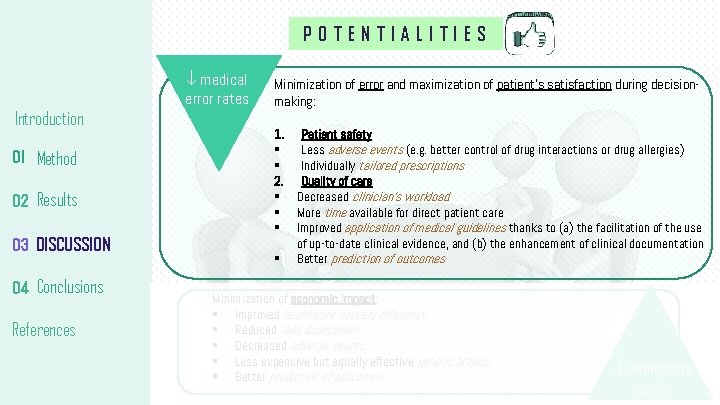
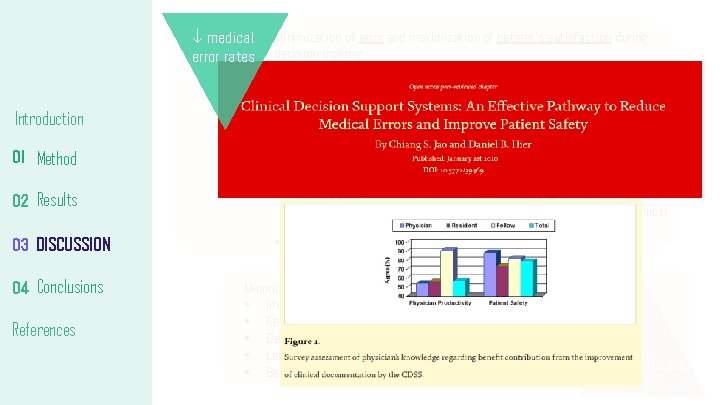
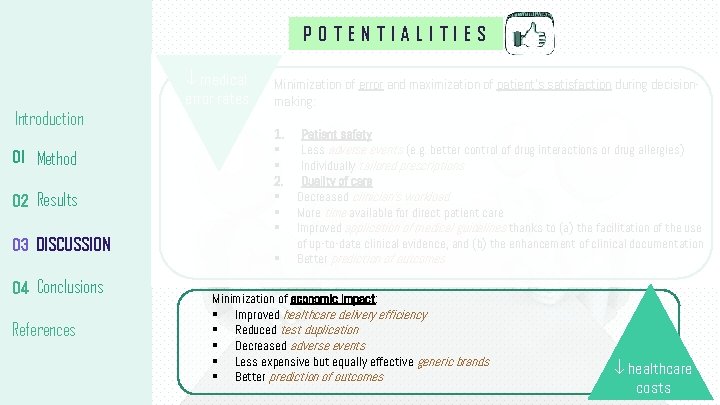
POTENTIALITIES medical error rates Introduction 01 Method 02 Results 03 DISCUSSION 04 Conclusions References Minimization of error and maximization of patient’s satisfaction during decisionmaking: 1. Patient safety § Less adverse events (e. g. better control of drug interactions or drug allergies) § Individually tailored prescriptions 2. Quality of care § Decreased clinician’s workload § More time available for direct patient care § Improved application of medical guidelines thanks to (a) the facilitation of the use of up-to-date clinical evidence, and (b) the enhancement of clinical documentation § Better prediction of outcomes Minimization of economic impact: § Improved healthcare delivery efficiency § Reduced test duplication § Decreased adverse events § Less expensive but equally effective generic brands § Better prediction of outcomes healthcare costs
medical error rates Introduction 01 Method 02 Results 03 DISCUSSION 04 Conclusions References Minimization of error and maximization of patient’s satisfaction during decision-making: 1. § Patient safety Less adverse events (e. g. better control of drug interactions or drug allergies) IER tailored prescriptions L § AIndividually R E Sof. IScare 2. Quality O N G A § DIDecreased clinician’s workload SURVEILLANCE / § More time available for direct patient care § Improved application of medical guidelines. FOLLOW-UP thanks to (a) the facilitation of the use of up-to-date clinical evidence, and (b) the enhancement of clinical documentation § Better prediction of outcomes Minimization of economic impact: § Improved healthcare delivery efficiency § Reduced test duplication § Decreased adverse events § Less expensive but equally effective generic brands § Better prediction of outcomes healthcare costs
POTENTIALITIES medical error rates Introduction 01 Method 02 Results 03 DISCUSSION 04 Conclusions References Minimization of error and maximization of patient’s satisfaction during decisionmaking: 1. Patient safety § Less adverse events (e. g. better control of drug interactions or drug allergies) § Individually tailored prescriptions 2. Quality of care § Decreased clinician’s workload § More time available for direct patient care § Improved application of medical guidelines thanks to (a) the facilitation of the use of up-to-date clinical evidence, and (b) the enhancement of clinical documentation § Better prediction of outcomes Minimization of economic impact: § Improved healthcare delivery efficiency § Reduced test duplication § Decreased adverse events § Less expensive but equally effective generic brands § Better prediction of outcomes healthcare costs
Minimization of error and maximization of patient’s satisfaction during decision-making: Introduction 01 Method 02 Results 03 DISCUSSION 04 Conclusions References 1. § Patient safety Less adverse events (e. g. better control of drug interactions or drug allergies) IER tailored prescriptions L § AIndividually R E Sof. IScare 2. Quality O N G A § DIDecreased clinician’s workload SURVEILLANCE / § More time available for direct patient care § Improved application of medical guidelines. FOLLOW-UP thanks to (a) the facilitation of the use of up-to-date clinical evidence, and (b) the enhancement of clinical documentation § Better prediction of outcomes Minimization of economic impact: § Improved healthcare delivery efficiency § Reduced test duplication § Decreased adverse events § Less expensive but equally effective generic brands § Better prediction of outcomes healthcare costs
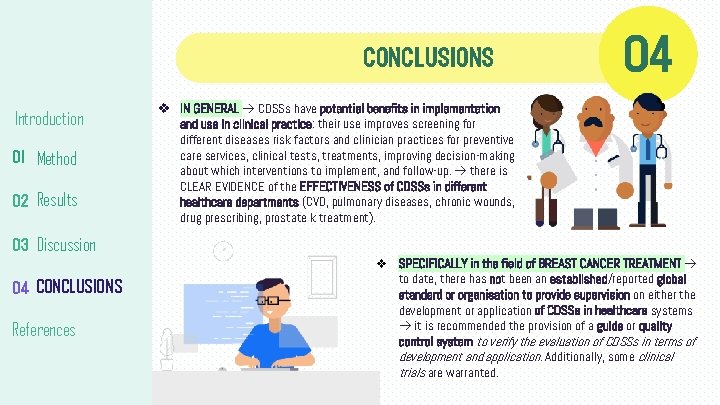
Conclusions Introduction 01 Method 02 Results 03 Discussion 04 CONCLUSIONS References 04 v IN GENERAL CDSSs have potential benefits in implementation and use in clinical practice: their use improves screening for different diseases risk factors and clinician practices for preventive care services, clinical tests, treatments, improving decision-making about which interventions to implement, and follow-up. there is CLEAR EVIDENCE of the EFFECTIVENESS of CDSSs in different healthcare departments (CVD, pulmonary diseases, chronic wounds, drug prescribing, prostate k treatment). v SPECIFICALLY in the field of BREAST CANCER TREATMENT to date, there has not been an established/reported global standard or organisation to provide supervision on either the development or application of CDSSs in healthcare systems it is recommended the provision of a guide or quality control system to verify the evaluation of CDSSs in terms of development and application. Additionally, some clinical trials are warranted.
FUTURE WORK 04 Introduction 01 Method 02 Results 03 Discussion 04 CONCLUSIONS References v INPUT DATA NOWADAYS medical imaging data, biological and genomic data, diagnostic tests and biomarkers, risk factors, social aspects, clinical trials, tumor characteristics, patient’s age and gender. v INPUT DATA IN THE FUTURE environmental data and lifestyle risk factors to provide more accurate and personalised treatment decision for breast cancer patients; other relevant variables such as ovarian suppression for premenopausal women, new genomic test results, ER or PR status, co-morbidities, the result of extended endocrine therapy, adjuvant bisphonates in postmenopausal women. This point should be considered as part of a CDSS flexible to emergent data.
REFERENCES • MAIN PAPER Introduction Mazo, C. ; Kearns, C. ; Mooney, C. ; Gallagher, W. M. Clinical Decision Support Systems in Breast Cancer: A Systematic Review. Cancers 2020, 12, 369. 02 Results 03 Discussion 04 Conclusions REFERENCES CDDSs for BREAST CANCER TREATMENT 01 Method • Shachar, S. S. ; Muss, H. B. Internet tools to enhance breast cancer care. Npj Breast Cancer 2016, 2, 1– 4. • Wishart, G. C. ; Azzato, E. M. ; Greenberg, D. C. ; Rashbass, J. ; Kearins, O. ; Lawrence, G. ; Caldas, C. ; Pharoah, P. D. PREDICT: A new UK prognostic model that predicts survival following surgery for invasive breast cancer. Breast Cancer Res. 2010, 12, R 1. • Cuzick, J. ; Sestak, I. ; Baum, M. ; Buzdar, A. ; Howell, A. ; Dowsett, M. ; Forbes, J. F. Effect of anastrozole and tamoxifen as adjuvant treatment for early-stage breast cancer: 10 -year analysis of the ATAC trial. Lancet Oncol. 2010, 1135– 1141.
Introduction • 01 Method • 02 Results 03 Discussion 04 Conclusions REFERENCES • • • Kawamoto, K. ; Lobach, D. F. Clinical decision support provided within physician order entry systems: A systematic review of features effective for changing clinician behavior. AMIA Annu. Symp. Proc. 2003, 361. Jao, C. S. ; Hier, D. B. Clinical Decision Support Systems: An Effective Pathway to Reduce Medical Errors and Improve Patient Safety. In Decision Support Systems; Jao, C. S. , Ed. ; Intech. Open: Rijeka, Croatia, 2010; Chapter 8. Mollon, B. ; Chong, J. J. ; Holbrook, A. M. ; Sung, M. ; Thabane, L. ; Foster, G. Features predicting the success of computerized decision support for prescribing: A systematic review of randomized controlled trials. BMC Med. Inform. Decis. Mak. 2009, 9, 1– 9. Ajami S, A. F. Reduce Medication Errors with Clinical Decision Support Systems. J. Inf. Technol. Soft Eng. 2013, 7, 1– 2. Wasylewicz ATM, Scheepers-Hoeks AMJW. Clinical Decision Support Systems. 2018 Dec 22. In: Kubben P, Dumontier M, Dekker A, editors. Fundamentals of Clinical Data Science [Internet]. Cham (CH): Springer; 2019. Chapter 11. Available from: https: //www. ncbi. nlm. nih. gov/books/NBK 543516/ Sutton, R. T. , Pincock, D. , Baumgart, D. C. et al. An overview of clinical decision support systems: benefits, risks, and strategies for success. npj Digit. Med. 3, 17 (2020). https: //doi. org/10. 1038/s 41746 -020 -0221 -y CDDSs IN DIFFERENT HEALTHCARE SETTINGS •
THANK YOU! A presentation by Angela Ferrari