Decision Support Systems an introduction to DSS with
- Slides: 54
Decision Support Systems an introduction to DSS with environmental application examples 2 © K. Fedra 20004
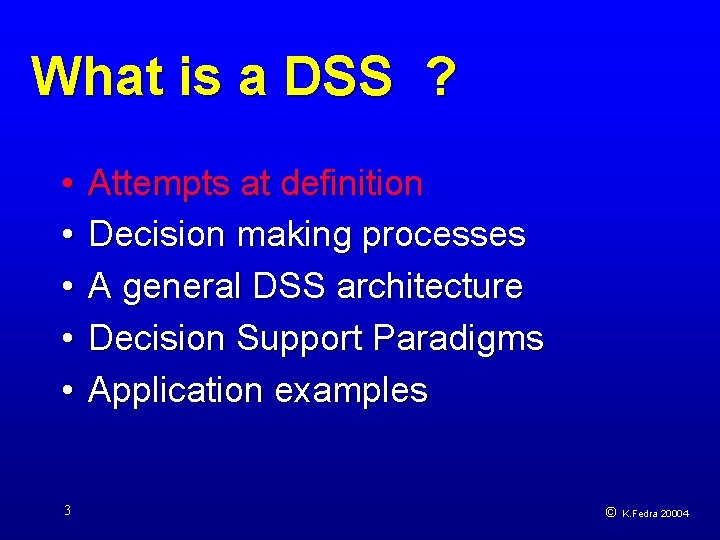
What is a DSS ? • • • 3 Attempts at definition Decision making processes A general DSS architecture Decision Support Paradigms Application examples © K. Fedra 20004
DSS Definition A DSS is a computer based problem solving system that assists choice between alternatives in complex and controversial domains. 4 © K. Fedra 20004
DSS Definition Problem solving: Problem: when the observed or perceived (expected) state of a system differs from the expectations, norms, goals. If the expectation is optimisation (maximisation, growth) we always have a problem (more than yesterday, more than others) 5 © K. Fedra 20004
DSS Definition A DSS provides • structured presentation • problem context, • and tools for the – design, – evaluation, – selection of alternatives 6 © K. Fedra 20004
What is a DSS ? • Attempts at definition • Decision making processes • • • 7 A general DSS architecture Decision Support Paradigms Application examples © K. Fedra 20004
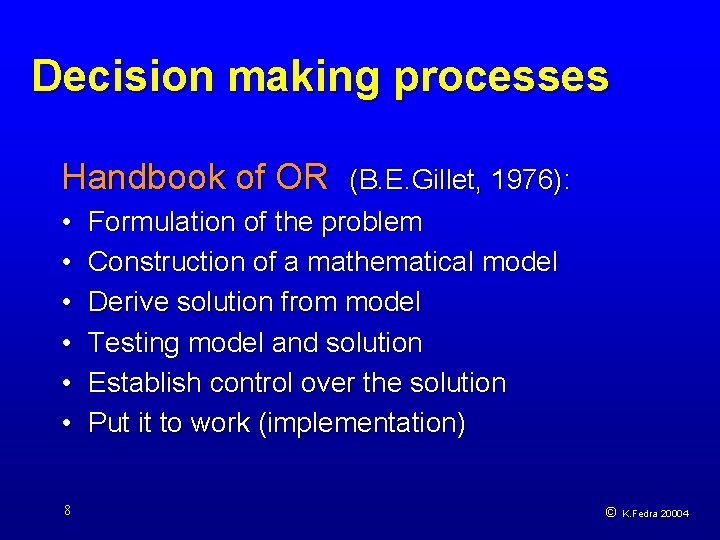
Decision making processes Handbook of OR • • • 8 (B. E. Gillet, 1976): Formulation of the problem Construction of a mathematical model Derive solution from model Testing model and solution Establish control over the solution Put it to work (implementation) © K. Fedra 20004
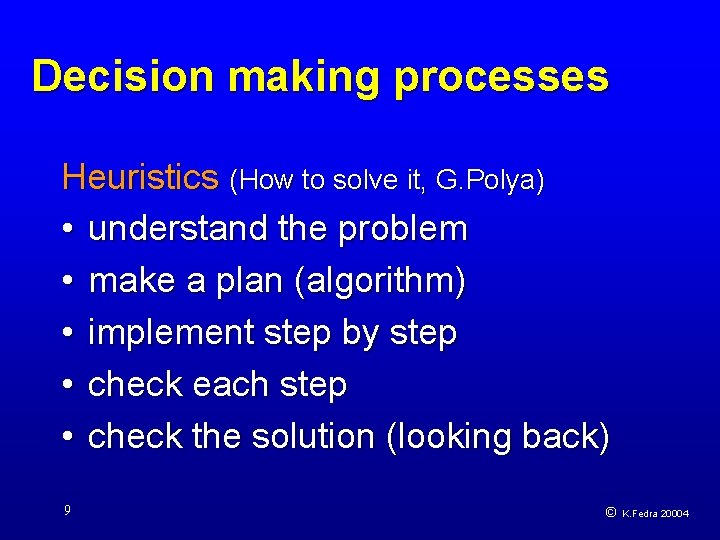
Decision making processes Heuristics (How to solve it, G. Polya) • understand the problem • make a plan (algorithm) • implement step by step • check each step • check the solution (looking back) 9 © K. Fedra 20004
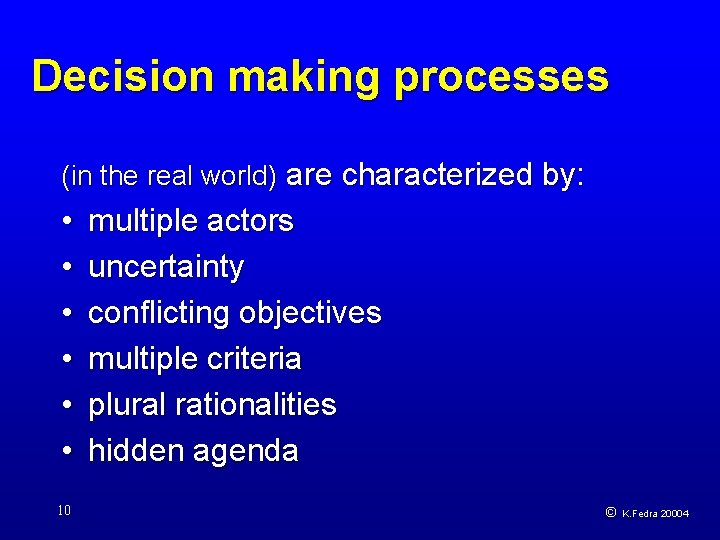
Decision making processes (in the real world) are characterized by: • • • 10 multiple actors uncertainty conflicting objectives multiple criteria plural rationalities hidden agenda © K. Fedra 20004
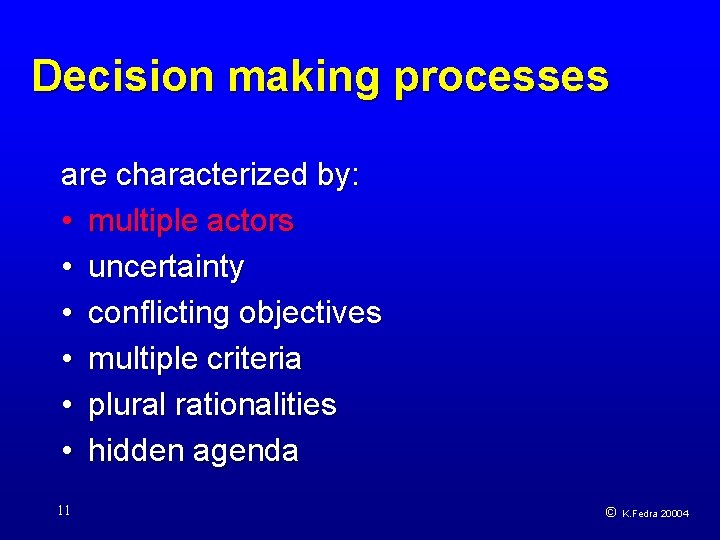
Decision making processes are characterized by: • multiple actors • uncertainty • conflicting objectives • multiple criteria • plural rationalities • hidden agenda 11 © K. Fedra 20004
Decision making processes multiple actors: • researchers and analysts • planners and managers • policy and decision makers • general public: • consumers (market) • concerned citizen (voters) 12 © K. Fedra 20004
Decision making processes are characterized by: • multiple actors • uncertainty • conflicting objectives • multiple criteria • plural rationalities • hidden agenda 13 © K. Fedra 20004
Decision making processes Uncertainty: All elements are “uncertain”: • Criteria, • Objectives, • Constraints 14 © K. Fedra 20004
Decision making processes are characterized by: • multiple actors • uncertainty • conflicting objectives • multiple criteria • plural rationalities • hidden agenda 15 © K. Fedra 20004
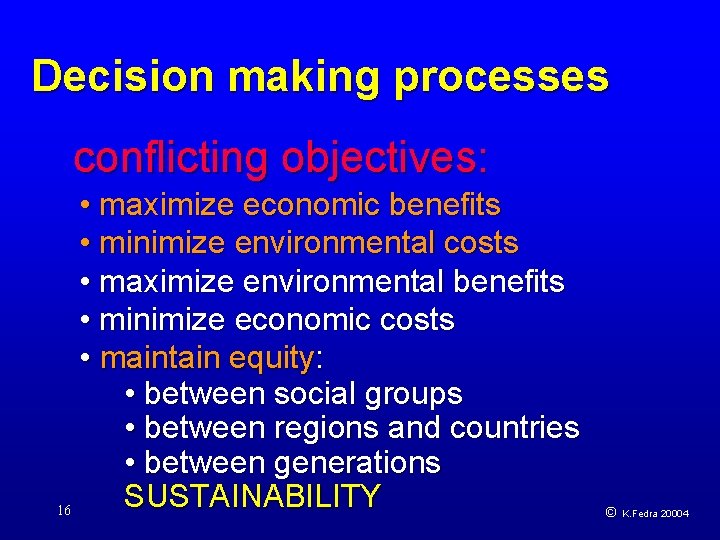
Decision making processes conflicting objectives: • maximize economic benefits • minimize environmental costs • maximize environmental benefits • minimize economic costs • maintain equity: • between social groups • between regions and countries • between generations SUSTAINABILITY 16 © K. Fedra 20004
Decision making processes are characterized by: • multiple actors • uncertainty • conflicting objectives • multiple criteria • plural rationalities • hidden agenda 17 © K. Fedra 20004
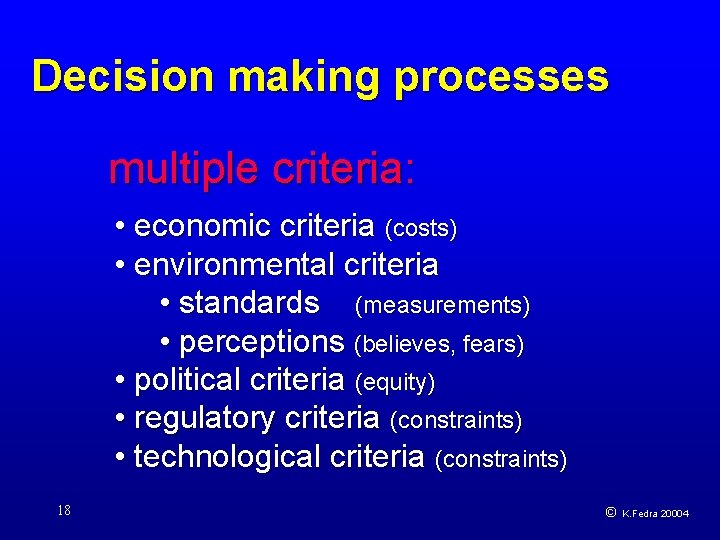
Decision making processes multiple criteria: • economic criteria (costs) • environmental criteria • standards (measurements) • perceptions (believes, fears) • political criteria (equity) • regulatory criteria (constraints) • technological criteria (constraints) 18 © K. Fedra 20004
Decision making processes are characterized by: • multiple actors • uncertainty • conflicting objectives • multiple criteria • plural rationalities • hidden agenda 19 © K. Fedra 20004
Decision making processes plural rationalities rational: relating to, based on, agreeable to reason: the power of inferring, comprehending, or thinking in an orderly, rational way. 20 © K. Fedra 20004
Decision making processes plural rationalities rational: L. ratio (reor, reri, ratus) computation, advantage, interest, behavior, procedure, ways and means, motivation, argument, proof, opinion, (scientific) theory. 21 © K. Fedra 20004
Decision making processes plural rationalities reaching different (contradictory) conclusions from the same set of premises in an internally consistent logical way. 22 © K. Fedra 20004
Decision making processes are characterized by: • multiple actors • uncertainty • conflicting objectives • multiple criteria • plural rationalities • hidden agenda 23 © K. Fedra 20004
Decision making processes Hidden agenda: Not all objectives of all actors are disclosed. Proclaim one (popular) objective to reach another, different (and not disclosed, less popular or acceptable) objective. 24 © K. Fedra 20004
A general DSS architecture • Information resources • The analytical engine • The user interface 25 © K. Fedra 20004
Information Resources • information on the status-quo (monitoring) • background for the identification or design of decision alternatives 26 © K. Fedra 20004
The analytical engine • • • 27 Data base management system Geographic Information System Simulation and optimization models Expert systems (rules) Decision Support tools proper © K. Fedra 20004
The User Interface • interactive, dialogue oriented, menu driven, intuitive, graphical, symbolic • consistent syntax and semantics, layout and symbolism, intelligent, context aware, customized • also includes organizational issues (e. g. , for workshops, presentations, hearings) group dynamics, communication ALL SCIENCE IS PROPAGANDA (P. Feyerabend) 28 © K. Fedra 20004
Decision support paradigms • Information systems • Scenario analysis WHAT IF • Rational maximization HOW TO • Multiple attributes 29 © K. Fedra 20004
Decision support paradigms • Information systems • Scenario analysis WHAT IF • Rational maximization HOW TO • Multiple attributes 30 © K. Fedra 20004
Information systems • provide problem context • describe available alternatives • offer a common language and shared information basis for the participants in the decision making process 31 © K. Fedra 20004
Information systems typical application example: State-of-the-Environment Reporting decision process usually diffuse, multi-stage and lengthy without clear technical objectives. Public information, awareness building, assists argumentation. 32 © K. Fedra 20004
Decision support paradigms • Information systems • Scenario analysis WHAT IF • Rational maximization HOW TO • Multiple attributes 33 © K. Fedra 20004
Decision support paradigms Scenario analysis explores the reaction of a system to changes in the control or decision variables on the performance variables (criteria) in terms of the objectives and constraints of the decision problem. 34 © K. Fedra 20004
Decision support paradigms Scenario from L. scaenarium, the stage an account or synopsis of a projected course of action or events; a set of assumptions. 35 © K. Fedra 20004
Decision support paradigms typical application example: Environmental Impact Assessment, that evaluates and compares project alternatives. Exploratory (policy) assessment, design of alternatives. 36 © K. Fedra 20004
Decision support paradigms • Information systems • Scenario analysis WHAT IF • Rational maximization HOW TO • Multiple attributes 37 © K. Fedra 20004
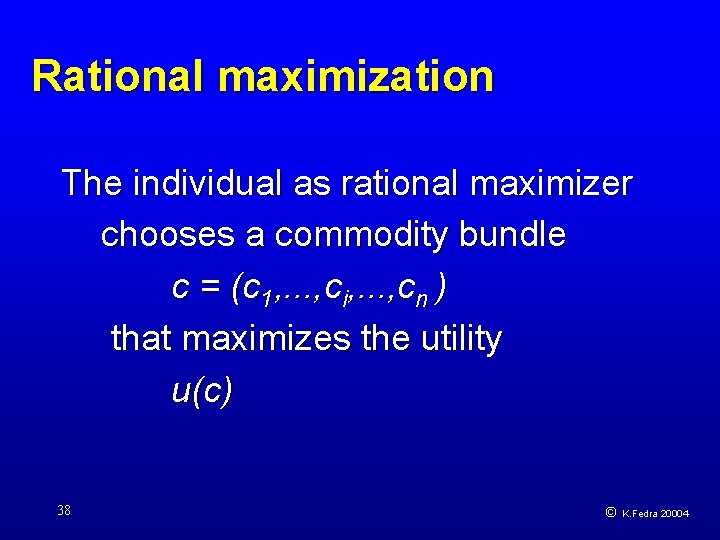
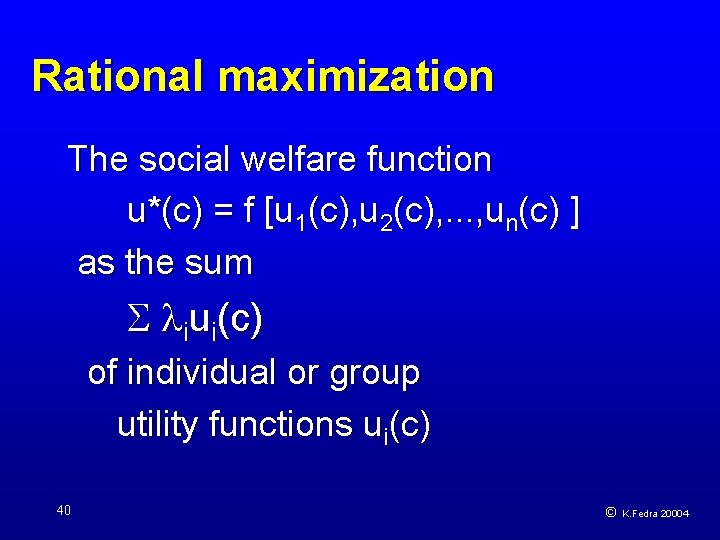
Rational maximization The individual as rational maximizer chooses a commodity bundle c = (c 1, . . . , ci, . . . , cn ) that maximizes the utility u(c) 38 © K. Fedra 20004
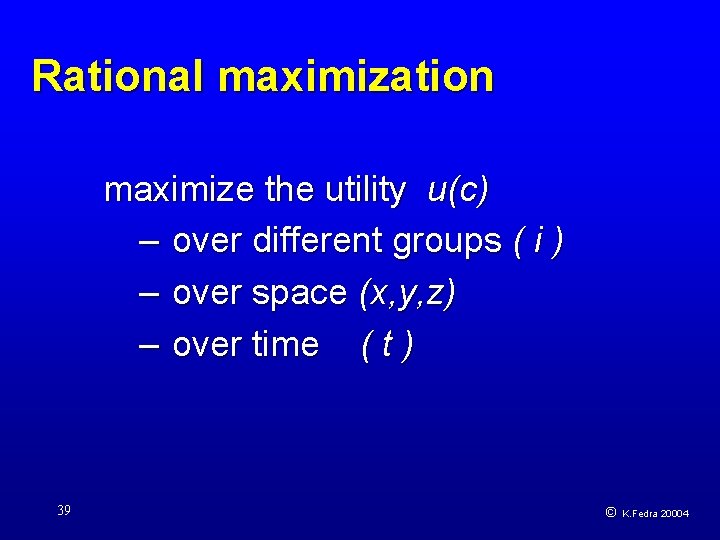
Rational maximization maximize the utility u(c) – over different groups ( i ) – over space (x, y, z) – over time ( t ) 39 © K. Fedra 20004
Rational maximization The social welfare function u*(c) = f [u 1(c), u 2(c), . . . , un(c) ] as the sum S liui(c) of individual or group utility functions ui(c) 40 © K. Fedra 20004
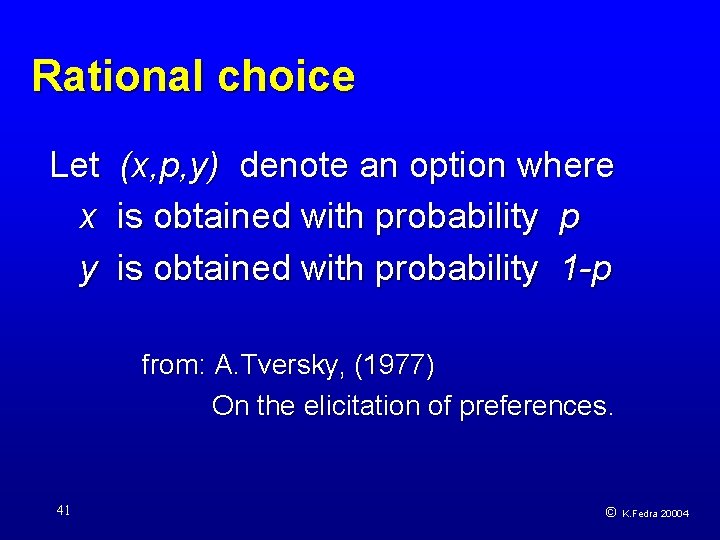
Rational choice Let (x, p, y) denote an option where x is obtained with probability p y is obtained with probability 1 -p from: A. Tversky, (1977) On the elicitation of preferences 41 © K. Fedra 20004
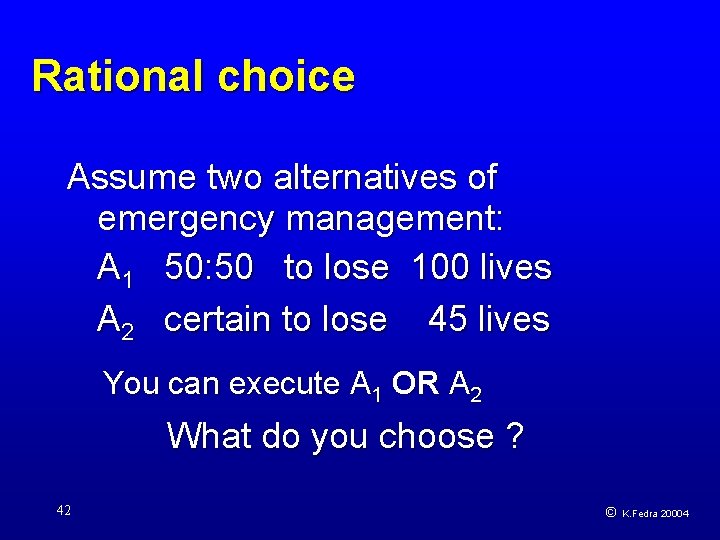
Rational choice Assume two alternatives of emergency management: A 1 50: 50 to lose 100 lives A 2 certain to lose 45 lives You can execute A 1 OR A 2 What do you choose ? 42 © K. Fedra 20004
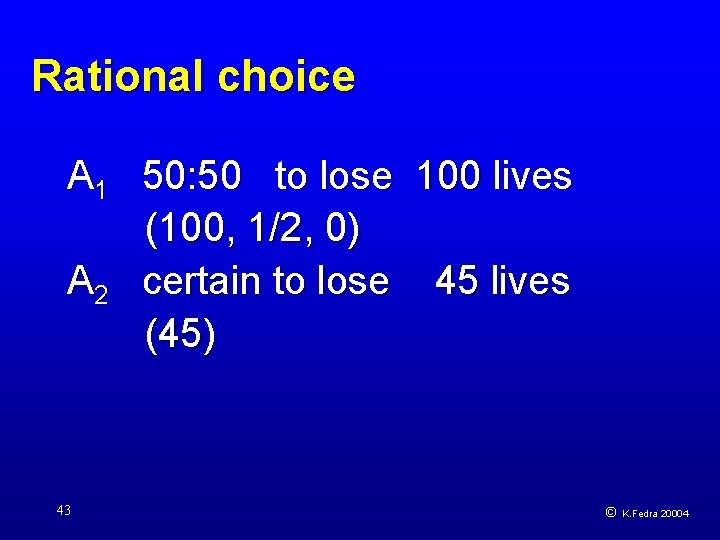
Rational choice A 1 50: 50 to lose 100 lives (100, 1/2, 0) A 2 certain to lose 45 lives (45) 43 © K. Fedra 20004
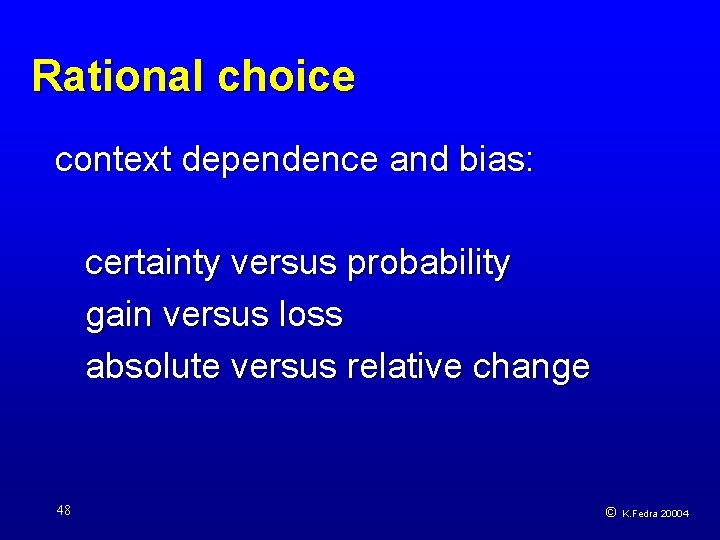
Rational choice context dependence and bias: certainty versus probability gain versus loss absolute versus relative change 48 © K. Fedra 20004
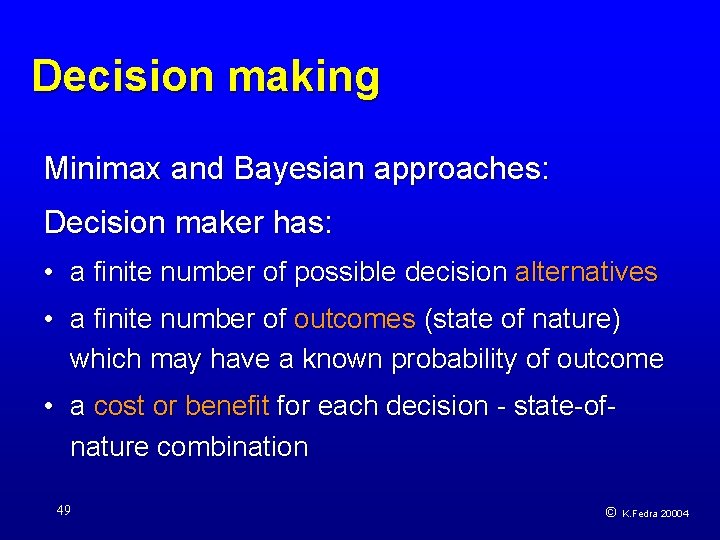
Decision making Minimax and Bayesian approaches: Decision maker has: • a finite number of possible decision alternatives • a finite number of outcomes (state of nature) which may have a known probability of outcome • a cost or benefit for each decision - state-ofnature combination 49 © K. Fedra 20004
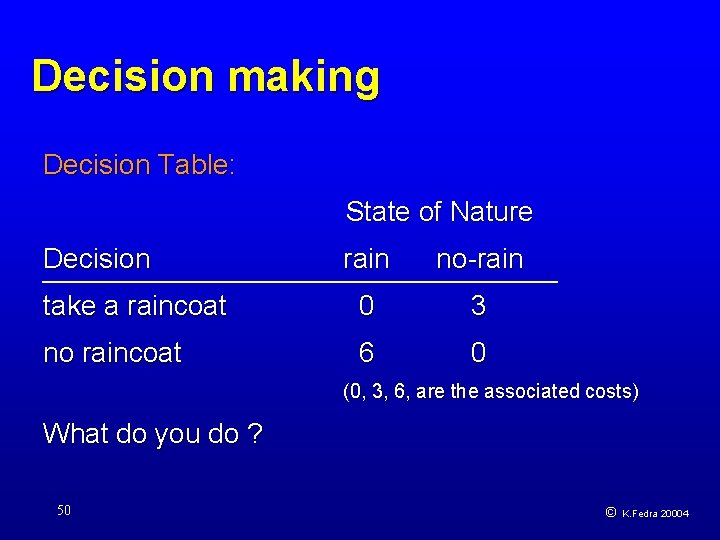
Decision making Decision Table: State of Nature Decision rain no-rain take a raincoat 0 3 no raincoat 6 0 (0, 3, 6, are the associated costs) What do you do ? 50 © K. Fedra 20004
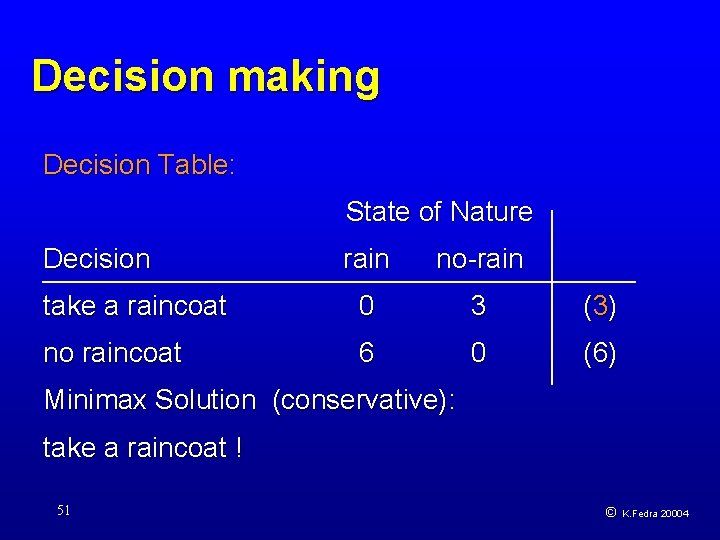
Decision making Decision Table: State of Nature Decision rain no-rain take a raincoat 0 3 (3 ) no raincoat 6 0 (6) Minimax Solution (conservative): take a raincoat ! 51 © K. Fedra 20004
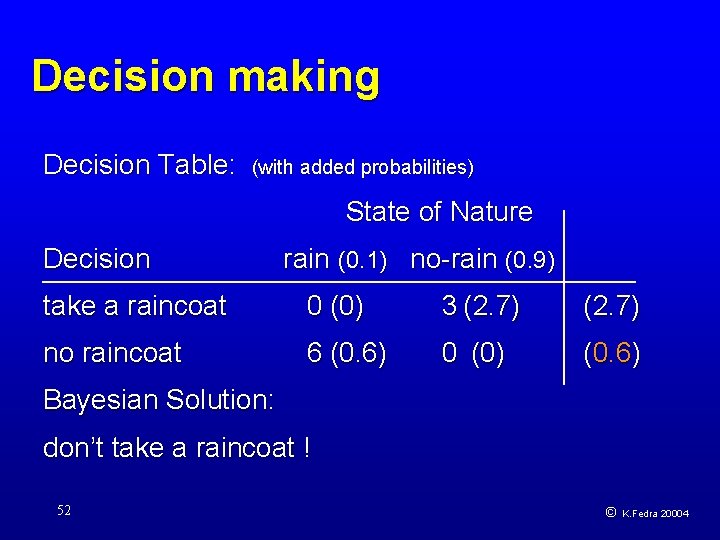
Decision making Decision Table: (with added probabilities) State of Nature Decision rain (0. 1) no-rain (0. 9) take a raincoat 0 (0) 3 (2. 7) no raincoat 6 (0. 6) 0 (0) (0. 6) Bayesian Solution: don’t take a raincoat ! 52 © K. Fedra 20004
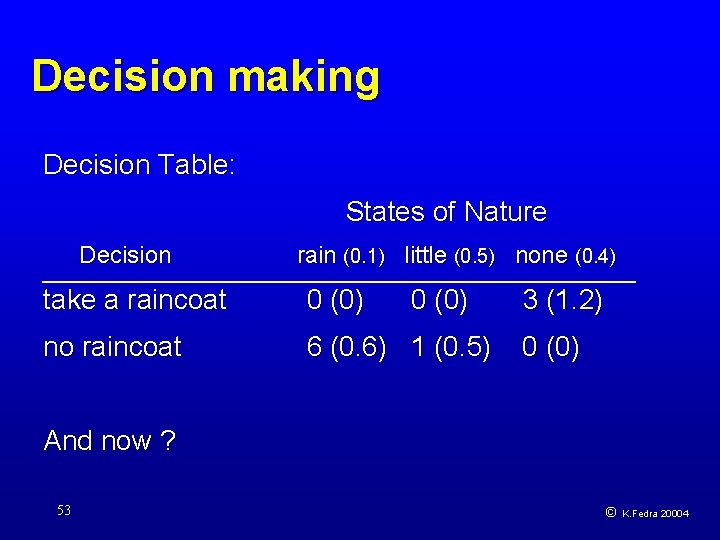
Decision making Decision Table: States of Nature Decision rain (0. 1) little (0. 5) none (0. 4) take a raincoat 0 (0) no raincoat 6 (0. 6) 1 (0. 5) 3 (1. 2) 0 (0) And now ? 53 © K. Fedra 20004
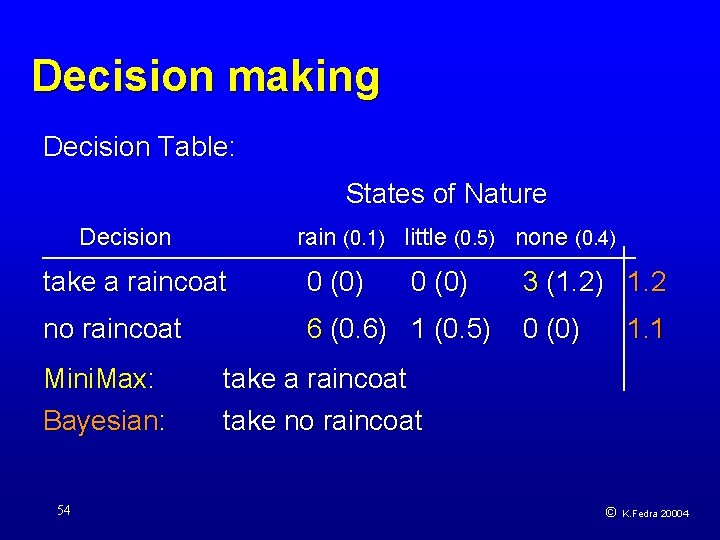
Decision making Decision Table: States of Nature Decision rain (0. 1) little (0. 5) none (0. 4) take a raincoat 0 (0) no raincoat 6 (0. 6) 1 (0. 5) Mini. Max: Bayesian: 54 0 (0) 3 (1. 2) 1. 2 0 (0) 1. 1 take a raincoat take no raincoat © K. Fedra 20004
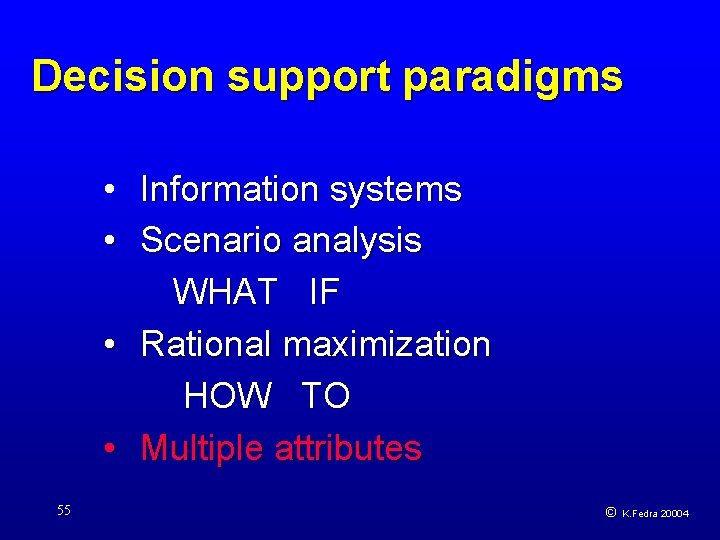
Decision support paradigms • Information systems • Scenario analysis WHAT IF • Rational maximization HOW TO • Multiple attributes 55 © K. Fedra 20004
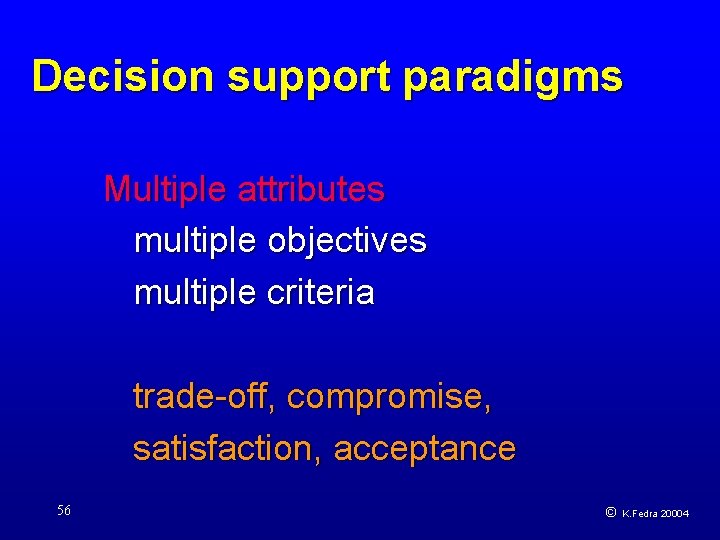
Decision support paradigms Multiple attributes multiple objectives multiple criteria trade-off, compromise, satisfaction, acceptance 56 © K. Fedra 20004
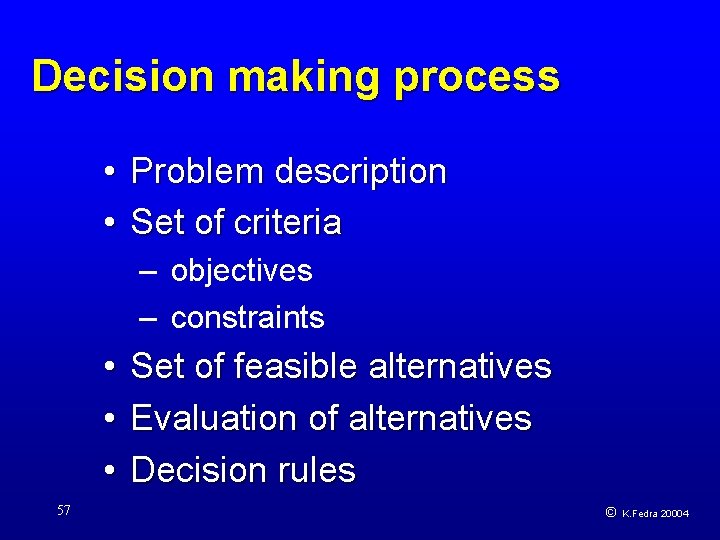
Decision making process • Problem description • Set of criteria – objectives – constraints • Set of feasible alternatives • Evaluation of alternatives • Decision rules 57 © K. Fedra 20004
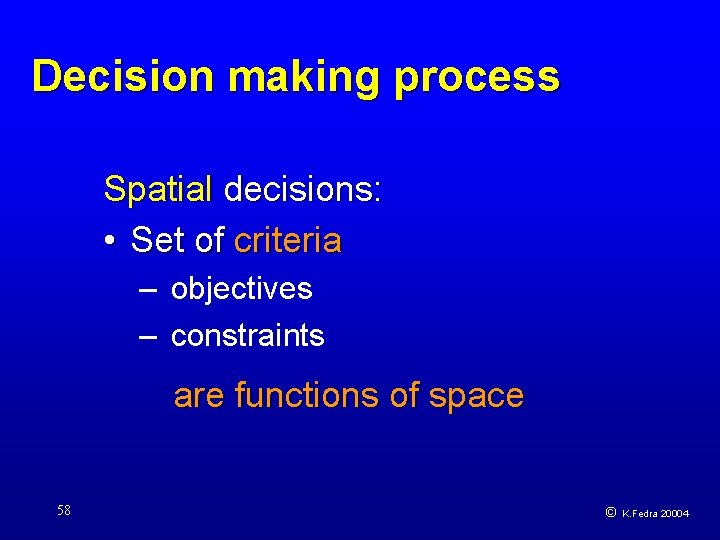
Decision making process Spatial decisions: • Set of criteria – objectives – constraints are functions of space 58 © K. Fedra 20004
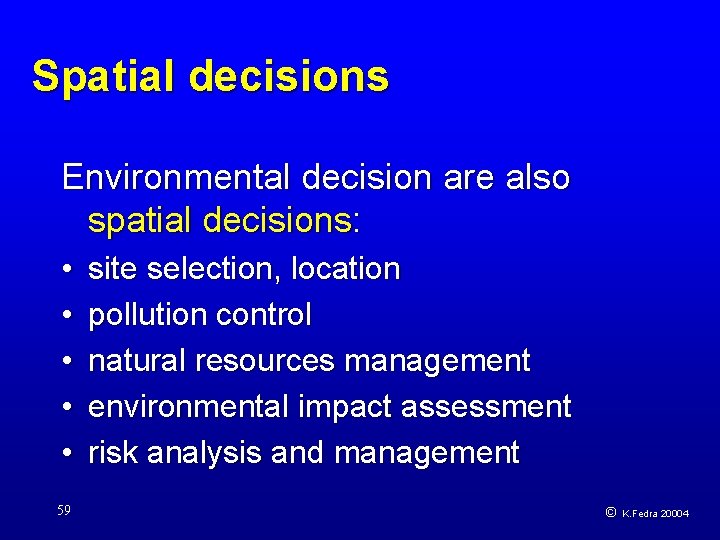
Spatial decisions Environmental decision are also spatial decisions: • • • 59 site selection, location pollution control natural resources management environmental impact assessment risk analysis and management © K. Fedra 20004