
CSE 5095 Clinical Decision Support Systems in Biomedical
CSE 5095 Clinical Decision Support Systems in Biomedical Informatics and their Limitations Alberto De la Rosa Algarín Computer Science & Engineering University of Connecticut, Storrs alberto. delarosa. algarin@engr. uconn. edu CDSS-1
Overview CSE m 5095 m m m Clinical Decisions q What types of clinical decisions exist? q Requirements for excellent decision-making q Definition of Decision Support Systems History q First possibility of a CDSS q First prototype and the shortcomings q Better CDSS (MYCIN, HELP, Leeds System) Existing Systems q Pathfinder, Iliad, Diagnosis. Pro, CKS, HDP, etc. Limitations q Patient’s Role, Usability (and performance), Knowledge sharing and maintenance and Security CDSS-2
Clinical Decisions CSE m 5095 Two types of clinical decisions: q Diagnosis decisions q Diagnosis process m Diagnosis decisions q Done analyzing to determine the cause of sickness m Diagnosis process q Used to determine which questions to ask in order to make better diagnosis decisions CDSS-3
Requirements for excellent decision-making CSE m 5095 Accurate data: q Bad data is useless obviously q Good data is equally useless if there is no knowledge on how to apply it. m Pertinent knowledge q The overload of information affects the process of decision making in a negative way. q Overload of information can be seen in the ICU m Appropriate problem-solving skills q The glue between the correct use of accurate and pertinent knowledge. CDSS-4
Goal CSE 5095 m The goal of clinical decision support systems (CDSS) is to emulate the clinician’s thought process during diagnosis. CDSS-5
Definition of Decision Support Systems CSE 5095 m A decision support system is a system in which one or more computers and computer programs assist in decision making by providing information. m They can exist as hardware-software solutions or stand alone software applications. CDSS-6
History CSE m 5095 m The possibility first appeared in 1959 [Ledley & Lusted] q With the use of symbolic logic, probability theory and value theory, the foundations of medical diagnosis could be understood. The first prototype appeared in 1964 [Walker et al. ] q Issues with logistics, scientific shortcomings related to medical diagnosis, and the lack of integration to the workflow made the widespread use and adoption virtually impossible. CDSS-7
History CSE m 5095 After this, several CDSS appeared that tackled the previous pitfalls (MYCIN, Leeds System and HELP) m MYCIN [Shortliffe, 1976] q A consultation system for patients with infections m Leeds Abdominal Pain System [De Dombal et al. , 1972] q A system for the diagnosis of acute abdominal pain m HELP [Warner, 1979] q A system to alert clinicians in case of abnormalities in patient records CDSS-8
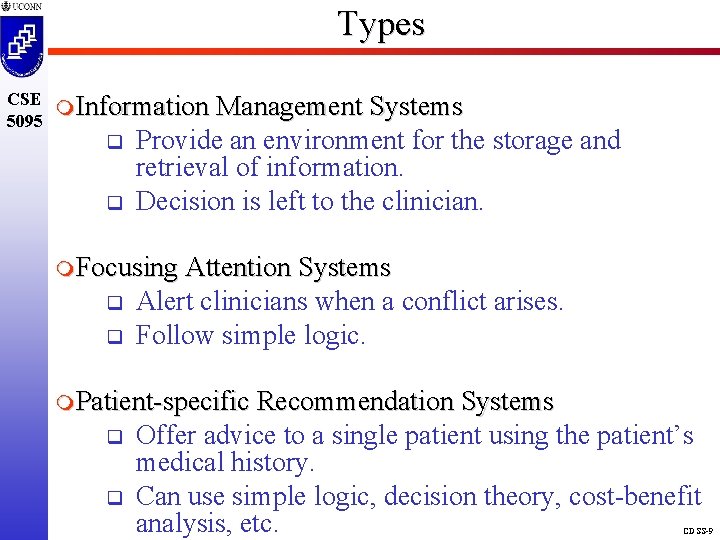
Types CSE m. Information 5095 q q Management Systems Provide an environment for the storage and retrieval of information. Decision is left to the clinician. m. Focusing Attention Systems q q Alert clinicians when a conflict arises. Follow simple logic. m. Patient-specific Recommendation Systems q q Offer advice to a single patient using the patient’s medical history. Can use simple logic, decision theory, cost-benefit analysis, etc. CDSS-9
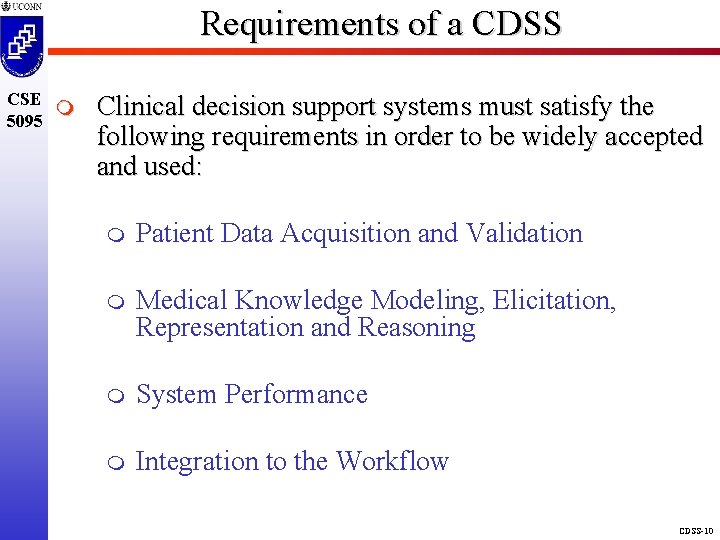
Requirements of a CDSS CSE m 5095 Clinical decision support systems must satisfy the following requirements in order to be widely accepted and used: m Patient Data Acquisition and Validation m Medical Knowledge Modeling, Elicitation, Representation and Reasoning m System Performance m Integration to the Workflow CDSS-10
Requirements: Patient Data Acquisition CSE m 5095 There is no standard way to acquire data. m Current methods range from keyboard to natural language processing. m Some health care professionals even use intermediaries like nurses or secretaries. m The end goal is to capture patient data without disrupting the workflow. CDSS-11
Requirements: Patient Data Validation CSE m 5095 Tons of coding systems exist for the validation of patient data. m Sadly none of the existing coding systems capture the subtle differences and the high details of the patient’s health care. m A clinical decision support system should be able to work with both detailed and general patient data. q And the system’s performance should not be affected by the type of data. CDSS-12
Requirements: Medical Knowledge Modeling CSE m 5095 Knowledge modeling is necessary for the identification of relationships and concepts. m Modeling is also used to decide what patient data is pertinent and what strategies to use. m These tasks require a large amount of modeling. m Luckily several methods exist that do a pretty good job regarding medical knowledge modeling. q Common KADS [De Hoog et al. , 1994] q CASNET [Weiss et al. ] CDSS-13
Requirements: Medical Knowledge Elicitation CSE m 5095 Current clinical decision support systems obtain knowledge and then work directly with the clinician. m But a clinical decision support system should be able to evoke useful knowledge seamlessly. m But this implies methods that facilitate the use of knowledge-bases. CDSS-14
Requirements: Medical Knowledge Representation CSE m 5095 The interpretation of trends is intuitive for clinicians. q For example, trends of sickness, trends of the results of medical treatments. m Clinical decision support systems must be able to represent the knowledge like trends. m But to achieve this, the clinical decision support system must emulate the clinicians intuition. CDSS-15
Requirements: Medical Knowledge Reasoning CSE m 5095 Computer systems have the capability of storing large amounts of factual knowledge. m Clinical decision support systems should be able to q Discern which knowledge is useful for the task at hand. q Know how to apply the knowledge in order to obtain worthy results. m The solution for this requirement is in the realm of artificial intelligence. CDSS-16
Requirements: System Performance CSE m 5095 Clinical decision support systems should be able to use ALL the pertinent data and knowledge available. m At the same time, the systems should be able to use the most updated data and knowledge. q This implies a lot when we talk about the use of knowledge-bases. m On top of it all, decision support should appear in an instant manner while maintaining high accuracy. CDSS-17
Requirements: Integration to the Workflow CSE m 5095 The most difficult of the requirements to fulfill. m Integration to the workflow requires fulfilling a couple of previous requirements: q Patient Data Acquisition q Knowledge Representation q System Performance m If a clinical decision support system is able to fulfill these previous three requirements, integration is given. CDSS-18
Existing Systems CSE m 5095 m There has been a surge of clinical decision support systems from the 1980’s to the present day. Their applications range from infectious disease diagnosis to cardiovascular treatment predictions. CDSS-19
Pathfinder (1992) CSE m 5095 Explains, acquires, represents and manipulates uncertain medical knowledge. q Uses probability and decision theory as strategies m Deductive reasoning is used to provide diagnosis q But the system is designed so that no recommendations are done m The user interface is menu based and mouse driven q Feature category, observed features and differential diagnosis are the windows in the initial screen. CDSS-20
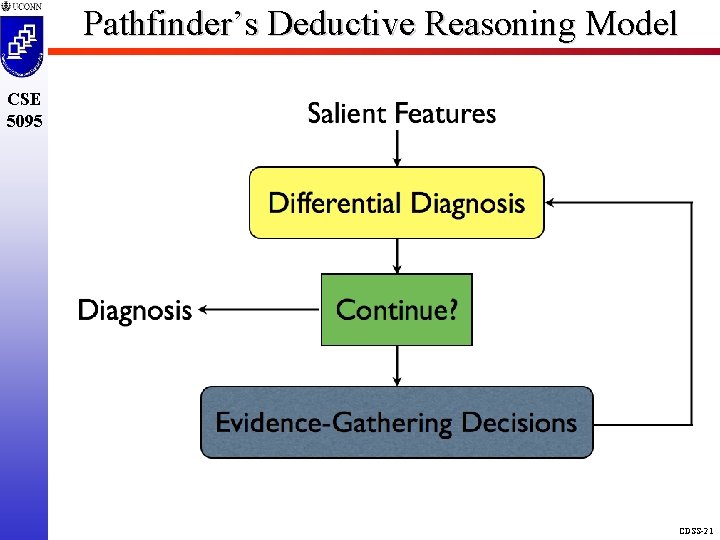
Pathfinder’s Deductive Reasoning Model CSE 5095 CDSS-21
Iliad (1988) CSE m 5095 Uses Boolean and Bayesian frames to represent knowledge. m The system has four basic components: q Inference engine q User interface q Data driver q Best information algorithm m Currently used as a teaching tool for medical students. q Particular cases are simulated so that students learn how to diagnose. CDSS-22
Diagnosis. Pro (1993) CSE m 5095 Uses differential diagnosis to remind the user of possible diagnoses in an effort to reduce medical errors. m The knowledge-base is huge: q 11, 000 diseases q 30, 000 findings q 300, 000 relationships m Information for the knowledge-base is taken from medical sources such as JAMA, Oxford Textbook of Medicine and others. CDSS-23
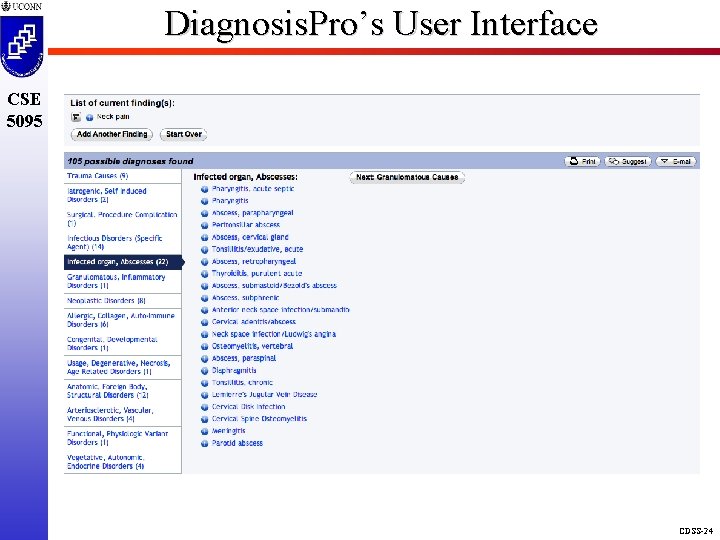
Diagnosis. Pro’s User Interface CSE 5095 CDSS-24
Heart Disease Program (HDP) (1980’s – 90’s) CSE m 5095 Assists the clinician in anticipating the effects of therapy in cardiovascular disorders. m Uses strategies as: q Knowledge-base and physiologic model q Probabilities q Constraints q Differential Diagnosis m The user interface is menu driven CDSS-25
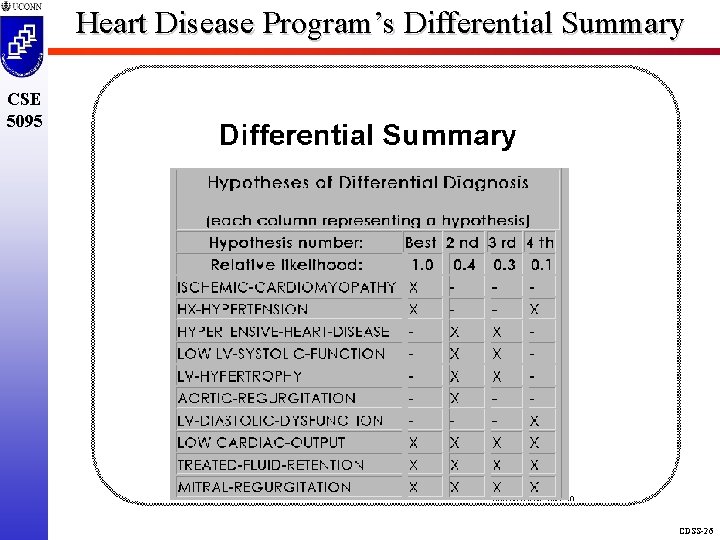
Heart Disease Program’s Differential Summary CSE 5095 CDSS-26
Clinical Knowledge Summaries (CKS) (2007) CSE m 5095 Helps clinicians make decisions about a patient’s health and provides strategies on how to use those decisions. q Provides knowledge on topics about common acute and chronic diseases and their prevention q Offers quick answers on how to manage common clinical scenarios m Built on the existing PRODIGY knowledge-base. m It is a web-based clinical decision support system, accessible from around the world. CDSS-27
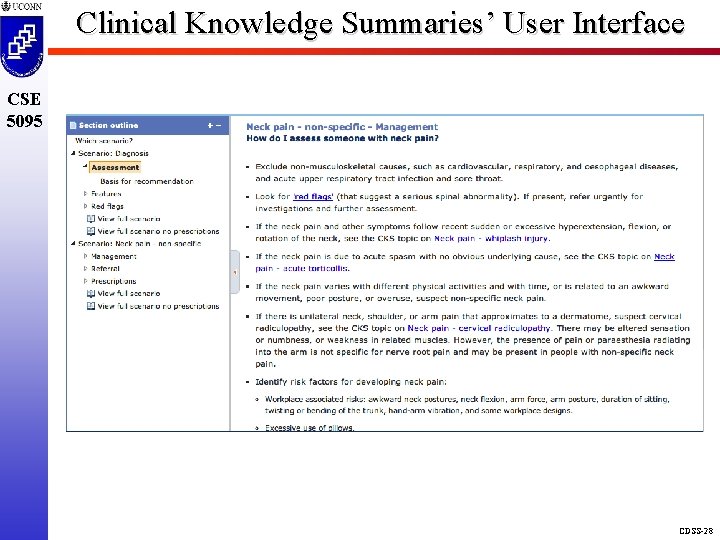
Clinical Knowledge Summaries’ User Interface CSE 5095 CDSS-28
Dxplain (1987) CSE m 5095 Combines characteristics of an electronic medical textbook with characteristics of a medical reference system. m Provides information on different diseases q Emphasizes in signs and symptoms m The knowledge-base includes: q 2, 400+ diseases q 5, 000+ symptoms, signs, lab data and clinical findings CDSS-29
Visual. Dx (2006) CSE m 5095 Java-based and image driven q Designed for point-of-care reference m One of the main functions is the facilitation of image matching for the end user, achieved with: q Graphical search tools q Knowledge-base of relationships q Thousands of digital images m Used to develop differential diagnoses based on morphologic and patient driven search. m Its focus is on infectious diseases. CDSS-30
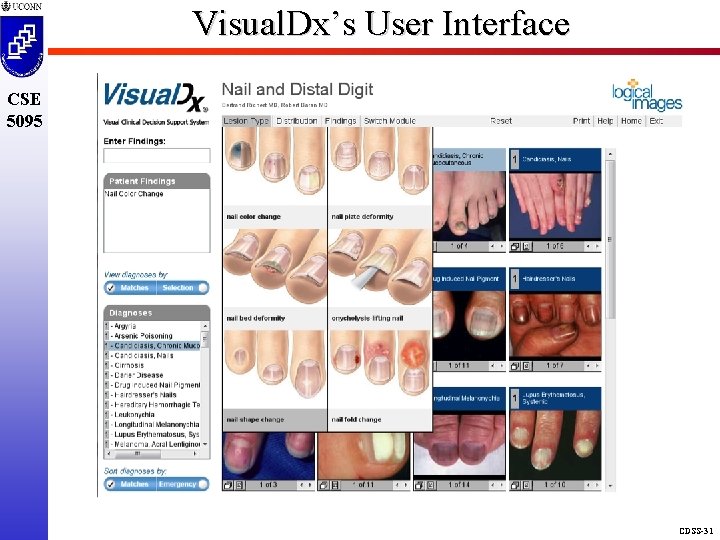
Visual. Dx’s User Interface CSE 5095 CDSS-31
INTERNIST-1 / QMR Project (1974 - 80’s) CSE m 5095 Designed to provide assistance in general internal medicine q Both INTERNIST-1 and QMR rely on the INTERNIST-1 knowledge-base m INTERNIST-1 works as a high-powered diagnostic consultant tool. m QMR acts as an information tool q Provides ways to manipulate and review diagnostic information for the knowledge-base CDSS-32
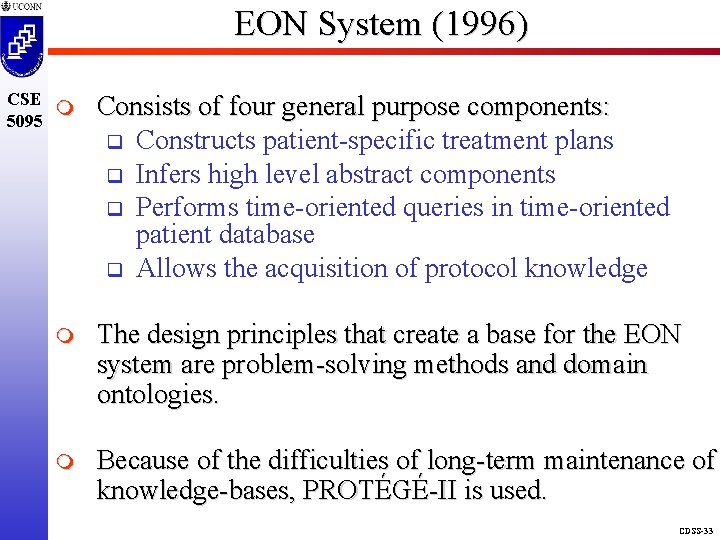
EON System (1996) CSE m 5095 Consists of four general purpose components: q Constructs patient-specific treatment plans q Infers high level abstract components q Performs time-oriented queries in time-oriented patient database q Allows the acquisition of protocol knowledge m The design principles that create a base for the EON system are problem-solving methods and domain ontologies. m Because of the difficulties of long-term maintenance of knowledge-bases, PROTÉGÉ-II is used. CDSS-33
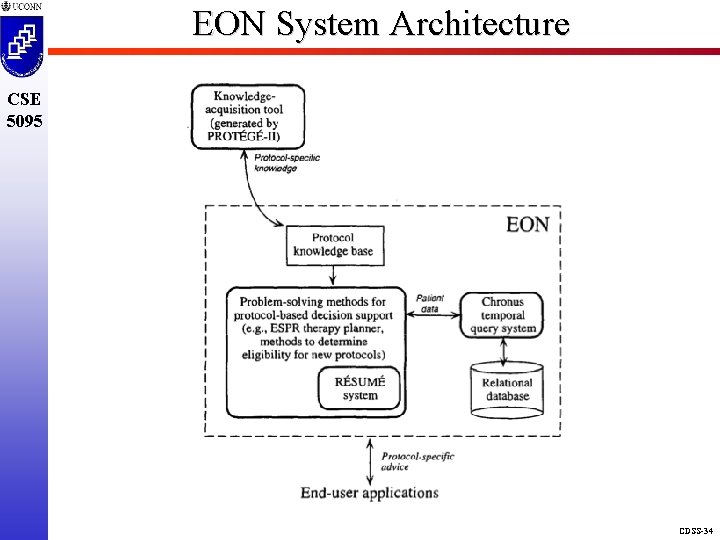
EON System Architecture CSE 5095 CDSS-34
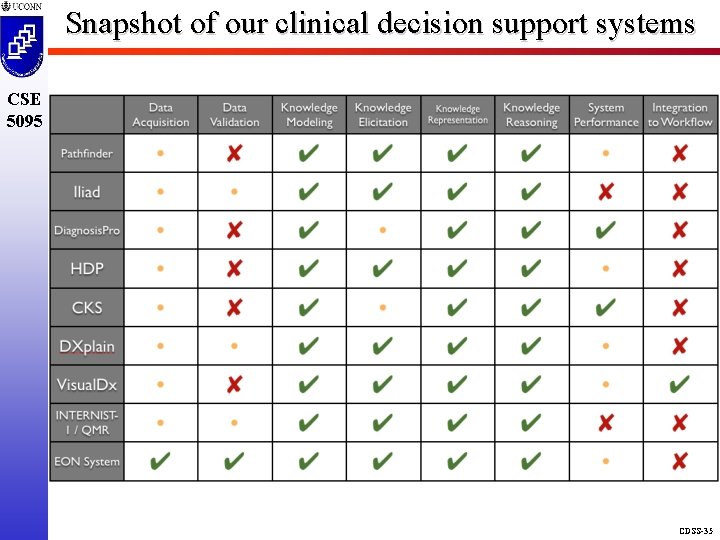
Snapshot of our clinical decision support systems CSE 5095 CDSS-35
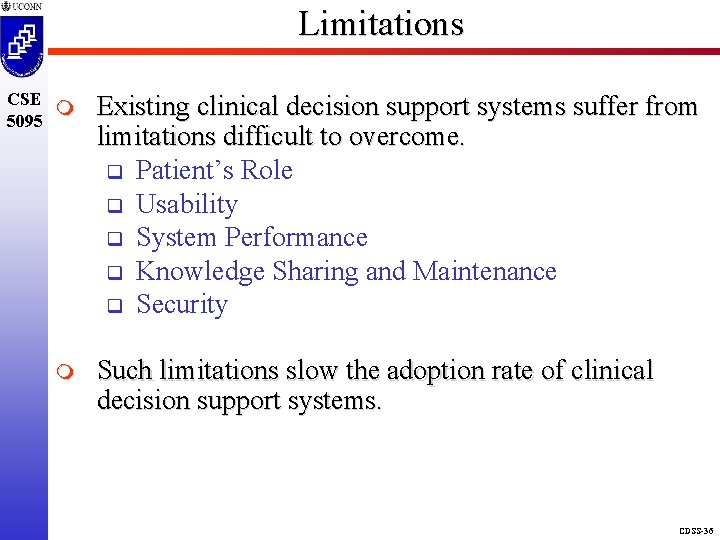
Limitations CSE m 5095 m Existing clinical decision support systems suffer from limitations difficult to overcome. q Patient’s Role q Usability q System Performance q Knowledge Sharing and Maintenance q Security Such limitations slow the adoption rate of clinical decision support systems. CDSS-36
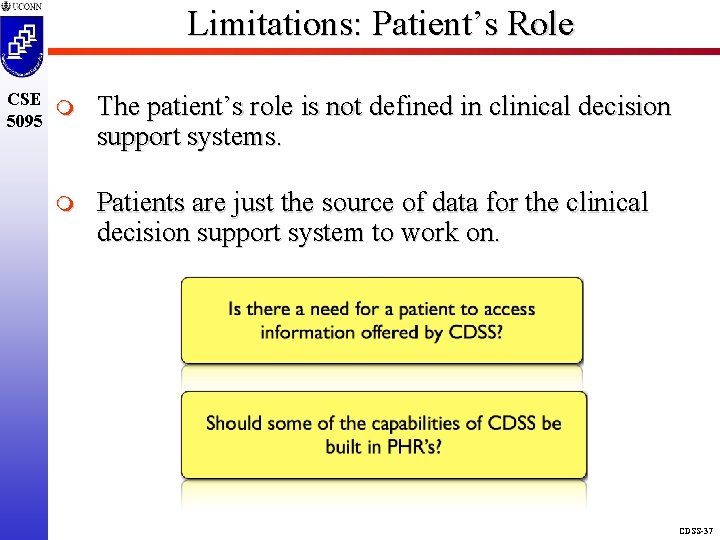
Limitations: Patient’s Role CSE m 5095 m The patient’s role is not defined in clinical decision support systems. Patients are just the source of data for the clinical decision support system to work on. CDSS-37
Limitations: Patient’s Role CSE m 5095 The answers to those questions do not only have implications in a moral or ethical sense, but can also provide the patient evidence for legal matters. m The patient will want to know every detail regarding his health. q After all, patients provide every bit of their personal information in order to get the best care. m Clinicians would like to withhold information for different matters. q For example, the clinician would like to be the one to break the news in case of a serious disease. CDSS-38
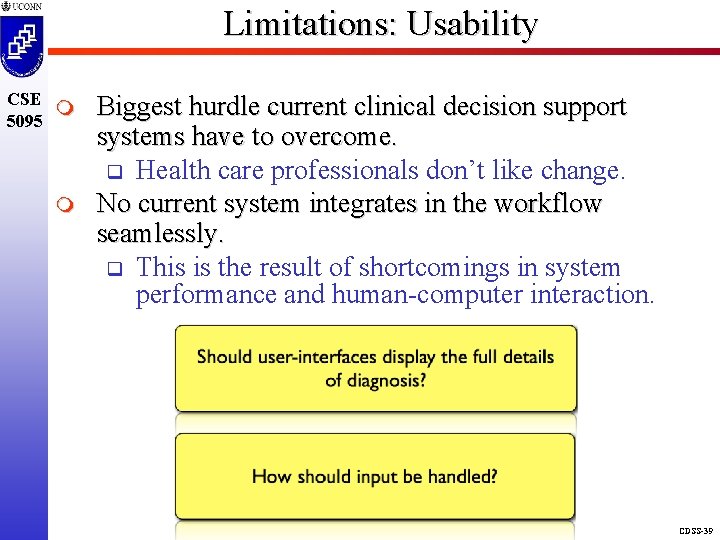
Limitations: Usability CSE m 5095 m Biggest hurdle current clinical decision support systems have to overcome. q Health care professionals don’t like change. No current system integrates in the workflow seamlessly. q This is the result of shortcomings in system performance and human-computer interaction. CDSS-39
Limitations: Usability CSE m 5095 m A busy clinician would only want pertinent information. A less busy clinician, or one who needs every detail to reach a diagnosis, would appreciate a high level of detail. m Clinicians do not like to modify the usual workflow to input data. New methods aim to bridge the gap between nondigital and digital data acquisition. q For example: TIMOS LINK m Preference on data input changes by person. m CDSS-40
Limitations: System Performance CSE 5095 CDSS-41
Limitations: System Performance CSE m 5095 Accurate support is the purpose of clinical decision support systems. m Current methods are not accurate enough to be widely used. q QMR’s accuracy being % in ED scenarios. q Iliad’s accuracy being % in ED scenarios. m At the same time, no matter how accurate, if a decision support takes to long to appear, it is useless. CDSS-42
Limitations: Knowledge Sharing CSE m 5095 m m Knowledge-bases are specific to each clinical decision support system. Its actually one of the “selling points” of current solutions. q Used to differentiate existing systems from others in an effort to stand above. The bigger the knowledge-base, the more decision support (and more accurate) the system is able to offer. CDSS-43
Limitations: Knowledge Sharing CSE m 5095 Having a centralized knowledge-base, or at least a framework that allows for current knowledge-bases to be shared, would improve reliability and accuracy across different clinical decision support systems. m Standards exist in an attempt to consolidate. q The problem is that there are so many standards, everyone uses a different one. m We need a standard of standards. CDSS-44
Limitations: Knowledge Maintenance CSE m 5095 Maintaining knowledge and managing pieces of the clinical decision support systems are critical for successful delivery of decision support. m Knowledge-base maintenance requires a lot of work. m Current methods rely on periodical update by humans. CDSS-45
Limitations: Knowledge Maintenance CSE m 5095 Periodical updates by human intervention is a primitive approach to knowledge maintenance. m The latest knowledge and information could be put on hold for months until the knowledge-base’s update is due. m This goes against one of the original requirements: q Clinical decision support systems should utilize the latest knowledge available. CDSS-46
Limitations: Security CSE m 5095 Clinical decision support systems provide an equal level of recommendations to whoever has access to the system. m Clinical decision support systems that exist as part of an EMR have some level of security. m Systems that exist as stand alone solutions do not. CDSS-47
Limitations: Security CSE m 5095 m We have to remember that other professionals (such as nurses, pharmacists, etc. ) are an equal part of the patient’s well-being. It is natural to think that clinical decision support systems should have some level of role-based access control. CDSS-48
Concluding Remarks CSE m 5095 A long road lies ahead of CDSS. m Improvements must be made in order to increase the adoption of clinical decision support systems. q Usability q System Performance q Knowledge Handling m Existing technologies and ideas offer possibilities to resolve several of the limitations. m Other limitations require a compromise in order to be solved. CDSS-49
- Slides: 49