CIS 183 Fall 2000 Dr Iren Valova 1
- Slides: 16
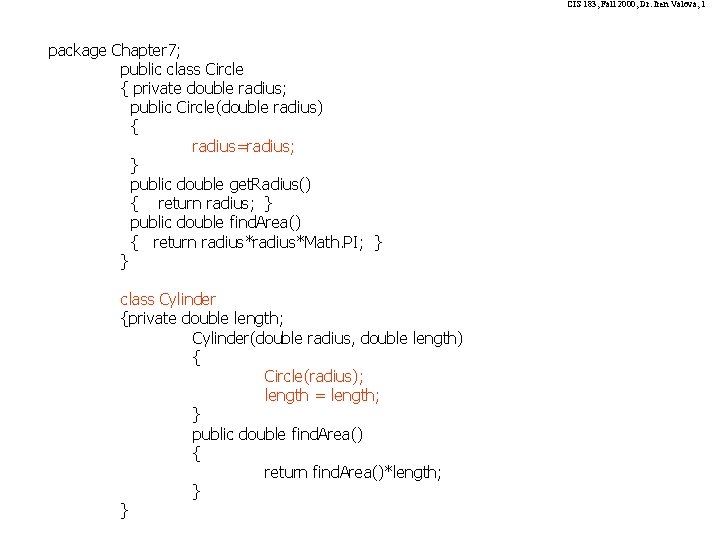
CIS 183, Fall 2000, Dr. Iren Valova, 1 package Chapter 7; public class Circle { private double radius; public Circle(double radius) { radius=radius; } public double get. Radius() { return radius; } public double find. Area() { return radius*Math. PI; } } class Cylinder {private double length; Cylinder(double radius, double length) { Circle(radius); length = length; } public double find. Area() { return find. Area()*length; } }
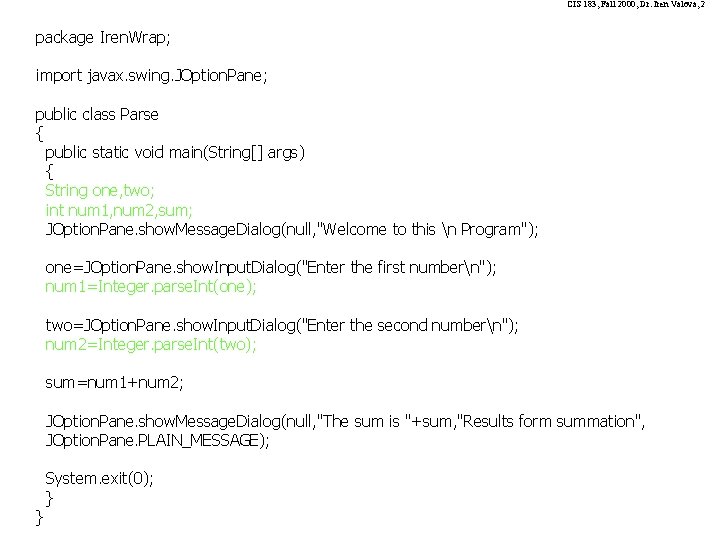
CIS 183, Fall 2000, Dr. Iren Valova, 2 package Iren. Wrap; import javax. swing. JOption. Pane; public class Parse { public static void main(String[] args) { String one, two; int num 1, num 2, sum; JOption. Pane. show. Message. Dialog(null, "Welcome to this n Program"); one=JOption. Pane. show. Input. Dialog("Enter the first numbern"); num 1=Integer. parse. Int(one); two=JOption. Pane. show. Input. Dialog("Enter the second numbern"); num 2=Integer. parse. Int(two); sum=num 1+num 2; JOption. Pane. show. Message. Dialog(null, "The sum is "+sum, "Results form summation", JOption. Pane. PLAIN_MESSAGE); } System. exit(0); }
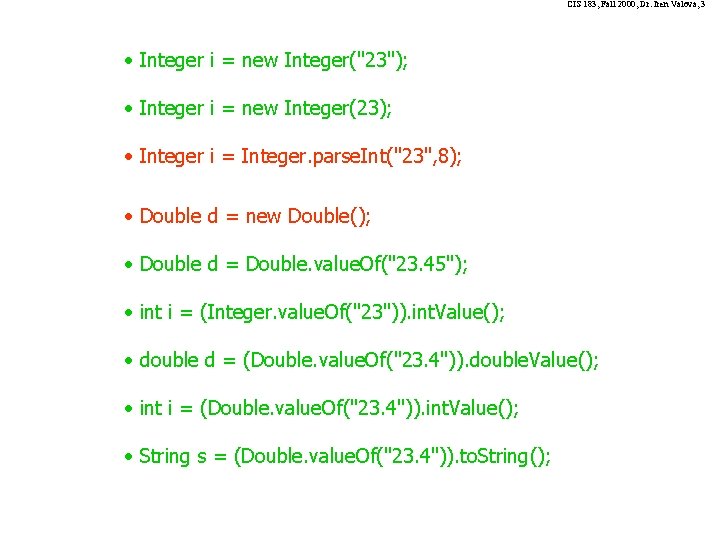
CIS 183, Fall 2000, Dr. Iren Valova, 3 • Integer i = new Integer("23"); • Integer i = new Integer(23); • Integer i = Integer. parse. Int("23", 8); • Double d = new Double(); • Double d = Double. value. Of("23. 45"); • int i = (Integer. value. Of("23")). int. Value(); • double d = (Double. value. Of("23. 4")). double. Value(); • int i = (Double. value. Of("23. 4")). int. Value(); • String s = (Double. value. Of("23. 4")). to. String();
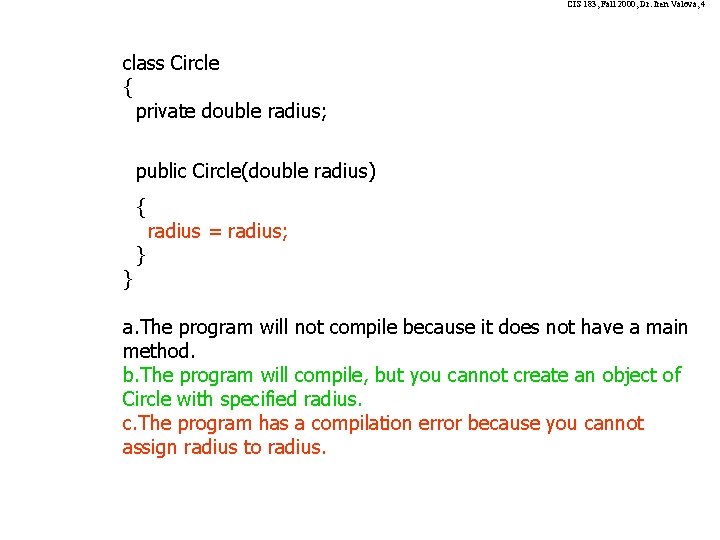
CIS 183, Fall 2000, Dr. Iren Valova, 4 class Circle { private double radius; public Circle(double radius) { } } radius = radius; a. The program will not compile because it does not have a main method. b. The program will compile, but you cannot create an object of Circle with specified radius. c. The program has a compilation error because you cannot assign radius to radius.
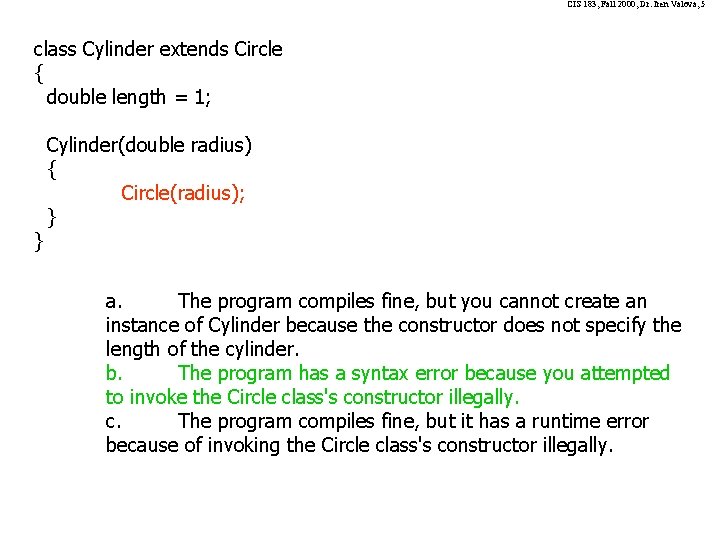
CIS 183, Fall 2000, Dr. Iren Valova, 5 class Cylinder extends Circle { double length = 1; } Cylinder(double radius) { Circle(radius); } a. The program compiles fine, but you cannot create an instance of Cylinder because the constructor does not specify the length of the cylinder. b. The program has a syntax error because you attempted to invoke the Circle class's constructor illegally. c. The program compiles fine, but it has a runtime error because of invoking the Circle class's constructor illegally.
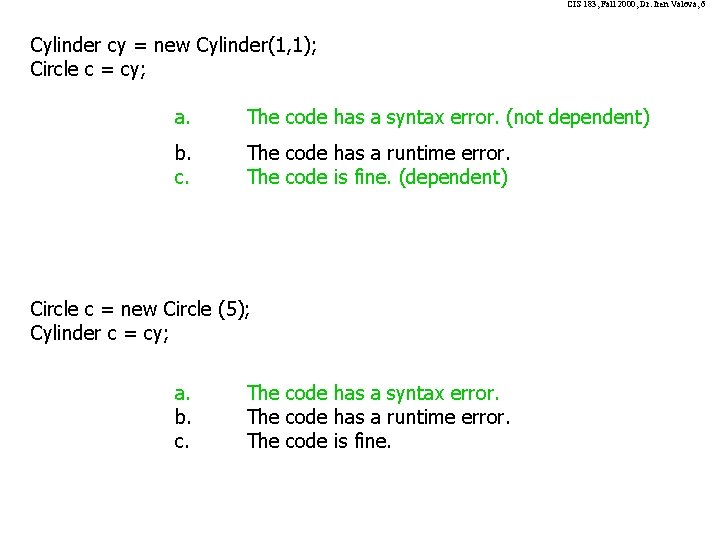
CIS 183, Fall 2000, Dr. Iren Valova, 6 Cylinder cy = new Cylinder(1, 1); Circle c = cy; a. The code has a syntax error. (not dependent) b. c. The code has a runtime error. The code is fine. (dependent) Circle c = new Circle (5); Cylinder c = cy; a. b. c. The code has a syntax error. The code has a runtime error. The code is fine.
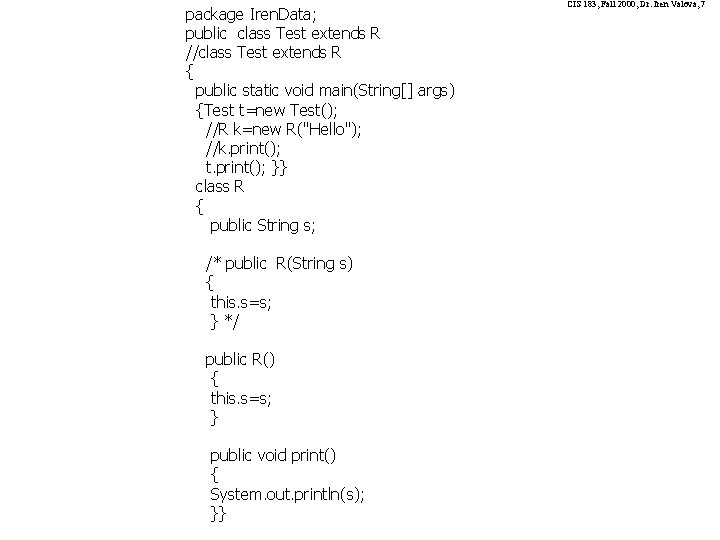
package Iren. Data; public class Test extends R //class Test extends R { public static void main(String[] args) {Test t=new Test(); //R k=new R("Hello"); //k. print(); t. print(); }} class R { public String s; /* public R(String s) { this. s=s; } */ public R() { this. s=s; } public void print() { System. out. println(s); }} CIS 183, Fall 2000, Dr. Iren Valova, 7
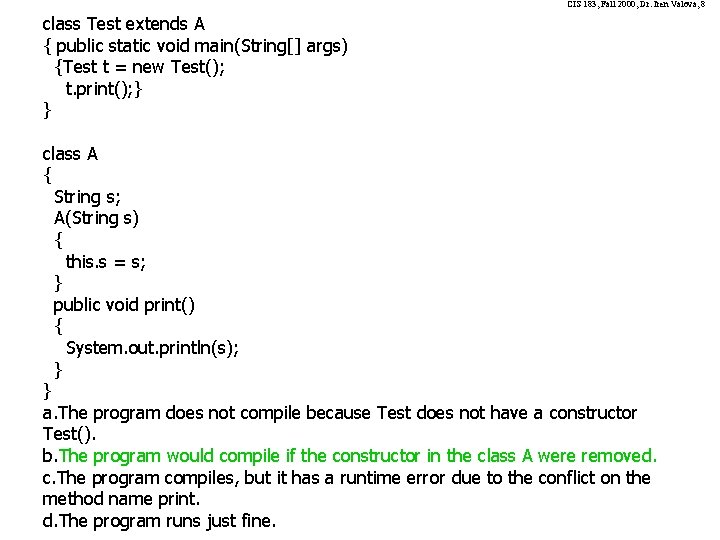
CIS 183, Fall 2000, Dr. Iren Valova, 8 class Test extends A { public static void main(String[] args) {Test t = new Test(); t. print(); } } class A { String s; A(String s) { this. s = s; } public void print() { System. out. println(s); } } a. The program does not compile because Test does not have a constructor Test(). b. The program would compile if the constructor in the class A were removed. c. The program compiles, but it has a runtime error due to the conflict on the method name print. d. The program runs just fine.
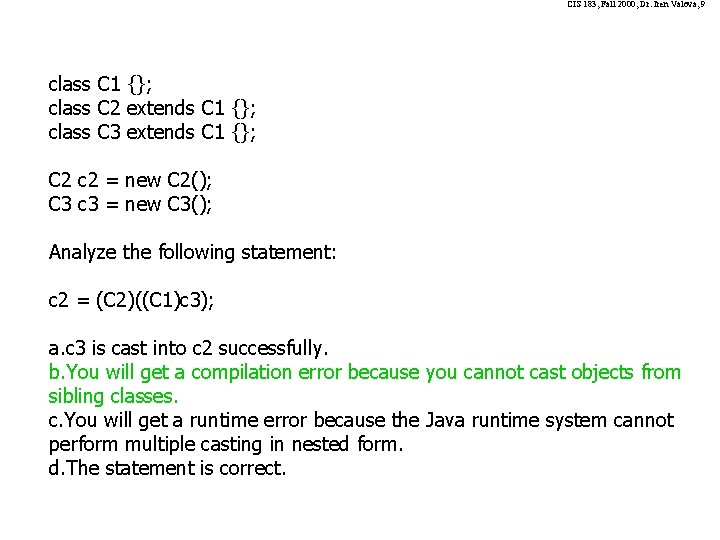
CIS 183, Fall 2000, Dr. Iren Valova, 9 class C 1 {}; class C 2 extends C 1 {}; class C 3 extends C 1 {}; C 2 c 2 = new C 2(); C 3 c 3 = new C 3(); Analyze the following statement: c 2 = (C 2)((C 1)c 3); a. c 3 is cast into c 2 successfully. b. You will get a compilation error because you cannot cast objects from sibling classes. c. You will get a runtime error because the Java runtime system cannot perform multiple casting in nested form. d. The statement is correct.
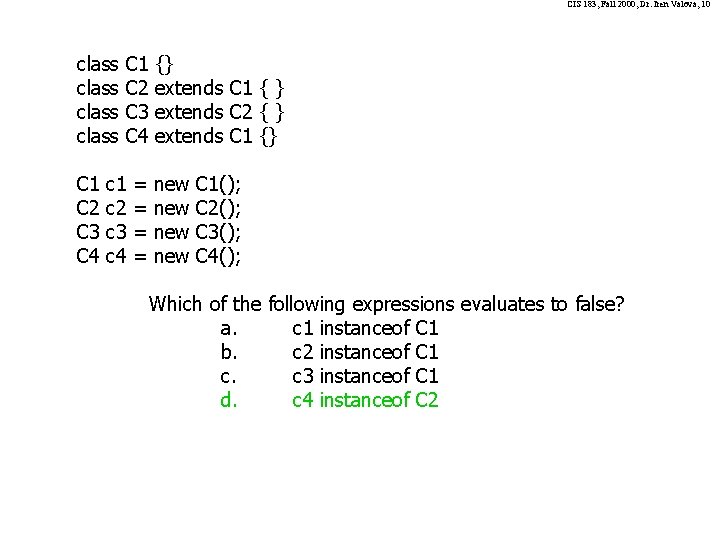
CIS 183, Fall 2000, Dr. Iren Valova, 10 class C 1 C 2 C 3 C 4 c 1 c 2 c 3 c 4 = = {} extends C 1 { } extends C 2 { } extends C 1 {} new new C 1(); C 2(); C 3(); C 4(); Which of the following expressions evaluates to false? a. c 1 instanceof C 1 b. c 2 instanceof C 1 c. c 3 instanceof C 1 d. c 4 instanceof C 2
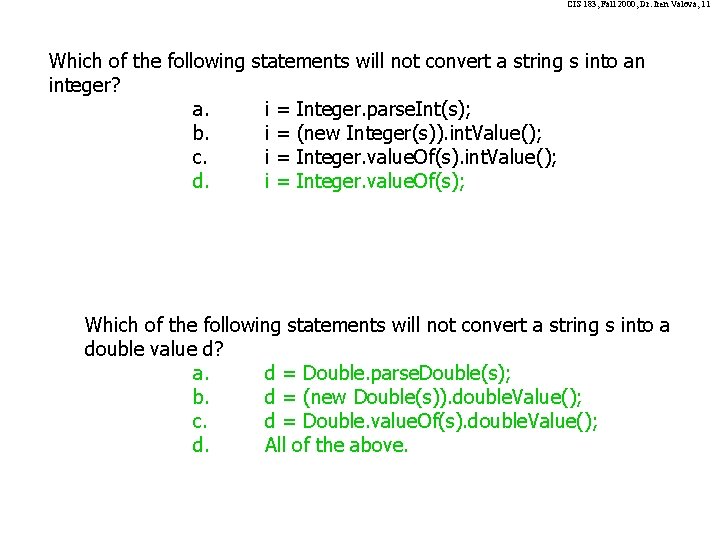
CIS 183, Fall 2000, Dr. Iren Valova, 11 Which of the following integer? a. b. c. d. statements will not convert a string s into an i i = = Integer. parse. Int(s); (new Integer(s)). int. Value(); Integer. value. Of(s); Which of the following statements will not convert a string s into a double value d? a. d = Double. parse. Double(s); b. d = (new Double(s)). double. Value(); c. d = Double. value. Of(s). double. Value(); d. All of the above.
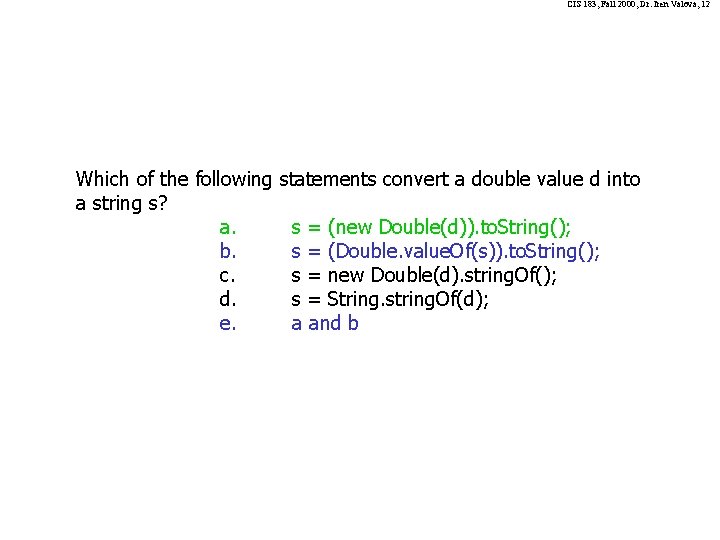
CIS 183, Fall 2000, Dr. Iren Valova, 12 Which of the following a string s? a. b. c. d. e. statements convert a double value d into s = (new Double(d)). to. String(); s = (Double. value. Of(s)). to. String(); s = new Double(d). string. Of(); s = String. string. Of(d); a and b
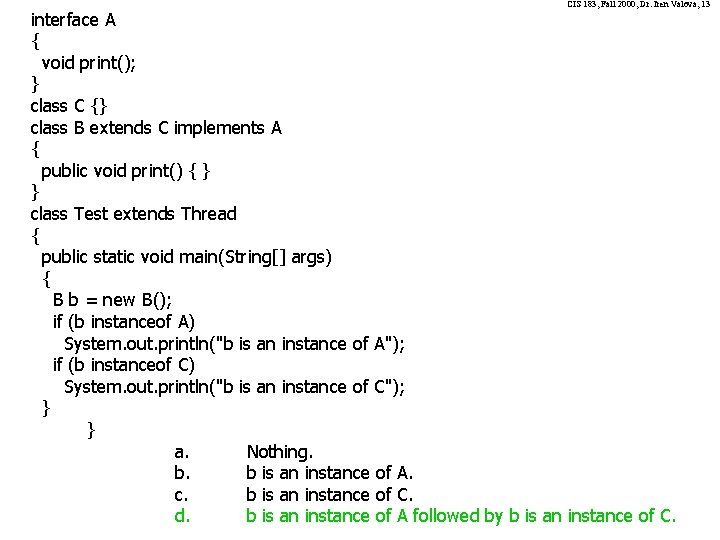
CIS 183, Fall 2000, Dr. Iren Valova, 13 interface A { void print(); } class C {} class B extends C implements A { public void print() { } } class Test extends Thread { public static void main(String[] args) { B b = new B(); if (b instanceof A) System. out. println("b is an instance of A"); if (b instanceof C) System. out. println("b is an instance of C"); } } a. Nothing. b. b is an instance of A. c. b is an instance of C. d. b is an instance of A followed by b is an instance of C.
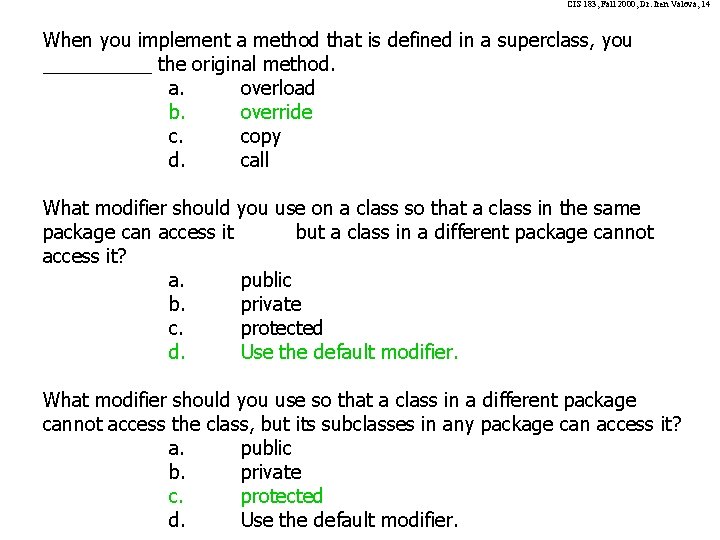
CIS 183, Fall 2000, Dr. Iren Valova, 14 When you implement a method that is defined in a superclass, you _____ the original method. a. overload b. override c. copy d. call What modifier should you use on a class so that a class in the same package can access it but a class in a different package cannot access it? a. public b. private c. protected d. Use the default modifier. What modifier should you use so that a class in a different package cannot access the class, but its subclasses in any package can access it? a. public b. private c. protected d. Use the default modifier.
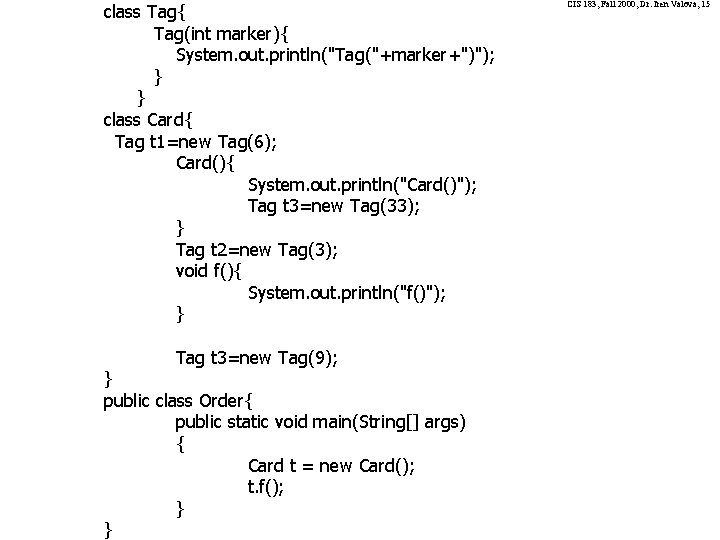
class Tag{ Tag(int marker){ System. out. println("Tag("+marker+")"); } } class Card{ Tag t 1=new Tag(6); Card(){ System. out. println("Card()"); Tag t 3=new Tag(33); } Tag t 2=new Tag(3); void f(){ System. out. println("f()"); } Tag t 3=new Tag(9); } public class Order{ public static void main(String[] args) { Card t = new Card(); t. f(); } } CIS 183, Fall 2000, Dr. Iren Valova, 15
q. A final class can have instances. CIS 183, Fall 2000, Dr. Iren Valova, 16 q. You cannot create an instance of an abstract class using the new operator. q. A final class can be extended. q. An abstract class can be extended. q. You can always successfully cast a subclass to a superclass. q. You can always successfully cast a superclass to a subclass. q. An interface can be a separate unit and can be compiled into a bytecode file. q. The order in which modifiers appear before a class or a method is important. q. Every class has a to. String() method an equals() method. q. The instanceof operator is used to determine whether an object is an instance of a certain class.