CHEM 312 Gamma Decay Readings Modern Nuclear Chemistry
- Slides: 31
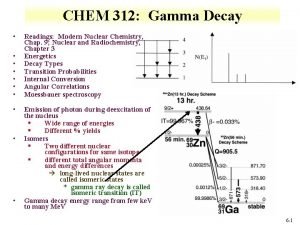
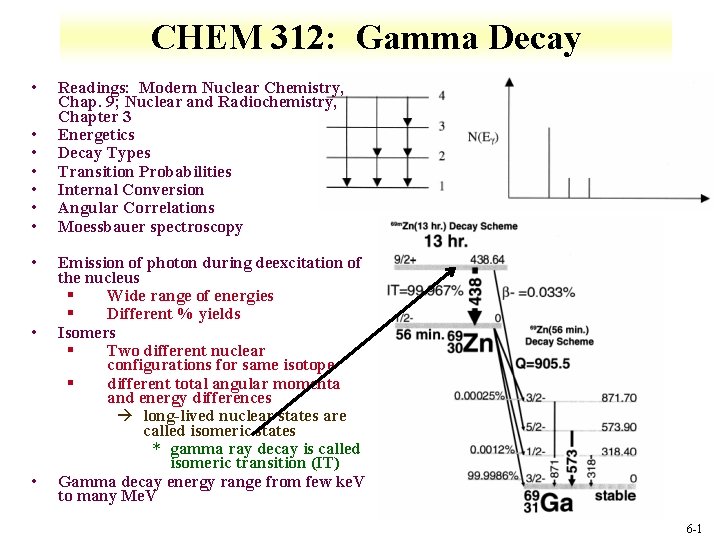
CHEM 312: Gamma Decay • • • Readings: Modern Nuclear Chemistry, Chap. 9; Nuclear and Radiochemistry, Chapter 3 Energetics Decay Types Transition Probabilities Internal Conversion Angular Correlations Moessbauer spectroscopy Emission of photon during deexcitation of the nucleus § Wide range of energies § Different % yields Isomers § Two different nuclear configurations for same isotope § different total angular momenta and energy differences à long lived nuclear states are called isomeric states * gamma ray decay is called isomeric transition (IT) Gamma decay energy range from few ke. V to many Me. V 6 -1
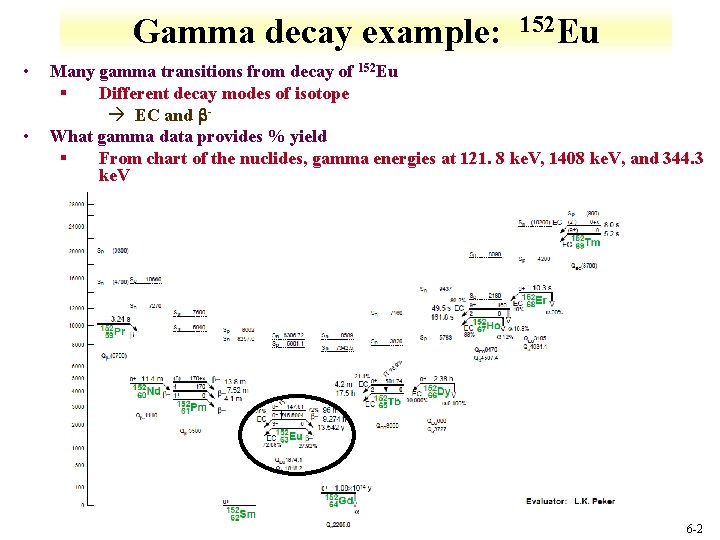
Gamma decay example: • • 152 Eu Many gamma transitions from decay of 152 Eu § Different decay modes of isotope à EC and What gamma data provides % yield § From chart of the nuclides, gamma energies at 121. 8 ke. V, 1408 ke. V, and 344. 3 ke. V 6 -2
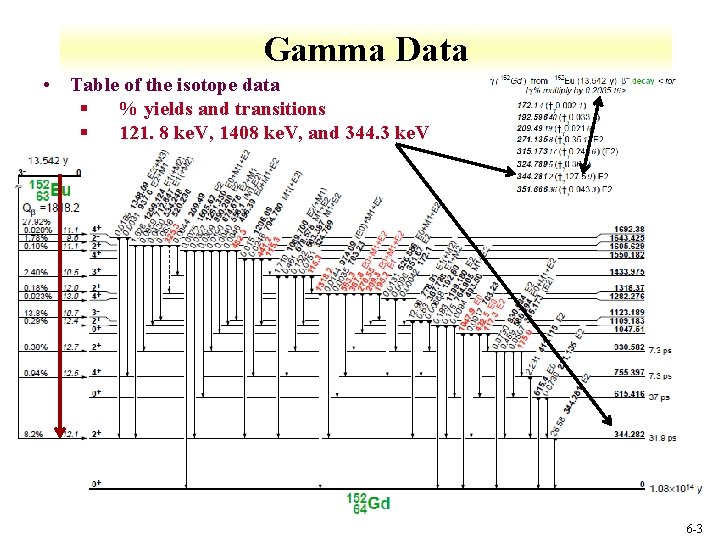
Gamma Data • Table of the isotope data § % yields and transitions § 121. 8 ke. V, 1408 ke. V, and 344. 3 ke. V 6 -3
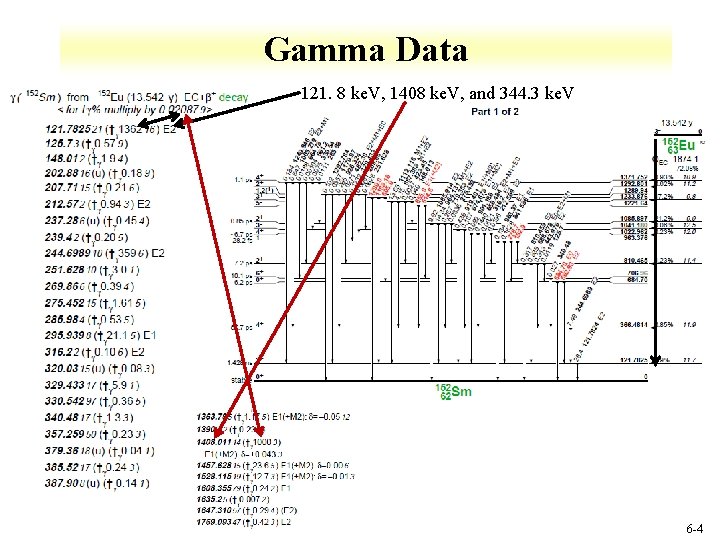
Gamma Data 121. 8 ke. V, 1408 ke. V, and 344. 3 ke. V 6 -4
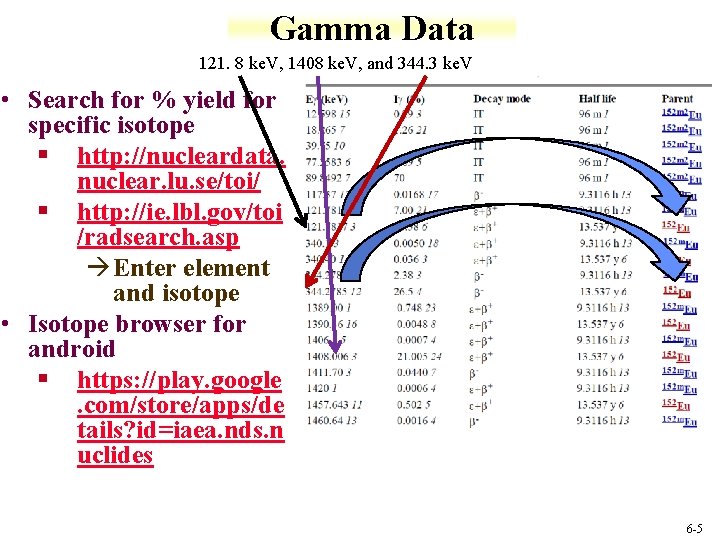
Gamma Data 121. 8 ke. V, 1408 ke. V, and 344. 3 ke. V • Search for % yield for specific isotope § http: //nucleardata. nuclear. lu. se/toi/ § http: //ie. lbl. gov/toi /radsearch. asp à Enter element and isotope • Isotope browser for android § https: //play. google. com/store/apps/de tails? id=iaea. nds. n uclides 6 -5
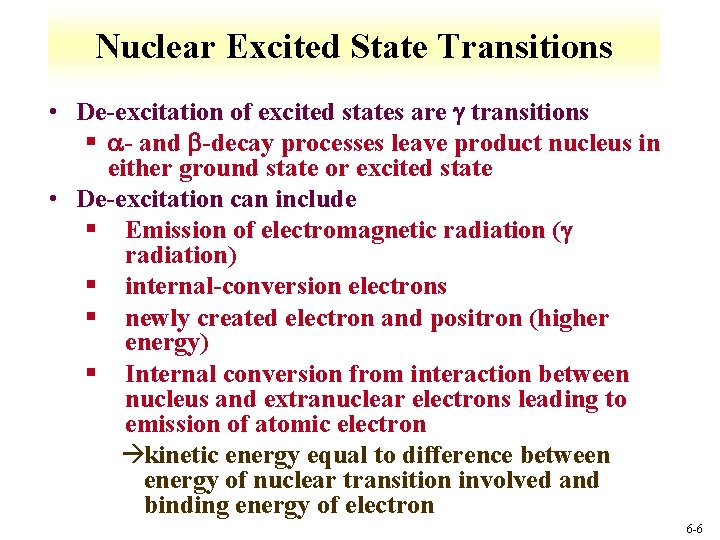
Nuclear Excited State Transitions • De excitation of excited states are transitions § and decay processes leave product nucleus in either ground state or excited state • De excitation can include § Emission of electromagnetic radiation ( radiation) § internal conversion electrons § newly created electron and positron (higher energy) § Internal conversion from interaction between nucleus and extranuclear electrons leading to emission of atomic electron àkinetic energy equal to difference between energy of nuclear transition involved and binding energy of electron 6 -6
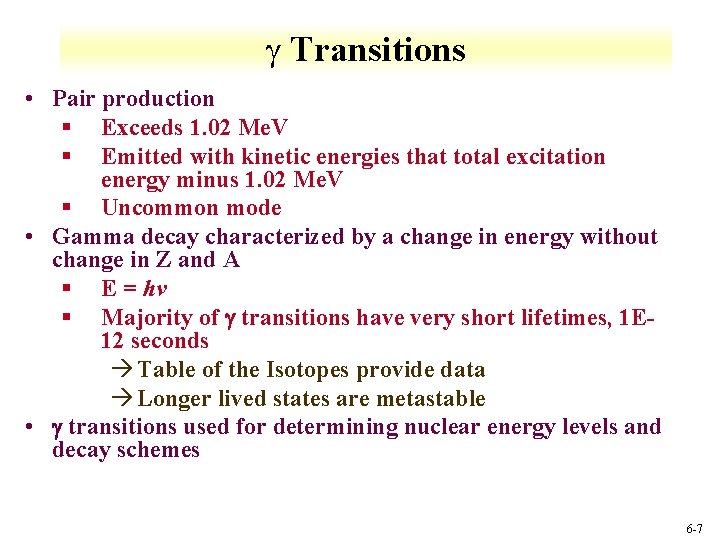
Transitions • Pair production § Exceeds 1. 02 Me. V § Emitted with kinetic energies that total excitation energy minus 1. 02 Me. V § Uncommon mode • Gamma decay characterized by a change in energy without change in Z and A § E = hv § Majority of transitions have very short lifetimes, 1 E 12 seconds à Table of the Isotopes provide data à Longer lived states are metastable • transitions used for determining nuclear energy levels and decay schemes 6 -7
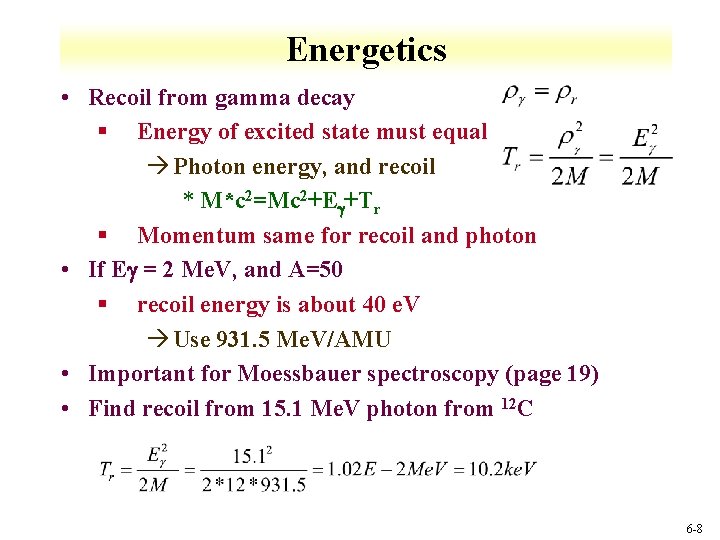
Energetics • Recoil from gamma decay § Energy of excited state must equal à Photon energy, and recoil * M*c 2=Mc 2+E +Tr § Momentum same for recoil and photon • If E = 2 Me. V, and A=50 § recoil energy is about 40 e. V à Use 931. 5 Me. V/AMU • Important for Moessbauer spectroscopy (page 19) • Find recoil from 15. 1 Me. V photon from 12 C 6 -8
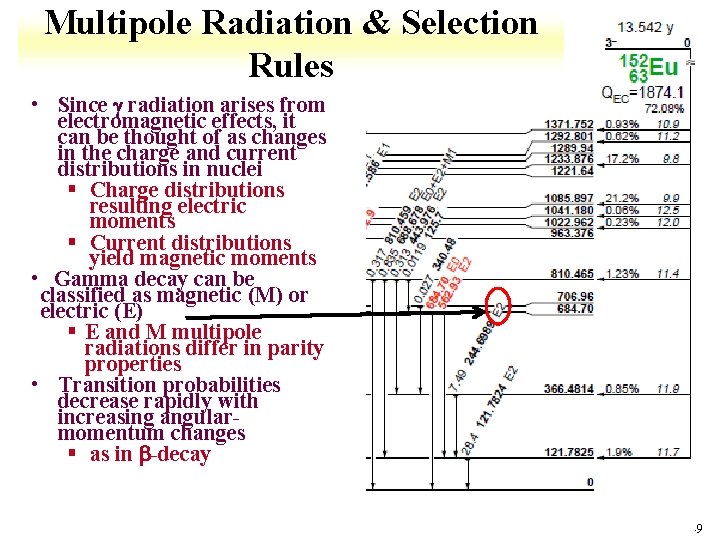
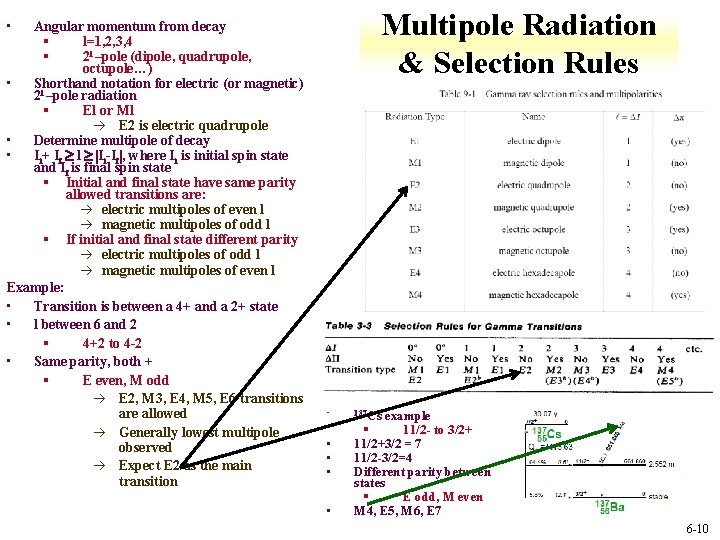
Multipole Radiation & Selection Rules • Since radiation arises from electromagnetic effects, it can be thought of as changes in the charge and current distributions in nuclei § Charge distributions resulting electric moments § Current distributions yield magnetic moments • Gamma decay can be classified as magnetic (M) or electric (E) § E and M multipole radiations differ in parity properties • Transition probabilities decrease rapidly with increasing angular momentum changes § as in decay 6 -9
Multipole Radiation & Selection Rules • Angular momentum from decay § l=1, 2, 3, 4 § 2 l –pole (dipole, quadrupole, octupole…) • Shorthand notation for electric (or magnetic) 2 l –pole radiation § El or Ml à E 2 is electric quadrupole • Determine multipole of decay • Ii+ If l Ii If , where Ii is initial spin state and If is final spin state § Initial and final state have same parity allowed transitions are: à electric multipoles of even l à magnetic multipoles of odd l § If initial and final state different parity à electric multipoles of odd l à magnetic multipoles of even l Example: • Transition is between a 4+ and a 2+ state • l between 6 and 2 § 4+2 to 4 2 • Same parity, both + § E even, M odd à E 2, M 3, E 4, M 5, E 6 transitions are allowed à Generally lowest multipole observed à Expect E 2 as the main transition • • • 137 Cs example § 11/2 to 3/2+ 11/2+3/2 = 7 11/2 3/2=4 Different parity between states § E odd, M even M 4, E 5, M 6, E 7 6 -10
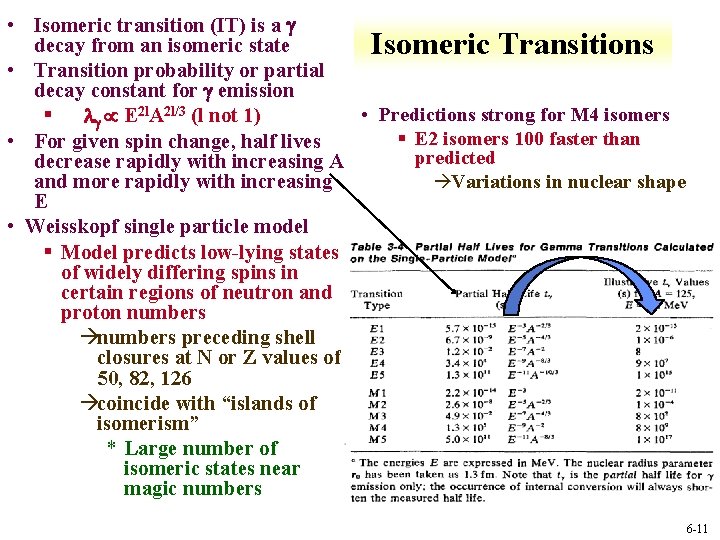
• Isomeric transition (IT) is a decay from an isomeric state Isomeric Transitions • Transition probability or partial decay constant for emission • Predictions strong for M 4 isomers § E 2 l. A 2 l/3 (l not 1) § E 2 isomers 100 faster than • For given spin change, half lives predicted decrease rapidly with increasing A and more rapidly with increasing àVariations in nuclear shape E • Weisskopf single particle model § Model predicts low lying states of widely differing spins in certain regions of neutron and proton numbers ànumbers preceding shell closures at N or Z values of 50, 82, 126 àcoincide with “islands of isomerism” * Large number of isomeric states near magic numbers 6 -11
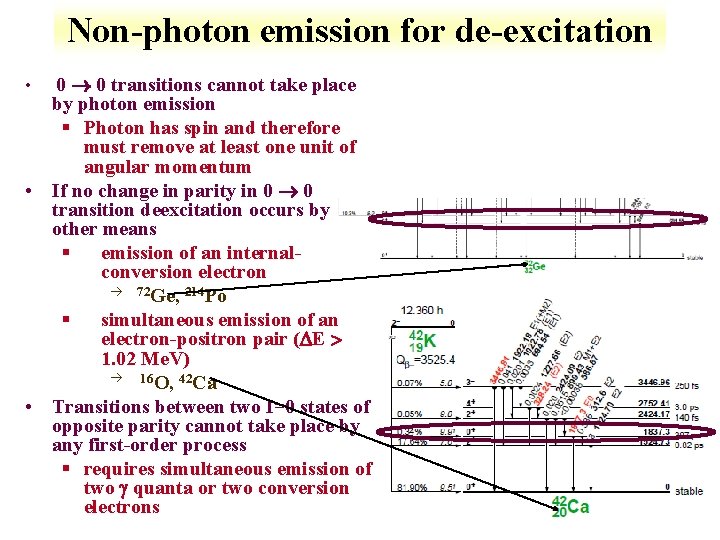
Non photon emission for de excitation 0 0 transitions cannot take place by photon emission § Photon has spin and therefore must remove at least one unit of angular momentum • If no change in parity in 0 0 transition deexcitation occurs by other means § emission of an internal conversion electron à 72 Ge, 214 Po § simultaneous emission of an electron positron pair ( E 1. 02 Me. V) à 16 O, 42 Ca • Transitions between two I=0 states of opposite parity cannot take place by any first order process § requires simultaneous emission of two quanta or two conversion electrons • 6 -12
Internal Conversion Coefficients • Excited nucleus ejects atomic electron § Discrete energy emission, only one particle § Generally k shell electrons • Interaction between nucleus and extranuclear electrons § emission of electron with kinetic energy equal to difference between energy of nuclear transition and electron binding energy • Internal conversion favored when: § energy gap between nuclear levels is small § 0+→ 0+ transitions 6 -13
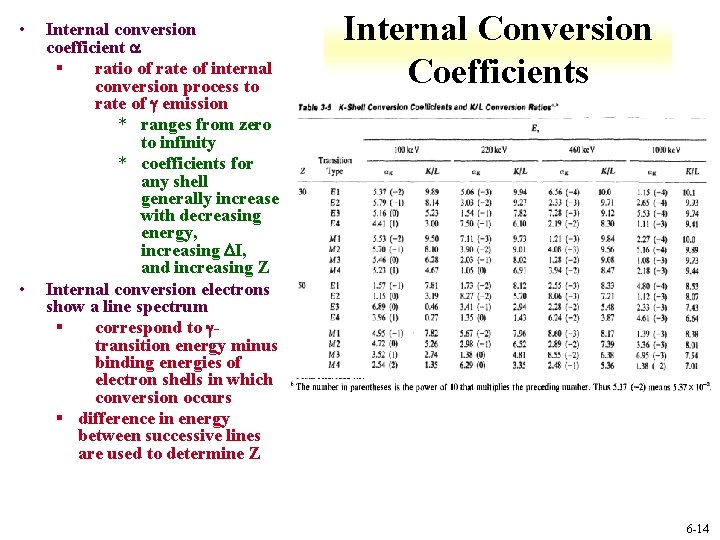
• • Internal conversion coefficient § ratio of rate of internal conversion process to rate of emission * ranges from zero to infinity * coefficients for any shell generally increase with decreasing energy, increasing I, and increasing Z Internal conversion electrons show a line spectrum § correspond to transition energy minus binding energies of electron shells in which conversion occurs § difference in energy between successive lines are used to determine Z Internal Conversion Coefficients 6 -14
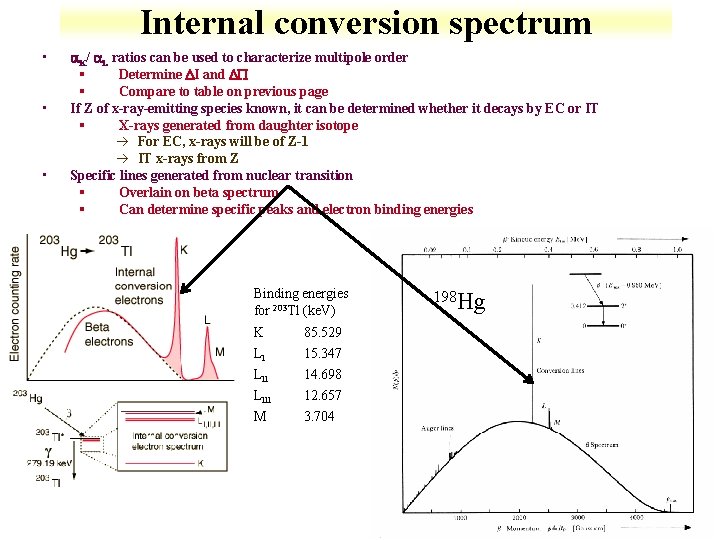
Internal conversion spectrum • • • K/ L ratios can be used to characterize multipole order § Determine I and § Compare to table on previous page If Z of x ray emitting species known, it can be determined whether it decays by EC or IT § X rays generated from daughter isotope à For EC, x rays will be of Z 1 à IT x rays from Z Specific lines generated from nuclear transition § Overlain on beta spectrum § Can determine specific peaks and electron binding energies Binding energies for 203 Tl (ke. V) K LI LIII M 198 Hg 85. 529 15. 347 14. 698 12. 657 3. 704 6 -15
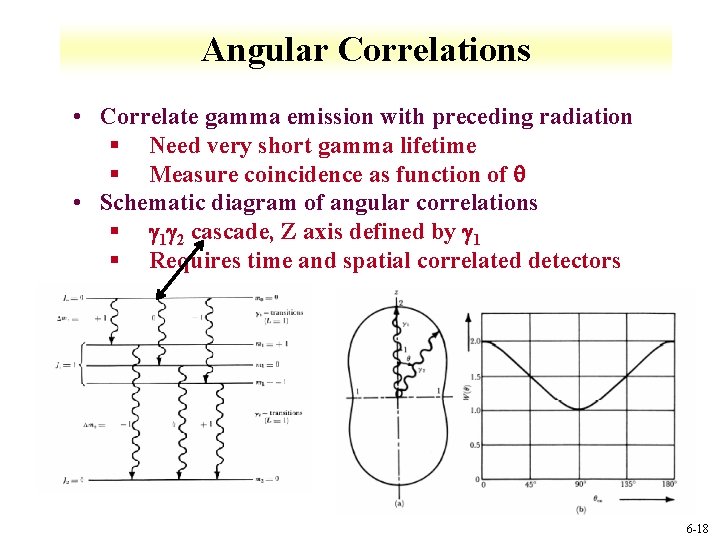
Angular Correlations of Gamma Decay • Assumes rays have no track of multipole interaction from production § In some cases multipole fields give rise to angular distributions of emitted radiation with respect to nuclear spin direction of emitting nucleus • Generally not observed during gamma decay § ordinarily samples contain randomly oriented nuclei § Observed angular distribution of rays is isotropic due to random orientation àWould be remove if nuclei aligned 6 -16
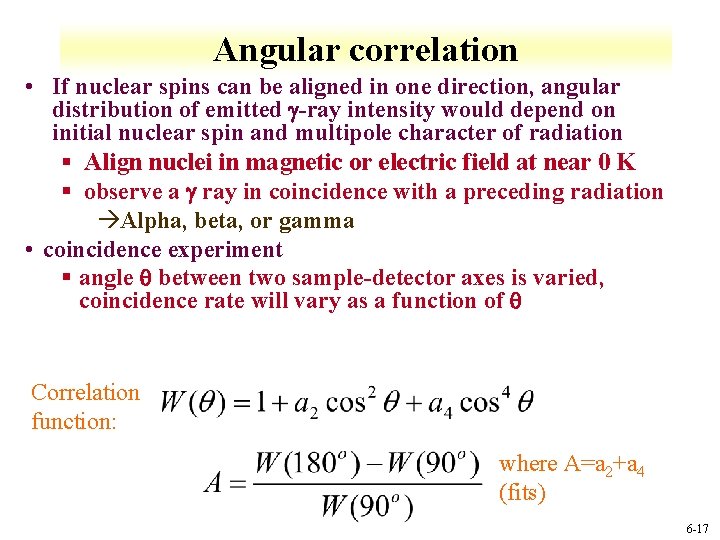
Angular correlation • If nuclear spins can be aligned in one direction, angular distribution of emitted ray intensity would depend on initial nuclear spin and multipole character of radiation § Align nuclei in magnetic or electric field at near 0 K § observe a ray in coincidence with a preceding radiation àAlpha, beta, or gamma • coincidence experiment § angle between two sample detector axes is varied, coincidence rate will vary as a function of Correlation function: where A=a 2+a 4 (fits) 6 -17
Angular Correlations • Correlate gamma emission with preceding radiation § Need very short gamma lifetime § Measure coincidence as function of • Schematic diagram of angular correlations § 1 2 cascade, Z axis defined by 1 § Requires time and spatial correlated detectors 6 -18
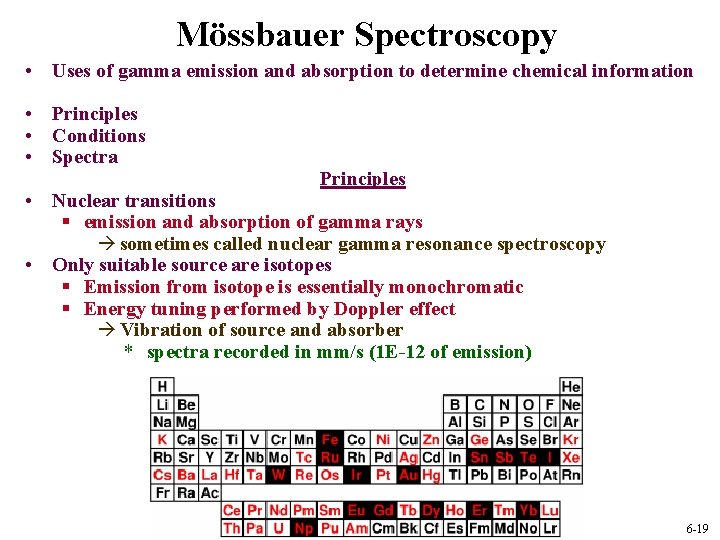
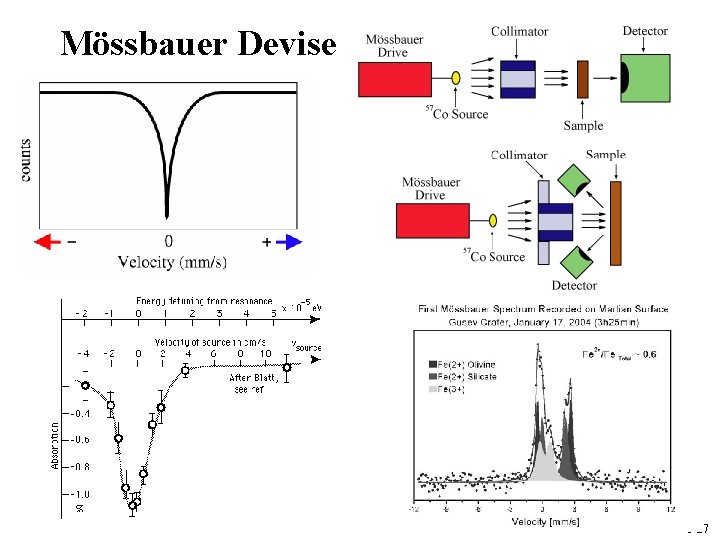
Mössbauer Spectroscopy • Uses of gamma emission and absorption to determine chemical information • Principles • Conditions • Spectra Principles • Nuclear transitions § emission and absorption of gamma rays à sometimes called nuclear gamma resonance spectroscopy • Only suitable source are isotopes § Emission from isotope is essentially monochromatic § Energy tuning performed by Doppler effect à Vibration of source and absorber * spectra recorded in mm/s (1 E 12 of emission) 6 -19
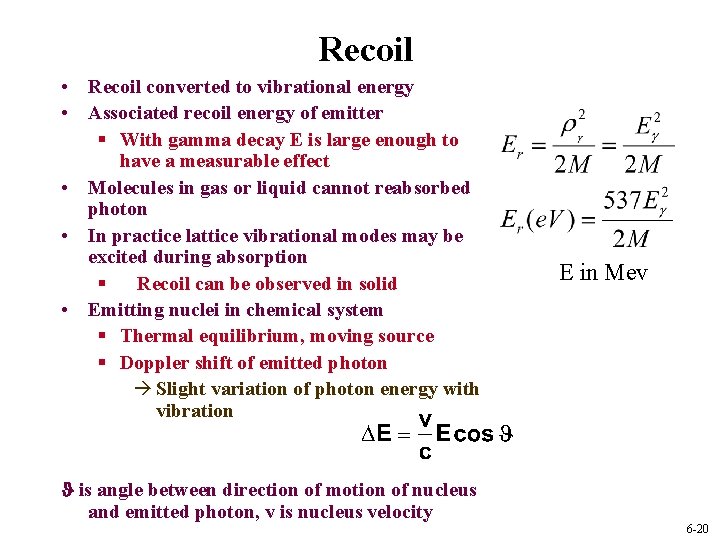
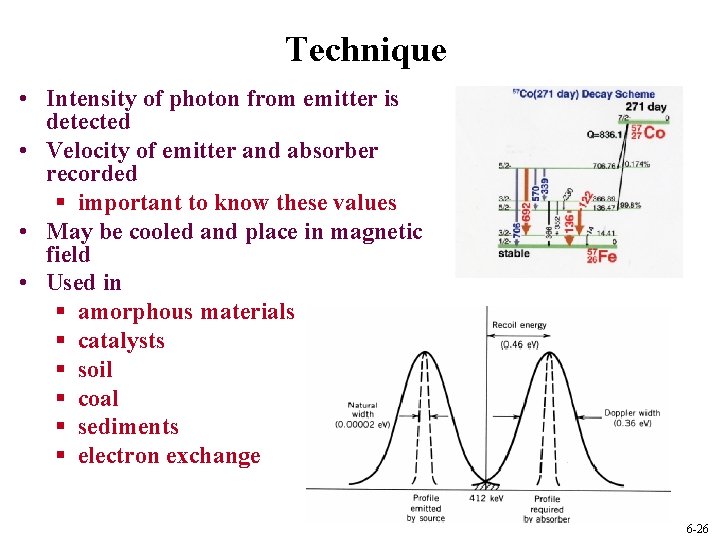
Recoil • Recoil converted to vibrational energy • Associated recoil energy of emitter § With gamma decay E is large enough to have a measurable effect • Molecules in gas or liquid cannot reabsorbed photon • In practice lattice vibrational modes may be excited during absorption § Recoil can be observed in solid • Emitting nuclei in chemical system § Thermal equilibrium, moving source § Doppler shift of emitted photon à Slight variation of photon energy with vibration E in Mev J is angle between direction of motion of nucleus and emitted photon, v is nucleus velocity 6 -20
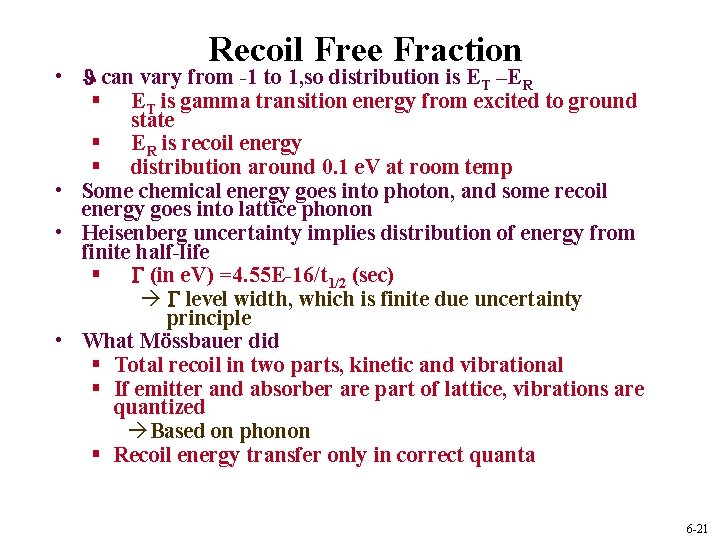
Recoil Free Fraction • J can vary from 1 to 1, so distribution is ET –ER § ET is gamma transition energy from excited to ground state § ER is recoil energy § distribution around 0. 1 e. V at room temp • Some chemical energy goes into photon, and some recoil energy goes into lattice phonon • Heisenberg uncertainty implies distribution of energy from finite half life § G (in e. V) =4. 55 E 16/t 1/2 (sec) à G level width, which is finite due uncertainty principle • What Mössbauer did § Total recoil in two parts, kinetic and vibrational § If emitter and absorber are part of lattice, vibrations are quantized àBased on phonon § Recoil energy transfer only in correct quanta 6 -21
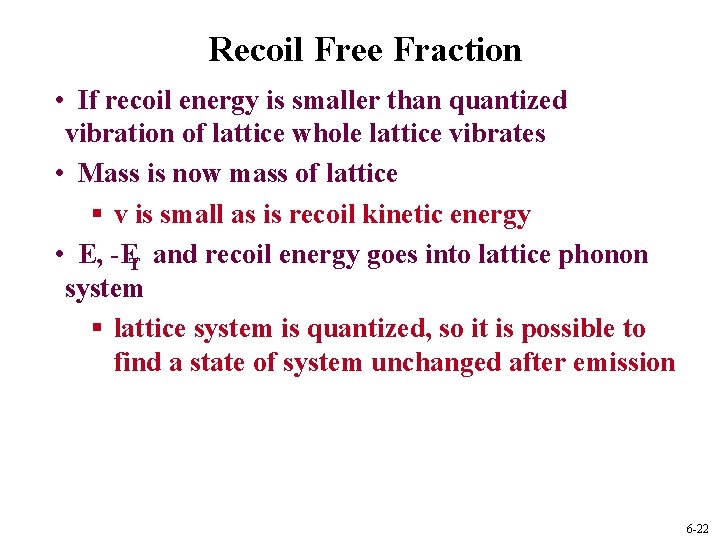
Recoil Free Fraction • If recoil energy is smaller than quantized vibration of lattice whole lattice vibrates • Mass is now mass of lattice § v is small as is recoil kinetic energy • E, ET and recoil energy goes into lattice phonon system § lattice system is quantized, so it is possible to find a state of system unchanged after emission 6 -22
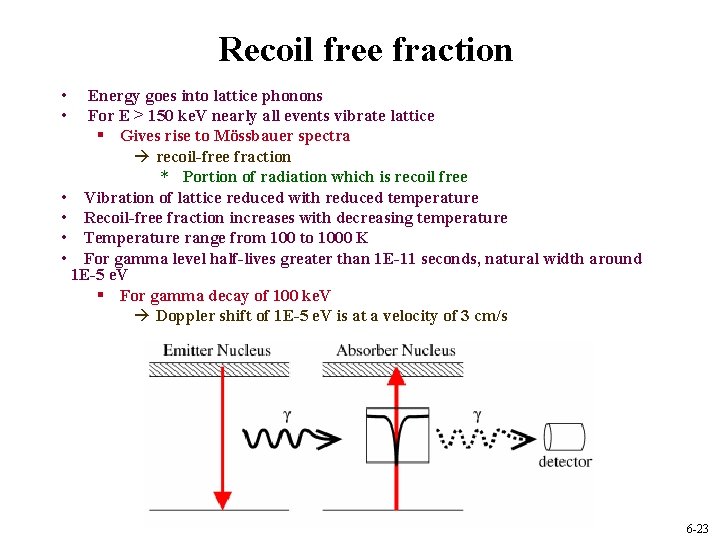
Recoil free fraction • • Energy goes into lattice phonons For E > 150 ke. V nearly all events vibrate lattice § Gives rise to Mössbauer spectra à recoil free fraction * Portion of radiation which is recoil free • Vibration of lattice reduced with reduced temperature • Recoil free fraction increases with decreasing temperature • Temperature range from 100 to 1000 K • For gamma level half lives greater than 1 E 11 seconds, natural width around 1 E 5 e. V § For gamma decay of 100 ke. V à Doppler shift of 1 E 5 e. V is at a velocity of 3 cm/s 6 -23
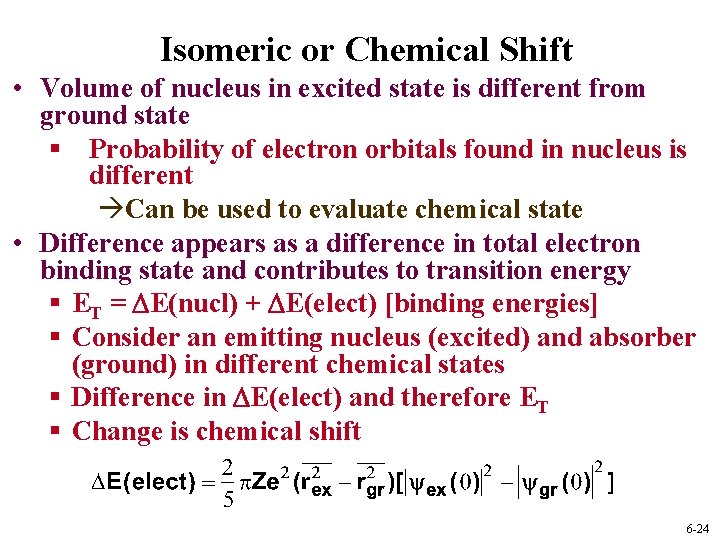
Isomeric or Chemical Shift • Volume of nucleus in excited state is different from ground state § Probability of electron orbitals found in nucleus is different àCan be used to evaluate chemical state • Difference appears as a difference in total electron binding state and contributes to transition energy § ET = E(nucl) + E(elect) [binding energies] § Consider an emitting nucleus (excited) and absorber (ground) in different chemical states § Difference in E(elect) and therefore ET § Change is chemical shift 6 -24
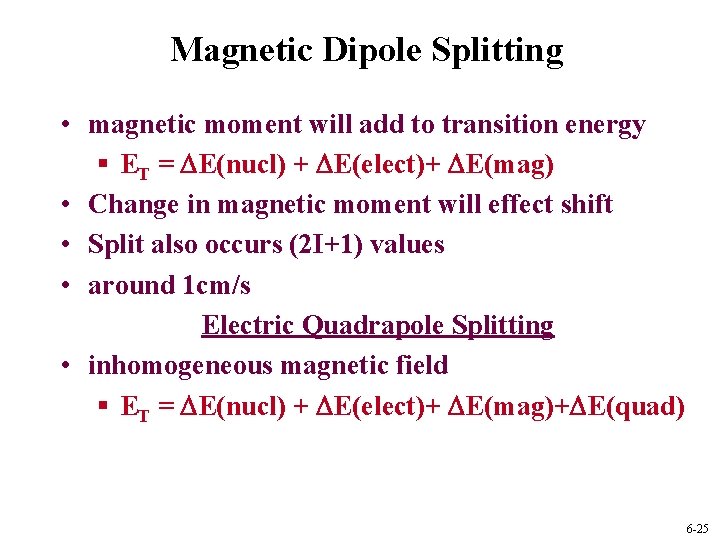
Magnetic Dipole Splitting • magnetic moment will add to transition energy § ET = E(nucl) + E(elect)+ E(mag) • Change in magnetic moment will effect shift • Split also occurs (2 I+1) values • around 1 cm/s Electric Quadrapole Splitting • inhomogeneous magnetic field § ET = E(nucl) + E(elect)+ E(mag)+ E(quad) 6 -25
Technique • Intensity of photon from emitter is detected • Velocity of emitter and absorber recorded § important to know these values • May be cooled and place in magnetic field • Used in § amorphous materials § catalysts § soil § coal § sediments § electron exchange 6 -26
Mössbauer Devise 6 -27
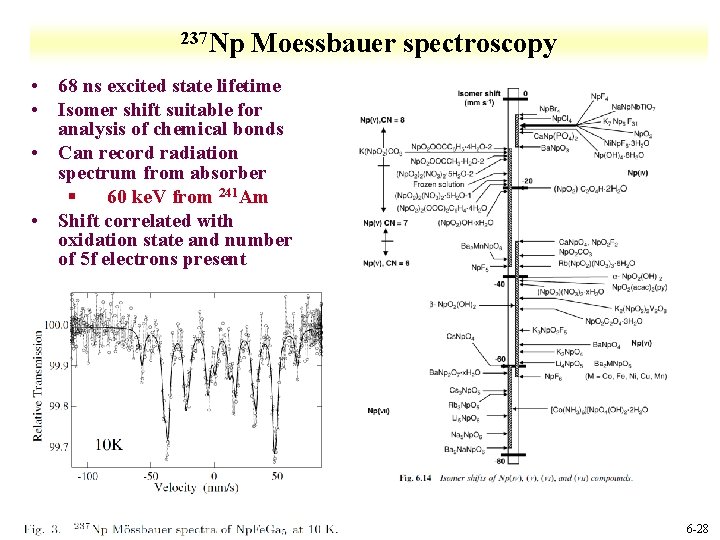
237 Np Moessbauer spectroscopy • 68 ns excited state lifetime • Isomer shift suitable for analysis of chemical bonds • Can record radiation spectrum from absorber § 60 ke. V from 241 Am • Shift correlated with oxidation state and number of 5 f electrons present 6 -28
Topic Review • Trends in gamma decay § How does it come about, how is it different from alpha and beta • Energetics of gamma decay • Decay Types § Photon emission, IC, pair production • E and M transitions § Probabilities, modes, and how to define • Angular Correlations § How are they measured and what do they inform about nucleus • Moessbauer spectroscopy 6 -29
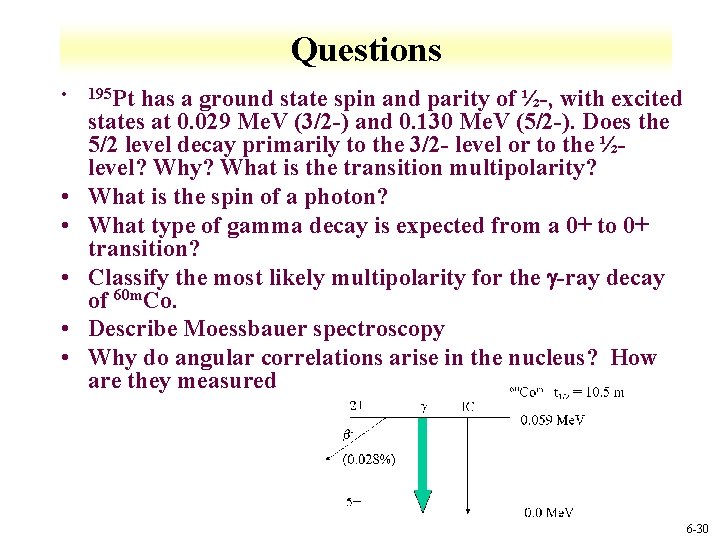
Questions • • • 195 Pt has a ground state spin and parity of ½ , with excited states at 0. 029 Me. V (3/2 ) and 0. 130 Me. V (5/2 ). Does the 5/2 level decay primarily to the 3/2 level or to the ½ level? Why? What is the transition multipolarity? What is the spin of a photon? What type of gamma decay is expected from a 0+ to 0+ transition? Classify the most likely multipolarity for the ray decay of 60 m. Co. Describe Moessbauer spectroscopy Why do angular correlations arise in the nucleus? How are they measured 6 -30
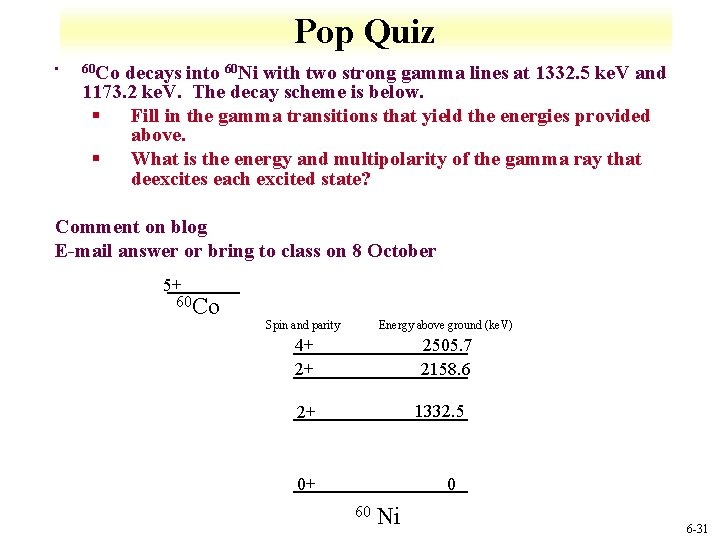
Pop Quiz • 60 Co decays into 60 Ni with two strong gamma lines at 1332. 5 ke. V and 1173. 2 ke. V. The decay scheme is below. § Fill in the gamma transitions that yield the energies provided above. § What is the energy and multipolarity of the gamma ray that deexcites each excited state? Comment on blog E mail answer or bring to class on 8 October 5+ 60 Co Spin and parity Energy above ground (ke. V) 4+ 2+ 2505. 7 2158. 6 1332. 5 2+ 0+ 0 60 Ni 6 -31