Chapter Eleven Pricing Strategies Copyright 2009 Pearson Education
- Slides: 48
Chapter Eleven Pricing Strategies Copyright © 2009 Pearson Education, Inc. Publishing as Prentice Hall Chapter 11 - slide
Pricing Products Topic Outline • • New-Product Pricing Strategies Product Mix Pricing Strategies Price Adjustment Strategies Price Changes Copyright © 2010 Pearson Education, Inc. Publishing as Prentice Hall Chapter 11 - slide 2
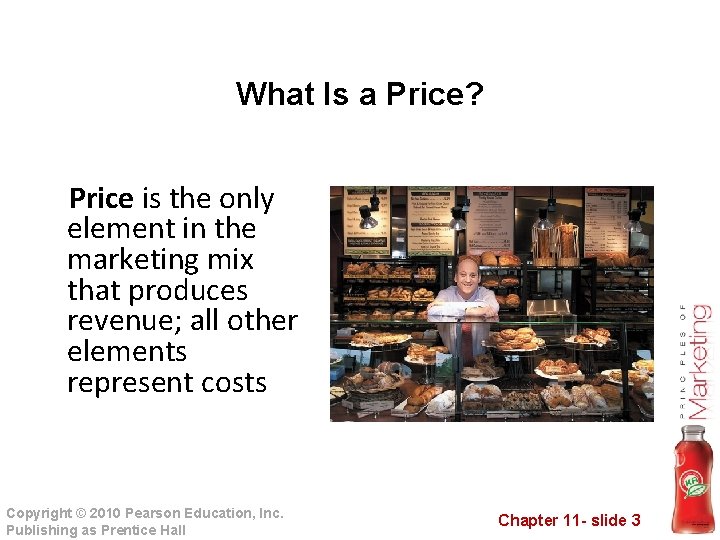
What Is a Price? Price is the only element in the marketing mix that produces revenue; all other elements represent costs Copyright © 2010 Pearson Education, Inc. Publishing as Prentice Hall Chapter 11 - slide 3
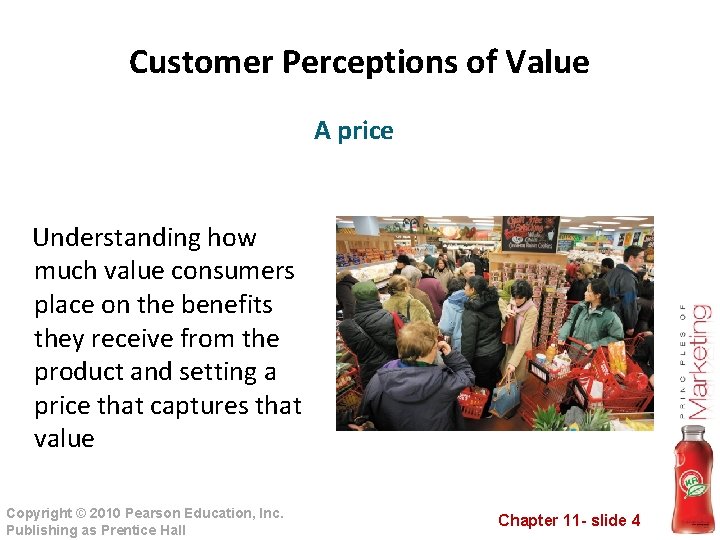
Customer Perceptions of Value A price Understanding how much value consumers place on the benefits they receive from the product and setting a price that captures that value Copyright © 2010 Pearson Education, Inc. Publishing as Prentice Hall Chapter 11 - slide 4
Price has many names: • • • Rent Tuition Fare Rate Commission Wage Copyright © 2010 Pearson Education, Inc. Publishing as Prentice Hall • • • Fee Dues Interest Donation Salary 14 -5 Chapter 11 - slide 5
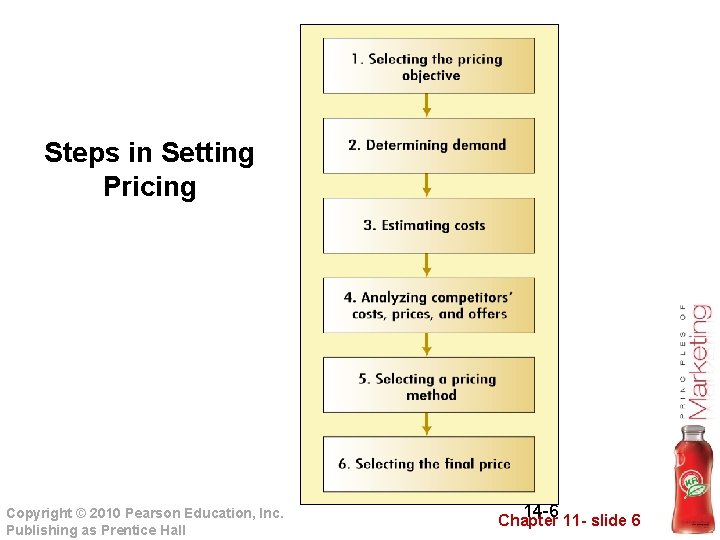
Steps in Setting Pricing Copyright © 2010 Pearson Education, Inc. Publishing as Prentice Hall 14 -6 Chapter 11 - slide 6
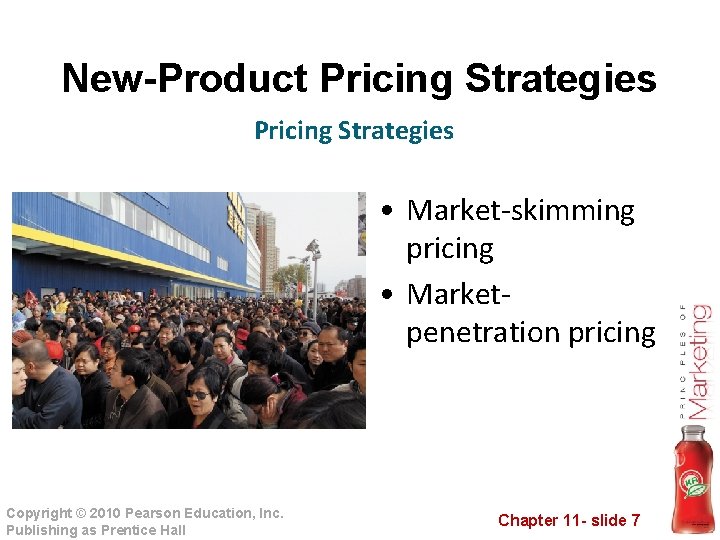
New-Product Pricing Strategies • Market-skimming pricing • Marketpenetration pricing Copyright © 2010 Pearson Education, Inc. Publishing as Prentice Hall Chapter 11 - slide 7
New-Product Pricing Strategies Market-skimming pricing is a strategy for setting a high price for a new product to skim maximum revenues layer by layer from the segments willing to pay the high price, the company make fewer but more profitable sales. • Product quality and image must support the price • Buyers must want the product at the price • Costs of producing the product in small volume should not cancel the advantage of higher prices • Competitors should not be able to enter the market easily Copyright © 2010 Pearson Education, Inc. Publishing as Prentice Hall Chapter 11 - slide 8
Market-skimming pricing • For example when Sony introduced the world first high definition television (HDTV) to the Japanese market , the high tech sets cost 43, 000$. These televisions were purchased only by customers who really wanted the new technology and afford to pay high prices. Copyright © 2010 Pearson Education, Inc. Publishing as Prentice Hall Chapter 11 - slide 9
New-Product Pricing Strategies Market-penetration pricing sets a low initial price in order to penetrate the market quickly and deeply to attract a large number of buyers quickly to gain market share • Price sensitive market • Production and distribution costs must fail as sales volume increases. • Low prices must keep competition out of the market Copyright © 2010 Pearson Education, Inc. Publishing as Prentice Hall Chapter 11 - slide 10
Market-penetration pricing • For example , Dell used penetration pricing to enter the personal computer market, selling high quality computer products through lower cost direct channels. Copyright © 2010 Pearson Education, Inc. Publishing as Prentice Hall Chapter 11 - slide 11
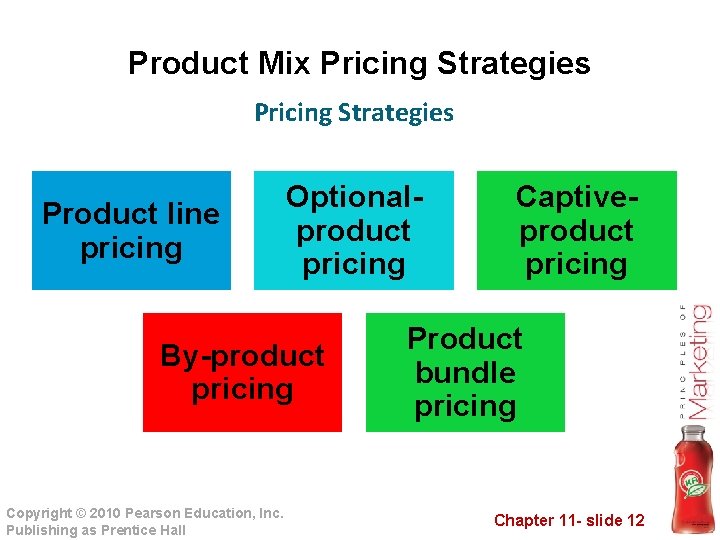
Product Mix Pricing Strategies Product line pricing Optionalproduct pricing By-product pricing Copyright © 2010 Pearson Education, Inc. Publishing as Prentice Hall Captiveproduct pricing Product bundle pricing Chapter 11 - slide 12
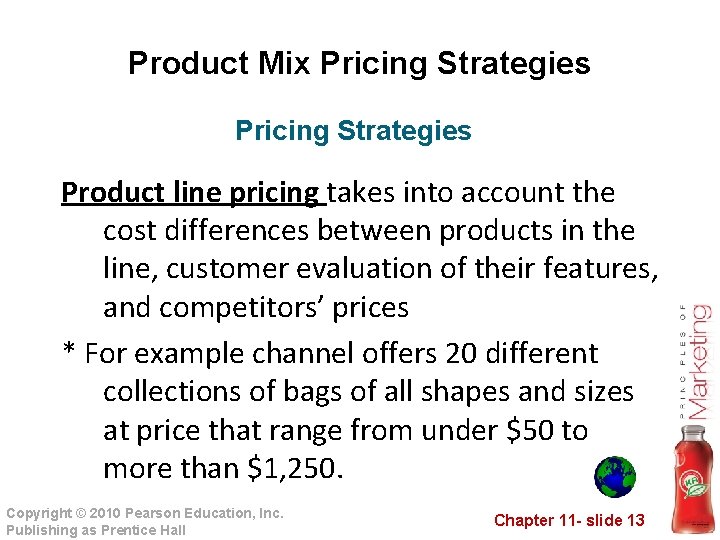
Product Mix Pricing Strategies Product line pricing takes into account the cost differences between products in the line, customer evaluation of their features, and competitors’ prices * For example channel offers 20 different collections of bags of all shapes and sizes at price that range from under $50 to more than $1, 250. Copyright © 2010 Pearson Education, Inc. Publishing as Prentice Hall Chapter 11 - slide 13
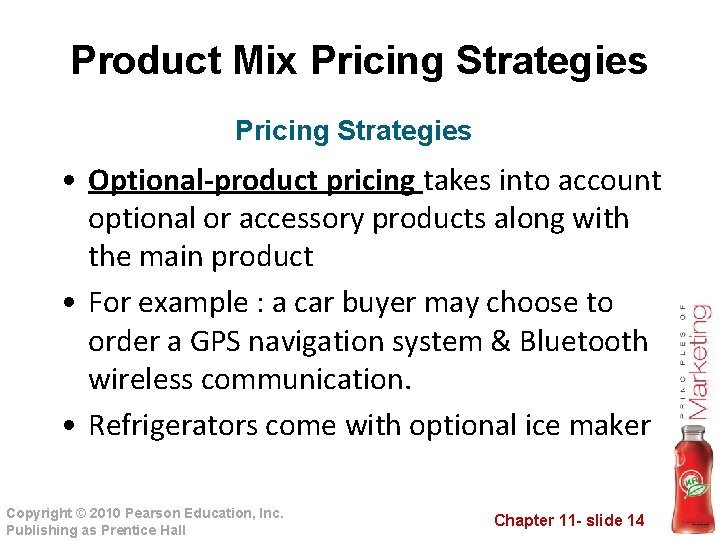
Product Mix Pricing Strategies • Optional-product pricing takes into account optional or accessory products along with the main product • For example : a car buyer may choose to order a GPS navigation system & Bluetooth wireless communication. • Refrigerators come with optional ice maker Copyright © 2010 Pearson Education, Inc. Publishing as Prentice Hall Chapter 11 - slide 14
Product Mix Pricing Strategies • Captive-product pricing involves products that must be used along with the main product • Examples of Captive products are razor blade cartridges , Gillette once you bought the razor, you are committed to buying replacement cartridges at $25 an eight pack. Chapter 11 - slide 15 Copyright © 2010 Pearson Education, Inc. Publishing as Prentice Hall
Product Mix Pricing Strategies • Two-part pricing involves breaking the price into: – Fixed fee – Variable usage fee – For example : Jawwal company charge a flat rate for a basic calling plan, then charge for minutes over what the plan allows. The service firm must decide how much to charge for the basic service and how much for the variable usage. – Another example is when you visit a park , you pay a ticket charge + fee for food and additional features Copyright © 2010 Pearson Education, Inc. Publishing as Prentice Hall Chapter 11 - slide 16
Price Mix Pricing Strategies • By-product pricing refers to products with little or no value produced as a result of the main product. Producers will seek little or no profit other than the cost to cover storage and delivery. • petroleum products often results in byproducts. Copyright © 2010 Pearson Education, Inc. Publishing as Prentice Hall Chapter 11 - slide 17
Price Mix Pricing Strategies Product bundle pricing combines several products at a reduced price For example : fast food restaurants bundle a burger , fries and a soft drink at a combo price Copyright © 2010 Pearson Education, Inc. Publishing as Prentice Hall Chapter 11 - slide 18
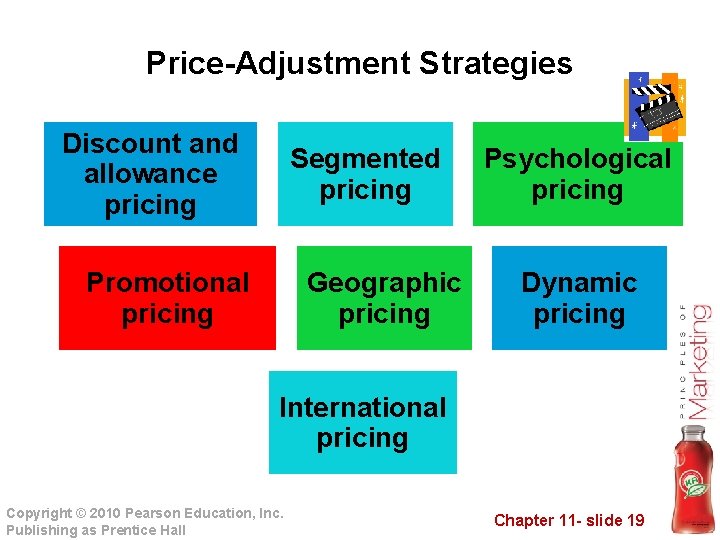
Price-Adjustment Strategies Discount and allowance pricing Segmented pricing Promotional pricing Geographic pricing Psychological pricing Dynamic pricing International pricing Copyright © 2010 Pearson Education, Inc. Publishing as Prentice Hall Chapter 11 - slide 19
Price-Adjustment Strategies Pricing Strategies Discount and allowance pricing reduces prices to reward customer responses such as paying early or promoting the product • Discounts • Allowances Copyright © 2010 Pearson Education, Inc. Publishing as Prentice Hall Chapter 11 - slide 20
Price-Adjustment Strategies Price Discounts and Allowances Quantity discount: The more you buy, the cheaper it becomes-- cumulative and non-cumulative. Trade discounts” functional”: Reductions from list for functions performed-- storage, promotion. Cash discount: A deduction granted to buyers for paying their bills within a specified period of time, (after first deducting trade and quantity discounts from the base price) Copyright © 2010 Pearson Education, Inc. Publishing as Prentice Hall Chapter 11 - slide 21
Price-Adjustment Strategies Functional discount: discount offered by a manufacturer to trade-channel members if they will perform certain functions. Seasonal discount: a price reduction to those who buy out of season. Allowance: an extra payment designed to gain reseller participation in special programs. a) Trade in allowances: are price reductions given for turning in an old item when buying a new one ( Automobiles industry) b) Promotional allowances: are payments or price reductions to reward dealer for participating in advertising and sales support program Copyright © 2010 Pearson Education, Inc. Publishing as Prentice Hall Chapter 11 - slide 22
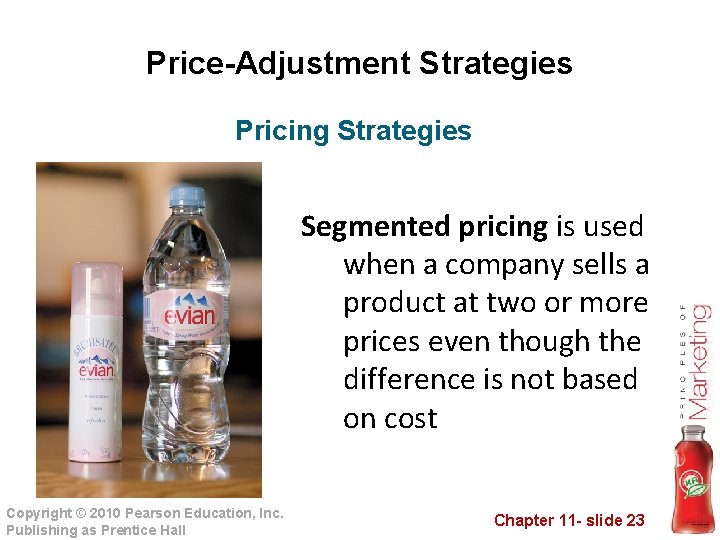
Price-Adjustment Strategies Pricing Strategies Segmented pricing is used when a company sells a product at two or more prices even though the difference is not based on cost Copyright © 2010 Pearson Education, Inc. Publishing as Prentice Hall Chapter 11 - slide 23
Segmented pricing a) Customer segment pricing: different customers pay different prices for the same product or service. For ex. Museums charge a lower admission for students. b) Product from pricing: different versions of the product are priced differently but not according to differences in their costs c) Location pricing: company charges different prices for different locations d) Time pricing : a firm varies it prices by the season , the month , the day and even the hour Copyright © 2010 Pearson Education, Inc. Publishing as Prentice Hall Chapter 11 - slide 24
Price-Adjustment Strategies Pricing Strategies Segmented Pricing To be effective: • Market must be segmentable • Segments must show different degrees of demand • Watching the market cannot exceed the extra revenue obtained from the price difference • Must be legal Copyright © 2010 Pearson Education, Inc. Publishing as Prentice Hall Chapter 11 - slide 25
Price-Adjustment Strategies Pricing Strategies • Psychological pricing occurs when sellers consider the psychology of prices and not simply the economics” the price is used to say something about the product” • Reference prices are prices that buyers carry in their minds and refer to when looking at a given product – Noting current prices – Remembering past prices – Assessing the buying situations – For example : a company could display its product next to more expensive ones in order to imply that it belongs in the same class Copyright © 2010 Pearson Education, Inc. Publishing as Prentice Hall Chapter 11 - slide 26
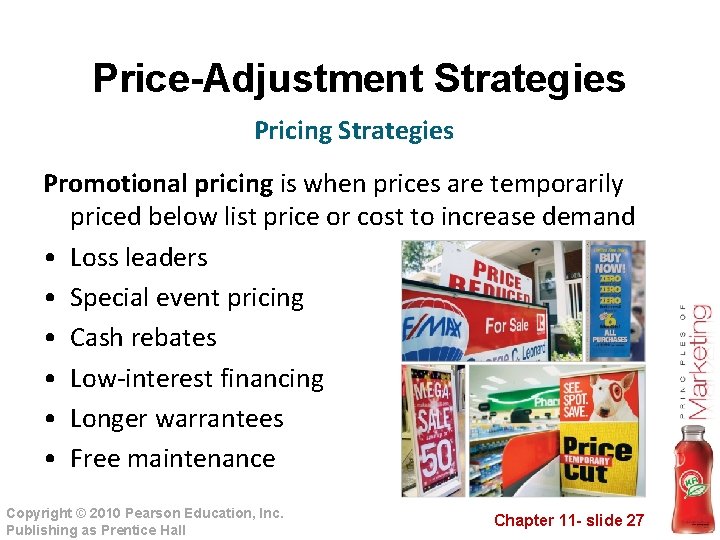
Price-Adjustment Strategies Pricing Strategies Promotional pricing is when prices are temporarily priced below list price or cost to increase demand • Loss leaders • Special event pricing • Cash rebates • Low-interest financing • Longer warrantees • Free maintenance Copyright © 2010 Pearson Education, Inc. Publishing as Prentice Hall Chapter 11 - slide 27
Price-Adjustment strategies Promotional Pricing • Loss-leader pricing: supermarkets and department stores often drop the price on well known brands to stimulate additional store traffic • Special-event pricing: sellers well establish special pricing in certain seasons to draw in more customers • Cash rebates: companies offer cash rebates to encourage purchase of the manufacturers products within a specified time period • Low-interest financing: the company can offer customers low -interest financing Copyright © 2010 Pearson Education, Inc. Publishing as Prentice Hall Chapter 11 - slide 28
Price-Adjustment strategies • Longer payment terms: sellers especially mortgage banks and auto companies stretch loans over longer periods and thus lower the monthly payment • Warranties and service contracts: companies can promote sales by adding a free or low cost warranty or service contract Copyright © 2010 Pearson Education, Inc. Publishing as Prentice Hall Chapter 11 - slide 29
Price-Adjustment Strategies Pricing Strategies Risks of promotional pricing • Used too frequently, and copies by competitors can create “deal-prone” customers who will wait for promotions and avoid buying at regular price • Creates price wars Copyright © 2010 Pearson Education, Inc. Publishing as Prentice Hall Chapter 11 - slide 30
Price-Adjustment Strategies Pricing Strategies Geographical pricing is used for customers in different parts of the country or the world • FOB pricing • Uniformed-delivery pricing • Zone pricing • Basing-point pricing • Freight-absorption pricing Copyright © 2010 Pearson Education, Inc. Publishing as Prentice Hall Chapter 11 - slide 31
Price-Adjustment Strategies Pricing Strategies • FOB (free on board) pricing means that the goods are delivered to the carrier and the title and responsibility passes to the customer • Uniformed-delivery pricing means the company charges the same price plus freight to all customers, regardless of location Copyright © 2010 Pearson Education, Inc. Publishing as Prentice Hall Chapter 11 - slide 32
Price Adjustment Strategies Pricing Strategies • Zone pricing means that the company sets up two or more zones where customers within a given zone pay a single total price • Basing-point pricing means that a seller selects a given city as a “basing point” and charges all customers the freight cost associated from that city to the customer location, regardless of the city from which the goods are actually shipped Copyright © 2010 Pearson Education, Inc. Publishing as Prentice Hall Chapter 11 - slide 33
Price-Adjustment Strategies Pricing Strategies • Freight-absorption pricing means the seller absorbs all or part of the actual freight charge as an incentive to attract business in competitive markets Copyright © 2010 Pearson Education, Inc. Publishing as Prentice Hall Chapter 11 - slide 34
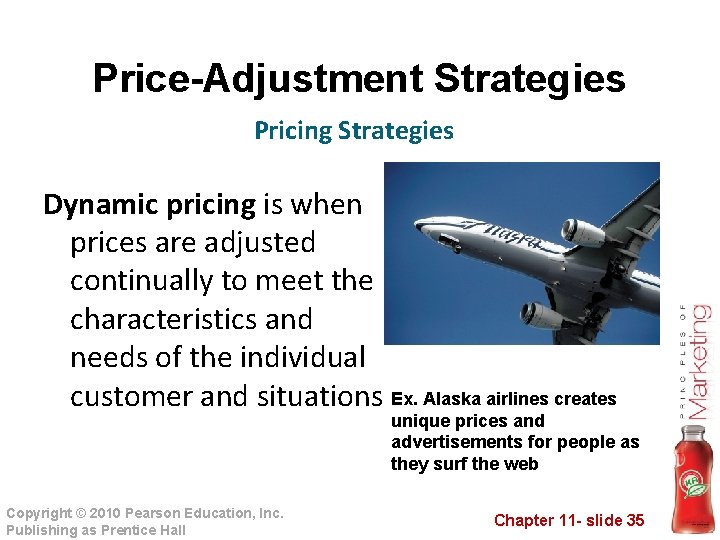
Price-Adjustment Strategies Pricing Strategies Dynamic pricing is when prices are adjusted continually to meet the characteristics and needs of the individual customer and situations Ex. Alaska airlines creates unique prices and advertisements for people as they surf the web Copyright © 2010 Pearson Education, Inc. Publishing as Prentice Hall Chapter 11 - slide 35
Price-Adjustment Strategies Pricing Strategies International pricing is when prices are set in a specific country based on country-specific factors • Economic conditions • Competitive conditions • Laws and regulations • Infrastructure • Company marketing objective Copyright © 2010 Pearson Education, Inc. Publishing as Prentice Hall Chapter 11 - slide 36
International pricing • For example : Boeing sells its jetliners at about the same price everywhere, whether in the United states , Europe or the third world • A pair of Levi’s selling for $30 in Canada might go for $ 63 in Tokyo and $ 88 in Paris Copyright © 2010 Pearson Education, Inc. Publishing as Prentice Hall Chapter 11 - slide 37
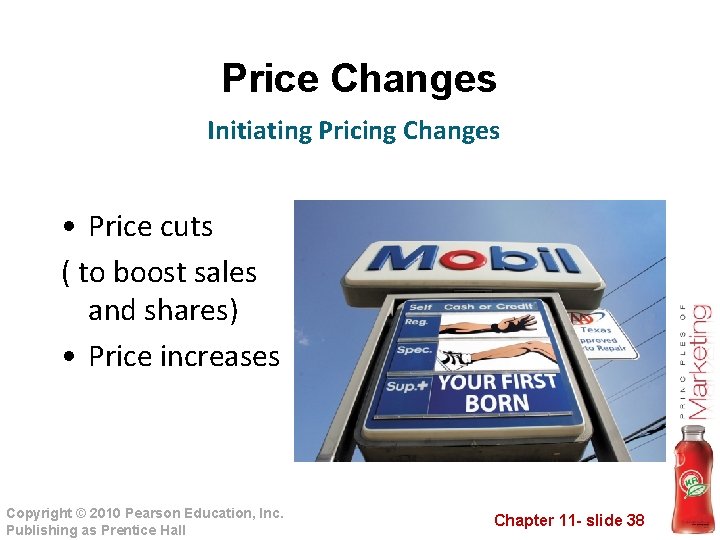
Price Changes Initiating Pricing Changes • Price cuts ( to boost sales and shares) • Price increases Copyright © 2010 Pearson Education, Inc. Publishing as Prentice Hall Chapter 11 - slide 38
Price Changes Initiating Pricing Changes Price cuts occur due to: • Excess capacity • Increased market share Price increase from: • Cost inflation • Increased demand • Lack of supply Copyright © 2010 Pearson Education, Inc. Publishing as Prentice Hall Chapter 11 - slide 39
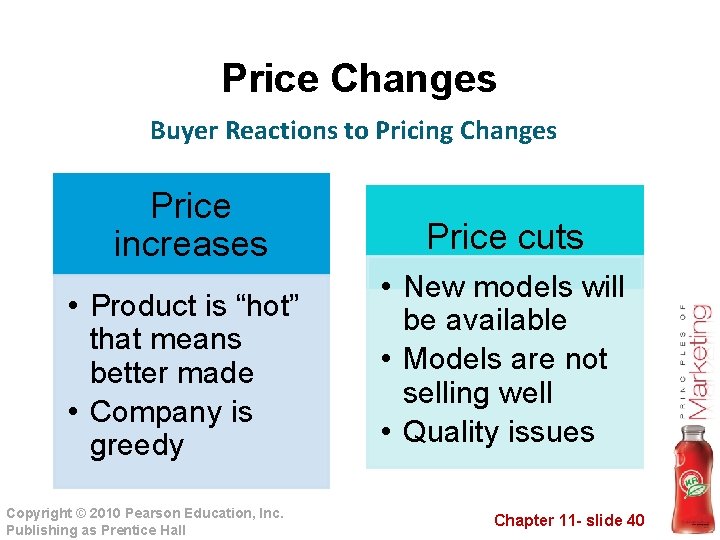
Price Changes Buyer Reactions to Pricing Changes Price increases Price cuts • Product is “hot” that means better made • Company is greedy • New models will be available • Models are not selling well • Quality issues Copyright © 2010 Pearson Education, Inc. Publishing as Prentice Hall Chapter 11 - slide 40
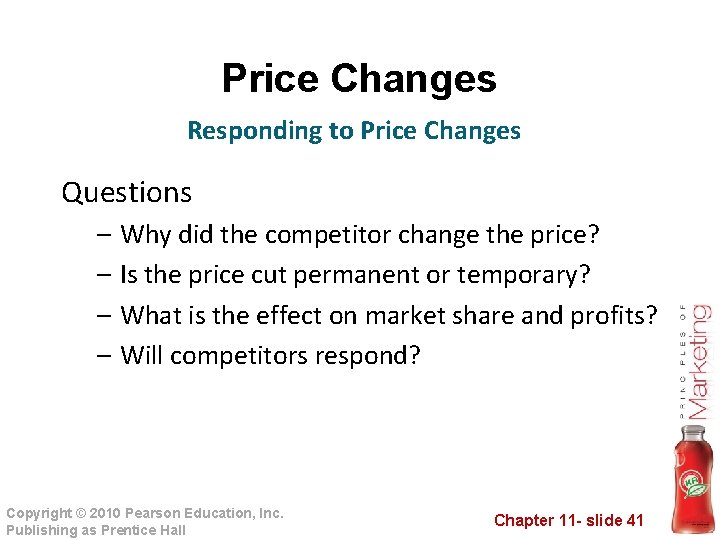
Price Changes Responding to Price Changes Questions – Why did the competitor change the price? – Is the price cut permanent or temporary? – What is the effect on market share and profits? – Will competitors respond? Copyright © 2010 Pearson Education, Inc. Publishing as Prentice Hall Chapter 11 - slide 41
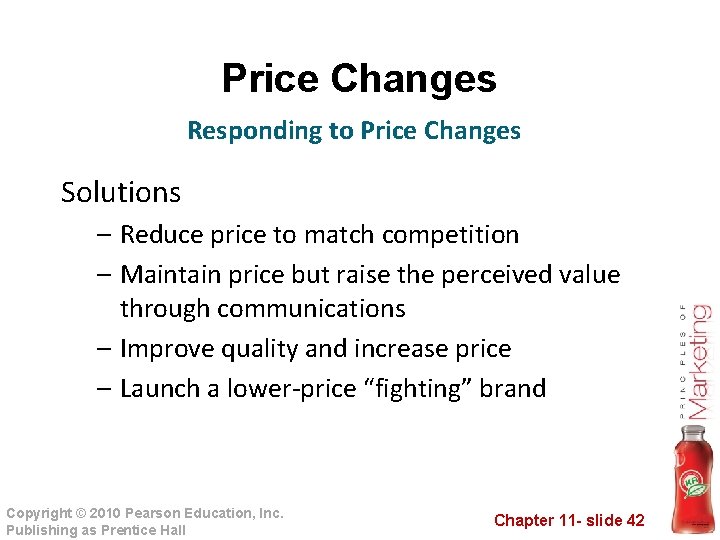
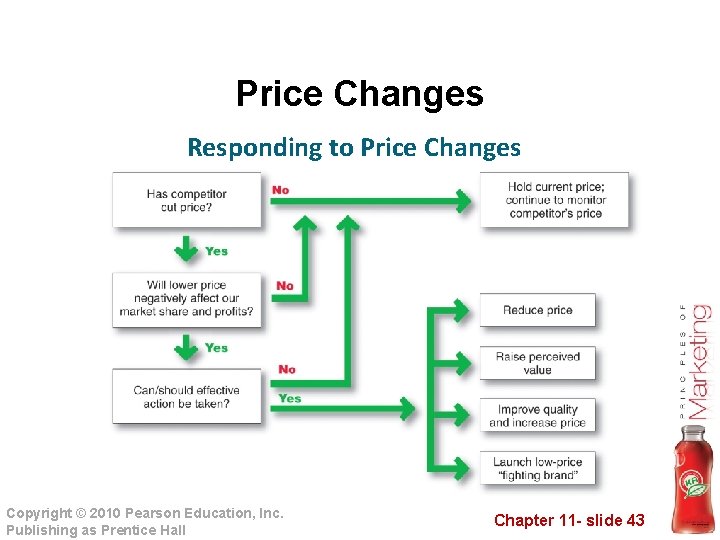
Price Changes Responding to Price Changes Solutions – Reduce price to match competition – Maintain price but raise the perceived value through communications – Improve quality and increase price – Launch a lower-price “fighting” brand Copyright © 2010 Pearson Education, Inc. Publishing as Prentice Hall Chapter 11 - slide 42
Price Changes Responding to Price Changes Copyright © 2010 Pearson Education, Inc. Publishing as Prentice Hall Chapter 11 - slide 43
Public Policy and Pricing Within Channel Levels Price fixing: Sellers must set prices without talking to competitors Predatory pricing: Selling below cost with the intention of punishing a competitor or gaining higher long-term profits by putting competitors out of business , this will protect small sellers from larger ones Copyright © 2010 Pearson Education, Inc. Publishing as Prentice Hall Chapter 11 - slide 44
Public Policy and Pricing Across Channel Levels Robinson-Patman Act prevents unfair price discrimination by ensuring that the seller offer the same price terms to customers at a given level of trade Copyright © 2010 Pearson Education, Inc. Publishing as Prentice Hall Chapter 11 - slide 45
Public Policy and Pricing Across Channel Levels Robinson-Patman Act • Price discrimination is allowed: – If the seller can prove that costs differ when selling to different retailers – If the seller manufactures different qualities of the same product for different retailers Copyright © 2010 Pearson Education, Inc. Publishing as Prentice Hall Chapter 11 - slide 46
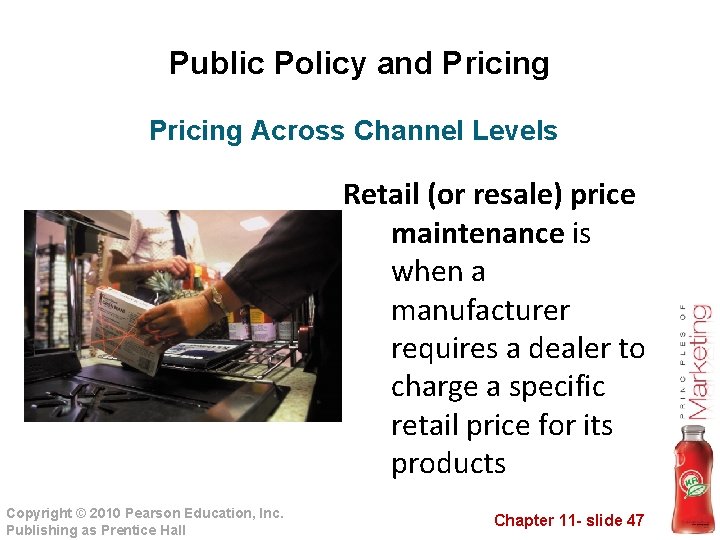
Public Policy and Pricing Across Channel Levels Retail (or resale) price maintenance is when a manufacturer requires a dealer to charge a specific retail price for its products Copyright © 2010 Pearson Education, Inc. Publishing as Prentice Hall Chapter 11 - slide 47
Public Policy and Pricing Across Channel Levels Deceptive pricing occurs when a seller states prices or price savings that mislead consumers or are not actually available to consumers • Scanner fraud failure of the seller to enter current or sale prices into the computer system • Price confusion results when firms employ pricing methods that make it difficult for consumers to understand what price they are really paying Copyright © 2010 Pearson Education, Inc. Publishing as Prentice Hall Chapter 11 - slide 48