Chapter 7 ARP and RARP Prof Choong Seon
- Slides: 33
Chapter 7 ARP and RARP Prof. Choong Seon HONG Kyung Hee University 1
Introduction q The logical addresses in TCP/IP protocol suite are IP addresses q Physical address is usually implemented in hardware Ex) 48 -bit MAC addresses in Ethernet and Token ring protocols, which are imprinted on the NIC installed in the host or router Kyung Hee University 2
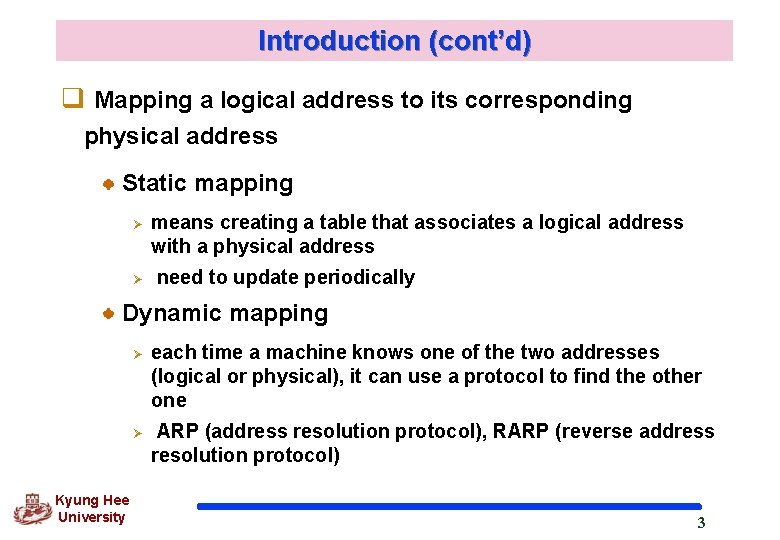
Introduction (cont’d) q Mapping a logical address to its corresponding physical address Static mapping Ø Ø means creating a table that associates a logical address with a physical address need to update periodically Dynamic mapping Ø Ø Kyung Hee University each time a machine knows one of the two addresses (logical or physical), it can use a protocol to find the other one ARP (address resolution protocol), RARP (reverse address resolution protocol) 3
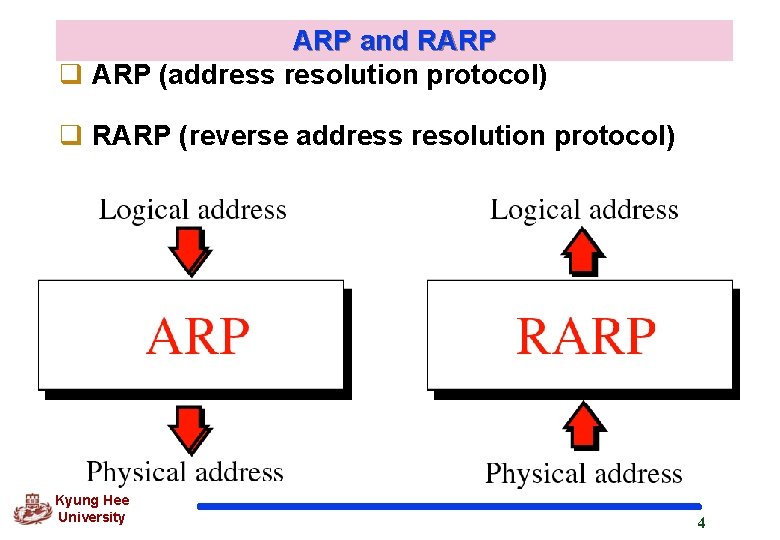
ARP and RARP q ARP (address resolution protocol) q RARP (reverse address resolution protocol) Kyung Hee University 4
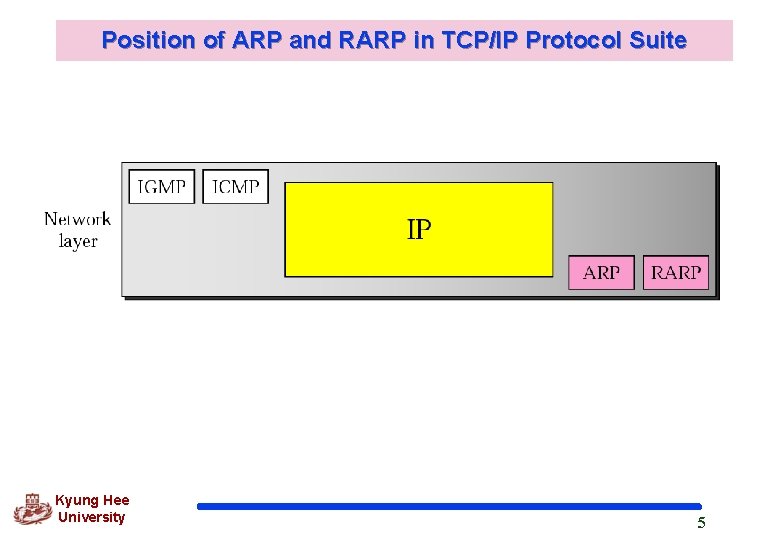
Position of ARP and RARP in TCP/IP Protocol Suite Kyung Hee University 5
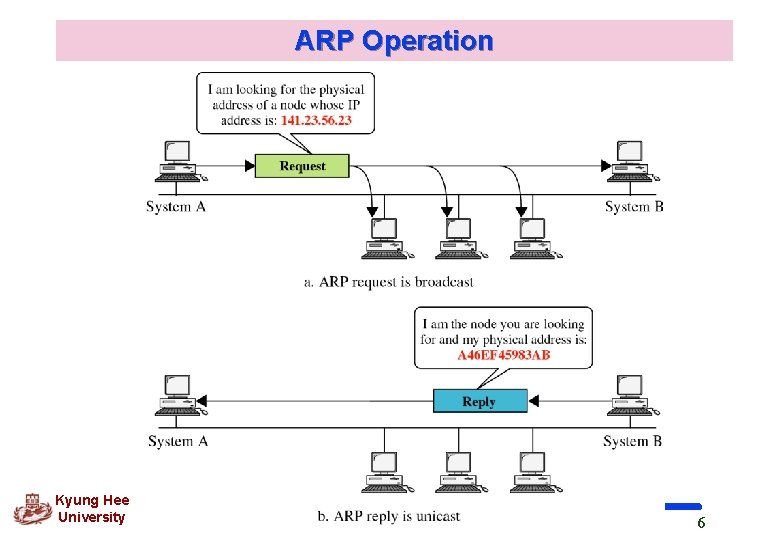
ARP Operation Kyung Hee University 6
ARP Operation (cont’d) q An ARP request is broadcast; an ARP reply is unicast Kyung Hee University 7
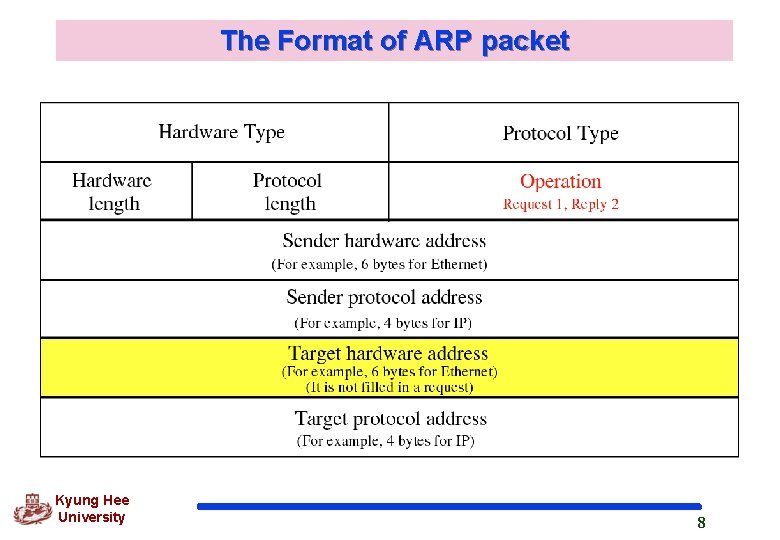
The Format of ARP packet Kyung Hee University 8
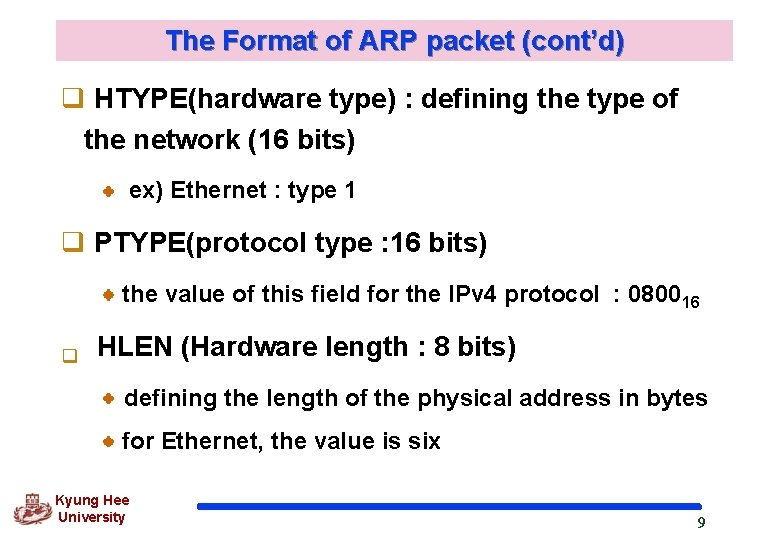
The Format of ARP packet (cont’d) q HTYPE(hardware type) : defining the type of the network (16 bits) ex) Ethernet : type 1 q PTYPE(protocol type : 16 bits) the value of this field for the IPv 4 protocol : 080016 q HLEN (Hardware length : 8 bits) defining the length of the physical address in bytes for Ethernet, the value is six Kyung Hee University 9
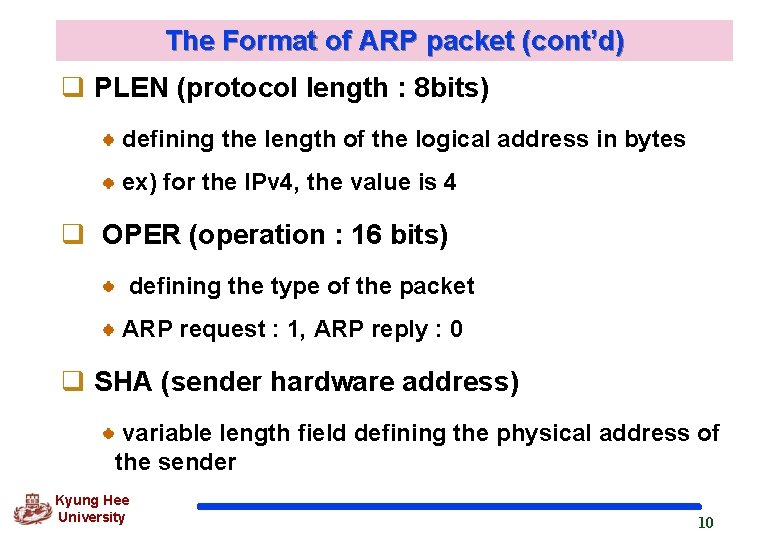
The Format of ARP packet (cont’d) q PLEN (protocol length : 8 bits) defining the length of the logical address in bytes ex) for the IPv 4, the value is 4 q OPER (operation : 16 bits) defining the type of the packet ARP request : 1, ARP reply : 0 q SHA (sender hardware address) variable length field defining the physical address of the sender Kyung Hee University 10
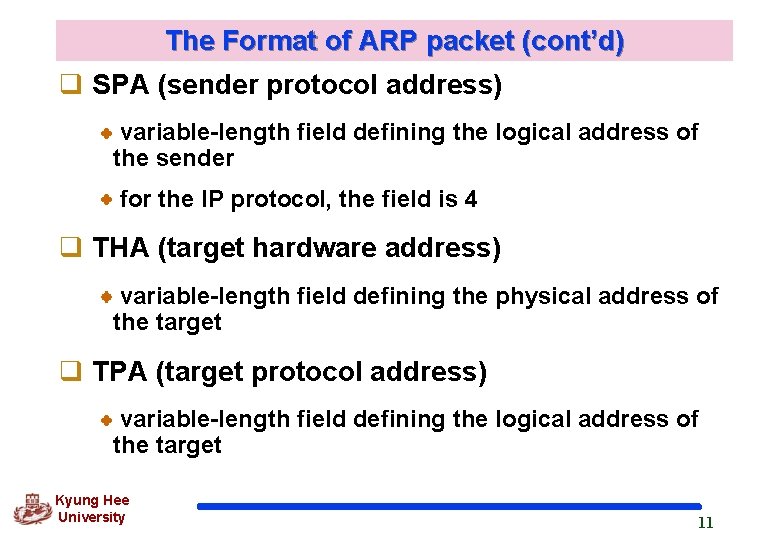
The Format of ARP packet (cont’d) q SPA (sender protocol address) variable-length field defining the logical address of the sender for the IP protocol, the field is 4 q THA (target hardware address) variable-length field defining the physical address of the target q TPA (target protocol address) variable-length field defining the logical address of the target Kyung Hee University 11
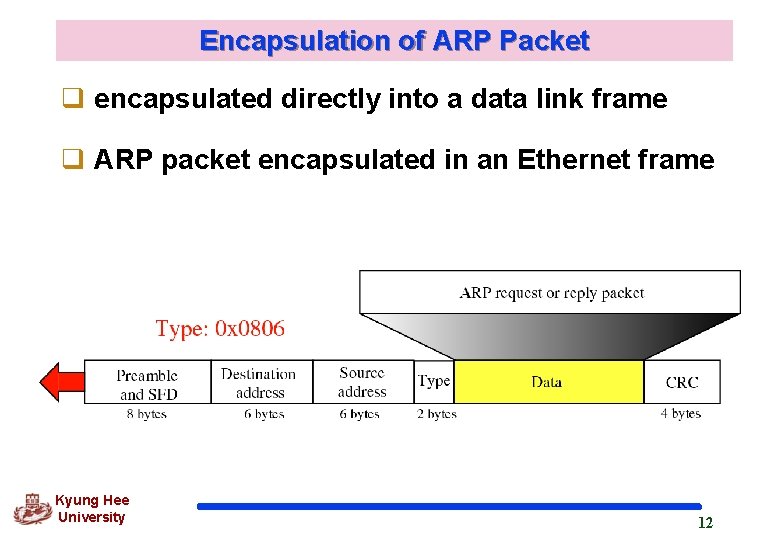
Encapsulation of ARP Packet q encapsulated directly into a data link frame q ARP packet encapsulated in an Ethernet frame Kyung Hee University 12
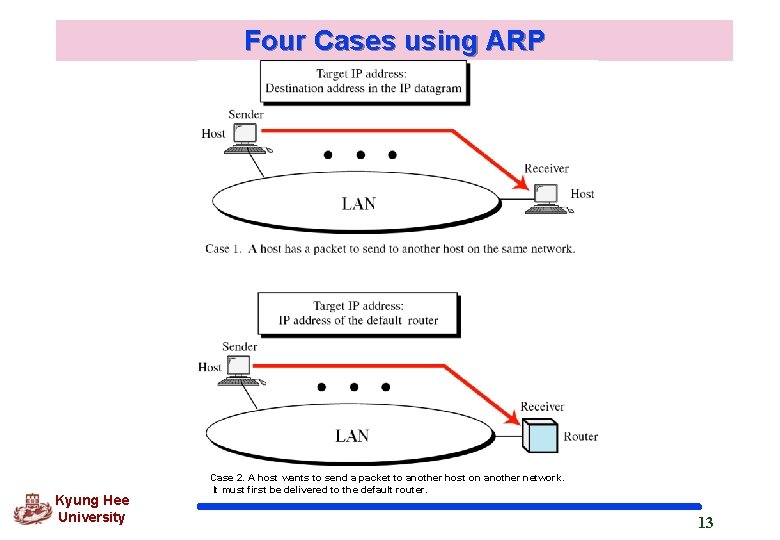
Four Cases using ARP Kyung Hee University Case 2. A host wants to send a packet to another host on another network. It must first be delivered to the default router. 13
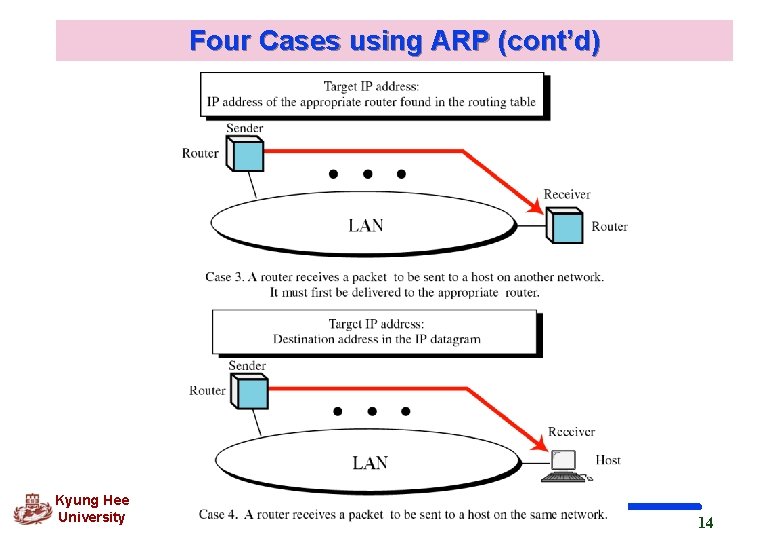
Four Cases using ARP (cont’d) Kyung Hee University 14
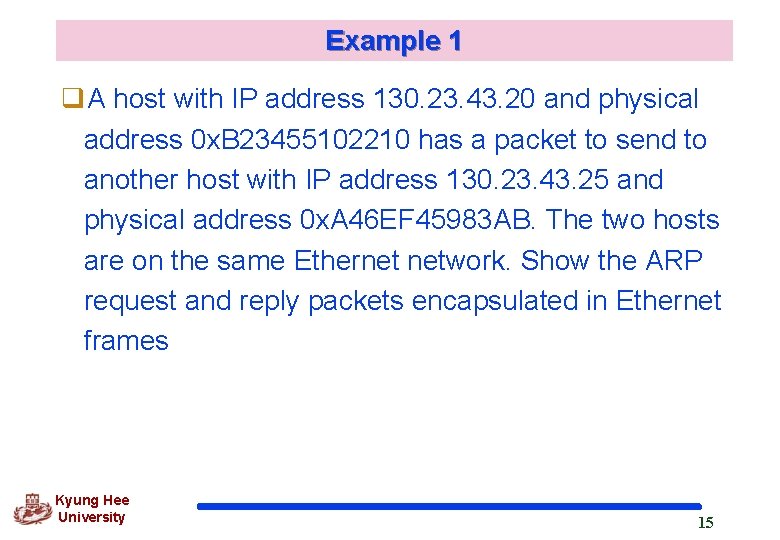
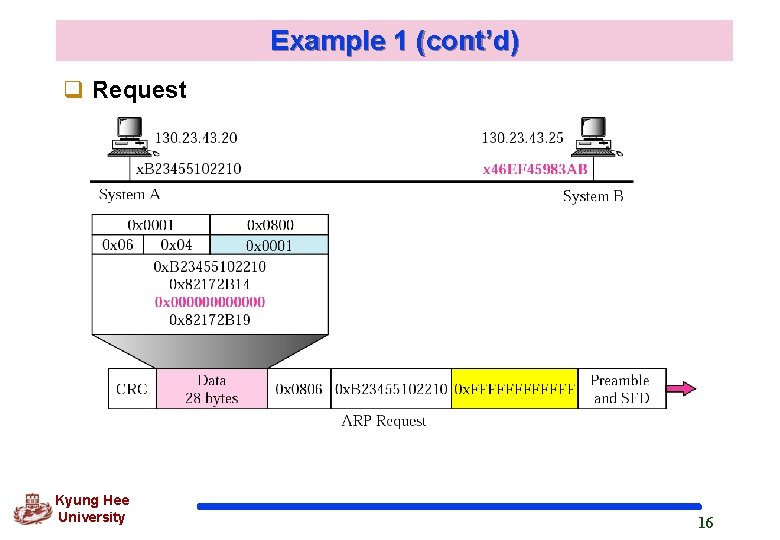
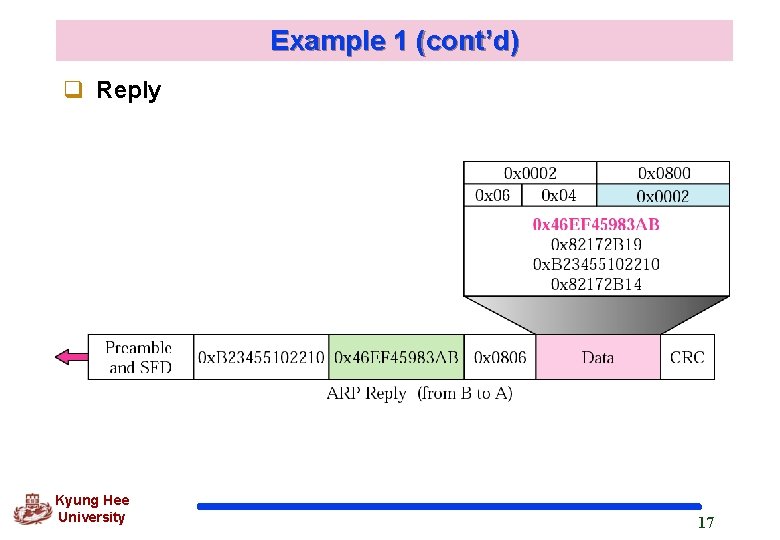
Example 1 q. A host with IP address 130. 23. 43. 20 and physical address 0 x. B 23455102210 has a packet to send to another host with IP address 130. 23. 43. 25 and physical address 0 x. A 46 EF 45983 AB. The two hosts are on the same Ethernet network. Show the ARP request and reply packets encapsulated in Ethernet frames Kyung Hee University 15
Example 1 (cont’d) q Request Kyung Hee University 16
Example 1 (cont’d) q Reply Kyung Hee University 17
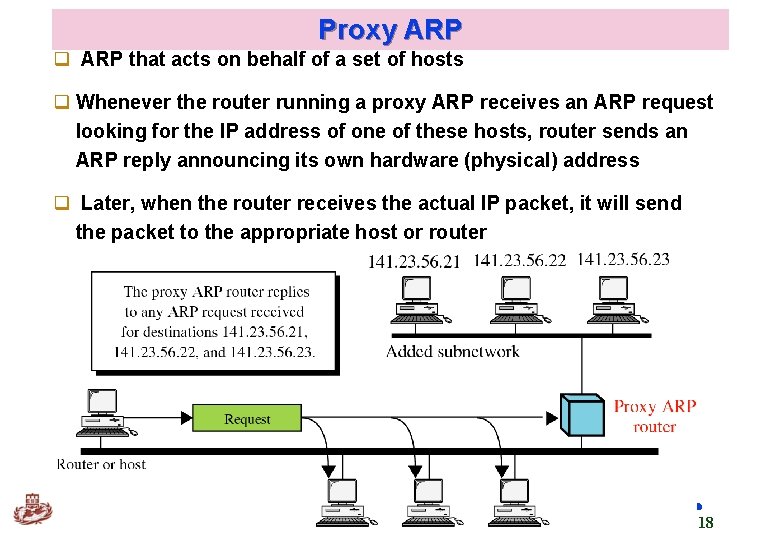
Proxy ARP q ARP that acts on behalf of a set of hosts q Whenever the router running a proxy ARP receives an ARP request looking for the IP address of one of these hosts, router sends an ARP reply announcing its own hardware (physical) address q Later, when the router receives the actual IP packet, it will send the packet to the appropriate host or router Kyung Hee University 18
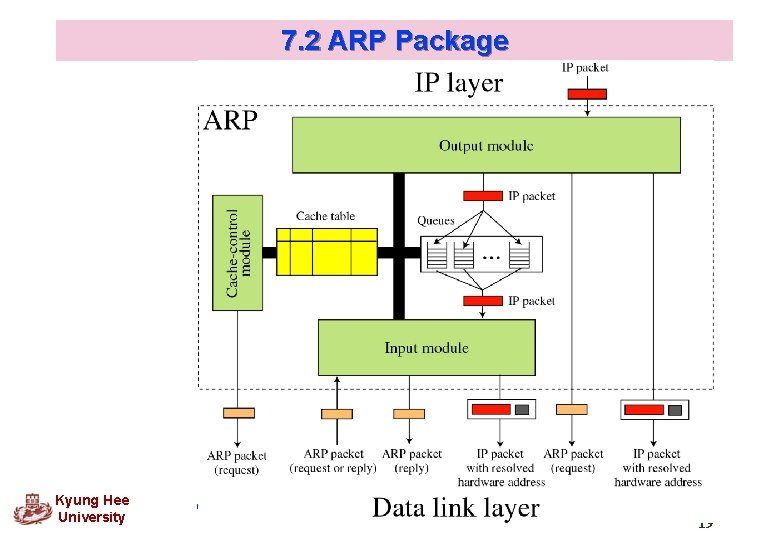
7. 2 ARP Package Kyung Hee University 19
ARP Design (cont’d) q Cache table When a host or router receives the corresponding physical address for an IP datagram, the address can be saved in the cache table. This address can be used for the datagrams destined for the same receiver within the next few minutes q Queues holding the IP address while ARP tries to resolve the hardware address Kyung Hee University 20
ARP Design (cont’d) q Output Module waiting for an IP packet from the IP software checking the cache table to find an entry corresponding to the destination IP address of this packet Kyung Hee University 21
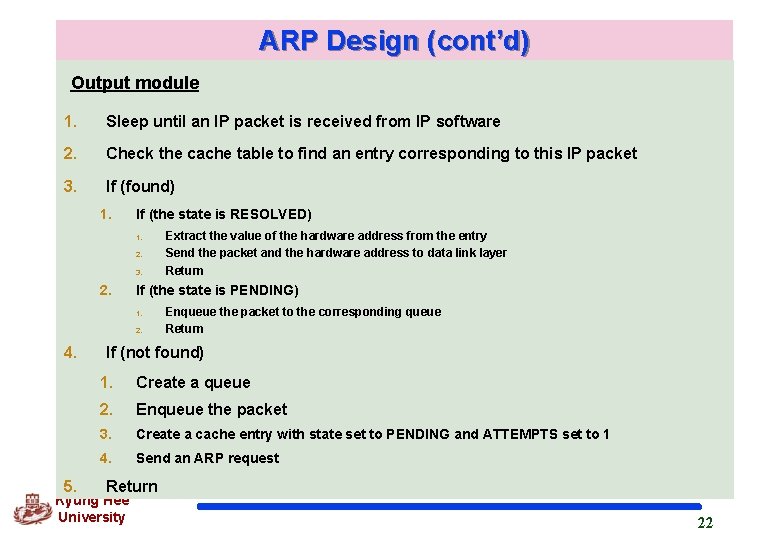
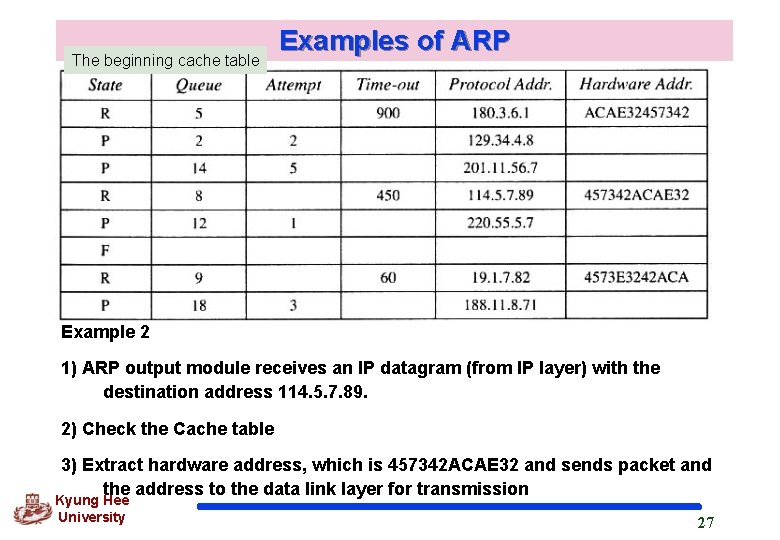
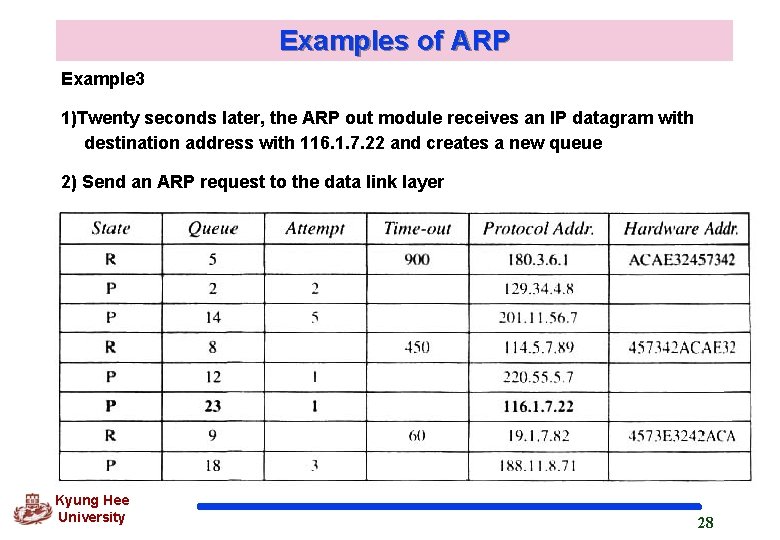
ARP Design (cont’d) Output module 1. Sleep until an IP packet is received from IP software 2. Check the cache table to find an entry corresponding to this IP packet 3. If (found) 1. If (the state is RESOLVED) 1. 2. 3. 2. If (the state is PENDING) 1. 2. 4. 5. Extract the value of the hardware address from the entry Send the packet and the hardware address to data link layer Return Enqueue the packet to the corresponding queue Return If (not found) 1. Create a queue 2. Enqueue the packet 3. Create a cache entry with state set to PENDING and ATTEMPTS set to 1 4. Send an ARP request Return Kyung Hee University 22
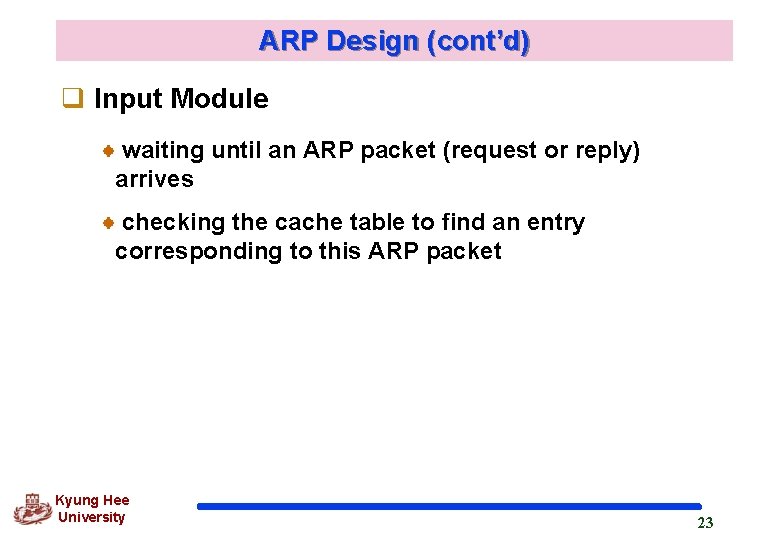
ARP Design (cont’d) q Input Module waiting until an ARP packet (request or reply) arrives checking the cache table to find an entry corresponding to this ARP packet Kyung Hee University 23
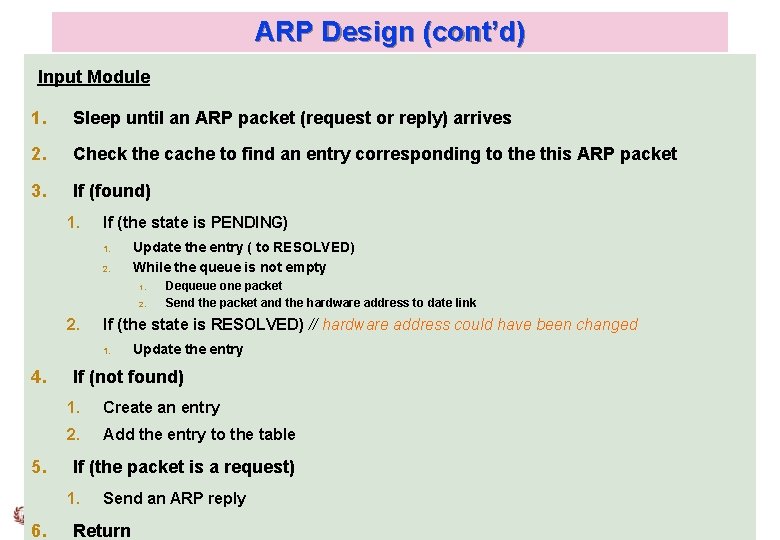
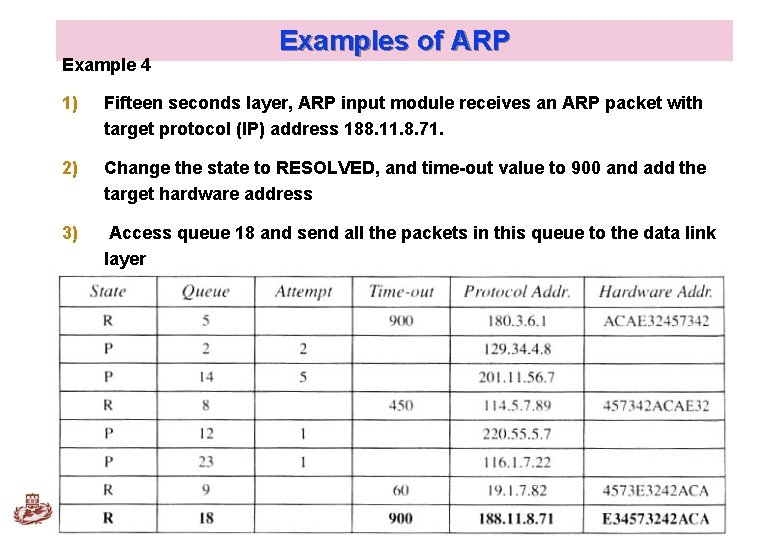
ARP Design (cont’d) Input Module 1. Sleep until an ARP packet (request or reply) arrives 2. Check the cache to find an entry corresponding to the this ARP packet 3. If (found) 1. If (the state is PENDING) 1. 2. Update the entry ( to RESOLVED) While the queue is not empty 1. 2. If (the state is RESOLVED) // hardware address could have been changed 1. 4. 5. 6. Dequeue one packet Send the packet and the hardware address to date link Update the entry If (not found) 1. Create an entry 2. Add the entry to the table If (the packet is a request) 1. Hee Send an ARP reply Kyung University Return 24
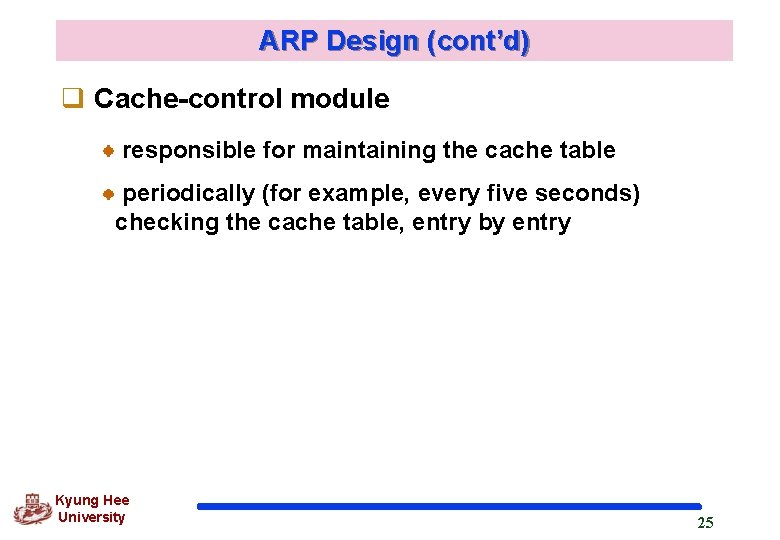
ARP Design (cont’d) q Cache-control module responsible for maintaining the cache table periodically (for example, every five seconds) checking the cache table, entry by entry Kyung Hee University 25
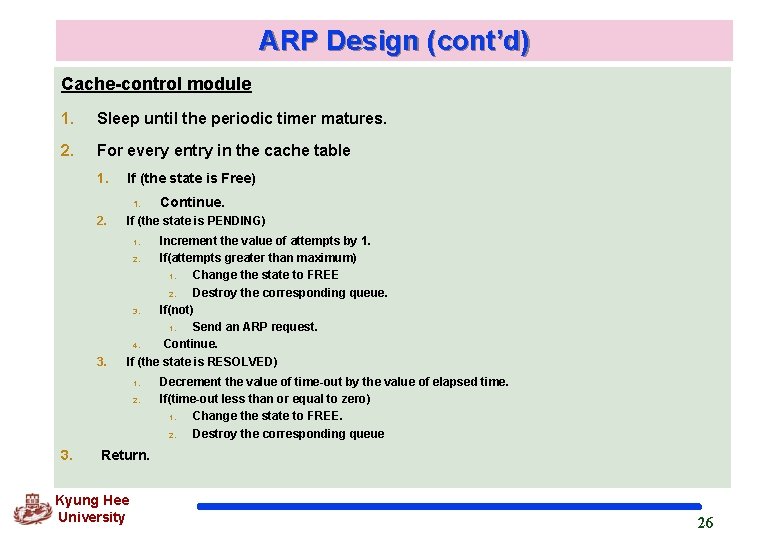
ARP Design (cont’d) Cache-control module 1. Sleep until the periodic timer matures. 2. For every entry in the cache table 1. If (the state is Free) 1. Continue. 2. If (the state is PENDING) 3. Increment the value of attempts by 1. 2. If(attempts greater than maximum) 1. Change the state to FREE 2. Destroy the corresponding queue. 3. If(not) 1. Send an ARP request. 4. Continue. If (the state is RESOLVED) 1. 2. 3. Decrement the value of time-out by the value of elapsed time. If(time-out less than or equal to zero) 1. Change the state to FREE. 2. Destroy the corresponding queue Return. Kyung Hee University 26
The beginning cache table Examples of ARP Example 2 1) ARP output module receives an IP datagram (from IP layer) with the destination address 114. 5. 7. 89. 2) Check the Cache table 3) Extract hardware address, which is 457342 ACAE 32 and sends packet and the address to the data link layer for transmission Kyung Hee University 27
Examples of ARP Example 3 1)Twenty seconds later, the ARP out module receives an IP datagram with destination address with 116. 1. 7. 22 and creates a new queue 2) Send an ARP request to the data link layer Kyung Hee University 28
Example 4 Examples of ARP 1) Fifteen seconds layer, ARP input module receives an ARP packet with target protocol (IP) address 188. 11. 8. 71. 2) Change the state to RESOLVED, and time-out value to 900 and add the target hardware address 3) Access queue 18 and send all the packets in this queue to the data link layer Kyung Hee University 29
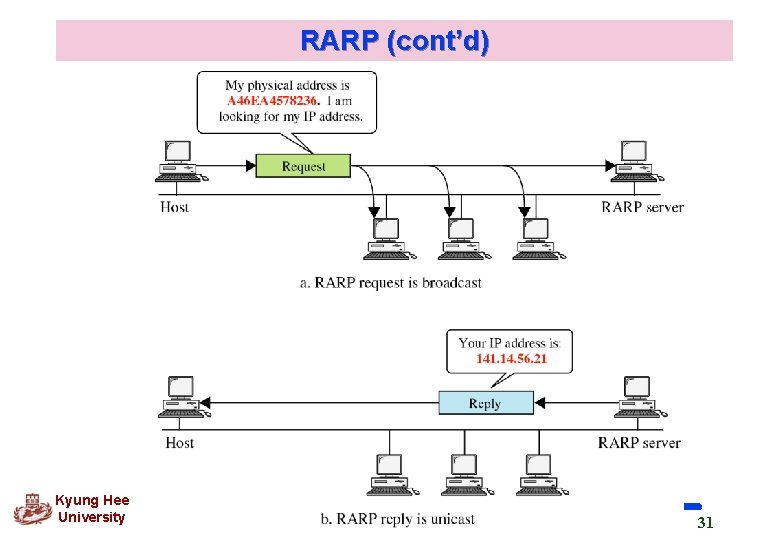
7. 3 RARP q To create an IP datagram, a host or a router needs to know its own IP address or addresses q The IP address of a machine is usually read from its configuration file stored on a disk file q A diskless machine is usually booted from ROM, which has minimum booting information It cannot include the IP address because the IP addresses on a network are assigned by the administrator. The machine can get its physical address by reading its NIC. Kyung Hee University 30
RARP (cont’d) Kyung Hee University 31
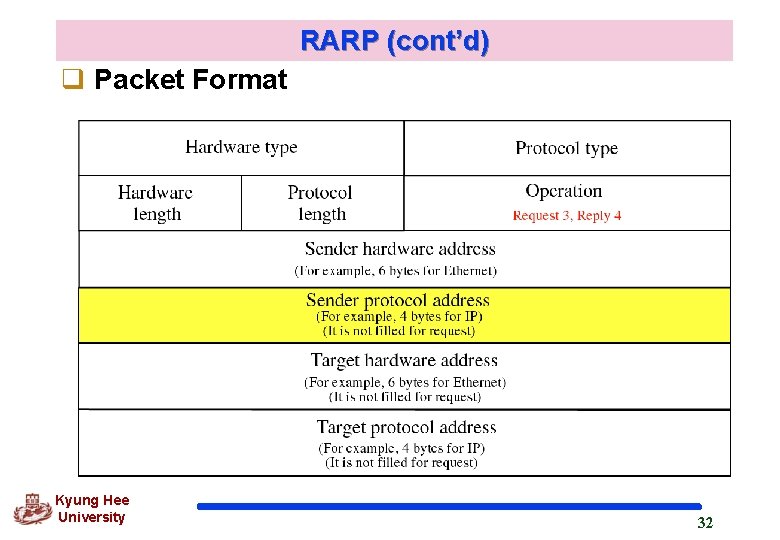
RARP (cont’d) q Packet Format Kyung Hee University 32
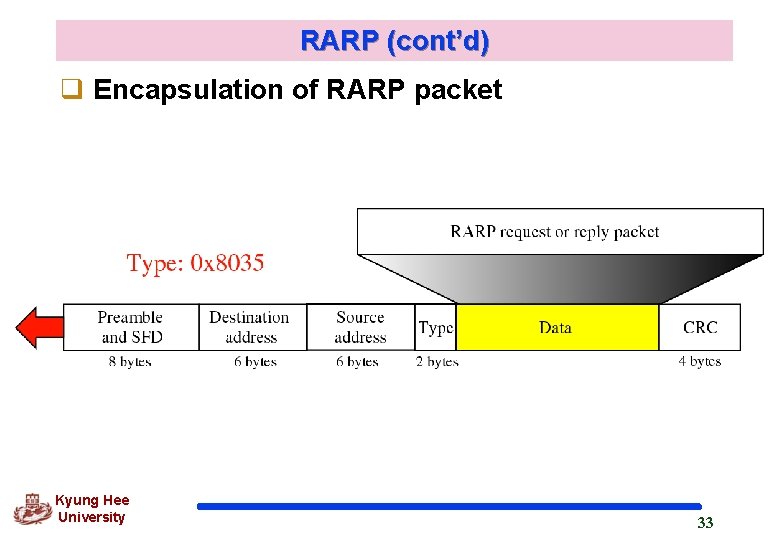
RARP (cont’d) q Encapsulation of RARP packet Kyung Hee University 33