ARP Address Resolution Protocol Ref http en wikipedia



- Slides: 29
ARP Address Resolution Protocol Ref: http: //en. wikipedia. org/wiki/Address_Resolution_Protocol
Network and Broadcast Addresses PRELIMINARY
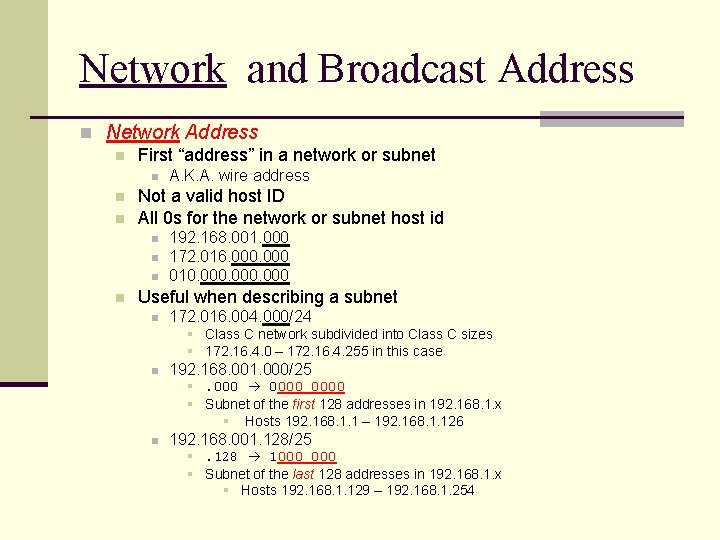
Network and Broadcast Address n Network Address n First “address” in a network or subnet n n n Not a valid host ID All 0 s for the network or subnet host id n n A. K. A. wire address 192. 168. 001. 000 172. 016. 000 010. 000 Useful when describing a subnet n 172. 016. 004. 000/24 § Class C network subdivided into Class C sizes § 172. 16. 4. 0 – 172. 16. 4. 255 in this case n 192. 168. 001. 000/25 §. 0000 § Subnet of the first 128 addresses in 192. 168. 1. x § Hosts 192. 168. 1. 1 – 192. 168. 1. 126 n 192. 168. 001. 128/25 §. 128 1000 § Subnet of the last 128 addresses in 192. 168. 1. x § Hosts 192. 168. 1. 129 – 192. 168. 1. 254
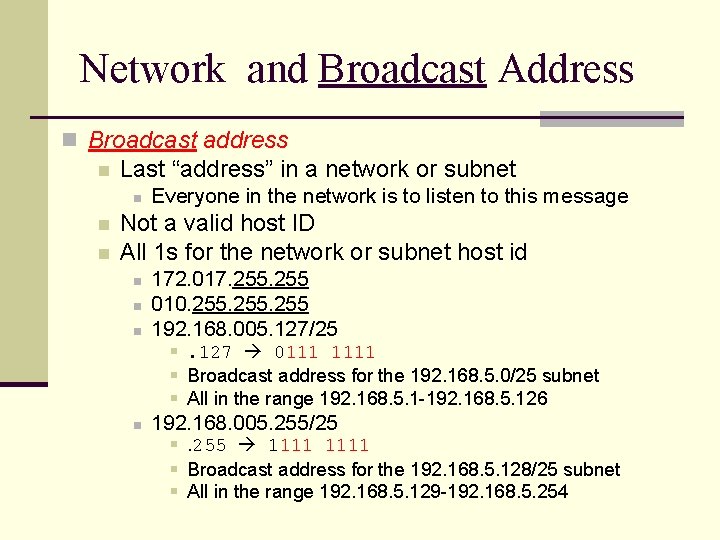
Network and Broadcast Address n Broadcast address n Last “address” in a network or subnet n n n Everyone in the network is to listen to this message Not a valid host ID All 1 s for the network or subnet host id n n n 172. 017. 255 010. 255 192. 168. 005. 127/25 §. 127 0111 1111 § Broadcast address for the 192. 168. 5. 0/25 subnet § All in the range 192. 168. 5. 1 -192. 168. 5. 126 n 192. 168. 005. 255/25 §. 255 1111 § Broadcast address for the 192. 168. 5. 128/25 subnet § All in the range 192. 168. 5. 129 -192. 168. 5. 254
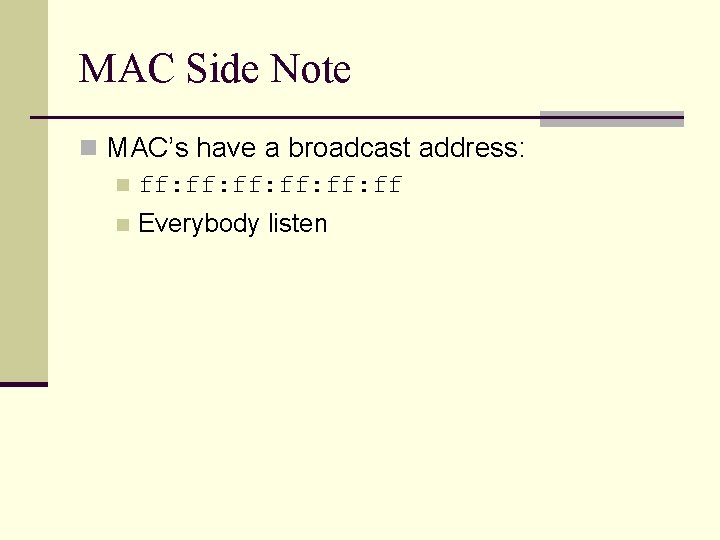
MAC Side Note n MAC’s have a broadcast address: n ff: ff: ff: ff n Everybody listen
ARP
Problem n Hosts can only communicate Host to nearby Host n This means MAC address to MAC address n These machines must be on the same connected physical (local) network n On the same Hub or Switch n Programs typically want to communicate with programs on other machines on other networks n n Whether or not they are on the same network Specifically, working at the IP address level n How do programs get their messages to the other machines? n ARP is one critical key in the solution n One machine can request the MAC address of a machine with a specific IP address
ARP n Address Resolution Protocol n Method for finding a host's hardware address (MAC) when only its network layer address (IP) is known n Remember OSI layers? n ARP is defined in RFC 826. n Current Internet Standard: STD 37
ARP n Not an IP-only or Ethernet-only protocol n Can be used to resolve many different networklayer protocol addresses to hardware addresses n However: n Nowadays almost all traffic is IPv 4 and Ethernet n n n IPv 6 is up and coming! Primarily used to translate IP addresses to Ethernet MAC addresses Also used for IP over other LAN technologies § Token Ring, FDDI, or IEEE 802. 11 § IP over ATM
ARP n IPv 6 n ARP's functionality is provided by the Neighbor Discovery Protocol (NDP)
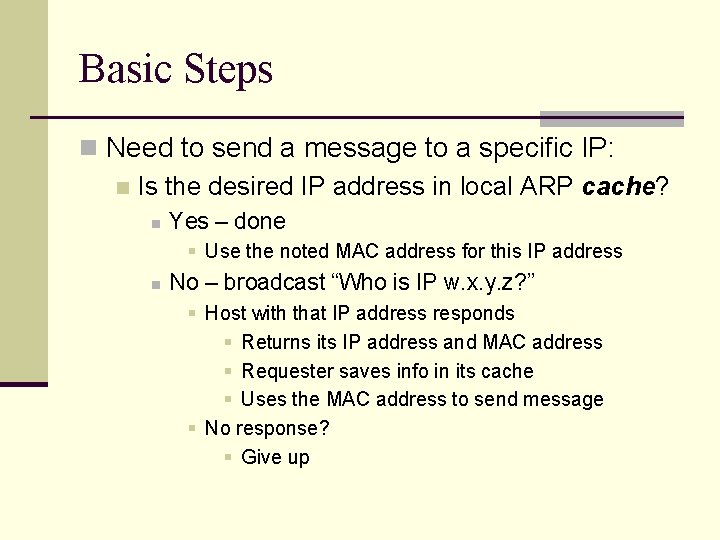
Basic Steps n Need to send a message to a specific IP: n Is the desired IP address in local ARP cache? n Yes – done § Use the noted MAC address for this IP address n No – broadcast “Who is IP w. x. y. z? ” § Host with that IP address responds § Returns its IP address and MAC address § Requester saves info in its cache § Uses the MAC address to send message § No response? § Give up
EXAMPLES
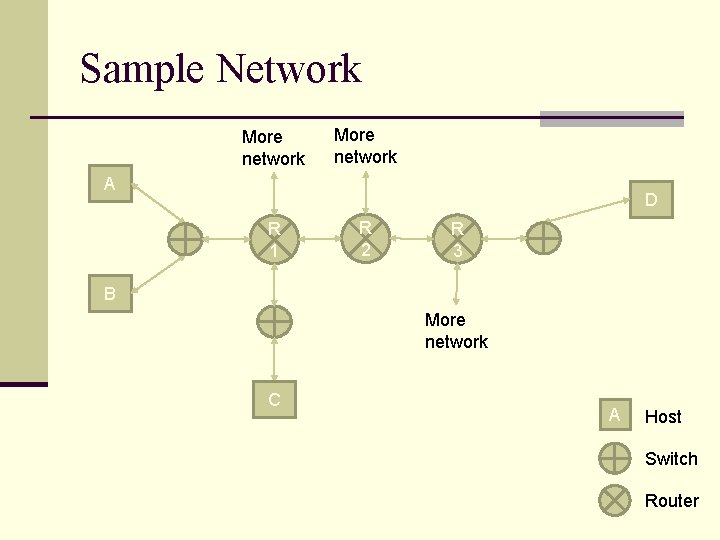
Sample Network More network A D R 1 R 2 R 3 B More network C A Host Switch Router
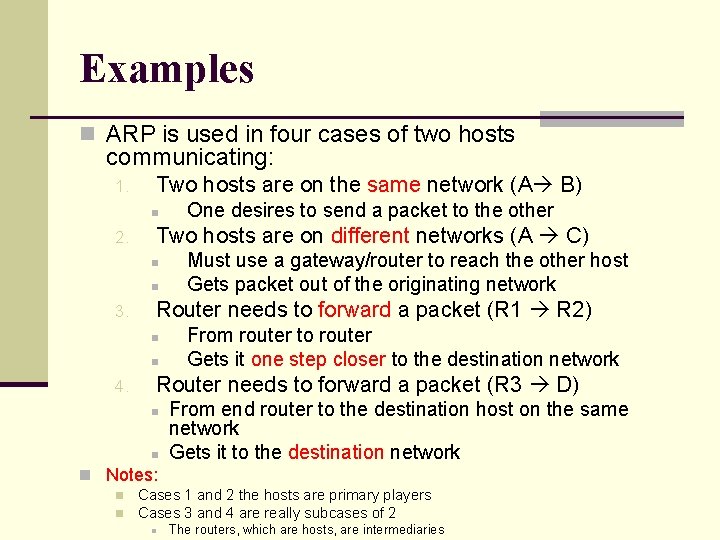
Examples n ARP is used in four cases of two hosts communicating: 1. Two hosts are on the same network (A B) n 2. Two hosts are on different networks (A C) n n 3. Must use a gateway/router to reach the other host Gets packet out of the originating network Router needs to forward a packet (R 1 R 2) n n 4. One desires to send a packet to the other From router to router Gets it one step closer to the destination network Router needs to forward a packet (R 3 D) n n From end router to the destination host on the same network Gets it to the destination network n Notes: n n Cases 1 and 2 the hosts are primary players Cases 3 and 4 are really subcases of 2 n The routers, which are hosts, are intermediaries
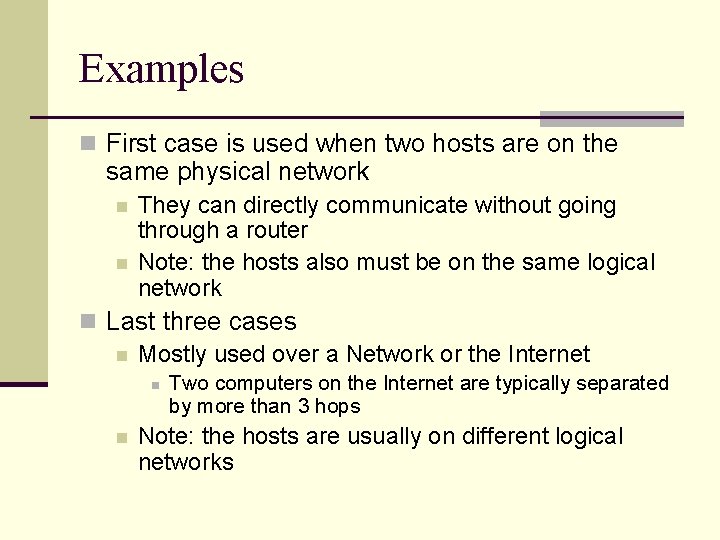
Examples n First case is used when two hosts are on the same physical network n n They can directly communicate without going through a router Note: the hosts also must be on the same logical network n Last three cases n Mostly used over a Network or the Internet n n Two computers on the Internet are typically separated by more than 3 hops Note: the hosts are usually on different logical networks
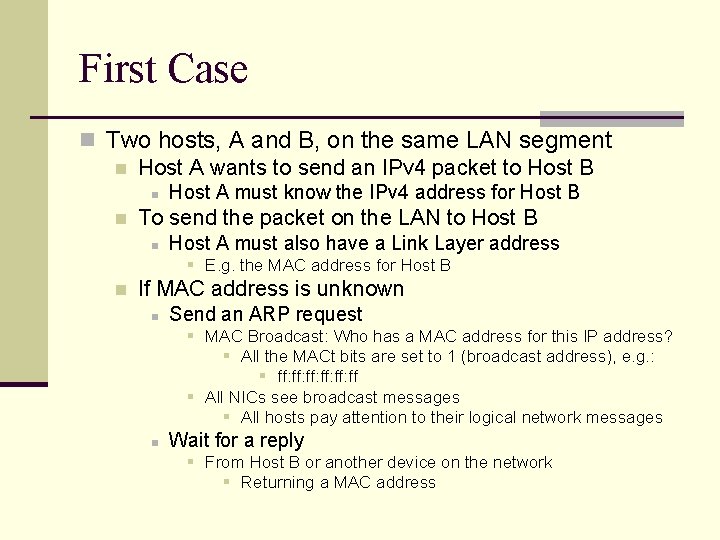
First Case n Two hosts, A and B, on the same LAN segment n Host A wants to send an IPv 4 packet to Host B n n Host A must know the IPv 4 address for Host B To send the packet on the LAN to Host B n Host A must also have a Link Layer address § E. g. the MAC address for Host B n If MAC address is unknown n Send an ARP request § MAC Broadcast: Who has a MAC address for this IP address? § All the MACt bits are set to 1 (broadcast address), e. g. : § ff: ff: ff: ff § All NICs see broadcast messages § All hosts pay attention to their logical network messages n Wait for a reply § From Host B or another device on the network § Returning a MAC address
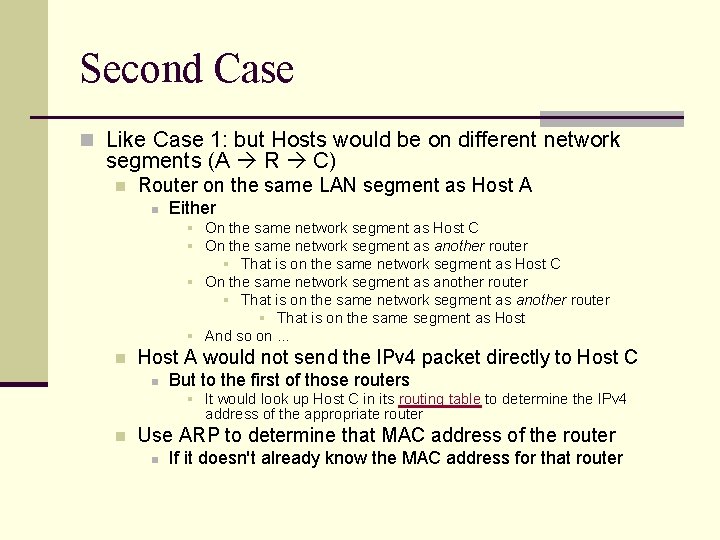
Second Case n Like Case 1: but Hosts would be on different network segments (A R C) n Router on the same LAN segment as Host A n Either § On the same network segment as Host C § On the same network segment as another router § That is on the same segment as Host § And so on … n Host A would not send the IPv 4 packet directly to Host C n But to the first of those routers § It would look up Host C in its routing table to determine the IPv 4 address of the appropriate router n Use ARP to determine that MAC address of the router n If it doesn't already know the MAC address for that router
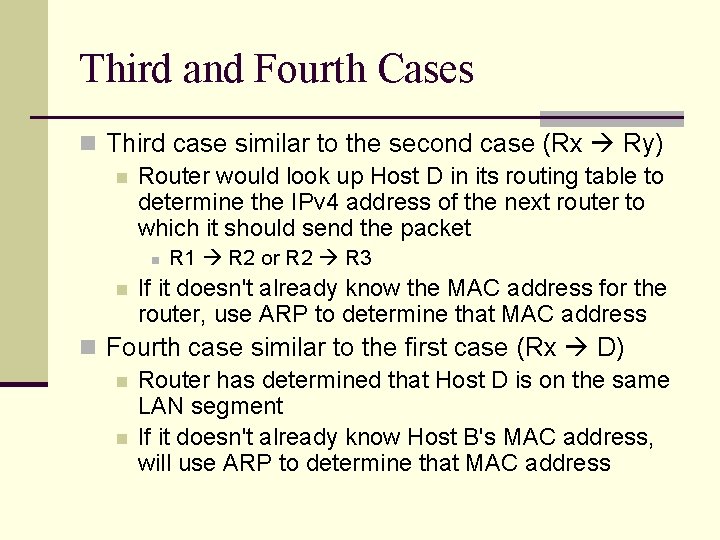
Third and Fourth Cases n Third case similar to the second case (Rx Ry) n Router would look up Host D in its routing table to determine the IPv 4 address of the next router to which it should send the packet n n R 1 R 2 or R 2 R 3 If it doesn't already know the MAC address for the router, use ARP to determine that MAC address n Fourth case similar to the first case (Rx D) n Router has determined that Host D is on the same LAN segment n If it doesn't already know Host B's MAC address, will use ARP to determine that MAC address
ARP mediation n Process of resolving Layer 2 addresses when different resolution protocols are used on either circuit n E. g. ATM on one end and Ethernet on the other
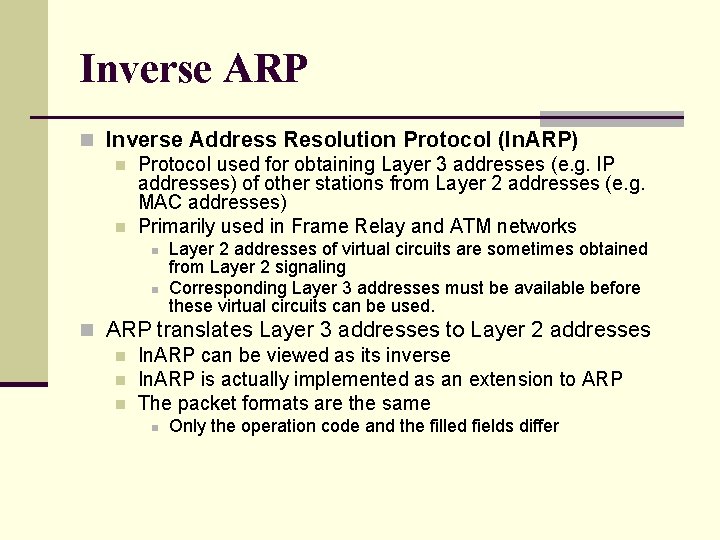
Inverse ARP n Inverse Address Resolution Protocol (In. ARP) n Protocol used for obtaining Layer 3 addresses (e. g. IP addresses) of other stations from Layer 2 addresses (e. g. MAC addresses) n Primarily used in Frame Relay and ATM networks n n Layer 2 addresses of virtual circuits are sometimes obtained from Layer 2 signaling Corresponding Layer 3 addresses must be available before these virtual circuits can be used. n ARP translates Layer 3 addresses to Layer 2 addresses n In. ARP can be viewed as its inverse n In. ARP is actually implemented as an extension to ARP n The packet formats are the same n Only the operation code and the filled fields differ
Resume 2/1
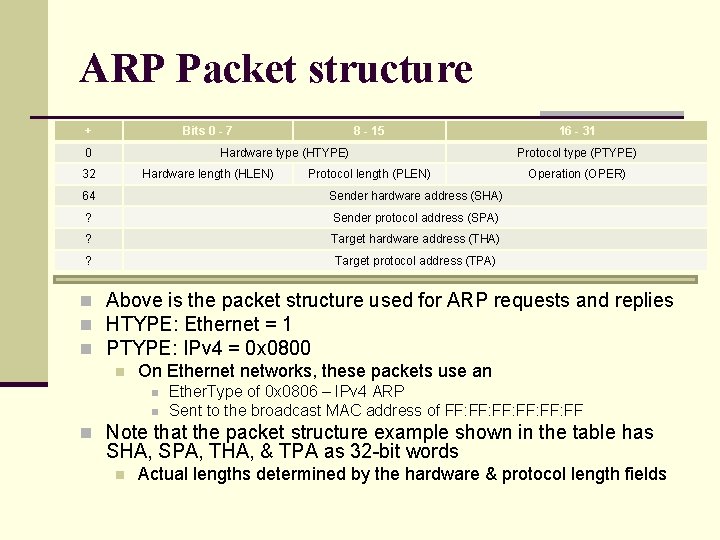
ARP Packet structure + Bits 0 - 7 0 8 - 15 Hardware type (HTYPE) 32 Hardware length (HLEN) Protocol length (PLEN) 64 Sender hardware address (SHA) ? Sender protocol address (SPA) ? Target hardware address (THA) ? Target protocol address (TPA) 16 - 31 Protocol type (PTYPE) Operation (OPER) n Above is the packet structure used for ARP requests and replies n HTYPE: Ethernet = 1 n PTYPE: IPv 4 = 0 x 0800 n On Ethernet networks, these packets use an n n Ether. Type of 0 x 0806 – IPv 4 ARP Sent to the broadcast MAC address of FF: FF: FF: FF n Note that the packet structure example shown in the table has SHA, SPA, THA, & TPA as 32 -bit words n Actual lengths determined by the hardware & protocol length fields
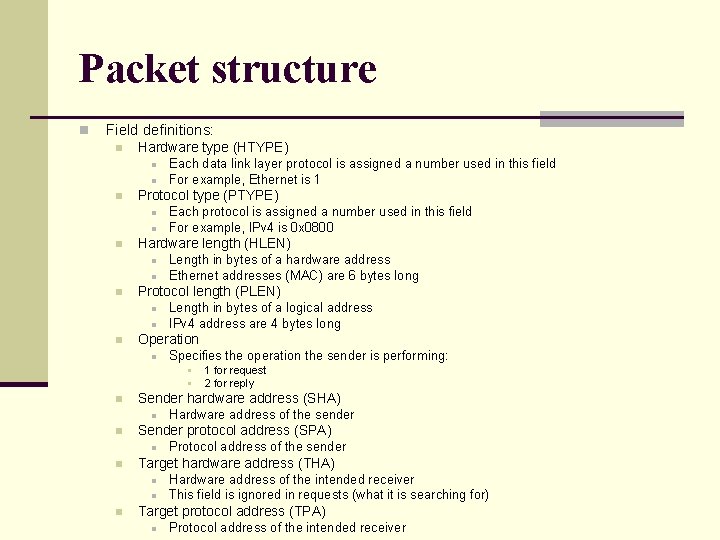
Packet structure n Field definitions: n Hardware type (HTYPE) n n n Protocol type (PTYPE) n n Length in bytes of a hardware address Ethernet addresses (MAC) are 6 bytes long Protocol length (PLEN) n n n Each protocol is assigned a number used in this field For example, IPv 4 is 0 x 0800 Hardware length (HLEN) n n Each data link layer protocol is assigned a number used in this field For example, Ethernet is 1 Length in bytes of a logical address IPv 4 address are 4 bytes long Operation n Specifies the operation the sender is performing: § § n Sender hardware address (SHA) n n Protocol address of the sender Target hardware address (THA) n n n Hardware address of the sender Sender protocol address (SPA) n n 1 for request 2 for reply Hardware address of the intended receiver This field is ignored in requests (what it is searching for) Target protocol address (TPA) n Protocol address of the intended receiver
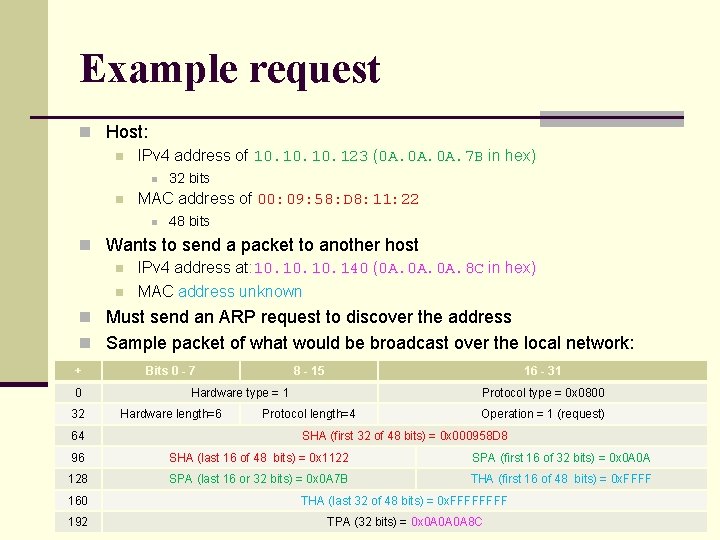
Example request n Host: n IPv 4 address of 10. 10. 123 (0 A. 0 A. 7 B in hex) n n 32 bits MAC address of 00: 09: 58: D 8: 11: 22 n 48 bits n Wants to send a packet to another host n IPv 4 address at: 10. 10. 140 (0 A. 0 A. 8 C in hex) n MAC address unknown n Must send an ARP request to discover the address n Sample packet of what would be broadcast over the local network: + 0 32 64 Bits 0 - 7 8 - 15 16 - 31 Hardware type = 1 Hardware length=6 Protocol type = 0 x 0800 Protocol length=4 Operation = 1 (request) SHA (first 32 of 48 bits) = 0 x 000958 D 8 96 SHA (last 16 of 48 bits) = 0 x 1122 SPA (first 16 of 32 bits) = 0 x 0 A 0 A 128 SPA (last 16 or 32 bits) = 0 x 0 A 7 B THA (first 16 of 48 bits) = 0 x. FFFF 160 THA (last 32 of 48 bits) = 0 x. FFFF 192 TPA (32 bits) = 0 x 0 A 0 A 0 A 8 C
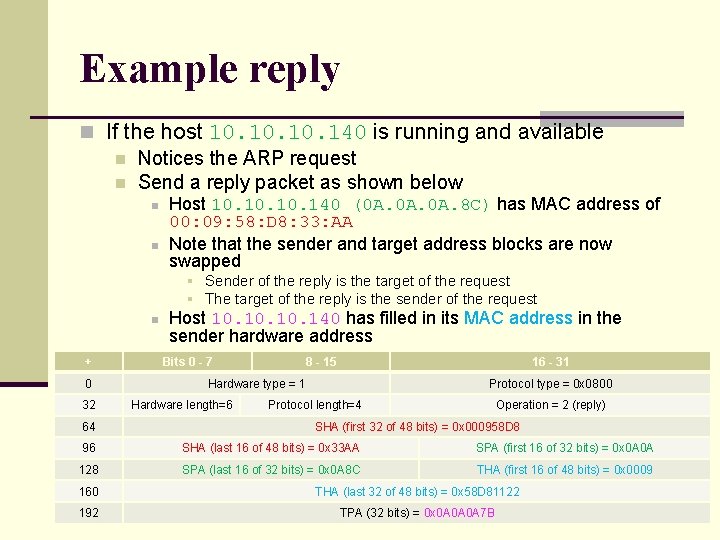
Example reply n If the host 10. 10. 140 is running and available n Notices the ARP request n Send a reply packet as shown below n n Host 10. 10. 140 (0 A. 0 A. 8 C) has MAC address of 00: 09: 58: D 8: 33: AA Note that the sender and target address blocks are now swapped § Sender of the reply is the target of the request § The target of the reply is the sender of the request n + 0 32 64 Host 10. 10. 140 has filled in its MAC address in the sender hardware address Bits 0 - 7 8 - 15 16 - 31 Hardware type = 1 Hardware length=6 Protocol type = 0 x 0800 Protocol length=4 Operation = 2 (reply) SHA (first 32 of 48 bits) = 0 x 000958 D 8 96 SHA (last 16 of 48 bits) = 0 x 33 AA SPA (first 16 of 32 bits) = 0 x 0 A 0 A 128 SPA (last 16 of 32 bits) = 0 x 0 A 8 C THA (first 16 of 48 bits) = 0 x 0009 160 THA (last 32 of 48 bits) = 0 x 58 D 81122 192 TPA (32 bits) = 0 x 0 A 0 A 0 A 7 B
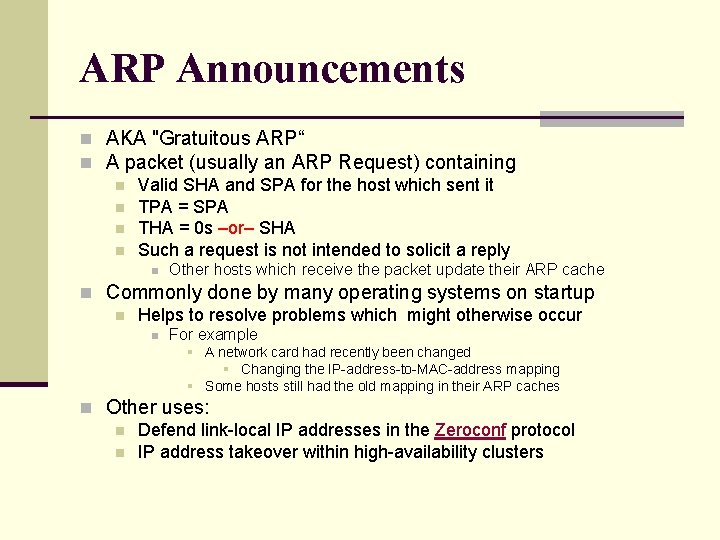
ARP Announcements n AKA "Gratuitous ARP“ n A packet (usually an ARP Request) containing n Valid SHA and SPA for the host which sent it n TPA = SPA n THA = 0 s –or– SHA n Such a request is not intended to solicit a reply n Other hosts which receive the packet update their ARP cache n Commonly done by many operating systems on startup n Helps to resolve problems which might otherwise occur n For example § A network card had recently been changed § Changing the IP-address-to-MAC-address mapping § Some hosts still had the old mapping in their ARP caches n Other uses: n Defend link-local IP addresses in the Zeroconf protocol n IP address takeover within high-availability clusters
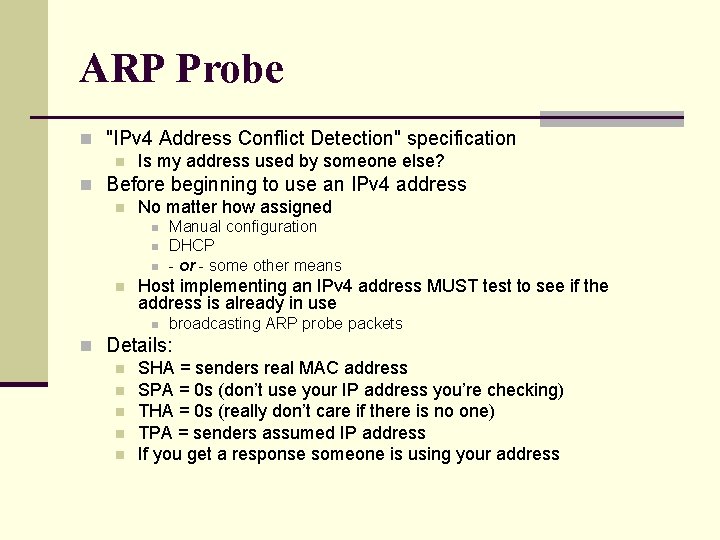
ARP Probe n "IPv 4 Address Conflict Detection" specification n Is my address used by someone else? n Before beginning to use an IPv 4 address n No matter how assigned n n Manual configuration DHCP - or - some other means Host implementing an IPv 4 address MUST test to see if the address is already in use n broadcasting ARP probe packets n Details: n SHA = senders real MAC address n SPA = 0 s (don’t use your IP address you’re checking) n THA = 0 s (really don’t care if there is no one) n TPA = senders assumed IP address n If you get a response someone is using your address
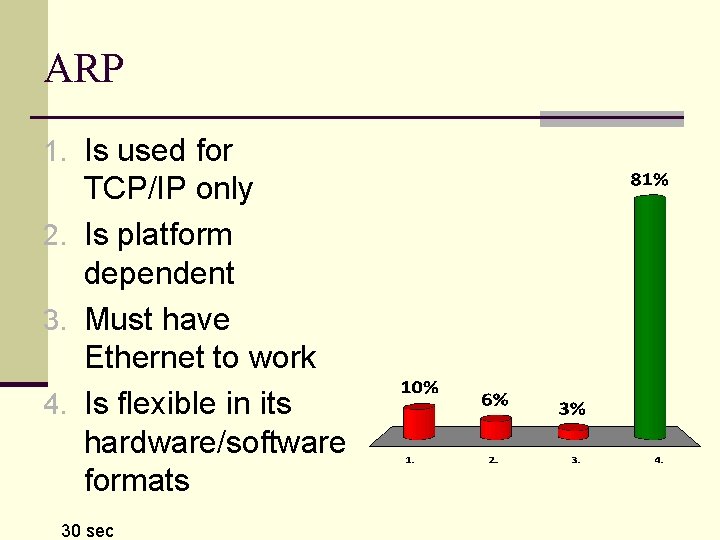
ARP 1. Is used for TCP/IP only 2. Is platform dependent 3. Must have Ethernet to work 4. Is flexible in its hardware/software formats 30 sec
Summary n ARP is used to find the hardware address (MAC) for a network protocol (IP) address Address of the target host if the host is on the local network n Address of a router if the host is not on the local network n n Some router must know that it can forward it closer