Chapter 5 SNMPv 1 Network Management Communication and
- Slides: 29
Chapter 5 SNMPv 1 Network Management: Communication and Functional Models Last modified: 17/02/2018 Network Management: Principles and Practice © Mani Subramanian 2010 1
Chapter 5 SNMPv 1 Network Management: Communication and Functional Models Objectives • Communication model: Administrative and messages • Administrative structure • Community-based model • Access policy • MIB view • Message PDU • SNMP protocol specifications • SNMP operations • SNMP MIB • SNMP functional model Network Management: Principles and Practice © Mani Subramanian 2010 2
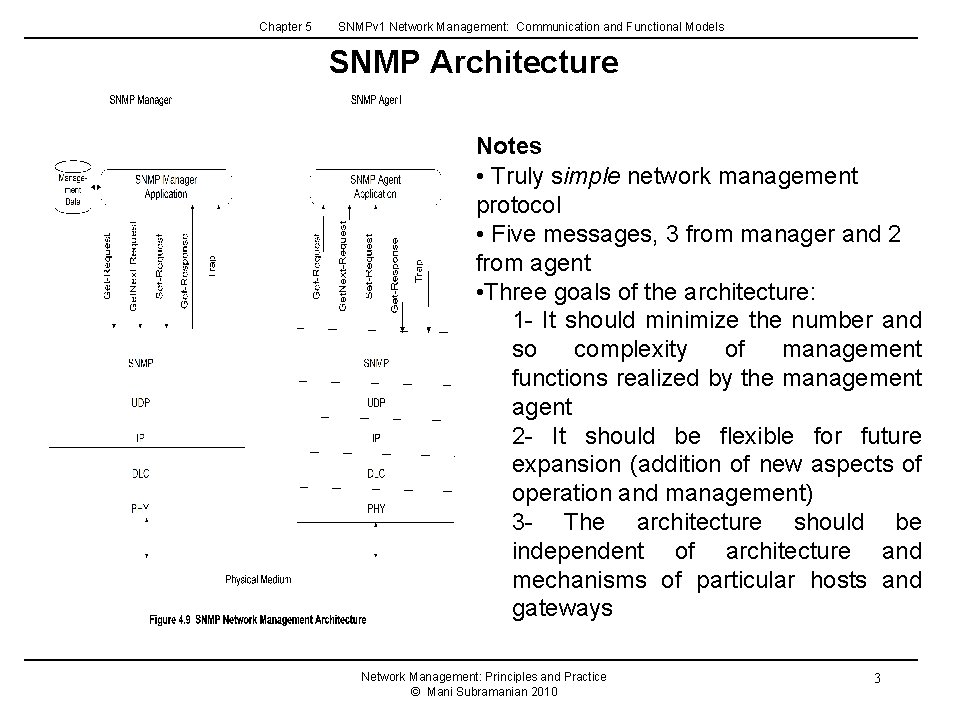
Chapter 5 SNMPv 1 Network Management: Communication and Functional Models SNMP Architecture Notes • Truly simple network management protocol • Five messages, 3 from manager and 2 from agent • Three goals of the architecture: 1 - It should minimize the number and so complexity of management functions realized by the management agent 2 - It should be flexible for future expansion (addition of new aspects of operation and management) 3 - The architecture should be independent of architecture and mechanisms of particular hosts and gateways Network Management: Principles and Practice © Mani Subramanian 2010 3
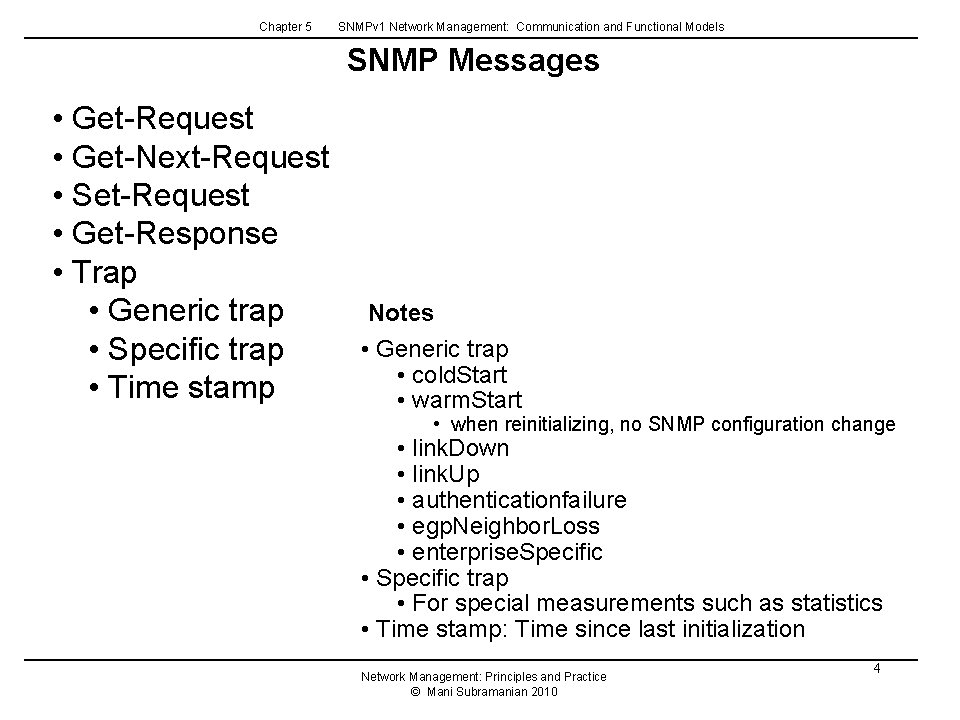
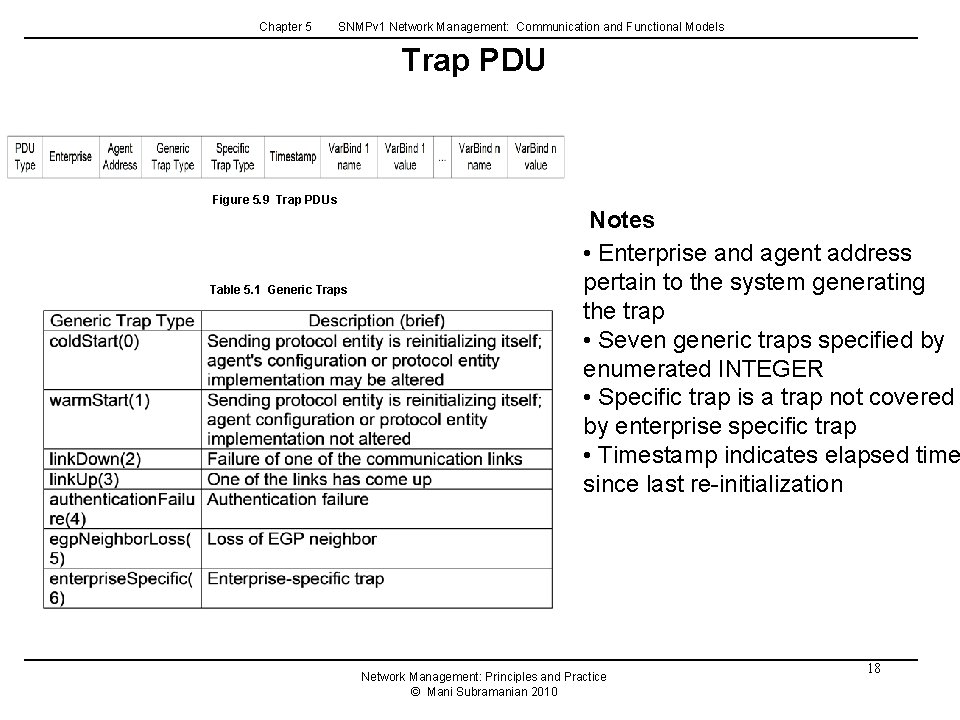
Chapter 5 SNMPv 1 Network Management: Communication and Functional Models SNMP Messages • Get-Request • Get-Next-Request • Set-Request • Get-Response • Trap • Generic trap • Specific trap • Time stamp Notes • Generic trap • cold. Start • warm. Start • when reinitializing, no SNMP configuration change • link. Down • link. Up • authenticationfailure • egp. Neighbor. Loss • enterprise. Specific • Specific trap • For special measurements such as statistics • Time stamp: Time since last initialization Network Management: Principles and Practice © Mani Subramanian 2010 4
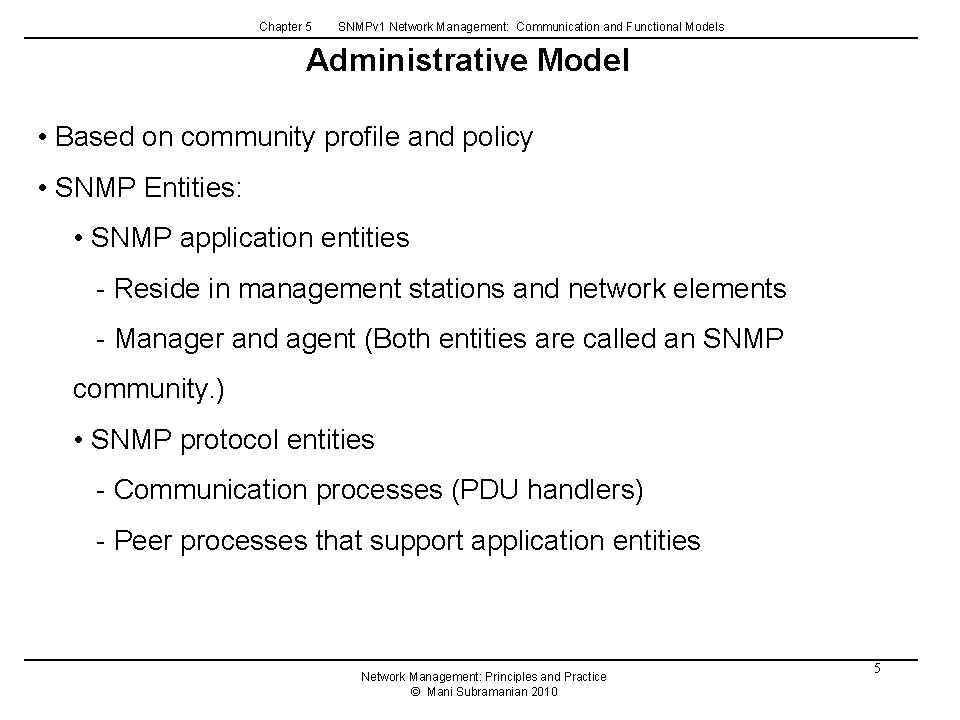
Chapter 5 SNMPv 1 Network Management: Communication and Functional Models Administrative Model • Based on community profile and policy • SNMP Entities: • SNMP application entities - Reside in management stations and network elements - Manager and agent (Both entities are called an SNMP community. ) • SNMP protocol entities - Communication processes (PDU handlers) - Peer processes that support application entities Network Management: Principles and Practice © Mani Subramanian 2010 5
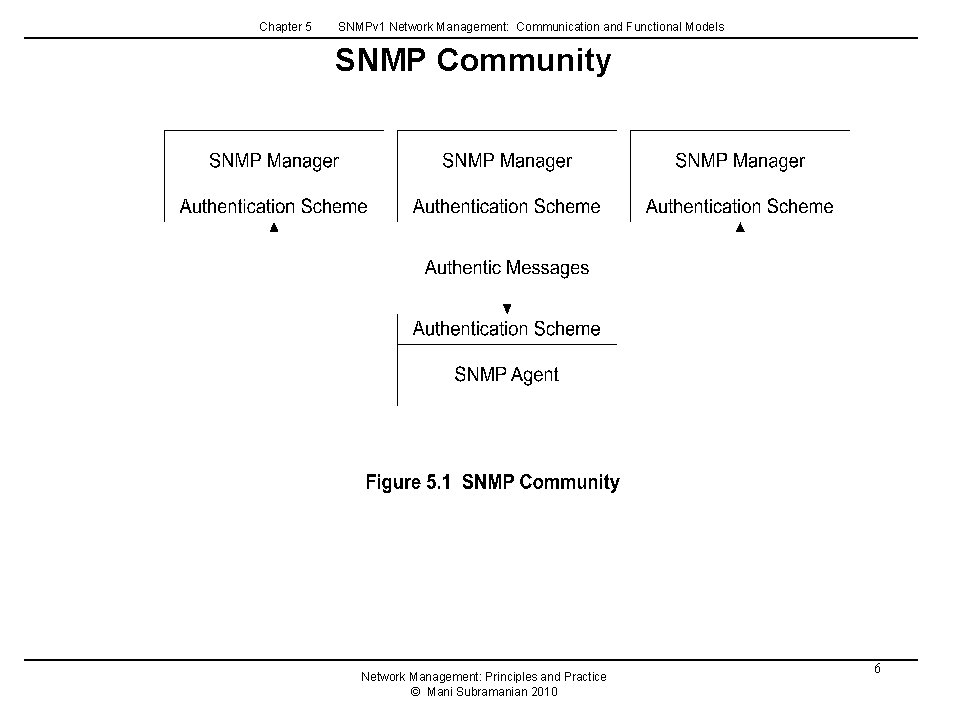
Chapter 5 SNMPv 1 Network Management: Communication and Functional Models SNMP Community Network Management: Principles and Practice © Mani Subramanian 2010 6
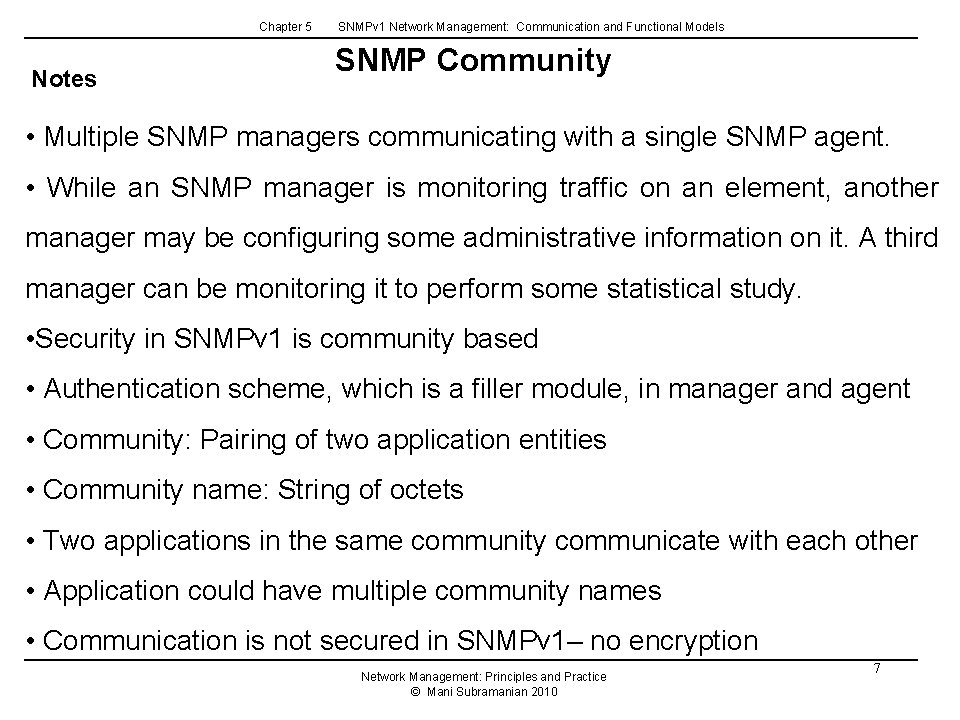
Chapter 5 Notes SNMPv 1 Network Management: Communication and Functional Models SNMP Community • Multiple SNMP managers communicating with a single SNMP agent. • While an SNMP manager is monitoring traffic on an element, another manager may be configuring some administrative information on it. A third manager can be monitoring it to perform some statistical study. • Security in SNMPv 1 is community based • Authentication scheme, which is a filler module, in manager and agent • Community: Pairing of two application entities • Community name: String of octets • Two applications in the same community communicate with each other • Application could have multiple community names • Communication is not secured in SNMPv 1– no encryption Network Management: Principles and Practice © Mani Subramanian 2010 7
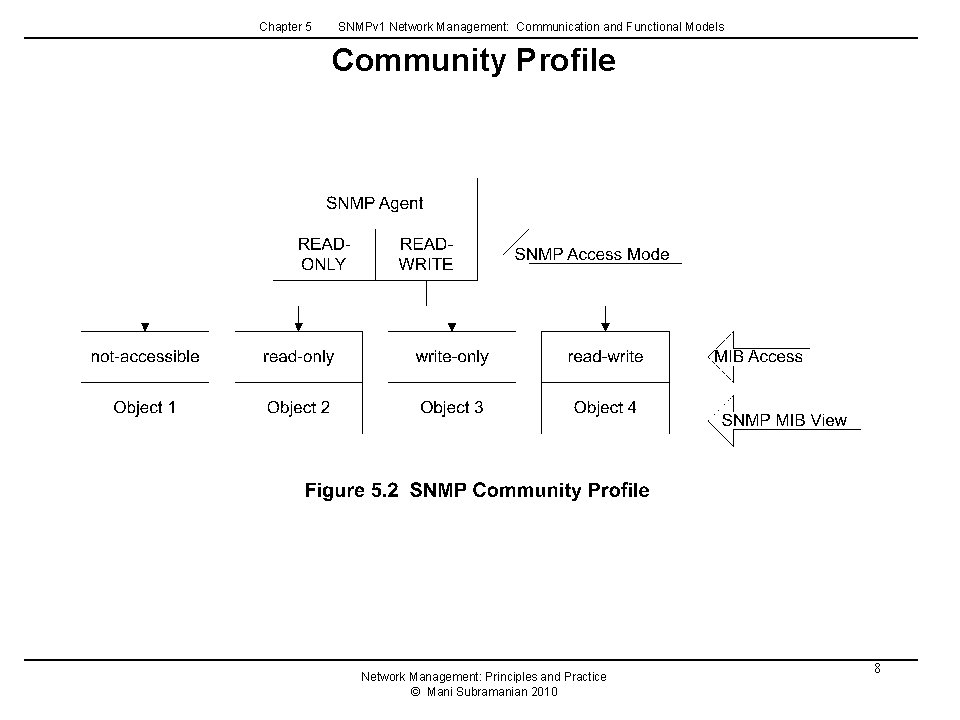
Chapter 5 SNMPv 1 Network Management: Communication and Functional Models Community Profile Network Management: Principles and Practice © Mani Subramanian 2010 8
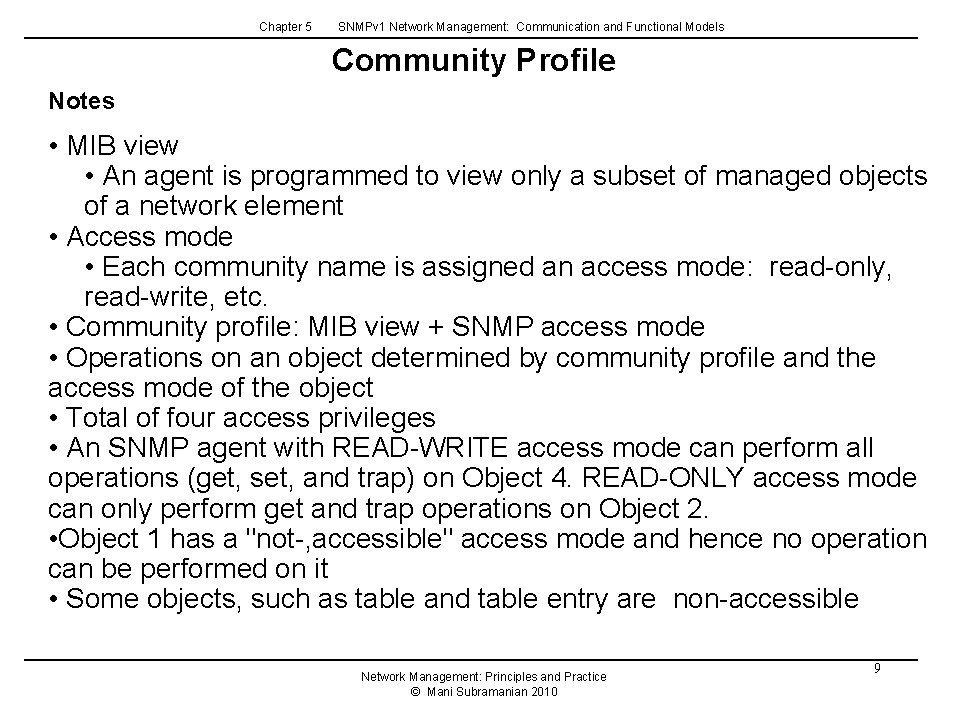
Chapter 5 SNMPv 1 Network Management: Communication and Functional Models Community Profile Notes • MIB view • An agent is programmed to view only a subset of managed objects of a network element • Access mode • Each community name is assigned an access mode: read-only, read-write, etc. • Community profile: MIB view + SNMP access mode • Operations on an object determined by community profile and the access mode of the object • Total of four access privileges • An SNMP agent with READ-WRITE access mode can perform all operations (get, set, and trap) on Object 4. READ-ONLY access mode can only perform get and trap operations on Object 2. • Object 1 has a "not-, accessible" access mode and hence no operation can be performed on it • Some objects, such as table and table entry are non-accessible Network Management: Principles and Practice © Mani Subramanian 2010 9
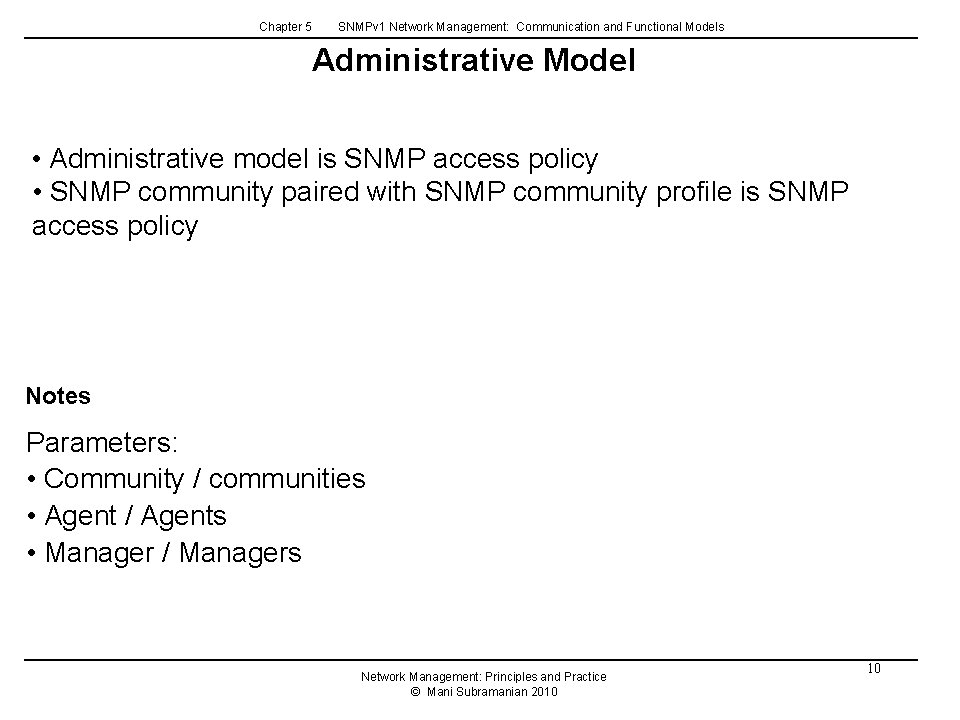
Chapter 5 SNMPv 1 Network Management: Communication and Functional Models Administrative Model • Administrative model is SNMP access policy • SNMP community paired with SNMP community profile is SNMP access policy Notes Parameters: • Community / communities • Agent / Agents • Manager / Managers Network Management: Principles and Practice © Mani Subramanian 2010 10
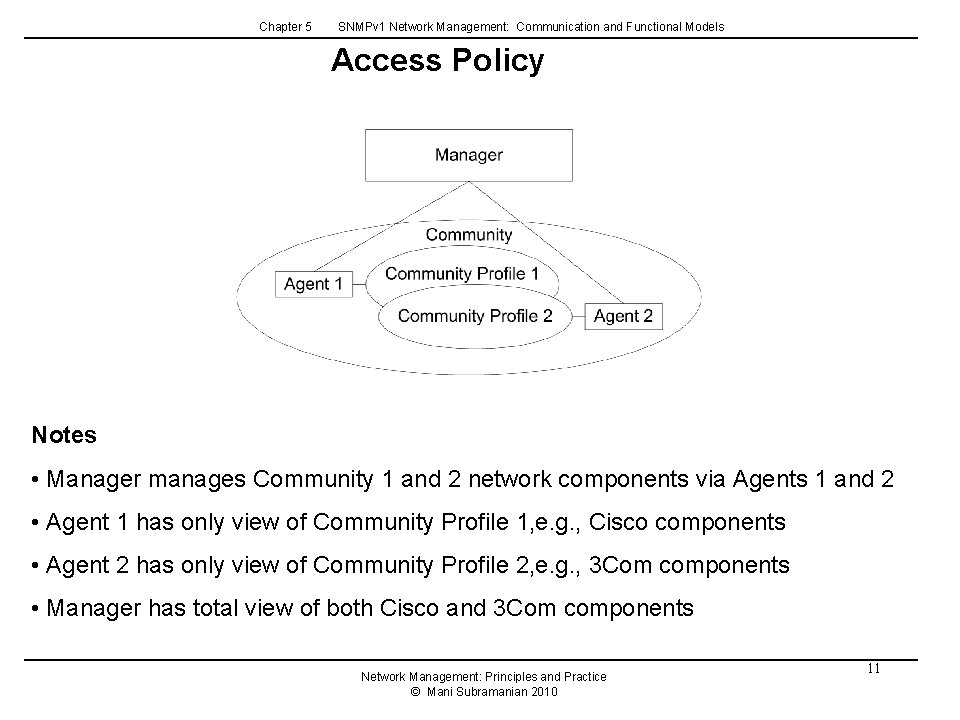
Chapter 5 SNMPv 1 Network Management: Communication and Functional Models Access Policy Notes • Manager manages Community 1 and 2 network components via Agents 1 and 2 • Agent 1 has only view of Community Profile 1, e. g. , Cisco components • Agent 2 has only view of Community Profile 2, e. g. , 3 Com components • Manager has total view of both Cisco and 3 Com components Network Management: Principles and Practice © Mani Subramanian 2010 11
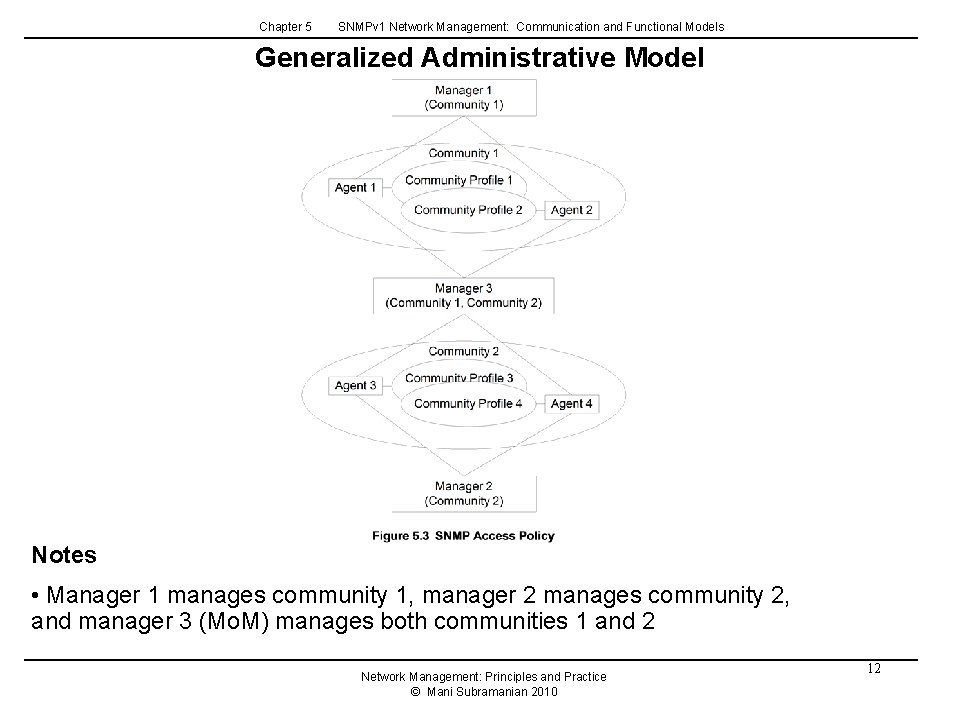
Chapter 5 SNMPv 1 Network Management: Communication and Functional Models Generalized Administrative Model Notes • Manager 1 manages community 1, manager 2 manages community 2, and manager 3 (Mo. M) manages both communities 1 and 2 Network Management: Principles and Practice © Mani Subramanian 2010 12
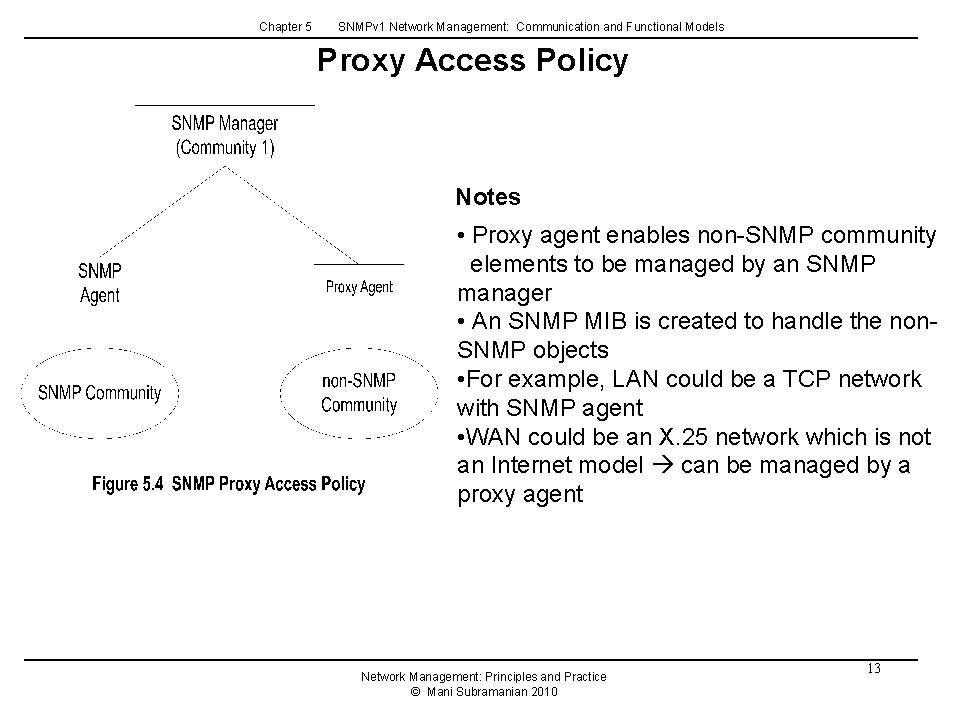
Chapter 5 SNMPv 1 Network Management: Communication and Functional Models Proxy Access Policy Notes • Proxy agent enables non-SNMP community elements to be managed by an SNMP manager • An SNMP MIB is created to handle the non. SNMP objects • For example, LAN could be a TCP network with SNMP agent • WAN could be an X. 25 network which is not an Internet model can be managed by a proxy agent Network Management: Principles and Practice © Mani Subramanian 2010 13
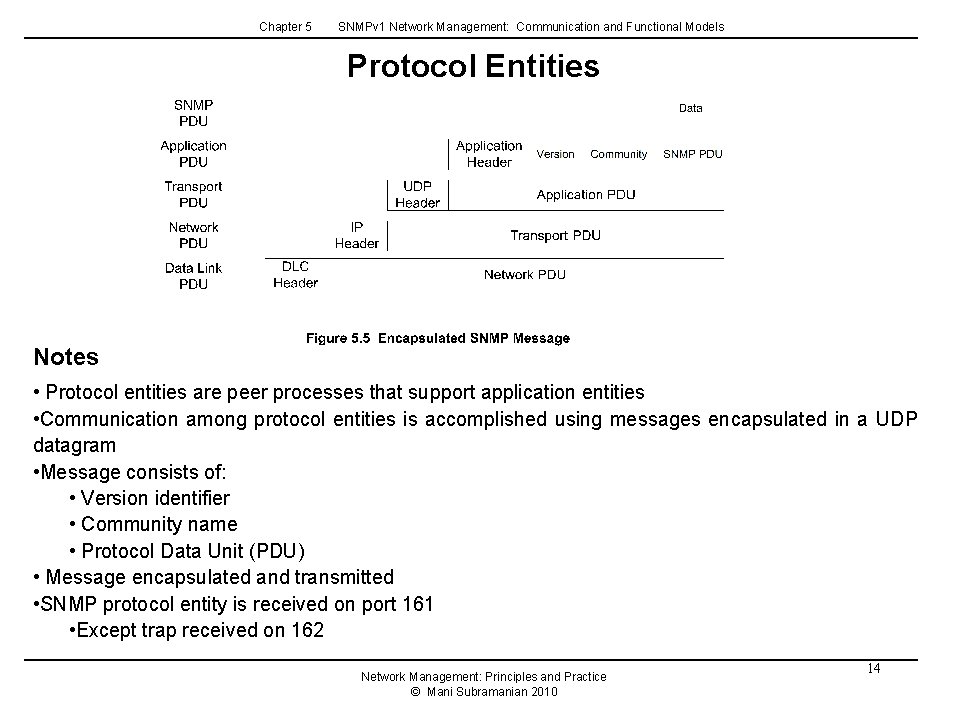
Chapter 5 SNMPv 1 Network Management: Communication and Functional Models Protocol Entities Notes • Protocol entities are peer processes that support application entities • Communication among protocol entities is accomplished using messages encapsulated in a UDP datagram • Message consists of: • Version identifier • Community name • Protocol Data Unit (PDU) • Message encapsulated and transmitted • SNMP protocol entity is received on port 161 • Except trap received on 162 Network Management: Principles and Practice © Mani Subramanian 2010 14
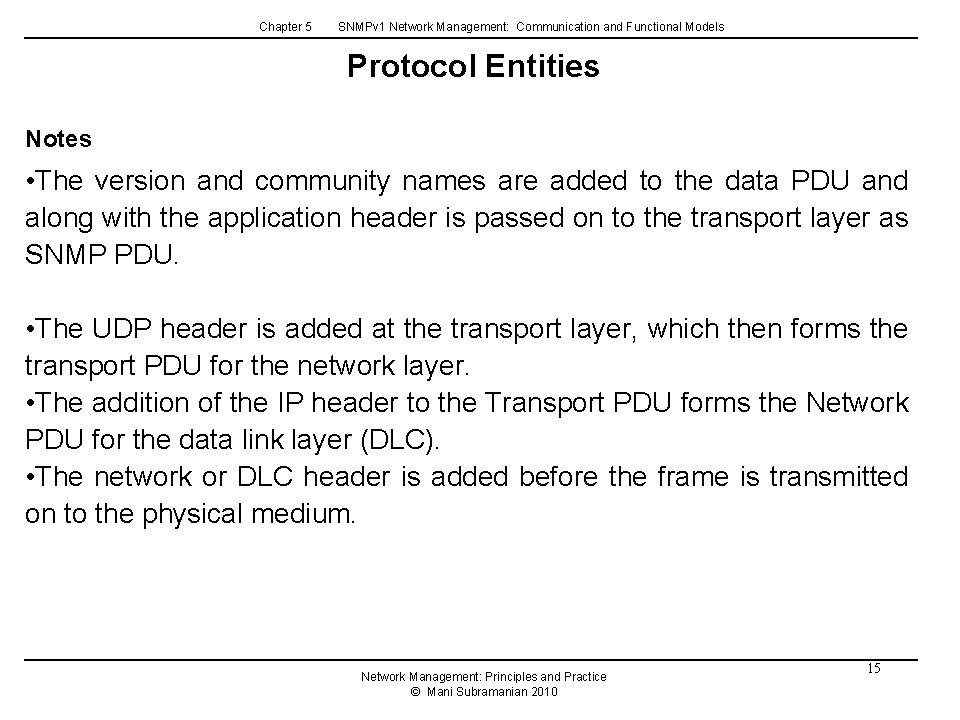
Chapter 5 SNMPv 1 Network Management: Communication and Functional Models Protocol Entities Notes • The version and community names are added to the data PDU and along with the application header is passed on to the transport layer as SNMP PDU. • The UDP header is added at the transport layer, which then forms the transport PDU for the network layer. • The addition of the IP header to the Transport PDU forms the Network PDU for the data link layer (DLC). • The network or DLC header is added before the frame is transmitted on to the physical medium. Network Management: Principles and Practice © Mani Subramanian 2010 15
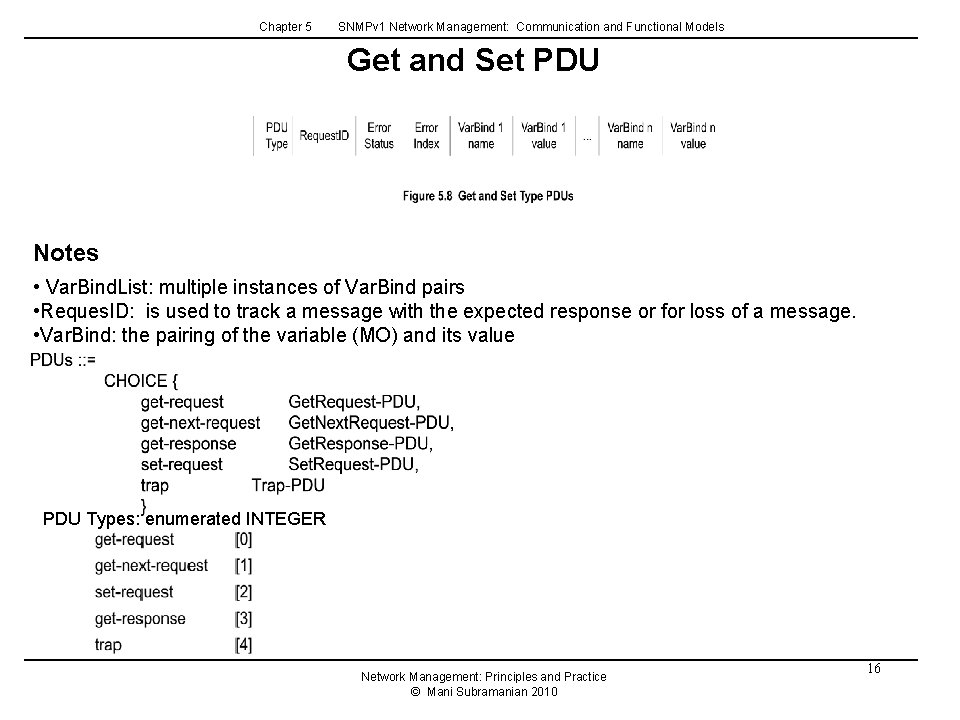
Chapter 5 SNMPv 1 Network Management: Communication and Functional Models Get and Set PDU Notes • Var. Bind. List: multiple instances of Var. Bind pairs • Reques. ID: is used to track a message with the expected response or for loss of a message. • Var. Bind: the pairing of the variable (MO) and its value PDU Types: enumerated INTEGER Network Management: Principles and Practice © Mani Subramanian 2010 16
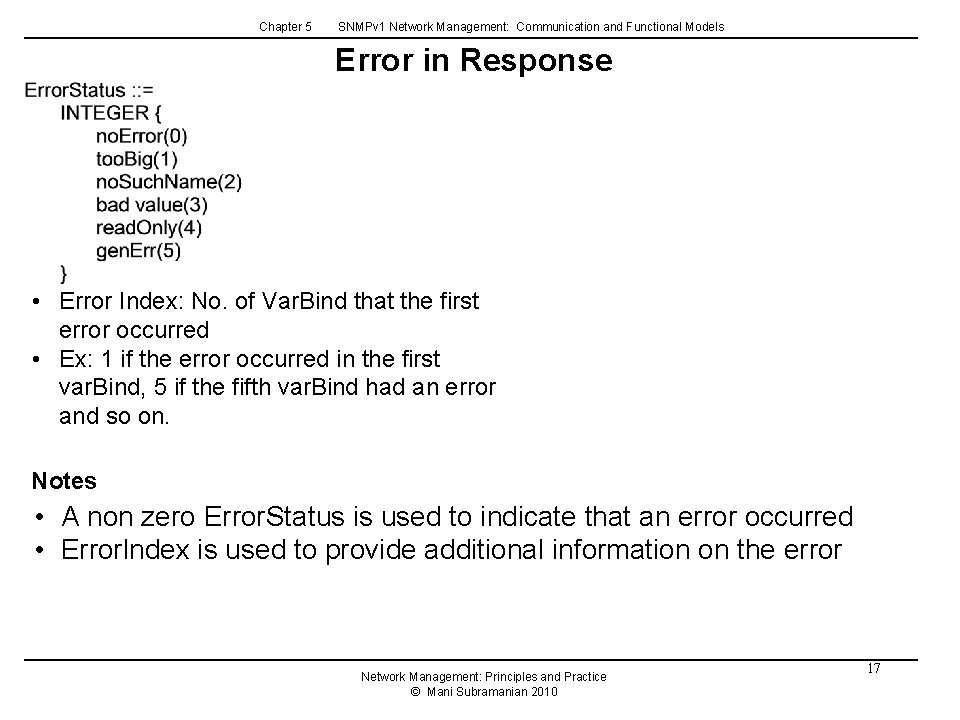
Chapter 5 SNMPv 1 Network Management: Communication and Functional Models Error in Response • Error Index: No. of Var. Bind that the first error occurred • Ex: 1 if the error occurred in the first var. Bind, 5 if the fifth var. Bind had an error and so on. Notes • A non zero Error. Status is used to indicate that an error occurred • Errorlndex is used to provide additional information on the error Network Management: Principles and Practice © Mani Subramanian 2010 17
Chapter 5 SNMPv 1 Network Management: Communication and Functional Models Trap PDU Figure 5. 9 Trap PDUs Table 5. 1 Generic Traps Notes • Enterprise and agent address pertain to the system generating the trap • Seven generic traps specified by enumerated INTEGER • Specific trap is a trap not covered by enterprise specific trap • Timestamp indicates elapsed time since last re-initialization Network Management: Principles and Practice © Mani Subramanian 2010 18
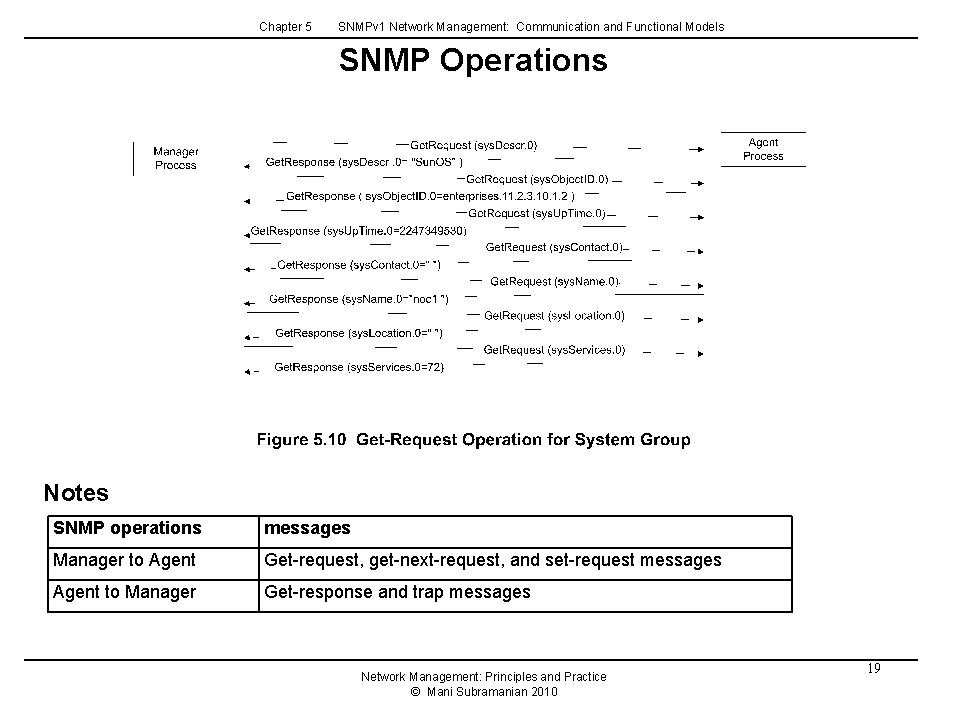
Chapter 5 SNMPv 1 Network Management: Communication and Functional Models SNMP Operations Notes SNMP operations messages Manager to Agent Get-request, get-next-request, and set-request messages Agent to Manager Get-response and trap messages Network Management: Principles and Practice © Mani Subramanian 2010 19
Chapter 5 SNMPv 1 Network Management: Communication and Functional Models MIB for Get-Next-Request Network Management: Principles and Practice © Mani Subramanian 2010 20
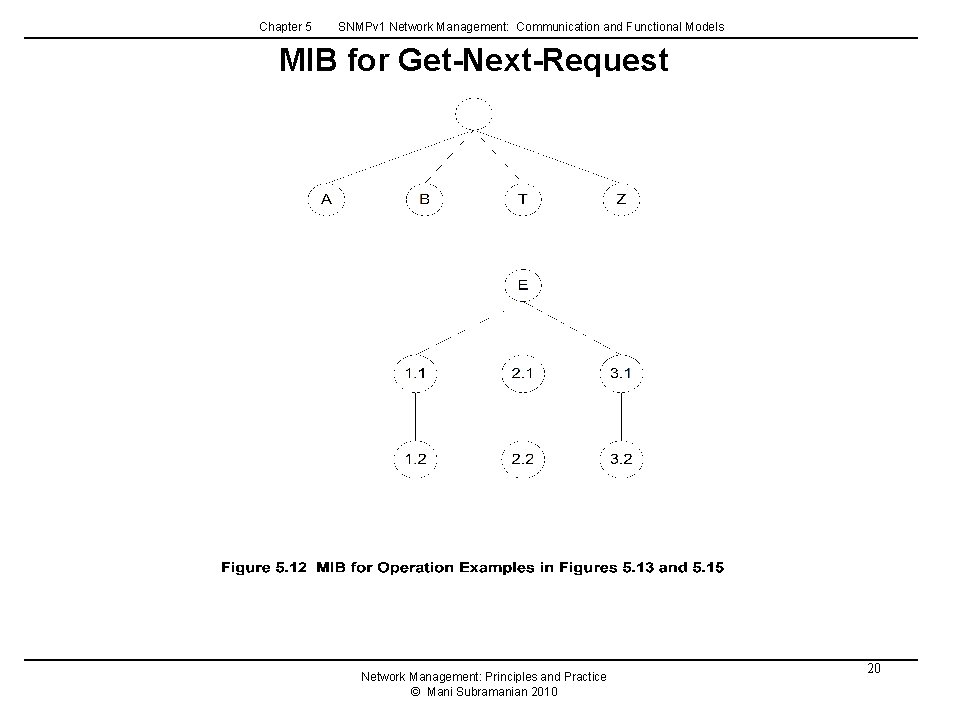
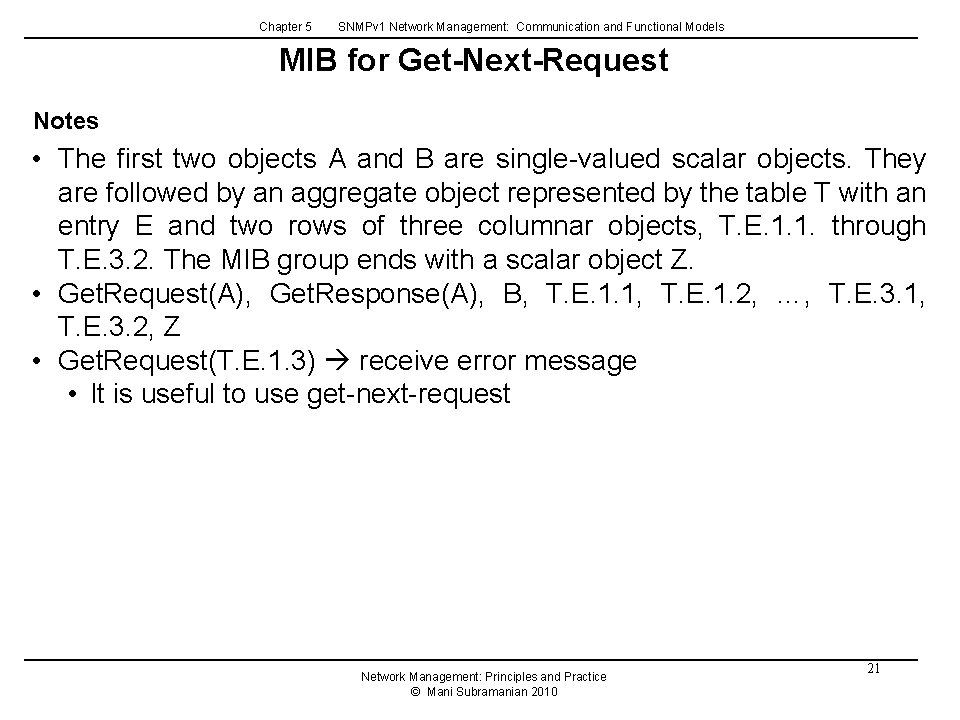
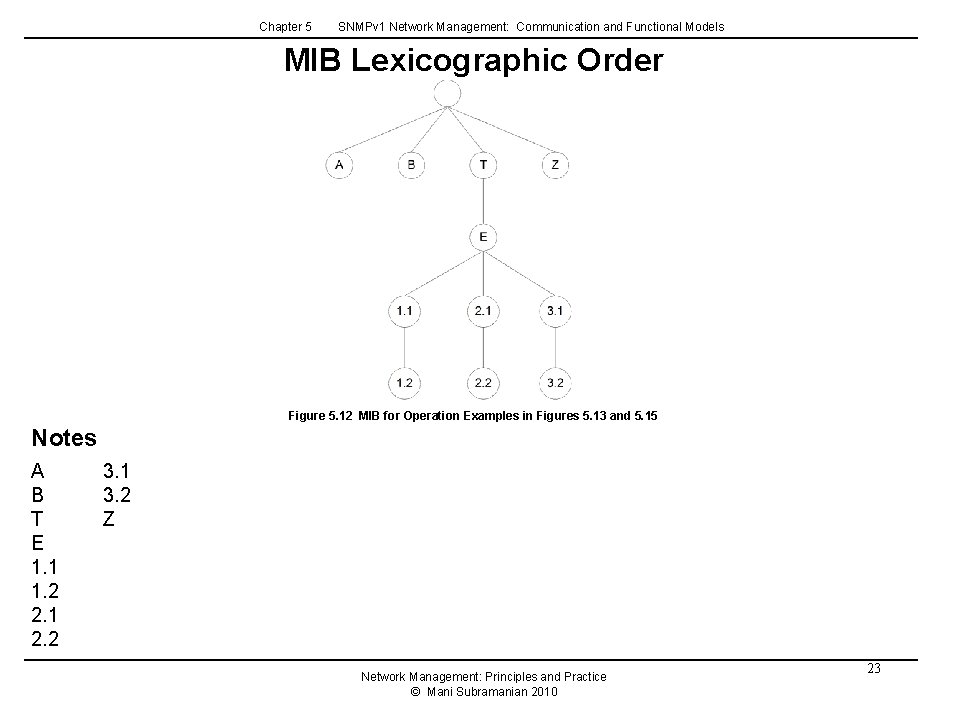
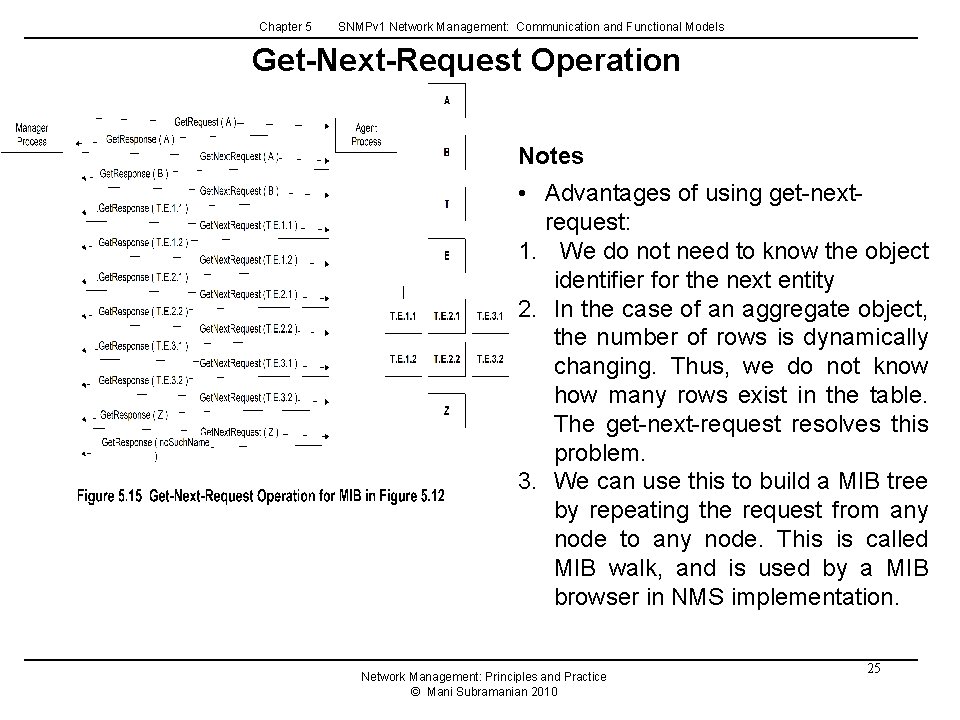
Chapter 5 SNMPv 1 Network Management: Communication and Functional Models MIB for Get-Next-Request Notes • The first two objects A and B are single-valued scalar objects. They are followed by an aggregate object represented by the table T with an entry E and two rows of three columnar objects, T. E. 1. 1. through T. E. 3. 2. The MIB group ends with a scalar object Z. • Get. Request(A), Get. Response(A), B, T. E. 1. 1, T. E. 1. 2, …, T. E. 3. 1, T. E. 3. 2, Z • Get. Request(T. E. 1. 3) receive error message • It is useful to use get-next-request Network Management: Principles and Practice © Mani Subramanian 2010 21
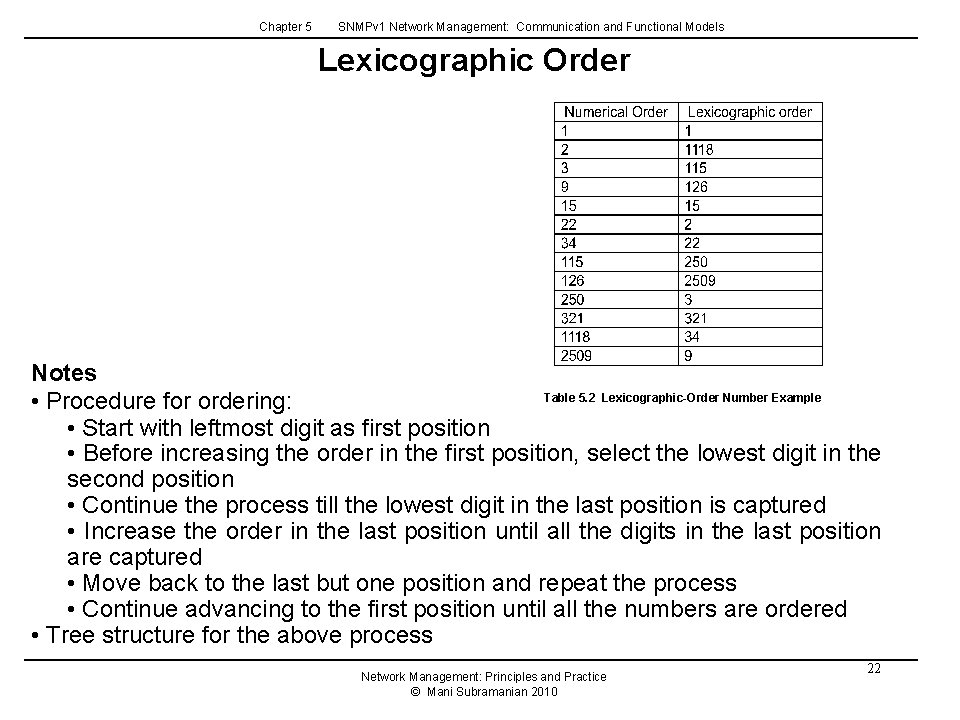
Chapter 5 SNMPv 1 Network Management: Communication and Functional Models Lexicographic Order Notes Table 5. 2 Lexicographic-Order Number Example • Procedure for ordering: • Start with leftmost digit as first position • Before increasing the order in the first position, select the lowest digit in the second position • Continue the process till the lowest digit in the last position is captured • Increase the order in the last position until all the digits in the last position are captured • Move back to the last but one position and repeat the process • Continue advancing to the first position until all the numbers are ordered • Tree structure for the above process Network Management: Principles and Practice © Mani Subramanian 2010 22
Chapter 5 SNMPv 1 Network Management: Communication and Functional Models MIB Lexicographic Order Figure 5. 12 MIB for Operation Examples in Figures 5. 13 and 5. 15 Notes A B T E 1. 1 1. 2 2. 1 2. 2 3. 1 3. 2 Z Network Management: Principles and Practice © Mani Subramanian 2010 23
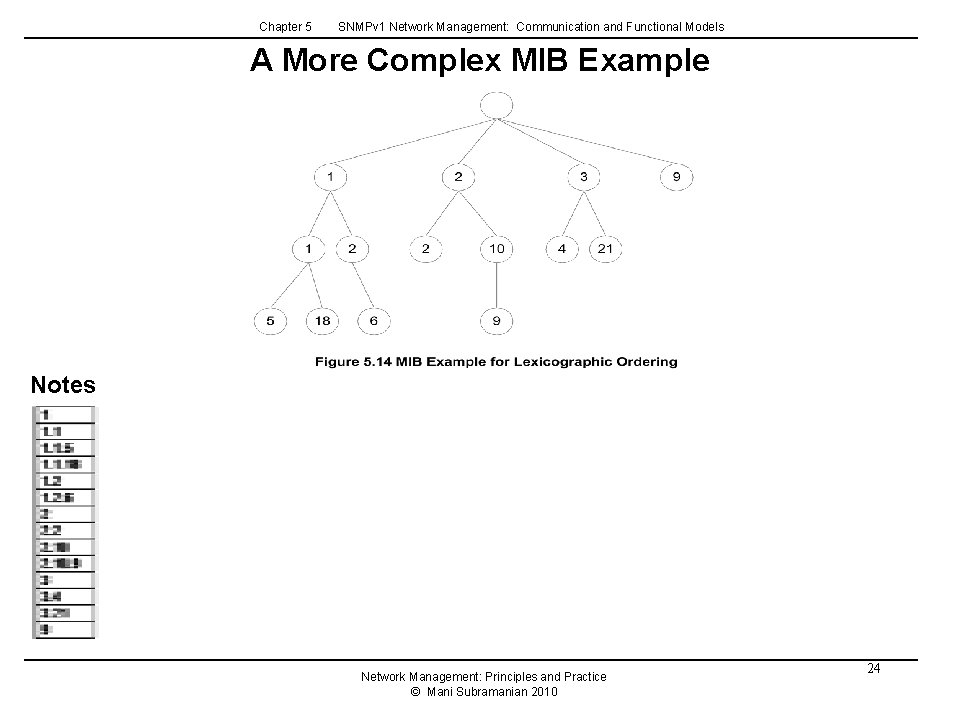
Chapter 5 SNMPv 1 Network Management: Communication and Functional Models A More Complex MIB Example Notes Network Management: Principles and Practice © Mani Subramanian 2010 24
Chapter 5 SNMPv 1 Network Management: Communication and Functional Models Get-Next-Request Operation Notes • Advantages of using get-nextrequest: 1. We do not need to know the object identifier for the next entity 2. In the case of an aggregate object, the number of rows is dynamically changing. Thus, we do not know how many rows exist in the table. The get-next-request resolves this problem. 3. We can use this to build a MIB tree by repeating the request from any node to any node. This is called MIB walk, and is used by a MIB browser in NMS implementation. Network Management: Principles and Practice © Mani Subramanian 2010 25
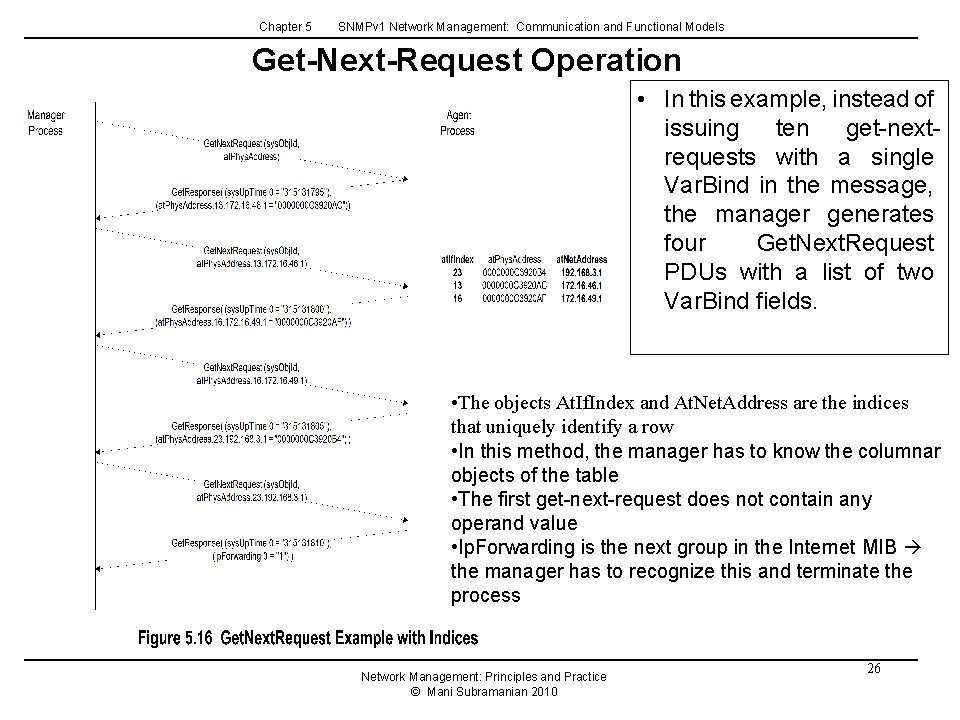
Chapter 5 SNMPv 1 Network Management: Communication and Functional Models Get-Next-Request Operation • In this example, instead of issuing ten get-nextrequests with a single Var. Bind in the message, the manager generates four Get. Next. Request PDUs with a list of two Var. Bind fields. • The objects At. If. Index and At. Net. Address are the indices that uniquely identify a row • In this method, the manager has to know the columnar objects of the table • The first get-next-request does not contain any operand value • Ip. Forwarding is the next group in the Internet MIB the manager has to recognize this and terminate the process Network Management: Principles and Practice © Mani Subramanian 2010 26
Chapter 5 SNMPv 1 Network Management: Communication and Functional Models Sniffer Data Network Management: Principles and Practice © Mani Subramanian 2010 27
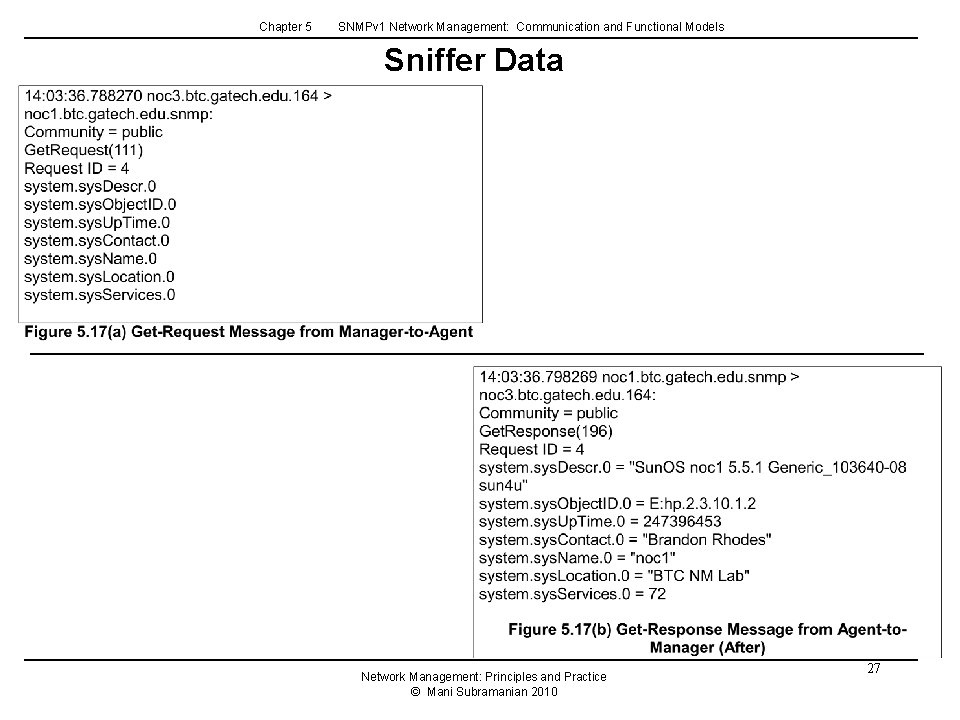
Chapter 5 SNMPv 1 Network Management: Communication and Functional Models Sniffer Data • Sniffer tool is a management tool that can capture packets going across a transmission medium. • The seven object IDs from System. sys. Descr. 0 to System. sys. Services. 0 all end with zero to indicate that they are single-valued scalar objects. • The community name is public • The request number identified in the Get. Response PDU is the same as the one in the Get. Request PDU. Network Management: Principles and Practice © Mani Subramanian 2010 28
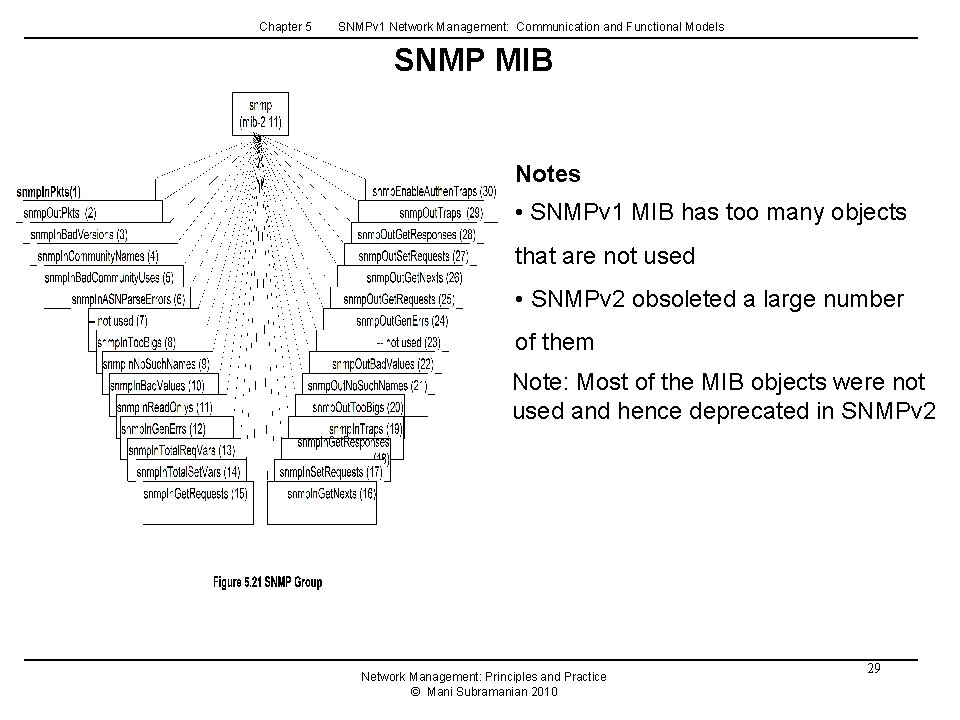
Chapter 5 SNMPv 1 Network Management: Communication and Functional Models SNMP MIB Notes • SNMPv 1 MIB has too many objects that are not used • SNMPv 2 obsoleted a large number of them Note: Most of the MIB objects were not used and hence deprecated in SNMPv 2 Network Management: Principles and Practice © Mani Subramanian 2010 29