
Chapter 7 SNMP Management SNMPv 3 Network Management

- Slides: 41
Chapter 7 SNMP Management: SNMPv 3 Network Management: Principles and Practice © Mani Subramanian 2010 *
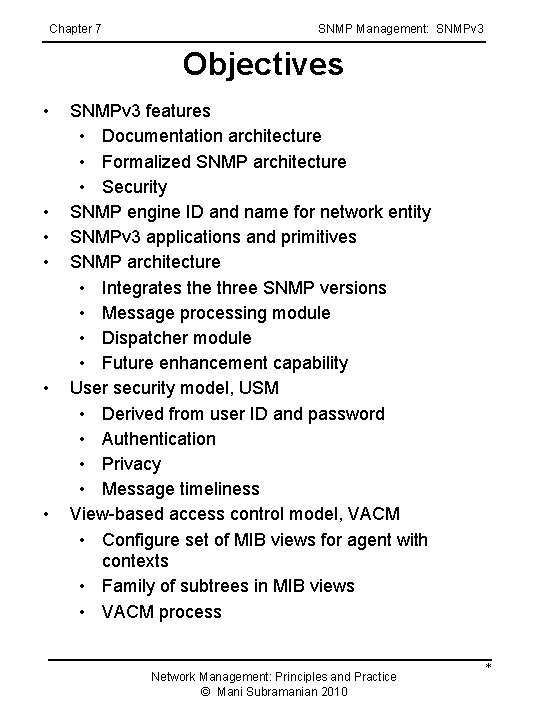
Chapter 7 SNMP Management: SNMPv 3 Objectives • • • SNMPv 3 features • Documentation architecture • Formalized SNMP architecture • Security SNMP engine ID and name for network entity SNMPv 3 applications and primitives SNMP architecture • Integrates the three SNMP versions • Message processing module • Dispatcher module • Future enhancement capability User security model, USM • Derived from user ID and password • Authentication • Privacy • Message timeliness View-based access control model, VACM • Configure set of MIB views for agent with contexts • Family of subtrees in MIB views • VACM process Network Management: Principles and Practice © Mani Subramanian 2010 *
Chapter 7 SNMP Management: SNMPv 3 Key Features • Modularization of document • Modularization of architecture • SNMP engine • Security feature • Secure information • Access control Notes Network Management: Principles and Practice © Mani Subramanian 2010 *
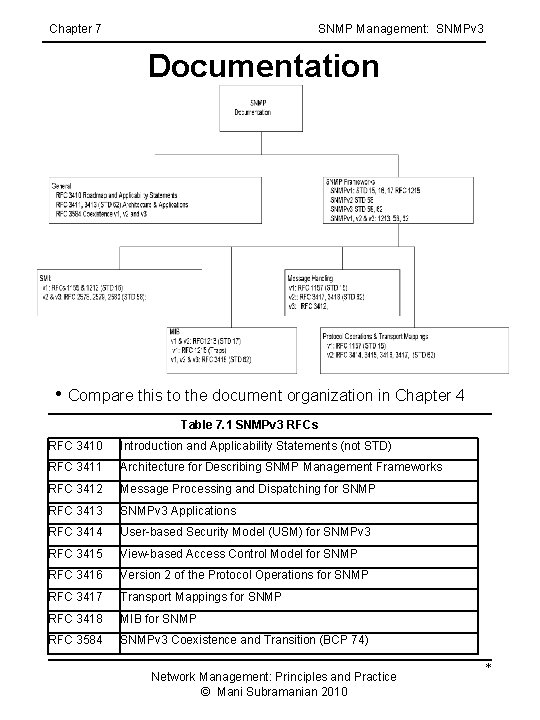
Chapter 7 SNMP Management: SNMPv 3 Documentation • Compare this to the document organization in Chapter 4 Table 7. 1 SNMPv 3 RFCs RFC 3410 Introduction and Applicability Statements (not STD) RFC 3411 Architecture for Describing SNMP Management Frameworks RFC 3412 Message Processing and Dispatching for SNMP RFC 3413 SNMPv 3 Applications RFC 3414 User-based Security Model (USM) for SNMPv 3 RFC 3415 View-based Access Control Model for SNMP RFC 3416 Version 2 of the Protocol Operations for SNMP RFC 3417 Transport Mappings for SNMP RFC 3418 MIB for SNMP RFC 3584 SNMPv 3 Coexistence and Transition (BCP 74) Network Management: Principles and Practice © Mani Subramanian 2010 *
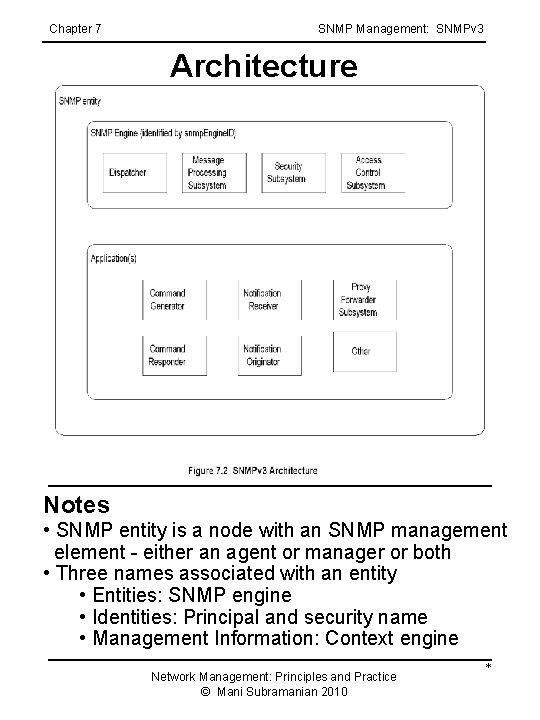
Chapter 7 SNMP Management: SNMPv 3 Architecture Notes • SNMP entity is a node with an SNMP management element - either an agent or manager or both • Three names associated with an entity • Entities: SNMP engine • Identities: Principal and security name • Management Information: Context engine Network Management: Principles and Practice © Mani Subramanian 2010 *
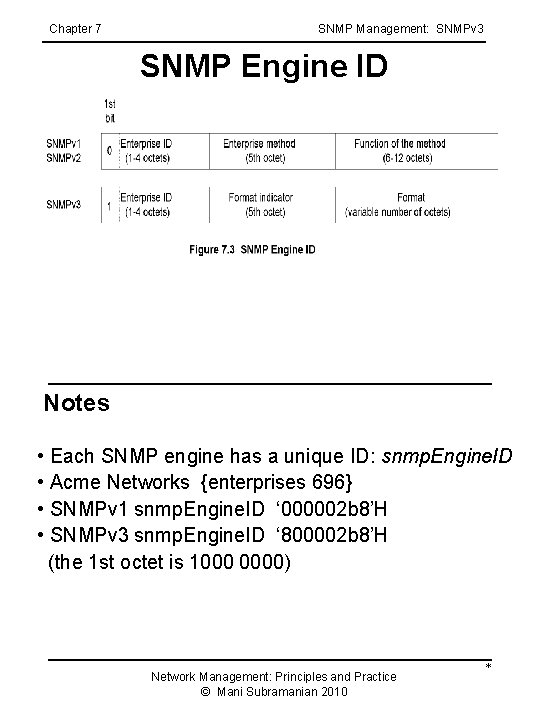
Chapter 7 SNMP Management: SNMPv 3 SNMP Engine ID Notes • Each SNMP engine has a unique ID: snmp. Engine. ID • Acme Networks {enterprises 696} • SNMPv 1 snmp. Engine. ID ‘ 000002 b 8’H • SNMPv 3 snmp. Engine. ID ‘ 800002 b 8’H (the 1 st octet is 1000 0000) Network Management: Principles and Practice © Mani Subramanian 2010 *
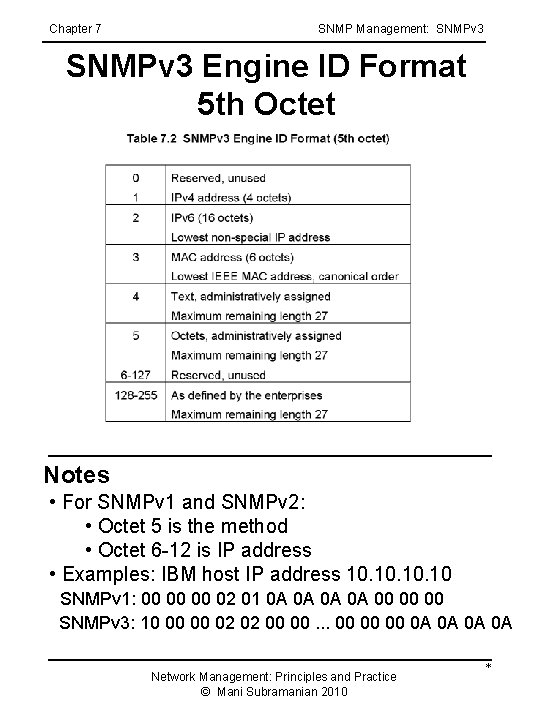
Chapter 7 SNMP Management: SNMPv 3 Engine ID Format 5 th Octet Notes • For SNMPv 1 and SNMPv 2: • Octet 5 is the method • Octet 6 -12 is IP address • Examples: IBM host IP address 10. 10. 10 SNMPv 1: 00 00 00 02 01 0 A 0 A 00 00 00 SNMPv 3: 10 00 00 02 02 00 00. . . 00 00 00 0 A 0 A Network Management: Principles and Practice © Mani Subramanian 2010 *
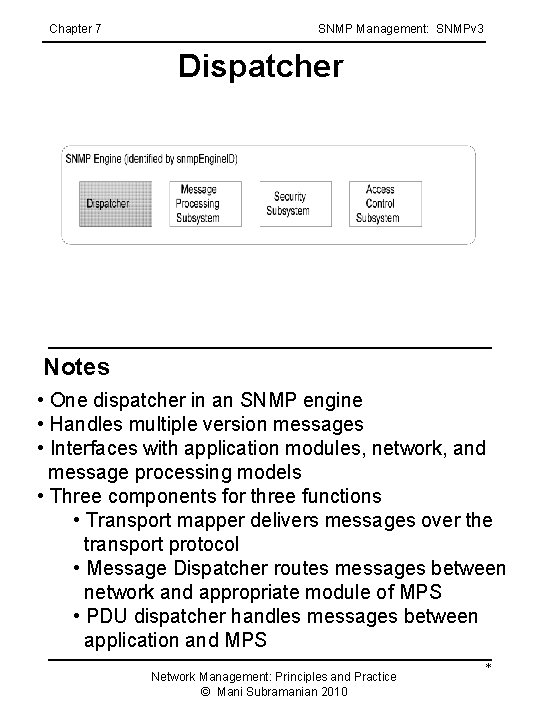
Chapter 7 SNMP Management: SNMPv 3 Dispatcher Notes • One dispatcher in an SNMP engine • Handles multiple version messages • Interfaces with application modules, network, and message processing models • Three components for three functions • Transport mapper delivers messages over the transport protocol • Message Dispatcher routes messages between network and appropriate module of MPS • PDU dispatcher handles messages between application and MPS Network Management: Principles and Practice © Mani Subramanian 2010 *
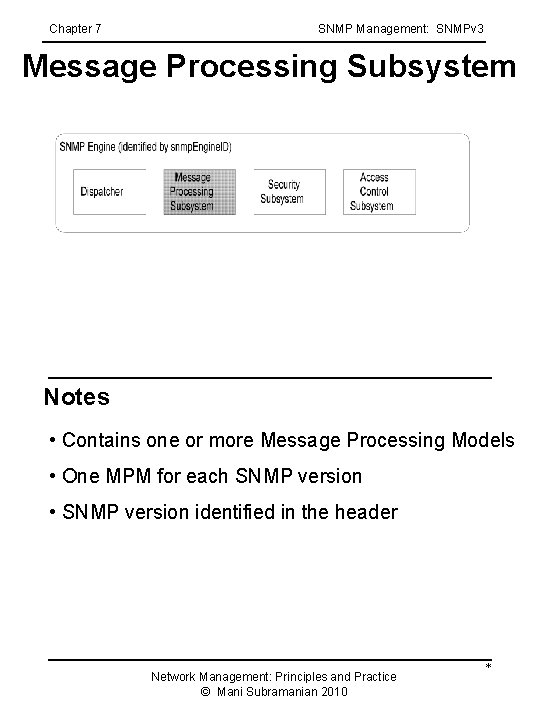
Chapter 7 SNMP Management: SNMPv 3 Message Processing Subsystem Notes • Contains one or more Message Processing Models • One MPM for each SNMP version • SNMP version identified in the header Network Management: Principles and Practice © Mani Subramanian 2010 *
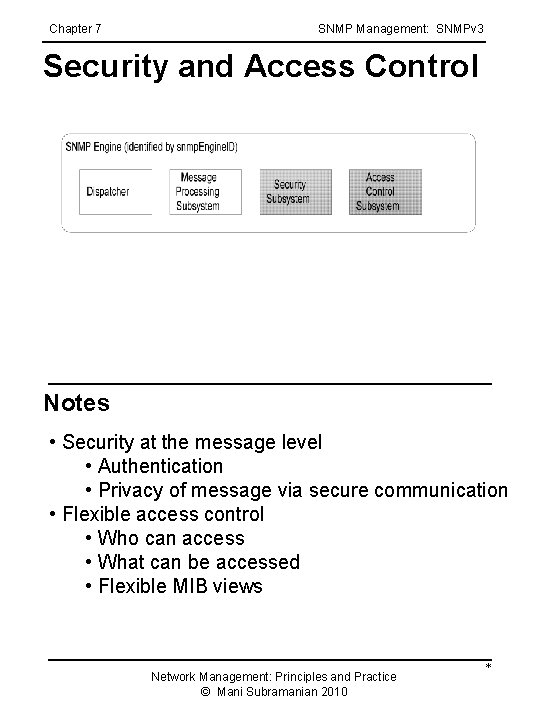
Chapter 7 SNMP Management: SNMPv 3 Security and Access Control Notes • Security at the message level • Authentication • Privacy of message via secure communication • Flexible access control • Who can access • What can be accessed • Flexible MIB views Network Management: Principles and Practice © Mani Subramanian 2010 *
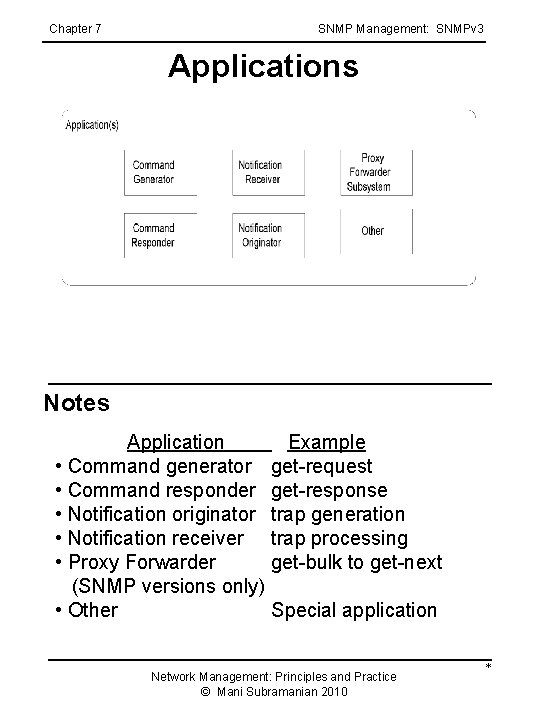
Chapter 7 SNMP Management: SNMPv 3 Applications Notes Application • Command generator • Command responder • Notification originator • Notification receiver • Proxy Forwarder (SNMP versions only) • Other Example get-request get-response trap generation trap processing get-bulk to get-next Special application Network Management: Principles and Practice © Mani Subramanian 2010 *
Chapter 7 SNMP Management: SNMPv 3 Names • SNMP Engine ID snmp. Engine. ID • Principal principal Who: person or group or application • Security Name security. Name human readable name • Context Engine ID context. Engine. ID • Context Name context. Name Notes • An SNMP agent can monitor more than one network element (context) Examples: SNMP Engine ID IP address Principal John Smith Security Name Administrator Principal Li, David, Kristen, Rashmi, Security Name Operator Network Management: Principles and Practice © Mani Subramanian 2010 *
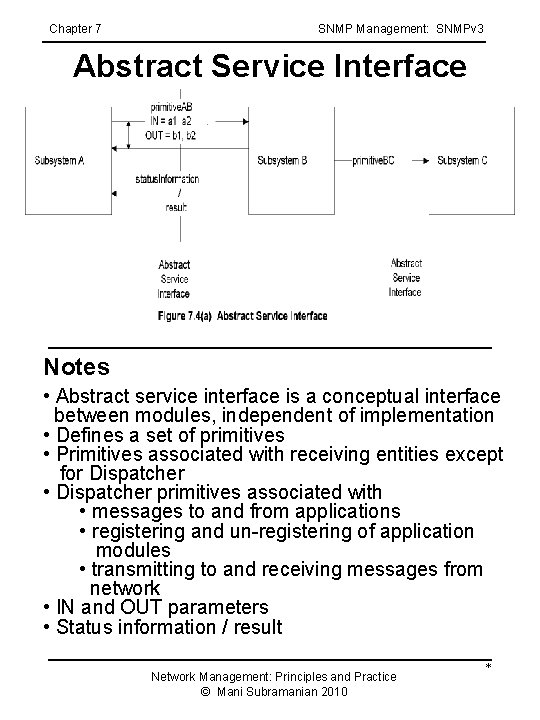
Chapter 7 SNMP Management: SNMPv 3 Abstract Service Interface Notes • Abstract service interface is a conceptual interface between modules, independent of implementation • Defines a set of primitives • Primitives associated with receiving entities except for Dispatcher • Dispatcher primitives associated with • messages to and from applications • registering and un-registering of application modules • transmitting to and receiving messages from network • IN and OUT parameters • Status information / result Network Management: Principles and Practice © Mani Subramanian 2010 *
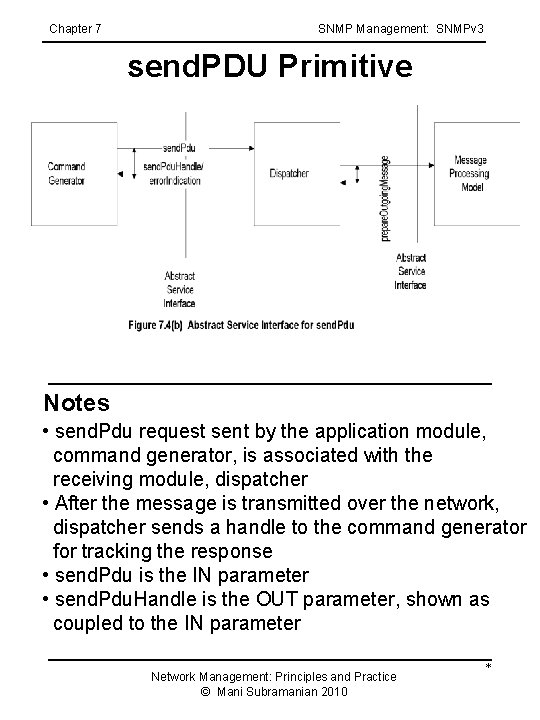
Chapter 7 SNMP Management: SNMPv 3 send. PDU Primitive Notes • send. Pdu request sent by the application module, command generator, is associated with the receiving module, dispatcher • After the message is transmitted over the network, dispatcher sends a handle to the command generator for tracking the response • send. Pdu is the IN parameter • send. Pdu. Handle is the OUT parameter, shown as coupled to the IN parameter Network Management: Principles and Practice © Mani Subramanian 2010 *
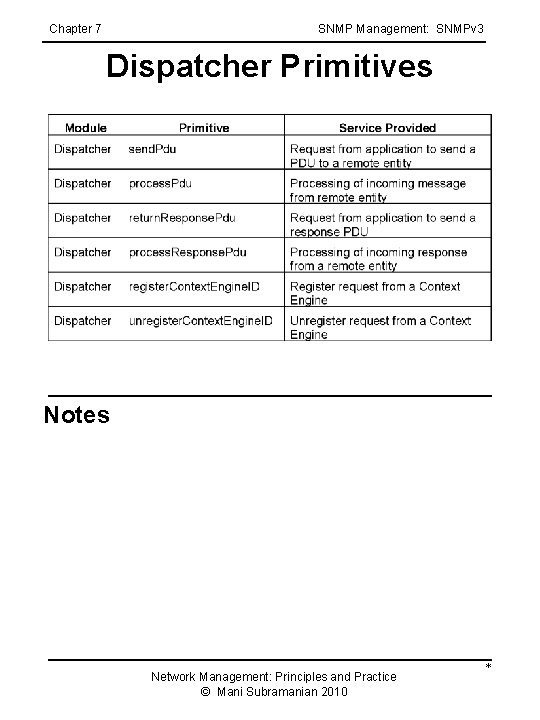
Chapter 7 SNMP Management: SNMPv 3 Dispatcher Primitives Notes Network Management: Principles and Practice © Mani Subramanian 2010 *
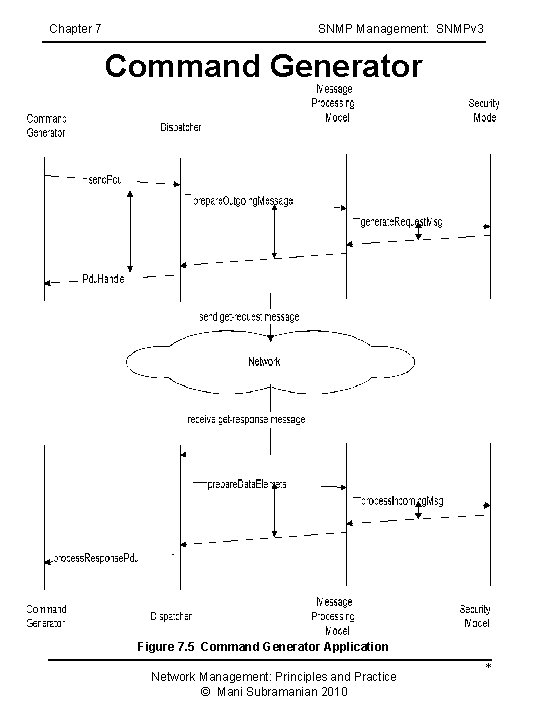
Chapter 7 SNMP Management: SNMPv 3 Command Generator Figure 7. 5 Command Generator Application Network Management: Principles and Practice © Mani Subramanian 2010 *
Chapter 7 SNMP Management: SNMPv 3 Command Responder Network Management: Principles and Practice © Mani Subramanian 2010 *
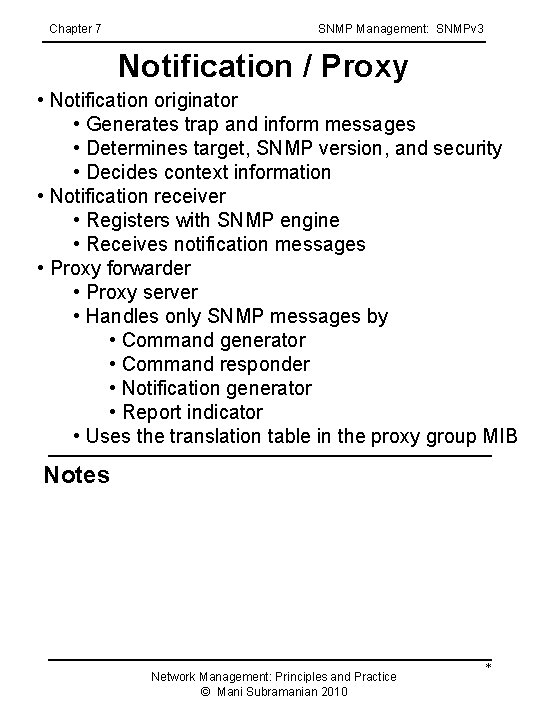
Chapter 7 SNMP Management: SNMPv 3 Notification / Proxy • Notification originator • Generates trap and inform messages • Determines target, SNMP version, and security • Decides context information • Notification receiver • Registers with SNMP engine • Receives notification messages • Proxy forwarder • Proxy server • Handles only SNMP messages by • Command generator • Command responder • Notification generator • Report indicator • Uses the translation table in the proxy group MIB Notes Network Management: Principles and Practice © Mani Subramanian 2010 *
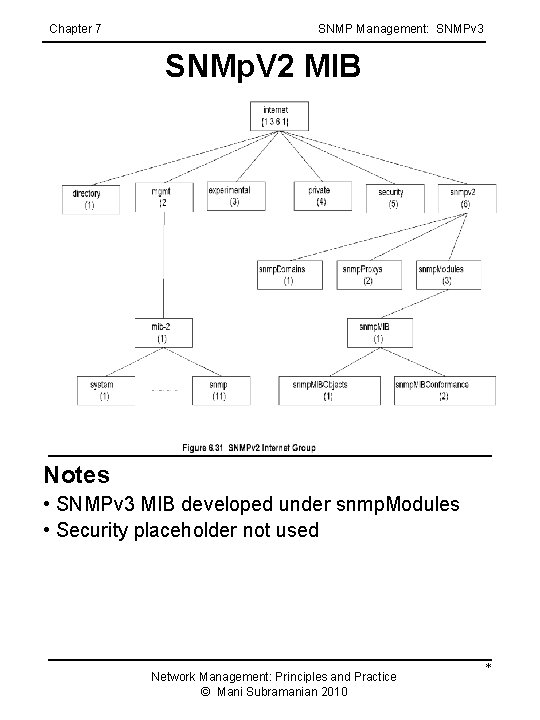
Chapter 7 SNMP Management: SNMPv 3 SNMp. V 2 MIB Notes • SNMPv 3 MIB developed under snmp. Modules • Security placeholder not used Network Management: Principles and Practice © Mani Subramanian 2010 *
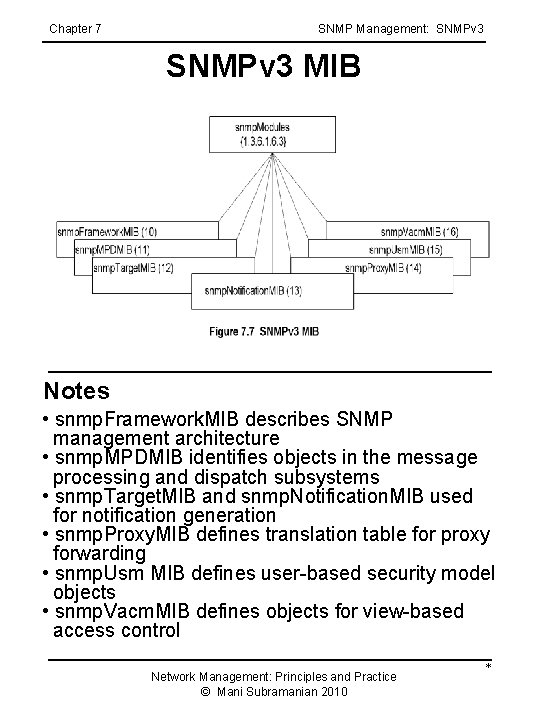
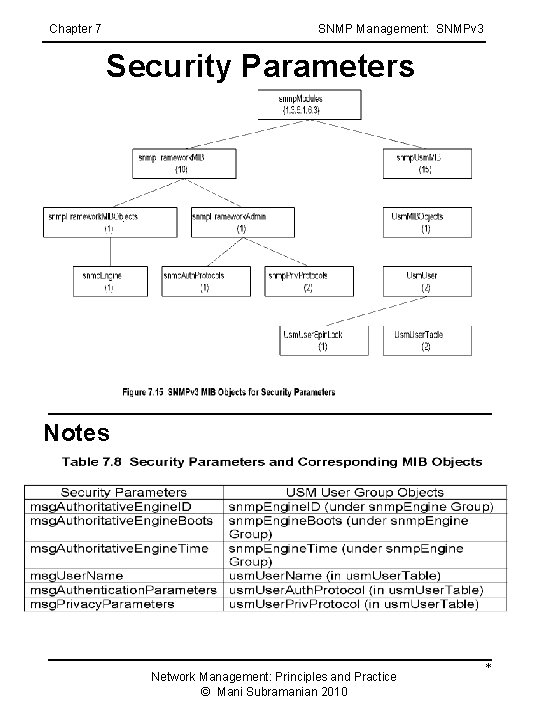
Chapter 7 SNMP Management: SNMPv 3 MIB Notes • snmp. Framework. MIB describes SNMP management architecture • snmp. MPDMIB identifies objects in the message processing and dispatch subsystems • snmp. Target. MIB and snmp. Notification. MIB used for notification generation • snmp. Proxy. MIB defines translation table for proxy forwarding • snmp. Usm MIB defines user-based security model objects • snmp. Vacm. MIB defines objects for view-based access control Network Management: Principles and Practice © Mani Subramanian 2010 *
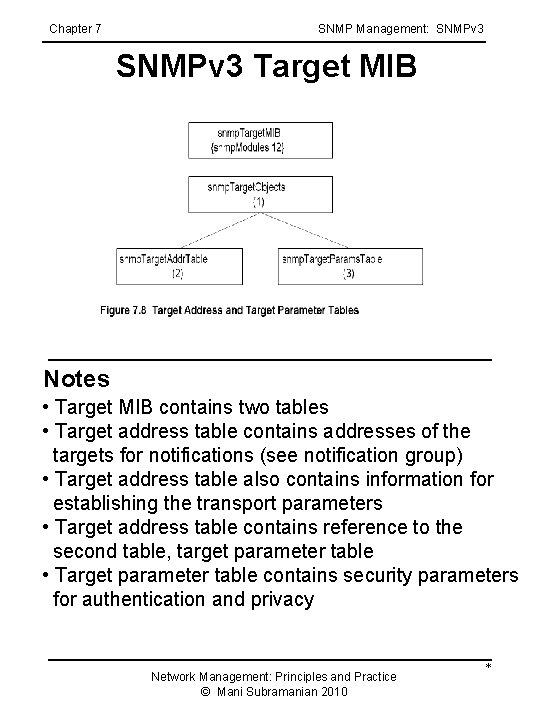
Chapter 7 SNMP Management: SNMPv 3 Target MIB Notes • Target MIB contains two tables • Target address table contains addresses of the targets for notifications (see notification group) • Target address table also contains information for establishing the transport parameters • Target address table contains reference to the second table, target parameter table • Target parameter table contains security parameters for authentication and privacy Network Management: Principles and Practice © Mani Subramanian 2010 *
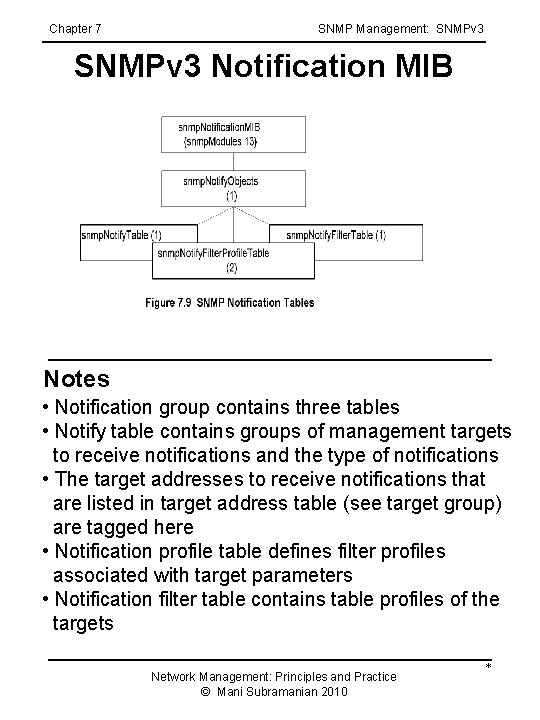
Chapter 7 SNMP Management: SNMPv 3 Notification MIB Notes • Notification group contains three tables • Notify table contains groups of management targets to receive notifications and the type of notifications • The target addresses to receive notifications that are listed in target address table (see target group) are tagged here • Notification profile table defines filter profiles associated with target parameters • Notification filter table contains table profiles of the targets Network Management: Principles and Practice © Mani Subramanian 2010 *
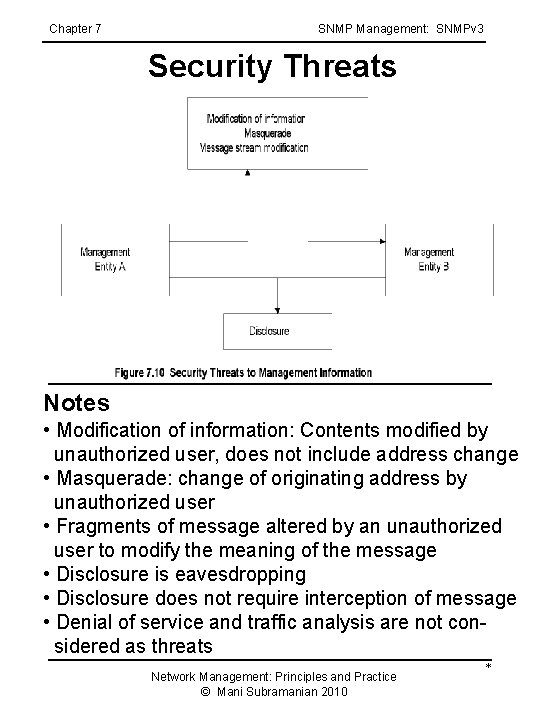
Chapter 7 SNMP Management: SNMPv 3 Security Threats Notes • Modification of information: Contents modified by unauthorized user, does not include address change • Masquerade: change of originating address by unauthorized user • Fragments of message altered by an unauthorized user to modify the meaning of the message • Disclosure is eavesdropping • Disclosure does not require interception of message • Denial of service and traffic analysis are not considered as threats Network Management: Principles and Practice © Mani Subramanian 2010 *
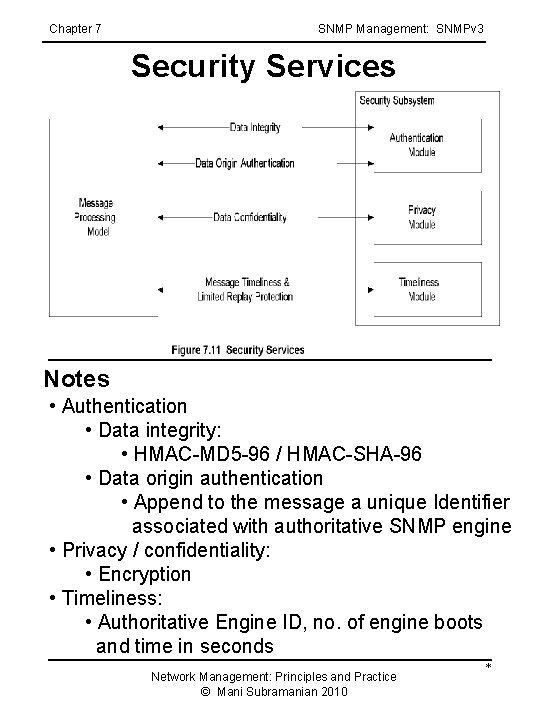
Chapter 7 SNMP Management: SNMPv 3 Security Services Notes • Authentication • Data integrity: • HMAC-MD 5 -96 / HMAC-SHA-96 • Data origin authentication • Append to the message a unique Identifier associated with authoritative SNMP engine • Privacy / confidentiality: • Encryption • Timeliness: • Authoritative Engine ID, no. of engine boots and time in seconds Network Management: Principles and Practice © Mani Subramanian 2010 *
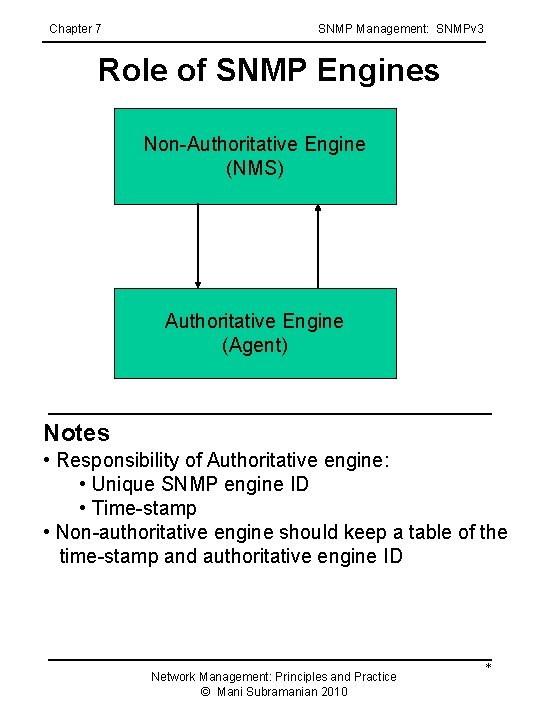
Chapter 7 SNMP Management: SNMPv 3 Role of SNMP Engines Non-Authoritative Engine (NMS) Authoritative Engine (Agent) Notes • Responsibility of Authoritative engine: • Unique SNMP engine ID • Time-stamp • Non-authoritative engine should keep a table of the time-stamp and authoritative engine ID Network Management: Principles and Practice © Mani Subramanian 2010 *
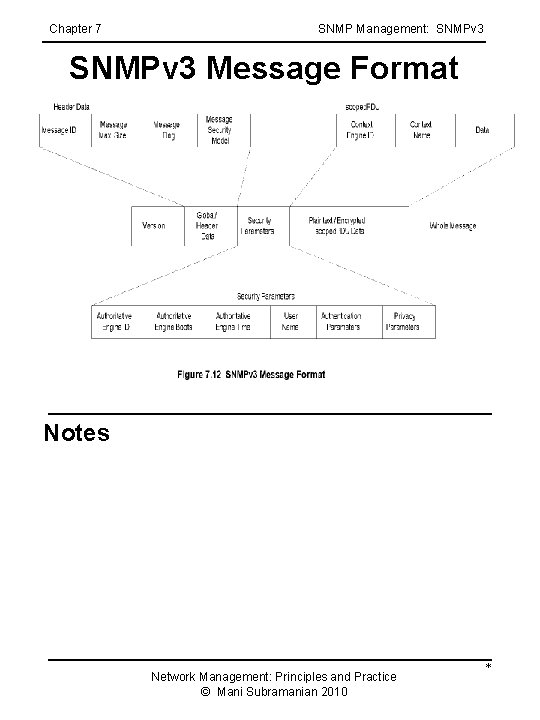
Chapter 7 SNMP Management: SNMPv 3 Message Format Notes Network Management: Principles and Practice © Mani Subramanian 2010 *
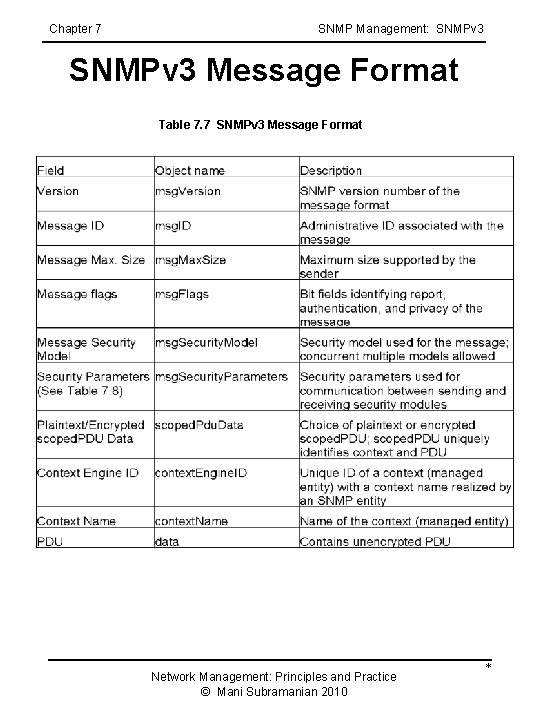
Chapter 7 SNMP Management: SNMPv 3 Message Format Table 7. 7 SNMPv 3 Message Format Network Management: Principles and Practice © Mani Subramanian 2010 *
Chapter 7 SNMP Management: SNMPv 3 User-based Security Model • Based on traditional user name concept • USM primitives across abstract service interfaces • Authentication service primitives • authenticate. Outgoing. Msg • authenticate. Incoming. Msg • Privacy Services • encrypt. Data • decrypt. Data Notes Network Management: Principles and Practice © Mani Subramanian 2010 *
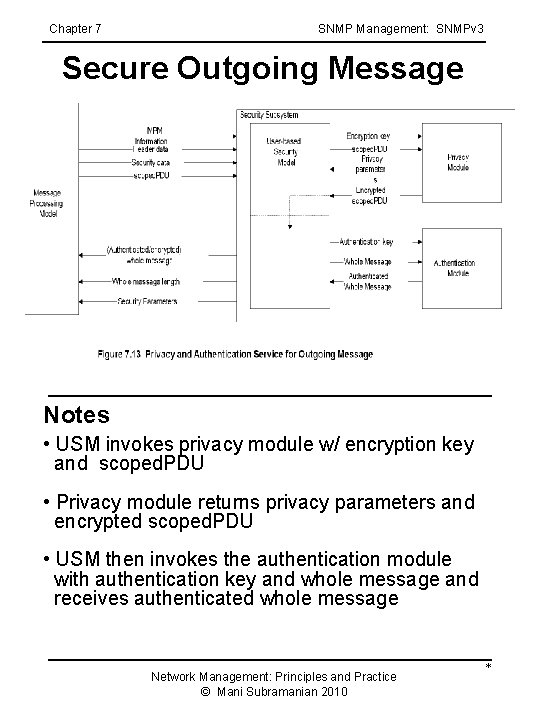
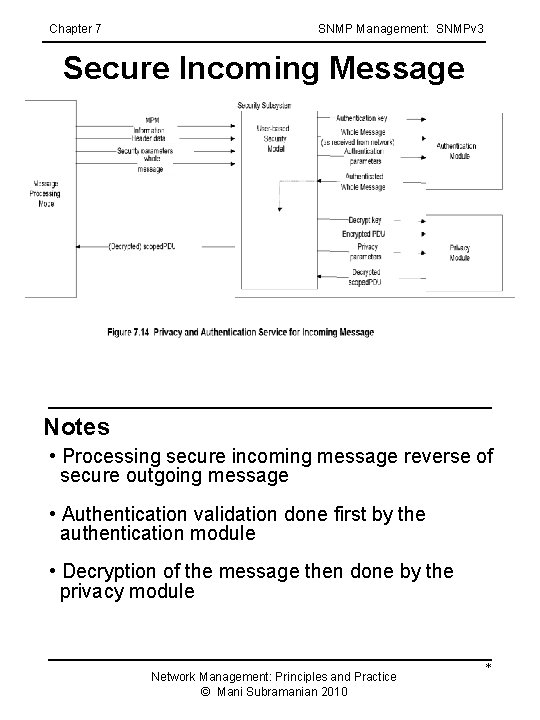
Chapter 7 SNMP Management: SNMPv 3 Secure Outgoing Message Notes • USM invokes privacy module w/ encryption key and scoped. PDU • Privacy module returns privacy parameters and encrypted scoped. PDU • USM then invokes the authentication module with authentication key and whole message and receives authenticated whole message Network Management: Principles and Practice © Mani Subramanian 2010 *
Chapter 7 SNMP Management: SNMPv 3 Secure Incoming Message Notes • Processing secure incoming message reverse of secure outgoing message • Authentication validation done first by the authentication module • Decryption of the message then done by the privacy module Network Management: Principles and Practice © Mani Subramanian 2010 *
Chapter 7 SNMP Management: SNMPv 3 Security Parameters Notes Network Management: Principles and Practice © Mani Subramanian 2010 *
Chapter 7 SNMP Management: SNMPv 3 Privacy Module • Encryption and decryption of scoped PDU (context engine ID, context name, and PDU) • CBC - DES (Cipher Block Chaining - Data Encryption Standard) symmetric protocol • Encryption key (and initialization vector) made up of secret key (user password), and timeliness value • Privacy parameter is salt value (unique for each packet) in CBC-DES Notes Network Management: Principles and Practice © Mani Subramanian 2010 *
Chapter 7 SNMP Management: SNMPv 3 Authentication Key • Secret key for authentication • Derived from user (NMS) ID and password • MD 5 or SHA-1 algorithm used • Authentication key is digest 2 Notes Procedure: 1. Derive digest 0: Password repeated until it forms 220 octets. 2. Derive digest 1: Hash digest 0 using MD 5 or SHA-1. 3. Derive digest 2: Concatenate authoritative SNMP engine ID and digest 1 and hash with the same algorithm Network Management: Principles and Practice © Mani Subramanian 2010 *
Chapter 7 SNMP Management: SNMPv 3 Authentication Parameters • Authentication parameter is Hashed Message Access Code (HMAC) • HMAC is 96 -bit long (12 octets) • Derived from authentication key (auth. Key) Notes Procedure: 1. Derive extended. Auth. Key: Supplement auth. Key with 0 s to get 64 -byte string 2. Define ipad, opad, K 1, and K 2: ipad = 0 x 36 (00110110) repeated 64 times opad = 0 x 5 c (01011100) repeated 64 times K 1 = extended. Auth. Key XOR ipad K 2 = extended. Auth. Key XOR opad 3. Derive HMAC by hashing algorithm used HMAC = H (K 2, H (K 1, whole. Msg)) Network Management: Principles and Practice © Mani Subramanian 2010 *
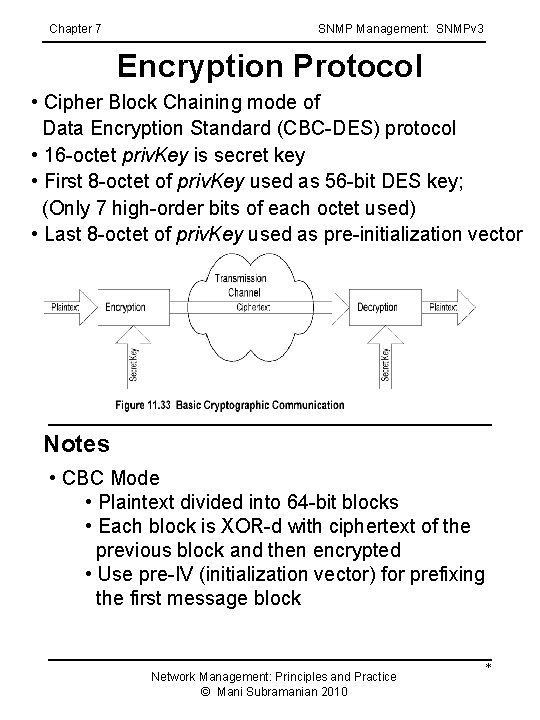
Chapter 7 SNMP Management: SNMPv 3 Encryption Protocol • Cipher Block Chaining mode of Data Encryption Standard (CBC-DES) protocol • 16 -octet priv. Key is secret key • First 8 -octet of priv. Key used as 56 -bit DES key; (Only 7 high-order bits of each octet used) • Last 8 -octet of priv. Key used as pre-initialization vector Notes • CBC Mode • Plaintext divided into 64 -bit blocks • Each block is XOR-d with ciphertext of the previous block and then encrypted • Use pre-IV (initialization vector) for prefixing the first message block Network Management: Principles and Practice © Mani Subramanian 2010 *
Chapter 7 SNMP Management: SNMPv 3 Access Control • View-based Access Control Model • Groups: Name of the group comprising security model and security name: In SNMPv 1, is community name • Security Level • no authentication - no privacy • authentication - privacy • Contexts: Names of the context • MIB Views and View Families • MIB view is a combination of view subtrees • Access Policy • read-view • write-view • notify-view • not-accessible Notes Network Management: Principles and Practice © Mani Subramanian 2010 *
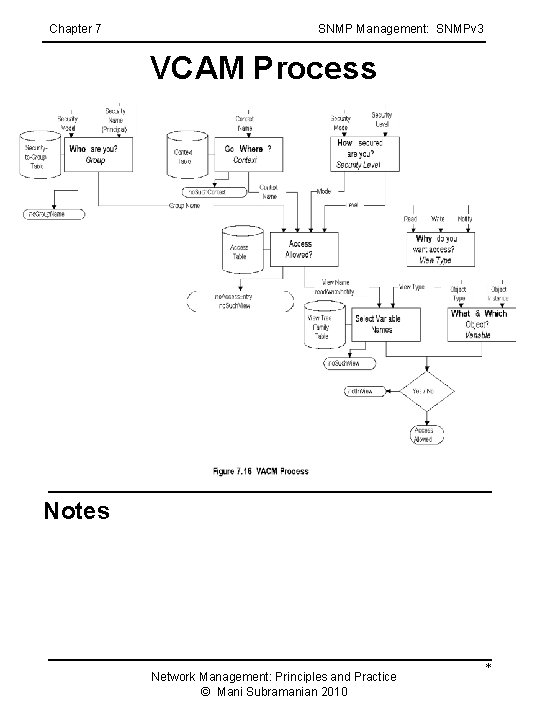
Chapter 7 SNMP Management: SNMPv 3 VCAM Process Answers 6 questions: 1. Who are you (group)? 2. Where do you want to go (context)? 3. How secured are you to access the information (security model and security level)? 4. Why do you want to access the information (read, write, or send notification)? 5. What object (object type) do you want to access? 6. Which object (object instance) do you want to access? Notes Network Management: Principles and Practice © Mani Subramanian 2010 *
Chapter 7 SNMP Management: SNMPv 3 VCAM Process Notes Network Management: Principles and Practice © Mani Subramanian 2010 *
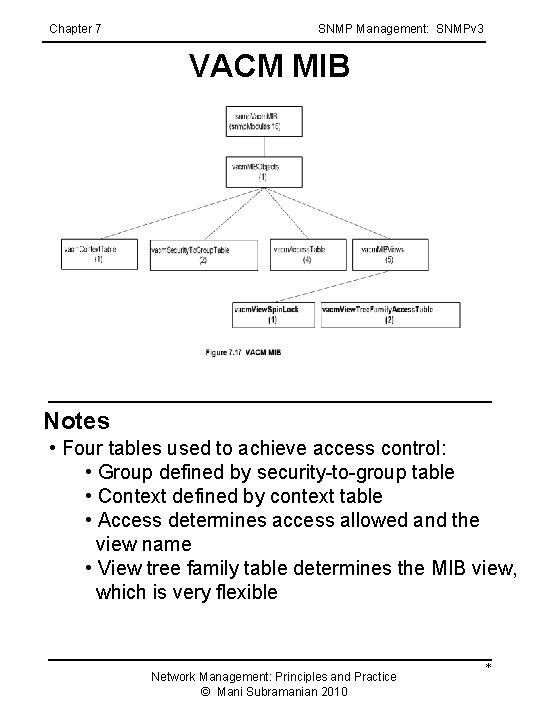
Chapter 7 SNMP Management: SNMPv 3 VACM MIB Notes • Four tables used to achieve access control: • Group defined by security-to-group table • Context defined by context table • Access determines access allowed and the view name • View tree family table determines the MIB view, which is very flexible Network Management: Principles and Practice © Mani Subramanian 2010 *
Chapter 7 SNMP Management: SNMPv 3 MIB Views • Simple view: • system 1. 3. 6. 1. 2. 1. 1 • Complex view: • All information relevant to a particular interface – system and interfaces groups • Family view subtrees • View with all columnar objects in a row appear as separate subtree. • OBJECT IDENTIFIER (family name) paired with bit-string value (family mask) to select or suppress columnar objects Notes Network Management: Principles and Practice © Mani Subramanian 2010 *
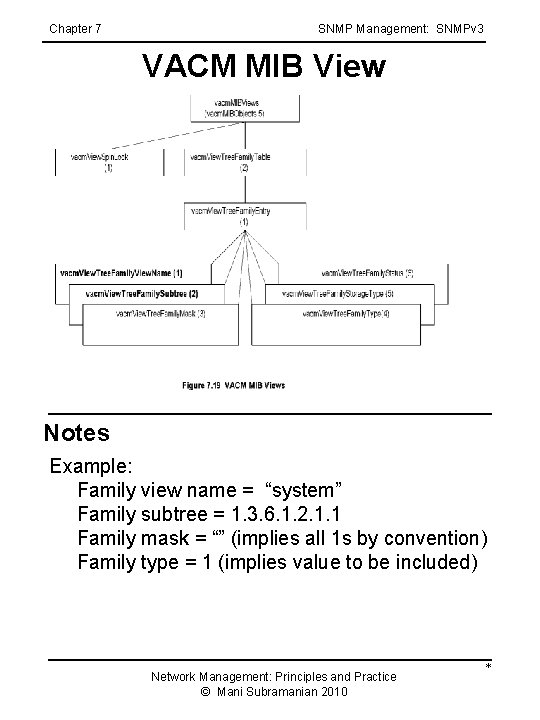
Chapter 7 SNMP Management: SNMPv 3 VACM MIB View Notes Example: Family view name = “system” Family subtree = 1. 3. 6. 1. 2. 1. 1 Family mask = “” (implies all 1 s by convention) Family type = 1 (implies value to be included) Network Management: Principles and Practice © Mani Subramanian 2010 *