Chapter 2 A Contextual History of Occupational Therapy

















- Slides: 33
Chapter 2 A Contextual History of Occupational Therapy Charles H. Christiansen and Kristine Haertl Copyright © 2014 Wolters Kluwer Health | Lippincott Williams & Wilkins
Learning Objectives After reading this chapter, you will be able to: 1. Appreciate that historical accounts are retrospective attempts to reconstruct and understand the events of the past with the purpose of gaining improved insight into the present. 2. Identify key personalities and events that influenced the founding and development of occupational therapy. 3. Recognize that wars, social movements, and legislation were associated with significant developments in occupational therapy. Copyright © 2014 Wolters Kluwer Health | Lippincott Williams & Wilkins
Learning Objectives (Continued) 4. Discern how mind/body dualism and the competition between social and biomedical approaches to health care have been persistent points of tension since occupational therapy’s founding. Copyright © 2014 Wolters Kluwer Health | Lippincott Williams & Wilkins
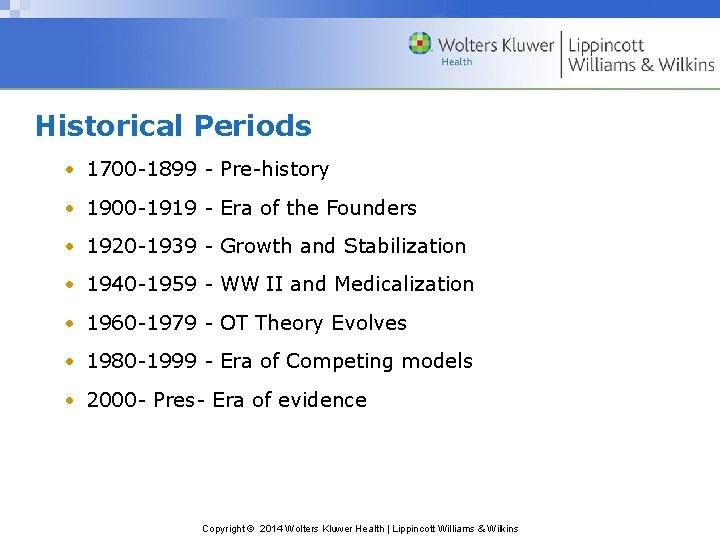
Historical Periods • 1700 -1899 - Pre-history • 1900 -1919 - Era of the Founders • 1920 -1939 - Growth and Stabilization • 1940 -1959 - WW II and Medicalization • 1960 -1979 - OT Theory Evolves • 1980 -1999 - Era of Competing models • 2000 - Pres- Era of evidence Copyright © 2014 Wolters Kluwer Health | Lippincott Williams & Wilkins
Pre-History (1700 -1899) • The Age of enlightenment (reason) questioned old ways of viewing the world and provided new ways of knowing. • Technological advancements, human migration and industrialization created social challenges and social developments. Copyright © 2014 Wolters Kluwer Health | Lippincott Williams & Wilkins
Pre-History: Key Figures • John Locke • Rene Descartes • Philippe Pinel • William Tuke • Adolf Meyer • John Dewey Copyright © 2014 Wolters Kluwer Health | Lippincott Williams & Wilkins
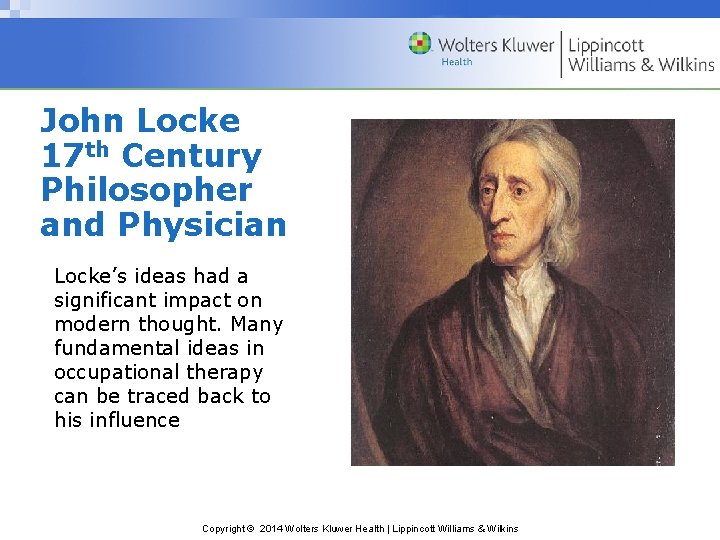
John Locke 17 th Century Philosopher and Physician Locke’s ideas had a significant impact on modern thought. Many fundamental ideas in occupational therapy can be traced back to his influence Copyright © 2014 Wolters Kluwer Health | Lippincott Williams & Wilkins
Adolf Meyer, MD and Colleagues at Kankakee Asylum in Illinois Copyright © 2014 Wolters Kluwer Health | Lippincott Williams & Wilkins
Era of the Founders (1900 -1919) • Modernization, immigration and industrialization created mental health problems that existing treatments were unable to address • The “work cure” replaced the “rest cure” and led to a belief that active engagement could be an effective remedy for nervous disorder-this became known as occupation therapy Copyright © 2014 Wolters Kluwer Health | Lippincott Williams & Wilkins
Era of the Founders: Key Figures • Susan Tracy* • Herbert J. Hall, M. D. • Eleanor Clarke Slagle* • William Rush Dunton, Jr. , M. D. * • George Barton* • General John J. Pershing • Thomas J. Kidner* • Clifford Wittingham Beers Copyright © 2014 Wolters Kluwer Health | Lippincott Williams & Wilkins
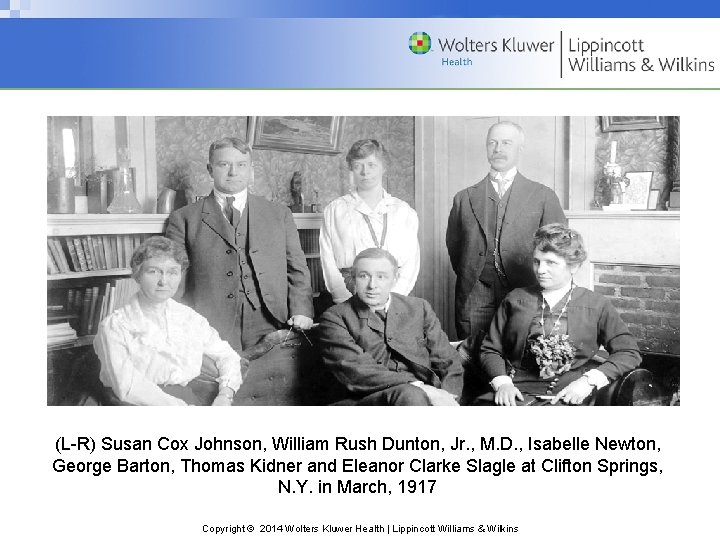
(L-R) Susan Cox Johnson, William Rush Dunton, Jr. , M. D. , Isabelle Newton, George Barton, Thomas Kidner and Eleanor Clarke Slagle at Clifton Springs, N. Y. in March, 1917 Copyright © 2014 Wolters Kluwer Health | Lippincott Williams & Wilkins
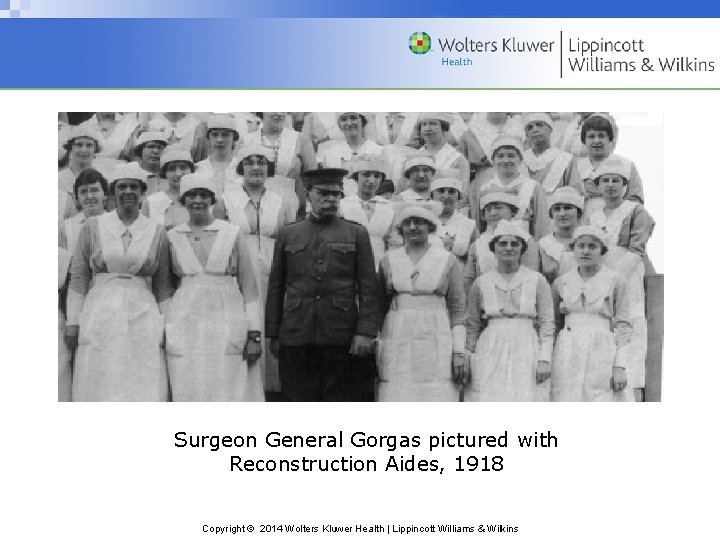
Surgeon General Gorgas pictured with Reconstruction Aides, 1918 Copyright © 2014 Wolters Kluwer Health | Lippincott Williams & Wilkins
Postwar Growth (1920 -1939) • After WWI, a period of standardization and stabilization ensued, where the new profession worked to gain recognition and sought to standardize practice and education to the extent possible • It’s alliance with the AMA helped it gain legitimacy, but at a cost of autonomy • From its deep roots in mental health, the profession branched out into physical rehabilitation and tuberculosis care Copyright © 2014 Wolters Kluwer Health | Lippincott Williams & Wilkins
Postwar Growth: Key Figures • Franklin Delano Roosevelt • Eleanor Clarke Slagle • William Rush Dunton, Jr. , M. D. • Thomas B. Kidner • Col. Frank Billings, M. C. , N. A. • Douglas Mc. Murtrie Copyright © 2014 Wolters Kluwer Health | Lippincott Williams & Wilkins
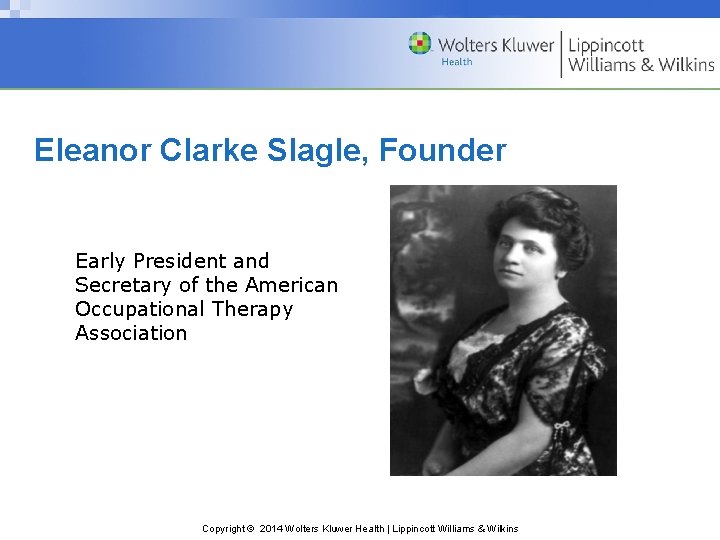
Eleanor Clarke Slagle, Founder Early President and Secretary of the American Occupational Therapy Association Copyright © 2014 Wolters Kluwer Health | Lippincott Williams & Wilkins
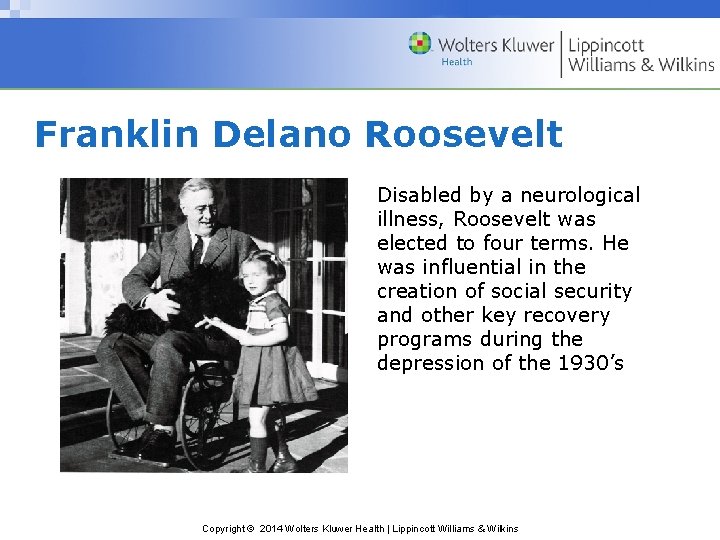
Franklin Delano Roosevelt Disabled by a neurological illness, Roosevelt was elected to four terms. He was influential in the creation of social security and other key recovery programs during the depression of the 1930’s Copyright © 2014 Wolters Kluwer Health | Lippincott Williams & Wilkins
WW II & Continued Development (1940 -59) • Large numbers of soldiers were deployed to European, African and Pacific Theatres to fight Germany and the Axis powers • Occupational therapy, strongly influenced by medicine, plays a key role in rehabilitation of soldiers • Developments in prosthetics, assistive technology and neurodevelopmental care were accelerated during this period Copyright © 2014 Wolters Kluwer Health | Lippincott Williams & Wilkins
WW II & Continued Development (1940 -59) • Colonel Ruth Robinson • Jonas Salk • Margaret Rood • Karl & Berta Bobath • Wilma West • Paul Elwood, M. D. Copyright © 2014 Wolters Kluwer Health | Lippincott Williams & Wilkins
Colonel Ruth Robinson Ruth A. Robinson served in World War II and helped establish training programs for therapy personnel. She later served as AOTA President, and influenced the creation of Certified Occupational Therapy Assistant programs. Copyright © 2014 Wolters Kluwer Health | Lippincott Williams & Wilkins
Medicare, Vietnam and the further Evolution of OT: (1960 -1979) • Civil rights, Medicare, and the Vietnam War provided important context on society as it addressed social justice • School based services for disabled children is mandated by law • AOTF is created Copyright © 2014 Wolters Kluwer Health | Lippincott Williams & Wilkins
Key Figures: (1960 -1979) • Lyndon B. Johnson • Mary Reilly, Ed. D. * • A. Jean Ayres, Ph. D. • Gail Fidler • Wilma L. West Copyright © 2014 Wolters Kluwer Health | Lippincott Williams & Wilkins
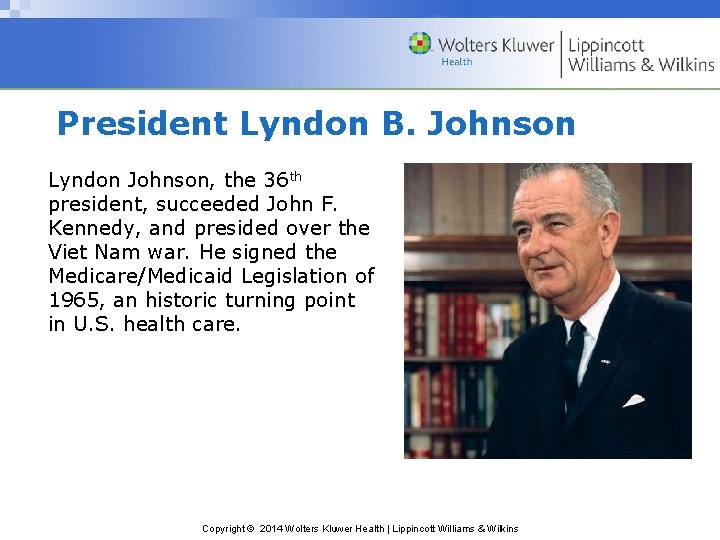
President Lyndon B. Johnson Lyndon Johnson, the 36 th president, succeeded John F. Kennedy, and presided over the Viet Nam war. He signed the Medicare/Medicaid Legislation of 1965, an historic turning point in U. S. health care. Copyright © 2014 Wolters Kluwer Health | Lippincott Williams & Wilkins
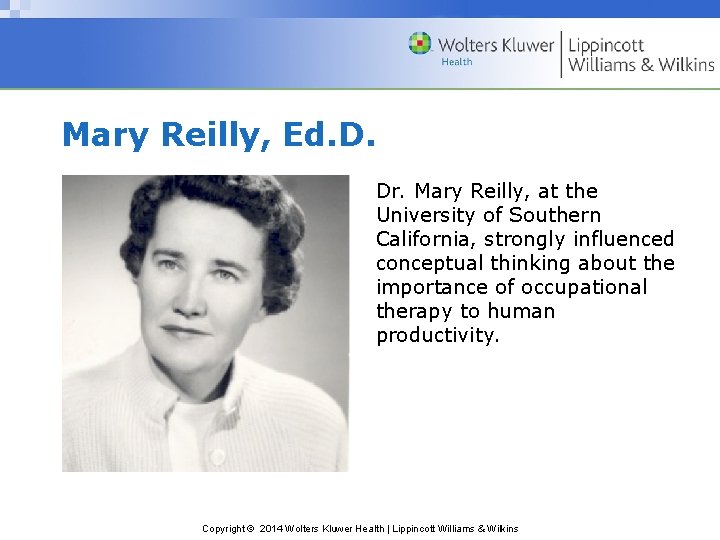
Mary Reilly, Ed. D. Dr. Mary Reilly, at the University of Southern California, strongly influenced conceptual thinking about the importance of occupational therapy to human productivity. Copyright © 2014 Wolters Kluwer Health | Lippincott Williams & Wilkins
New Theories, ADA, and Occupational Science: (19801999) • Occupational therapy experiences dramatic growth • Graduate education evolves, and along with it, new theories and models of practice • New theorists urge a return to occupation-based practice, which gains momentum • Occupational science is born Copyright © 2014 Wolters Kluwer Health | Lippincott Williams & Wilkins
Key Figures: (1980 -1999) • George H. W. Bush • Paul Elwood, M. D. • Elizabeth Yerxa, Ed. D. • Gary Kielhofner, Dr. P. H. • Florence Clark, Ph. D. • Gail Fidler • Wilma L. West Copyright © 2014 Wolters Kluwer Health | Lippincott Williams & Wilkins
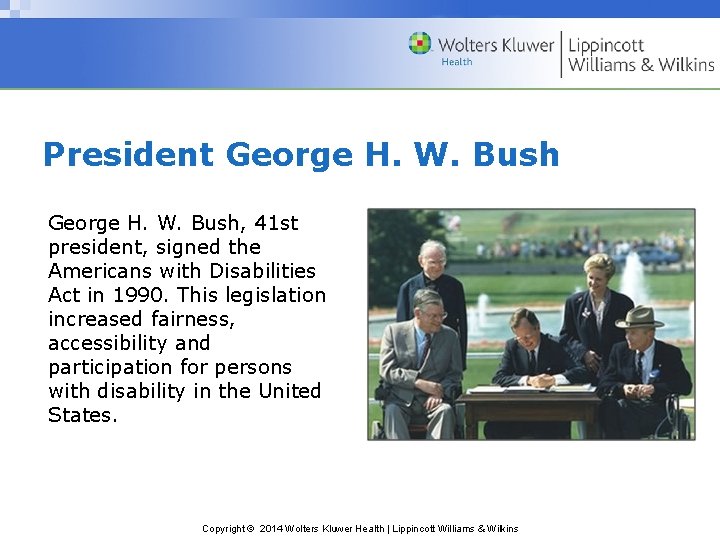
President George H. W. Bush, 41 st president, signed the Americans with Disabilities Act in 1990. This legislation increased fairness, accessibility and participation for persons with disability in the United States. Copyright © 2014 Wolters Kluwer Health | Lippincott Williams & Wilkins
Elizabeth Yerxa, Ed. D. & Florence Clark, Ph. D. Dr. Elizabeth Yerxa (top) and Dr. Florence Clark, leaders at the University of Southern California, developed the first Ph. D. in occupational science and advocated strongly for research. Copyright © 2014 Wolters Kluwer Health | Lippincott Williams & Wilkins
New Millennium: (2000 -Present) • Digital technology and the Internet have a profound effect on lifestyles • 9/11 leads to wars in the Middle East, which again challenge rehabilitation and O. T. with polytrauma cases • Occupational science matures • Cost containment comes to the forefront as health care costs rise Copyright © 2014 Wolters Kluwer Health | Lippincott Williams & Wilkins
New Millennium: (2000 -Present) (Continued) • Federal health care policies emphasize the importance of evidence to guide practice • Occupational therapy researchers gain new heights • Occupational therapy expands globally Copyright © 2014 Wolters Kluwer Health | Lippincott Williams & Wilkins
Key Figures: (2000 -present) • Barack Obama • Ann Wilcock, Ph. D. • Carolyn Baum, Ph. D. • Elizabeth Townsend Copyright © 2014 Wolters Kluwer Health | Lippincott Williams & Wilkins
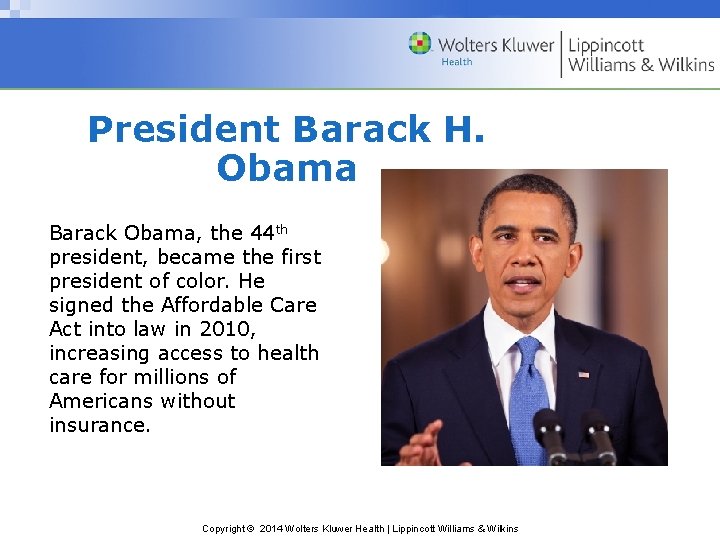
President Barack H. Obama Barack Obama, the 44 th president, became the first president of color. He signed the Affordable Care Act into law in 2010, increasing access to health care for millions of Americans without insurance. Copyright © 2014 Wolters Kluwer Health | Lippincott Williams & Wilkins
Elizabeth Townsend, Ph. D. & Ann Wilcock, Ph. D. Dr. Elizabeth Townsend (top) of Canada and Dr. Ann Wilcock, of Australia advanced the idea of occupational justice as an important social aim with health implications. Copyright © 2014 Wolters Kluwer Health | Lippincott Williams & Wilkins
Acknowledgment Many of the photographs and materials used to formulate this chapter were from the Archives of the American Occupational Therapy Association, which are maintained by the American Occupational Therapy Foundation (AOTF), Inc. Tax deductible contributions to the AOTF can be made at www. aotf. org Copyright © 2014 Wolters Kluwer Health | Lippincott Williams & Wilkins