
What PDGM Means for Occupational Therapy The Next



- Slides: 28
What PDGM Means for Occupational Therapy
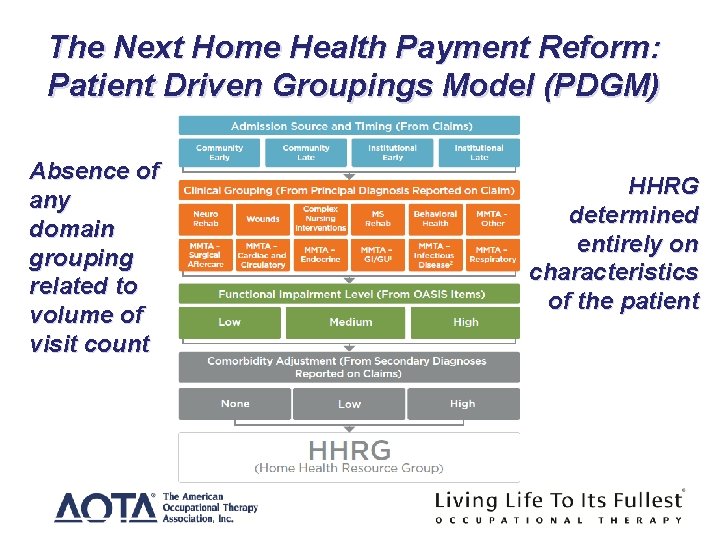
The Next Home Health Payment Reform: Patient Driven Groupings Model (PDGM) Absence of any domain grouping related to volume of visit count HHRG determined entirely on characteristics of the patient
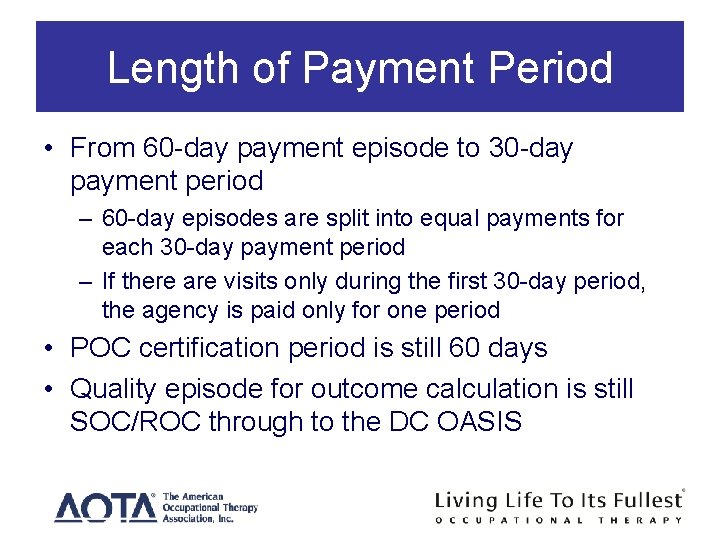
Length of Payment Period • From 60 -day payment episode to 30 -day payment period – 60 -day episodes are split into equal payments for each 30 -day payment period – If there are visits only during the first 30 -day period, the agency is paid only for one period • POC certification period is still 60 days • Quality episode for outcome calculation is still SOC/ROC through to the DC OASIS
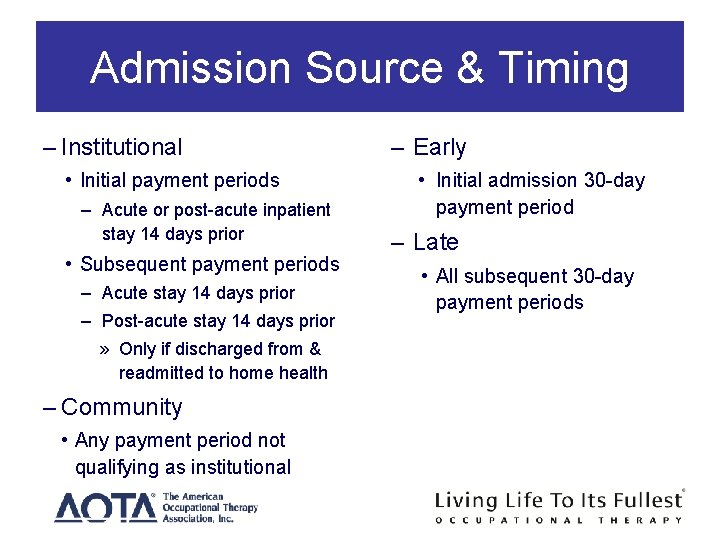
Admission Source & Timing – Institutional • Initial payment periods – Acute or post-acute inpatient stay 14 days prior • Subsequent payment periods – Acute stay 14 days prior – Post-acute stay 14 days prior » Only if discharged from & readmitted to home health – Community • Any payment period not qualifying as institutional – Early • Initial admission 30 -day payment period – Late • All subsequent 30 -day payment periods
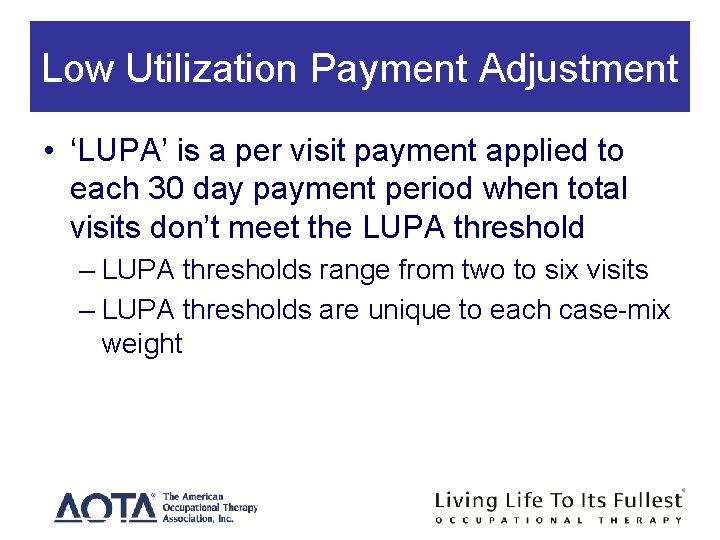
Low Utilization Payment Adjustment • ‘LUPA’ is a per visit payment applied to each 30 day payment period when total visits don’t meet the LUPA threshold – LUPA thresholds range from two to six visits – LUPA thresholds are unique to each case-mix weight
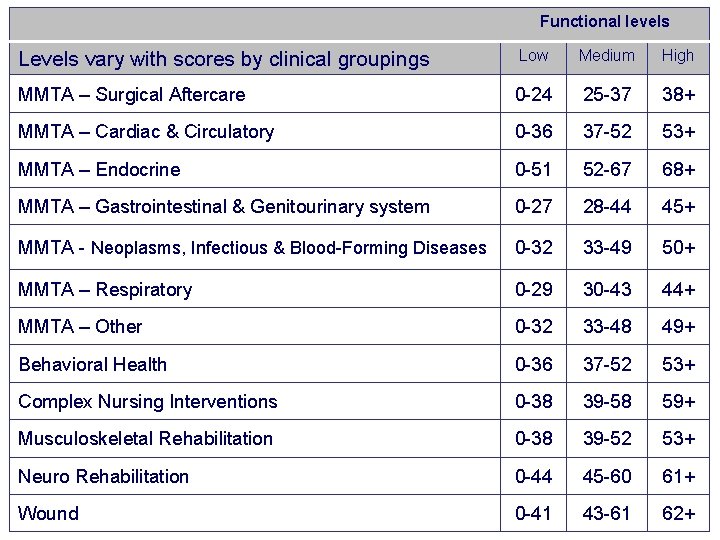
Functional levels Levels vary with scores by clinical groupings Low Medium High MMTA – Surgical Aftercare 0 -24 25 -37 38+ MMTA – Cardiac & Circulatory 0 -36 37 -52 53+ MMTA – Endocrine 0 -51 52 -67 68+ MMTA – Gastrointestinal & Genitourinary system 0 -27 28 -44 45+ MMTA - Neoplasms, Infectious & Blood-Forming Diseases 0 -32 33 -49 50+ MMTA – Respiratory 0 -29 30 -43 44+ MMTA – Other 0 -32 33 -48 49+ Behavioral Health 0 -36 37 -52 53+ Complex Nursing Interventions 0 -38 39 -58 59+ Musculoskeletal Rehabilitation 0 -38 39 -52 53+ Neuro Rehabilitation 0 -44 45 -60 61+ Wound 0 -41 43 -61 62+
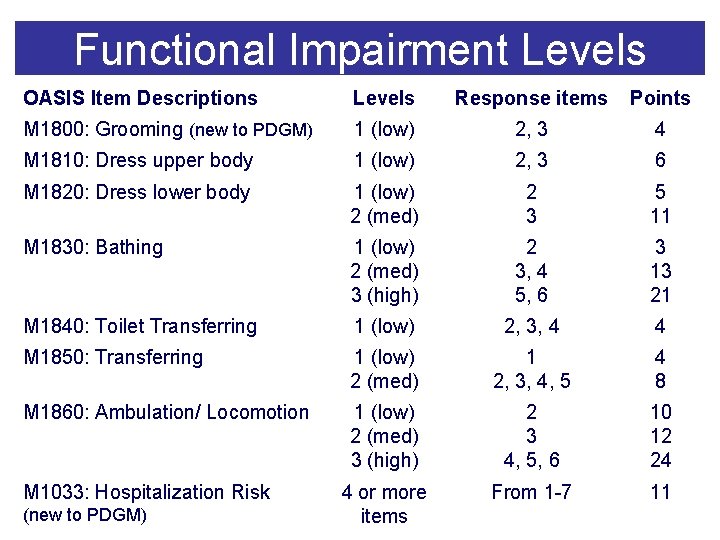
Functional Impairment Levels OASIS Item Descriptions Levels Response items Points M 1800: Grooming (new to PDGM) 1 (low) 2, 3 4 M 1810: Dress upper body 1 (low) 2, 3 6 M 1820: Dress lower body 1 (low) 2 (med) 2 3 5 11 M 1830: Bathing 1 (low) 2 (med) 3 (high) 2 3, 4 5, 6 3 13 21 M 1840: Toilet Transferring 1 (low) 2, 3, 4 4 M 1850: Transferring 1 (low) 2 (med) 1 2, 3, 4, 5 4 8 M 1860: Ambulation/ Locomotion 1 (low) 2 (med) 3 (high) 2 3 4, 5, 6 10 12 24 4 or more items From 1 -7 11 M 1033: Hospitalization Risk (new to PDGM)
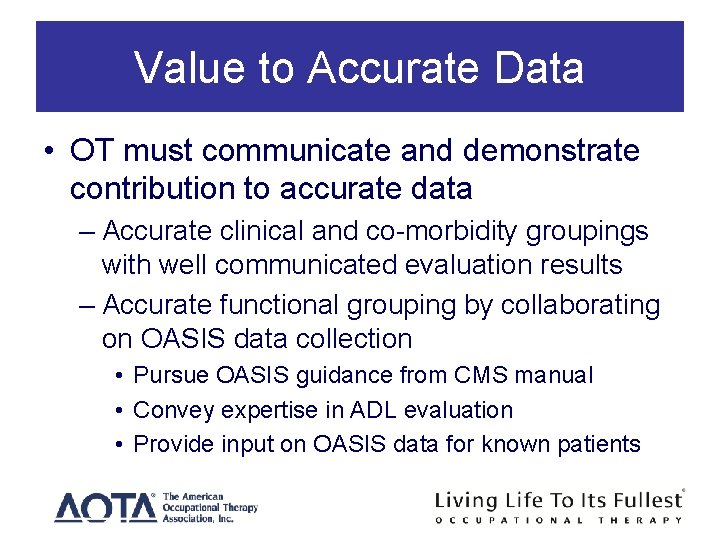
Value to Accurate Data • OT must communicate and demonstrate contribution to accurate data – Accurate clinical and co-morbidity groupings with well communicated evaluation results – Accurate functional grouping by collaborating on OASIS data collection • Pursue OASIS guidance from CMS manual • Convey expertise in ADL evaluation • Provide input on OASIS data for known patients
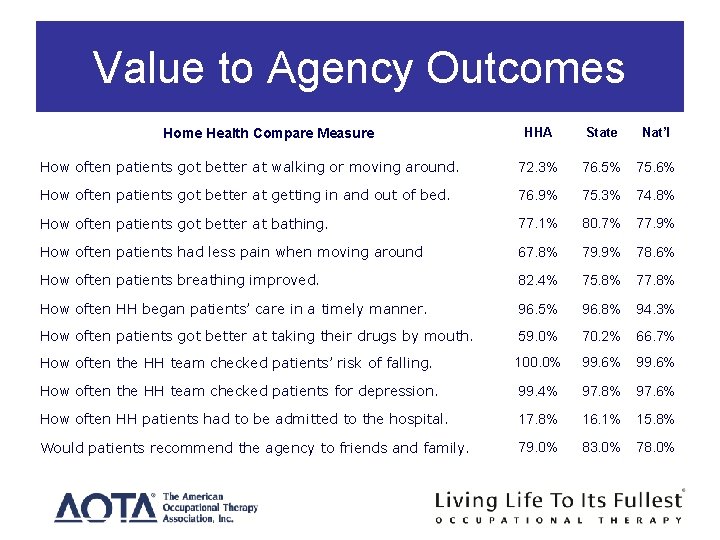
Value to Agency Outcomes HHA State Nat’l How often patients got better at walking or moving around. 72. 3% 76. 5% 75. 6% How often patients got better at getting in and out of bed. 76. 9% 75. 3% 74. 8% How often patients got better at bathing. 77. 1% 80. 7% 77. 9% How often patients had less pain when moving around 67. 8% 79. 9% 78. 6% How often patients breathing improved. 82. 4% 75. 8% 77. 8% How often HH began patients’ care in a timely manner. 96. 5% 96. 8% 94. 3% How often patients got better at taking their drugs by mouth. 59. 0% 70. 2% 66. 7% How often the HH team checked patients’ risk of falling. 100. 0% 99. 6% How often the HH team checked patients for depression. 99. 4% 97. 8% 97. 6% How often HH patients had to be admitted to the hospital. 17. 8% 16. 1% 15. 8% Would patients recommend the agency to friends and family. 79. 0% 83. 0% 78. 0% Home Health Compare Measure
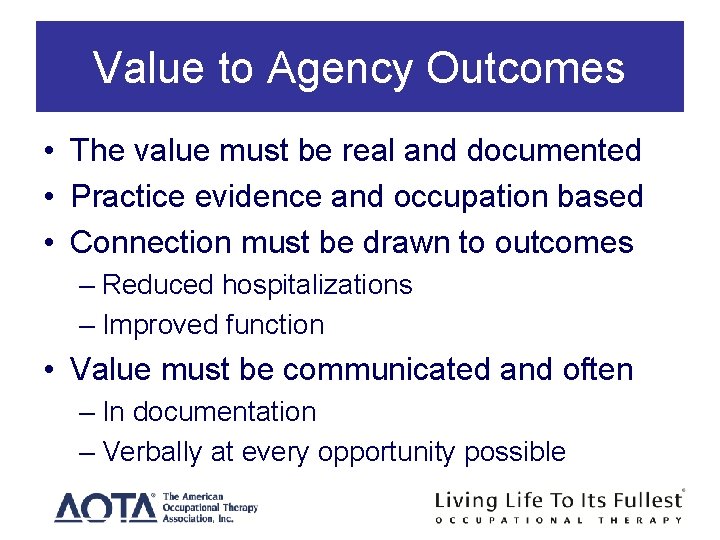
Value to Agency Outcomes • The value must be real and documented • Practice evidence and occupation based • Connection must be drawn to outcomes – Reduced hospitalizations – Improved function • Value must be communicated and often – In documentation – Verbally at every opportunity possible
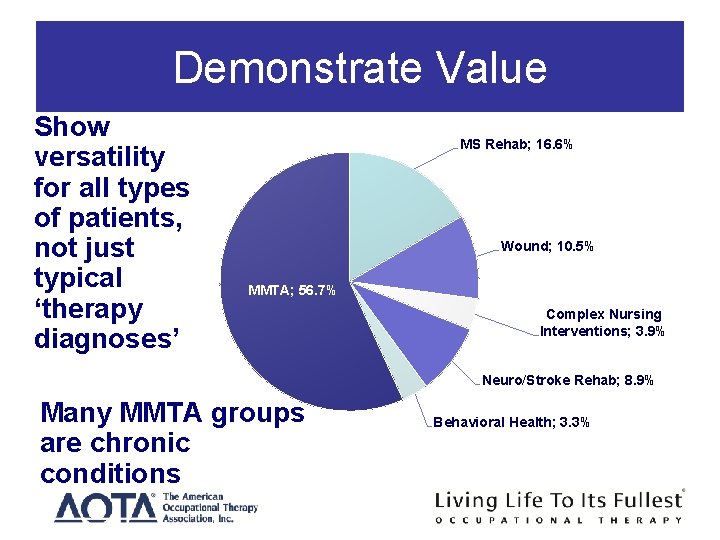
Demonstrate Value Show versatility for all types of patients, not just typical ‘therapy diagnoses’ MS Rehab; 16. 6% Wound; 10. 5% MMTA; 56. 7% Complex Nursing Interventions; 3. 9% Neuro/Stroke Rehab; 8. 9% Many MMTA groups are chronic conditions Behavioral Health; 3. 3%
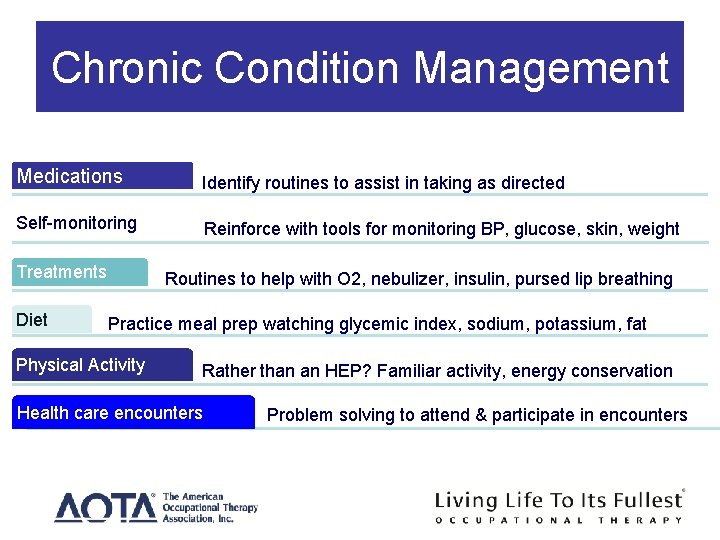
Chronic Condition Management Medications Identify routines to assist in taking as directed Self-monitoring Reinforce with tools for monitoring BP, glucose, skin, weight Treatments Diet Routines to help with O 2, nebulizer, insulin, pursed lip breathing Practice meal prep watching glycemic index, sodium, potassium, fat Physical Activity Rather than an HEP? Familiar activity, energy conservation Health care encounters Problem solving to attend & participate in encounters
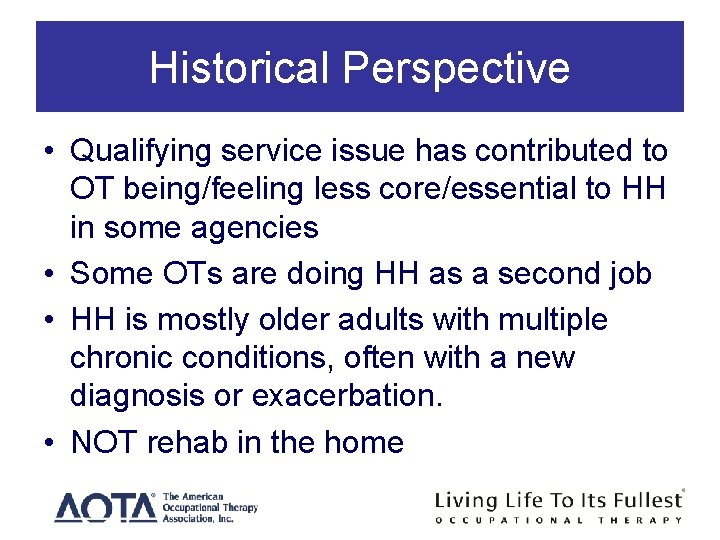
Historical Perspective • Qualifying service issue has contributed to OT being/feeling less core/essential to HH in some agencies • Some OTs are doing HH as a second job • HH is mostly older adults with multiple chronic conditions, often with a new diagnosis or exacerbation. • NOT rehab in the home
OT Practice Patterns in HH • Influenced by rehab/remediation • Shaped by longstanding “rules of thumb” regarding “rehab potential” • Influenced by almost 20 years of therapy being the one factor in the Medicare HH payment algorithm where more visits usually translated to more payment for the agency • Per-visit therapy employment has incentivized making visits vs employing the episode to achieve goals
Managing Reactions • Natural response to react • Members may feel anger, fear • Some SNF chain’s reaction to PDPM has increased anxiety • Change is always challenging • Important to acknowledge anxiety but help members manage reactions, evaluate their readiness, and see the opportunities/needs
Strategies • • Respond to anxiety with concern, facts Respond to rumor with facts, resources Direct members to the resources Encourage/support members to evaluate their own practice patterns • Consider partnering with state homecare association re: education and collaboration
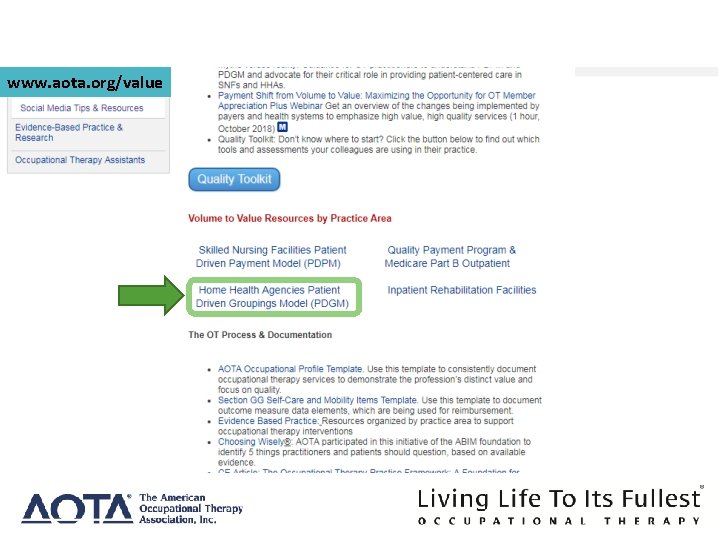
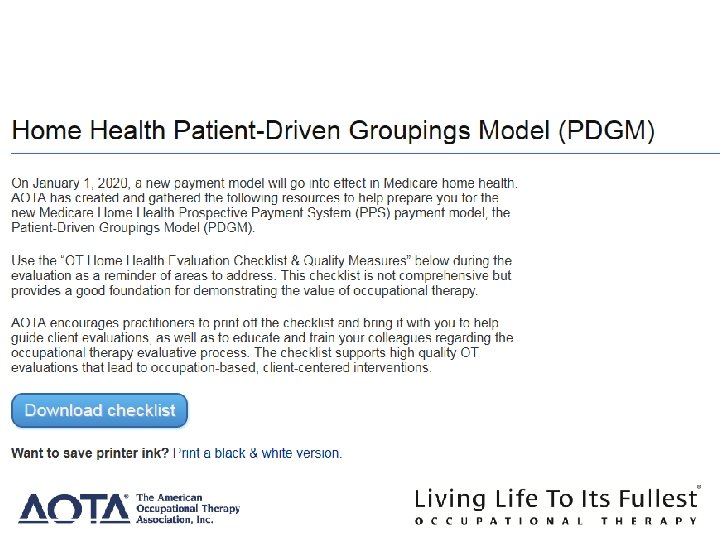
Resources • AOTA PDGM Page: https: //www. aota. org/Practice/Manage/value/Home. Health-Patient-Driven-Groupings-Model-PDGM. aspx • AOTA Value Page: https: //www. aota. org/Practice/Manage/value. aspx • OT Practice article: https: //www. aota. org/publicationsnews/otp/archive/2019/pdgm-oasis. aspx (AOTA member access)
AOTA Home Health PDGM Resources
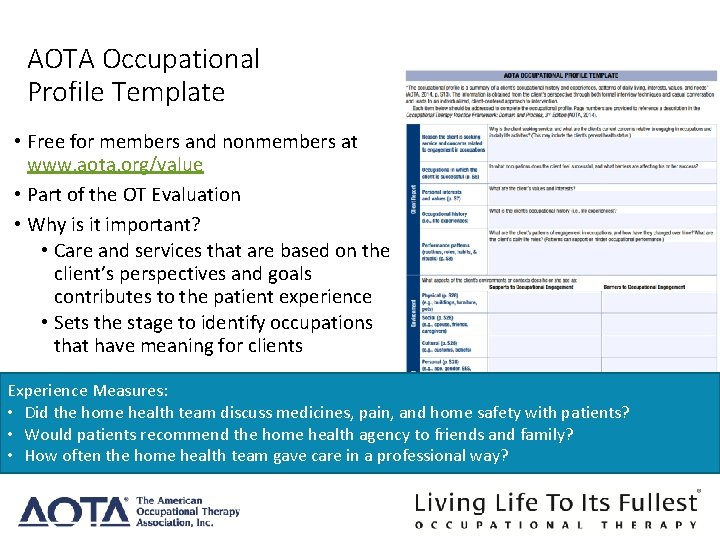
AOTA Occupational Profile Template • Free for members and nonmembers at www. aota. org/value • Part of the OT Evaluation • Why is it important? • Care and services that are based on the client’s perspectives and goals contributes to the patient experience • Sets the stage to identify occupations that have meaning for clients Experience Measures: • Did the home health team discuss medicines, pain, and home safety with patients? • Would patients recommend the home health agency to friends and family? • How often the home health team gave care in a professional way?
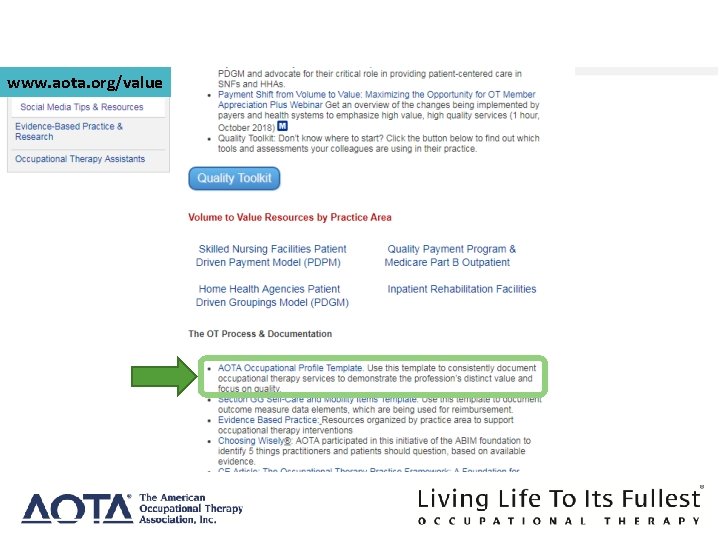
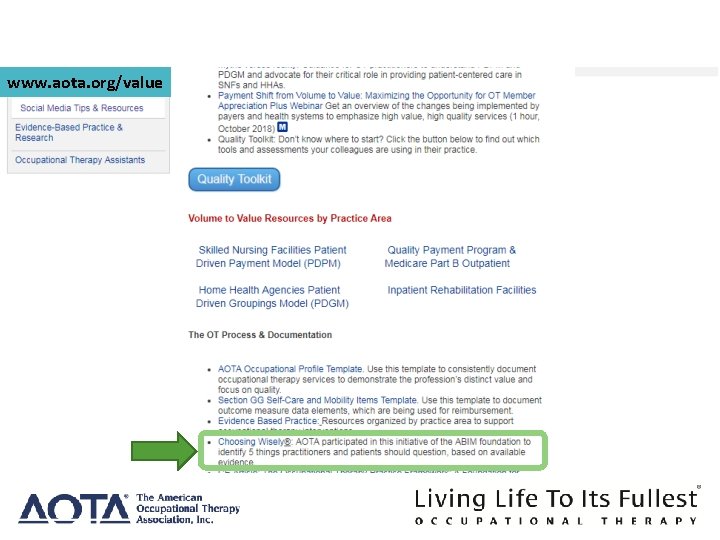
www. aota. org/value
EVALUATION CHECKLIST Making the most out of the time together
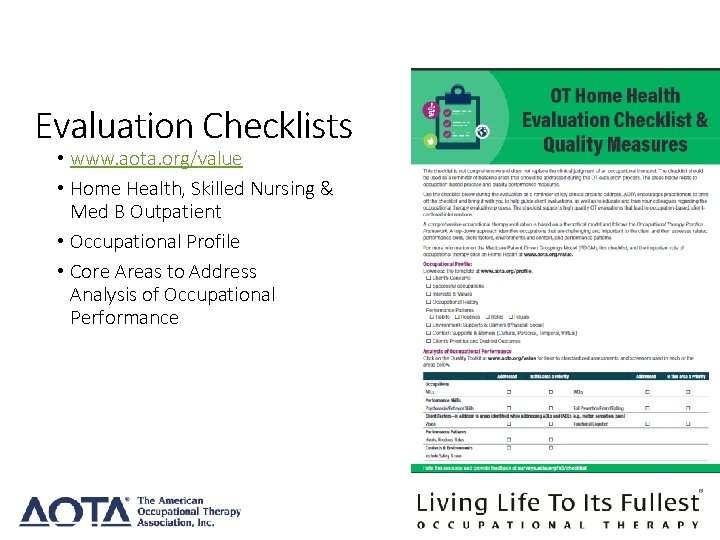
Evaluation Checklists • www. aota. org/value • Home Health, Skilled Nursing & Med B Outpatient • Occupational Profile • Core Areas to Address Analysis of Occupational Performance
www. aota. org/value
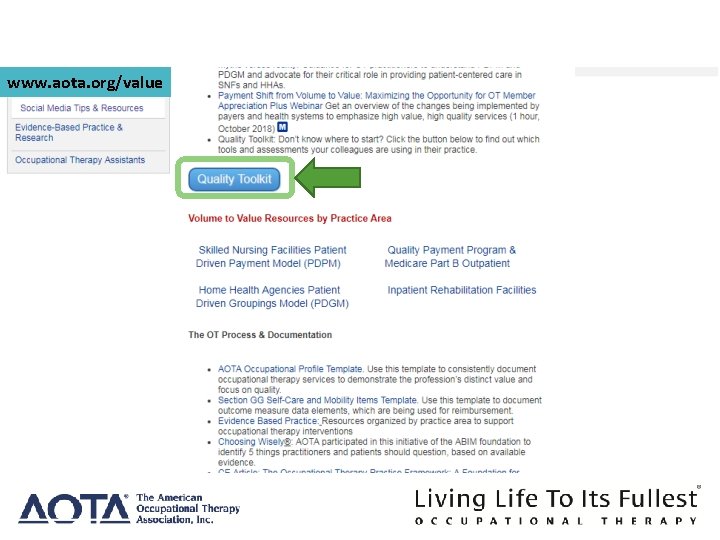
www. aota. org/value
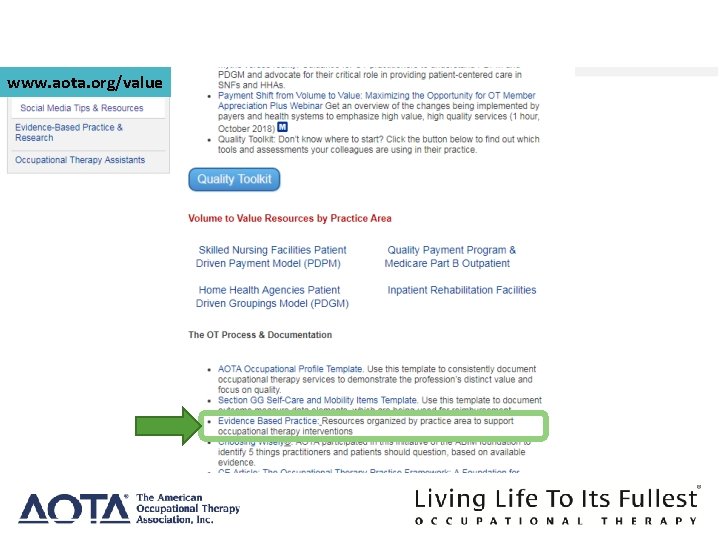
www. aota. org/value
www. aota. org/value
Thank you! regulatory@aota. org quality@aota. org www. aota. org/value