Chapter 14 The Ideal Gas Law and Kinetic

- Slides: 15
Chapter 14 The Ideal Gas Law and Kinetic Theory
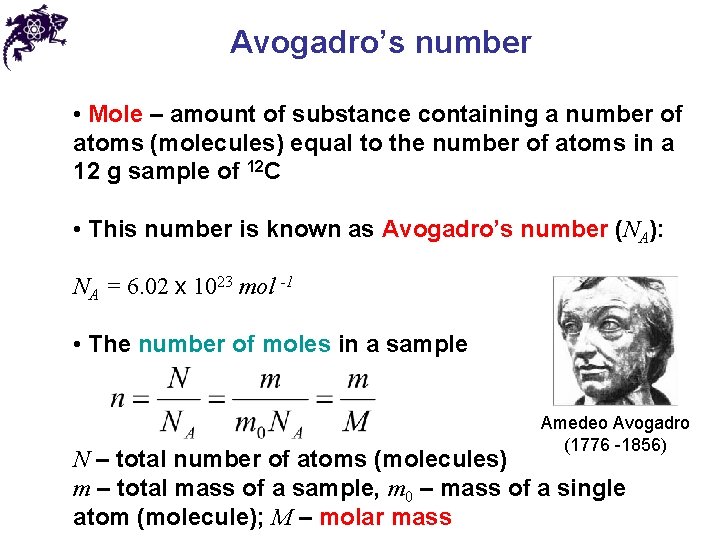
Avogadro’s number • Mole – amount of substance containing a number of atoms (molecules) equal to the number of atoms in a 12 g sample of 12 C • This number is known as Avogadro’s number (NA): NA = 6. 02 x 1023 mol -1 • The number of moles in a sample Amedeo Avogadro (1776 -1856) N – total number of atoms (molecules) m – total mass of a sample, m 0 – mass of a single atom (molecule); M – molar mass
Chapter 14 Problem 10 A cylindrical glass of water (H 2 O) has a radius of 4. 50 cm and a height of 12. 0 cm. The density of water is 1. 00 g/cm 3. How many moles of water are contained in the glass?
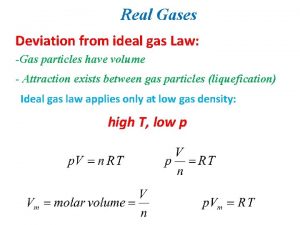
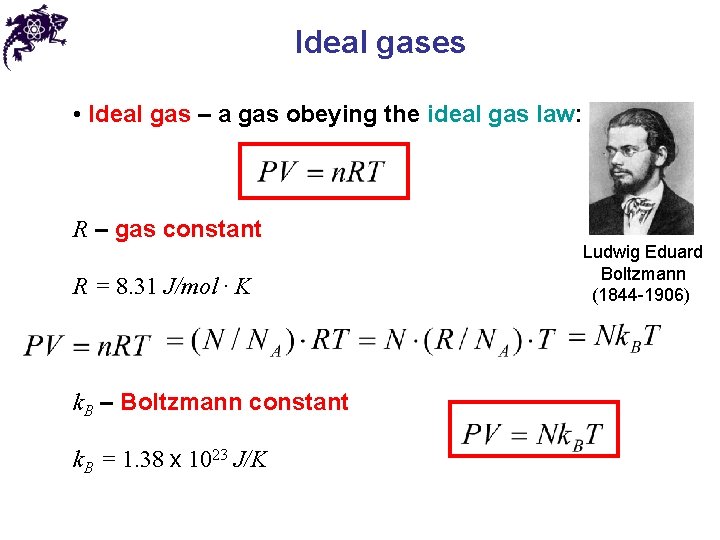
Ideal gases • Ideal gas – a gas obeying the ideal gas law: R – gas constant R = 8. 31 J/mol ∙ K k. B – Boltzmann constant k. B = 1. 38 x 1023 J/K Ludwig Eduard Boltzmann (1844 -1906)
Chapter 14 Problem 29 One assumption of the ideal gas law is that the atoms or molecules themselves occupy a negligible volume. Verify that this assumption is reasonable by considering gaseous xenon (Xe). Xenon has an atomic radius of 2. 0 x 10 -10 m. For the standard temperature and pressure (STP) conditions, calculate the percentage of the total volume occupied by the atoms. Express your answer as a percentage with no units.
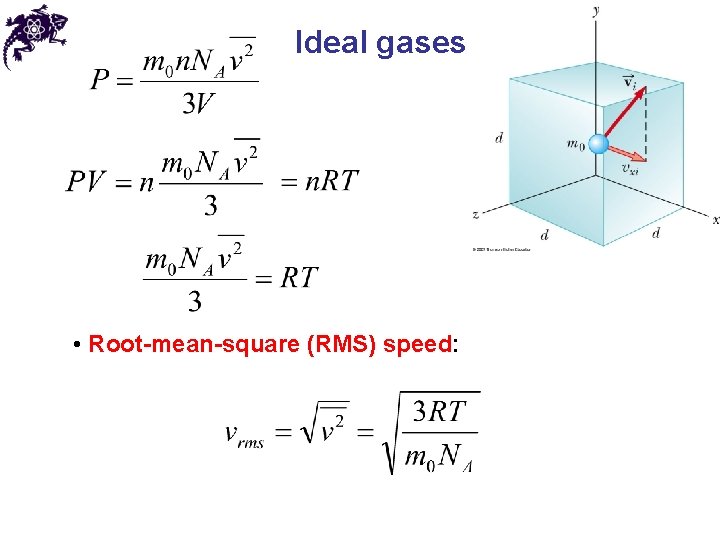
Ideal gases • The gas under consideration is a pure substance • All molecules are identical • Macroscopic properties of a gas: P, V, T • The number of molecules in the gas is large, and the average separation between the molecules is large compared with their dimensions – the molecules occupy a negligible volume within the container • The molecules obey Newton’s laws of motion, but as a whole they move randomly (any molecule can move in any direction with any speed)
Ideal gases • The molecules interact only by short-range forces during elastic collisions • The molecules make elastic collisions with the walls and these collisions lead to the macroscopic pressure on the walls of the container • At low pressures the behavior of molecular gases approximate that of ideal gases quite well
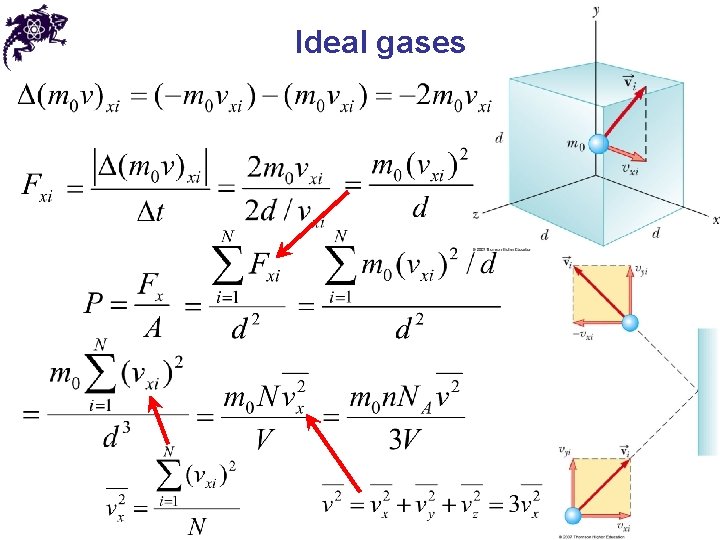
Ideal gases
Ideal gases • Root-mean-square (RMS) speed:
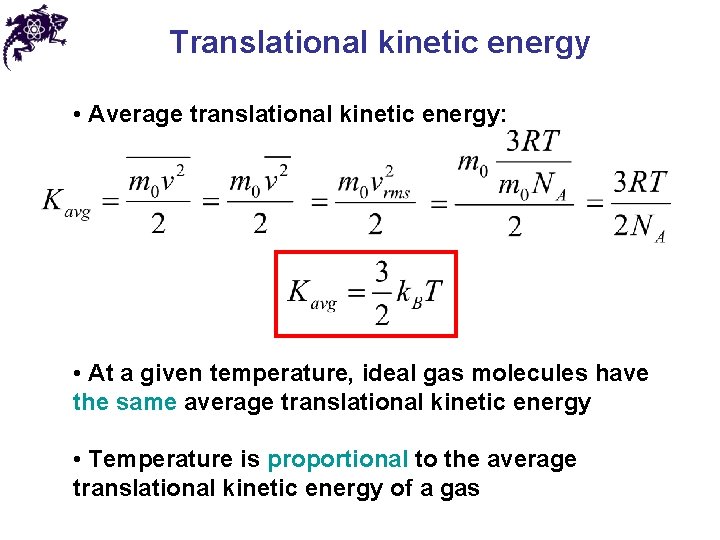
Translational kinetic energy • Average translational kinetic energy: • At a given temperature, ideal gas molecules have the same average translational kinetic energy • Temperature is proportional to the average translational kinetic energy of a gas
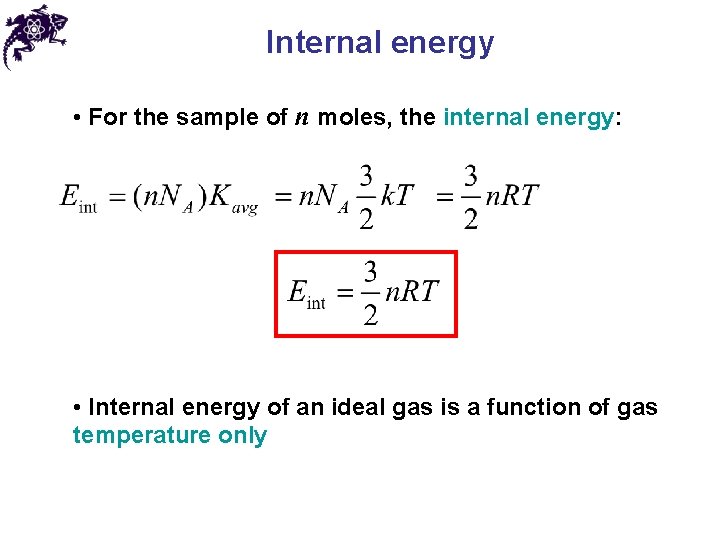
Internal energy • For the sample of n moles, the internal energy: • Internal energy of an ideal gas is a function of gas temperature only
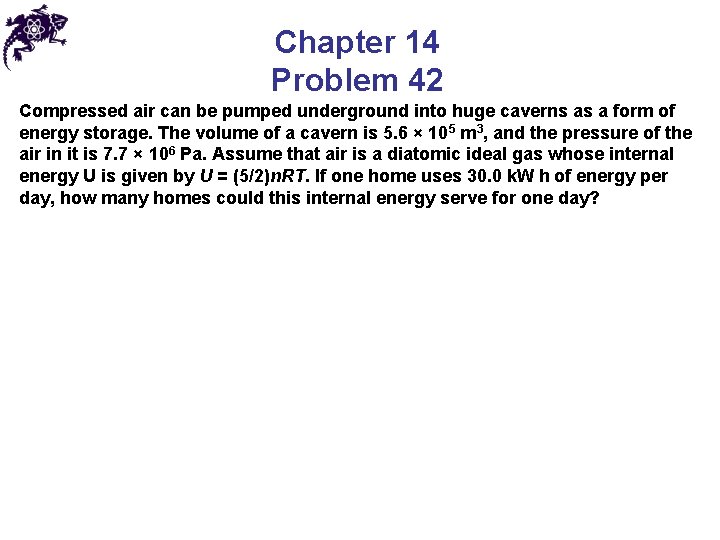
Chapter 14 Problem 42 Compressed air can be pumped underground into huge caverns as a form of energy storage. The volume of a cavern is 5. 6 × 10⁵ m 3, and the pressure of the air in it is 7. 7 × 10⁶ Pa. Assume that air is a diatomic ideal gas whose internal energy U is given by U = (5/2)n. RT. If one home uses 30. 0 k. W h of energy per day, how many homes could this internal energy serve for one day?
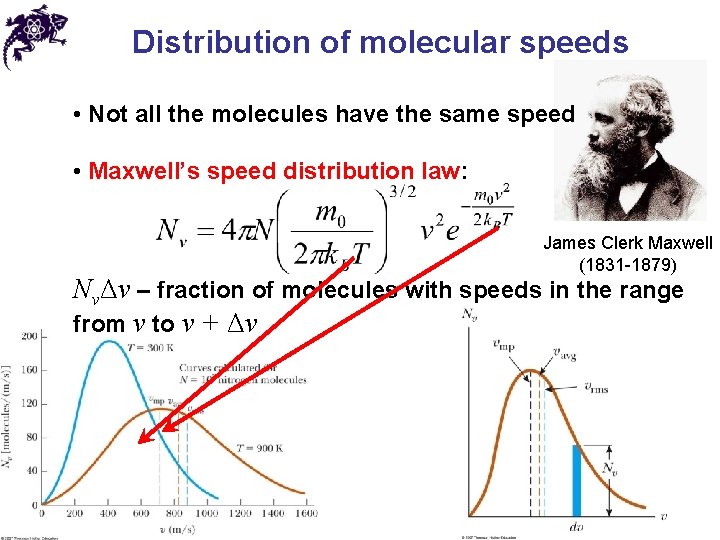
Distribution of molecular speeds • Not all the molecules have the same speed • Maxwell’s speed distribution law: James Clerk Maxwell (1831 -1879) NvΔv – fraction of molecules with speeds in the range from v to v + Δv
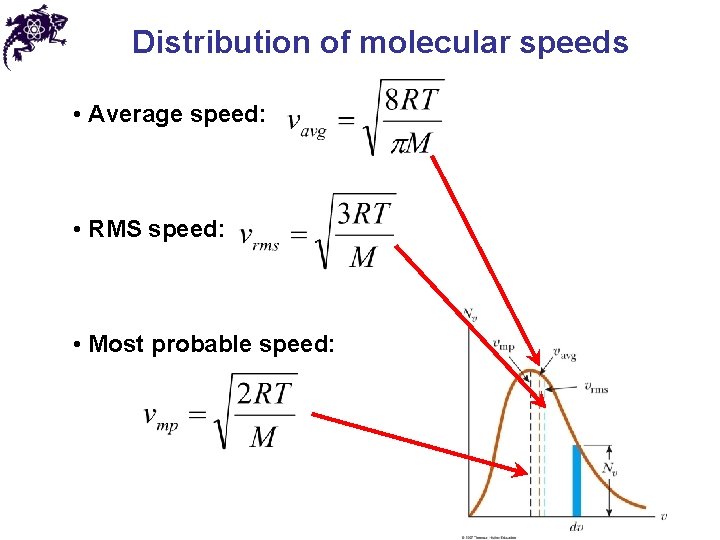
Distribution of molecular speeds • Average speed: • RMS speed: • Most probable speed:
Questions?